It’s possible that I shall make an ass of myself. But in that case one can always get out of it with a little dialectic. I have, of course, so worded my proposition as to be right either way (K.Marx, Letter to F.Engels on the Indian Mutiny)
Saturday, July 11, 2026
Foreship Develops Energy-Efficient Ferry Design for Greek Domestic Market
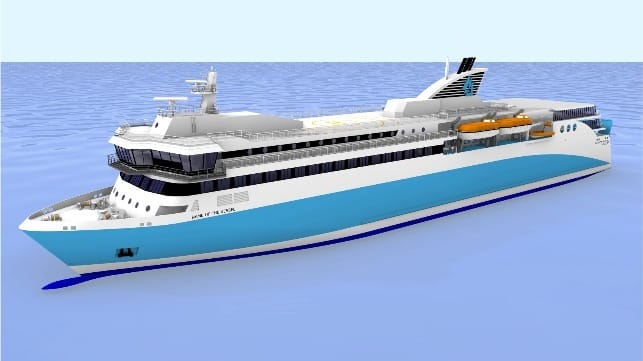
Foreship, the naval architecture and marine engineering company of RINA, has developed a new ferry concept tailored to the specific operational and economic requirements of the Greek domestic market, with a focus on efficiency, simplicity and cost control.
Greece’s ferry network is one of the most extensive in Europe, connecting more than 200 inhabited islands and transporting around 50 million passengers annually. At the same time, operators are working within a highly constrained environment, shaped by strong seasonality, regulated pricing and increasing pressure on operating costs, alongside the need to renew an ageing fleet.
Ari Huttunen, Marine Design & Engineering Projects Principal Consultant at Foreship, said, “This new vessel concept has been developed in response to the specific challenges of the Greek market, with a focus on optimising both capital and operating expenditure. The design integrates all essential functionalities for safe and reliable operations, while avoiding unnecessary complexity, resulting in a robust and economically sustainable vessel.”
A central element of the concept is the operating profile. While speed has traditionally been a defining factor in the Greek ferry sector, the new design is optimised for more moderate speeds, enabling a significant improvement in fuel efficiency and overall operating economics.
The vessel has also been conceived in line with the latest regulatory developments, including updated stability requirements that are reshaping ferry design across Europe and influencing aspects such as dimensions and passenger capacity. These changes have been taken into account from the early design stages, ensuring the concept remains aligned with the evolving framework.
By shaping design choices in the realities of the Greek ferry sector, including cost sensitivity, operational intensity during peak periods and the need for reliable, straightforward vessels, the concept provides a practical reference point for future fleet renewal.
The products and services herein described in this press release are not endorsed by The Maritime Executiv
GTT New Order from Samsung Heavy Industries for Tank Design of FLNG Unit
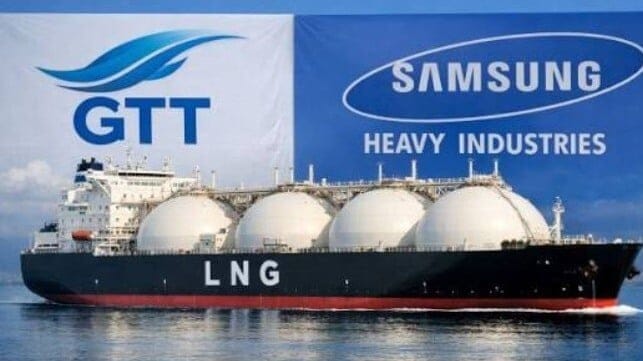
GTT announces that it has received, in the second quarter of 2026, an order from Samsung Heavy Industries shipyard for the tank design of Delfin FLNG 1, a floating liquefied natural gas unit (FLNG) to be built for the Delfin LNG project.
Delfin FLNG 1 will be the first floating liquefied natural gas unit to enter service in the United States, as well as the world’s largest in terms of expected production capacity (4.4 million tonnes of LNG1 per year).
As part of this order, GTT will design the cryogenic tanks of the unit, which will offer a total LNG storage capacity of 180,000 m³. The eight tanks will be arranged in two rows and will incorporate GTT’s Mark III Flex membrane containment system, suitable for demanding maritime and offshore applications, including operations in a region exposed to hurricane conditions.
Delfin FLNG 1, which will be operated off the coast of Louisiana, is scheduled for delivery in mid-2030.
François Michel, CEO of GTT, declared: “With Delfin FLNG 1, offshore LNG is entering a new phase in the United States. This project, unprecedented in scale, will contribute to the development of new LNG production capacity to meet global energy demand. It also illustrates the ability of GTT’s membrane technologies to support complex offshore projects facing demanding operational constraints, while meeting the highest standards of performance, reliability and safety."
The products and services herein described in this press release are not endorsed by The Maritime Executive.
Steel Cut for Carnival Cruise Line’s Next Mega Ship, Carnival Destiny
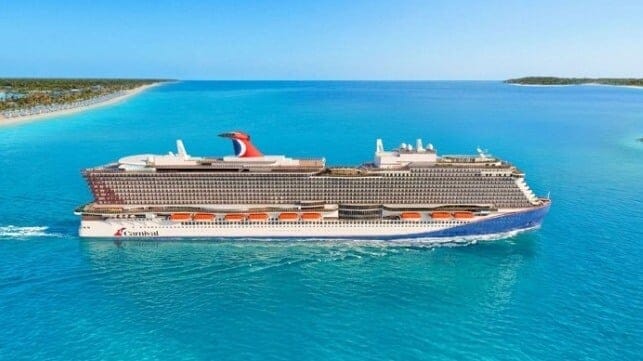
At approximately 230,000 gross tons the new Carnival Destiny will be among the largest cruise ships in the world (Carnival Cruise Line)
Fincantieri and Carnival Cruise Line celebrated the first steel cut for the line’s new cruise ship, which will be the largest built by Fincantieri and the largest built in Italy as the line becomes the next to jump the 200,000 gross tons milestone. Expected to be approximately 25 percent larger than Carnival’s current largest cruise ship, the line is harkening back to another revolutionary ship, announcing the new ship will be named Carnival Destiny.
Scheduled for delivery in the summer of 2029, the new Carnival Destiny will be approximately 230,000 gross tons. The ship will feature more than 3,000 passenger cabins and will accommodate over 8,000 passengers at full capacity. It is the first of three ships on order in Carnival’s new Ace Class, with sisters scheduled for delivery in 2031 and 2033.
"Carnival Destiny builds on a legacy that changed cruising once before, reimagining what guests can experience at sea," said Christine Duffy, president of Carnival Cruise Line. "With this ship, we're elevating the guest experience again creating a ship that feels more expansive, while helping guests feel more connected and ultimately have more fun."
According to the company, the ship will introduce a new way of experiencing the ocean. It incorporates Fincantieri’s concepts connecting passengers to the sea, with Carnival saying the new ship will “become the most outward-facing megaship at sea. The line points to more than 4.5 acres of glass, which it says will open up sightlines across the vessel. The ship will “create ocean views from more places on board.”
Carnival is also saying the ship will be evolutionary in how passengers engage on board. More than 70 percent of the venues and attractions will be new concepts for Carnival. It promises reimagined dining, bars and lounges, immersive entertainment, and vibrant outdoor spaces.
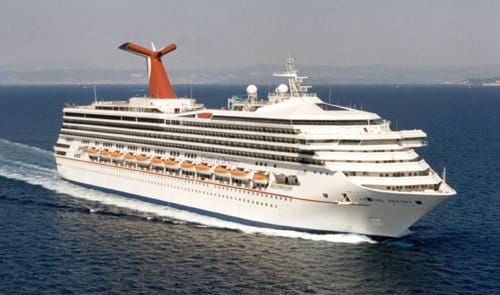
The first Carnival Destiny, launched 30 years ago, was the industry's first 100,000 gross ton cruise ship (Carnival)
The name Carnival Destiny was chosen to highlight the company’s heritage in pioneering and the long relationship with Fincantieri. The Italian shipyard delivered the first Carnival Destiny 30 years ago. The ship was the first passenger ship to exceed 100,000 gross tons. Carnival says it changed the industry, including expanding the availability of balcony cabins and new venues. Renamed Carnival Sunshine in 2013, the ship continues as part of the fleet.
The ceremony took place at the shipbuilder’s main production site in Monfalcone, Italy. It highlights that it has built 76 cruise ships for the brands of Carnival Corporation, including 15 cruise ships for Carnival Cruise Line. They highlight that the ship, which will be powered by LNG, will be equipped with advanced technologies aimed at improving energy efficiency, waste management, and emissions reduction.
Carnival Cruise Line will become the fourth cruise line after Royal Caribbean International, MSC Cruises, and Disney Cruise Line to surpass the 200,000 gross ton mark. Fincantieri will also build mega cruise ships over 200,000 gross tons for Norwegian Cruise Line. It is part of a trend among the mainstream contemporary brands that continue to upsize their vessels to add new amenities and realize economic efficiencies in their operations.

No comments:
Post a Comment