Ukraine Raises Tanker Tally to 35 Struck in 96 Hours
Ukraine is continuing its fierce pace of drone attacks, reporting it has now struck a total of 35 vessels in the Sea of Azov over 96 hours. It is part of a broader campaign targeting occupied Crimea and southern portions of the country.
While most of the targets have been smaller vessels in the Sea of Azov, the reports are citing two large tankers also stuck in the Black Sea. Greece’s Yasa Tankers confirmed that their vessel Yasa Polaris (158,200 dwt) was struck on July 7 while operating under charter to Chevron. The vessel was near the Caspian Pipeline Consortium terminal in the Black Sea. The company told Reuters the tanker was empty and that the crew was uninjured. It said the damage was minor.
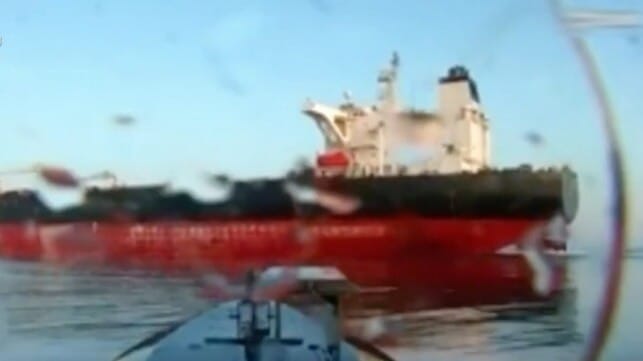
(Sea Baby attacking the tanker Blue on July 8)
The Security Service of Ukraine also reported an attack on a tanker named Blue (165,293 dwt). The vessel’s AIS signal last showed it in the center of the Black Sea, although it was transmitting that it was bound for Constanta, Romania. The vessel is Turkish-managed and has been sanctioned by both the EU and the UK. It is reported to be registered in Cameroon, but last year it falsely claimed flags in both Timor-Leste and Benin. Ukraine is saying the vessel sustained “significant damage” from one of its Sea Baby marine drones.
The overnight strikes in the Sea of Azov reportedly hit an additional 12 tankers, a dry cargo ship, and a tugboat. Commanders posted a list of the vessel names showing some repeats. It also listed off five dry cargo ships among the tally. They reported one tugboat and previously said one ferry was also hit.
(Ukraine said 12 more tankers were hit in the Sea of Azov overnight, raising the tally to 35 vessels)
In total, Ukraine claimed attacks on 45 military targets overnight. It said that two oil terminals had also been struck, as well as an ammunition depot and communications towers. It said the terminals were being used to transship petroleum products for export and to supply Russian forces. Unconfirmed media reports are also saying that Russian air defense positions in Crimea had been struck and were on fire.
Earlier reports this week had already indicated that Crimea was experiencing fuel rationing and rolling blackouts. Ukrainian officials said they were working to disrupt the Russian energy sector. President Volodymyr Zelensky had said they were launching a 40-day offensive, widely targeting energy in an effort to bring the war to an end.
Russia reportedly concentrated its most recent attacks on the region around Mykolaiv. Reports said the transportation infrastructure was heavily damaged, as well as a warehouse and multiple civilian buildings.
IEA Cuts Russia's Oil Production Forecast Due to Ukrainian Attacks
Russia's oil production in 2026 and 2027 is set to be lower than previously expected, due to intensified Ukrainian drone attacks on Russia's energy infrastructure, the International Energy Agency said in its monthly oil market report on Friday.
Russia produced on average 9.2 million barrels per day (bpd) in 2025. The forecasts for this year and next, however, has been downgraded from previous projections as Ukraine continues to inflict damage on Russia's storage, refining, and transportation assets.
“Continued strikes on refineries, storage facilities and transport infrastructure underpin a weaker production outlook and we have accordingly cut our Russian supply outlook for this year and next, by 85,000 barrels per day and 150,000 bpd respectively, to average 8.8 million bpd over the forecast period,” the IEA said.
For 2026, the oil supply forecast was cut by 85,000 bpd to 8.9 million, and the 2027 forecast was revised down by nearly twice this year's downgrade, 150,000 bpd, to 8.8 million.
According to the IEA's estimates on OPEC+ supply, Russia's crude oil production increased to 8.86 million bpd in June from 8.74 million bpd in May. However, the crude production in June was 910,000 bpd below Russia's implied OPEC+ target of 9.76 million bpd, the IEA's figures showed.
But Russia has increased its crude oil exports in recent months as the Ukrainian campaign to cripple its refineries has led to a domestic fuel crisis and a surge in shipments because domestic storage capacity is very limited.
Ukraine has now expanded its offensive to cripple supply in Russia by targeting fuel supply routes and vessels, alongside a persistent campaign to hit Russian refineries and force them out of operation.
Even Russian President Vladimir Putin acknowledged two weeks ago there is a problem with fuel supply after regional authorities had tried to downplay the issue for weeks.
Two weeks ago, Putin said that following the temporary ban on exports of gasoline and jet fuel, “We are considering a full ban on exports of diesel fuels.”
The ban on diesel exports is now a fact, as of Wednesday, amid the incessant Ukrainian campaign to slash fuel supply in Russia.
By Michael Ker for Oilprice.com

No comments:
Post a Comment