Showing posts sorted by relevance for query ARM BEARS. Sort by date Show all posts

Tuesday, December 27, 2005

A Revised Second Amendment


ITS BEAR HUNTING SEASON IN ALBERTA

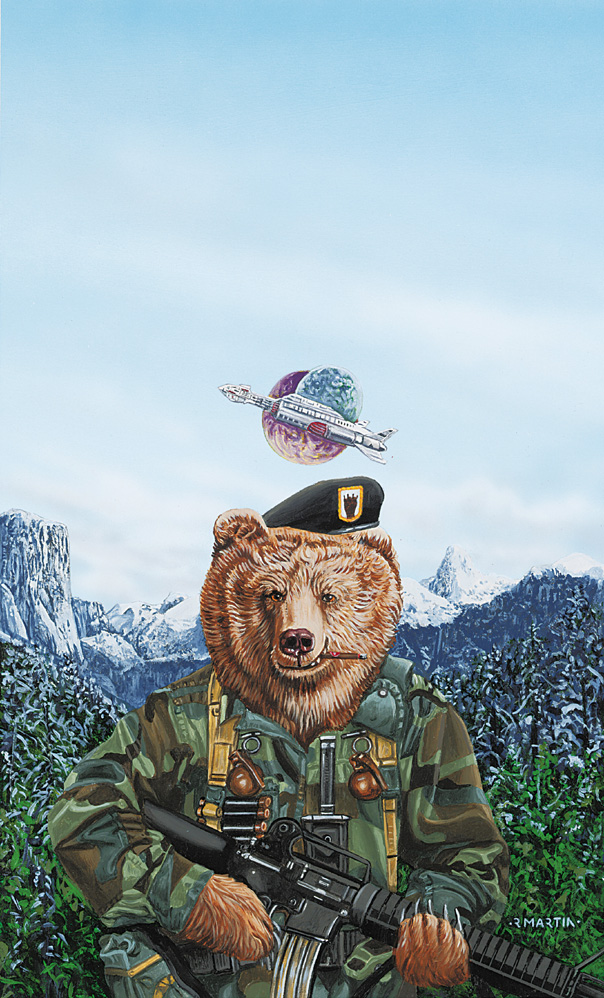
I Support The Right To Arm Bears!

The Right to Arm Bears Sample chapters

(Paperback)by Gordon R. Dickson

Charlton Heston would just be an old, washed up actor. A bear would run the NRA as according to 2nd amendment...only bears can have guns.


"Bears are not companions of men, but children of God, and His charity is broad enough for both... We seek to establish a narrow line between ourselves and the feathery zeros we dare to call angels, but ask a partition barrier of infinite width to show the rest of creation its proper place. Yet bears are made of the same dust as we, and breathe the same winds and drink of the same waters. A bears days are warmed by the same sun, his dwellings are overdomed by the same blue sky, and his life turns and ebbs with heart-pulsings like ours and was poured from the same fountain....." John Muir

By BONNIE ERBE
Nov 1, 2005,

Last week's local section of The Washington Post celebrated -- yes, celebrated -- the killing of a black bear by an 8-year-old girl. The compassionate among us mourned not just the cruel and completely unnecessary killing of one of nature's most fabulous creatures, but the love of violence and destruction instilled in this child by her family.
That certain Americans sadly find valor in killing is beyond doubt. But in many ways, it's also beyond belief. That they would take pleasure in a wantonly destructive act and train this into an 8-year-old female heart is beyond forgiveness.
We've heard it all before. Hunters love nature. Hunters work to preserve wildlife. Hunters are great stewards of the environment. Hunters eat what they kill. What was the justification here? That enough bears exist in Maryland to kill them off without destroying the species, as mankind once almost did. Only cowards could find solace, justification and pride in that.
There's no sport in taking down a large, lumbering animal with a .243 caliber rifle, the kind used by the young girl portrayed in worshipful prose by the Post. That's the same caliber weapon NATO uses in its assault weapons. There's more technology than sport in today's high-powered, scoped weapons. (The Post did not report whether the rifle she used was scoped or not.)
Tags
species

Monday, August 02, 2021

RIGHT TO ARM BEARS
Polar bears sometimes bludgeon walruses to death with stones or ice

It’s long been said that a piece of ice is the perfect murder weapon


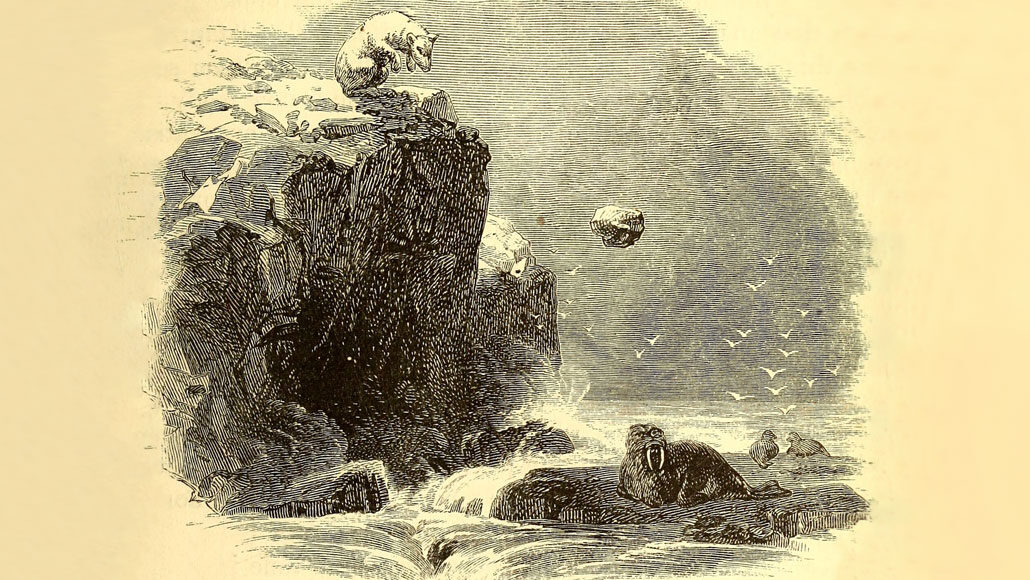
In this illustration, which appears in an 1865 book by adventurer Charles Francis Hall, a polar bear uses a rock as a tool to kill a walrus. Some have thought that Inuit reports of this behavior were just stories, but new research suggests not.
CHARLES FRANCIS HALL, LIBRARY OF CONGRESS


By Gloria Dickie
JULY 29, 2021

Walruses, weighing as much as 1,300 kilograms with huge tusks and nearly impenetrable skulls, are almost impossible for a hungry polar bear to kill. But new research suggests that some polar bears have invented a work-around — bashing walruses on the head with a block of stone or ice.

For more than 200 years, Inuit in Greenland and the eastern Canadian Arctic have told stories of polar bears (Ursus maritimus) using such tools to aid in killing walruses. Yet explorers, naturalists and writers often dismissed such accounts, relegating them to myth along with tales about shape-shifting bears.

The persistence of these reports, including one report from an Inuk hunter in the late 1990s, coupled with photos of a male polar bear named GoGo at a Japanese zoo using tools to obtain suspended meat compelled Ian Stirling and colleagues to investigate further.

“It’s been my general observation that if an experienced Inuit hunter tells you that he’s seen something, it’s worth listening to and very likely to be correct,” says Stirling, one of the world’s leading polar bear biologists

The researchers reviewed historical, secondhand observations of tool use in polar bears reported by Inuit hunters to explorers and naturalists as well as recent observations by Inuit hunters and non-Inuit researchers and documented observations of GoGo and brown bears — polar bears’ closest relatives — using tools in captivity to access food. This review suggests that tool use in wild polar bears, though infrequent, does occur in the case of hunting walruses because of their large size, the researchers report in the June Arctic.

“Really, the only species you would want to bonk on the head with a piece of ice would be a walrus,” says Andrew Derocher, director of the Polar Bear Science Lab at the University of Alberta in Edmonton, Canada, who wasn’t involved with the new study. He suspects that it might just be a few polar bears that do this behavior. For example, if a mother bear figured out how to use ice or stone in this way, “it’s something her offspring would pick up on,” but not necessarily a skill polar bears across the Arctic would acquire, he says.

Among animals, using tools to solve problems has long been regarded as a marker of a higher level of what humans consider intelligence. Notoriously smart chimpanzees, for example, craft spears to hunt smaller mammals (SN: 2/28/07). Dolphins carry marine sponges in their mouths to stir sand and uncover prey (SN: 6/8/05). And elephants have been known to drop logs or large rocks onto electric fences to cut off the power supply.

Studies on the cognitive abilities of polar bears are lacking. “We don’t know anything experimental or objective at all,” Stirling says. “However, we have a great deal of observational information that tends to suggest polar bears are really smart.”

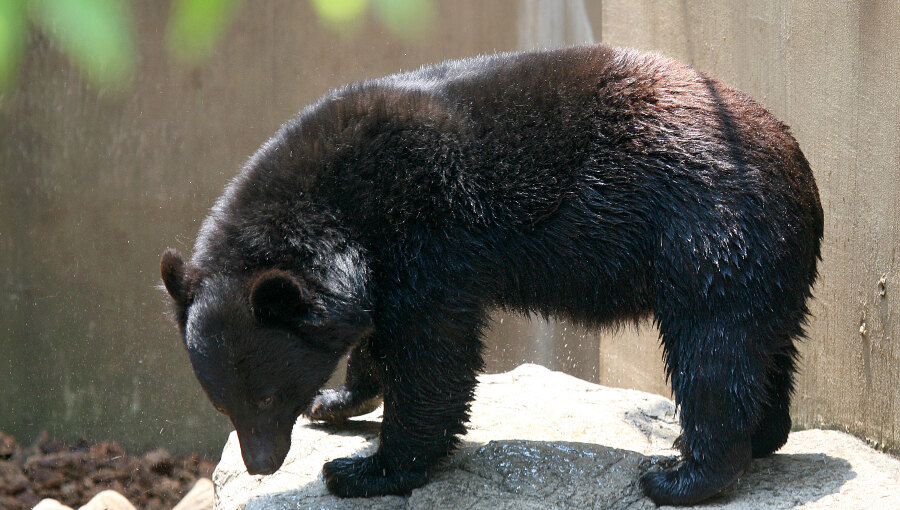
Members of the bear family, Ursidae, are typically assumed to have strong cognitive skills as a result of their large brains and evidenced by their sophisticated hunting strategies. Studies on captive American black bears have even revealed some mental capabilities that appear to exceed those of primates.

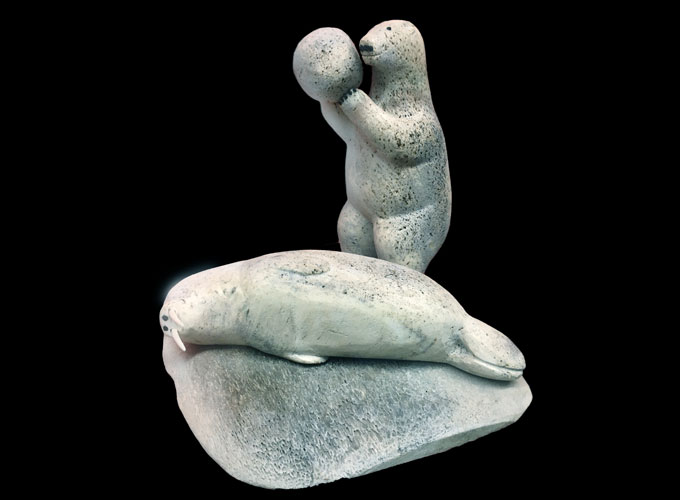
This sculpture in the Itsanitaq Museum in Churchill, Canada shows a polar bear lifting a block of ice above the head of a sleeping walrus.
GLORIA DICKIE

Gabriel Nirlungayuk, an Inuk hunter of Rankin Inlet in Nunavut, Canada, says he has heard such stories of polar bears using tools to hunt walruses. “I’ve seen polar bears since I was probably 7 years old. I’ve been around them, I’ve hunted alongside them, and I have seen their behaviors. The smartest hunters are usually the female bears.” Sometimes, he says, polar bears will trick young seals to come closer by pretending to be asleep in open water. Other times he’s observed that a polar bear can sniff out a seal’s breathing hole in ice, even if it’s obscured by snow.

“I have worked with the Inuit on traditional knowledge for a very long time and one of my favorite subjects is polar bears, because science often suggests one thing and the Inuit say another thing,” he notes.

There are around 26,000 wild polar bears living in 19 subpopulations across the Arctic and sub-Arctic. The bears primarily eat seals, hunting the marine mammals by staking out above their breathing holes. Because of climate change, Arctic sea ice is fast disappearing, and scientists predict that many polar bear populations will be extinct by the century’s end. Desperate polar bears may increasingly attack walruses, but “there are limitations to how many walruses an adult bear can take down,” says coauthor Kristin Laidre, an Arctic ecologist at the University of Washington in Seattle. It takes a lot of energy.

Following publication of the new study, Stirling received a video from U.S. Geological Survey scientist Anthony Pagano, based in Anchorage, Alaska, who had previously attached a GoPro camera to a wild polar bear for a separate project. That footage, Stirling says, shows a female polar bear sliding a large block of ice around before throwing it into the water at a seal.


Monday, June 19, 2023

HEY MISTER LEAVE THOSE BEARS ALONE
Why grizzly bears will start to be trapped in parts of Yellowstone


Hillary Andrews
Sun, June 18, 2023

BOZEMAN, Mont. – Scientists will start capturing grizzly bears Monday to study in the greater Yellowstone National Park area. The baiting and trapping operations will continue through August 31 in parts of the Custer Gallatin National Forest as well as private lands.

"Research and monitoring of the grizzly bear population is vital to ongoing recovery and management of grizzly bears in the Greater Yellowstone Ecosystem," said the U.S. Forest Service in a statement.

Grizzlies, once found throughout western North America, were reduced to surviving in only 2% of their historic range by the 1960s, according to the U.S. Geological Survey. In 1973, the Department of the Interior formed the Interagency Grizzly Bear Study Team and Committee.

AGENCIES EVALUATE OPTIONS TO RESTORE GRIZZLY BEARS TO NORTH CASCADES AFTER POPULATION VANISHES


The green represents the historic range of the Grizzlies and the yellow represents the species current range.

Its findings prompted the lower 48 to list the animal as threatened under the Endangered Species Act due to population and range reduction due to human impact in 1975.

"In the greater Yellowstone ecosystem. Grizzly bear numbers had declined to perhaps fewer than 250," stated the USGS in a preservation video.

After almost 50 years of research, the bears are making a comeback. The USGS said it could be the largest collection of scientific evidence on any bear species in the world

YELLOWSTONE NATIONAL PARK WARNS OF DANGERS AFTER FIRST GRIZZLY BEAR SIGHTINGS OF 2023


A female grizzly bear exits Pelican Creek October 8, 2012 in the Yellowstone National Park in Wyoming.

"Today, the study team estimates that the population has rebounded to a minimum of 700," the USGS continued. "And these bears are now delisted from the Endangered Species Act, though much of the credit goes to the grizzly bear and its resilience over decades of management and landscape changes. Rigorous science that informs effective management decisions is also part of the equation."


Biologists will bait foot snares and culvert traps with natural food like road-kill elk and deer, the Forest Service said. Culvert traps are cages or enclosures with one open end that closes when the bait is pulled.

The committee recommends radio-collaring at least 25 adult females annually. They also collar male bears.

BEAR TAKES ABOUT 400 SELFIES AFTER DISCOVERING WILDLIFE CAMERA IN COLORADO


YELLOWSTONE NATIONAL PARK, WYOMING, UNITED STATES - 2017/06/02: A Mother Grizzly and her cub walk through a meadow in Yellowstone National Park. (Photo by Will Powers/SOPA Images/LightRocket via Getty Images)

"Data collected from radio-marked bears provide information necessary for tracking key population parameters," stated the USGS on its site. "By observing radio-collared bears, we document age of first reproduction, average litter size, cub and yearling survival, how often a female produces a litter, and causes of mortality. These data allow us to estimate survival among different sex and age classes of bears."

Grizzlies can weigh up to 600 pounds and eat over 200 food items, including plants, animals and fungi. A bear can live up to 30 years, but they reproduce slowly, said the USGS.

"Since the mid-1980s, science has shown that Yellowstone grizzly bears have increased in number and expanded their range, ensuring the future viability of grizzly bears in the greater Yellowstone ecosystem will require continued public engagement, along with the reliable scientific information that assists wildlife managers in conserving the Yellowstone grizzly bear," explained the USGS.

Officials placed bright yellow signs in baited areas.

The study team conducts similar capture operations in other national parks.


Sunday, April 12, 2026


Why cruise passengers are missing out on seeing Alaska’s ‘queen of fjords’

Tracy Arm features two tidewater glaciers and wildlife, including seals and bears
Copyright Peter Mulligan, CC BY 2.0


By Michael Starling & AP
Published on 

Tracy Arm, a majestic fjord located southeast of Juneau, is being skipped by major cruise lines this season following a massive landslide last summer.

For years, sailing through Tracy Arm in southeast Alaska has been a highlight of many cruise itineraries, drawing visitors with its dramatic fjord landscapes and active glaciers that calve into icy waters.

The narrow passage, framed by rugged wilderness, has long been considered one of the region’s most scenic cruising experiences. However, this season several major cruise lines are choosing to bypass the route.

The decision follows a massive landslide last summer, when a large section of a glacier collapsed into the fjord, triggering a tsunami that sent waves surging high up the opposing mountainside. The event raised concerns about the stability of surrounding slopes, which remain potentially hazardous.

Citing passenger safety and ongoing geological risks, cruise operators have opted to alter itineraries, reflecting a more cautious approach as conditions in the area continue to be assessed.

“Tracy Arm is the majestic princess, you know, she is the queen of fjords,” said travel agent Nate Vallier.

The destination cruise and tour companies have chosen as an alternative – nearby Endicott Arm and Dawes Glacier – is “still beautiful by any means, but it’s just not the same”, he said.

Tracy Arm, southeast of Juneau, is a roughly 50-kilometre fjord that leads to the Sawyer Glacier and features wildlife, including seals and bears.

On 10 August 2025, a landslide originating high on a slope above the toe of the South Sawyer, near the head of the fjord, sent water surging more than a quarter mile (more than half a kilometre) up the mountain wall opposite the slide and out Tracy Arm.

No ships were in the fjord, officials said, and no deaths or injuries were reported. But kayakers camped on an island near where Tracy and Endicott arms meet had much of their gear swept away by the rushing water.

Southeast Alaska, largely encompassed by a temperate rainforest, is no stranger to landslides. And while it's long been known the fjord network in the Tracy Arm region has been susceptible, the slope that failed had not been identified as an active hazard before last summer's collapse, said Gabriel Wolken, manager of the state’s climate and ice hazards programme.

Scientists are working to understand not only what caused the slope to collapse but to understand what other hazards might exist in the fjord, he said.

The area remains unstable, said Steven Sobieszczyk, a US Geological Survey spokesperson. Steep landslide areas continue to change for years after an initial slide, he said by email.

“Continued rockfall and small-scale sliding from the exposed landslide scar are expected and could impact the water, potentially causing a future localised tsunami,” he said.

A cruise ships sails into Tracy Arm fjord in Alaska JOE KAFKA/AP


Major cruise companies, including Holland America, Carnival Cruise Line and Royal Caribbean said in response to inquiries from AP that they are replacing a Tracy Arm visit with Endicott Arm. MSC Cruises, Virgin Voyages and regional tour company Allen Marine also are doing Endicott and Dawes Glacier instead. Norwegian Cruise Line said it does not have voyages sailing by Tracy Arm.

Endicott already has been a stop for some ships previously and an alternative when conditions in Tracy Arm, such as excess ice, have been unsafe.

Vallier, who owns the Alaska Travel Desk, said he would have liked cruise companies to give travellers more advance notice about itinerary changes.

After leaving Seattle, the first ships of the season are due 21 April in Ketchikan and in Juneau the following week.

Seeing a glacier – particularly a dynamic, calving glacier – is a bucket-list item for many tourists, and that's what has made Tracy Arm so popular, he said. While the Mendenhall Glacier in Juneau is a major attraction for the capital city and cruise port, many visitors view it from across a large lake, and it has diminished or entirely retreated from view from some hiking overlooks.

Kimberly Lebeda of Wichita, Kansas, was excited when she booked tickets for a Tracy Arm excursion for her family last year. Lebeda, who researches areas she visits, said she was sold on the scenery.

But the night before the stop, they were told that due to ice in Tracy Arm, they would go up Endicott instead. Her family and others who'd booked the excursion got off the ship and onto a smaller boat with glass windows, abundant seating and snacks. They saw seals on ice floes, waterfalls and “a wall of ice” calve from Dawes Glacier, she said.

She called it “an amazing thing to witness”.

“Was it worth it? Yes, because I don’t know if I'll ever get to do that trip again,” she said. “Again, I haven’t ever been to Tracy Arm so I can’t really compare. But to me, was it worth it and was it exciting? Absolutely.”

Wednesday, February 08, 2006

Da' Bears Have It

Bear with me here as I pun around some great news for Ursus Major. A sancturary for bears and the ancient forest has been declared in B.C.; Great Bear Rainforest.

Years of tension end with 'unique' BC rain forest deal
Globe and Mail - 20 hours ago
VANCOUVER -- After 10 years of logging-road blockades, marketplace boycotts and meetings that were so fractious people couldn't even agree on lunch breaks, the antagonists in British Columbia's great land-use debate finally made peace. ...
Canada creates massive `working` park Monsters and Critics.com
Canada signs deal with loggers to save ancient rainforest Independent
CTV.ca - The Moscow Times - Vancouver Sun (subscription) - Environment News Service - all 178 related »

And the US is looking at the crisis of the Polar Bear in the Arctic due to Climate Change. Someone hasn't told Bush about this cause you know what he thinks of Global Warming.

White House to Study Protecting Polar Bears
Washington Post, United States - 4 hours ago
The Bush administration has agreed to study whether polar bears should be added to the nation's endangered species list because global warming is shrinking ...
US considers endangered status for polar bears CBC News
US mulls protecting polar bears as Arctic melts Reuters Canada
Polar Bears May Join Endangered Species ListiThe NewStandard


This must mean the Right To Arm Bears campaign has been making headway.


See A Hunting We Will Go


Find blog posts, photos, events and more off-site about:
, , , , , , ,


Friday, July 03, 2026


Success story brown bear: 3D analysis reveals the secret of their climate resilience


Staatliche Naturwissenschaftliche Sammlungen Bayerns
Lower jaws of fossil brown bears 

image: 

Lower jaws of fossil brown bears from the Le Régourdou Cave, Dordogne, France, dating back 243,000 years, and from the Postes Cave, Extremadura, Spain, dating back 71,000–104,000 years. The brown bear from the Postes Cave lived during a warmer interglacial period and had a shorter row of teeth than Ice Age brown bears, as well as a shorter lever arm for its masticatory muscles.

view more 

Credit: Mónica Villalba de Alvarado


Brown bears have lived in Europe for 175.000 years, right up to the present day. A new study now shows that, over the course of their evolution, the masticatory function of the lower jaws of European brown bears (Ursus arctos arctos) changed significantly time and again and did so in sync with the climate, alternating between warm and cold periods. This is the conclusion reached by zoologist Anneke van Heteren of the Bavarian State Collections of Natural History (SNSB) and her colleague from the Universidad del País Vasco, Donostia-San Sebastián. In their study, the two researchers compared the lower jaws of fossil and modern brown bears with those of their closest relatives, including two extinct cave bear species (Ursus spelaeus and Ursus deningeri) as well as polar bears (Ursus maritimus).

Detailed geometric 3D analyses show that the basic jaw structurehas remained remarkably stable in European brown bears over thousands of years. In contrast to the specialized herbivorous cave bear or the carnivorous polar bear, the brown bear retained a versatile, omnivorous jaw structure. This has not changed drastically since the Pleistocene. The crucial flexibility, however, lies in the details: The researchers found subtle differences in lower jaw morphology in the area where the large chewing muscle, Musculus masseter, attaches. Here, the morphology of brown bears varies over the course of their evolution, depending on whether they lived during warm or cold climatic periods. The lower jaws of fossil brown bears from cold periods resemble those of modern bears native to cooler regions of the Northern Hemisphere and high-altitude areas. The jaws of fossil brown bears from warm periods, regardless of geological age, differ significantly from these. Apparently, changes in the available food supply for brown bears were reflected in the flexible adaptation of their masticatory musculature.

“This morphological flexibility of the masticatory structures in brown bears shows us that the animals were evidently able to adapt optimally to the selective demands of their environment. Their ability to cope with such extreme climatic fluctuations likely played a decisive role in their evolutionary success. Brown bears have been continuously present in Europe since the Middle Pleistocene. More specialized species, such as the cave bear, however, became extinct,” explains Anneke van Heteren, curator of mammals at the Bavarian State Collections of Natural History (SNSB) and lead author of the study. 


Lower jaw and skull bone of a Syrian brown bear Ursus arctos syriacus, a subspecies of the brown bear adapted to warmer climates, from the paleoanatomical collection of the SNSB.

Lower jaw of a Syrian brown bear Ursus arctos syriacus, a subspecies of the brown bear adapted to warmer climates from the paleoanatomical collection of the SNSB.

Skulls of brown bears from the SNSB’s paleoanatomical collection. On the right is a Syrian brown bear Ursus arctos syriacus, a subspecies adapted to warmer climates.

Credit

K. Hagemann, SNSB

Monday, December 15, 2025

Japan's recent bear attacks blamed on food and land crises

Japan's recent bear attacks blamed on food and land crises
/ Kabacchi - CC BY 2.0 - Wiki
By bno - Tokyo Office December 15, 2025

A dangerous rise in confrontations between wild bears and humans is causing widespread concern across Japan, compelling the government to call on its military for assistance. Authorities are now working alongside residents, who are employing cutting edge tools like drone surveillance and alert systems to monitor the movement of these large animals.

Aljazeera reports that the severity of the situation is clear from the casualty figures. Since April 2025, the nation has seen the highest death toll from bear attacks since record keeping began in 2006. According to an October statement from the Ministry of Environment, at least 13 individuals have lost their lives and over 100 more have been hurt.

This surge in bear attacks, which has necessitated military deployment in some areas, underscores a critical ecological and social problem in Japan: the growing conflict between expanding wildlife populations and human settlements, worsened by environmental factors and rural decline.

Japan is home to two primary bear species. The colossal Brown Bear, weighing over 450kg, is predominantly found on the northern island of Hokkaido. The smaller, more numerous Asiatic Black Bear (or Moon Bear), weighing between 80kg and 200kg, inhabits the more densely populated mainland. Both species are involved in the incidents. Encounters with Asiatic Black Bears are more frequent, but Brown Bear attacks are more dangerous. Shota Mochizuki, an associate professor at Fukushima University, told Aljazeera that Black Bears are widely distributed across Honshu and Shikoku, where many people live. He added that attacks by Brown Bears are far more severe because they are significantly stronger and larger animals.

Worst-hit regions and personal accounts

The crisis has been felt most acutely in Japan’s northern prefectures. Japan’s public broadcaster, NHK, reported that the death toll for the year includes four individuals in Akita, five in Iwate, two in Hokkaido, and one each in Nagano and Miyagi.

Bear sightings in Akita prefecture have risen sixfold this year, and bears have attacked over 50 people since May, mostly by Asiatic Black Bears encroaching upon residential districts. For instance, NHK reports that on November 9, a Black Bear assaulted a 78 year old woman in Gojome Town and subsequently attacked a 50 year old woman who came to her aid, though both survived. An elderly woman was killed after encountering a bear while working on a farm in Akita City in late October. The situation is overwhelming, with Kenta Suzuki, the governor of the mountainous region, saying in an Instagram post that the crisis has exceeded the capacity of local authorities.

The dangers have been evidenced by harrowing personal stories. Billy Halloran, a New Zealander, described being severely mauled by an adult Black Bear, estimated to be around 60 or 70kg, while jogging in the woods of Myoko in northern Japan in early October. In an interview, he told CNN that the bear seized his arm and pushed him to the ground, resulting in a broken arm and injured leg that required three surgical procedures and the insertion of metal plates. Attacks are not limited to remote areas; according to NHK, a bear entered a supermarket in Numata city in central Japan in October and injured shoppers.

The severity of the situation has prompted other nations to issue warnings. The US Department of State issued a "wildlife alert" to its citizens, noting the increased sightings near populated zones, and the UK’s Foreign Office warned in late October British travellers against venturing alone into woodland areas.

Experts point to multiple factors driving the escalation. A primary cause is a significant food deficit in the bears’ natural mountain habitats. Mochizuki told Aljazeera that the bears mainly feed on acorns and beech nuts, which have been scarce this year. He said that when natural sustenance is low, bears are more likely to venture into human settlements. According to the Ministry of Environment, a similar spike in attacks occurred in 2023 following poor acorn yields. Some experts say climate change is a reason for the low production.

Furthermore, bear populations are growing. Mochizuki noted that long-term conservation and reduced hunting pressure have contributed to this increase, resulting in more opportunities for bears to encounter humans. Government figures suggest the overall bear population exceeds 54,000. Mochizuki also highlights that rural depopulation is playing a role. He added that as young people move to cities, unmanaged fields and village edges create easy access routes for the animals.

Government response

The Japanese authorities are responding forcefully. Last week, both the country’s military (Japan Self Defence Forces) and riot police were deployed to Akita. Riot police can shoot bears, but the military is legally restricted to national defence and disaster relief. Mochizuki said the military is supporting licensed private hunters by setting traps and removing shot bear carcasses. He explained that hunters hold official licences and firearm permits to conduct nuisance control, including shooting bears when authorised by prefectural governments.

Local residents are using AI-based surveillance and drone technology to detect bears, according to Akita’s mayor. NHK reported that people are also advised to secure food waste and cut down nut-bearing trees near their homes.

Mochizuki said three key long term preventative measures can prove effective: eliminating food sources around human settlements, installing physical barriers like electric fencing, and enhancing early detection through technology and mobile alerts. He stressed the importance of addressing the shortage of hunters and wildlife staff due to the ageing population, calling for increased recruitment and better education for both residents and tourists.

Sunday, March 13, 2022

Are Polar Bears Altruistic or Just Bad At Math?

Polar bear mothers are known to adopt and raise cubs from non-related litters. Why do they make a multi-year commitment to do it?


Getty

By: Mena Davidson
February 27, 2022

In the 21st century, most mentions of polar bears conjure images of stranded bears, on exposed beaches or drifting ice sheets as glaciers melt away into the ocean. The harsh conditions of the rapidly-changing Arctic don’t make it easy for animals to raise the next generation of youngsters, and raising a polar bear cub is a lot of work.

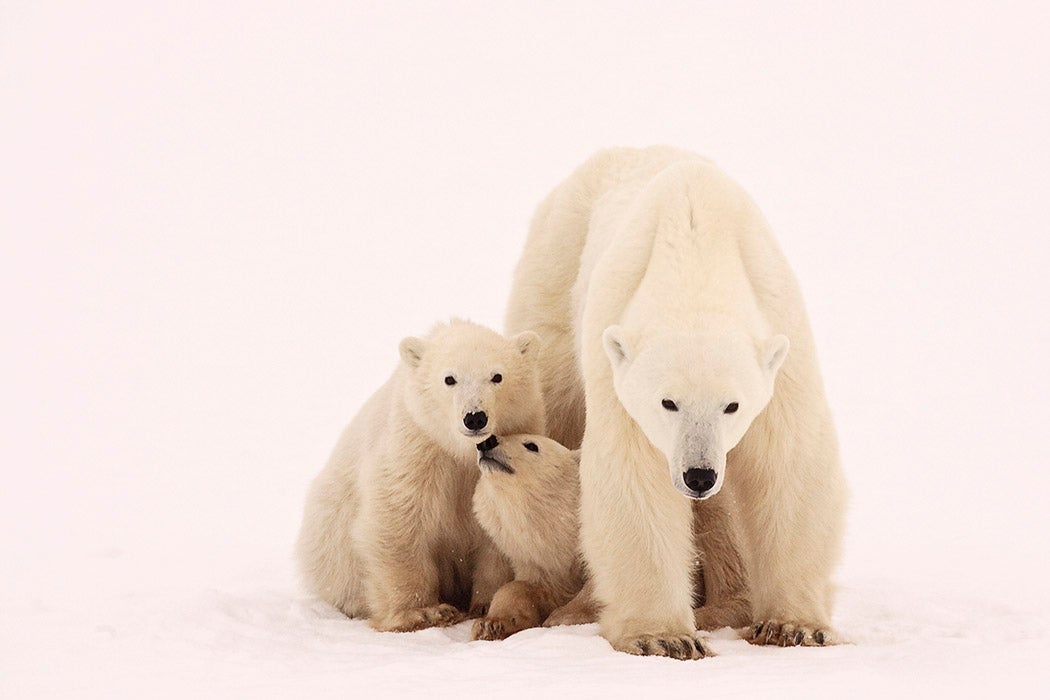
Polar bear moms must build a snow den in the fall, where they will stay, without food or water, to give birth and care for their newborn cubs through the winter. Polar bears usually give birth to litters of one or two cubs, and about 70% of cubs will survive–although this number is declining closer to 40% over time. In the spring, mom and cubs will emerge from the den, where she will spend the next 2.5-3 years showing them the ropes of Arctic living. Given this significant investment in her cubs, it’s surprising to find that polar bear moms will sometimes adopt additional cubs from another mother.
Many species care for young that aren’t their own, a natural phenomenon known as alloparenting or cooperative breeding.

This behavior isn’t uncommon throughout the animal kingdom–many species care for young that aren’t their own, a natural phenomenon known as alloparenting or cooperative breeding. In fact, some animals, like meerkats, are unable to raise young without the cooperation of helpers in the social group. Alloparenting most commonly evolves in group-living species, when individuals are highly related or very social. In these cases, animals pass on their shared genes by caring for more distant relatives or increase the chance of gaining reciprocal care for their future offspring. In this way, helpers benefit from their efforts, under the guise of a seemingly altruistic act.

However, polar bears do not meet any of these prerequisites for the evolution of alloparenting. They are solitary, live at low densities far from other groups, and raise cubs that impose a large energetic cost due to their prolonged care. So, why do they do it?

Western researchers have studied several populations of polar bears around the Arctic since the 1960’s, although Indigenous communities likely have traditional knowledge of polar bears that spans thousands of years. In this time, polar bears have been observed adopting a single unrelated cub into an existing litter, as well as adopting a litter of new cubs following the loss of their own cubs.

One possible explanation is that new moms gain valuable parenting experience through adoption, increasing the probability of success for a subsequent litter. But this doesn’t seem to be supported by research. The most likely explanation is that polar bears haven’t developed the cognitive ability to keep track of the number or identity of their own cubs. Solitary polar bears don’t cross paths very often, so it’s usually safe for a mother to assume that any cubs within an arm’s reach are hers… with the caveat that she won’t notice if one of her cubs has just wandered into the group and doesn’t belong. It’s also possible that mothers who have lost their own cubs recently are biologically predisposed to parenting, and will adopt any cubs that come her way as her own.

Either way, it looks like this curious case of cub adoption is just another example of an energetically costly mistake, rather than a heartwarming instance of altruism and concern. In the wild, it’s still every parent for themselves in the struggle to survive, and pass their genes to the next generation.


The Estimation of Survival and Litter Size of Polar Bear Cubs
By: Douglas P. Demaster and Ian Stirling
Bears: Their Biology and Management, Vol. 5, A Selection of Papers from the Fifth International Conference on Bear Research and Management, Madison, Wisconsin, USA, February 1980 (1983), pp. 260-263
International Association for Bear Research and Management

Factors Affecting Pup Growth and Survival in Co-Operatively Breeding Meerkats Suricata suricatta
By: A. F. Russell, T. H. Clutton-Brock, P. N. M. Brotherton, L. L. Sharpe, G. M. McIlrath, F. D. Dalerum, E. Z. Cameron and J. A. Barnard
Journal of Animal Ecology, Vol. 71, No. 4 (Jul., 2002), pp. 700-709
British Ecological Society

The Evolution of Alloparental Care and Adoption in Mammals and Birds
By: Marianne L. Riedman
The Quarterly Review of Biology, Vol. 57, No. 4 (Dec., 1982), pp. 405-435
The University of Chicago Press

The Status and Conservation of Bears (Ursidae) of the World: 1970
By: I. McTaggart Cowan
Bears: Their Biology and Management, Vol. 2, A Selection of Papers from the Second International Conference on Bear Research and Management, Calgary, Alberta, Canada, 6-9 November 1970. IUCN Publications New Series no. 23 (1972), pp. 343-367
International Association for Bear Research and Management

Wabusk of the Omushkegouk: Cree-Polar Bear (Ursus maritimus) Interactions in Northern Ontario
By: Raynald Harvey Lemelin, Martha Dowsley, Brian Walmark, Franz Siebel, Louis Bird, George Hunter, Tommy Myles, Maurice Mack, Matthew Gull, Matthew Kakekaspan, The Washaho First Nation at Fort Severn and The Weenusk First Nation at Peawanuck
Human Ecology, Vol. 38, No. 6 (DECEMBER 2010), pp. 803-815
Springer

Observation of Adoption in Polar Bears (Ursus maritimus)
By: A. E. Derocher and Ø. Wiig
Arctic, Vol. 52, No. 4 (Dec., 1999), pp. 413-415
Arctic Institute of North America

A Case of Offspring Adoption in Free-Ranging Polar Bears (Ursus maritimus)
By: S. N. Atkinson, M. R. L. Cattet, S. C. Polischuk and M. A. Ramsay
Arctic, Vol. 49, No. 1 (Mar., 1996), pp. 94-96
Arctic Institute of North America