Showing posts sorted by relevance for query EASTER. Sort by date Show all posts

Sunday, March 29, 2026


The History And Meaning Of Easter Eggs: Origins, Symbolism & Traditions

Have you ever wondered about the true Easter eggs meaning? Long before they were made of chocolate and hidden in gardens, eggs were profound ancient symbols of rebirth and spring. For Christians, Easter egg symbolism represents the sealed tomb and the glorious resurrection of Jesus Christ. From the royal courts of King Edward I to the legendary red egg of Mary Magdalene, discover the fascinating history of Easter eggs, the true origin of the Easter egg tradition, and exactly why we decorate Easter eggs to celebrate this joyful season.

Easter Eggs
The History And Meaning Of Easter Eggs: Origins, Symbolism & Traditions

When we think of Easter, a few familiar images instantly come to mind: colourful spring blooms, playful bunnies, and, most iconically, beautifully decorated eggs. Whether they are carefully painted, intricately designed, or made of chocolate and hidden for a festive hunt, they are a cherished part of the holiday. But what is the true meaning of Easter eggs, and how did this practice begin? Beyond their bright colours lies a fascinating story. By exploring the history of Easter eggs and the origin of the Easter eggs tradition, we uncover a beautiful blend of ancient spring festivals, profound Easter egg symbolism, and evolving cultural practices.

What Do Easter Eggs Really Mean?

At its heart, the egg has long been a universal symbol of new life, renewal, and fertility. This meaning existed well before Christianity, tracing back to ancient spring festivals that celebrated the end of winter and the rebirth of nature. The image of a chick emerging from an egg naturally came to represent fresh beginnings and the cycle of life.

With the rise of Christianity, this powerful symbol was given a deeper spiritual meaning. For Christians, the Easter egg represents the resurrection of Jesus Christ. The hard shell is seen as a symbol of the sealed tomb, while cracking the egg signifies Jesus rising from the dead, bringing with it hope, renewal, and the promise of eternal life.

In many traditions, eggs are also dyed in vibrant colours, especially red, which symbolizes the blood shed by Christ during the crucifixion. Over time, these symbolic practices blended with local customs, eventually evolving into the joyful Easter egg traditions we see today, where meaning, faith, and celebration come together in one simple yet powerful symbol.

Why Are Eggs Part of Easter?

The connection between eggs and Easter developed over centuries, blending ancient customs with Christian practices. Long before the rise of Christianity, many cultures celebrated spring festivals around the time of the vernal equinox. These festivals often focused on fertility and the return of light and life after winter, and symbols like eggs and rabbits (known for their prolific breeding) were likely used in these celebrations. As Christianity spread, it often incorporated existing pagan symbols and traditions, adapting them to fit Christian narratives. The egg, with its potent symbolism of new life, was a natural fit for celebrating the resurrection, the ultimate story of new life in Christian belief.

There was also a very practical reason rooted in religious observance. For centuries, Christians traditionally abstained from eating certain foods, including eggs, meat, and dairy products, during Lent – the 40-day period of fasting and repentance leading up to Easter. However, hens continued to lay eggs throughout this period. By the time Easter Sunday arrived, households often had a large surplus of eggs. What better way to celebrate the end of the fast and the joyous occasion of Easter than by decorating, sharing, and feasting on these accumulated eggs? This practical necessity helped solidify the egg's place as a staple of Easter celebrations.

Legends and Royals: The History of Easter Eggs

The origin of the Easter egg tradition is also steeped in fascinating legends and royal history. One of the most famous stories in early Christianity involves Mary Magdalene. According to Eastern Orthodox tradition, Mary attended a banquet hosted by Emperor Tiberius Caesar. She held up a plain egg and proclaimed, "Christ is risen!" The Emperor laughed, stating that Christ rising from the dead was as likely as the egg in her hand turning red. Miraculously, the egg immediately turned a brilliant red, cementing the tradition of dyeing eggs for Easter.

Historically, the practice of gifting decorated eggs can be traced back to the Middle Ages. One of the earliest recorded instances was in 1290, when King Edward I of England ordered 450 eggs to be covered in gold leaf and decorated. These luxurious eggs were presented as Easter gifts to the royal household, sparking a tradition of elaborate egg gifting that would eventually lead to the creation of the famous, jewel-encrusted Fabergé eggs in the 19th century.

The Ancient Art of Pysanky

When asking why we decorate Easter eggs, one cannot ignore the breathtaking Ukrainian tradition of Pysanky. Unlike standard dyeing, Pysanky involves a complex wax-resist method where intricate folk motifs and geometric patterns are drawn onto the eggshell using beeswax before dipping it into various dyes. These eggs are not meant to be eaten but are preserved as powerful talismans, believed to ward off evil and bring prosperity, showcasing how deeply Easter egg symbolism is woven into global cultures.

How Do You Prepare Easter Eggs?

The most common way involves real chicken eggs:

  1. Hard-Boil Them: Cook the eggs in boiling water until the inside (yolk and white) is solid. This stops them from breaking easily and makes them safe to handle (and eat later if you keep them cold!).

  2. Let Them Cool: Make sure the eggs are cool before you decorate them.

  3. Decorate! This is the fun part:

    • Dyeing: Use special Easter egg dye kits you can buy at the store. You mix colours with water and vinegar, then dip the eggs in.

    • Painting: Use non-toxic paints to paint designs on the shells.

    • Crayons: Draw on the warm, hard-boiled egg with crayons (the wax melts a bit onto the shell). You can even dye them after drawing for cool effects.

    • Stickers: Use Easter-themed stickers.

Nowadays, many "Easter eggs" are also chocolate eggs (often hollow and filled with candy) or plastic eggs that you can open and fill with small treats or toys.

What Do People Do With Easter Eggs?

Easter eggs are the centrepiece of many joyful springtime activities:

  • Easter Egg Hunts: Grown-ups hide decorated eggs (real, chocolate, or plastic) around the house or garden, and children race to fill their baskets.

  • Egg Rolling: A popular tradition, most famously hosted at the White House, where children use long spoons to roll decorated hard-boiled eggs down a grassy hill.

  • Egg Tapping (or Egg Fights): A traditional game where two people hold a hard-boiled egg and tap them together. The person whose eggshell remains uncracked wins!

  • Festive Decorations: Beautifully painted eggs serve as stunning centrepieces for the Easter dinner table or are hung on decorative Easter trees.

  • Sweet Treats: Let’s not forget eating them! While hard-boiled eggs are enjoyed as a breakfast treat, hollow chocolate eggs filled with candy remain a global favourite.

From ancient fertility symbols to representations of Christian resurrection, and from simple dyed hen's eggs to elaborate chocolate creations, the Easter egg has journeyed through history, adapting and accumulating layers of meaning. Whether you're decorating them, hunting for them, or simply enjoying a sweet treat, Easter eggs remain a powerful and joyful symbol of new beginnings, hope, and the enduring spirit of spring. Happy Easter!

Frequently Asked Questions (FAQs)

1. Why do we decorate Easter eggs?

We decorate Easter eggs to celebrate new life and the resurrection of Jesus Christ. Historically, Christians painted eggs bright colours to mark the end of the strict Lenten fast, turning a practical food surplus into a joyful, vibrant celebration.

2. What is the Easter egg symbolism in Christianity?

In Christianity, the Easter egg symbolizes the resurrection of Jesus. The hard outer shell represents the sealed tomb of Christ, and the cracking of the egg represents Jesus rising from the dead and the promise of eternal life.

3. What does a red Easter egg mean?

In Orthodox Christian traditions, Easter eggs are dyed a deep red to symbolize the blood shed by Jesus Christ during his crucifixion on the cross.

4. Who invented the Easter egg hunt?

The Easter egg hunt is widely believed to have originated in Germany. Protestant reformer Martin Luther is said to have organized egg hunts for his congregation, where men hid eggs for women and children to find, symbolizing the discovery of the empty tomb.


Sunday, April 12, 2020

THE EASTER CURMUDGEON 
Simon Harris’s pronouncement on the Easter bunny made me gag
I know it’s a time of crisis, but when did this mythical rabbit become part of Irish Easter?


Sat, Apr 11, 2020

Donald Clarke

German-American pride: US president Donald Trump and the Easter Bunny.
 Photograph: Joshua Roberts/Reuters THE BUNNY IS NOT SEAN SPICER

I don’t think I could love anyone who smiles when newsreaders – at gunpoint, I trust – report on the progress of Santa’s sleigh. Never does the dread phrase “only a bit of fun” more vigorously curl the lip. We’re getting this at Easter now.

Yes, I know it’s a time of crisis. Yes, I know it’s particularly difficult if you insisted upon having children. Sorry and all that. But Simon Harris’s pronouncement on the Easter bunny put my gag reflex into paroxysms. “Important news for children,” he tweeted. “Many of you contacted me & asked … if the Easter Bunny was allowed work this weekend. I have checked with our top doctors & the good news is he can.” Nurse! The kidney dish!

Never mind the nauseatingly cosy tone. Here’s the real issue. Since when did this mythical rabbit become part of Irish Easter? When I was a child (screen turns to monochrome, violins accompany the sounds of hooves on cobbled streets), the season was about the bloody death of the God child and his subsequent miraculous recovery. The St Matthew Passion. There is a Green Hill Far Away. All that stuff.

When I was a child, nobody pretended the Malteser or Crunchie eggs were delivered by a supernatural leporine presence


Okay, that’s a lie. Then as now, Easter was mainly an excuse to eat chocolate in the shape of novelty ovoids. But nobody pretended the Malteser or Crunchie eggs (shot of apple-cheeked child munching to the strains of Little Jimmy Osmond) were delivered by a supernatural leporine presence. My Auntie Daphne did that and she got the credit she deserved. 

Softball and root beer

The Easter Bunny and his foreign egg hunts were largely unknown here until the end of the century. Most middle-aged people regard him as some American thing encountered in Bugs Bunny cartoons. He belongs with softball, root beer and the sale of bazookas in Walmart. Yet children, young adults and teenagers (like Simon Harris) view the creature as an integral part of the domestic festival.

Will the creeping Americanisation of our culture never cease?

The Easter Bunny is largely a German invention and it has remained part of north European culture for centuries

The rise of the Easter bunny is analogous to the similar bastardisation of the Irish Halloween. In both cases a European invention is being flogged back to the old countries in homogenised, marketable form. We can claim the autumn festival as our own. But I’m not sure I had even seen a pumpkin in the flesh until I was a grown man. Trick or treat, a variation on an Irish tradition, seems, under that name, to have taken off here after the success of ET in the early 1980s. If you are in your mid-40s you probably remember it. If you are in your mid-50s you probably don’t.


The Easter Bunny is largely a German invention and it has remained part of north European culture for centuries. The film critic Guy Lodge, who writes for Variety, attributes its prominence in the country of his birth to Dutch influence. “Very much a thing in my 1980s South African childhood, and my parents largely did these things according to their own experience, so I think it goes back some way,” he told me.

Yet, despite making its way to the other end of the planet, the tradition just couldn’t get itself across the North Sea. In order to set in here, it had to go to the US, get transferred into corporate junk and hitch its way back as – among other things – a useless 2011 movie featuring the perennially unwelcome Russell Brand. Now we’re stuck with it.
Right about everything

Our parents were right about almost everything. Drop into almost any Irish home in the past 100 years and you’ll find them complaining about the malign influence of the US on domestic culture.

Obviously, we wouldn’t be without rock’n’roll, Hollywood or tomato ketchup. Let’s be reasonable, the place was a genuine dump before those things arrived to wake us up. But a tussle between disdain and admiration has been raging since at least the last war. Look at the American tourist in Fawlty Towers. He may be vulgar in his language and flash with his money, but he’s right about the shoddiness of the British service industry. Even in the age of Trump, we still want to be like them.

We’re saying “I’m good” for “I’m fine”. We’re saying “lawmaker” for “politician”. We say “grilled cheese” for “toasted cheese”

Younger people have, thank goodness, learned to look elsewhere for influence. Never before has east Asia – particularly Japan and Korea – had such an influence on youth culture. But we’re still dallying with the American versions of Halloween and the Easter Bunny. We’re saying “I’m good” for “I’m fine”. We’re saying “lawmaker” for “politician”. We say “grilled cheese” for “toasted cheese”.

We may have only a few years before Irish politicians are wishing us “Happy Thanksgiving”. At which point, I’m off to set up shop in Pyongyang.

WTF THE GODS HAVE TO WORK WEEKENDS DURING A PANDEMIC?


Simon Harris has announced that the Easter Bunny is allowed to work this weekend


By Anna O'Donoghue Tuesday, April 07, 2020

Simon Harris has announced that the Easter Bunny is in fact, allowed to work this weekend.

Worried children across Ireland have been contacting the Health Minister to ask whether their furry friend is classed as an essential worker during the Covid-19 crisis.


In a tweet this morning, Harris said that he has checked with Ireland’s top doctors, who agreed that he is allowed to work, once washes his hands regularly and keeps his distance.

Important news for children: Many of you contacted me & asked me to if the Easter Bunny was allowed work this weekend. I have checked with our top doctors & the good news is he can. But he has been contacted to remind him about washing his hands regularly & keeping his distance
— Simon Harris TD (@SimonHarrisTD) April 7, 2020

New Zealand prime minister Jacinda Ardern also announced at a press conference yesterday that both the Easter Bunny and the Tooth Fairy are considered as “essential workers”.

You'll be pleased to know that we do consider both the Tooth Fairy and the Easter Bunny to be essential workers.

She also warned children it may be "a bit difficult at the moment" for the Bunny to make it to all their homes, as they are potentially quite busy with their family as well and their own bunnies.

Thursday, April 17, 2025

SISTERS OF PERPETUAL INDULGENCE


San Francisco’s Hunky Jesus Contest stirs up controversy, community and 'courage'


SAN FRANCISCO (RNS) — Hosted by a global order of drag nuns, the Easter event draws thousands to what some call sacrilege but its participants say is liberating, joyful, even sacred.


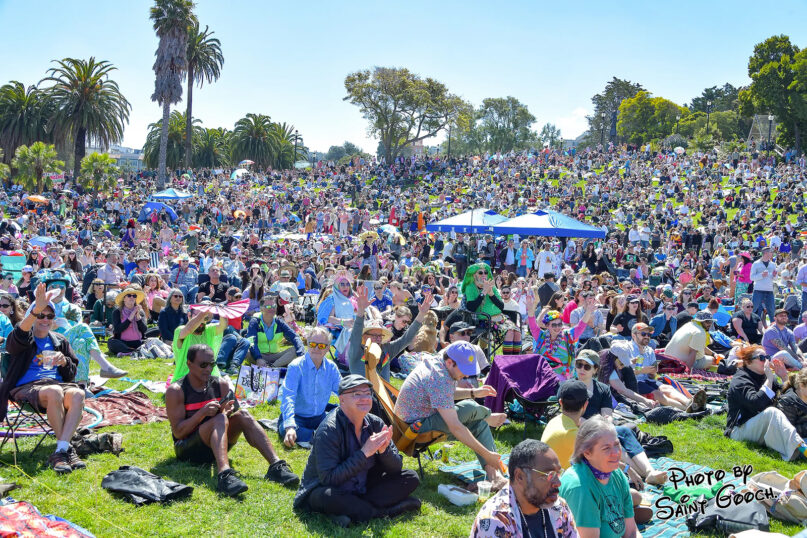
Participants in the 2024 Hunky Jesus competition at Dolores Park in San Francisco, March 31, 2024. (Photo by Garaje Gooch, courtesy of Sisters of Perpetual Indulgence)

Hayden Royster
April 17, 2025


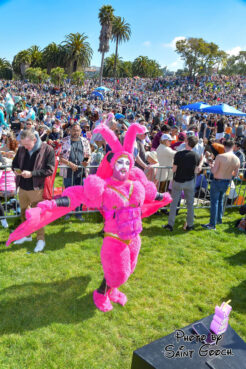
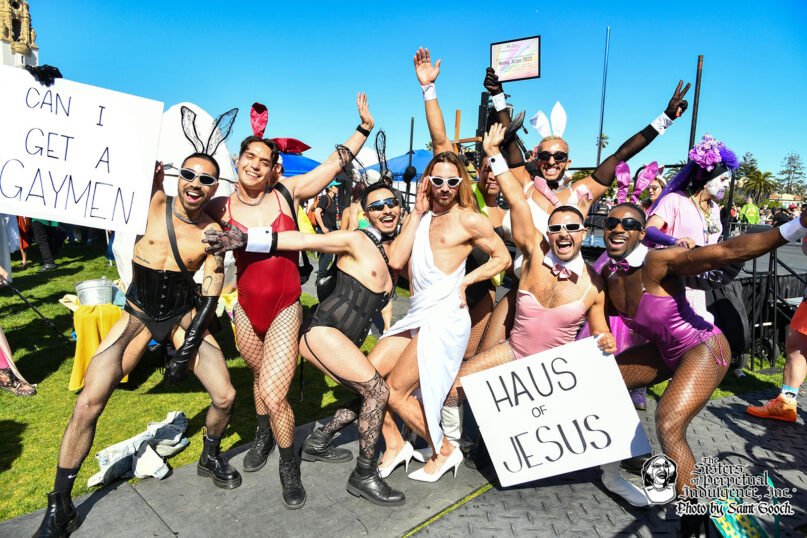
SAN FRANCISCO (RNS) — The most popular Easter service in this capital of alternative living occurs not in church but on the sloping lawns of Dolores Park, where thousands show up in their Sunday best — which at the annual Hunky Jesus Contest can mean steampunk bonnets, a life-size Peep suit or, for those competing, elaborate (and usually scanty) Jesus and Mary costumes.

The event is hosted by the Sisters of Perpetual Indulgence, the global nonprofit group of drag nuns founded in San Francisco on Easter Sunday 46 years ago. Over the years, “Hunky Jesus” has expanded from a small anniversary celebration for the sisters alone to a raucous, all-day affair. Today, the free festival includes a family egg hunt, musical acts and a “canonization” ceremony in which community members are recognized for service.

Today, the Sisters of Perpetual Indulgence have hundreds of members across the U.S. and in 14 countries. Made up of queer and trans individuals, the sisters are not affiliated with the Catholic Church or any official religious organization. But like traditional nuns, they do take lifelong vows of service and see their work as “ministry and outreach to those on the margins.


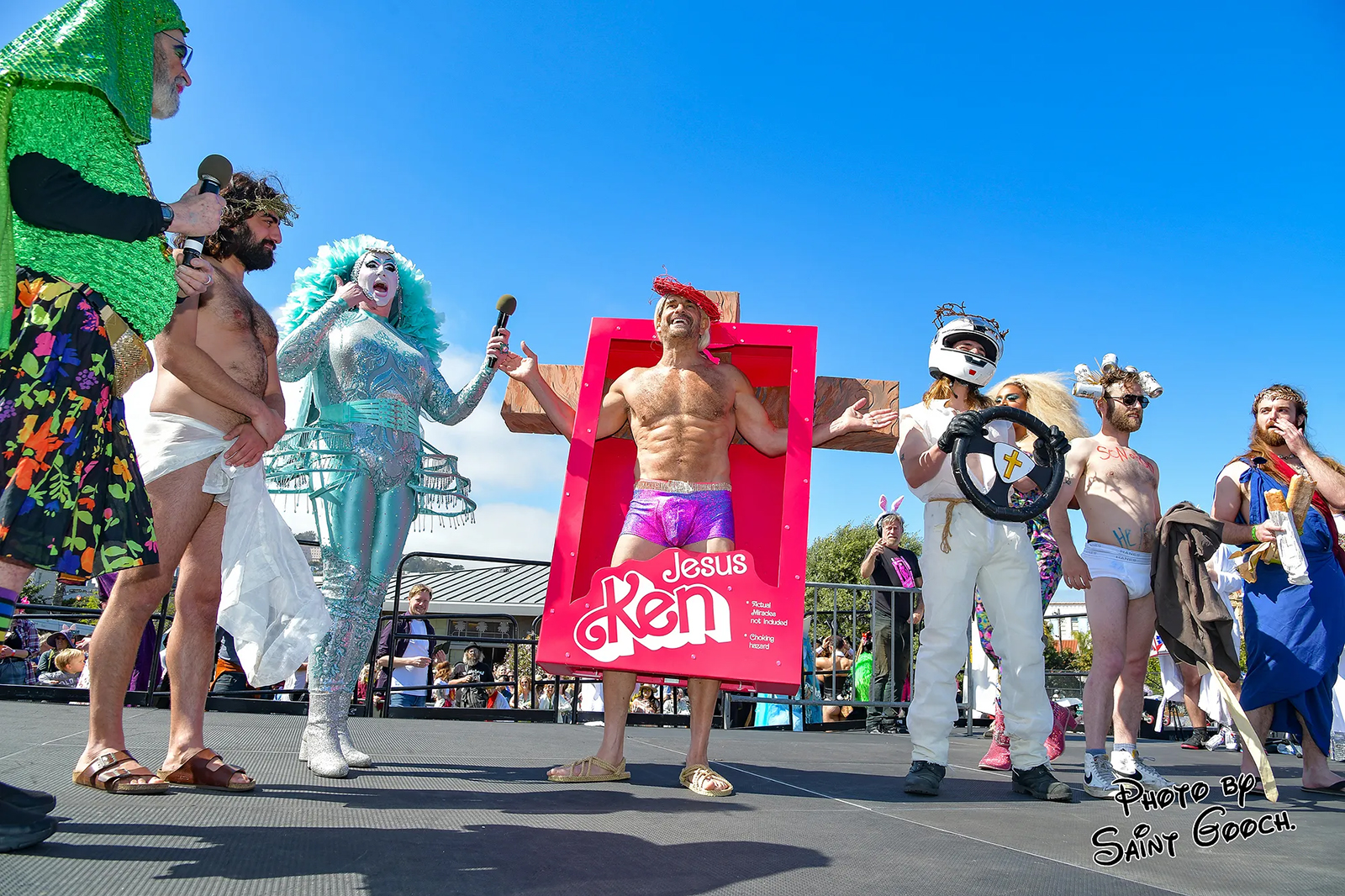
The day’s biggest draw, of course, is its eponymous contest: A handful of competitors vie for the titles of Hunky Jesus and Foxy Mary. Last year’s winning Jesus, very of-the-moment, was “Ken Jesus,” who blasphemed both the box-office giant “Barbie” and the resurrection by sporting a pink crown of thorns and a blond bowl cut, striking a crucified pose in the doll’s distinctive box.

His packaging even included a disclaimer: “Actual miracles not included.”

From the outset, the sisters and their Easter celebration have drawn calls of sacrilege and bigotry, even by some progressive and gay Christians. In 2023, after the Los Angeles Dodgers announced plans to recognize the sisters for public service, then-U.S. Sen. Marco Rubio decried them as “a group that mocks Christians through diabolical parodies of our faith.”


Overview of the 2024 Easter festivities at Dolores Park in San Francisco. (Photo by Ardo Servito, courtesy of Sisters of Perpetual Indulgence)

Nonetheless, in a metro area famous for its gay culture but where the number of nonreligious nearly equals the Christian population, many San Franciscans consider Hunky Jesus their Easter tradition. The event offers a playful space to celebrate both the Christian holiday and the LGBTQIA+ community. Attendees describe the day as liberatory, joyful and even sacred.

“The Easter event is probably the most spiritual, beautiful, uplifting, holy event I can think of,” said Sister Roma, the celebration’s longtime emcee. “It’s just about pure love.”

The sisters were among the first activists to serve gay men affected by AIDS. Over the years, the organization has organized HIV benefits, offered sex education, served the unhoused, advocated for public safety and raised tens of thousands of dollars for school programs and more.

The sisters, according to co-founder Ken Bunch, were born out of boredom. Bunch (later Sister Vish Knew) moved from Iowa to the Castro District in the late 1970s, bringing along some nuns’ habits that he and his drag troupe acquired from a convent in Cedar Rapids.

On a lark, Bunch and two friends decided to don the habits on Easter Sunday 1979, walking through the streets of the city. The public’s reaction was “electric,” Bunch recently told Little Village Magazine.

Exhilarated, the trio wore the outfits again at a gay softball game. By 1980, they had a name for their organization, new nun monikers and a mission statement: to “promulgate universal joy and expiate stigmatic guilt.”

It was that beginning, and not necessarily Easter itself, that the sisters chose to celebrate annually. In time, though, the anniversary and high holy day bled into one another.

Participants in the 2024 Easter festivities at Dolores Park in San Francisco. (Photo by Garaje Gooch, courtesy of Sisters of Perpetual Indulgence)

On Easter 1995, two sisters started a controversial pub crawl that parodied the Stations of the Cross. Four years later, on its 20th anniversary, the organization obtained a permit to host an Easter block party. Some city residents were incensed. A spokesman for the Roman Catholic archdiocese compared it to “allowing a group of neo-Nazis to close a city street for a celebration on the Jewish feast of Passover.”

Sister Roma was there for the 1999 Easter party — the first time, in her recollection, there was a Hunky Jesus Contest. The event was intended as a thank-you to San Francisco for allowing the sisters to “be of service with them,” she said. Five thousand people showed up. The next year, the sisters moved the celebration to Dolores Park, where it has mostly remained ever since. In 2024, an estimated 10,000 people attended.


Devlin Shand, a photographer, has competed twice for the Hunky Jesus title, coming in second in 2016 with Drop Dead Jesus, performing a “death drop” — a dramatic drag move he has never done before or since. “I actually rolled my ankle on the stage,” he said. “But it was worth it.”

Shand first attended after relocating to San Francisco in 2014. “It was what I moved to San Francisco for: that kind of irreverent, joyful energy that allows you to poke fun at something.” A queer gay man who was raised Catholic, Shand said, “It’s no secret that queer people are oppressed by Christianity. This whole event really is reclamation of the things that have held us down.”


Participants in the 2023 Easter festivities at Dolores Park in San Francisco. (Photo by Garaje Gooch, courtesy of Sisters of Perpetual Indulgence)

While Shand no longer identifies as Christian, some LGBTQ individuals who do have more complicated feelings around the sisters’ Easter party. The conservative Catholic writer Andrew Sullivan, who is gay, infamously railed against the event in 2011, challenging the sisters to “hold a Hunky Mohammad Contest on Ramadan.”

The Rev. Donal Godfrey, an openly gay Jesuit priest and chaplain at the University of San Francisco, has a more measured response. “Clearly it is controversial,” he said by email. As a matter of respect, Godfrey would prefer the event not be “played out in a public park.”

At the same time, he noted, he is far more disturbed by, say, the Trump administration’s recent deportations to El Salvador. “I believe the Christian God must find that much more deeply blasphemous.”

Others see harmony between the holiday and Hunky Jesus. Julia Tremaroli, a data analyst who was raised Catholic, said she has never “felt any sort of disrespect towards Jesus, Mary and the Catholic religion” at the event. Instead, Tremaroli, who identifies as queer-curious, finds the day to be a “Venn diagram” that brings together current and former Christians and the LGBTQ+ community and “finds the beauty at the center.”

“It’s so much more than just a drag show or a costume contest,” she said. “It’s a community event that celebrates what is good and can be good about Easter and Catholicism.”

As irreverent as Hunky Jesus is, Sister Merry Peter explained, the contest embodies a core principle of the sisters: “using the symbology of these traditions to open up a conversation with a society.”


Attendees of the 2024 Easter festivities at Dolores Park in San Francisco. (Photo by Garaje Gooch, courtesy of Sisters of Perpetual Indulgence)

Often, that conversation has a political edge. Last year, state Sen. Scott Wiener stepped up to the mic and called out, “Let’s hear it for triggering the right-wing extremists!” He earned cheers from the crowd — and coverage from Fox News.

This year, the event’s theme is especially pointed: “No Easter without the T.” “We are definitely expressing solidarity with the trans members of our community, who are under really vicious and cynical attack right now,” said Sister Merry Peter.


“It’s always been an act of defiance and solidarity,” said Shand, but in a time when the Trump administration is unwinding the rights of trans people and some emboldened lawmakers are threatening same-sex marriage, Hunky Jesus is taking on an added level of resistance.

“Right now is a moment that requires courage and requires community, which our Easter definitely creates,” Sister Merry Peter said.

Over the years, she has encountered people from all walks of life at the Hunky Jesus Contest — including, she said, traditional Catholic nuns.

That kind of diversity creates courage, Sister Merry Peter argued. “You may be an Irish nun sitting on your picnic blanket, but you might be next to a 300-pound drag queen in a giant pink Easter bonnet.

“That’s going to give you a sense that, maybe, there’s a little more room to express yourself than you grew up with.”


Sunday, March 31, 2024

Christians mark grim Easter as pilgrims shun Jerusalem amid Gaza war

As Christians observed Easter amidst Israel's ongoing war, the Catholic community in Gaza held a somber vigil service at the Holy Family Church while bombings happened nearby.


AFP

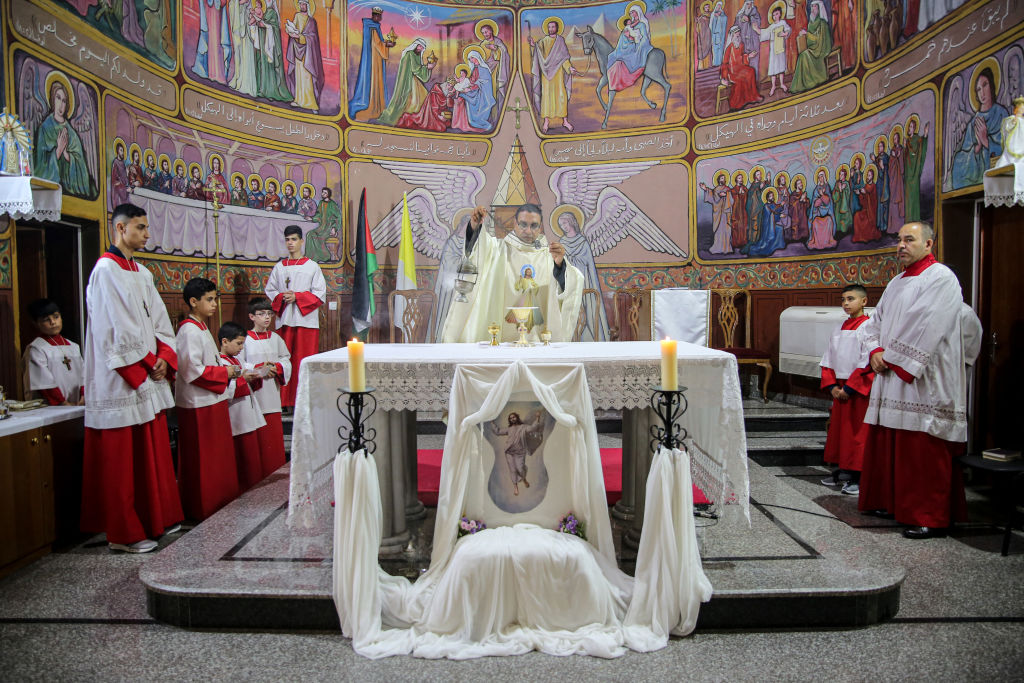
Palestinian Christians celebrate Easter Sunday Mass at the Catholic Holy Family Church in Gaza City, on March 31, 2024. / Photo: AFP


Christians celebrated a grim Easter in Gaza and Jerusalem, with the tiny Catholic community in the war-torn Palestinian territory holding their vigil service as Israel continued with its bombing of the enclave.


Around 100 people gathered by candlelight on Saturday night at the Holy Family Church in Gaza City in the famine-threatened north to mark the resurrection, when Christians believe Christ rose from the dead.


The church is a short drive from al-Shifa hospital where the Israeli military has been carrying out attacks.


The atmosphere in Jerusalem was equally heavy, with few people at the sacred sites which are usually crowded at Easter.


Even the main Catholic Easter Sunday service at the Holy Sepulchre Church — built on what is said be the tomb of Jesus — was not full.


'People are afraid'


Pierbattista Pizzaballa, the Latin Patriarch of Jerusalem, led worshippers who bowed down and kissed the marble slab where Christians believe Christ's body was anointed after he was taken down from the cross.


Sister Angelica, an Italian nun from Perugia, said she was heartbroken to see so few people at the ancient church, regarded as Christianity's holiest shrine.


"We were so few. It breaks my heart. But we are like the first Christians, they were few too."


She said pilgrims were staying away because of the "suffering and death (in Gaza)".


With pilgrims prostrating themselves on the marble stone, she said most years there was a crush even to get into the square in front of the Holy Sepulchre Church.


"Look, how (this year) it is empty, even inside," she said.


Mother and daughter Kasia, 33, and Ewa, 60, from Warsaw in Poland — veterans of 10 Holy Land pilgrimages — said they had never seen the sacred shrines so quiet.


"It is no wonder with the war," said Kasia, who spoke on condition her full name not be published. "It is terrible. They are killing children (in Gaza). It is so wrong."


A Nigerian Pentecostal pastor from Agege near Lagos said the war would had not put him off staying for a month.


But he admitted that in 30 years of visits he had never seen "the Holy City so empty. There were more priests than people in the Holy Sepulchre Church on Holy Thursday. People are afraid".


Shopkeeper George Habib in the Old City said Easter — usually his busiest period — "is a disaster".


"There is no one here. It is worse than Covid... It feels that this war is never going to end."


Grim Easter for Gaza's Christians, Jerusalem churches empty

Christians in Gaza celebrated Easter as Israel's brutal military assault continued, while pilgrims avoided Jerusalem due to the war, leaving its churches empty.


The New Arab Staff & Agencies
31 March, 2024

Gaza's Christians celebrated Easter as Israeli attacks continued [Getty]


Christians celebrated a grim Easter in Gaza and Jerusalem Sunday, with the tiny Catholic community in the devastated Palestinian territory holding their vigil service as Israeli attacks continued.

Around 100 people gathered by candlelight on Saturday night at the Holy Family Church in Gaza City in the famine-threatened north to mark the resurrection, when Christians believe Christ rose from the dead.

The church is a short drive from Al-Shifa hospital which has been under a sustained Israeli assault for two weeks, with over 400 people killed according to Gaza's government media office.

The atmosphere in occupied East Jerusalem was equally heavy, with few people at the sacred sites which are usually crowded at Easter.

Even the main Catholic Easter Sunday service at the Holy Sepulchre Church - built on what is said be the tomb of Jesus - was not full.

Pierbattista Pizzaballa, the Latin Patriarch of Jerusalem, led worshippers who bowed down and kissed the marble slab where Christians believe Christ's body was anointed after he was taken down from the cross.

Sister Angelica, an Italian nun from Perugia, said she was heartbroken to see so few people at the ancient church, regarded as Christianity's holiest shrine.

"We were so few. It breaks my heart. But we are like the first Christians, they were few too."

RELATED
This Easter, Gaza's Christian community faces extinction
Perspectives
Khalil Sayegh

She said pilgrims were staying away because of the "suffering and death [in Gaza]".

Israel's relentless and indiscriminate military campaign has killed 32,782 people, most of them women and children, with hospitals, schools, and residential areas targeted and destroyed.

With pilgrims prostrating themselves on the marble stone, she said most years there was a crush even to get into the square in front of the Holy Sepulchre Church.


"Look, how (this year) it is empty, even inside," she told AFP.

Mother and daughter Kasia, 33, and Ewa, 60, from Warsaw in Poland - veterans of 10 Holy Land pilgrimages -- said they had never seen the sacred shrines so quiet.

"It is no wonder with the war," said Kasia, who spoke on condition her full name not be published. "It is terrible. They are killing children [in Gaza]. It is so wrong."

A Nigerian Pentecostal pastor from Agege near Lagos said the war would had not put him off staying for a month.

But he admitted that in 30 years of visits he had never seen "the Holy City so empty. There were more priests than people in the Holy Sepulchre Church on Holy Thursday. People are afraid".

Shopkeeper George Habib in the Old City said Easter - usually his busiest period - "is a disaster".

"There is no one here. It is worse than Covid... It feels that this war is never going to end."

Sunday, April 12, 2020

Why Orthodox and Western Easter Are on Different Dates

ORTHODOX IN THE WEST GET TWO EASTERS AND TWO CHRISTMASES 

By Tasos Kokkinidis-Apr 10, 2020 
https://greece.greekreporter.com/


Greece is slowly but surely coming closer to the great feast of Easter — a religious occasion celebrated here with more gusto than in many other Western Christian countries.

Unlike most European nations, which will celebrate on April 12, Greece will adhere to the date for Orthodox Easter, which falls very late this year — on April 19.

Orthodox Churches still use the Julian calendar for Easter, meaning at some times that there can be a 13-day lag behind the Gregorian.

So, for example, on Mount Athos — an autonomous religious state in northern Greece under the protection of Athens — the residents there are always 13 days behind the rest of Europe.

However, the Passover link has been largely dropped by Western Christianity’s calculation of Easter. In fact, the last time the two great Christian denominations shared a date for Easter was in 2017.

Calculating the date

Another complicating factor historically was finding a date and sticking to it. In the early days of their faith, Christians celebrated the resurrection of Jesus Christ at different times.

It was the Holy Fathers of the First Ecumenical Council in 325 AD who came up with a uniform way of setting the date. They decreed that Easter was to be celebrated on the first Sunday after the first full moon following the vernal equinox, but always after Passover.

In order to ensure there was no confusion as to when the vernal equinox occurred, the date of the vernal equinox was set to be March 21 (April 3 on the Julian Calendar).

To this day, the Orthodox have stuck with this method of calculating the date of Easter, leading to it usually falling later than in the Western world. In some years, however, Eastern and Western Easter fall on the same date, and this will happen again in the year 2025.

In 1923, a group of Orthodox churches met in Istanbul to re-examine the calendar issue, eventually adopting a controversial position that important religious dates would follow the more astrologically-accurate Georgian calendar — except Easter.

So, in 2020 the Greek Orthodox will celebrate Good Friday on Friday, April 17, Easter Sunday on April 19 and Easter Monday on April 20.


Friday, October 29, 2021

IT INCLUDES THE MARITIMES 
Nor'easter off U.S. coast has similarities to 1991 'Perfect Storm,' may become tropical

By Alex Sosnowski, AccuWeather, Accuweather.com

These side-by-side images show the nor'easter from Thursday (L) and the nor'easter known as the "Perfect Storm" from Oct. 31, 1991, (R) off the coast of the northeastern United States. File Photos courtesy of NOAA

Oct. 28 (UPI) -- A nor'easter that pummeled areas from New Jersey to Maine, leaving hundreds of thousands without power, bears striking similarities to the 1991 "Perfect Storm," an infamous nor'easter that meteorologists still use as a benchmark storm 30 years later.

The nor'easter could also transform into a tropical or subtropical system in the coming days, claiming the last designated name on the 2021 Atlantic hurricane season list, according to AccuWeather forecasters. The storm became the latest bomb cyclone to impact the United States, in the footsteps of two bomb cyclones that brewed over the eastern Pacific and slammed into the West Coast.

The storm that would later garner names such as the Halloween storm of 1991 and the 'Perfect Storm' for a Hollywood motion picture, took the lives of more than a dozen people. The greatest impacts on the U.S. were from heavy seas that caused considerable coastal flooding and beach erosion in New England and the mid-Atlantic.


Winds from this week's nor'easter gusted over 100 mph, far above the readings from the 1991 storm, which maxed out at 76 mph. However, AccuWeather.com senior weather editor Jesse Ferrell pointed out, "There are hundreds of weather stations on the Massachusetts coast today compared to only a handful 30 years ago, so we can't be sure this storm had higher winds."

RELATED Deadly nor'easter knocks out power for more than 500,000 in N.Y., New England

"Because wind speeds can be local," Ferrell went on to say, "meteorologists typically use pressure to gauge storm strength. By that measure, so far, this week's nor'easter dropped to 28.76 inches of mercury (974 mb), slightly less powerful than the 'Perfect Storm' which measured 28.70 inches (972 mb) at its lowest reading."

After undergoing bombogenesis (a pressure drop of 0.71 of an inch of mercury in 24 hours) on Tuesday, the nor'easter continued to circulate off the southeastern coast of New England overnight Wednesday, completing a counterclockwise loop.

Even though rain is over from the nor'easter, the system remains a significant low-pressure area and is acting like a giant vacuum in the atmosphere and will continue to create strong winds over the North Atlantic.

"Since the storm will spend a considerable amount of time over sufficiently warm Atlantic Ocean waters into the end of the week, there is the potential for the system to acquire tropical or subtropical characteristics," AccuWeather senior meteorologist Bill Deger said. A subtropical system has both tropical and non-tropical storm features.


"In either case, there is a chance that the nor'easter could become a named storm late this week to this weekend while taking an eastward path away from the U.S.," Deger stated.

No significant impacts from the feature as a tropical or subtropical system are expected on the U.S. other than a continuation of heavy seas well offshore. The most significant impacts would be to cross-Atlantic shipping, cruise and deep-sea fishing interests.

Temperatures in the waters a couple of hundred miles off the New England coast range from the upper 60s to the lower 70s F and are a bit too cool to nurture tropical development. Water temperatures near and above 78 degrees are generally the threshold.


However, several hundred miles offshore, water temperatures are higher. As the system turns eastward and treks over that warmer water, there could be some tropical development. The area where development may take place is somewhat detached from disruptive wind shear to the east.

No official names are given to non-tropical storms in the United States, but toward the latter part of the lifecycle of the storm in late October and early November three decades ago, it became apparent that a tropical storm or hurricane had formed near the center of circulation. Despite this, no name was officially assigned to the storm by the National Hurricane Center.

The storm in 1991 had some piece of the tropics with it since it had absorbed Hurricane Grace, but the system churning just offshore in the Atlantic this week has no real tropical roots, according to AccuWeather senior meteorologist Randy Adkins.

The next and final name on the pre-determined list of tropical storm names for the 2021 Atlantic hurricane season is Wanda.


There have been 20 named systems as of Thursday morning, of which one was a sub-tropical storm (Teresa), with seven hurricanes. Four of the systems strengthened into major hurricanes of Category 3 strength or greater.

The most intense tropical system of the season has been Category 4 Hurricane Sam with maximum sustained winds that reached 155 mph. Fortunately, Sam remained at sea while a tropical system from Sept. 22 to Oct. 5. However, the second strongest hurricane of the season, Category 4 Hurricane Ida, produced maximum sustained winds of 150 mph and slammed into the Louisiana coast on Aug. 29. Ida was a deadly and destructive hurricane in the United States with 95 fatalities and damage estimates of at least $60 billion.

Should Wanda form, the 2021 Atlantic hurricane season will be solely in third place of the number of named systems, surpassing the 1930 season (20 named storms). Only the infamous 2005 season, which brought Katrina and 28 systems of tropical storm strength or greater, and the record 2020 season with 30 named systems had more.

Sunday, March 22, 2026


Finding Easter eggs in entertainment boosts enjoyment, fan behavior, study finds


Viewers with strong connection to story, characters most likely to notice subtle references to other art; can inform how people enjoy media


University of Kansas


LAWRENCE — If you’ve watched popular movies or television shows in the last decade, there’s a good chance you’ve found an Easter egg or two: not an actual brightly colored egg but a subtle reference to another movie or story in the form of a character in the background or object that also appears in other stories. 

While fan discussions abound online about what such clues might represent, little research has examined which types of fans are most likely to find them and whether they influence enjoyment.

New research from the University of Kansas has found that people with strong connections to a character or story were more likely to spot Easter eggs, and when they did, it not only heightened their enjoyment, but they were more likely to engage in fan behavior, such as posting about the experience online or rewatching.

Many Pixar fans have spotted the same toy ball showing up in “Toy Story,” “Brave” and “Inside Out,” while Marvel fans have noted Captain America’s shield appearing in “Iron Man” movies. Such instances are common in transnarrative media, or stories told across formats like movies, television shows, video games and books.

“We know Easter eggs are something that people come across and seem to enjoy, so we wanted to better understand how they experienced them and what they meant to them,” said Judy Watts, assistant professor of journalism & mass communications at KU and an author of the study. “But the interesting thing about Easter eggs, at least to us, is that it’s almost like an opt-in experience. You don’t have to look for an Easter egg. You don’t have to correctly identify it. Will the people who do identify them connect them to other media, what is that feeling like for them? Do they enjoy it?”

For the study, Watts and Hannah Wing of Wichita State University surveyed more than 950 people. When participants were asked whether they had found an Easter egg within the past year, 41% responded yes. They were also asked about their level of fandom, if they sought explanations of these subtle or hidden surprises and if they enjoyed the challenge of finding them. 

The study was published in the journal PLOS One.

Results showed that among those who could recall finding an Easter egg, those with parasocial relationships or a connection strong enough to feel part of the story’s world and those who took part in fan behavior also reported higher levels of intrinsic reward and enjoyment upon spotting these subtle clues.

“I felt excited, like I found some hidden treasure. I was also eager to see if anyone else saw the Easter egg/parallel,” one respondent replied.

The findings suggest that filmmakers and storytellers can engage fans in a way that will enhance their enjoyment and engagement with the media without negatively affecting the enjoyment of those who don’t seek out or notice such hidden or subtle references. The clues also can add layers to what might otherwise be considered light fare.

“People were really excited to see an Easter egg, and they felt a sense of pride, which is kind of a cool finding, because it does kind of suggest that something that is really like lighthearted and maybe a popcorn film could be a little cognitively challenging if you chose to make it harder for yourself to watch,” Watts said. “But we also read some comments that people felt like when they found the Easter egg that the creators were doing it for them, like they were being spoken to. So, I think for a certain type of audience, it can be really special to come across one, and you can really feel like you kind of almost like stitched a puzzle together in a way.”

For her part, Watts said she is not good at finding Easter eggs but is intrigued by them both as a researcher and a fan. She said she recently finished the series “Stranger Things” and was as entertained by reading fan theories about the meaning of such subtle callbacks contained in the series as she was by the show itself. 

The study’s findings are not meant to tell film and television makers what sort of content they should or should not include in their work, but to help understand how people enjoy media, Watts said.

Watts and colleagues plan to further study links between exposure to such Easter eggs and viewers’ enjoyment when people are shown examples instead of recalling their own experiences. For now, the research shows fans, especially those strongly connected to a show or movie, enjoy finding hidden references and acting upon that excitement.

“We’re humans. We tend to want to share that information with other people. And so that can be in forums or in social media posts,” Watts said. “Or we want to know more or want to maybe confirm that we did find one, so we might do a little internet research and look it up and see if other people found it as well, or maybe what the hidden meaning could have been. It shows there are a lot of pathways to enjoying media. Beyond the content of the plot or characters, what other factors might be enjoyable?”