Showing posts sorted by relevance for query JINN. Sort by date Show all posts

Wednesday, February 28, 2024

REVIEW

Bedeviled: Jinn Doppelgangers in Islam & Akbarian Sufism


Book Author(s): Dunja Rasic
Published Date: March 2024
Publisher: State University of New York Press
Hardback:220 pages
ISBN-13:9781438496894
February 19, 2024 

Doppelgangers are the stuff of fantasy, folklore and tradition and are an integral part of popular culture; one only has to think of Jake Gyllenhaal’s 2014 film, Enemy, where a depressed history teacher discovers he has an exact look-alike who works as an extra in films, to see how doppelgangers capture our imaginations today. The main definition of doppelganger seems to be a biologically unrelated exact look-alike of a person, or the double of a living person. Outside of the West, there is also a tradition of doppelgangers and, in the Islamicate, they are associated with jinns. Dunja Rasic’s Bedeviled: Jinn Doppelgangers in Islam & Akbarian Sufism explores the world of doppelganger jinn in medieval Islam and the writings of thirteenth-century Sufi mystic, traveller, scholar and poet, Ibn Arabi. Devotees of Ibn Arabi, who follow the Akbari Sufi order, not only continue to pore over his works for wisdom, they also preserve and pass down some of our understanding of doppelganger jinns. Who the jinn are and what their significance is has long been debated but, broadly, they are understood to be beings who are neither human nor angels, who exist between worlds and can influence humans.

REVIEW: The City in Arabic Literature

Doppelganger jinn, known as qarin (pl. qurana) or qarina, were the subject of lively debate in the medieval period. In Islamic tradition, “a qarin was generally understood to be a jinni companion and a doppelganger of human beings. Each qarin was thought to be conceived at the same time as its human. When a child is born, a qarin enters its heart.” Qurana are usually evil or mischievous beings who whisper to humans to tempt them to either follow whims and passions, or to do bad things. While we find jinns discussed in the Quran and a collection of prophetic narrations known as hadiths, the concept of jinns predates Islam and has strong ties to pre-Islamic Arabian folklore traditions. In different regions, local oral traditions make their way into Islamic debates about jinn, including qarin. In Palestinian oral tradition, the idea of evil doppelgangers may have given rise to tales of a female demoness, Qarina, who was a succubus, seductress and murderer of pregnant women and children. The belief in Qarina was likely inspired by tales of Lilith, the first wife of Adam, who, like Qarina, became a succubus, seduced men and harmed children. Qarina could appear as a beautiful woman and, in the Iraqi tradition, we encounter stories of men marrying her. But does this disqualify her from being classed as a jinn? As Rasic observers, “the main difference between a qarin and Qarina is reflected in the fact that Qarina’s cruelty is not reserved for a single person. Jinn are disgusted with menstrual blood which seems to attract Qarina.” What these discussions highlight is a concern with identifying boundaries and categorising jinn by medieval thinkers.

For Ibn Arabi, he saw qarin as “a devil within the blood and hearts of humans”. For the Sufi mystic, both jinn and qarin were not only supernatural entities, they were also ways of probing theological issues and problems in society. Through writing about them, Ibn Arabi not only tried to make sense of evil, but also, “to show how humans, jinn and, even the Devil himself, might be saved from it.” Indeed spiritual self work was key for all humans, “Sufi works often made no distinction between the act of taming a qarin and the purification of the lower soul.” Given how closely tied qarin were to humans, advice on how to deal with them often meant advice on how to deal with the individual self. A righteous human being who resists temptation offered by qarin could actually convert the qarin to Islam, as they will follow the piety and good actions of the person they are tied to.

Bedeviled offers a niche and exciting exploration of Jinn doppelgangers in Islamic thought; it lays out both clearly and concisely debates Ibn Arabi and others were having about the qarin and gives the read an excellent introduction into the world of jinn studies. In both medieval and contemporary societies in the Middle East, jinns are an active part of how people interpret the world around them and, while there is a lot of complexity and nuance in how people interact with these ideas, to imagine a world in which jinns are not part of the cultural landscape in the Islamicate would be hard to fathom. Both medieval and contemporary debates about jinn are not merely about exchanging scary stories, as we have become accustomed to doing with ghost stories, but are about grappling with moral issues, boundaries, religious obligations and the edge of human knowledge. While reading Bedeviled, I got a sense of a whole range of issues confronting society in the time of Ibn Arabi and the book provides an important window into it. Rasic’s book will surely not only be of interest to those who are interested in jinns, but also to those who are interested in the concept of doppelgangers and how different cultures think about them.

REVIEW: Sufis in Medieval Baghdad


Wednesday, August 04, 2021

Cryptozoology and the Banshee


Once again discovery of an unknown animal, in itself a mystery, resolves a paranormal mystery.


Jim Corbett, the famous hunter who spent many years in India, had discovered the churail, the native variant of banshee, as an unknown bird which has a high-pitched, shrill voice. He located this strange nocturnal bird by means of a pair of powerful binoculars in the Kumaon jungles.

The existence of unknown species and varieties of wild animals may thus explain why ghosts are frequently present in jungle lore; why supernatural fear is so ingrained in people who live near the wild! The myths of werewolves and tigers or lions masquerading as human beings are common in Africa and India — the two famous habitats of the fearsome felines.

See:
Jim Corbett man-hunter of man-killers


Churail is an Indian/Pakistani Urdu term for a female jinn or witch.
A banshee by any other name.

The churail is also a reference to a female ghost , a woman who dies in childbirth, whose feet point backwards. Reminding us of Baba Yaga as well as Lilith.

The jinn succumbed to Mohamed according to Surat 72 of the Koran. In imitation of the earlier legend of Solomon/Suliman who had control over angels and demons.


The Banshee (IPA: [ˈbæn.ʃi]), from the Irish bean sí ("woman of the sídhe" or "woman of the fairy mound") is a female spirit in Irish mythology, usually seen as an omen of death and a messenger from the Otherworld. Her Scottish counterpart is the Bean Nighe ("washer-woman").

The sídhe are variously believed to be the survivals of pre-Christian Gaelic deities, spirits of nature, or the ancestors. Some Theosophists and Celtic Christians have also referred to the sídhe as "fallen angels". They are commonly referred to in English as "fairies", and the banshee can also be described as a "fairy woman".

Banshee
The banshee in Irish Gælic, is called 'bean sidhe', which means 'supernatural woman'. She is envisioned with a sunken nose, scraggy hair and huge hollow eye sockets. Her eyes are fiery red from continuous weeping. She wears a tattered white sheet flapping around her. She wails outside the door of someone who is about to die, but only for old families. All the best clans have their own private banshee. They are very closely related to the bean-nighe and cointeach.

Churel
Also called churail, this vicious and vengeful ghostlike female vampire found in India is normally the result of a woman who died while pregnant during the 'Devali Festival' or unclean at any time.

Churels

India. Also known as Jakhin/Jakhai/Mukai/Nagulai/Alvantin. Churels are women who died in childbirth, during the Dewali festival. If a woman had been treated badly by her family, she would return to seek vengeance upon them and dry up the blood of the male family members. Such a woman would become a Dakini an associate of Kali and partake in her vampiric activities. If a young man was tempted by churel and ate the food she offered. She would keep him until dawn and return him to his village a grey haired old man. Churels are said to have an awful appearance; possessing pendant breasts, long sharp teeth, thick lips, unkempt hair and a black tongue. A noticeable feature of the woman is that she would have her feet turned backwards. Seeds affect the churels. A woman who had died in childbirth was buried in a special place with red flowers on top of the grave to prevent her coming back from the dead. Prevention can also be achieved if the woman is buried face down or by filling the grave with thorns or stones. Also called a churail.

*Djinni
(Arabic, also spelled genie) In the Arabian Nights, lived in a rose-domed city called Shadukiam. The oldest genie, by whom they swear, is named Kashkash. Ampharool is the genie who can teach men the secret of flying, according to a medieval grimmoire called The Book of Power.)


The prevalence, classification and treatment of mental disorders among attenders of native faith healers in rural Pakistan

Background: Although native faith healers are found in all parts of Pakistan, where they practice in harmony with the cultural value system, their practice is poorly understood. This study investigated the prevalence, classification and treatment of mental disorders among attenders at faith healers. Method: The work of faith healers with 139 attenders was observed and recorded. The mental status of attenders was assessed using a two-stage design: screening using the General Health Questionnaire followed by diagnostic interview using the Psychiatric Assessment Schedule. Results: The classification used by faith healers is based on the mystic cause of disorders: saya (27%), jinn possession (16%) or churail (14%). Sixty-one percent of attenders were given a research diagnosis of mental disorder: major depressive episode (24%), generalized anxiety disorder (15%) or epilepsy (9%). There was little agreement between the faith healers' classification and DSM-IIIR diagnosis. Faith healers use powerful techniques of suggestion and cultural psychotherapeutic procedures. Conclusions: Faith healers are a major source of care for people with mental health problems in Pakistan, particularly for women and those with little education. Further research should assess methods of collaboration that will permit people with mental health problems to access effective and culturally appropriate treatment.

SESHADRI, B.

The Global Islamic Community Forums - Can Jinn appear to Humans?

I am also interested, are 'churail' the same thing as Jinn ... Churail is a mirpuri style name for jinn, When i was small and i misbehaved they used to say ...

PakPassion - Pakistan Cricket Forum - Jinns and Bhoots


my friend, who i've know since 2nd grade, his mom can see jinn. they have moved about 3 times already because she saw shaytan in that house. my friend tells me that a jinn watches over her and her family. we were playing cricket, i ACCIDENTLY broke his nose with a bat, DO NOT ASK HOW!! ok anyway and afterwards he called home to tell his mom and dad about what happened and his mom said i know that already, the jinn told me( the jinn actually had a name which i dont remember) this happened when we both were in high school in pennsylvania, and our families were in saudia.

In the company of ghosts

Minakshi Chaudhry's "Ghost Stories of Shimla Hills" spins some eerie phantom yarns, says R.V. SMITH

Contained in this 139-page book (pardon the misprints) are a host of stories by the author while wandering around the Shimla Hills in 1999. Minakshi was looking for British ghosts but came across several tales of native ghosts too, whose haunts sometimes merged with those of their dead sahibs and sometimes not. She did not meet any bhoot or churail, maybe just a sudden breeze that brushed past the cheek and tingled the spine, but no unearthly form grinning in diabolical glee at the former Indian Express reporter.

Exploring Pakistan’s ‘Haunted Places’

Haunted Places in Pakistan


In partnership with TheShawdolands.net
For more "haunted" locations click here.
Juicee News Daily does not necessarily support or believe in the existence of ghosts. We are sure that some of these may simply be local legends and folklore, but often these legends do spring out of past events. Never trespass on any of these locations. Always get permission to enter
abandonded or private property.

Kalabagh - Punjab - Here a lady who is very fat and with a small lenght. Her hair are too long. She attacks if gazed by someone.

Karachi - 39-k block 6 - P.E.C.H.S. - Sometimes you will see a white light glowing at night.? Also people have reported seeing a very pale women wearing a white dress walk around for about a minute then disappear at about 3:00 in the morning, it has also been said that this lady had been kidnapped and rapped, after she was rapped she was murdered and buried there.

Karachi - Liari - Witnesses report seeing an apparition of a man badly cut and bleeding, when approached, he vanishes.

Lahore - Defense - T Block - Reports of an apparition of a gil in white clothes.

Beautiful girl with feet pointing backwards

One Qari Muhammad Asghar wrote in the Khabrain magazine that once he was passing by a graveyard when a beautiful girl appeared, crying most movingly and begging to be taken home. He agreed to take her but when she fell to the ground and he bent to pick her up he noted that her feet were pointing backward. He ran away but heard the voice of the churail that, had he not been holding a tasbih, she would have eaten him alive.

‘Churail’ in the car

Writing in Khabrain magazine, Jamal Ashraf stated that he was going in a car from Lahore to Daska with a friend when his car was flagged down by a good looking girl on the road. She was beautiful and spoke most charmingly but suddenly the tyre of the car burst and the friends were stranded. The girl suddenly became churail and said that she would eat both of them. The writer began reciting Ayat al-Kursi on which the churail begged him to stop, but since they kept reading the ayat the churail had to run away.

Are ghosts really there????????

‘Ghost Stories of Shimla Hills by Minakshi Choudhary’. Just read some ghost incidents in Shimla as narrated by local residents and visitors there. A churail walking right besides you, an eerie feeling occurring without any reason, you see some figure in the 1st second that disappears in the 2nd, hear some conversations but you don’t see anyone there, some strange looking person calling out your name …..so many more. Do all these things actually happen? Have what the people narrated, their real experiences, their imaginations or is it simply made up? But on second thoughts, why will they make up such stories? Maybe for its sheer excitement. No one knows and I am one of those 'no one'.


Pakistani police have arrested a man accused of murdering his 22-year-old daughter because he said she was possessed by demons.

Police say Mr Arain told them a "churail' (female demon) had possessed his daughter a few days ago and threatened to kill him and his sons.

Technique to kill lantana
By Ravinder Sood
LANTANA, commonly known as “lal phulnu”, “phulbehri”, “panchphuli buti”, “churail buti, etc, is an obnoxious weed growing in waste lands, grasslands, orchards and forest areas. This weed having its origin in South America and Central America has spread to all districts of Himachal Pradesh except Lahaul and Spiti and Kinnaur.


Burma Banshees, "Angels on our Wings," the call of death to the enemy

February 22, 2005

The 80th Fighter Group, some stories and photos


80th Fighter Group (FG) "Burma Banshee" P-40N "Warhawk," 1944. A painting by Richard Groh, presented by Adam Lewis' "Adam's planes." The P-40 was flown in the CBI by the 88th, 89th and 90th Fighter Squadrons.

The Banshee’s Wail and the Huge Night Prowler

Theatre Banshee


The Black Death, a plague which struck in the years 1348-1350 (the time frame of Red Noses), killed a third of the population of Europe in three short years. From Iceland to India, the highly infectious epidemic spread, striking all segments of society, particularly the young. The Black Death was the greatest and most profound natural disaster in recorded human history. Wildly infectious, the plague struck all levels of society, although the young and the poor were hardest hit. Infected persons were usually dead within five days, sometimes in less than a day. Plague victims were commonly seen to have the famed buboes, egg-sized swellings in the groin and armpits which ruptured and festered shortly before death.


The Black Ravens – the collectors of corpses had a difficult and dangerous job during the years of the Black Death. Some wore bird-like masks, the beaks of which were filled with cloth and sweet-smelling herbs to overcome the hellish stench of rampant decomposition. Also called sextons, corpse collectors lived by helping themselves to the belongings of the fallen.

Morgana of the Dark Moon Night

Onyx bird, bold in flight

Raven, come to us now!

Keeper of the sacred well

Where the faerie spirits dwell

Raven, come to us now!

Guardian of the Blackthorn Tree

Home of the feared Banshee

Raven, come to us now!

Teacher of warriors, and of sex,

spells that heal and spells that hex

Raven, come to us now!

Bean Sidhe by the river bed

Washing shrouds of the newly dead

Raven, come to us now!

Twin birds of memory and thought

Who brought the knowledge Odin sought

Raven, come to us now!

Raven with his bag of tricks

Always getting in a fix

Raven, come to us now!

Stalwart guardian of the Land

The sacred bird of mighty Bran

Raven, come to us now!

Wise One of the Second Sight

Who foretells our human plight

Raven, come to us now!

Raven, Oldest of us All

Watch over us and hear our call

Raven, come to us now!

Cry of the Banshee. English lord Vincent Price destroys a witches' temple, with disastrous results, in Gordon Hessler's scream-a-thon. 1970. 92 min.

Bush Stone Curlews
are predominantly a nocturnal species hunting and vocalizing of a night. They have a diet consisting of invertebrates (eg. Insects, worms) through to small vertebrates (eg. Mice, small snakes, birds). It is their distinctly mournful cry of a night that has also given them the Aussie slang names of 'Wailing Woman' and 'Banshee Bird'.


Saturday, July 12, 2025

MY FAVORITE JINN
Iranian official claims Israel used 'the occult and supernatural spirits' during 12-day war

Abdollah Ganji, former editor of the IRGC-linked newspaper Javan, told his 150,000 followers on X that a “strange phenomenon” had taken place during the 12-day war.

An illustrative image of the silhouettes of Iranian Supreme Leader Ali Khamenei and Israeli Prime Minister Benjamin Netanyahu set to a backdrop of their respective countries' flags.(photo credit: SHUTTERSTOCK)

JULY 13, 2025 

A senior Iranian official claims that Israel deployed "the occult and supernatural spirits" during its war with Iran, Iran International reported on Friday.

Abdollah Ganji, former editor of the IRGC-linked newspaper Javan, told his 150,000 followers on X/Twitter on Wednesday that a “strange phenomenon” had taken place during the 12-day war.


"After the recent war, a few sheets of paper were found on the streets of Tehran containing talismans with Jewish symbols," he wrote. "In the first year of the Gaza war, news had also leaked about Netanyahu meeting with occult specialists.

"A few years ago, the Supreme Leader had stated that hostile countries and Western and Hebrew intelligence services use occult sciences and jinn entities for espionage."

Israeli air defense systems operating during the war with Iran. (credit: IDF SPOKESPERSON'S UNIT)The Mossad's official X account in Farsi responded to Ganji's post on Tuesday.

"Using drugs and talking to the jinn are not desirable traits for someone leading a country," they wrote.


Waleed Gadban, Israel's Political Advisor to the Permanent Representative of Israel to the United Nations, reposted the Mossad's X post, with the caption in Farsi, "Jinn, jinn are everywhere," with a ghost emoji at the end.


Jinn are also said to have the capability of assuming different forms and exercising extraordinary powers.


Tuesday, August 08, 2023


Investigating the 'spiritual healers' sexually abusing women

  • PublishedShare
Image caption,
BBC Arabic went undercover to find out just how prevalent such abuse is

A hidden world of sex abuse and exploitation by men working as "spiritual healers" has been uncovered by BBC Arabic.

Spiritual healing, also known as "Quranic healing", is a popular practice in the Arab and Muslim world. It is mostly women who visit healers - believing that they can solve problems and cure illness by expelling evil spirits known as "jinn".

Testimonies gathered by the BBC from 85 women, over a period of more than a year, named 65 so-called healers in Morocco and Sudan - two countries where such practices are particularly popular - with accusations ranging from harassment to rape.

We spent months speaking to NGOs, courts, lawyers and women, gathering and verifying stories of abuse. An undercover reporter who underwent treatment with one such healer for our investigation, was herself inappropriately touched before fleeing the scene.

Warning: Readers may find some of the details below distressing.

Short presentational grey line

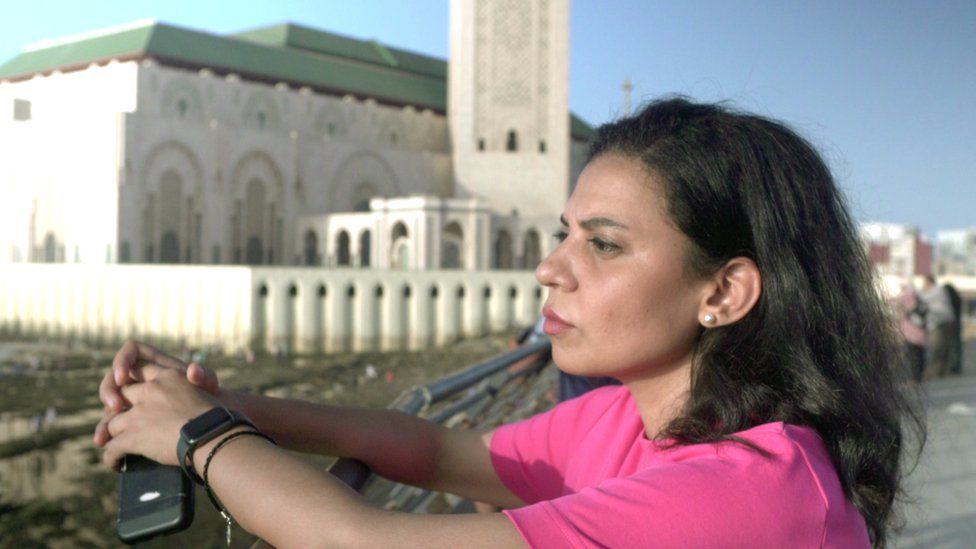
Dalal (not her real name) sought treatment for depression from a spiritual healer in a town near Casablanca a few years ago, when she was in her mid-20s. She says the healer told her the depression was caused by a "jinn lover" who had possessed her.

At a one-to-one session he asked her to smell a scent he said was musk - but which she now believes to have been some kind of drug, because she lost consciousness.

Dalal, who had never had any sexual experience before, says she woke to find her underwear had been removed, and realised she had been raped. She says she began screaming at the raqi (Quranic healer), asking him what he had done to her.

"I said: 'Shame on you! Why did you do this to me?' He said: 'To make the jinn leave your body.'"

She says she didn't tell anyone what happened, as she was so ashamed and was sure she would be blamed. When she discovered a few weeks later that she was pregnant, she was terrified.

She even thought about taking her own life.

When she told the healer about the pregnancy, he replied that the jinn must have impregnated her. Dalal says she was so traumatised by her experience that when her baby was born, she refused to look at her, hold her, or even give her a name, and gave her up for adoption.

She told us that if her family found out what had happened to her, they would kill her.

Many of the women we spoke to said they feared they themselves would be blamed if they reported their abuse, and therefore very few had told their families, let alone the police. Some said they also worried that reporting what had happened might provoke the jinn to take revenge on them.

In Sudan, a woman named Sawsan told us that when her husband left the family home to live with a second wife - as is his right under Sharia (Islamic law) - she found herself destitute, and approached a healer for help. She said she hoped he could give her some kind of medicine for her husband which would make him treat her better.

But she was not expecting his suggested treatment.

"He said he would have sex with me and use the resulting body fluids to concoct a potion I should feed to my husband."

His recommendation suggested he was "fearless", she said.

"He was confident I would not report him to the police or the courts or even my husband."

Image caption,
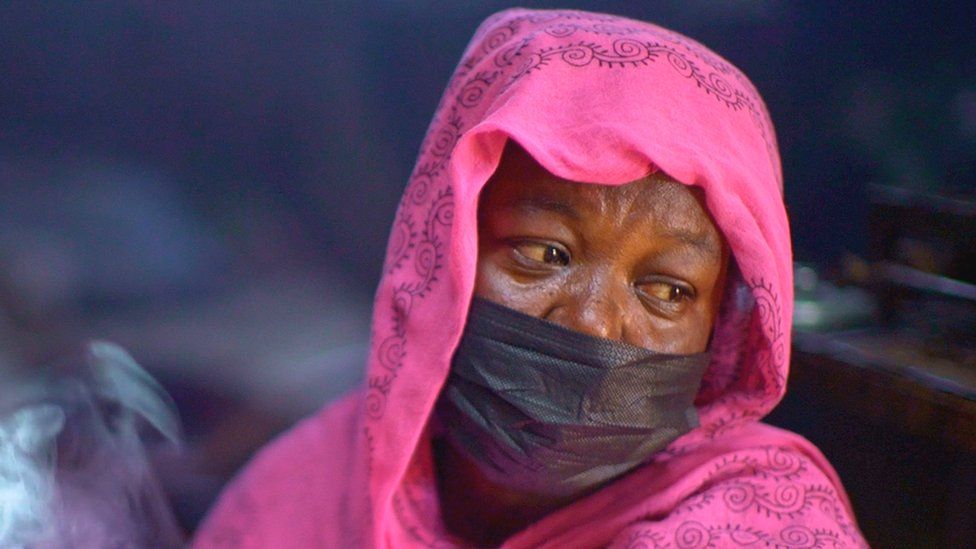
Sawsan, a woman in Sudan, said the healer suggested sex with him would help her reconcile with her husband

Sawsan says she left the session immediately and never returned. She did not report his behaviour.

Three of the 50 women we spoke to in Sudan about exploitation or abuse named the same religious leader - Sheikh Ibrahim. One of the women, who we are not naming, said he manipulated her into having sex with him. Another, Afaf, told us she had to push him off her when he asked to have sex with her. She said she felt powerless.

"People don't accept that sheikhs say and do these things. They don't believe it. How can I find witnesses? No-one saw me in the room with him."

So, an undercover journalist working with our team agreed to visit Sheikh Ibrahim in a bid to collect more evidence.

The reporter, who we are calling Reem, posed as a client suffering from infertility.

Sheikh Ibrahim said he would say a prayer for her, and prepared a bottle of "healing water" - known as "mahayya" - for her to take home and drink.

Reem says he then moved to sit extremely close to her, and put his hand on her stomach. When she asked him to take his hand away, she says, he simply moved it down her body, over her clothes, to her genitals. She ran from the room.

"I was really shaken by him," she told us afterwards. "He had a worrying look about him."

She says she felt that his manner suggested this was not the first time he had behaved in this way.

The BBC questioned Sheikh Ibrahim about what had happened to Reem. He denied that he sexually harassed or assaulted women seeking his help, and abruptly ended our interview.

Image caption,
Sheikh Ibrahim groped the BBC's undercover reporter

One woman who is offering an alternative to those who would like spiritual healing, without the risk of exploitation, is Sheikha Fatima.

Based near Khartoum, she has opened a female-only healing centre. For 30 years, this has been one of the few places where women can experience ruqyah or healing from other women.

We were given unique access to this private space. During our visit, it was intense watching women around me losing all awareness of their surroundings. Sheikha Fatima tells me how women can be vulnerable in this state, which allows other healers to take advantage of them.

"Many women told us that they believed the sheikh is extracting the devil by touching them. They thought it was part of the treatment," she says. "It's shocking what you hear from these women."

We approached political authorities in both Morocco and Sudan with our evidence.

In Sudan, Dr Alaa Abu Zeid, head of the family and society department at the Ministry of Islamic Affairs, was initially reluctant to believe that so many women had reported experiences of abuse to us. But he did admit that the lack of regulation in spiritual healing meant that it was "causing chaos", and that the role was being used as "a profession for those who have no job".

He told the BBC that he had explored its regulation in the past, but that the country's political instability meant it was not currently a priority.

In Morocco, Minister of Islamic Affairs Ahmed Toufiq said he did not believe there was a need for any separate legislation regarding spiritual healers.

"It is hard to intervene legally in these matters. The solution lies in religious education and preaching," he told us.

Despite all the evidence we have gathered, Moroccan and Sudanese authorities are reluctant to take action. So the burden remains on women to speak up against those hiding behind a healing profession.