How the IHRA definition of antisemitism is being used to criminalize Palestine solidarity across Latin America
The IHRA definition of antisemitism is being used in a coordinated offensive across Latin America to criminalize solidarity with Palestine. The targets are not only Palestine activists but also the backbone of Latin America's social movements.
By Blanca Missé
June 3, 2026 2
MONDOWEISS
MONDOWEISS
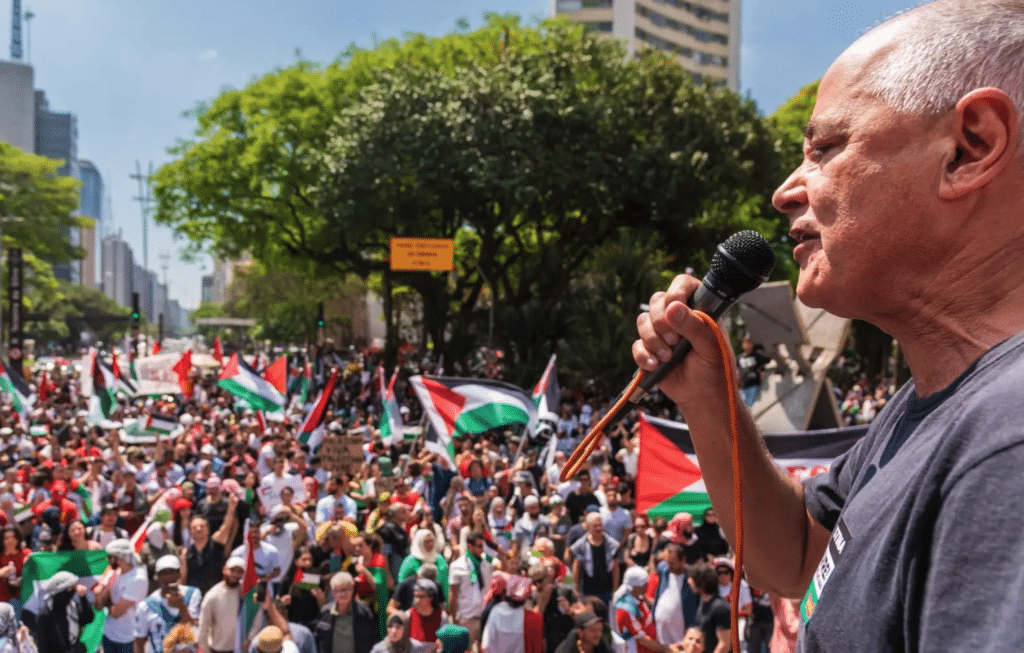
Zé Maria (Image courtesy IWL-FI)
On April 28, 2026, a federal judge in São Paulo sentenced José Maria de Almeida—known as Zé Maria—to two years in open prison. His offense was a speech. The 69-year-old metalworker and lifelong union activist had denounced Israel’s genocide in Gaza and used the slogan “Free Palestine, from the river to the sea.” The lawsuit was filed by CONIB, the Israeli Confederation of Brazil.
Zé Maria is no stranger to prison or persecution. He was arrested in 1977 for handing out May Day leaflets under Brazil’s military dictatorship. He was detained alongside Lula during the historic ABC region strikes of 1980. He is a founder of the Workers’ Party (PT) and a leader on the national board of CUT, Brazil’s largest union federation. Later expelled from the PT for refusing to align with business interests, he helped build CSP-Conlutas, an independent federation representing over 2 million workers. Now, at 69, he faces prison for a slogan.
As he wrote in Folha de S. Paulo: “Saying that the State of Israel must end has nothing to do with preaching against the Jewish people—it’s the same as saying that the apartheid State of South Africa had to end. Accusing those who protest against this atrocity of being racist is the desperate resort left to Zionism.”
Zé Maria is not Brazil’s only target. In October 2024, journalist Breno Altman, founder of Opera Mundi, was convicted of racism and ordered to pay R$20,000 and remove five social media posts. The case was also brought by CONIB. Notably, Altman is Jewish—undermining the claim that opposition to Zionism is inherently antisemitic.
While Altman was fined, Zé Maria was sentenced to two years in an open prison—a significant escalation. The message is clear: the penalties are rising.
Similar cases have been seen in Argentina as well, and many countries in the region have adopted a controversial framework that conflates anti-Zionism with racism: the IHRA definition of antisemitism which is being used to press these cases. However, what is unfolding across Latin America is not a series of isolated legal cases. It is a coordinated offensive to criminalize solidarity with Palestine, using the IHRA definition as the legal backbone. The targets are specific: union leaders, left-wing politicians, journalists — the same actors who have historically been the backbone of Latin American social movements.
On April 28, 2026, a federal judge in São Paulo sentenced José Maria de Almeida—known as Zé Maria—to two years in open prison. His offense was a speech. The 69-year-old metalworker and lifelong union activist had denounced Israel’s genocide in Gaza and used the slogan “Free Palestine, from the river to the sea.” The lawsuit was filed by CONIB, the Israeli Confederation of Brazil.
Zé Maria is no stranger to prison or persecution. He was arrested in 1977 for handing out May Day leaflets under Brazil’s military dictatorship. He was detained alongside Lula during the historic ABC region strikes of 1980. He is a founder of the Workers’ Party (PT) and a leader on the national board of CUT, Brazil’s largest union federation. Later expelled from the PT for refusing to align with business interests, he helped build CSP-Conlutas, an independent federation representing over 2 million workers. Now, at 69, he faces prison for a slogan.
As he wrote in Folha de S. Paulo: “Saying that the State of Israel must end has nothing to do with preaching against the Jewish people—it’s the same as saying that the apartheid State of South Africa had to end. Accusing those who protest against this atrocity of being racist is the desperate resort left to Zionism.”
Zé Maria is not Brazil’s only target. In October 2024, journalist Breno Altman, founder of Opera Mundi, was convicted of racism and ordered to pay R$20,000 and remove five social media posts. The case was also brought by CONIB. Notably, Altman is Jewish—undermining the claim that opposition to Zionism is inherently antisemitic.
While Altman was fined, Zé Maria was sentenced to two years in an open prison—a significant escalation. The message is clear: the penalties are rising.
Similar cases have been seen in Argentina as well, and many countries in the region have adopted a controversial framework that conflates anti-Zionism with racism: the IHRA definition of antisemitism which is being used to press these cases. However, what is unfolding across Latin America is not a series of isolated legal cases. It is a coordinated offensive to criminalize solidarity with Palestine, using the IHRA definition as the legal backbone. The targets are specific: union leaders, left-wing politicians, journalists — the same actors who have historically been the backbone of Latin American social movements.
A legal weapon: The IHRA in Latin America
Zé Maria’s conviction is based on twisting the existing anti-racist Law 7.716//89, which criminalizes hate speech and acts of racism. It is one sign of the IHRA definition of antisemitism’s growing influence in Brazil. Adopted by the International Holocaust Remembrance Alliance in 2016, this definition has since been promoted globally by pro-Israel lobbies and since 2020, at least six Latin American countries have joined the International Holocaust Remembrance Alliance: Argentina, Guatemala, Costa Rica, Colombia, Panama, and Uruguay (as an observer member) under U.S. pressure. Brazil’s federal government withdrew in July 2025, but 12 of 27 states have incorporated it locally into law. Now, Brazil’s Bill 1424/2026 is attempting to codify it into federal law.
Colombia represents an interesting paradox. President Gustavo Petro, who broke diplomatic relations with Israel and called Netanyahu’s government “genocidal,” governs a country that has adopted the IHRA definition—likely under the previous conservative administration. The legal architecture is in place, even if the political will to use it remains unclear. Colombia’s large Palestinian diaspora community remains on alert.
Argentina was the first Latin American country to adopt the IHRA definition in 2020, following years of pressure from the DAIA (Delegation of Argentine Jewish Associations). Since then, the Zionist organization has filed numerous legal complaints against pro-Palestinian activists.
The first major case involved Alejandro Bodart, a left-wing politician from the FIT-U (Workers’ Left Front). In December 2024, Bodart was convicted of violating anti-discrimination law for tweets calling Israel “racist and genocidal” and using the slogan “from the river to the sea.” He received a six-month suspended sentence. In a public statement, he said: “This permanent anti-democratic attitude of seeking to silence every critical voice only strengthens our political conviction that authoritarianism is an intrinsic component of Zionism.”
A broad defense campaign—rooted in Argentina’s combative union currents—successfully argued that the IHRA definition has “no legally binding effect” in Argentina and that criticizing the State of Israel “cannot be prohibited.” Bodart was eventually acquitted on appeal. Yet the machinery of repression kept moving.
On April 17, 2026, police occupied the union headquarters of the State Workers Association (ATE) in Rosario. The trigger: another DAIA complaint against a scheduled event featuring Palestinian political prisoners. The Santa Fe Police arrived without a warrant, deployed riot squads, and shut down the event before a single word was spoken. ATE issued a statement calling the police action “a serious event that violates basic principles of democratic life.”
But Bodart is not alone. The DAIA has also prosecuted Ana Contreras, a teacher in La Pampa, for mentioning Palestine in a public school class, and Federico Puy, an educator disciplined by the Buenos Aires government for expressing solidarity with Palestinian children.
The most serious threat is still to come. In April 2025, federal judge Daniel Rafecas formally indicted Vanina Biasi, a national deputy and Buenos Aires City legislator from the Partido Obrero (also part of the FIT-U), for tweets comparing Israel’s actions in Gaza to Nazism and calling the state “genocidal.” Rafecas explicitly cited the IHRA definition—specifically the “double standard” and “comparison to Nazis” clauses—in his ruling. The Federal Chamber confirmed the indictment in August 2025, and in April 2026, Argentina’s Supreme Court rejected Biasi’s appeal, effectively clearing the way for an oral trial. If convicted, she faces up to three years in prison.
Biasi has refused to be silenced. Her defense team has presented a list of 50 international witnesses, including Israeli historian Ilan Pappé, to challenge the validity of the IHRA definition. In a statement to Página 12, she declared: “This is not a gag on me… I will say much more, and when the oral trial comes, we will launch a campaign for the Palestinian cause that will make them reflect on the purpose of the trial.”
Bodart won his case. But the DAIA has simply moved on to new targets. The Biasi case demonstrates that the legal offensive is not slowing down—it is escalating, with the threat of actual prison time.
Beyond the courtroom, Argentine artist and poet Dani Zelko has built a cultural critique of the IHRA framework. In his 2025 book Oreja madre — described by UC Berkeley as the work of a “Latin American anti-Zionist Jew” — Zelko writes from the intersection of personal tragedy and political clarity. His cousins were killed on October 7, 2023. Yet he has never stopped denouncing Israel’s genocide in Gaza. “The main promoter of antisemitism today is the State of Israel,” he told Clarín. Guided by Mapuche and Wichí elders, Zelko traces an anti-Zionist Judaism rooted not in state power but in solidarity with all colonized peoples — a living refutation of the IHRA definition’s attempt to criminalize such solidarities.
Labor fights back
Unlike Argentina, Brazil’s labor movement has rallied behind Zé Maria. On April 29, 2026, nine national union centrals — including CUT (7 million workers), Força Sindical, and CSP-Conlutas — issued a joint statement condemning the conviction as “a serious attack on freedom of expression.”
The Rio de Janeiro State Union of Education Professionals warned: “If today they seek to silence Zé Maria, tomorrow they may try to silence teachers, students, and workers who rise up against injustices.”
In contrast to Argentina’s more isolated legal battles, Brazil has witnessed a broad and vocal mobilization of intellectuals, artists, and academics in support of Palestine. Figures like sociologist Sabrina Fernandes, rapper Emicida, musicians Chico Buarque and Caetano Veloso, Indigenous intellectual Ailton Krenak, and cartoonist Carlos Latuff have all publicly denounced the genocide in Gaza. Many signed the manifesto “Intelectuais, artistas e acadêmicos brasileiros pelo fim do genocídio” — a collective document with hundreds of signatories. Latuff, internationally known for his pro-Palestine cartoons, has repeatedly defended that accusations of antisemitism are weaponized to discredit criticism of Zionism and the State of Israel. This distinction — antisemitism is a form of racism against Jews, while anti-Zionism is a political position against colonialism and occupation — has become a rallying cry for the movement against the IHRA definition across Latin America.
A hemisphere at a crossroads
International solidarity with Zé Maria and Biasi is building and sorely needed. As Soraya Misleh, Palestinian-Brazilian journalist and BDS Brazil coordinator, wrote: “They won’t silence us! […] We resist, we exist, we will not be erased from the map! They won’t silence us! Until Palestine is free from the river to the sea!”
Zé Maria’s appeal is pending. Bodart’s acquittal proves that the IHRA framework can be challenged in court. But Vanina Biasi’s impending trial, where she faces up to three years in prison, shows that the legal offensive is escalating. And the ATE Rosario police occupation proves that the offensive continues by other means — censorship before a word is spoken. Together, these cases reveal a coordinated strategy that spans borders, targeting anyone who dares to speak for Palestine.
As Zé Maria wrote: “They will not silence us. And Palestine will be free, from the river to the sea.”
The IHRA legal architecture is expanding and the threat is clear. What is needed now is not scattered resistance but the emergence of broad, united fronts — labor unions, student movements, social movements, and intellectuals — capable of rolling back this offensive against Palestine solidarity and all liberation movements before the damage becomes irreversible.
Blanca Missé
Blanca Missé is an Associate Professor of Cinema at San Francisco State University, a member of the San Francisco State University Chapter of the California Faculty Association, and of the Labor for Palestine National Network.
Israel and Latin American Christian Zionists seek to promote Isaac Accords
Ana Maria Monjardino

Javier Milei, Argentina’s president, shakes hands with his “dearest friend,” Israeli prime minister Benjamin Netanyahu. Debbie HillUPI
On 19 April 2026, Argentina’s self-proclaimed “most Zionist president in the world,” Javier Milei, arrived in Jerusalem.
After greeting his “dearest friend” Benjamin Netanyahu, Israel’s prime minister, and affirming his support for the US-Israeli war on Iran, he signed a series of agreements to strengthen ties between Argentina and Israel despite its ongoing genocide in Gaza, where over 75,000 people have been killed since October 2023.
The Isaac Accords, which include a commitment to counter-terrorism and improved cooperation in artificial intelligence, have been in preparation since August 2025 when Milei launched a nonprofit aimed at increasing cooperation in trade, technology and cultural exchange between Israel and various Latin American countries.
Bankrolled by the Genesis Prize, the American Friends of the Isaac Accords (AFOIA) is a registered nonprofit based in New York.
Just two months earlier, Milei became the first non-Jewish recipient of the Genesis prize, dubbed the “Jewish Nobel.”
With an initial focus on Costa Rica, Panama and Uruguay, three countries “primed for enhanced cooperation with Israel,” and proposed interest in Brazil, Colombia, Chile, and potentially El Salvador, “the Isaac Accords are a natural continuation of the Abraham Accords,” according to Stafford Fitzgerald Haney, a former US ambassador to Costa Rica and current head of AFOIA, during an interview with The Jerusalem Post.
“Same spirit, new region, broader impact.”
Biblical narratives
AFOIA has the financial backing of numerous Christian Zionist and Zionist organizations including Passages Israel, formerly the Philos Project, the Israel Allies Foundation and the ILAN Israel Innovation Network, all of which have extensive networks of pro-Israel pastors and politicians working to influence policy and public opinion across the Americas.
The Israel Allies Foundation, which works in collaboration with the Knesset Christian Allies Caucus (KCAC) to promote “faith-based diplomacy” between Israel and “bible-believing Christians” around the world, has caucuses in 14 Latin American countries, including Argentina, Costa Rica, Panama and Uruguay.
The Costa Rican chapter is chaired by Fabricio Alvarado Muñoz, an evangelical Christian and far-right deputy in the country’s legislative assembly who “certainly knows how to manage his rhetoric,” and “avoids calling himself a Zionist,” according to Mónica Ulloa Gómez, a specialist in political-religious participation in Latin America.
“But when one analyzes his speeches piecemeal, one observes the lines of action he maintains as a political Christian and his direct relationship with Zionism,” she told The Electronic Intifada. In Muñoz’ book, Christians in Politics, she added, “references to Jewish identity, prophetic times and the restoration of the kingdom of God are constant throughout the work.”
On 7 October 2025, he gave a speech to Costa Rica’s parliament on the situation in Gaza in which he decried “those who have tried to distort reality by blaming the victim, justifying the aggressor and sowing hatred against the Jewish people for exercising their legitimate right to defend themselves.”
He proceeded to blame left-wing activists and regurgitate false narratives about the use of Palestinian children in Gaza as human shields.
And it’s not just idle rhetoric.
“Conservative evangelical communities have become vehicles for strategic political channeling,” said Nicolás Panotto, an Argentine theologian based in Chile. The Isaac Accords – aimed at strengthening cooperation between “nations of the Judeo-Christian tradition” – is the product of that new framework.
“The Isaac Accords focus on the ‘defense of Western values’ and ‘democracy,’ understood as signifiers that draw a line against the ‘other,’” Panotto told The Electronic Intifada. “In this sense, the fight against drug trafficking in Latin America – as presented by the document – ultimately not only refers to a real problem traversing the region but is also an excuse to persecute critical, left-wing voices.”
This has been clearly demonstrated in the case of Colombian President Gustavo Petro, whom US President Donald Trump has branded a drug manufacturer. It was also evident in the special forces raid that saw Venezuela’s president Nicolás Maduro snatched from his home in January and flown to the US where he is to be prosecuted as a “narco-terrorist.”
With its narrative of “defense of Western values,” the Isaac Accords promote coordinated strategic action on the basis of shared religious ties. In this case that includes Israelis, Argentines and other “like-minded partners in the Western Hemisphere.”
Even the reference to “Isaac” is bound to a manufactured paradigm in which the so-called “conflict” between Israelis and Palestinians represents a perpetual feud between Isaac and Ishmael, Abraham’s sons.
Genocidal diplomacy
Iván Zeta, a founding member of JudiesXPalestina – a Jewish anti-Zionist collective founded in 2021 – in Argentina, said the Isaac Accords were largely a braggadocious effort to “imitate Trump” and “a way for Milei to appear as the head of this new far-right, Zionist regrouping in Latin America.”
“I do not see the Isaac Accords as a complete novelty,” he told The Electronic Intifada. “I see them as a way to make relationships between the states stronger and deeper … Argentina was already completely aligned with Israel,” he said, pointing to the presence in Argentina of Israeli companies such as Mekorot, a state-owned Israeli water company responsible for illegally pillaging natural resources in occupied Palestine.
Similarly, Costa Rica, Panama and Uruguay have all maintained economic ties with Israel since October 2023, despite not being the most outwardly Zionist nations in the region. Honduras, Ecuador and Bolivia have all demonstrated much more fervent support in recent months, from official visits to security cooperation and renewing previously severed ties.
All, according to AFOIA, “stand to benefit significantly from Israeli expertise in water technology, agriculture, cyber defense, fintech, healthcare and energy.”
And the foundations are already in place.
At a recent convention in Montevideo, Uruguay, officials from 15 Latin American nations, including Uruguay, Panama and Costa Rica signed a joint statement in which, despite an alleged focus on combating anti-Semitism, they announced their “resolute solidarity” with Israel and advocated for bilateral ties between Latin American countries and Israel “in every relevant realm, including diplomacy, security, trade, technology, economic development, agriculture and tourism.”
Panama also signed a free trade agreement (FTA) with Israel in 2018 which included reduced export tariffs on goods such as pistols, revolvers and muzzle-loading firearms. The agreement came into effect in 2020 and, by 2021, their bond came under scrutiny when photographs emerged of Panamanian policemen shooting at the image of a keffiyeh-wearing figure during an Israeli-run target training session hosted by the Israeli embassy.
On 8 December 2025, Costa Rica became the latest country to sign an FTA with Israel “after more than two and a half years of negotiations,” setting the scene for increased trade in the fields of cybersecurity and agrotech, among others.
The agreement marks an “historic milestone,” said Manuel Tovar Rivera, Costa Rica’s Minister of Foreign Trade, describing the agreement as a further step on “Costa Rica’s path to consolidate itself as an innovation hub” in Latin America.
“Viva Costa Rica! Am Yisrael Chai,” he enthused.
However “various social sectors believe that the FTA will open the door to bilateral relations beyond the economic sphere, which could negatively impact Costa Rica’s image as a peaceful and democratic country,” Mónica Ulloa Gómez told The Electronic Intifada.
Undivided capital
Another core tenet of Milei’s Zionist fervor is his persistent commitment to relocating the Argentine embassy from Tel Aviv to Jerusalem “as soon as conditions allow.”
The move would align Argentina with nearby Paraguay, Guatemala and Honduras, all of which relocated their embassies following the US move in 2018.
But it’s not just Argentina. Costa Rica, which moved its embassy to Tel Aviv in 2006, recently announced that it would open a trade and innovation office with diplomatic status in Jerusalem.
That would constitute a significant retreat from the 2006 decision by former President Óscar Arias “to correct an historic mistake.”
“Opening a diplomatic office in Jerusalem would be an act of symbolic legitimacy for a fundamentalist, genocidal regime that violates human rights and has been undermining Costa Rican diplomatic activity since the 1940s,” Gómez said.
The Brazilian presidential candidate Flávio Bolsonaro, a fervent Evangelical and son of the disgraced former President Jair Bolsonaro, has also pledged to move Brazil’s embassy to Jerusalem if he is elected in October. He has also promised to sign up Brazil to the Isaac Accords, describing them as an “historic step forward.”
Panama and Uruguay have made no such promises, at least not yet. But with a new wave of right-wing administrations renewing support for Israel, from Honduras to Bolivia, and elections in Brazil and Colombia looming, regional solidarity with Palestine is under critical threat.
Milei, Netanyahu’s chainsaw-wielding comrade, certainly stands stoutly in Israel’s corner.
Ana Maria Monjardino is an independent journalist based in London.
Ana Maria Monjardino
22 May 2026
Javier Milei, Argentina’s president, shakes hands with his “dearest friend,” Israeli prime minister Benjamin Netanyahu. Debbie HillUPI
On 19 April 2026, Argentina’s self-proclaimed “most Zionist president in the world,” Javier Milei, arrived in Jerusalem.
After greeting his “dearest friend” Benjamin Netanyahu, Israel’s prime minister, and affirming his support for the US-Israeli war on Iran, he signed a series of agreements to strengthen ties between Argentina and Israel despite its ongoing genocide in Gaza, where over 75,000 people have been killed since October 2023.
The Isaac Accords, which include a commitment to counter-terrorism and improved cooperation in artificial intelligence, have been in preparation since August 2025 when Milei launched a nonprofit aimed at increasing cooperation in trade, technology and cultural exchange between Israel and various Latin American countries.
Bankrolled by the Genesis Prize, the American Friends of the Isaac Accords (AFOIA) is a registered nonprofit based in New York.
Just two months earlier, Milei became the first non-Jewish recipient of the Genesis prize, dubbed the “Jewish Nobel.”
With an initial focus on Costa Rica, Panama and Uruguay, three countries “primed for enhanced cooperation with Israel,” and proposed interest in Brazil, Colombia, Chile, and potentially El Salvador, “the Isaac Accords are a natural continuation of the Abraham Accords,” according to Stafford Fitzgerald Haney, a former US ambassador to Costa Rica and current head of AFOIA, during an interview with The Jerusalem Post.
“Same spirit, new region, broader impact.”
Biblical narratives
AFOIA has the financial backing of numerous Christian Zionist and Zionist organizations including Passages Israel, formerly the Philos Project, the Israel Allies Foundation and the ILAN Israel Innovation Network, all of which have extensive networks of pro-Israel pastors and politicians working to influence policy and public opinion across the Americas.
The Israel Allies Foundation, which works in collaboration with the Knesset Christian Allies Caucus (KCAC) to promote “faith-based diplomacy” between Israel and “bible-believing Christians” around the world, has caucuses in 14 Latin American countries, including Argentina, Costa Rica, Panama and Uruguay.
The Costa Rican chapter is chaired by Fabricio Alvarado Muñoz, an evangelical Christian and far-right deputy in the country’s legislative assembly who “certainly knows how to manage his rhetoric,” and “avoids calling himself a Zionist,” according to Mónica Ulloa Gómez, a specialist in political-religious participation in Latin America.
“But when one analyzes his speeches piecemeal, one observes the lines of action he maintains as a political Christian and his direct relationship with Zionism,” she told The Electronic Intifada. In Muñoz’ book, Christians in Politics, she added, “references to Jewish identity, prophetic times and the restoration of the kingdom of God are constant throughout the work.”
On 7 October 2025, he gave a speech to Costa Rica’s parliament on the situation in Gaza in which he decried “those who have tried to distort reality by blaming the victim, justifying the aggressor and sowing hatred against the Jewish people for exercising their legitimate right to defend themselves.”
He proceeded to blame left-wing activists and regurgitate false narratives about the use of Palestinian children in Gaza as human shields.
And it’s not just idle rhetoric.
“Conservative evangelical communities have become vehicles for strategic political channeling,” said Nicolás Panotto, an Argentine theologian based in Chile. The Isaac Accords – aimed at strengthening cooperation between “nations of the Judeo-Christian tradition” – is the product of that new framework.
“The Isaac Accords focus on the ‘defense of Western values’ and ‘democracy,’ understood as signifiers that draw a line against the ‘other,’” Panotto told The Electronic Intifada. “In this sense, the fight against drug trafficking in Latin America – as presented by the document – ultimately not only refers to a real problem traversing the region but is also an excuse to persecute critical, left-wing voices.”
This has been clearly demonstrated in the case of Colombian President Gustavo Petro, whom US President Donald Trump has branded a drug manufacturer. It was also evident in the special forces raid that saw Venezuela’s president Nicolás Maduro snatched from his home in January and flown to the US where he is to be prosecuted as a “narco-terrorist.”
With its narrative of “defense of Western values,” the Isaac Accords promote coordinated strategic action on the basis of shared religious ties. In this case that includes Israelis, Argentines and other “like-minded partners in the Western Hemisphere.”
Even the reference to “Isaac” is bound to a manufactured paradigm in which the so-called “conflict” between Israelis and Palestinians represents a perpetual feud between Isaac and Ishmael, Abraham’s sons.
Genocidal diplomacy
Iván Zeta, a founding member of JudiesXPalestina – a Jewish anti-Zionist collective founded in 2021 – in Argentina, said the Isaac Accords were largely a braggadocious effort to “imitate Trump” and “a way for Milei to appear as the head of this new far-right, Zionist regrouping in Latin America.”
“I do not see the Isaac Accords as a complete novelty,” he told The Electronic Intifada. “I see them as a way to make relationships between the states stronger and deeper … Argentina was already completely aligned with Israel,” he said, pointing to the presence in Argentina of Israeli companies such as Mekorot, a state-owned Israeli water company responsible for illegally pillaging natural resources in occupied Palestine.
Similarly, Costa Rica, Panama and Uruguay have all maintained economic ties with Israel since October 2023, despite not being the most outwardly Zionist nations in the region. Honduras, Ecuador and Bolivia have all demonstrated much more fervent support in recent months, from official visits to security cooperation and renewing previously severed ties.
All, according to AFOIA, “stand to benefit significantly from Israeli expertise in water technology, agriculture, cyber defense, fintech, healthcare and energy.”
And the foundations are already in place.
At a recent convention in Montevideo, Uruguay, officials from 15 Latin American nations, including Uruguay, Panama and Costa Rica signed a joint statement in which, despite an alleged focus on combating anti-Semitism, they announced their “resolute solidarity” with Israel and advocated for bilateral ties between Latin American countries and Israel “in every relevant realm, including diplomacy, security, trade, technology, economic development, agriculture and tourism.”
Panama also signed a free trade agreement (FTA) with Israel in 2018 which included reduced export tariffs on goods such as pistols, revolvers and muzzle-loading firearms. The agreement came into effect in 2020 and, by 2021, their bond came under scrutiny when photographs emerged of Panamanian policemen shooting at the image of a keffiyeh-wearing figure during an Israeli-run target training session hosted by the Israeli embassy.
On 8 December 2025, Costa Rica became the latest country to sign an FTA with Israel “after more than two and a half years of negotiations,” setting the scene for increased trade in the fields of cybersecurity and agrotech, among others.
The agreement marks an “historic milestone,” said Manuel Tovar Rivera, Costa Rica’s Minister of Foreign Trade, describing the agreement as a further step on “Costa Rica’s path to consolidate itself as an innovation hub” in Latin America.
“Viva Costa Rica! Am Yisrael Chai,” he enthused.
However “various social sectors believe that the FTA will open the door to bilateral relations beyond the economic sphere, which could negatively impact Costa Rica’s image as a peaceful and democratic country,” Mónica Ulloa Gómez told The Electronic Intifada.
Undivided capital
Another core tenet of Milei’s Zionist fervor is his persistent commitment to relocating the Argentine embassy from Tel Aviv to Jerusalem “as soon as conditions allow.”
The move would align Argentina with nearby Paraguay, Guatemala and Honduras, all of which relocated their embassies following the US move in 2018.
But it’s not just Argentina. Costa Rica, which moved its embassy to Tel Aviv in 2006, recently announced that it would open a trade and innovation office with diplomatic status in Jerusalem.
That would constitute a significant retreat from the 2006 decision by former President Óscar Arias “to correct an historic mistake.”
“Opening a diplomatic office in Jerusalem would be an act of symbolic legitimacy for a fundamentalist, genocidal regime that violates human rights and has been undermining Costa Rican diplomatic activity since the 1940s,” Gómez said.
The Brazilian presidential candidate Flávio Bolsonaro, a fervent Evangelical and son of the disgraced former President Jair Bolsonaro, has also pledged to move Brazil’s embassy to Jerusalem if he is elected in October. He has also promised to sign up Brazil to the Isaac Accords, describing them as an “historic step forward.”
Panama and Uruguay have made no such promises, at least not yet. But with a new wave of right-wing administrations renewing support for Israel, from Honduras to Bolivia, and elections in Brazil and Colombia looming, regional solidarity with Palestine is under critical threat.
Milei, Netanyahu’s chainsaw-wielding comrade, certainly stands stoutly in Israel’s corner.
Ana Maria Monjardino is an independent journalist based in London.

No comments:
Post a Comment