Showing posts sorted by date for query OCALAN. Sort by relevance Show all posts

Saturday, January 03, 2026

The social construction of freedom: A theoretical study on Leader Apo's 
(aka Ocalan) understanding of socialism

Leader Apo's understanding of socialism combines ontological and sociological expansion with the concept of socialism. He considers socialism as a project limited to the seizure of power, but as the revelation of the organizational capacity of society.


SİNAN CÛDÎ
ANF  
NEWS CENTER
Thursday, December 25, 2025

The question of social freedom is one of the most central but also one of the most problematic topics of modern political thought. Within the Marxist tradition in particular, freedom has been largely associated with the transformation of production relations and the abolition of class rule. Although this approach has provided a strong theoretical framework for revealing the structural workings of capitalist exploitation, historical experience has shown that freedom does not emerge spontaneously only through the transformation of economic relations.

The fact that relations of domination can be reproduced in different ways even under conditions where class power changes reveals that the issue of freedom requires a deeper theoretical questioning.

It is clear that social freedom should be considered together with the relationship established with existence and the way society understands itself. In other words, freedom is not a political gain to be obtained later; It is a process shaped within ontological assumptions, social relations and practical forms of action. When human and society are considered as fixed essences, freedom is inevitably limited; On the other hand, approaches that comprehend existence as a relational, processual, and historical becoming expand the material and social conditions of freedom.

In this context, Leader Apo's approach to socialism as socialism should not be read as a rejection of classical dialectical materialism. Rather, we should discuss it as an attempt to update it to transcend the limits it encounters with historical experiences. Leader Apo's treatment of ontology, sociology and socialism as intertwined necessities makes it possible to rethink freedom as a problem of social existence that is not limited to the change of power.

We can formulate our question as follows: Can social freedom be established only through the transformation of production relations, or is the understanding of being and social ontology a constitutive component of this process? Around this question, it will be possible to make visible the theoretical and practical blockages caused by the neglect of the ontological dimension while acknowledging the strengths of the classical Marxist understanding of freedom.

In this direction, this article will first deal with the approach of classical dialectical materialism to the problem of freedom and its limits that emerge in historical practice. Then, the relationship between the issue of ontology and freedom will be discussed; the decisive effect of the way of existence of man and society on political practice will be examined.

In the following sections, the necessity of expanding class-centered analyses will be discussed in a sociological framework and Leader Abdullah Öcalan's understanding of socialism based on socialism will be positioned at the intersection of these theoretical discussions. The study will conclude by discussing how dialectical materialism can be moved to a more historical and inclusive framework by adding ontological and social dimensions.

CLASSICAL DIALECTICAL MATERIALISM AND THE PROBLEM OF FREEDOM

Dialectical materialism constitutes one of the most powerful theoretical frameworks of modern social criticism. With Marx and Engels, history was grasped on the basis of material production relations; The engine of social transformation has been defined as class struggle. This approach has transformed freedom from a moral or legal category into a historical problem linked to the transformation of material conditions. In particular, the structure of the capitalist mode of production based on labor exploitation is of central importance in terms of explaining why freedom is systematically restricted.

In the classical Marxist framework, freedom is considered as a historical outcome that will become possible with the abolition of private property on the means of production and the end of class rule. In this context, the state is defined as the oppressive apparatus of the ruling class and it is assumed that it will wither away with the disappearance of classes. In this scheme, freedom is positioned as a social situation that will emerge after the seizure of political power and the transformation of production relations.

Although this approach seems theoretically consistent, historical experience has revealed certain limits. Socialist experiences in different geographies throughout the twentieth century have shown that although radical transformations have been made in the relations of production, freedom has not been established automatically. Far from disappearing, the state apparatus has become more centralized and more interventionist in most cases; domination over social life has been reproduced in different ways. This suggests that freedom cannot be reduced to the transformation of economic infrastructure alone.

At this point, dialectical materialism's understanding of freedom faces two fundamental problems. First, freedom becomes a goal that is often postponed to the future. Existing authoritarian practices are justified as temporary imperatives, and freedom is relegated to a post-revolutionary stage.

Secondly, the human subject is largely defined by its class position; daily life practices, cultural relations, gender regimes and the functioning of power at the micro level are seen as secondary areas. This makes it difficult to grasp how domination permeates the entire social fabric.

The point to be emphasized here is that these limits are not necessary consequences of Marx's theory. The understanding of praxis, which came to the fore in Marx's early texts, is that human beings are not only the product of material conditions; while transforming these conditions, it also reveals that it transforms itself. However, in most of the Marxist tradition, this ontological dimension has taken a back seat to the emphasis on historical determination. Dialectics is often confined to the field of production; freedom has not been considered as a problem that covers the whole of social existence.

Therefore, the dilemma of classical dialectical materialism in the problem of freedom does not stem from its neglect of the material basis, but from its narrow definition of the material. Production relations continue to be decisive; However, the issue of freedom is incomplete if it is not adequately explained how these relations are reproduced through human beings' understanding of existence, social ties and daily practices. This determination makes it necessary to expand dialectical materialism with ontological and social dimensions.

THE ISSUE OF ONTOLOGY: THE RELATIONSHIP BETWEEN THE CONCEPTION OF EXISTENCE AND FREEDOM

The fact that the question of freedom is addressed only on the political or economic level is one of the main limitations of modern social theory. Classical dialectical materialism offers a strong historical analysis by centering on the relations of production; however, it often leaves the deeper connections that humans form with the world in the background. At this point, ontology, that is, the question of being, stands out as a decisive field in terms of understanding the ground on which freedom becomes possible.

Ontology asks the question of how man exists in the world. Man is not just a being who produces, provides labor power or is defined by his class position. At the same time, it has an existence that establishes meaning, develops relationships, and interprets itself and its environment. In this respect, ontology is not just external structures; It shows that human beings reproduce these structures by internalizing them. Without changing the understanding of existence, it becomes difficult for the claim of social freedom to become permanent.

Heidegger's main criticisms of modern philosophy are illustrative here. According to him, modern thought reduces existence to an object; It is based on what can be measured, calculated and audited. This approach compresses man's relationship with the world to a technical and instrumental level. Existence ceases to be a lived and shared process; it turns into a managed and regulated space. Such an understanding of existence makes domination ordinary rather than an exceptional situation.

This ontological contraction is not unique to capitalism. A similar problem is observed in state-centered socialist experiences. Even if the means of production have been nationalized, human existence is still defined through central planning, representation and discipline mechanisms. Freedom turns into a goal regulated from above rather than a constantly produced relationship in social practice. This creates a new area of tension between emancipation and power.

At this point, Leader Apo's approach pulls ontology to the center of political theory. According to him, the problem is not only property relations or class contradictions; How people comprehend themselves and society is a more important problem. When existence is considered as a set of relations in a state of continuous becoming, freedom ceases to be a static state and becomes a practice that is established, disrupted and reconstructed in daily life. In this perspective, freedom undergoes a transformation from a promise postponed to the future to being a responsibility of the present.

This ontological framework also establishes a distant relationship with identitarian or nationalist modes of existence. Fixed identities, unchanging essences and singular historical narratives treat "existence" as a frozen structure. However, an ontologically relational understanding of existence requires people to define themselves through the bonds they establish with others. This makes it possible to think of freedom not as an individual or collective property, but as a process that is constantly re-established within common life.

From this point of view, there is no hierarchical relationship between ontology, sociology and socialism.

Ontology provides the ground for sociological analysis.

Sociology reveals the social equivalent of ontological assumptions.

Socialism, on the other hand, offers a practical orientation that aims to transform these two in the direction of freedom.

When the ontological dimension is neglected, socialism is inevitably reduced to an administrative model.

Leader Apo's intervention is precisely against this reduction.

THE ISSUE OF SOCIOLOGY: THE BOUNDARIES OF CLASS AND PLURAL FORMS OF SOCIAL DOMINATION

Classical Marxist sociology analyzes society basically through the relations between classes. The bond established with the means of production determines the social position of the individual; politics, law, culture and ideology are shaped on this material ground. This approach is extremely powerful in exposing the structural inequalities of capitalist society. However, it has been insufficient to explain all forms of social domination over time.

Although it has lost its homogeneous character, class and class analysis are indispensable for understanding the functioning of modern capitalism. However, when considered on a historical and anthropological level, it does not offer an explanation that covers the whole of society. It is known that hierarchies, gender-based inequalities, religious and cultural forms of domination also exist in pre-state or semi-state societies. This situation shows that domination does not start only with class relations; suggests that it is associated with older, deeper forms of social organization.

Leader Apo's sociological intervention gains meaning at this point.

According to Leader Apo, class is an important form of social domination; however, it is not its first and founding form. The rupture that society experienced with state civilization is not only an economic transformation. It is also a mental, cultural and organizational rupture. Male domination, hierarchical authority, representation relations and centralism were shaped before classification and deepened with classification.

This approach makes sociology not a narrow field of economic analysis. Society is considered both as a result of production relations and as a living structure established through values, norms, habits and daily practices. Domination cannot be observed only in the factory or in property relations; because it is reproduced in the family, language, education and political representation. This makes it insufficient to treat the struggle for freedom only as a class conflict.

In the Marxist tradition, this gap has been tried to be filled in different ways. Gramsci's concept of hegemony, Althusser's analysis of ideological apparatuses, and later cultural Marxist approaches have taken important steps towards overcoming class reductionism. However, these contributions have often been limited to questioning the central state and party model. Social transformation is also designed as a top-down organized process.

Leader Apo's sociological framework, on the other hand, re-centers society. Society is not a passive mass; it is a subject with the capacity for self-organization. Communes, assemblies and local organizations are therefore not only administrative units. They are also constitutive areas of social emancipation. Here, sociology is not content with analyzing the relations between classes; it turns into a field of knowledge that reveals the self-management potential of society.

At this point, the class is not completely rejected; however, it ceases to be the only decisive axis. Class struggle, gender struggle, ecological struggle and the search for cultural freedom are considered as intertwined processes. This approach accepts the fact that social domination is not unicentric and carries the struggle for freedom to a plural ground.

As a result, this sociological expansion does not contradict the basic intuitions of Marxism, but deepens them historically and socially. Class analysis is preserved; but it is repositioned within the holistic structure of society. Here, Leader Apo's contribution is that sociology is not only an explanatory discipline, but a part of the practice of freedom.

SOCIALISM AS SOCIALISM: THE SOCIAL CONSTRUCTION OF FREEDOM

In classical socialist theory, socialism is defined by the socialization of the means of production and the abolition of class rule. In this context, socialism refers to a historical stage that will emerge after the overcoming of capitalism. The state plays a central role in this transition process. Planning, distribution and coordination of production are carried out through the state apparatus. The emancipation of society is largely attributed to the success of this central transformation.

Although this approach has produced a strong alternative to the destructive effects of capitalism, it has also produced its own limits over time. Socialism began to be perceived as an economic and administrative model rather than a living re-establishment of social relations. Society has ceased to be a subject and has turned into an object that is decided on its behalf. This situation has led to the consideration of freedom as an administrative issue, not a social one.

Leader Apo's understanding of socialism creates a significant break at this point. According to him, socialism is primarily the revelation of society's capacity for self-organization and decision-making. For this reason, socialism is conceived as a social way of life, not as a form of state or only as an economic system. The concept of socialism becomes decisive here. Socialism is considered as the practice of re-establishing society.

In this perspective, freedom does not emerge automatically with the withdrawal of central power. Freedom is embodied in communes, assemblies and forms of organization of daily life. Economy, politics and culture cannot acquire an emancipatory function without the direct participation of society. Collectivism is not a collectivism that ignores the individual, but a form of relationality in which the individual is strengthened within social ties.

Leader Apo's understanding of socialism does not make his state-centered criticism of socialism based only on historical experiences; it also puts it on an ontological and sociological basis. When human beings are considered as an essentially relational being, freedom is also built in relationships. Therefore, freedom cannot be distributed from a single center. If forms of social organization do not produce freedom, the transformation in property relations alone is not enough.

This understanding of socialism does not invalidate the class struggle; but it makes it part of a wider field of social struggle. Labor-capital contradiction, gender inequality, ecological destruction and cultural domination are considered as different manifestations of the same social crisis. Socialism claims to produce responses to each of these crises at the social level.

As a result, socialism in Leader Apo is not a goal limited to the seizure of power. Socialism is the process of rebuilding society itself. This process requires constant practice and action. Socialism does not consider freedom as a final stop; as a lived experience. In this respect, Leader Apo's socialism offers a perspective of social emancipation that transcends the state and power-centered horizon of the classical left.

UPDATING DIALECTICAL MATERIALISM: PROCESS, RELATIONALITY AND SUBJECT

Dialectical materialism is a powerful way of thinking that grasps historical change through contradictions. This is known. The interaction between material conditions and social consciousness constitutes the basic assumption of this approach. However, this framework is often limited to the production area. Dialectics is identified with the laws of motion of the economic infrastructure. This narrowing is not the fault of dialectics; it stems from a certain historical interpretation of it.

Leader Apo's intervention forces dialectics to think again in the center of process and relationality. Social change cannot be experienced only by resolving the antagonisms between classes. It also takes place through the transformation of human relationships with themselves, with the community and with nature. In this approach, dialectics ceases to be a historical scheme that progresses in closed stages and becomes a continuous becoming.

In classical dialectical materialism, the subject is often considered as the bearer of historical imperatives. The class is the dominant actor on the stage of history. This makes sense in highlighting the importance of collective action; however, it deals with individual and social subjectivation processes in a limited framework. Leader Apo's approach, on the other hand, does not define the subject only with its class position. The subject is conceived as an existence that is established and transformed in practice.

This update does not make material reality secondary; on the contrary, it expands the scope of the material. Economic relations of production are an important dimension of social life; however, it is not the only dimension. Language, culture, gender relations, ecological ties and forms of political participation are also considered as part of material reality. Thus, dialectics is not limited to the labor-capital contradiction; becomes able to analyze the complete contradictions of social existence.

At this point, updating dialectical materialism does not mean bringing it closer to idealism. On the contrary, it aims to go beyond idealistic abstractions and comprehend the concrete multi-layered structure of social life. The material is not limited to the measurable. Social relations, habits and common life practices also have a material reality. This acceptance increases the social depth of the dialectic.

In Leader Apo's approach, dialectics ceases to be a strategy focused on the seizure of power and becomes a method to understand the capacity of society to constantly reproduce itself. Contradiction is not an obstacle that needs to be broken down; it is a dynamic that contains the possibility of transformation. This makes it possible to think of the idea of revolution as a long-term process of social construction rather than a singular moment of rupture.

As a result, this update does not invalidate dialectical materialism, but reworks it in line with historical experience and theoretical needs. Leader Apo's contribution is to transform dialectics from a state, party and class-centered framework into a society and life-centered way of thinking. This transformation makes freedom a social practice of today, rather than a postponed goal.

CONCLUSION AND DISCUSSION: THE CONSTITUTIVE RELATIONSHIP BETWEEN ONTOLOGY, SOCIETY AND FREEDOM

The basic claim is that social freedom cannot be established only by the transformation of production relations. It is clearly emphasized that liberation will not become permanent without changing the understanding of human beings' existence, social ties and forms of subjectivity. This framework aimed to make visible the areas that classical leftist thought could not open historically, without rejecting its founding intuitions.

Classical dialectical materialism is still a powerful theoretical tool to explain capitalist exploitation and class inequalities. However, the fact that it treats freedom as a goal that is often postponed to the future has created a structural distance between it and social practice. State-centered socialist experiences have shown that this distance produces historical as well as theoretical results. The transformation in the relations of production has progressed with new forms of domination when social relations are not transformed.

At this point, the ontological dimension is placed at the center of the study. Human beings are not only in economic relations in the world; it exists in meaning, relationship and practice. Existence is not a fixed state; It is a process that develops in a state of continuous becoming. This understanding does not consider freedom as a completed goal. It makes it possible to understand freedom as a form of relationship that is constantly reproduced in social life. In this sense, ontology ceases to be an abstract field of political theory and becomes one of the material grounds of freedom.

The discussion on the sociological plane also reveals that social domination cannot be reduced to a single axis while maintaining the indispensability of class analysis. Male domination, cultural hierarchies, centralism and representation relations are historical phenomena intertwined with class structures. The emancipation of society requires confronting each of these forms of domination. This makes sociology a constitutive component of the practice of emancipation as well as an explanatory tool.

Leader Apo's understanding of socialism combines this ontological and sociological expansion around the concept of socialism. Socialism is considered as a project limited to the seizure of power and as the revelation of the self-organization capacity of society. Communes, assemblies and local organizations are defined as areas where freedom is produced rather than being instrumental administrative structures. In this context, society ceases to be a passive object and becomes the main subject of liberation.

This approach inevitably brings with it some criticisms. The most common objection is that the class struggle has been pushed into the background. However, what is done here is not to exclude class, but to remove it from being the only explanatory axis. The labor-capital contradiction remains at the heart of modern capitalism; however, social domination cannot be understood in its entirety without taking into account the hierarchies and forms of power that emerged historically before classification.

Another criticism is the claim that this approach means a break with Marxism. It can be argued that the emphasis on ontology and society approaches idealism. However, the material reality is not abandoned here, and the scope of the material is expanded. Social relations, daily practices, forms of organization and common living spaces are also part of the material world. This approach aims to make the repressed ontological vein of Marxism visible again.

Criticisms about the issue of state and power are also important. The emphasis on socialism can be questioned on the grounds that it obscures the problem of central power. However, this criticism reduces power only to the state apparatus. However, in modern societies, power is spread to all of daily life. The seizure of the state does not automatically eliminate these scattered networks of power. Socialism does not hide power; rather, it makes it visible at the local and plural levels.

The treatment of society as the subject of liberation can also be criticized as romanticizing society. Inequalities, reactionary tendencies and conflicts within society may seem to be ignored in this gaze. However, society is not idealized here; on the contrary, it is treated as a field of struggle. Freedom cannot develop through the suppression of tensions; on the contrary, it becomes possible by experiencing these tensions openly.

Lastly, the practical applicability of this approach is questionable. Especially in conditions of crisis, war and authoritarianism, the sustainability of society-centered models can be discussed. However, this objection reflects the limits of the existing political order, not the theory. Historical experience shows that social self-organization can emerge even in the most difficult conditions. As a matter of fact, the Rojava practice shows exactly this.

As a result, when ontology, sociology and socialism are taken together, freedom ceases to be an abstract ideal or a deferred promise and turns into a lived social practice. Leader Apo's contribution gains meaning in the effort to re-establish this unity and offers a serious theoretical update for contemporary leftist thought.

Tuesday, December 30, 2025

Jailed Turkish Kurd leader Ocalan calls on govt to broker deal for Syrian Kurds

Jailed Turkish Kurd leader Abdullah Ocalan on Tuesday implored the Turkish government to broker a "crucial" peace deal between the Kurdish-led Syrian Democratic Forces and the Damascus government


Issued on: 30/12/2025 
By: FRANCE 24

Youngsters hold a photograph of Abdullah Ocalan, the jailed leader of the militant Kurdish group PKK, in Diyarbakir, Turkey on February 27, 2025. © Metin Yoksu, AP

Jailed Turkish Kurd leader Abdullah Ocalan said in a message published Tuesday that it was "crucial" for the Turkish government to broker a peace deal between the Kurdish-led Syrian Democratic Forces (SDF) and the Damascus government.

"It is essential for Turkey to play a role of facilitator, constructively and aimed at dialogue ... This is crucial for both regional peace and to strengthen its own internal peace," Ocalan, founder of the Kurdistan Workers' Party (PKK) militant group, said in a message relayed by Turkey's pro-Kurdish DEM party.

Earlier this year, the Kurdistan Workers' Party (PKK) ended its four-decade armed struggle against Turkey at the urging of its jailed founder Abdullah Ocalan, shifting its focus to a democratic political struggle for the rights of Turkey's Kurdish minority.

The ongoing process has raised hopes among Kurds across the region, notably in Syria where the Kurds control swathes of territory in the north and northeast.

Turkey has long been hostile to the Kurdish SDF force that controls swathes of northeastern Syria, seeing it as an extension of PKK, and pushing for the US-backed force to integrate into the Syrian military and security apparatus.

(FRANCE 24 with AFP)


Jailed Turkish Kurd Leader Calls on Government to Broker Deal for Syrian Kurds


(FILES) Supporters display a poster depicting jailed leader of the Kurdistan Workers' Party (PKK) Abdullah Ocalan, after he called on the Kurdistan Workers' Party (PKK) to disarm and dissolve itself in Diyarbakir, southeastern Türkiye, on February 27, 2025. (Photo by Yasin AKGUL / AFP)


Asharq Al Awsat
30 December 2025
 AD ـ 10 Rajab 1447 AH

Jailed Turkish Kurd leader Abdullah Ocalan said Tuesday that it was "crucial" for Türkiye’s government to broker a peace deal between the Kurdish-led Syrian Democratic Forces (SDF) and the Damascus government.

Clashes between Syrian forces and the SDF have cast doubt over a deal to integrate the group's fighters into the army, which was due to take effect by the end of the year, reported AFP.

Ocalan, founder of the Kurdistan Workers' Party (PKK) group, called on Türkiye to help ensure implementation of the deal announced in March between the SDF and the Syrian government.

"It is essential for Türkiye to play a role of facilitator, constructively and aimed at dialogue," he said in a message released by Türkiye's pro-Kurdish DEM party.

"This is crucial for both regional peace and to strengthen its own internal peace," Ocalan, who has been jailed for 26 years, added.

"The fundamental demand made in the agreement signed on March 10 between the SDF and the government in Damascus is for a democratic political model permitting (Syria's) peoples to govern together," he added.

"This approach also includes the principle of democratic integration, negotiable with the central authorities. The implementation of the March 10 agreement will facilitate and accelerate that process."

The backbone of the US-backed SDF is the YPG, a Kurdish group seen by Türkiye as an extension of the PKK.

Türkiye and Syria both face long-running unrest in their Kurdish-majority regions, which span their shared border.

In Türkiye, the PKK agreed this year at Ocalan's urging to end its four-decade armed struggle.

In Syria, Sharaa has agreed to merge the Kurds' semi-autonomous administration into the central government, but deadly clashes and a series of differences have held up implementation of the deal.

The SDF is calling for a decentralized government, which Sharaa rejects.

Turkish Foreign Minister Hakan Fidan, whose country sees Kurdish fighters across the border as a threat, urged the SDF last week not to be an "obstacle" to stability.

Syrian Kurdish leader Mazloum Abdi said Thursday that "all efforts" were being made to prevent the collapse of talks.

Öcalan urges SDF to abide by integration deal with Damascus


Imprisoned PKK leader Abdullah Öcalan on Dec. 30 called on the Syrian Democratic Forces (SDF) to honor an integration agreement with the country's new administration.


Haberin Devamı
ANKARA
www.hurriyetdailynews.com/

"The fundamental demand made in the agreement signed on March 10 between the SDF and the government in Damascus is for a democratic political model permitting [Syria's] peoples to govern together," Öcalan said in a message released by the Peoples’ Equality and Democracy Party (DEM Party).

Disputes over local autonomy and recent military skirmishes have cast doubt on whether the deal will take effect by its year-end deadline.

The jailed PKK leader called on Türkiye to help ensure the implementation of the deal.

"It is essential for Türkiye to play a role of facilitator, constructively and aimed at dialogue," he said. "This is crucial for both regional peace and to strengthen its own internal peace."

The appeal come amid an ongoing anti-terrorism campaign in Türkiye, where PKK agreed earlier this year to end its 40-year armed struggle at Öcalan’s urging. A Turkish parliamentary commission is currently working on the "terror-free Türkiye" initiative to codify the peace process.

The backbone of the U.S.-backed SDF is YPG, which Ankara views as a direct extension of PKK. "The implementation of the March 10 agreement will facilitate and accelerate the process," Öcalan said.

Last week, Turkish Foreign Minister Hakan Fidan warned the SDF not to become an "obstacle" to Syria's stability. For his part, SDF leader Mazloum Abdi said "all efforts" were being made to prevent the collapse of talks.

PKK

Historical Blockages of the Left and the Radical Rupture of Öcalan

Source: Originally published by Z. Feel free to share widely.

​To understand the historical blockage of the Left, one must first expose its internal contradictions. The Left claims to criticize the state but fails to interrogate the state’s ontology. It asserts a rejection of power, yet fails to realize that its own visions of authority reproduce the same hierarchical patterns.

​While the Left emphasizes its opposition to exploitation, it remains reluctant to grasp that exploitation operates not only through economic means but through cultural, gender-based, ethnic, spatial, and even affective dimensions. In this respect, the crisis of the Left is not merely a crisis of strategy; it is a crisis of ontology, a crisis of being, of the subject, of knowledge, and most crucially, a crisis of meaning.

​At this juncture, the thought of Kurdish People’s Leader Abdullah Öcalan is either ignored or categorically rejected by modern leftist theories. The reason for this is not merely a matter of political positioning. The true reason is that this body of thought has shattered the conceptual ground upon which the Left feels comfortable.

​The Left has become a movement that produces thousands of pages of theoretical texts but remains incapable of producing its own self-criticism. Öcalan’s approach carries an inherent power of critique against the Left’s historical dogmas; it touches the Left at its weakest point: the loss of its capacity for self-explanation.

​The Left’s current inability to explain the world does not stem from the disintegration of capitalism, but rather from the fact that capitalism has reconstructed the entire social fabric in its own image. Capitalism is no longer a system to be criticized from the outside; it is an ontological framework lived from within.

​It is a fundamental regime of existence that shapes human imagination, desires, fears, modes of relation, memories, perceptions of time, and ties to space. The Left continues to attempt to analyze this regime using categories from the era in which Marx wrote; however, capitalism has long since expanded beyond Marx’s conceptual universe.

​Consequently, the narratives the Left develops about itself no longer possess definitive or explanatory power. As the Left attempts to grasp social reality, it finds itself facing a world that slips through its fingers like water. 

This is because today’s social struggle is not merely about the control of the means of production; it is about the reconstruction of the network of relationships that produce life itself. And the factor that most blinds this field is the Left’s historical and subconscious attachment to the idea of the state.

​The state is the structure that the Left overtly criticizes but subconsciously sanctifies. Throughout history, nearly all revolutionary movements have claimed to view the state merely as a tool, yet as they approached power, they could not avoid internalizing the state’s ontological logic.

​This is because the state is not a neutral organization of power; it is an apparatus that captures social energy, institutionalizes hierarchy, and subordinates the subjectivity of society to its own existence. Here lies the deepest impasse of the Left: the belief that one can transform power without first deciphering its ontology.

​The most incisive impact of Öcalan’s thought within the Left stems from his treatment of the state not merely as an apparatus of oppression, but as the foundational axis of the historical system of civilization. In his definition, the state is not an accidental institution of the modern age; it is the crystallized form of the historical evolution of male-dominated civilization, hierarchical societies, and property relations.

​This radically breaks the Left’s understanding of the state. For the Left, the state is often viewed as a “mismanaged tool,” a “power that is dangerous in the wrong hands,” or a “temporary apparatus of coercion.” Conversely, Öcalan’s perspective posits that the state is the primary cause of the failure to achieve liberation, rather than its instrument. This is a theoretical upheaval that the Left finds difficult to accept.

​Precisely for this reason, the idea of “stateless democracy” emerges within the Left as a proposition that is both radical and unsettling. The Left’s century-old strategic vision has ultimately been anchored to the seizure of the state.

​To suggest that the passion for seizing the state is futile or that it even paralyzes the struggle for freedom is to target the foundational narrative of the Left. The Left’s defensive reflex against this proposition points to a fear it has failed to resolve within itself: the inability to conceive of a revolution without power.

​However, freedom cannot be established by reproducing the mechanics of power. Every form of centralism, even when emerging with the most revolutionary intentions, eventually turns into a machine that extinguishes social creativity and subjectivity. Therefore, criticizing the state is insufficient. 

The state must be removed as a category of “solution.” The Left’s inability to accept this idea is not just a theoretical resistance but a psychological one. The Left has built its historical legitimacy through a struggle aimed at the state.

​The reason Öcalan’s thought creates such friction within the Left is his assertion that a politics beyond the state is possible. 

This politics centers not on seizing power, but on its dispersal. Not on centralization, but on social self-governance. Not on representation, but on direct social participation. Not on hierarchy, but on horizontal organization. When moving outside the paradigm familiar to the Left, politics ceases to be a struggle for power and becomes the process of society creating itself.

​In this context, the centralization of women’s liberation is not just a promise of social transformation; it is a shift in the ontological ground of political theory. 

Women’s liberation signifies the destruction of the historical continuity of patriarchy, and without dismantling patriarchy, the dismantling of the state and capitalism is impossible. This is the rupture that reveals the male-dominant structure hidden within leftist theory. The discomfort the Left feels in the face of this critique demonstrates that patriarchy remains the deepest subconscious of the Left.

​Placing women’s liberation at the heart of the revolution means redefining revolution itself. This implies a change in the subject of the revolution, its objective, its method, and its epistemology.

​The reason the Left cannot internalize this transformation is that it has always viewed revolution as a power dynamic, a struggle for dominance, and a moment of violence. Yet, when freedom is situated outside of violence, moved beyond power, and transcends the state, revolution attains its true meaning.

​This perspective mandates that the Left transcend the boundaries of its own historical universe. The Left can no longer exist solely by criticizing capitalism. Capitalism has become a system that feeds on critique; it absorbs every criticism directed at it and reproduces itself through them. Therefore, critique alone is not revolutionary. What is radical is to move beyond critique and construct an alternative ontology.

​Öcalan’s thought is a radical rupture for this very reason: it does not settle for critique; it proposes a new social ontology, a new sociology of freedom, a new vision of democracy, a new understanding of the subject, and a new political practice. The conventional conceptual universe of the Left is insufficient to meet any of these proposals. The Left will either accept this paradigm shift and reconstruct itself, or it will continue to exist as a nostalgic movement on the margins of history.


The books he wrote are technically submissions to various courts, in Turkish called savunmalar, 'the defences', but are also a discussion of the Kurdish issue.

The future is democratic confederalism. Page 45. 45. Writings by Abdullah ocalan ... the Kurdish Question (Summary), Cologne, 2011, PDF http://www.freedom ...

“Freedom for Abdullah Öcalan – Peace in Kurdistan”. P.O. Box 100511. 50445 Cologne. Germany www.freedom-for-ocalan.com www.freeocalan.org www.ocalan-books.com ...

chures on specific themes that are important in his writings. ... www.ocalan-books.com www.democraticmodernity.com. Page 40. “Ecology stands for ...

... books sent to Abdullah. Öcalan during his captivity. A complete list of books available to Öcalan can be found at www.ocalan-books.com. 4. Page 7. Manifesto ...

In his prison writings, the liberation of women is touched on numerous times as part of Öcalan's discussions of history, contemporary society and political ...

PDF Icon. download. Download Free PDF. Download Free PDF. PRISON WRITINGS THE ROOTS OF CIVILISATION ABDULLAH OCALAN. Profile image of serhat masis serhat masis.


Monday, December 01, 2025


Free leader Ocalan or peace process will grind to halt, PKK warns Turkey

Free leader Ocalan or peace process will grind to halt, PKK warns Turkey
Ocalan seen on a flag at a Kurdish left gathering in Paris. / UCL Photos,Partout, France, Belgique, cc-by-sa 2.0
By bne IntelliNews November 30, 2025

A senior commander of the Kurdistan Workers’ Party (PKK) has told AFP that the politico-militant group will not implement any further steps in indirect talks on a peace process with Turkey as long as its founder Abdullah Ocalan remains imprisoned, France 24 reported on November 30.

The commander, Amed Malazgirt, was interviewed in a bunker in the Qandil mountains in northern Iraq, where the PKK is headquartered. He urged Turkey to advance negotiations and free 76-year-old Ocalan, known to followers as Apo,

Malazgirt was reported as saying: "All the steps the leader Apo has initiated have been implemented... there will be no further actions taken.

"From now on, we will be waiting for the Turkish state and they have to be the one taking steps."

The commander of the insurgent PKK – which fought an almost continuous four-decade conflict with Turkey prior to May’s formal declaration that the fighting is over and a pledge from the PKK to disband and disarm – added that the PKK wants Ankara to agree to two demands.

"First, the freedom of leader Apo... without this, the process will not succeed. The second is the constitutional and official recognition of the Kurdish people in Turkey," he said.

Female senior commander Serda Mazlum Gabar told AFP that "as long as the leadership is inside [prison], the Kurdish people cannot be free. Nor can we, as guerrillas, feel free."

"Our path to freedom passes through the freedom of our leadership," she added.

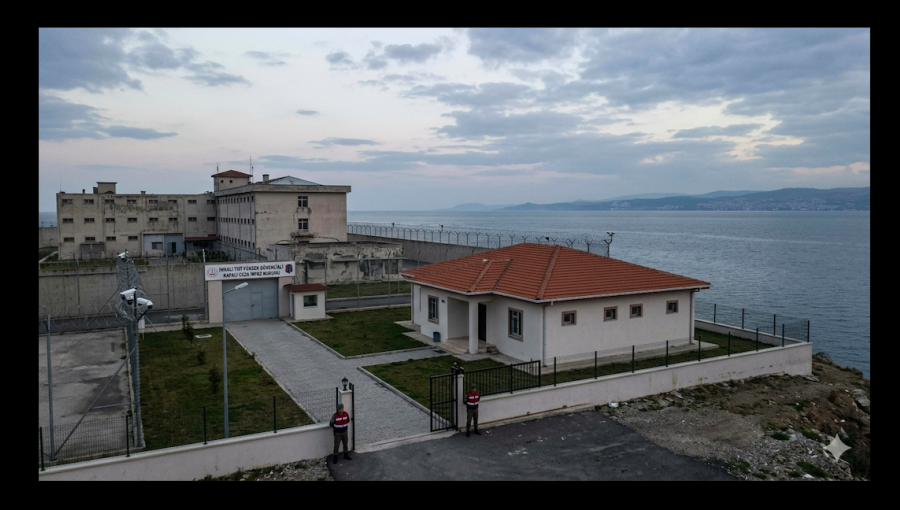
Ocalan is imprisoned on Imrali island near Istanbul, where he has been held in solitary confinement since 1999.

Turkish lawmakers from a cross-party committee set up to advance the peace process with the Kurds paid a first visit to Ocalan last week.

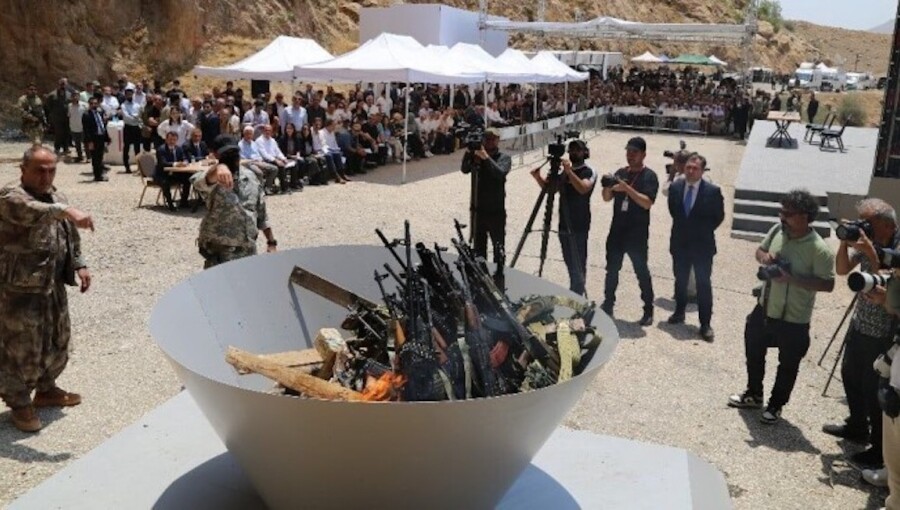
Though the PKK six months ago pledged to disarm, it has so far only burnt a handful of weapons in a cauldron in a symbolic ceremony to demonstrate commitment to the peace process.

Lately, it announced it was withdrawing all of its forces from Turkish soil into northern Iraq and confirmed the withdrawal of militia from a key border area in northern Iraq.

The parliamentary party that represents the Kurds in Turkey is left-wing DEM. If Turkish President Recep Tayyip Erdogan can form a successful partnership with DEM and, de facto, with the still outlawed PKK, he could secure votes that could be decisive in an attempt to change the constitutional law in a way that would permit him unending rule.

In northeastern Syria, the Kurds still run what amounts to their own statelet, despite heavy pressure from Ankara and Damascus to move forward with an integration into the post-Assad Syrian government led by the former jihadist commander Ahmed al-Sharaa.

In July, the US Ambassador to Ankara and Donald Trump’s special envoy for Syria, Tom Barrack, told Turkey’s government-run news service Anadolu Agency  “The US government has stated that it will review all their [the PKK commanders’] issues and do its best to ensure a fair and accurate decision. If they want to come to America and live with us, they can do so.”