Tuesday, March 17, 2020

LOBSTER FINDS A KARDASHIAN IN LA

You can see a lot of odd things in the Los Angeles area, but a lobster walking around the streets? That's a new one.
Image result for LOBSTER BLACK AND RED
On Monday afternoon, Kim Kardashian posted a video to her Twitter that seemed to show a live lobster in the middle of the road.

Just confused how a lobster is walking on my street in Calabasas! What is happening?!?!?! pic.twitter.com/h5cy1IzTPI— Kim Kardashian West (@KimKardashian) March 16, 2020

For the record, lobster fishing isn't exactly a booming industry in California, as it's more of an east coast thing. Many of Kim's followers claimed the sea creature was a crawfish, not a lobster.

Nonetheless, shortly after Kim's land encounter, a Twitter account under the handle @CalabasasLobster suddenly appeared and quickly amassed thousands of followers.

Wtf I think I just passed Kim K’s house— Calabasas Lobster (@calabasalobster) March 16, 2020

"Wtf I think I just passed Kim K's house," the "lobster" wrote on Twitter. It later added that it would "bite Kanye" if it got a thousand likes.

The handle, which now has nearly 3,000 followers, even began responding to Kim's fans, some of whom questioned its lobster-hood.

"Y'all are quick to assume my species. Maybe I look like a 'crawfish', but I am a proud LOBSTER," it wrote.

In a direct response to Kim, the lobster noted that the reality TV star shouldn't be confused by its presence in Calabasas, but rather the other way around.

"Confused as to why you're walking on MY street," @CalabasasLobster replied to Kim, later adding, "I have the right to be here just as much as you, Kim."

I have the right to be here just as much as you, Kim.— Calabasas Lobster (@calabasalobster) March 16, 2020   


Mysterious Ice Age structure made from hundreds of mammoth bones discovered in Russia

By Ashley Strickland, CNN (NOT THE SIBERIAN TIMES)


The majority of the bones found at the site investigated, in the Russian Plains, are from mammoths. A total of 51 lower jaws and 64 individual mammoth skulls were used to construct the walls of the 30ft by 30ft structure and scattered across its interior.
4 SLIDES © Alex Pryor

The majority of the bones found at the site investigated, in the Russian Plains, are from mammoths. A total of 51 lower jaws and 64 individual mammoth skulls were used to construct the walls of the 30ft by 30ft structure and scattered across its interior.

Around 25,000 years ago, hunter-gatherers used the bones from 60 mammoths to build a large circular structure in Russia.

And no one knows why.

Researchers have excavated the site in an attempt to understand it, but they don't know why the structure was built, according to a new study.

This isn't the first "mammoth house" to be found in Russia, but it is the oldest and largest, measuring 41 feet across.

In the 1960s and '70s, researchers found similar, smaller buildings at the site, which they dubbed Kostenki 11. It's 310 miles south of Moscow and now home to a museum, the State Archaeological Museum-Reserve Kostenki.

In 2014, researchers found evidence of this structure at the site and began excavation in 2015, which took three years. A study detailing their findings published this week in the journal Antiquity.


These mammoth bone structures, dating to the Ice Age, have been found across Eastern Europe. But until now, the oldest ones found were dated to 22,000 years ago.

Based on previous discoveries, researchers believe they were constructed by Palaeolithic people to serve as houses, providing refuge during harsh winters. Ice Age winters likely had lows reaching negative four degrees Fahrenheit.

And constructing something this massive out of hundreds of mammoth bones would have taken time. It's surprising, considering that populations of hunter-gatherers never spent much time in one location.

"Mammoth bones are very heavy, and building the circular structure represents a huge investment of time and energy by the humans that built this," said Alexander Pryor, lead study author and Palaeolithic archaeologist at the University of Exeter.

The bones formed a continuous circle, with no obvious entrance, according to the study. So far, the researchers have identified 51 mammoth mandibles and 64 skulls, the researchers said.

Inside the circle, the researchers also found the first evidence that wood was burned inside it. But overall, there are no signs of long-term habitation inside the structure.

The researchers believe that it didn't act as a wintertime refuge, which has them rethinking the purpose of these massive, time-consuming structures.

"It clearly meant something to them, and there was very likely a ritual element to it, even if the structure ultimately had some sort of practical purpose too," Pryor said.
Investigating a mammoth house

As the first "mammoth house" found in more than 40 years at Kostenki, the researchers took advantage of new techniques to investigate the site that weren't available for the structures previously found nearby.

This included flotation, something fairly new when the other structures were excavated. Archaeologists use flotation to separate material from soil, using water and sieves. This allows for the discovery of tiny fragments, which can provide the minute details of a larger story.

Flotation helped the archaeologists find evidence of a possible food source for the hunter-gatherers at the site -- besides the mammoths.

"We found pieces of soft plant tissue typically found in edible roots or tubers, hinting at a plant food component in peoples' diet," Pryor said. "These finds are important because they illustrate how our human ancestors adapted to survive the harsh environments of the last Ice Age by making use of the resources they found around them."

It was also flotation that revealed the tiny bits of charred wood, the first evidence that humans burned wood fires in the mammoth structure. And it suggests that wood was still a resource used by hunter-gatherers during the Ice Age.

Other areas in Northern Europe showed signs of abandonment at the time, and suggest that trees were a rare and precious resource. This may hint at why Kostenki was chosen.

"This demonstrates that trees were still present in the landscape, despite the harsh climatic conditions of the time," Pryor said.

The discovery also inspires more questions for the researchers because they believed hunter-gatherers built these structures out of mammoth bones because wood was unavailable. This makes the choice of mammoth bones deliberate. But why?

"It's not yet clear whether the bones are from mammoths recently hunted and killed by humans or if they were scavenged from carcases of animals that died of natural causes," Pryor said.

The researchers plan to investigate the site further, in hopes of determining the purpose of the structure.

"Kostenki 11 also seems too large to be a dwelling," Pryor said. "It is difficult to imagine how an area this large could be roofed over using materials available in this environment."

One suggestion by the researchers is that the site's purpose was food storage, which helped them survive the Ice Age and its devastating winters.
Image result for Ethics: Origin and Development
Ethics: Origin and Development 
Pëtr Kropotkin
PDF
https://lib.anarhija.net/library/petr-kropotkin-ethics-origin-and-development.pdf

Contents

Translators’ Preface . . . . . . . . . . . . . . . . . . . . . . . . . . . . . 3
Introduction by the Russian Editor . . . . . . . . . . . . . . . . . . . . . 4
Chapter 1: The Present Need of Determining the Bases of Morality 10
Chapter 2: The Gradually Evolving Bases of the New Ethics 23
Chapter 3: The Moral Principle in Nature (17th and l8th Centuries) (continued) 33
Chapter 4: Moral Conceptions of Primitive Peoples 54
Chapter 5: Development of Moral Teachings — Ancient Greece 70
Chapter 6: Christianity — The Middle Ages — The Renaissance 91
Chapter 7: Development of Moral Teachings in the Modern Era (17th and
18th Centuries) 114
Chapter 8: Development of Moral Teachings in the Modern Era (17th and
l8th Centuries) (continued) 136
Chapter 9: Development of Moral Teachings in the Modern Era (End of
18th century and beginning of 19th century) 161
Chapter 10: Development of Moral Teachings — XIX Century 174
Chapter 11: Development of Moral Teachings — XIX Century (continued) 195
Chapter 12: Development of Moral Teachings — XIX Century (continued) 215
Chapter 13: Development of Moral Teachings — XIX Century (concluded) 240
Chapter 14: Conclusion 248
Restore soil to absorb billions of tonnes of carbon: study

AFP

Restoring and protecting the world's soil could absorb more than five billion tonnes of carbon dioxide each year -- roughly what the US emits annually -- new research showed Monday.
© Raul ARBOLEDA Last year the United Nations' Intergovernmental Panel on Climate Change said that the world needed to work harder to retain the land's ability to absorb and store planet-warming greenhouse gases

Last year the United Nations' Intergovernmental Panel on Climate Change said that the world needed to work harder to retain the land's ability to absorb and store planet-warming greenhouse gases and prevent it turning from a carbon sink to a source.


Just the first metre of soil around the world contains as much carbon as is currently in the atmosphere, locking up the CO2 sequestered in trees as they decompose and return to the earth.

A new paper in the journal Nature Sustainability analysed the potential for carbon sequestration in soils and found it could, if properly managed, contribute a quarter of absorbtion on land.

The total potential for land-based sequestration is 23.8 gigatonnes of CO2-equivalent, so soil could in theory absorb 5.5 billion tonnes annually.

Most of this potential, around 40 percent, can be achieved simply by leaving existing soil alone -- that is, not continuing to expand agriculture and plantation growth across the globe.

"Most of the ongoing destruction of these ecosystems is about expanding the footprint of agriculture, so slowing or halting that expansion is an important strategy," said Deborah Bossio, principal study author and lead soil scientist for The Nature Conservancy.

She said that soil restoration would have significant co-benefits for humanity, including improved water quality, food production and crop resilience.

"There are few trade-offs where we build soil carbon and continue to produce food," she told AFP.

The IPCC said in August that humanity was facing tough choices between how land -- Earth's forests, wetlands, savannah and fields -- is used to provide food and material and how it is used to mitigate climate change.

There is simply not enough space to feed 10 billion people by 2050 and limit catastrophic climate change, its 1,000-page study warned.

Agriculture already contributes as much as a third of all greenhouse gas emissions and vast amounts of food are wasted, driving global inequality.

Bossio said governments needed to ensure that agricultural practices seek to provide us with more than just food.

"Shift the incentive structures in agriculture towards payments for the range of ecosystem services, food, climate, water and biodiversity that agriculture can provide to society," she said.


READ

Fields, Factories, and Workshops - Wikipedia
en.wikipedia.org › wiki › Fields,_Factories,_and_Workshops

Fields, Factories, and Workshops is an 1899 book by anarchist Peter Kropotkin that discusses the decentralization of industries, possibilities of agriculture, and uses of small industries. Before this book on economics, Kropotkin had been known for his anarchist militarism and Siberian geography.
Pages‎: ‎315
Publisher‎: ‎Houghton, Mifflin & Co.
Publication date‎: ‎1899

Bibliography · ‎Further reading

 Fields, Factories and Workshops Tomorrow - Center for a ...
c4ss.org › wp-content › uploads › 2014/08 › FactoriesPDF
by P Kropotkin - ‎Cited by 221 - ‎Related articlesFields, Factories and Workshops Tomorrow by Pyotr Kropotkin. Contents. 1. Introduction to the C4SS Edition by Kevin A. Carson. 5. 2. Introduction by Colin Ward.

Ice loss in Antarctica and Greenland increased sixfold in the last 30 years


Brandon Specktor, Live Science


Antarctica and Greenland are losing ice six times faster than in the 1990s, a pair of studies in the journal Nature show.
© Murat Tellioglu Image: Iceberg

According to the international team of climatologists behind the research, the unprecedented rate of melt has already contributed 0.7 inches (1.78 centimeters) to global sea level rise in the last three decades, putting the planet on track for the worst-case climate warming scenario laid out in the Intergovernmental Panel on Climate Change's (IPCC) latest report.


The dreaded scenario, which predicts a total sea level rise of 23.6 inches (60 cm) by the year 2100, would put hundreds of millions of people living in coastal communities at risk of losing their homes — or their lives — to flooding.

"Every centimeter of sea level rise leads to coastal flooding and coastal erosion, disrupting people's lives around the planet," study author Andrew Shepherd, a professor of Earth Observation at the University of Leeds in England, said in a statement. "If Antarctica and Greenland continue to track the worst-case climate warming scenario, they will cause an extra 6.7 inches (17 cm) of sea level rise by the end of the century."

"This would mean 400 million people are at risk of annual coastal flooding by 2100," Shepherd added.

For the new studies, a team of 89 scientists assessed ice loss data from 11 satellites that have been monitoring Antarctica and Greenland since the early 1990s. The data created a detailed picture of how much mass each region's glaciers have lost over the last 30 years, and showed how quickly the remaining ice is flowing into the sea.

The team found that Greenland and Antarctica have lost a combined 7 trillion tons of ice (6.4 trillion metric tons) from 1992 to 2017. Almost all of the lost ice in Antarctica and about half of the lost ice in Greenland is due to warming ocean waters melting the edges of glaciers, causing each region's ice sheets to flow more quickly toward the sea. The rest of Greenland's ice loss is due to warming air temperatures, which melt the ice sheets at their surfaces, the researchers said.

The rate of ice loss in each ice sheet also increased substantially over that period, rising from a combined 89 billion tons (81 billion metric tons) per year in the 1990s to 523 billion tons (475 billion metric tons) per year in the 2010s.

This sixfold increase in the rate of ice loss means that the melting polar ice sheets are responsible for a third of all sea level rise, the researchers said. (Thermal expansion, which causes water to take up more space as it warms, is responsible for much of the remaining sea level rise.)

The accelerated ice loss puts the planet well on the way toward the IPCC's worst-case scenario.

Current oil prices will be around for a while: 
Sadad Al-Husseini

Sadad Al-Husseini of Husseini Energy joins “Squawk on the Street”
 via phone to discuss the oil markets. TUE, MAR 17 2020


Oil below $30 a barrel a disaster for shale producers: API CEO

Mike Sommers, American Petroleum Institute CEO, calls in to 'Power Lunch' to discuss what oil falling below $30/barrel means for the industry in the U.S.
‘No blank check’ for airlines seeking more than $50 billion in coronavirus aid, Democrats warn

PUBLISHED TUE, MAR 17 2020


KEY POINTS

U.S. airlines are seeking more than $50 billion in government aid as business collapses during the coronavirus outbreak.

Some lawmakers and labor unions say airlines have to protect workers and consumers in return.

The four biggest U.S. carriers — Delta, American, Southwest and United — have collectively spent about $39 billion over the last five years buying back shares, according to a tally from S&P Dow Jones Indices.

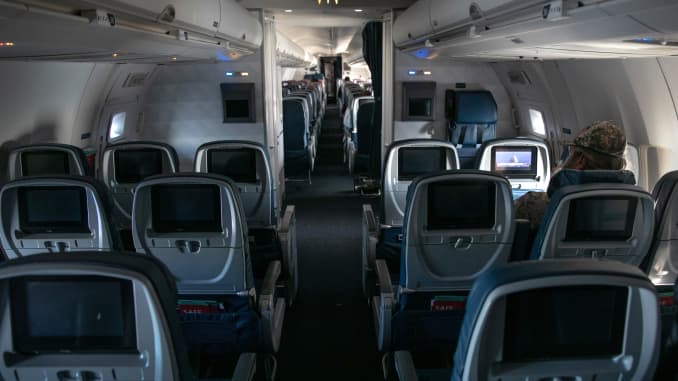
A Delta flight from Seattle-Tacoma International Airport flies
 nearly empty to JFK on March 15, 2020 near New York City.
John Moore | Getty Images

The more than $50 billion in government aid U.S. airlines are seeking as the coronavirus ravages their businesses must include worker and consumer protections, Democratic lawmakers and labor unions said Tuesday. They criticized airlines for spending years of windfall profits buying back their own stock.

“No blank check industry bailouts,” tweeted Sen. Richard Blumenthal, D-Conn.

Airlines are reeling from what executives have called an unprecedented collapse in travel demand as COVID-19 spreads, prompting millions of Americans to stay at home. More than 5,000 cases of coronavirus have been detected so far in the United States, according to Johns Hopkins University.

Treasury Secretary Steven Mnuchin on Tuesday said he is discussing with lawmakers a sprawling aid package that will include assistance for U.S. airlines.

As a result of the virus, airlines are culling thousands of flights, parking airplanes, deferring orders and asking workers to take unpaid leave in a bid to preserve cash. U.S. airlines employ close to 750,000 people, according to federal data.

Airlines’ requested aid includes $25 billion in direct grants — five times more than what they received following the Sept. 11, 2001, attacks — and it is crucial for the carriers, according to their lobbying group, Airlines for America, which represents American, Delta, United, Southwest and others.

Congress has begun negotiations around a third emergency funding bill to address the pandemic. The bill is expected to include some form of industry aid, as well as protections for individuals and companies battling the virus.

Labor unions and some Democratic lawmakers say that while the carriers didn’t cause the dire situation they’re now in, aid should come with some conditions.


“We have told Congress that any funds for the aviation industry must come with strict rules,” said Sara Nelson, president of the Association of Flight Attendants, which represents some 50,000 cabin crews at United, Alaska, Spirit and others. “That includes requiring employers across aviation to maintain pay and benefits for every worker. No taxpayer money for CEO bonuses, stock buybacks or dividends. No breaking contracts through bankruptcy.”

Rep. Jan Schakowsky, D-Ill., on Monday her support of the framework laid out by Nelson.

The four biggest U.S. carriers — Delta, American, Southwest and United — have collectively spent about $39 billion over the last five years buying back shares, according to a tally from S&P Dow Jones Indices. Those carriers’ shares are now trading at multiyear lows. Boeing, which is also seeking government aid, spent more than $35 billion in that period.

“If there is so much as a DIME of corporate bailout money in the next relief package, it should include a reinstated ban on stock buybacks,” tweeted Rep. Alexandria Ocasio-Cortez, a New York Democrat.


“We fully recognize that the company had the opportunity to build up its cash reserves and repeatedly advocated for them to do so,” wrote Todd Insler, chairman of the union that represents United’s pilots, the Air Line Pilots Association. “In spite of ALPA’s warnings, they instead chose to spend company resources differently.

“In the future, there will be a time for a reckoning, blame, and restitution — I assure you of that. For now, we need management to focus on the enterprise, and we need to work together to survive,” he said.


Larry Willis, president of the Transportation Trades Department, an umbrella group of 33 unions in the sector, notes that workers were hit with layoffs after the 9/11 bailouts and that it took years for the sector to recover.

“Lawmakers must ensure bailout and stimulus funds flow to working families, and collective bargaining rights need to be preserved and respected,” he said. “Front-line workers, including those in the aviation sector, need to know they are supported by policies that will put their families first and position our country to flourish once this crisis passes.”

Lawmakers are also seeking that airlines protect workers and consumers. Airlines have increased fees to change tickets and for check bags, and also added new ones such as seat selection for standard legroom, drawing ire from some lawmakers.

Sen. Edward Senator Markey, a Massachusetts Democrat, said that “any infusion of money to the airlines must have some major strings attached,” which include protections for front-line airline employees like flight attendants, pilots and airport workers. It must also come with new rules to “prohibit consumer abuses like unfair change and cancellation fees,” which can run $200 or more.


Congress should ensure workers and businesses receive relief on a “broad and equitable basis,” said Sen. Tom Udall, a New Mexico Democrat. “While the travel and tourism industries are important to New Mexico, economic relief should be focused on keeping workers and their families in their homes with enough support for their daily needs. Any economic relief should be contingent on the benefits flowing to workers and their families, not CEOs and shareholders.”


Other travel companies are also talking with White House officials, including Vice President Mike Pence, about the drop in bookings. The U.S. Travel Association, whose members include giants like Hilton, Hyatt, Marriott and retailers like Macy’s, are meeting with White House officials about the financial damage from the coraonvirus crisis. They estimate a loss of $1.4 billion in revenue every week and that 1 million hotel jobs have been eliminated or will be because of the drop in bookings.

Correction: Sen. Tom Udall is a New Mexico Democrat. An earlier version misidentified his state.
MEDICARE FOR ALL WILL BE $1 TRILLION PER YEAR FOR TEN YEARS
FREE POST SECONDARY EDUCATION AND LOAN FORGIVENESS              WILL BE ABOUT $1 TRILION DOLLARS
CONSERVATIVES GO NUTS OVER THESE SANDERS PROPOSALS
SAME  CONS THAT APPROVED THIS NO QUESTIONS ASKED 
The White House is seeking a stimulus package worth anywhere from $850 billion to more than $1 trillion as the Trump administration looks to battle the economic impact from the coronavirus pandemic, according to a source familiar with the matter.

An administration official said the package could include:

  • $500 billion to $550 billion in direct payments or tax cuts
  • $200 billion to $300 billion in small business assistance 
  • $50 billion to $100 billion in airline and industry relief

Potentially $250 billion of the package could go toward making direct payments to Americans, 

Treasury Secretary Steven Mnuchin said earlier Tuesday that the administration wants to get emergency funds in Americans’ pockets “immediately.


The coronavirus outbreak is a ‘different kind of crisis,’ says Nobel laureate Joseph Stiglitz


PUBLISHED TUE, MAR 17 2020 Huileng Tan@HUILENG_TAN

KEY POINTS


On Sunday, the Fed slashed interest rates to near-zero and announced a $750 billion asset-purchasing program to shelter the economy from the impact of the virus.


“This is a different kind of crisis than normal crises. It’s just not a problem of aggregate demand,” said Joseph Stiglitz, former chief economist at the World Bank.


The spread of the coronavirus disease, formally known as COVID-19, has disrupted the global economy and supply chains as countries implement strict border controls, massive city-wide lockdowns and quarantines in order to contain the virus.


Aggressive policy action by the Federal Reserve is “obviously not” enough to help the U.S. avert a downturn caused by the coronavirus outbreak, said Joseph Stiglitz, a Nobel laureate in economics.

“Given the nature of the uncertainties, given the nature of the collapsing incomes of so many people, it can help stabilize financial markets at best and it’s clear that it didn’t do that,” Stiglitz told CNBC on Tuesday.

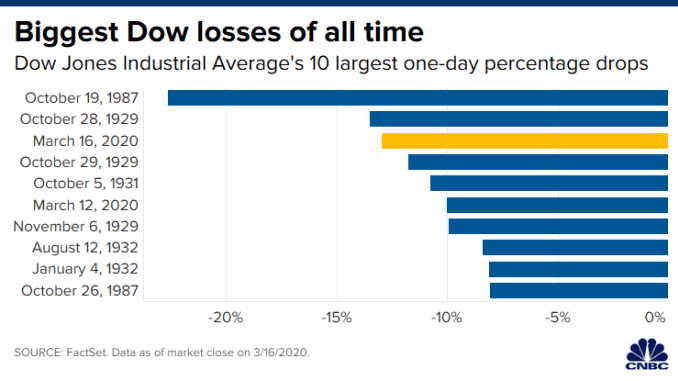
On Sunday, the Fed slashed interest rates to near-zero and announced a $750 billion asset-purchasing program to shelter the economy from the impact of the virus. Despite that, the markets crashed Monday — with the Dow suffering its worst day since the “Black Monday” market crash in 1987 and its third-worst day ever.


While the situation might have been worse without the Fed’s moves, “clearly it didn’t stabilize the stock markets,” said Stiglitz, who is a former chief economist at the World Bank.

The problem is that “this is a different kind of crisis than normal crises. It’s just not a problem of aggregate demand,” he said.

“Because of the disease, people are shutting down their businesses. In the United States, restaurants in New York City have been closed,” said Stiglitz. “More demand is not going to save that particular problem.”

The spread of the coronavirus disease, formally known as COVID-19, has disrupted the global economy and supply chains as countries implement strict border controls, massive city-wide lockdowns and quarantines in order to contain the virus.

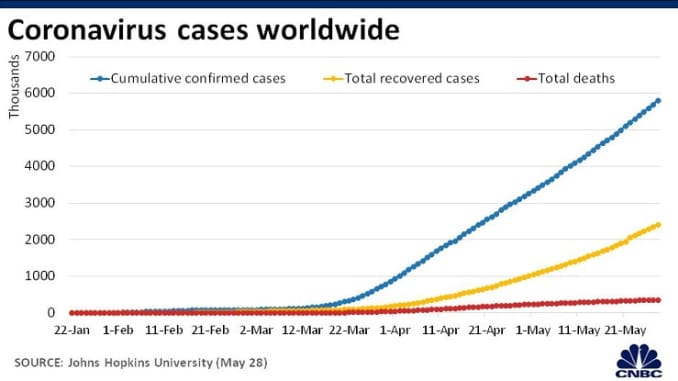
There are now at least 168,019 cases of the coronavirus worldwide, according to data from the World Health Organization. At least 6,610 have died from the disease.
Even though financial institutions have assured that their positions are strong amid the market rout, Stiglitz said no bank would be spared from the impact of a major economic downturn even if it is adequately capitalized.

“People wouldn’t be able to repay their loans, people wouldn’t be taking out new loans, businesses wouldn’t be taking out new loans. The business model of banks is very sensitive to the business cycle,” he said.
Give help to targeted segments

Stiglitz advocated for targeted assistance to help people and sectors weather the public health emergency.

“It is clearly a case where targeted fiscal policy is what is needed. It’s been true for a long while that monetary policies has had only have limited efficacy,” said the Columbia University professor, who is also chief economist at the Roosevelt Institute.

The support should focus on those who will be “facing enormous stress,” strengthening the capacity of the healthcare system and encouraging people to not interact, as well as get tested and not show up at work if they are sick, said Stiglitz.

“We are going to need to get large amounts of money — you might call it ‘helicopter money’ — to those people who are going to be under enormous stress,” he said, citing the example of Hong Kong, which announced a 10,000 Hong Kong dollar ($1,287) cash payout to all permanent residents above 18 years old.

In fact, large government spending in today’s pressing circumstances while paying no attention to deficit “is correct,” he said.

“The deficit is something that we will have to deal with in the future. When we went to World War II, we didn’t ask ‘could we afford it,’” said Stiglitz. “We spent the money as we needed it.”

“We had to make sure that we weren’t overspending in the sense that we had inflation. We had to manage the economy.”

Trump had ‘no idea’ about the seriousness of coronavirus crisis: Stiglitz
WATCH NOW VIDEO 2:55

Public health emergency declared in Alberta

'The situation is very serious': COVID-19 pandemic prompts Alberta to declare a state of public health emergency

Matthew Black CTV News Edmonton March 17, 2020 


EDMONTON -- Alberta Premier Jason Kenney declared a public state of health emergency on Tuesday in an effort to combat the growing spread of COVID-19.

"The situation is very serious," said Kenney. "Decisive action is needed and we are taking that action."

"We have to take more aggressive measures to contain the virus, more aggressive social distancing measures."

Kenney also announced a number of new measures on social distancing as recommended by provincial health authorities, including a ban on any organized gatherings of more than 50 people.

Albertans are now prohibited from visiting a number of venues including: public recreation centres, casinos, bingo halls, bars, nightclubs, fitness centres, arenas, museums, and indoor children's play centres.

Sit-down restaurants, pubs, delis and coffee shops are now limited to a maximum of 50 people or 50 per cent of their maximum capacity, whichever is lower.

"Drive-thru, take-out and delivery will still be permitted," Kenney said adding the province has changed regulations allowing restaurants to engage in off-sales of liquor.

Conferences, weddings and funerals are not exempt from the declaration and should be cancelled, said Kenney.

He said the new restrictions go into effect immediately.

"I recognize these measures will have a profound impact on the lives of Albertans. But they are frankly necessary in the face of this growing pandemic."

Venues deemed to be essential services including grocery stores, airports, homeless shelters, soup kitchens and the Alberta legislature building will remain open.

The government also announced $60 million in funding to be sent to social agencies and another $30 million devoted to supporting seniors.

Kenney announced more government spending measures to deal with the economic implications of the pandemic will be announced tomorrow.

"This is a serious moment in our history," said Kenney. "This province is resilient and we are ready for the test."

Kenney said the availability of trained personnel remains a concern for health authorities as the pandemic continues.

He said the province may bring back recently retired medical professionals or cancel vacation for existing staff to boost the province's health care capacity.

WHAT DOES A PUBLIC HEALTH EMERGENCY MEAN?

The declaration comes under the province's Public Health Act which typically permits a 30-day period for the state of emergency, which can be extended to 90 days.

Kenney said the declaration is limited to health care powers, where section 52 of the act allows a 60-day state of emergency to "prompt co-ordination of action or special regulation of persons or property is required in order to protect the public health."

The Emergency Management Act also allows the government to take central control of a crisis by enacting a number of emergency powers over a 28-day period, including:
Putting into operation an emergency plan or program.

Authorize or require local authorities to put into effect their own emergency plans.
Acquire or use any property necessary to prevent or alleviate the effects of the emergency.
Control or prohibit travel to or from any area of Alberta.

Procure or fix prices for food, clothing, fuel, equipment, or other essential supplies.
Order the evacuation of persons and property from any area affected by a disaster.

Kenney said his government is not enacting all aspects of the act's powers, instead using the declaration to aid health care administration. He said the other powers could be used in the future if needed.

The legislation permits for a 90-day period if the order is "in respect of a pandemic influenza."

In 2016, the province declared a provincial state of emergency in response to the Fort McMurray fires. The state of emergency came into effect on May 4, 2016 and lasted for 58 days, until July 1, 2016.

Earlier Tuesday, Ontario Premier Doug Ford declared a state of emergency in his province, including a ban on public events of over 50 people including parades, events and services within places of worship until March 31.


'This is a serious moment in our history': Alberta Premier Jason Kenney declares public health emergency

Bars, casinos to shut immediately while restaurants, coffee shops to get seating limits

CBC News · Posted: Mar 17, 2020

The decision to put the province under a state of public emergency is part of Alberta's effort in a bid to slow the rising number of coronavirus infections. 3:02Alberta Premier Jason Kenney has declared a state of public health emergency as the province works to contain the COVID-19 pandemic.

"This declaration is meant to empower authorities under the Public Health Act to effectively manage the COVID response," Kenney said.

"Decisive action is needed and we are taking that action."

Kenney made the announcement Tuesday at the Alberta legislature.

Alberta's Provincial Operations Centre has been elevated from a level 3 to a level 4, the highest level, Kenney said.

he funding will go to adult homeless shelters, women's emergency shelters and the Family and Community Support Services (FCSS) program, which supports municipalities and civil society organizations in providing services to vulnerable Albertans.

Bars, nightclubs and casinos will close immediately.

Seating in restaurants and coffee shops will be limited to a maximum of 50 people or 50-per-cent capacity, whichever is lower, he said.
Take-out, delivery and drive-through service is permitted.

Licensed facilities will also be permitted to deliver liquor, in part to help them sell off inventory.

"We apologize to operators of these establishments for the suddenness of this, although I think they've seen it coming," Kenney said.

Mass gatherings are now limited to no more than 50 attendees. This includes worship gatherings and family events such as weddings, the province said in a news release.

Kenney said funerals with more than 50 people should also be cancelled.

Grocery stores, shopping centres, health-care facilities, airports, the legislature and other essential services are not included. Soup kitchens and homeless shelters will also not be affected by the order.

Albertans are prohibited from attending public recreational facilities and private entertainment facilities, including gyms, swimming pools, arenas, science centres, museums, art galleries, community centres, children's play centres, casinos, racing entertainment centres, and bingo halls.

Not-for-profit community kitchens, soup kitchens and religious kitchens are exempt, but sanitization practices are expected to be in place and support will be in place for this practice

The decision to put the province under a state of public health emergency is part of Alberta's effort to try to slow the rising number of coronavirus infections.

"This is a serious moment in our history and COVID-19 will test us," Kenney said. "We will do whatever it takes to slow the spread of this virus."
$60 million in emergency funding

Municipalities, charitable and non-profit organizations providing social services support will immediately get $60 million to help their COVID-19 response, the government news release said.
The money will be dispersed before March 31, Kenney said. He said he has appointed Jeremy Nixon, former executive director of The Mustard Seed, as parliamentary secretary for civil society.

Nixon will work with charities and non-profits to ensure they are helping to reach out to seniors and other vulnerable people who are in isolation.

Half of the $60 million will be dedicated to immediate support to women's shelters and homeless shelters.

The other $30 million will extend support services to seniors and other communities who are isolated because of the pandemic or otherwise affected.

Don't hoard groceries, Kenney says

Kenney said he has been assured by the Retail Council of Canada, and chains such as Loblaws and Walmart, that supply chains and food security are not compromised, so there is no need for people to engage in hoarding or panic buying.

"We do recommend that people have enough food on hand to cope through a couple of weeks, given the likelihood that many people will be affected by self-isolation for 14 days," he said. "But there is no logical reason for people to go out and buy weeks and weeks or months of supplies."

He commended Alberta retailers who have set specific hours for seniors to do their shopping in safety, and encouraged all other retailers to follow suit.
Emergency Management Act may be needed

Kenney said officials may decide to invoke other powers under the Emergency Management Act.

Those powers could be used to prevent people from leaving or entering the province, or allow authorities to seize property, he said

"It's conceivable that if the pandemic goes in the wrong direction, that we may need to effectively use hotels to house people for quarantine, for example," Kenney said.

"The [legislation] would give us those authorities. We do not believe that they are currently necessary but I have told officials that if they believe we need those powers, they should recommend it and we should invoke that."

Earlier Tuesday, Ontario Premier Doug Ford declared a state of emergency in that province


Public health emergency declared in Alberta

NOW PLAYING
Alberta Premier Jason Kenney declares a state of emergency amid COVID-19 pandemic.
What does public health emergency mean for you?COVID-19 Cases in Alberta

NOW PLAYING
Alberta Premier Jason Kenney lists the aggressive new measures to control the spread of COVID-19. Full coverage at CTVNews.ca/Coronavirus

Tracking every case of COVID-19 in Canada

BREAKING
Alberta declares state of public health emergency over COVID-19

BREAKING
PM Trudeau says emergency measures are under consideration

LIVE @ 3:30 P.M.
Alberta provides COVID-19 update

WATCH LIVE
CTV News Channel ongoing coverage and updates on the COVID-19 outbreak