CU
Column: AI may not be the demand booster copper bulls expect
(The opinions expressed here are those of Andy Home, a columnist for Reuters.)

From the Bronze Age to the AI age, copper is again at the heart of the latest big investment craze.
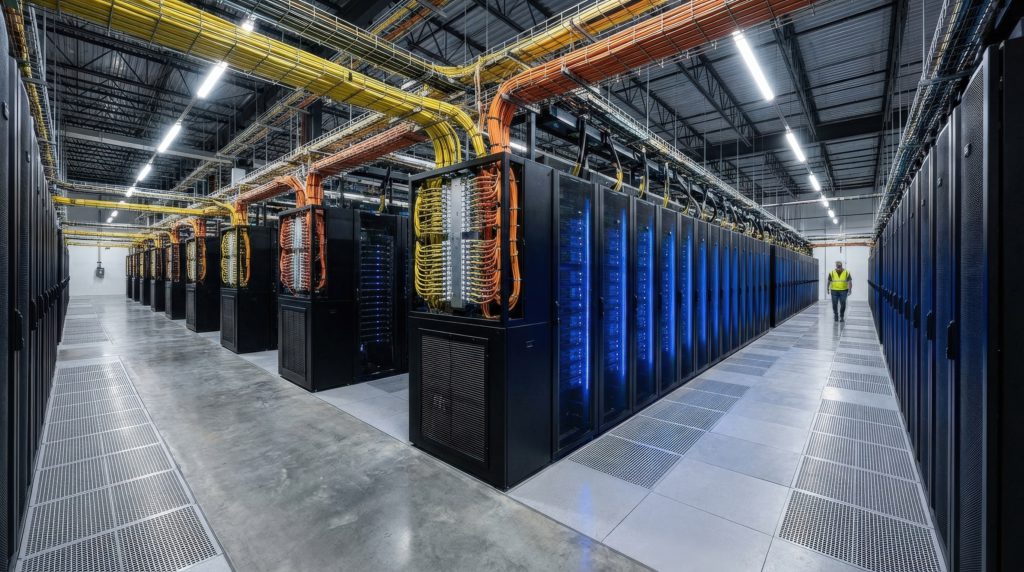
The rationale is simple. Data centers need a lot of wiring, cooling and power, which means they need a lot of copper. AI data centers need even more.
A crypto data center requires 21 metric tons of copper per megawatt installed, while an AI training data center in China has a copper intensity of 47 tons, according to S&P Global Market Intelligence.
The escalating global AI arms race will undoubtedly boost demand for copper. But by how much?
S&P Global forecasts usage in data centers and associated infrastructure will rise from 1.1 million tons in 2025 to 2.5 million tons in 2040.
There are, though, a lot of “buts” lurking in that forecast.
Demand could be as high as 2.7 million tons or as low as 1.7 million, depending on the interaction of multiple fast-changing variables.
As the authors of “Copper in the Age of AI” put it, the “wide span underscores both the uncertainty and the scale of the challenge ahead.”
The delivery gap
One key variable in assessing likely copper demand is the scale of AI data center expansion.
Many of the new megawatts of announced AI computing capacity are “bragawatts”, according to a study released by the Oxford Smith School and financial broker Marex Group.
While media and markets are expecting and pricing a rapid exponential ramp-up in AI infrastructure, the outcome is likely to be “a roll-out that is delayed, lumpy, and constrained by physical realities.”
The biggest hurdle is grid connectivity. A data center can be built in 18 to 24 months but the average US waiting time for a grid connection was four years between 2018 and 2023.
That assumes there is enough power in the first plac
Ireland built so many data centers that by 2021 the sector’s share of national energy consumption had risen to over 20%, threatening to overwhelm the country’s energy system.
The Irish grid operator imposed a de facto four-year moratorium on new applications, which has only just been lifted, albeit with strict new conditions.
Throw into the mix long lead times for essential equipment such as transformers and a shortage of specialized labour and there is a growing gap between announced and delivered AI computing capacity, according to the Smith study.
Copper, it warns, is in danger of falling down that gap.
More power, less copper
Quantifying how much copper is used in data centers is also a fast-moving target.
The battle for AI supremacy is one of computing power, and as chips evolve, so must the architecture of rack design and wiring.
S&P Global notes there is already a shift underway from copper to fiber optics in the interconnect cabling between processor racks.
This could result in copper intensity in data centers falling by 4 or 5 tons per megawatt installed, not a trivial change given the overall 30- to 40-ton range deployed in non-crypto data centers.
More fundamentally, though, chip company Nvidia argues that even copper will be challenged to deliver the low latency and high bandwidth of next-generation AI centers.
Using traditional low voltages would necessitate “an unsustainable volume of copper cabling.”
Nvidia is proposing a transition to 800 volts, which means the same wire gauge can carry 157% more power. A simpler set-up also means fewer copper conductors and smaller connectors.
Reducing copper usage is both a cost consideration and, the company argues, a critical pathway to ever-increasing rack power.
Material wars
Ardent copper bulls argue that such is the looming deficit in copper that the metal could itself become a bottleneck in the roll-out of AI capacity.
That may be more true of some of the other metals that go into connecting physical and virtual worlds.
Data centers are a sink for all sorts of minerals, 60 to 70 tons of them per megawatt installed, according to the World Economic Forum.
There’s copper, but also aluminum, cobalt, nickel, tin, gold, silver, germanium and gallium and, of course, a smattering of the increasingly ubiquitous rare earth metals.
Germanium and gallium are more likely to pose a materials bottleneck than copper. Western supply of both metals is acutely tight after China imposed export restrictions in 2023.
Big Tech is competing for limited supply with both the US Pentagon and the European Union, which is looking to build a strategic metals stockpile. It’s by no means certain it will win.
Pricing complexity
All new industries are liable to the same disconnect between promise and delivery, but power availability, grid connectivity and critical metals supply are structural real-world inhibitors of the AI revolution.
And while no-one’s going to stop using copper in data center design, its intensity of use is beholden to the race for ever more computing power, which in turn requires constant evolutions in AI architecture.
There are multiple moving parts to copper’s new data center demand vector. The market, which has seized on AI as the next big thing, may not be pricing that complexity.
(Editing by Marguerita Choy)
Abu Dhabi’s IRH turns down Zambian copper concentrate waiver
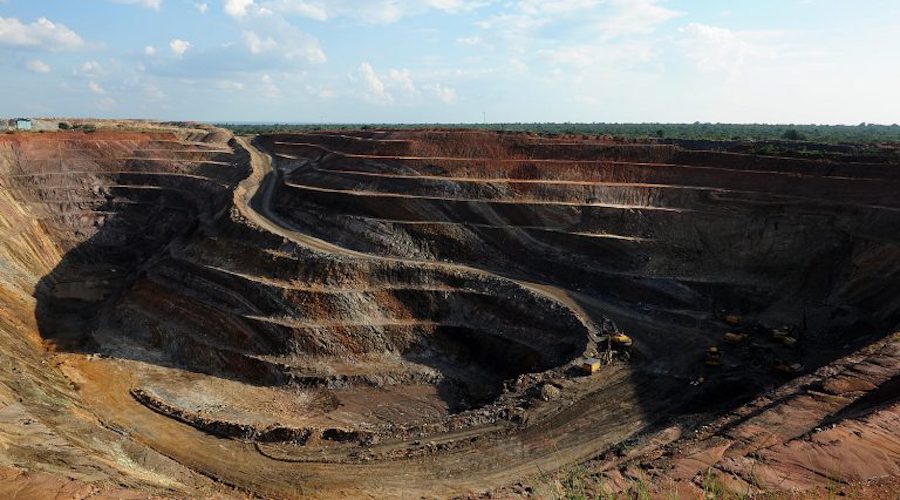
The Zambian unit of Abu Dhabi’s International Resources Holding doesn’t plan to export copper concentrate, after again being granted the largest quota in a government waiver to ship the semi-processed form of the metal.
Mopani Copper Mines said it hasn’t changed its position since July when the first exemptions were announced. At that time, the company said it had “no plan to export any part” of the allocation and intended to feed that output into its own “processing operations in line with our long-term strategy of strengthening domestic refining capacity.”
Zambia’s government on June 2 suspended a 10% export duty on almost 272,000 tons of copper concentrate that can be shipped via the state-owned Industrial Resources Ltd. during the next three months. IRL has a metals-trading partnership with Mercuria Energy Group.
Mopani’s share is 100,000 tons, while the three biggest mines in Zambia — owned by Barrick Mining Corp. and First Quantum Minerals Ltd. — are entitled to export a similar volume combined. Mopani was also awarded allocations of the same size 11 months ago and in March.
IRH, which is part of a vast conglomerate controlled by United Arab Emirates National Security Adviser Sheikh Tahnoon Bin Zayed Ali Nahyan, acquired 51% of the Zambian copper mining complex, in early 2024.
The export duty is normally in place to encourage miners to process all their concentrate at Zambia’s four operational copper smelters, one of which belongs to Mopani. The exemptions are introduced when that smelting capacity is constrained.
Konkola Copper Mines said on May 29 that its smelter had begun a planned 60-day shutdown to undertake maintenance and repairs.
Mopani’s “priority is to smelt all available concentrate,” the company’s public relations department previously said.
(By William Clowes)

No comments:
Post a Comment