Friday, February 12, 2021

Roses are red and contributing to climate change, florists warn

Florists in Paris are trying to convince their customers to choose locally grown flowers over roses, which must be flown in and contribute to carbon emissions.

Most of the roses sold in France in the run-up to Valentine's Day have to be imported from countries such as Kenya, ECUADOR, resulting in carbon emissions that contribute to climate change [File: Sarah Meyssonnier/Reuters]

12 Feb 2021


It is the classic romantic combination: Valentine’s Day and a bouquet of red roses. But some Parisian florists are trying to wean customers off the flowers because of their ecological cost.

Most roses sold in France in the run-up to Valentine’s Day, a peak sales period for the global flower industry, have to be imported by air freight from countries such as Kenya, ECUADOR, resulting in carbon emissions that contribute to climate change.

Florists worried about the environmental damage from this trade say there are viable alternatives that can be grown locally and are trying to encourage their customers to try them.

But these ecologically-minded florists face an uphill struggle because the tradition of gifting red roses on Valentine’s Day, which is celebrated on February 14, is so ingrained in many cultures.

Hortense Harang, founder of an online flower shop called “Fleurs d’Ici” — French for “Flowers from here” — has been spearheading the campaign to wean people off roses.

“Red roses are so 1950s,” she said. “Roses are something that is completely a no-go in this season because it doesn’t make sense basically to buy roses. Roses do not grow under our latitudes in this season.”

Her campaign has gathered support.

“It’s not logical to have flowers from the other side of the planet if we can get them locally,” said Edith Besenfelder, a 46-year-old Parisian florist who works with local and seasonal flowers.

But old habits die hard. Celine Argente, the 40-year-old owner of the Sylvine flower shop in Paris, said she had been encouraging clients to buy red tulips as a way of declaring their love. But despite that, her shop this week was packed to the rafters with red roses to meet demand.

“It’s a classic which people can’t change from,” she said. “The red rose remains the flower for Valentine’s Day.”

SOURCE : REUTERS
Lidia Thorpe: The Indigenous woman shaking up Australia

Granddaughter of a revered Indigenous matriarch takes her fight for equality nationwide as member of the federal parliament.
Draped in a possum-skin cloak, Senator Thorpe entered the Australian Federal parliament for the first time as member last September [File: Photo from Thorpe's office]

By
Ali MC
12 Feb 2021

Melbourne, Australia – The image is striking.

Draped in a possum-skin cloak Senator Lidia Thorpe entered her first day in the Australian Federal parliament last September with her right fist raised in a Black Power salute.

KEEP READING
Australia police in spotlight on Indigenous deaths in custody

In her left hand, she carried a stick engraved with 441 stripes representing the number of Indigenous people to die in custody since a landmark Royal Commission in 1991.

Thorpe tells Al Jazeera she raised her fist “as a sign of resistance and as a sign of our struggle and in solidarity with Black people across the world”.

She also described the responsibility as “carrying the voice of my people into a place which denied our rights for so long” and confirmed her intent: “I’m not saying anything different to what the people on the ground are calling for.”

While not the first Indigenous senator in parliament Thorpe is perhaps the most outspoken, and certainly the most controversial, even stating last year that she did not identify as Australian.

She is not your average politician.

A grassroots campaigner and activist, she is a descendant of the Gunnai, Gunditjmara and Djab Wurrung peoples and a granddaughter of the revered Indigenous matriarch Alma Thorpe.

Having growing up in Melbourne’s council estates, she had her first child at age 17, became a victim of domestic violence and in 2013 was declared bankrupt [Courtesy of Lidia Thorpe]In 2017, she was the first Indigenous person elected to parliament in the state of Victoria, a seat she ultimately lost a year later.

The 48-year-old is no stranger to tough times. Having grown up 0n Melbourne’s council estates, she had her first child at age 17, became a victim of domestic violence and in 2013 was declared bankrupt.

She is now a mother to three children and a grandmother twice over, and a federal senator for the left-wing Greens party.


Thorpe tells Al Jazeera that while her time in state politics was useful, entering the federal arena meant she could start conversations “on a national level”.

Yet the task before her might seem insurmountable.

Indigenous Australians suffer from vast inequalities in health, education, poverty and employment.

While accounting for less than three percent of the nation’s population, they also make up 27 percent of the prison inmates.

These inequalities mean that Indigenous Australians on average die up to 17 years younger than non-Indigenous people.

The numbers are reported annually under a policy called Closing the Gap, yet the statistics have barely changed in the 12 years since the initiative was implemented.

Last year Prime Minister Scott Morrison called the failure of successive governments to address the ongoing racial divide a “national shame”.

In response, Thorpe told Al Jazeera that the annual Closing the Gap report “isn’t taken as seriously as it should be”.

“I want to be working a lot harder and faster to reduce those numbers,” she said. “We’re running out of time.”

Last year Prime Minister Scott Morrison called the failure of successive governments to address the treatment of the Indigenous people as a ‘national shame’ [Ali MC/Al Jazeera]

“We know what it’s like to hear all the fanfare about announcements in Black lives but we never actually see the action. I want to go into [parliament] with action, not talk.”

Thorpe says at the heart of the debate between Black and white Australia is the unresolved issue of a treaty.

While historically the British had negotiated treaties with Indigenous peoples in colonies such as Canada and New Zealand, in Australia, the land was declared “terra nullius”, a Latin term for “nobody’s land”.

As such, no treaties were formed with the more than 500 different Indigenous nations who had lived on the continent for more than 60,000 years.

While the legal fiction of terra nullius was finally overturned in a 1992 High Court decision, a national treaty process has never been instigated.

Thorpe says that it is “imperative we get down to the grassroots level” with each individual Indigenous nation and “start a conversation so they can determine their own destiny”.

While some treaty processes have been implemented at a state level, Thorpe says these are just a token if the vast inequalities remain unchanged and Indigenous cultural sites continue to be destroyed.

“You can’t frack our country and talk treaty,” she said.


“You can’t extinguish Native Title to build the Adani coal mine and talk treaty. And you certainly can’t destroy sacred birthing trees in Victoria and log our country to the point of totems becoming extinct and still want to talk treaty.”

The Adani Mining’s Carmichael coal mine in Queensland state has been controversial, drawing criticism from environmentalists and Indigenous leaders, who denounced the project’s impact on groundwater as well as the Great Barrier Reef.

While historically the British had negotiated treaties with Indigenous peoples in colonies such as Canada and New Zealand, in Australia, the land was declared ‘terra nullius’, a Latin term for ‘nobody’s land’ despite the existence of Indigenous people [Ali MC/Al Jazeera]

“There’s no good faith in any of those discussions – how can we trust these people when it comes time to negotiate?”


Thorpe said that a treaty should take precedence over initiatives such as the recent Uluru Statement which calls for a constitutionally enshrined Indigenous voice to parliament by way of an advisory committee.

She says that the Uluru Statement did not consult adequately with Indigenous people and instead relied on “hand-picked” leaders.


However, Dani Larkin, an Indigenous Bundjalung woman and legal academic with the University of New South Wales, has a different view.

She said that a constitutionally enshrined Indigenous advisory committee would, in fact, allow treaty negotiations to have political legitimacy.

“[The Uluru Statement] was recognising if we are going to now look at treaty, if we establish this body first, we will have all the resources, we will have the political empowerment, the standing and we’ll have things safeguarded in the constitution.”

Larkin also said that the idea for such a committee – termed “a voice to parliament” – was borne out of community frustration with the inequality gaps such as the high incarceration rates.

“These were the types of issues that [Indigenous people] reflected on and asked: ‘What would change that’? Because that’s an immediate need to be addressed,” she said.

“And what they came to was – this is all going to require law and policy reform. It’s going to require us actually having a say on how laws and policies are either reformed or created that will directly or indirectly impact us.”


While Larkin agrees with Thorpe that “we need a treaty”, she is adamant that such a parliamentary voice would legally protect any negotiations, which is vital given the history of poor relations between Indigenous communities and the government.

“I don’t want to see my mob – or any mob in Australia – further traumatised or disempowered by these really important processes that could bring us so much success and healing as a people,” she said.

“It’s unfortunate that some people within political leadership that have a huge following behind them disregard the legal technical expertise that one needs to acquire to properly guide their mob and their constituents that follow them.”

While presenting views that are likely to be polemical within the Indigenous political and legal community, Thorpe raises far greater ire from some non-Indigenous people.

Thorpe told Al Jazeera that she regularly receives racist and violently threatening messages, some of which needed to be referred to the police for investigation.

She also described being bullied and racially vilified her whole life and said while she should not get used to it, she has.


“I don’t hide it. I call it out. And I gain strength from the people around me – my family, my friends, my community.”

Thorpe described being bullied and racially vilified her whole life – even as an adult [Courtesy of Lidia Thorpe]

She told Al Jazeera that while some people are abusive – especially via social media – she will engage with those people, even at times turning people’s views around.

“The more we can educate people out there, the better off we are going to be. If anything, it gives me more strength. I’ve been taught by that older generation and I wasn’t to pass that on to the next generation so we can continue to grow our movement.”

And with thousands of people now attending the annual January 26 Invasion Day rallies – a contemporary version of an Indigenous protest that began in 1938 – it would seem that movement is set to grow even further.

“It’s where I need to be,” she said about her role in Australian federal politics.

“I’m very confident in my skin to be in that place and continue to call [the government] out because it is a very white, colonial place and they are not used to having people like me in there.”


SOURCE : AL JAZEERA
New Zealand parliament drops tie requirement after Māori lawmaker ejected for refusing to wear one

New Zealand's parliament has dropped its requirement that male members wear neckties, after a Māori leader was ejected earlier this week for refusing to wear one in the chamber.

© Lynn Grieveson/Newsroom/Getty Images
 Rawiri Waititi wore a traditional Māori jade pounama instead of a tie.

Rawiri Waititi, 40, argued that forcing him to a Western dress code was a breach of his rights and an attempt to suppress indigenous culture. Instead, on Tuesday he arrived wearing a taonga, a Māori greenstone pendant.

Speaker Trevor Mallard twice prevented Waititi from asking questions in the debating chamber on Tuesday, insisting that lawmakers could only ask a question if they were wearing a tie.

When Waititi continued with his question after being stopped a second time, Mallard ordered him to leave.

"It's not about ties, it's about cultural identity, mate," Waititi said as he exited the chamber.

The incident kicked off a debate about colonialism in New Zealand, and sparked outrage from around the world with #no2tie soon trending on Twitter. By Wednesday, Mallard had announced that the parliament was scrapping the tie requirement.

"A meeting of the committee held tonight discussed this and heard a submission from Te Paati Māori. The committee did not reach a consensus but the majority of the committee was in favour of removing a requirement for ties to be part of 'appropriate business attire' for males," he wrote on Twitter.

"As Speaker, I am guided by the committee's discussion and decision, and therefore ties will no longer be considered required as part of 'appropriate business attire'. I acknowledge those who felt this was an important issue worthy of further consideration."

Speaking to Reuters on Wednesday, Waititi said he was not surprised by the treatment of the speaker as Māori people had been facing this type of treatment for hundreds of years.

"Māori have not been treated equal in its own country and indigenous people all over the world have been subjected to discrimination due to racist systems that keep our peoples in second place," he said.

"For us to stand up against subjugation, to stand up again assimilation, to stand up against those who try and make us look, feel, make us think like they want us to think ... this was standing up against that."

Waititi wore the same attire to parliament on Wednesday and this time he was permitted to speak.

"The noose has been taken off our necks, and we are now able to sing our songs," Waititi said in the interview.

The New Zealand parliament is the most inclusive ever elected in the country. Nearly half of the 120 seats are held by women.

It has a 11% LGBTQI representation and 21% Māori representation. The parliament saw its first member of Parliament of African origin and of Sri Lankan origin after the election last October.

But Waititi, who has called ties "a colonial noose," said there is still systemic racism in New Zealand, and this was a product of colonization.

Māori are over-represented in prisons, the majority of children in state care are Māori, and poverty and unemployment are rife in the community.

Asked to comment, Prime Minister Jacinda Ardern said that it was not something she had a strong opinion on, and that she had no objection to someone wearing a tie in parliament or not.

"There are much more important issues for all of us," Ardern said.on to someone wearing a tie in parliament or not.

"There are much more important issues for all of us," Ardern said.
IT WAS NOT MEXICO'S LAND TO GIVE AWAY

US judge will not stop land transfer for mine in Arizona

The ruling means the land transfer can now take place by mid-March under a timeline approved by Congress and then-President Barack Obama in 2014.

US District Judge Steven Logan, an appointee of former President Barack Obama said the group of Native Americans who brought the suit lacked standing and that the government has the right to give the land to whomever it chooses [File: David Stanway/Reuters]

12 Feb 2021

A federal judge on Friday said he would not stop the US Forest Service from transferring government-owned land in Arizona to Rio Tinto for its Resolution Copper project, denying a request from Native Americans who said the land has religious and cultural import.

The judge’s decision is likely to escalate the clash between members of Arizona’s San Carlos Apache Tribe, who consider the land home to deities, and Rio and minority partner BHP Group Plc, who have spent more than $1bn on the project without producing any copper, the red metal used to make electric vehicles and other electronic devices.

KEEP READING
Thousands march in Australia for Indigenous recognition

The ruling means the land transfer can now take place by mid-March under a timeline approved by Congress and then-President Barack Obama in 2014.

US District Judge Steven Logan, an Obama appointee, said the group of Native Americans who brought the suit lacked standing and that the government has the right to give the land to whomever it chooses.

A view of the future block cave mine planned by mining company Rio Tinto in the Tonto National Forest near Superior, Arizona [File: Deanna Dent/Reuters]

Tribal members claimed the US government has illegally occupied the land for more than 160 years, but Logan sided with government lawyers by finding that Washington gained the land in an 1848 treaty with Mexico.

Representatives for the tribe, Rio Tinto and the US Forest Service were not immediately available for comment. BHP declined to comment.

“We remain undaunted,” said Michael Nixon, a lawyer for Apache Stronghold, the nonprofit group of Native Americans opposed to the mine.

Logan’s ruling was related to an injunction request. Apache Stronghold had also asked for a jury trial to determine, in part, whether the US government can give the land away. It was not immediately clear when that trial could take place as US courts have prioritised criminal cases during the coronavirus pandemic.

Some Native Americans work for and support the Resolution project, though many others have pledged to oppose it forcefully.

Logan declined last month to block the publication of an environmental study that started the 60-day countdown for the land swap.
How Myanmar’s popular uprising aims to topple military rulers

Amid crackdown, protesters aim is to take away the coup leaders’ power by stopping all governance mechanisms from working.

“For this revolution to be successful, everyone needs to participate,” said the union organiser. “Workers, students, even soldiers and the police. Everyone.”

Trade unions took the lead because they had no other option, the organiser said. “Even under the democratically elected government, we didn’t have our rights, so under a dictatorship, we don’t have a chance.”
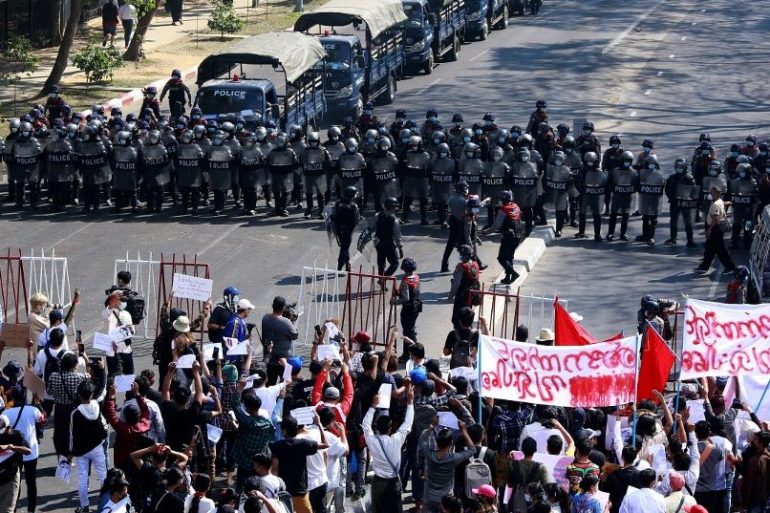
A civil disobedience movement began almost immediately after the coup and amassed support from broad swaths of society [File: Stringer/AFP]

By Joshua Carroll
13 Feb 2021

Starve the government of legitimacy and recognition; stop it from functioning by staging strikes; and cut off its sources of funding. That is the strategy emerging from a mass movement in Myanmar aimed at toppling the new military dictatorship.


As protesters defying the February 1 coup brave beatings, arrests, water cannon, and even live ammunition, activists hope a “no recognition, no participation” approach can sustain pressure even if demonstrations are stamped out with violence.

KEEP READING
Myanmar under pressure at UN as anti-coup protests rage

“The immediate aim is to take away the military’s power by stopping all of its governance mechanisms from working,” said Thinzar Shunlei Yi, who like many activists is now in hiding to avoid arrest.

“It will disable the military’s ability to rule.”

Myanmar’s fragile 10-year experiment in democracy was snuffed out in early February when soldiers arrested civilian leader Aung San Suu Kyi, President Win Myint, and other top officials in early morning raids as military chief Min Aung Hlaing seized power.

A civil disobedience movement began almost immediately and amassed support from broad swaths of society. Trains have ground to a halt, hospitals have closed, and ministries in the capital, Naypyidaw, are believed to be straining amid mass walkouts.

Many thousands including nurses, doctors, lawyers, teachers, engineers, farmers, railway staff, civil servants, factory workers and even some police officers, have gone on strike or defected in a bid to cripple the new military government.

Disrupting military’s business empire

In a statement published on a military Facebook page on Thursday, Min Aung Hlaing said “unscrupulous” people were inciting civil servants to leave work.

“Those who are away from their duties are requested to return to their duties immediately for the interests of the country and people,” he said.

The strikes are also disrupting parts of the military’s vast business empire. A copper mine in northern Sagaing region, jointly owned by the military and a Chinese company, has ceased operations after more than 2,000 workers walked out.

And hundreds of engineers and other staff working for Mytel, a telecoms operator part-owned by the military, have stopped work
.

Activists hope a ‘no recognition, no participation’ approach can sustain pressure against the military even if demonstrations are stamped out with violence [Reuters/Stringer]

Calls for a boycott of products produced by army-owned companies have also gained momentum. Local business owners have destroyed cartons of cigarettes produced by the Virginia Tobacco Company, which is part-owned by Myanmar Economic Holdings Ltd, a military conglomerate.

Lim Kaling, a major Singaporean shareholder in the venture, announced he was divesting this week after facing pressure from activists at Justice For Myanmar and elsewhere.

Japanese brewer Kirin, meanwhile, has said it will withdraw from a joint venture with a military-owned beer company.

New connectivity

The movement’s tactics go further than a similar uprising did in 2007, when there were widespread street protests similar to those seen in recent days, but no coordinated efforts to hobble the military government with industrial action.

One difference today compared with 2007 is that many people in the formerly isolated country own smartphones and are online, allowing calls for civil disobedience to spread rapidly in the aftermath of the coup, even amid sporadic internet shutdowns.

Another is that, after a ban on trade unions was lifted in 2011, Myanmar has a young but tenacious workers’ rights movement with years of experience organising strikes.


Approximately 5,000 workers in Hlaing Tharyar, an industrial zone in the main city of Yangon, have joined the general strike, a union organiser who requested anonymity told Al Jazeera.

“I can’t say how long we’ll be on strike, but it will be until the abolition of the dictatorship,” she said.


Workers’ rights groups, joined by student activists, were among the first to protest in the streets on February 6, galvanising others who had been reluctant to march because of the military’s history of shooting protesters.

Civil servants risk jobs


Trade unions took the lead because they had no other option, the organiser said.

“Even under the democratically elected government, we didn’t have our rights, so under a dictatorship, we don’t have a chance.”

Myanmar’s civil servants, who have spent the last five years working for the only credibly elected government most people in the country have ever known, are also risking their livelihoods and their freedom to avoid a return to the dark days.

Than Toe Aung, deputy permanent secretary at the Ministry of Construction, announced he was joining the strike on Monday.

“I call on my colleagues to follow suit to help bring down the dictatorship,” he said in a statement posted to Facebook.


From civil servants to healthcare workers and labourers, Myanmar protesters have defied the military threats and arrests as they march to call an end to the coup [Than Lwin Times/Reuters]

Staff from the ministries of investment, transport, energy and social welfare, among others, have also pledged not to return to work until power is handed back to Aung San Suu Kyi’s government.


Myanmar’s ambassador to the United States, Maung Maung Latt, said last week he is seeking asylum in the US to protest the coup, and urged other diplomats to follow suit.

On Thursday, staff from the Myanmar Economic Bank, which disburses government salaries, also joined the strike.

Threat of defections

But perhaps most worrying for the generals is the threat of defections from the military-controlled police force.

During a rally in Naypyidaw on Tuesday, a police lieutenant named Khun Aung Ko Ko broke ranks to join protesters.

“I am aware I will be put in jail with a long prison sentence if our fight for democracy does not succeed,” he wrote in a statement handed out at the demonstration afterwards.

“My sacrifice for the people and members of the police force, to fight for democracy and the fall of dictator Min Aung Hlaing, will be worth it.”


MUTINY!

Some Myanmar police officers across the country have also reportedly joined in the protests against the military rule [File: Stringer/AFP]

Another officer joined protesters in the coastal town of Myeik, while dramatic footage from Magwe in central Myanmar showed three riot officers leaving their lines to defend protesters from water cannon with their shields.

Then on Wednesday, 49 uniformed officers from the police department in Loikaw, the capital of eastern Kayah state, joined a march there with a banner that read, “No military dictatorship.”

The officers are now in hiding and the remaining members of the department are looking to arrest them, The Kantarawaddy Times reported.

Thinzar Shunlei Yi said she believed that not just police officers but also rank and file soldiers want to join the movement.


“I hope this is possible,” she said. “In the past few years, I’ve been contacted by different soldiers asking for help because their rights have been violated. They’ve been bullied, they’ve been harassed, they’ve been tortured. It’s brutal inside the military.”


Military crackdown


One of the key demands from protesters has been for the military to return power to Aung San Suu Kyi and her National League for Democracy party. But many activists, especially those from often ethnic minority groups who feel betrayed by the party, are pushing for more radical demands.

“Some people are demanding the military accept the 2020 election result and restore democracy,” said Maung Saungkha, a prominent freedom of expression activist, referring to a November 8 poll, which the NLD won in a landslide.

“If we accept the 2020 election, then we will still be under the military’s 2008 constitution, and with that constitution, coups will happen again and again,” he added.

“So, we need to negotiate with protesters about the strategy and a set of common demands.”

The military government’s crackdown has already begun. Dozens of protesters have been arrested and one young woman is on life support after police shot her in the head on Tuesday.

The military government is also making plans to impose a so-called “cybersecurity law” that would mean three-year prison sentences for speaking out against the government online.

Activists said the movement’s best hope of survival is solidarity.

“For this revolution to be successful, everyone needs to participate,” said the union organiser.

“Workers, students, even soldiers and the police. Everyone.”


VIDEOS HERE

How Myanmar’s popular uprising aims to topple military rulers | Politics News | Al Jazeera

Hundreds of thousands swell Myanmar protests against coup

Protests on Friday the biggest so far, and came a day after the US imposed sanctions on generals who led the coup.

The sanctions name top military commander Min Aung Hlaing and his deputy Soe Win, as well as four members of the State Administration Council [Sai Aung Main/AFP]
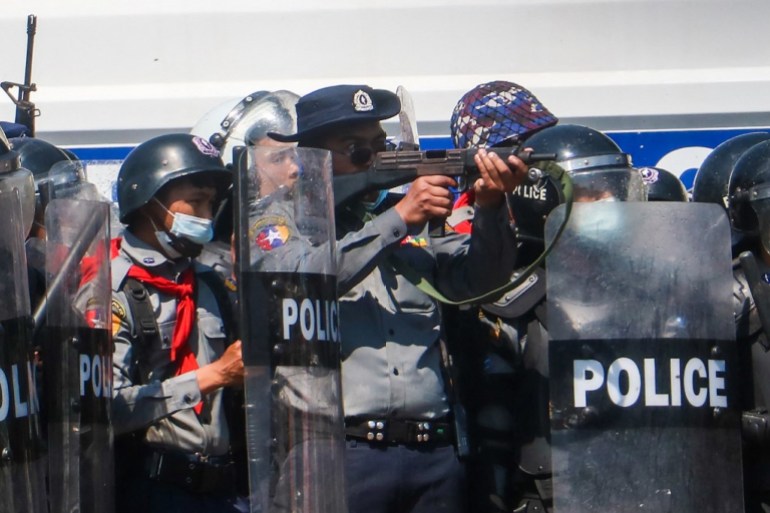

11 Feb 2021


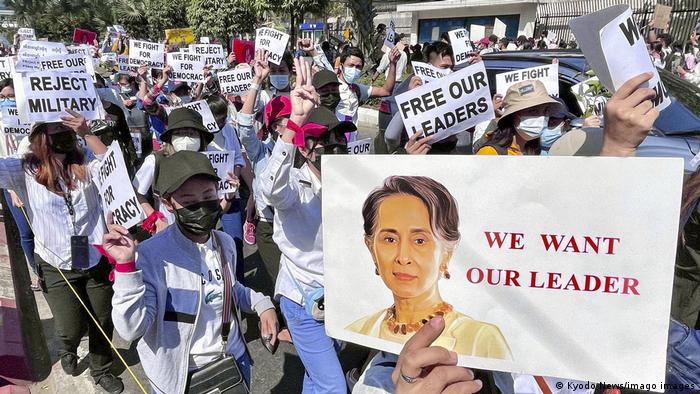
Anti-coup protesters in Myanmar clashed with police as hundreds of thousands joined nationwide pro-democracy demonstrations in defiance of the military government’s call to halt mass gatherings.

The United Nations human rights office said more than 350 people, including officials, activists and monks, have been arrested in Myanmar since the February 1 military coup that removed Myanmar leader Aung San Suu Kyi, including some who face criminal charges on “dubious grounds”.

KEEP READING
New arrests in Myanmar, as US moves to sanction coup leaders

The UN rights investigator for Myanmar told a special session of the Human Rights Council in Geneva that there were “growing reports, photographic evidence” that security forces have used live ammunition against protesters, in violation of international law.

The mass protests on Friday were mostly peaceful but were the biggest so far, and came a day after Washington slapped sanctions on generals who led the takeover.

More than 100,000 people joined various protests in Yangon that remained peaceful.

But three people were wounded when police fired rubber bullets to break up a crowd of tens of thousands in the southeastern city of Mawlamyine, a Myanmar Red Cross official told Reuters news agency.

Footage broadcast by Radio Free Asia showed police charging at protesters, grabbing one and smashing him in the head. Stones were then thrown at police before the shots were fired.

“Three got shot – one woman in the womb, one man on his cheek and one man on his arm,” said Myanmar Red Cross official Kyaw Myint, who witnessed the clash.

“The crowd is still growing,” he added.

Doctors do not expect a 19-year-old woman shot during a protest in the capital Naypyitaw on Tuesday to survive. She was hit in the head with a live round fired by police.


Far from losing steam, it looks like today is the largest protest turnout yet #WhatsHappeningInMyanmar pic.twitter.com/N6R1ThcSIh
— Andrew Nachemson (@ANachemson) February 12, 2021


On Friday, protesters welcomed the US decision hours earlier imposing new sanctions against Myanmar the country’s top military officials who ordered this month’s coup.

US President Joe Biden signed an executive order that allowed the Treasury Department to also target the spouses and adult children of those being sanctioned.

“As a part of today’s action, Treasury is designating 10 current and former military officials responsible for the February 1, 2021 coup or associated with the Burmese military regime,” the US Treasury said in a statement announcing the sanctions.

The sanctions name top military commander Min Aung Hlaing and his deputy Soe Win, as well as four members of the State Administration Council.

A police officer aims a gun during clashes with protesters taking part in a demonstration against the military coup in Naypyidaw on February 9, 2021 [STR/AFP]


The move will prevent the generals from accessing more than $1bn in Myanmar government funds held in the United States. The sanctions also will affect the Myanmar Ruby Enterprise and Myanmar Imperial Jade Co, businesses controlled by the regime.

President Win Myint, de facto leader Aung San Suu Kyi and other civilian officials were arrested in what Biden administration said earlier this month was a coup. The declaration set the stage for the administration to levy the new sanctions.

“Today’s sanctions need not be permanent,” the White House said in a statement.

“Burma’s military should immediately restore power to the democratically elected government, end the state of emergency, release all those unjustly detained, and ensure peaceful protestors are not met with violence.”

In a separate statement of social media, US Secretary of State Antony Blinken called on the generals “to relinquish power, restore the democratically elected government, and release those unjustly detained.”

While welcoming the sanctions, supporters of detained leader Suu Kyi and her party, National League for Democracy (NLD), said tougher action was needed to push the military out of power and force it to recognise the NLD’s landslide victory in November elections.

“We are hoping for more actions than this as we are suffering every day and night of the military coup here in Myanmar, ” Suu Kyi supporter Moe Thal, 29, told Reuters news agency on Friday.

“We want to finish this ASAP. We may need more punishment and action against Myanmar’s acting president and generals.”


The 7th day of nationwide protests against military rule starting agains all over Myanmar despite that raids had taken place throughout the country the night before which targeted protest organisers and election officials. #2021uprising pic.twitter.com/MV3bR89UuD

— Myanmar Now (@Myanmar_Now_Eng) February 12, 2021


The military cited unsubstantiated allegations of electoral fraud as part of the reason for the February 1 takeover of the government and declaration of a one-year state of emergency.

The generals have maintained the actions are legally justified, and have cited an article in the Constitution that allows the military to take over in times of emergency.

It remains to be seen what, if any, affect the sanctions will have. Many of the military leaders are already under sanctions because of attacks against the mostly Muslim Rohingya minority.

Treasury Secretary Janet Yellen said the US is “prepared to take additional action should Burma’s military not change course. If there is more violence against peaceful protestors, the Burmese military will find that today’s sanctions are just the first.”

The White House also announced that USAID, the US foreign development agency, is redirecting $42.4m of assistance that had been slated for Myanmar, funding that was intended to support efforts to overhaul the nation’s economic policy, as well as programmes that support civil society and the private sector.

USAID, however, is keeping in place $69m to support healthcare, food security, independent media, and peace and reconciliation efforts.

Meanwhile, arrests and detentions continue across Myanmar against those who are suspected of expressing their opposition to the military rule.

One social media posted on Friday showed a man being taken away by authorities, as his daughter confronted them, saying his father is not a criminal.

At the same time, the government announced that at least 23,000 prisoners have been pardoned, or have been issued shorter sentences.

The order is signed by Min Aung Hlaing, the chairman of the military junta government.

According to reports, among those included in the pardon is the controversial Buddhist monk, Wirathu, who has a history of inciting violence against minority Muslims in the country including the Rohingya.

There is a serious concern that the release of the prisoners is meant to clear space for the detention of more political detainees and anti-military protesters.

"My father is not a criminal, tell me why you arrested him" A man was taken by armed soldiers in Southern Shan State, at least 260 political dissidents were arrested after military coup in Myanmar. #WhatsHappeningInMyanmar pic.twitter.com/RkWQjCPD3x
— Wa Lone (@walone4) February 12, 2021


SOURCE : AL JAZEERA AND NEWS AGENCIES

Myanmar's military: A state within a state

Since Myanmar emerged as an independent nation in 1948, the army has staged three coups to secure its firm hold on political and economic power. Here's a look at the long arm of the military.


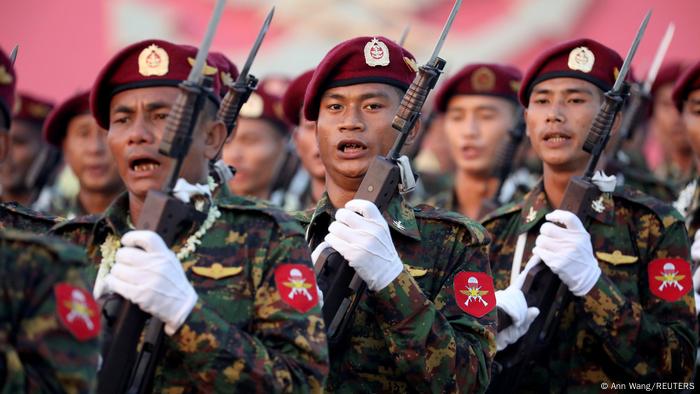
Soldiers take part in a military parade in the capital Naypyidaw in 2019
THIS IS AN ARTIFICIAL CAPITOL CREATED BY THE MILITARY TO REPLACE THE TRADITIONAL CAPITOL


Myanmar has witnessed widespread anti-coup protests this week where public anger at the military for toppling a democratically elected civilian government is on full display. On Wednesday, young protesters in the nation's largest city Yangon held a mock funeral for the army chief Min Aung Hlaing.

Protesters were seen carrying placards demanding an end to military dictatorship, as well as the release of the de facto leader of the civilian government, Aung San Suu Kyi, and other political prisoners.

The Tatmadaw, as the military is known in Myanmar, is both omnipresent and impalpable. It is omnipresent because it dominates not only the political landscape but also the country's economy. It is impalpable because the military functions like a "state within a state," Marco Bünte, political analyst and Myanmar expert at the University of Erlangen-Nuremberg, told DW.

Yoshihiro Nakanishi, a Myanmar expert who published a book on the Tatmadaw in 2013, wrote: "Information about civil-military relations still remains limited; to a considerable extent we are forced to rely on hearsay and guesswork for analysis."

It was not without reason that the generals decided to relocate the capital to Naypyidaw, surrounded by dense forest and mountains, in the nation's heartland. A large area of the capital is a restricted military zone.

IN PICTURES: PROTESTS SPREAD IN MYANMAR OVER COUP
Doctors and nurses on the frontline
Less than 24 hours after the coup, doctors and nurses from many state hospitals announced that they were going on strike. They also called on others to join a campaign of civil disobedience.  PHOTOS 123456789101112

Self-perception of the military

Myanmar's army has about 406,000 soldiers in active duty as of 2019, according to data published by the International Institute for Strategic Studies. In absolute terms, it's the 11th largest army in the world.

The Tatmadaw has been the most powerful political player in Myanmar since it emerged as an independent country in 1948, and the army's influence has continued to grow over the years.

It is the only institution that has endured all challenges and survived with its power intact. Even massive international sanctions in the 1990s and early 2000s made little impact on the generals.

The military's self-perception and self-confidence are rooted in the nation's history. "One must not forget that the army is older than the state. It was founded in 1941 in Thailand as the 'Burma Independence Army' by the independence hero Aung San, who is still revered today," Bünte said. "Money and logistical support came from Imperial Japan. Aung San admired Japanese militarism, at least until he defected to the Allies shortly before the end of World War II."

Protesters are demanding an end to military dictatorship, as well as the release of Suu Kyi and other political prisoners

'Paranoid security complex'

Until his assassination in 1948, Aung San considered a strong army indispensable, as only it could guarantee the country's independence and unity. The army's motto, which is still valid today, originated in Japan. It reads: "One blood, one voice, one command."

In the years after independence, the military saw its main task as fighting communist and ethnic insurgency movements, and preserving the unity of the country. The military always put security above everything else, developing a "paranoid security complex" that persists to this day, Bünte stressed. "The impression that you are surrounded by enemies has not changed since the founding of the state."

Coup and state transformation in 1962


The military first staged a coup in 1962, when General Ne Win initiated the "Burmese Way to Socialism." While the socialist revolution failed, Ne Win was successful in completely transforming the political system to suit the military, Nakanishi underlined in his book. This created a strong linkage between the military and the state. A key mechanism here was that officers leaving military service were given posts in the civilian administration, depending on their rank. Generals were usually provided with ministerial posts.

This system remains largely intact today. According to all that is known about the recent military coup, an important factor was that army chief Min Aung Hlaing would have had to leave the military in 2021 and no follow-up post could be found for him in the civilian government. This was partly because the military's proxy party, the Union Solidarity and Development Party (USDP), had performed poorly in the November 2020 elections.

The people as a new threat


The socialist experiment ended with mass protests in 1988, which the military put down with another coup. According to estimates, about 3,000 people were killed. Saw Maung, the leader of the military regime at the time, declared, as Min Aung Hlaing did a few days ago, that the new military government was fundamentally different from the previous government.

1988 marked a profound turning point, as the military no longer viewed only external enemies and ethnic groups as opponents, but for the first time also own citizens, Nakanishi and Bünte pointed out.

Nakanishi observes a growing paternalism on the part of the military, since from its point of view, only the generals knew what was good for the country and the people. As a motto, the military government defined three national tasks: "No disintegration of the union, no disintegration of national solidarity and consolidation of national sovereignty."

The system of providing retiring military officers with positions in the government was maintained, in addition to an economic opening that saw the emergence of large state-owned companies such as the Union of Myanmar Economic Holding (UMEHL). These firms offered further opportunities to provide army officers with posts in the civilian administration and business.

This resulted in deepening ties between the military, the state and the economy.

The extent of the military's influence can also be seen in the fact that except for Aung San Suu Kyi all founding members of the National League for Democracy (NLD), founded in 1988, were ex-military officers.

As Bünte puts it, "Myanmar was a heavily militarized agrarian state." A military career was the most attractive for many at the time. So it is not surprising that even opposition politicians came from the ranks of the military.
'Disciplined democracy'

In the following years, the military government developed the so-called seven-step road map to a "disciplined democracy," which resulted in the 2008 constitution that is still in effect today.

The goal of the new constitution was, among other things, to assign a political role to the Tatmadaw, in order to sustain the military's vast network of patronage.

At the same time, a "developmental dictatorship" was implemented, as Nakanishi calls it. Cooperation with the NLD led to the lifting of international sanctions, an influx of foreign investment and gave the country a major development boost.

Darling of democracy


But the period after Aung San Suu Kyi's and NLD's election victory in 2015 threatened the model of disciplined democracy in several ways, from the military's perspective.

The NLD's civil service reform in 2017 succeeded in breaking the rule that military personnel should be appointed to government posts. And the NLD made no secret of the fact that it would not accept the 2008 constitution.

"Basically, Suu Kyi never recognized the military. She had become part of the political system to change it, but not to implement it," Bünte said.

With the February 1 coup, the military put a temporary end to the erosion of its power.
Splitting the military?

The crucial question in light of the nationwide protests is how the military will now respond. Will it use force to quell the protests, as it did in the violent crackdown of 1988, or is it indeed a "new military," as Min Aung Hlaing said. Reports are emerging that the military has started using live ammunition against protesters. A look at other countries in the region shows that democracy movements, such as in Indonesia, have only been successful when the military has been unable to maintain its cohesion.

Looking at Myanmar, Bünte noted, "Deviation or diversity of voices is seen as a weakness. There is a decidedly strong esprit de corps and a cultural tendency not to disagree with higher-ranking or older members of the (military) community." However, he added, the military is also like a black box, and it is difficult to judge from the outside whether there are forces that want to reverse the coup.
Myanmar: UN rights body spotlights human rights violations

The United Nations' leading human rights body has highlighted the Myanmar junta's "dubious" arrests and the firing of live ammunition. However, the protests go on.


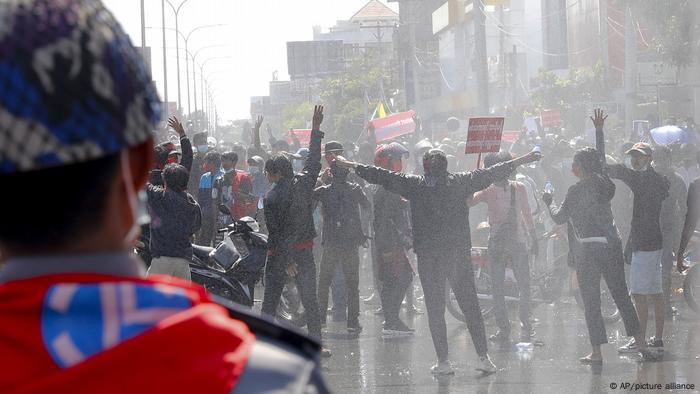
Protesters regroup after police fired warning-shots and use water cannons during a protest in Mandalay


The United Nations' top rights body opened an urgent session on the Myanmar military coup on Friday, amid calls for sanctions against the junta.

The UN Human Rights Council (UNHRC) has no power to impose sanctions, but it can act as a vehicle to train international attention to human rights violations.


What did the UN Human Rights Council say?

More than 350 people in Myanmar have been arrested since the February 1 military coup

Some of those arrested, including officials, activists, and monks, face charges on "dubious grounds"

There are growing reports and photographic evidence that "Myanmar security forces have used live ammunition against protesters"

There was evidence that the military had given "draconian orders" against freedom of expression

There has been a growing presence of soldiers on the street

PROTEST MOVEMENT SYMBOLS GRAB ATTENTION
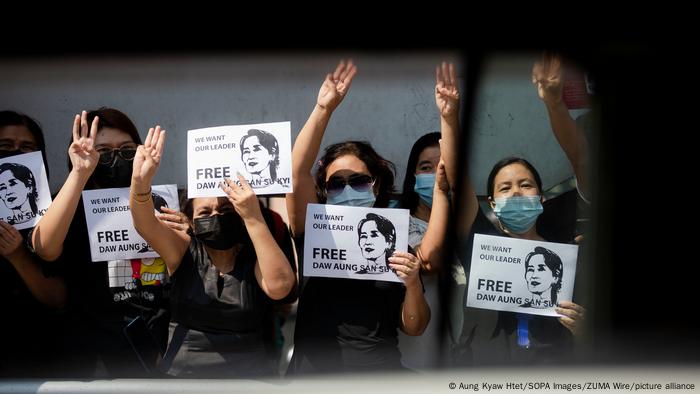
Three-finger salute
In Myanmar, people show the three-finger salute as a sign of protest against the military coup. The gesture stems from the dystopian novel and film series "Hunger Games" and has also been a symbol of resistance in neighboring Thailand, which has been under a military dictatorship since 2014. There, some protesters were arrested when they showed the salute.
PHOTOS 123456789


'The world is watching'


The UN's deputy human rights chief Nada al-Nashif said the international community must make clear the coup and subsequent crackdown were unacceptable.

"The world is watching," al-Nashif warned. "Draconian orders have been issued this week to prevent peaceful assembly and free expression, and police and military presence on the streets has grown progressively over the last several days.

"Let us be clear: the indiscriminate use of lethal or less-than-lethal weapons against peaceful protestors is unacceptable," she said.

However, al-Nashif stressed it was important that any sanctions against the regime should be targeted against "specific individuals who are credibly alleged to have violated the people's rights."

The US has already announced new sanctions that target junta leader Min Aung Hlaing and other top generals.


YOUTH PROTEST IN COS PLAY COSTUMES. BALL ROOM GOWNS, SUPERHERO COSTUMES, TOPLESS BODY BUILDERS.....


Woman shot in head

Amnesty International told DW on Friday that it had evidence that security forces had used live ammunition.

A woman was critically injured after being shot in the head at a protest in Naypyitaw on Tuesday.

"The incident in question in Naypyitaw, the capital, was filmed. We were able to geolocate where the incident took place. We saw that they were using a locally made clone of an Uzi weapon," Kayleigh Long, a researcher covering Myanmar for Amnesty International, told DW. "The shells would indicate it was light ammunition and not rubber bullets."

"That is, as far as we can tell, the first use of live ammunition against protesters. We've also seen them using water cannons and other disproportionate force in trying to quell the protests."

Renewed protests across country


Demonstrations against the coup continued unabated on Friday with tens of thousands of people reportedly turning out.

While demonstrations in the country's largest city Yangon remained peaceful, there were reports that those elsewhere had resulted in clashes with police.

After its arrest of the country's de facto leader Aung San Suu Kyi last week, the junta has proclaimed a state of emergency lasting a year. It had promised to hold fresh elections, but with no precise offer of a timeframe.


While the coup has triggered widespread international condemnation, China — a regional and economic ally — has declined to criticize the generals that presided over it.

Myanmar, a former British colony then known as Burma, was under military rule for five decades following a 1962 coup. While Suu Kyi's five years as the nation's effective leader have represented a brief period of relative democracy, the country's authorities have continued to apply repressive colonial-era laws and engage in ethnic conflict.

rc/aw (Reuters, AFP, AP)

Myanmar: UN rights body spotlights human rights violations | News | DW | 12.02.2021


Myanmar’s military grants amnesty to more than 23,000 prisoners

Sentences of 23,314 Myanmar prisoners and 55 foreign prisoners are remitted as mass protests against the coup continue.

Demonstrators urged Washington to toughen sanctions imposed on Myanmar's ruling generals [Reuters]

12 Feb 2021


Myanmar on Friday granted amnesty to more than 23,000 prisoners and the coup leader Senior General Min Aung Hlaing called on people to “join hands” with the military for democracy – but despite that thousands of people have rallied demanding a return of the civilian administration.

The release of prisoners comes on Union Day, which is observed to mark the unification of the country, but the supporters of overthrown leader Aung San Suu Kyi defied the call from the military rulers to halt mass gatherings as the protests entered the seventh day.

KEEP READING
Myanmar police used machine guns against protesters, says Amnesty

“I would seriously urge the entire nation to join hands with the Tatmadaw for the successful realization of democracy,” Min Aung Hlaing said using the local term for the military.

“Historical lessons have taught us that only national unity can ensure the non-disintegration of the Union and the perpetuation of sovereignty.”

The announcement said sentences for Myanmar prisoners were being remitted while the country “is establishing a new democratic state with peace, development and discipline to turn the prisoners into certain decent citizens, to please the public and to create the humanitarian and compassionate grounds”.

The sentences of 23,314 Myanmar prisoners and 55 foreign prisoners were remitted, according to the reports.

Protests in multiple cities


On Friday, at least six shots were fired when police sought to disperse a protest against the military in the city of Mawlamyine, video footage posted on Facebook showed.

Meanwhile, security forces carried out another series of arrests overnight, with those detained including at least one doctor who had taken part in an escalating civil disobedience campaign.

Demonstrators on Friday urged Washington to toughen sanctions imposed on Myanmar’s ruling generals to force the military to release Aung San Suu Kyi from house arrest.

The US sanctions target 10 current and former military officials deemed responsible for the coup, including Min Aung Hlaing. It also blacklisted three gem and jade companies it said were owned or controlled by the military.

In the biggest city, Yangon, hundreds of doctors in white duty coats and scrubs marched past the golden Shwe Dagon Pagoda, the country’s holiest Buddhist site, while in another part of town, football fans wearing team kits marched with humourous placards denouncing the military.

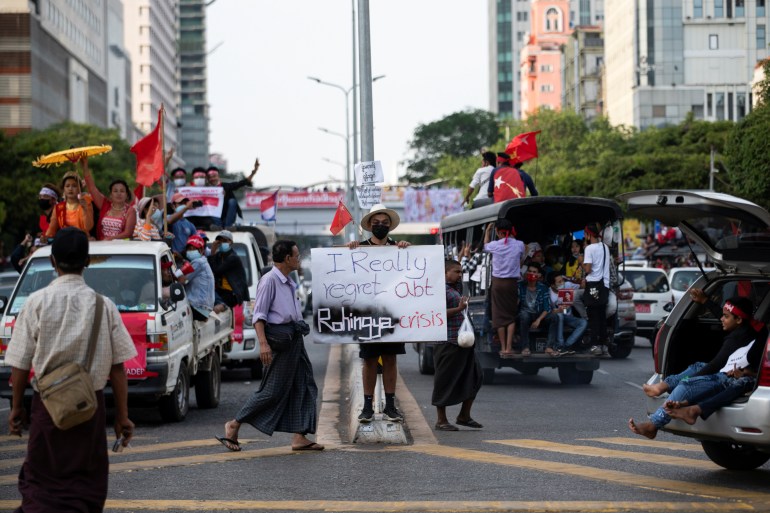
In the coastal town of Dawei, the streets were crowded with protesters giving fiery speeches, many carrying red flags with peacocks, a national symbol of pride and resistance.

Thousands also gathered in Myitkyina, the capital of the far north Kachin state, with young men playing rap music and staging a dance-off.

In the capital of Naypyidaw, some demonstrators put sheets over their heads and dressed as ghosts with sunglasses under the scorching sun. One carried a placard saying: “Not all ghosts are scary. But the Burmese police are more frightening.”

As Washington announced sanctions, European Union members of Parliament on Thursday called for action from their countries and the United Kingdom said it was considering measures to punish the coup leaders. The United Nations human rights council will discuss the issue later on Friday.

Social media giant Facebook said it would cut the visibility of content run by Myanmar’s military, saying they had “continued to spread misinformation” after seizing power in the February 1 coup.
Fifteen years of imprisonment

The military launched the coup after what it said was widespread fraud in the November 8 election, although the electoral commission has said the vote was free and fair. Nobel Peace laureate Aung San Suu Kyi’s National League for Democracy won the elections in a landslide.

The 75-year-old leader first swept to power following an historic election victory in 2015. She now faces charges of illegally importing six walkie-talkie radios and has not been seen in public since the coup.

Aung San Suu Kyi, who spent nearly 15 years under house arrest under previous military governments, remains hugely popular at home despite damage to her international reputation over the plight of Myanmar’s Rohingya minority.

The generals have promised to stick to the 2008 constitution and hand over power after elections, but on Friday, they said they would “work for the emergence of a constitution that is in alignment and harmony with the Democratic Federal Union”.


SOURCE : NEWS AGENCIES
COVID: Bangladesh's textile industry hit hard by pandemic

Bangladesh's garment manufacturers and workers are suffering as the coronavirus pandemic has soured long-term demand and big fashion brands continue to cancel orders.


The EU is the top importer of garments from Bangladesh


Global demand for clothing plummeted amid the COVID pandemic and big fashion brands remain reluctant to place big orders, posing a major problem for Bangladesh's vital textile industry.

In 2020, textile exports from the South Asian nation dropped by nearly 17%. Shipments to Europe, which is the destination for 60% of Bangladesh's garment exports, recorded a significant decline of just under 19%.

There hasn't been any uptick in demand and exports so far this year, the Bangladesh Garment Manufacturers and Exporters Association (BGMEA) said.

"Apparel exports declined by 5.83% year-over-year in January," Rubana Huq, president of the association, told DW.

"Based on current scenarios and the global trade or economic outlook, retail sales trends in the West, and the slowdown in order situation by our customers, it appears that exports may continue suffering till the third quarter of this year."

Bangladesh is hugely dependent on the export of textiles for its national income as the industry accounts for more than 80% of overall exports.

About 4 million workers are employed by the garment industry, most of them female seamstresses who often support several family members and live from paycheck to paycheck.

THE COST OF CHEAP CLOTHES
From rags to riches
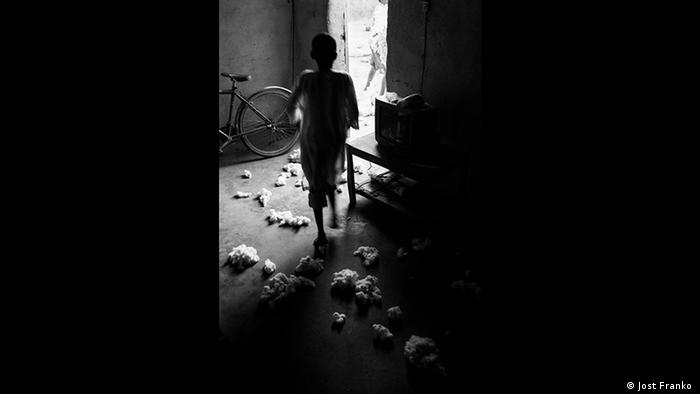
The idea of farming seems today more abstract than ever before. Jost Franko's latest photo essay brings this distant world back to our reality, in which the ridiculous price of garments is paid by workers living in dire conditions. Pictured here is a relative of Issa Gira (67) from Burkina Faso, who's been growing cotton for 30 years, but still earns less than a dollar a day.  PHOTOS 12345678 


Clothing surplus piles up


Many clothing retailers have seen their stocks pile up over the past year.

According to the US-based business consultancy McKinsey, the value of unsold clothing in stores and warehouses worldwide ranges from $168-192 billion (€140-160 billion), which is more than double the level seen before the pandemic.

Also, global fashion brands continue to cancel orders from local suppliers. Britain's Marks & Spencer and Germany's Hugo Boss, for instance, said they had placed smaller orders than usual for this year’s spring collection.

Swedish firm H&M said a drop in demand worldwide will "inevitably" have an impact on their purchases.

"Our purchasing strategy is long-term but considering the uncertainties with how the pandemic will develop, we are of course closely evaluating the situation," H&M told DW in an emailed reply.

"A drop in customer demand and temporarily closed stores inevitably have an impact on our purchases."

The retailer also said that it is keen to work closely with suppliers to find solutions to support garment workers.

"That's why we have joined the ILO global call to action where we are working together with the ILO and trade unions to establish social protection systems, which the pandemic has highlighted the need for in many countries around the world," the company said.
Delayed recovery

"Until mid-January, 24% of our existing orders were postponed," Arshad Jamal Dipu, a vice-president of BGMEA, told DW. "We will get the whole picture in April-May. We fear a 30% order loss."

The European Union is Bangladesh's biggest garment export market, while the US is the largest single-country market.

In 2020, Bangladesh's textile exports to the EU dropped by nearly 19%, whereas to the US they fell by 16% and to Canada by as much as 25%.


With the increasing spread of new variants of the virus, BGMEA fears the economic recovery will be delayed further as countries tighten restrictions on business and public movement to combat their spread.

"We are observing a 'go slow' approach by buyers since the end of last year, which appears to be taking a further drastic turn," BGMEA president Rubana Huq told DW. "We are not getting pleasant signals from the local liaison offices of the buyers."

               GLOBALIZATION + COVID = END OF TRADITIONAL WEAVING 
AS IT DID TO ENGLISH WEAVERS IN THE 19TH CENTURY