It’s possible that I shall make an ass of myself. But in that case one can always get out of it with a little dialectic. I have, of course, so worded my proposition as to be right either way (K.Marx, Letter to F.Engels on the Indian Mutiny)
Saturday, August 10, 2024
BREAKING: Nigerians Begin One-Million Man March In Abuja In Day 10 Of #EndBadGovernance
The peaceful protest turned violent in the Nigeria's capital since it started as police and other security agents clamped down on the protesters and journalists and other media professionals covering the protest.
Nigerians on Saturday hit the roads in the Federal Capital Territory, Abuja, for a one-million man march marking the 10th day of the nationwide protest against hunger, hardship and bad governance under President Bola Tinubu.
Protesting Nigerians on Saturday morning carried banners and placards in photographs seen by SaharaReporters in Abuja in the 10th day of the nationwide protests.
Some of the placards read, "End Bad Governance in Nigeria," "Nigerians are tired of bad leaders."
Angry Nigerians have embarked on a 10-day nationwide peaceful hunger and hardship protest tagged #EndBadGovernanceInNigeria to express the pains they have been subjected to by the economic policies of President Tinubu.
The peaceful protest turned violent in the Nigeria's capital since it started as police and other security agents clamped down on the protesters and journalists and other media professionals covering the protest.
SaharaReporters had reported how hundreds of protesters who gathered at the Moshood Abiola stadium in Abuja on the third day of the #Endbadgovernance protest were arrested by the Nigerian police.
The protesters and journalists had assembled calmly before the police violently disrupted them with teargas canisters on Saturday morning.
Human rights activist and convener of #RevolutionNow movement, Omoyele Sowore, had also confirmed the violent attack on the protesters by the Nigerian police, including the killing of a teenage boy at the Kubwa area of the federal capital city.
The protesters had however, defied all odds marching to the Eagles Square on day 1 of the protests, after some protesters who had gone to the Eagle Square were attacked by Police who fired tear gas.
The #Endbadgovernance protests seek an end to inflation, food inflation and rising cost of living and has continued up till day 3 of the protest.
Although the government has said the protest is sponsored, it has been unable to substantiate its claims.
Bangladesh’s interim leader Yunus hails slain student in appeal for unity
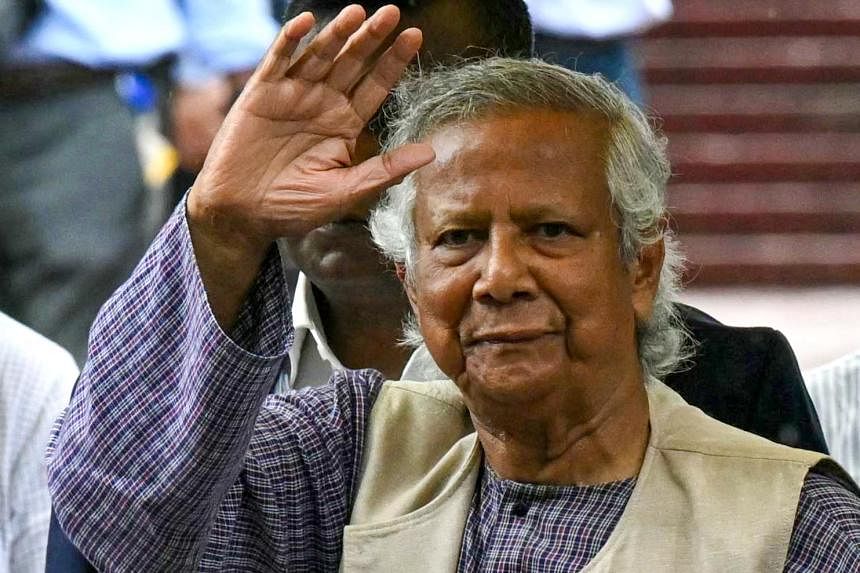
Nobel laureate and chief adviser of Bangladesh's new interim government, Muhammad Yunus, greets the public after laying a wreath at the National Martyrs' Memorial in Dhaka on Aug 9. PHOTO: AFP
Aug 10, 2024
DHAKA - Bangladesh’s interim leader Muhammad Yunus appealed for religious unity on Aug 10 as he embraced the weeping mother of a student shot dead by police, a flashpoint in mass protests that ended Ms Sheikh Hasina’s 15-year rule.
Nobel laureate Dr Yunus, 84, returned from Europe this week to helm a temporary administration facing the monumental challenge of ending disorder and enacting democratic reforms.
“Our responsibility is to build a new Bangladesh,” he told reporters.
Several reprisal attacks against the country’s Hindu minority since autocratic former premier Hasina’s toppling have caused alarm in neighbouring India as well as fear at home.
“Don’t differentiate by religion,” Dr Yunus said.
He called for calm during a visit to the northern city of Rangpur by invoking the memory of Mr Abu Sayeed, the first student slain during July’s unrest.
“Abu Sayeed is now in every home. The way he stood, we have to do the same,” he added. “There are no differences in Abu Sayeed’s Bangladesh.”
Mr Sayeed, 25, was shot dead by police at close range on July 16 at the start of a police crackdown on student-led protests against Ms Hasina’s government.
His mother sobbed as she clung to a visibly emotional Dr Yunus, who had come to pay his respects alongside members of the “advisory” Cabinet now administering the country.
Fellow Cabinet member Nahid Islam, a 26-year-old sociology graduate who led the protests that culminated in Ms Hasina’s ouster, wept by the leader’s side.
Ms Hasina, 76, fled by helicopter to neighbouring India on Aug 5 as protesters flooded Dhaka’s streets in a dramatic end to her iron-fisted rule.
Her government was accused of widespread human rights abuses including the extrajudicial killing of thousands of her political opponents.
In the immediate aftermath of Ms Hasina’s fall, some businesses and homes owned by Hindus were attacked, a group seen by some in Muslim-majority Bangladesh as having been her supporters.
Bangladeshi Hindus account for around 8 per cent of the country’s population.
Hundreds have since arrived at India’s border, asking to be let in.
Ms Hasina’s flight has heightened rancour towards India, which played a decisive military role in securing Bangladesh’s independence, but also backed her to the hilt.
Indian Prime Minister Narendra Modi on Aug 8 called for the “safety and protection of Hindus and all other minority communities”.
More than 450 people were killed in the unrest leading up to Ms Hasina’s departure, including dozens of police officers killed during clampdowns on demonstrations.
The caretaker administration Dr Yunus helms has said that restoration of law and order is its “first priority”.
Complicating its efforts is a strike declared on Aug 6 by the police union, saying its members would not return to work until their safety was assured.
Bangladesh’s police force said more than half of the country’s police stations had reopened by Aug 10.
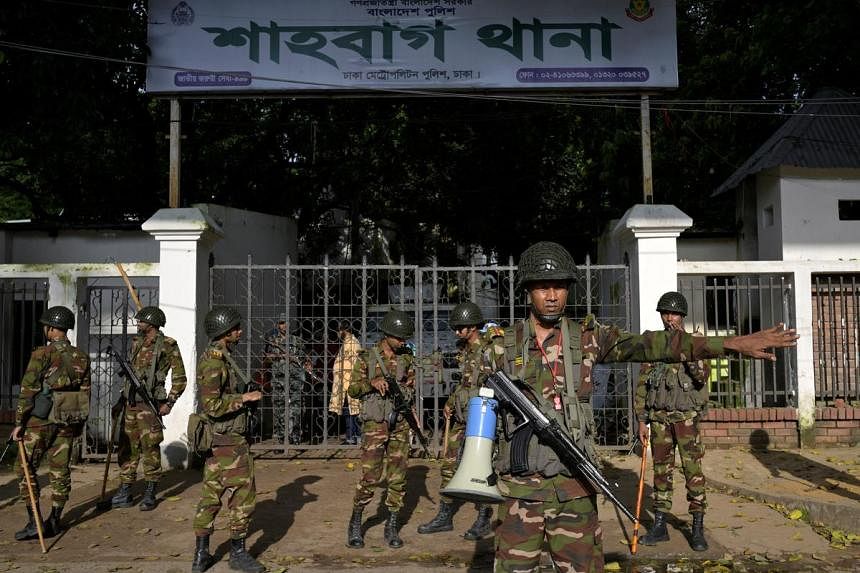
The buildings are being guarded by soldiers from the army, an institution held in higher public regard than the police for opting not to forcibly quell the protests.
“We are happy that police are returning to their duty,” university pupil Umar Faruk, 22, told AFP.
“Police are needed to maintain law and order. But it’s also a matter of concern for us whether the police can gain the trust of the people.”
Two attempted jailbreaks were staged at prisons north of the capital Dhaka this week, with more than 200 inmates fleeing one facility.
Dr Yunus won the Nobel Peace Prize in 2006 for his pioneering work in micro-finance, credited with helping millions of Bangladeshis out of grinding poverty.
He took office on Aug 8 as “chief adviser” to a caretaker administration comprised of fellow civilians, bar one retired brigadier-general, and has said he wants to hold elections “within a few months”.
He will have further challenges with media also reporting that other key officials have also departed their posts.
Bloomberg News reported on Aug 10 that Bangladesh Bank governor Abdur Rouf Talukder has resigned, citing people familiar with the matter.
The resignation comes days after protesters stormed the central bank’s headquarters.
Mr Talukder stepped down on Aug 9 and cited “personal reasons” for the departure, the report added citing unnamed sources.
The chief justice of Bangladesh’s top court also said he had agreed to resign “in principle” after an ultimatum to do so from protesters, broadcaster Jamuna TV reported.
Mr Obaidul Hassan, who was appointed to helm the Supreme Court in 2023 and is seen as a Hasina loyalist, was told to step down by protesters who gathered outside the court in Dhaka.
“No one should do anything that pits the Supreme Court against the mass uprising of the students and the people,” Mr Asif Nazrul, a student protest leader now serving in Dr Yunus’ government, told reporters. AFP, REUTERS
Bangladesh’s Sheikh Hasina still PM: Son claims she didn’t have the time to hand in her resignation before fleeing the country
A mural of Bangladeshi Prime Minister Sheikh Hasina vandalised by protesters. — Reuters pic
Saturday, 10 Aug 2024
NEW DELHI, Aug 10 — Long-time Bangladeshi leader Sheikh Hasina had not resigned as prime minister before fleeing this week to India as anti-government protesters marched on her official residence, her son and adviser told Reuters early today.
Hasina has been sheltering in New Delhi since Monday following an uprising that killed about 300 people, many of them students, ending her uninterrupted rule of 15 years in the country of 170 million people.
“My mother never officially resigned. She didn’t get the time,” Hasina’s son Sajeeb Wazed told Reuters from Washington.
“She had planned to make a statement and submit her resignation. But then the protesters started marching on the prime minister’s residence. And there was no time. My mother wasn’t even packed. As far as the constitution goes, she is still the prime minister of Bangladesh.”
He said though the president had dissolved parliament after consulting with military chiefs and opposition politicians, the formation of a caretaker government without the prime minister actually formally resigning “can be challenged in court”.
Wazed also said Hasina’s Awami League party would contest the next election, which he said must be held within three months.
“I’m confident the Awami League will come to power. If not, we will be the opposition. Either way is fine,” he said.
He said he was encouraged by a recent statement from Khaleda Zia, chief of the main opposition Bangladesh Nationalist Party (BNP) and a Hasina foe, that there should be no revenge or vengeance after Hasina fled.
“I was very happy to hear Mrs. Khaleda Zia’s statement that let bygones be bygones,” Wazed said. “Let’s forget the past. Let us not pursue the politics of vengeance. We are going to have to work together, whether it’s a unity government or not.”
He said he was “willing to work with the BNP... to have democratic elections in Bangladesh and restore democracy and to work with them to ensure that going forward, we have peaceful democracy where there will be free and fair elections”.
“I believe that politics and negotiations are very important,” he said. “We can argue. We can agree to disagree. And we can always find a compromise.”
Asked whether he would be the Awami League’s prime ministerial candidate, he said: “My mother was going to retire after this term anyway. If the party wants me to, maybe. I will definitely consider it.”
He said his mother was ready to face trial back home, as demanded by students who led the uprising.
“The threat of arrest has never scared my mother before,” he said. “My mother has done nothing wrong. Just because people in her government did illegal things, did not mean my mother ordered it. That does not mean my mother is responsible for that.”
He did not say who in the government was responsible for allowing the shooting of people during the protests.
“A government is a big, big machinery,” Wazed said. “Those who are responsible, they should be brought to justice. My mother absolutely did not order anyone to commit violence against the protesters. The police were trying to stop the violence, but some police officers used excessive force.”
“Our government immediately, and I was part of those conversations, I also told my mother, we need to immediately tell (our students wing) not to attack, stop the violence,” he said.
“We suspended the police officers that shot at students. We did everything we could.”
He said he would return home when he liked.
“I have never done anything illegal. So, how is anyone going to stop me?” he said. “The political parties are not going anywhere. You cannot wipe us out. Without our help, without our supporters, you are not going to be able to bring stability to Bangladesh.” — Reuters
Bangladesh chief justice, central bank chief quit amid protests, officials say
Security personnel stand guard next to a police station in Dhaka, Bangladesh, August 9, 2024. REUTERS/Fatima Tuj Johora/File Photo
Updated Aug 10, 2024
DHAKA - Bangladesh's chief justice and central bank governor have resigned, officials said on Saturday, as student protests that forced Prime Minister Sheikh Hasina to flee widen to target more officials appointed during her regime.
Chief Justice Obaidul Hassan resigned, a law ministry official said on the condition of anonymity, after students warned him of "dire consequences" if he did not. Reuters could not immediately contact Hassan.
Bangladesh Bank Governor Abdur Rouf Talukder has also resigned but his resignation has not been accepted given the importance of the position, finance ministry adviser Salehuddin Ahmed told reporters. Reuters could not contact Talukder.
Days earlier, four deputy governors were forced to resign by 300 to 400 bank officials accusing them of corruption.
Hasina has been sheltering in New Delhi since Monday following an uprising that killed about 300 people, many of them students, ending her uninterrupted rule of 15 years in the South Asian nation of 170 million people.
REUTERS
When 'Battling Begums' joined hands to save democracy in Bangladesh Sheikh Hasina and Khaleda Zia's rivalry is decades old and its impact on Bangladesh politics is profound. However, the 'Battling Begums' once joined forces to defeat a common foe and restore parliamentary democracy in the country.
Awami League's Sheikh Hasina (left) and BNP chief Khaleda Zia have been staunch opponents for decades. (Photo: India Today/Vani Gupta)
The 'Battle of Begums' in Bangladesh has defined the politics of the country in the last three decades. Sheikh Hasina and Khaleda Zia, the two former prime ministers, have ruled Bangladesh alternatively since 1991 and their rivalry has led to many political tensions in the country.
The enmity is inherited as much as cultivated by the two leaders. Hasina is the daughter of Sheikh Mujibur Rahman, the founding father of Bangladesh. Zia is the widow of ex-president Ziaur Rahman who, like Mujib, was one of the heroes of the 1971 liberation war. Both were assassinated.
Hasina has always claimed that Ziaur Rahman had connections to Mujib's killers, while Khaleda Zia maintains that Awami League members were behind her husband's
Both leaders have accused each other of harming democracy when in opposition while in power, they have taken steps which reek of political vendetta.
However, the 'Battling Begums' once joined hands to save parliamentary democracy in the country. The extraordinary circumstances arose during the rule of General Hussain Muhammad Ershad, a military dictator who reigned supreme between 1982 and 1990.
IDEOLOGICAL FAULTLINES
Sheikh Mujib and Ziaur Rahman, despite fighting for Bangladesh's independence from Pakistan in 1971, had polarising views.
Mujib's ideology was deeply rooted in Bengali nationalism, secularism, and socialism. He championed secularism as one of the four pillars of the 1972 Constitution of Bangladesh and believed in the separation of religion from politics.
Ziaur Rahman’s ideology was also centred around Bangladeshi nationalism, but it also emphasised the Islamic identity of the nation, distancing itself from the secularism promoted by Mujib. He amended the Constitution to replace the term "secularism" with "absolute trust and faith in the Almighty Allah", signalling a move towards incorporating Islamic principles into state affairs.
This is important to highlight as both Sheikh Hasina and Khaleda Zia inherited these ideological patterns and continue to follow them.
BEGINNING OF POLITICAL RIVALRY
However, it is not just ideology which is the reason for their enmity. Both leaders have accused each other's political parties of having a role in the assassinations in their respective families.
On August 15, 1975, six mid-level officers of the Bangladesh Army along with a few hundred soldiers assassinated Sheikh Mujibur Rahman. His entire family was killed along with him, except for his two daughters -- Sheikh Hasina and Sheikh Rehana -- who were in Germany.
While there is no evidence that Ziaur Rahman was involved in the coup, he benefited from Mujib's assassination. From Chief of Army Staff to President, Ziaur Rahman climbed the ladder within two years of Mujib's assassination.
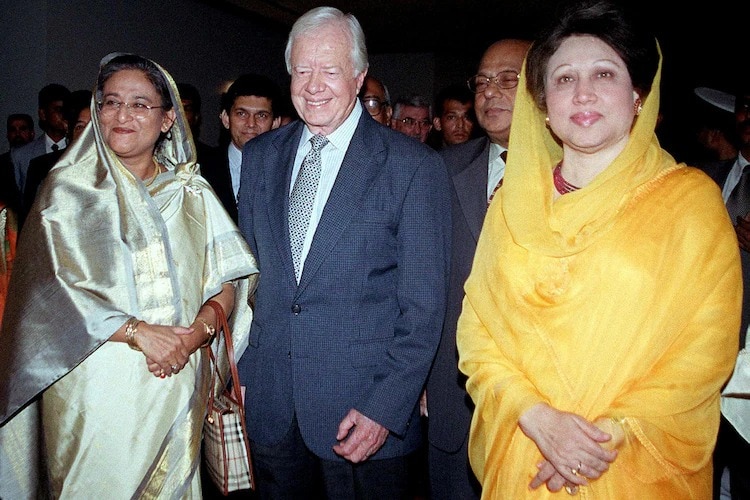
Former US President Jimmy Carter with Sheikh Hasina (left) and Khaleda Zia in Dhaka in this August 2001 photo. (Photo: AFP)
Moreover, he did not take steps to bring Mujib's assassins to justice during his tenure. In fact, his government provided immunity to the assassins through an indemnity ordinance, which was later repealed by Sheikh Hasina in 1996.
Khaleda Zia, on the other hand, had accused Awami League members of having a role in the assassination of her husband. She was widely seen as a shy wife and devoted mother until Ziaur Rahman's assassination in an attempted army coup in 1981.
She also argues that Ziaur Rahman's role in securing independence from Pakistan is ignored by the Awami League.
UNITED AGAINST A COMMON FOE
A year after Ziaur Rahman's assassination, General Hussain Muhammad Ershad took control of Bangladesh as the Chief Martial Law Administrator (CMLA) in a bloodless coup. Ershad was a pro-Islamic ruler who made Islam the national religion of Bangladesh.
At the time, Sheikh Hasina was the leader of the Awami League while Khaleda Zia was leading the Bangladesh Nationalist Party (BNP). Both women had to take the respective responsibilities on parties' demands after the assassinations in their families.
In 1986, Hussain Muhammad Ershad conducted a presidential election, the first under the military regime. The election was boycotted by the BNP, citing a lack of a fair and free electoral environment.
Former Bangladesh President Hussain Mohammad Ershad.
(Photo: Wikimedia Commons)
The Awami League did participate in the election but lost. Ershad's Jatiya (People’s) Party won a large majority, securing 153 of the 300 seats, while the Awami League won 76 seats.
Opposition parties and independent observers claimed that the government manipulated the results to ensure a victory for the Jatiya Party.
Even as opposition parties refused to recognise the legitimacy of the Ershad regime, he did not step down. This led to mass demonstrations demanding his removal in 1987.
SIEGE OF DHAKA
Ershad's strengthening rule forced Sheikh Hasina and Khaleda Zia to shake hands. The two women leaders, who did not even like to come face-to-face, met on October 28, 1987 to coordinate efforts to put more pressure on the Ershad regime.
A series of events were planned in protest against Ershad, and the action was called the 'Siege of Dhaka'.
As part of the movement, opposition parties planned strikes across Dhaka, aiming to put pressure on Ershad to step down. However, a 72-hour-strike plan was foiled by Ershad, who declared an emergency on November 27, 1987, which resulted in the arrest of Hasina, Khaleda Zia, and other main opposition leaders.
Ershad also ordered police to detain protesters in Dhaka and imposed a 30-hour curfew at midnight.
The Opposition found itself in a weak spot, with Ershad's regime still standing tall and the President announcing he would complete his term.
However, the Opposition launched another round of protests in October 1990, bolstered by the support of civil society members like doctors, lawyers, and intellectuals.
After the shutting of universities, declaration of another emergency and the imposition of an indefinite curfew in Dhaka, Ershad finally announced on December 3, 1990 that he was willing to make concessions to the Opposition.
A day later, his proposal was rejected by the Opposition and over one lakh people marched on the streets of Dhaka.
Ershad agreed to step down on the same day, making Hasina and Zia's resistance against him successful.
The unity between the two leaders was crucial in bringing about the downfall of Ershad. It led to the establishment of a caretaker government, which oversaw the transition to parliamentary democracy and the holding of elections in 1991.
BACK TO BEING BITTER
Even though their show of strength against Ershad was a defining moment in Bangladesh's political history, Sheikh Hasina and Khaleda Zia's unity was short-lived.
The 1991 elections saw the BNP rise to power in the country, and Khaleda Zia became the first woman prime minister of Bangladesh. She replaced the presidential system with a parliamentary form of government where the power rested with the prime minister.
The BNP and the Awami League have been at loggerheads since then, alternatively ruling the country.
Khaleda Zia lost to Hasina in a 1996 election, then returned to power in another election five years later.
Their enmity continued, which was borderline petty. After Sheikh Hasina returned to power in 2009, she launched a massive crackdown against the BNP leaders. Zia, too, faced several criminal charges and was jailed in 2018 after she was sentenced to 17 years in prison in a graft case.
However, Zia also tried to portray herself as the peacemaker between the two. In an interview with Time Magazine in 2006, she said, "It's not mutual. I want to be friends. I'd be very happy to meet her... We have to (work) together (to) resolve problems. I wrote a letter, but she did not receive it. If she really wants to cooperate, tell her she can come. But if she does not want to, I cannot help."
Sheikh Hasina was more adamant. "Why should I collaborate with those who have the stink of corruption all over them? As it is we are being bracketed with these corrupt, power-hungry people. Why should we take responsibility for them?" she told Bangladesh's New Age newspaper in May 2007.
In 2015, Khaleda Zia courted controversy after she celebrated her fake birthday on August 15, the day Sheikh Mujibur Rahman was assassinated in 1975. A case was also registered against her.
HASINA's OUSTER, ZIA's RETURN
The decades-old 'Battle of Begums' saw a new twist on August 6 this year as Khaleda Zia was freed from jail.
This happened after Sheikh Hasina resigned as Prime Minister on August 5 and fled Bangladesh with her sister Sheikh Rehana. Her resignation came amid student protests against a quota for government jobs. Her residence was attacked and protesters looted her belongings from there.
A day after her resignation, Khaleda Zia was freed from jail. However, the 78-year-old BNP leader is recovering from multiple ailments and may not return as prime minister.
The political career of Sheikh Hasina is also in twilight. At 76, she may find it difficult to return to Bangladesh and reclaim power amid strong public sentiment against her. This is despite her son Sajeeb Wazed Joy claiming that she will return to Bangladesh and revive the Awami League once the situation improves.
In all likelihood, the 'Battle of Begums' will never again be fought on the political fields of Bangladesh. But their rivalry will remain a defining feature of the country's politics in the years to come.
PETULANT TYRANT
Kim Jong-un’s flood recovery plan: Move 15,000 flood victims to Pyongyang, reject aid offers
NO ONE IS SMILING OR LAUGHING NOW North Korean leader Kim Jong-un and Premier Kim Tok-hun visit a flood-affected area near the border with China, in North Pyongan Province, North Korea, in this undated photo released July 31, 2024 by North Korea’s official Korean Central News Agency. — Reuters pic/KCNA
Saturday, 10 Aug 2024
SEOUL, Aug 10 — North Korea will move more than 15,000 flood victims to the capital, state media said today, as leader Kim Jong-un insisted recovery efforts would be “based on self-reliance” despite offers of aid from abroad.
Pyongyang last week said a record downpour in late July had killed an unspecified number of people, flooded dwellings, and submerged swathes of farmland in its northern regions near China.
On a visit to flood-hit Uiju on Friday, Kim said the government planned to accommodate around 15,400 flood victims from the northern region at facilities in the capital until their destroyed homes are rebuilt, according to the official Korean Central News Agency.
The plan, which will include food and medical assistance as well as educational support for the thousands of students being moved, will be “a top priority of the state,” Kim said.
International offers of support have poured in since news of the flooding disaster first emerged, including from South Korea, which offered humanitarian aid via the Korean Red Cross despite the two countries’ strained relations.
Moscow has reached out with a similar offer, according to Pyongyang, while Seoul’s Yonhap news agency has reported that China and the United Nations Children’s Fund had signalled their willingness to help.
But Kim said Friday that the country’s recovery efforts would be “thoroughly based on self-reliance”, according to KCNA.
Still, he expressed “thanks to various foreign countries and international organizations for their offer of humanitarian support,” the report said.
South Korean media have reported that the number of dead and missing in the North could be as high as 1,500, but Kim yesterday dismissed the reports as a “grave provocation” and “an insult to the flood-stricken people who are all safe and well”.
Natural disasters tend to have an outsized impact on the isolated and impoverished country due to its weak infrastructure, while deforestation has left it vulnerable to flooding.
Relations between the two Koreas are at one of their lowest points in years, with the North recently announcing the deployment of 250 ballistic missile launchers to its southern border. — AFP
Tehran refrains from arming Moscow until Ukraine war over: Iran’s UN mission
New York, IRNA – Iran’s Permanent Mission to the United Nations says Iran refrains from transferring any weapons, including missiles, to Russia until the Ukraine war is over.
Responding to claims that Tehran will soon deliver hundreds of the Fath-360 close-range ballistic missiles to Russia, the mission pointed out on Friday that Iran and Russia have forged long-term strategic cooperation agreements across various sectors, including the military.
“Legally, Iran is under no restrictions or prohibitions regarding the purchase or sale of conventional weapons,” it said.
“Nevertheless, from an ethical standpoint, Iran refrains from transferring any weapons, including missiles, that could potentially be used in the conflict with Ukraine until it is over.”
It came after Reuters claimed in a report that dozens of Russian military personnel are being trained in Iran to use the Fath-360 close-range ballistic missile system.
Citing two European intelligence sources, Reuters further said they expected the imminent delivery of hundreds of the satellite-guided weapons to Russia for its war in Ukraine.
4354**9417
THEY ARE KEEPING THE ARSENAL READY FOR A YANKEE INVASION
MONOPOLY CAPITALI$M: BIG PHARMA
ADHD medications hit by supply shortages important to improve quality of life
University of Southampton
Research led by the University of Southampton has found that medications play an important role in improving the quality of life of people with ADHD, but the authors suggest more support – in addition to medications – is needed.
The findings published online today (8 August 2024) in The Journal of the American Academy of Child and Adolescent Psychiatry throw the likely impact of shortages of certain ADHD medications into sharp relief.
“It is deeply concerning to think of the impact on people who cannot access their medication due to supply shortages or for other reasons,” says Professor Samuele Cortese from the University of Southampton, senior author on the paper.
Attention-Deficit/Hyperactivity Disorder (ADHD) is primarily characterised by inattention, hyperactivity, and impulsivity. These core symptoms can negatively impact social interactions and relationships, work, education, and the ability to perform daily tasks.
“People with ADHD report lower quality of life in areas such as work productivity, social and family life, and self-esteem, compared to their neurotypical peers,” says Dr Alessio Bellato, a lecturer in Psychology at the University of Southampton and lead author of the paper.
“This study shows that medications play an important role in improving quality of life for those with the condition.”
The researchers conducted the first systematic review and meta-analysis investigating the effects of stimulant (amphetamines and methylphenidate) and non-stimulant (atomoxetine) drugs for ADHD on quality of life.
They included 17 placebo-controlled trials, encompassing over five thousand participants in the analysis. Trials were drawn from the MED-ADHD dataset (https://med-adhd.org), the largest dataset of trials of ADHD medication, set up by Professor Cortese and international collaborators.
Both stimulant and non-stimulant drugs were significantly more effective in improving quality of life than placebo. However, the study also found that while the effects of these drugs on the core ADHD symptoms are usually medium to high, the impact on quality of life was in the small-to-medium range.
Professor David Coghill from the University of Melbourne, a co-author on the paper, added: “This disparity shows that, for most people, targeting core symptoms through medication alone is unlikely be enough to counter the impact of ADHD on quality of life. More research is needed to find out whether combining medication with other approaches can lead to further improvements in well-being, and what types of support might be most effective in situations where medication is not available.”
“More research is also needed to better understand how these medications affect quality of life,” says Dr Bellato. “It could be that reducing the core symptoms of ADHD (inattention, hyperactivity, impulsivity) leads to more efficient task management and this results in better academic and professional outcomes. Medications may also help to stabilise emotional dysregulation, which might promote emotional well-being and higher self-esteem.”
“Considering that ADHD medication might not be acceptable, effective, or well tolerated for everyone with ADHD, more research is needed to evaluate alternative approaches, including psychological interventions.”
Steve Williams, Media Manager, University of Southampton, press@soton.ac.uk or 023 8059 3212.
Notes for editors
Systematic Review and Meta-Analysis: Effects of Pharmacological Treatment for Attention-Deficit/Hyperactivity Disorder on Quality of Life will be published in The Journal of the American Academy of Child and Adolescent Psychiatry. The final online version was published today (8 August 2024) and is available here: https://www.sciencedirect.com/science/article/pii/S0890856724003046?via%3Dihub
For Interviews with Dr Alessio Bellato and Professor Samuele Cortese, please contact Steve Williams, Media Manager, University of Southampton press@soton.ac.uk or 023 8059 3212.
For interviews with Professor David Coghill, please contact Danielle Galvin, Media Advisor, University of Melbourne, danielle.galvin@unimelb.edu.au or +61439301953.
Additional information
The University of Southampton drives original thinking, turns knowledge into action and impact, and creates solutions to the world’s challenges. We are among the top 100 institutions globally (QS World University Rankings 2023). Our academics are leaders in their fields, forging links with high-profile international businesses and organisations, and inspiring a 22,000-strong community of exceptional students, from over 135 countries worldwide. Through our high-quality education, the University helps students on a journey of discovery to realise their potential and join our global network of over 200,000 alumni. www.southampton.ac.uk
Systematic Review and Meta-Analysis: Effects of Pharmacological Treatment for Attention-Deficit/Hyperactivity Disorder on Quality of Life
Article Publication Date
8-Aug-2024
COI Statement
Disclosure: Dr. Bellato has declared an honorarium as Joint Editor of JCPP Advances. Prof. Coghill has received honoraria or conference support from Novartis, Medice, Takeda, and Servier and royalties from Cambridge University Press and Oxford University Press. Prof. Cortese has declared honoraria and reimbursement for travel and accommodation expenses for lectures from the following non-profit associations: Association for Child and Adolescent Central Health (ACAMH), Canadian ADHD Alliance Resource (CADDRA), British Association of Pharmacology (BAP), Medice, and Healthcare Convention for educational activity on ADHD. He has served on the advisory board of the Association for Child and Adolescent Mental Health and the British Association for Psychopharmacology. Drs. Marzulli and Parlatini and Ms. Perrott have reported no biomedical financial interests or potential conflicts of interest.
Exploring the impact of attentional uniqueness and attentional allocation on firm growth
Researchers posit that a balance between attentional uniqueness and allocation can positively impact a firm’s growth
According to the attention-based view, a firm’s actions and growth performance are directly influenced by its attentional allocation to specific issues. The consequences of organizational attention are reflected in the firm’s strategic decision-making and adaptability. However, existing literature is limited in its exploration of how a firm’s attentional uniqueness impacts its behavior and performance. Notably, attentional uniqueness refers to how the firm’s attentional allocation diverges from competitors in the same industry.
To address the above-mentioned knowledge gap, Associate Professor Takumi Shimizu of Keio University led a study that examined the relationship between attentional uniqueness and firm performance, mediated by the frequency of growth actions. It was co-authored by Associate Professor Junichi Yamanoi and Associate Professor Susumu Nagayama from Waseda University and Hitotsubashi University, respectively, and published in the Journal of Management Studies on 23 June 2024.
Yamanoi remarks, “We observedvariations in the issues that different firms focus on and were interested in exploring the behavioral and performance consequences of these differences.”
Using the structural topic model, an unsupervised machine learning technique in natural language processing, the researchers examined publicly listed companies on the Tokyo Stock Exchange from 2004 to 2016 as their sample. A total of 9,366 observations were finalized from 986 firms. The data collection process involved extracting raw text and focusing on strategic agendas and managerial issues outlined in the reports.
After thorough analysis, the researchers discovered an inverted U-shaped relationship between attentional uniqueness and firm performance, indicating that firms achieve optimal performance with a balanced level of attentional uniqueness. Both too much and too little divergence in focus can be detrimental to performance. Additionally, the frequency of growth actions, which are initiatives aimed at capitalizing on opportunities, plays a mediating role in this relationship. This inverted U-shaped relationship is further pronounced in environments with scarce opportunities, demonstrating that a moderately unique attentional focus is required in the absence of market opportunities.
The researchers illustrate how organizational attention can drive growth actions with the example of Toyota’s development of the Prius. In 1993, Eiji Toyoda, then-chairman of Toyota, questioned the sustainability of current trends and emerging challenges in the automobile industry, leading to the formation of a project committee. This committee identified ‘resources’ and ‘environment’ as crucial issues for future vehicles. By 1997, Toyota introduced the Prius, a gasoline-electric hybrid designed to address these environmental challenges, significantly improving fuel efficiency and reducing air pollution. While Toyota focused on these forward-looking issues, competitors like General Motors remained fixated on traditional concerns such as model variety, design, and conventional engine performance. Consequently, they were slow to respond to the innovative launch of the Prius.
Yamanoi emphasizes, “We propose practical implications for managers aiming to pursue firm growth through proactive actions. Managers are encouraged to direct their focus towards issues that are relatively distinct from those of their competitors.”
The findings of the present study indicate that, while monitoring competitors often focus on tangible aspects, such as market positioning or strategic initiatives, it is crucial to also pay attention to how competitors allocate their attention and the underlying assumptions they make about managerial issues. This approach is particularly pertinent for managers operating in mature industries, where growth opportunities are scarce. Recognizing the importance of attentional uniqueness can empower a firm to identify and seize growth opportunities that might otherwise go unnoticed. By understanding and acting upon unique insights, firms can initiate growth actions that capitalize on these opportunities.
Overall, this study marks a notable advancement in our understanding of the strategic importance of attentional uniqueness. It highlights the nuanced ways in which firms can harness their unique perspectives to drive performance and achieve lasting success.
About Waseda University Located in the heart of Tokyo, Waseda University is a leading private research university that has long been dedicated to academic excellence, innovative research, and civic engagement at both the local and global levels since 1882. The University has produced many changemakers in its history, including nine prime ministers and many leaders in business, science and technology, literature, sports, and film. Waseda has strong collaborations with overseas research institutions and is committed to advancing cutting-edge research and developing leaders who can contribute to the resolution of complex, global social issues. The University has set a target of achieving a zero-carbon campus by 2032, in line with the Sustainable Development Goals (SDGs) adopted by the United Nations in 2015.
About Associate Professor Junichi Yamanoi Junichi Yamanoi is an Associate Professor at the School of Commerce, Waseda University, Japan. He received a Ph.D. in Business Administration from the University of Connecticut, USA. His research focuses on strategic management, including diverse topics such as managerial psychological characteristics, the interplay of competition and cooperation, mergers and acquisitions, foreign direct investment, and family firms.
Attentional Uniqueness and Firm Performance: The Mediating Role of Growth Actions
Pusan National University researchers use artificial intelligence to create powerful sound-dampening materials
The new deep learning-based inverse design method allows the optimization of complex acoustic metamaterials as well as complex mechanical structures
Pusan National University
image:
The proposed inverse-design strategy allows optimization of complex geometries for the ventilated acoustic resonator and other mechanical structures. This novel design strategy can lead to quieter cities as well as more sustainable mechanical designs.
Credit: Sang Min Park from Pusan National University
Noise pollution has become increasingly common in urban areas, stemming from traffic, construction activities, and factories, which can seriously impact health, causing stress, sleep disturbances, and cardiovascular issues. Consequently, various methods for noise reduction have been proposed, such as physically blocking the path of sound and active noise control. However, since sound travels through air, physically blocking sound can also lead to poor ventilation, highlighting the need for research into simultaneous sound attenuation and ventilation.
Acoustic metamaterials (AMs) have been extensively studied as a promising solution for this purpose owing to their unique acoustic properties. Recently a new type of AM, called a ventilated acoustic resonator (VAR), has been proposed that can manipulate both sound waves and airflow using only geometric shapes. It can block even low-frequency noise with a compact structure while maintaining ventilation. A VAR consists of a waveguide that guides sound waves to a resonant cavity that traps them. For appropriate performance, a VAR requires a functional shape optimized for broadband sound attenuation across a target peak frequency. However, conventional analytical design methods only allow relatively simple parametric designs and cannot be used for achieving VARs with complex geometries.
To address this limitation, a team of researchers from Korea, led by Associate Professor Sang Min Park from the School of Mechanical Engineering at Pusan National University developed an innovative deep-learning-based inverse design method. “We proposed a latent-space exploration strategy that searches for broadband VAR with the target frequency through genetic algorithm-based optimization. Compared to conventional methods, our approach allows for high design flexibility while reducing computational costs,” explains Dr. Park. Their study was made available online on May 15, 2024, and published in Volume 133, Part F of the journal Engineering Applications of Artificial Intelligence in July 2024.
In the proposed inverse design method, a conditional variational autoencoder (CVAE), a deep-learning generative model, encodes the geometric features of the VAR in the latent space. The latent space is a lower-dimensional space that contains the essential information of a higher-dimensional input, in this case, the VAR. To generate this space, the CVAE is trained with cross-section images of the resonant cavity of VAR and peak frequency information. The generated latent space is then used for genetic algorithm (GA) optimization, aimed at searching for a VAR with broadband sound attenuation performance for various peak target frequencies. GA applies a natural-selection-based approach to search for optimized VAR over multiple successive generations, much like the selection of favorable genes in biological evolution.
The researchers trained the CVAE with cross-section images of VAR with a T-shaped resonant cavity with varying values for its design parameters. Using this data, their optimization strategy produced a non-parametric VAR with an atypical but functional structure. The researchers compared the optimization results with the VAR having the widest bandwidth in the training data for each target frequency and found that the optimized designs exhibited broader bandwidths in all cases. Furthermore, they compared the performance of the non-parametric VAR to that designed using a parameter-based inverse design method and found that the former had considerably larger bandwidths.
Highlighting the significance of these results, Dr. Park says, “Our ultra-broadband VARs can be deployed in urban environments to effectively reduce noise pollution without compromising ventilation, thereby improving quality of life by creating quieter, more comfortable living and working spaces. Additionally, our strategy opens new horizons for artificial-intelligence-based design of complex mechanical structures, potentially revolutionizing fields like automotive and aerospace engineering.”
This pioneering design method represents a significant step towards the AI-driven design of AMs and other complex mechanical structures.
***
Reference
Title of original paper: Beyond the limits of parametric design: Latent space exploration strategy enabling ultra-broadband acoustic metamaterials
Journal:Engineering Applications of Artificial Intelligence
Pusan National University, located in Busan, South Korea, was founded in 1946 and is now the No. 1 national university of South Korea in research and educational competency. The multi-campus university also has other smaller campuses in Yangsan, Miryang, and Ami. The university prides itself on the principles of truth, freedom, and service, and has approximately 30,000 students, 1200 professors, and 750 faculty members. The university is composed of 14 colleges (schools) and one independent division, with 103 departments in all.
Sang Min Park is currently an Associate Professor at the School of Mechanical Engineering, Pusan National University, South Korea. His group is focusing on developing an AI-driven structure inverse design and optimization framework and its application for enhancing the performance of nano-micro sensors, soft robotics, energy harvesting devices, and complex mechanical structures.