‘A politics that feels real: Andy Burnham, electoral reform, and the redistribution of power’
As Andy Burnham’s march to Downing Street gathers pace, Westminster is reckoning with something unusual in British politics: a serious argument about how power is distributed in our country.
At the heart of that argument is electoral reform. Speaking to Labour for a New Democracy in 2024, Burnham argued that First Past the Post (FPTP) is ‘straining with the complexity of the modern world’. The existence of ‘a political system that doesn’t let opinions and voices be heard’ – he said – precludes the emergence of bold ideas and ‘creates the conditions in which people can say: we are being shut out. We are being silenced by the elite’.
On this, he is manifestly right.
The case against FPTP is no longer theoretical but grounded in lived experience. It is visible in the mismatch between votes and seats won at the recent General Election; in the collapse of the two-party system; and in the growing sense that political outcomes are increasingly disconnected from meaningful public consent.
The polls reflect that disquiet. A clear majority of the public now support proportional representation (PR), with YouGov polling consistently indicating majority backing for reform since 2019. Burnham is not so much leading public opinion on this issue as registering it.
But we shouldn’t mistake public acceptance for enthusiasm.
Back in 2011, I worked as an organiser on the ‘Yes to Fairer Votes’ campaign – the ‘pro’ campaign in the now largely forgotten referendum on introducing the Alternative Vote (AV). I remember well that we spent many months ahead in the polls, only to be thoroughly trounced come polling day. Support for reform was broad but shallow.
The campaign sought to counteract the sense that the change on offer had little purchase on the realities of everyday life by tapping into the anti-politics mood that had sprung up in the wake of the financial crisis and the expenses scandal. The country, however, called bulls**t. If that was partly because AV was a particularly tepid proposition (and partly because of Nick Clegg), it was also because people recognised that changing how parliamentary seats are apportioned wouldn’t have fundamentally altered their or their communities’ relationships with power. This was never a chance for real reckoning.
Last month, the We’re Right Here campaign for community power, of which I am the director, asked Opinium to test the extent to which the public believe different proposals for reform would be effective in restoring trust in politics and revitalising our democracy.
The results were revealing.
40% said introducing ‘a more proportional voting system that will encourage collaboration among MPs from different parties’ would be effective (whereas just 14% said this would be ineffective). That result placed PR pretty solidly in the middle of the pack. Perhaps unsurprisingly, it was outperformed by measures aimed more directly at bringing political power to heel – banning MPs from having second jobs (48% effective vs 16% ineffective) and restricting the influence of party donors (49% vs 13%).
What cannot be explained quite so neatly by anti-system feeling is that ‘giving more power to local people and community organisations’ also scored 49% vs 13%, tying for first place. Alongside distrust in the political class, this signals something more affirmative: faith in our neighbours and in local forms of collective decision-making.
Indeed, the results point to a clear belief that power should sit closer to ordinary people. The pattern is clear: as reforms become less concerned with the fabric of people’s everyday lives and more focused on the design of remote political institutions, their perceived effectiveness weakens. ‘Giving more power to local authorities’ (42% vs 16%) was rated more highly than ‘giving more power to mayors’ (27% vs 27%). Even relatively radical proposals for constitutional reform centred on national institutions, such as replacing the House of Lords with a senate of the nations and regions, attracted comparatively modest support (30% vs 19%).
None of this is an argument against electoral reform. It is an argument against treating it as some sort of silver bullet – or imagining that a more faithfully representative and deliberative parliamentary politics fused with Mayoral devolution represents a plan to ‘rewire Britain’ that will set every circuit humming. Responding effectively to democratic alienation – the felt distance between people and decision-making – will require a Burnham government to situate these changes within a bigger story of democratic renewal. One that takes the capacity of our communities seriously.
Intriguingly, Burnham’s track record suggests that he, perhaps more than any other Labour politician, may be capable of rising to this challenge. As a recent analysis noted, Manchesterism rests on a simple but politically significant proposition: ‘people are more likely to trust institutions they can see working in their own lives’. A central plank of his programme for Greater Manchester is Live Well, which has driven a shift towards integrated, neighbourhood-based provision of health, employment, and welfare support – designed with rather than for communities.
Arguably, a drive to make the practice of power more grounded, participatory, and relational lies closer to the core of Burnham’s politics than is often recognised. In an essay collection on Labour’s communitarian tradition published last year by We’re Right Here and UCL Policy Lab, he wrote that ‘People don’t want more promises from on high. They want to be part of something. They want to be seen, heard, and trusted.’ The task before Labour, he argued, is to build ‘a politics that feels real. A politics that says: you matter. Your voice matters. Your community matters.’
This politics will only be made possible through the development of a comprehensive plan to redistribute power by means both constitutional and civic, generational and everyday.
In practice, this would mean building on Pride in Place and the various other initiatives launched by the Starmer government with a view to unlocking the agency of our communities – including neighbourhood governance arrangements, community power pilots, and Local Covenant Partnerships – while consolidating them within a unified framework for neighbourhood-level decision-making. It would mean radically expanding the community ownership of economic assets, as championed by Burnham’s close ally Miatta Fahnbulleh. And it would mean organising public services around communities instead of institutional boundaries, and reforming them to prioritise ‘the user interest over the provider interest’, as called for by Communities Secretary (and Starmer ally) Steve Reed in a strikingly bold speech last week.
Electoral reform matters because power matters. A more representative parliament may be a necessary condition of democratic renewal, but it is unlikely to be a sufficient one. If Burnham’s politics is really about making people feel seen, heard, and trusted, then it must bring power closer to where people actually live their lives. Fulfilling the promise of that politics will require decisive action to change not only how power is won, but how power is shared.

Andy Burnham’s victory in Makerfield marks a political crossroads
JUNE 21, 2026
By Mick Antoniw
Andy Burnham’s historic victory is a victory for us all and particularly for Wales. The by-election marked a political crossroads for UK Labour. Fail, and the next general election was all but lost. For Wales it offers a chance for Welsh Labour to restore, refresh and renew itself.
The by-election by itself solves nothing but it does offer an historic opportunity for change, for a common vision of a Wales and a United Kingdom able work in harmony and sharing common, traditional Labour principles of justice, equality and fairness.
It is an opportunity Andy Burnham has seized, it was a last chance and for Wales maybe the last throw of the dice for democratic socialism as we know it.
The voters of Makerfield saw this and those of us from Wales who travelled up North to canvass for Andy felt it on the doorstep. People instinctively wanted something different from Labour. They had lost confidence and the trust once held that Labour spoke for them. It was exactly the feeling we had on the doorstep in Wales during the Senedd elections.
So when Tony Blair intervened in the by-election with his statement emphasising a focus on economic and social neoliberalism, Andy was quick to challenge: no return to the past, people want change and we have to have a renewed focus on the inequality that is do destabilising our society.
I could feel the crisis of conscience on the doorstep. People wanted change, but felt the Labour they had supported all these years had turned against them. Andy Burnham offered them hope and a vision of an alternative. They seized it.
For Wales, this is a make or break moment. It’s a chance to revitalise Welsh Labour not for Labour’s sake, but for the political alternative and progressive values that I believe only we can deliver, as Wales, part of the UK, but a UK that sees Wales as a nation and an equal part of the UK.
When Andy talked about Place not Party he resonated with so many in Wales. He has learned through his experience in Manchester the need to decentralise power and to empower nations, regions and local communities . So when he talks about public ownership of public utilities – gas, electricity and water – he is talking about empowering people in the decisions over these vital services that impact on their lives. The same applies to transport, housing and many other victims of the disastrous Thatcher agenda that handed them over to private corporations, putting profit ahead of public service.
So much of this is vital to Wales, recognising the need to reform funding, not just for Wales but across the regions of England. Local accountability of policing, youth justice, rail, the Crown Estate – all the things that Welsh Labour was calling for that Starmer and the Welsh Office rejected.
In the Senedd elections we were not seen as standing up for Wales. UK Labour was not seen as fair to Wales, and we were not seen as the natural opposition to the divisive hate politics of Reform.
We have a chance to change. We can and will change and Andy, I believe, will be a friend to Wales, to restore confidence and trust. We have to have confidence in Welsh Labour and our socialist traditions, values and principles, that we can be a genuine Welsh Party , part of the Labour family but always standing up for Wales, sharing much in common across the UK but always putting Wales first. After all, isn’t that what devolution is meant to mean and to achieve?
A key test for change will be the election of the Welsh representative on the Labour National Executive Committee. I held this position in the past, appointed by then First Minister Mark Drakeford. I intend to stand again to ensure we have a strong and vital Welsh voice supporting radical change at the heart of the UK Labour Party. We mustn’t waste the historic opportunities that Andy’s win presents for the whole of the UK and for Wales . Ymlaen! I’rGad!
Mick Antoniw is a former Labour Member of Senedd for Pontypridd and former Counsel General and Minister for the Constitution. He is a candidate for the Welsh seat on UK Labour’s National Executive Committee. This article was originally published by Nation Cymru.
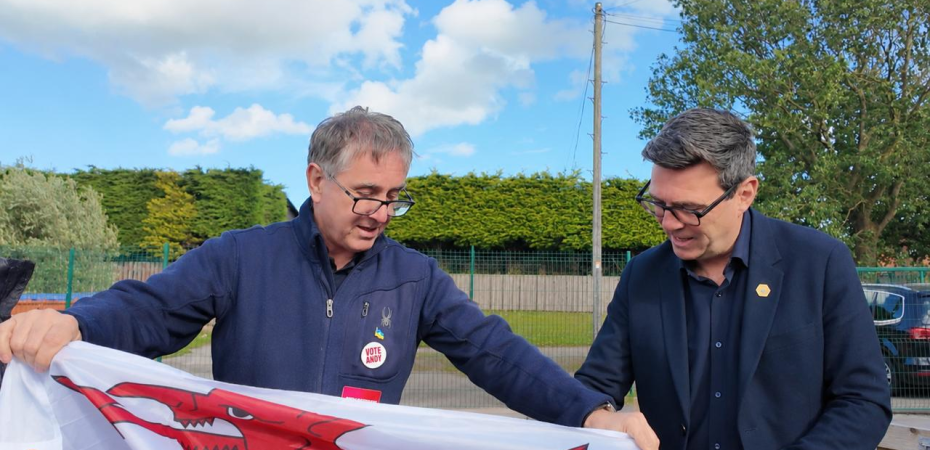
Image: Mick Antoniw with Andy Burnham, c/o author.
The British public prefer a Labour leadership contest over any coronation for Andy Burnham, a poll has found.
The British public prefer a Labour leadership contest over any coronation for Andy Burnham, a poll has found.
The poll, carried out by YouGov, found that 46% of respondents prefer a contest, compared to 23% of those who said they preferred a coronation.
When it comes to 2024 Labour voters however, more people prefer a coronation (40%) compared to a contest (37%).
It comes after Keir Starmer announced he was stepping down as Prime Minister, following intense pressure to set a timeline for his departure from MPs and cabinet ministers.
Nominations for Labour leader open on 9th July, and Burnham could become PM as early as 17th July, should no one challenge him.
There had been reports that Starmer loyalists were encouraging Darren Jones to stand, however, he has ruled himself out this morning, with a coronation looking increasingly likely.
Blairite retread James Purnell tipped to be Andy Burnham’s Chief of Staff

JUNE 24, 2026
This would be a catastrophic mistake. Labour’s new leader needs to think again.
In a move that will alarm those hoping for genuine change from an incoming Andy Burnham government, former Blairite minister James Purnell, who has extensive corporate lobbying links, looks set to be the next Prime Minister’s Chief of Staff.
Purnell is tipped to take over one of the most powerful jobs in government, the role occupied by Morgan McSweeney under Keir Starmer until he was forced to resign in disgrace.
There are several reasons that this is very bad news. The privately educated Oxford graduate had a long relationship with Tony Blair since he worked as a researcher for him during summer vacations between 1989 and 1992. He then worked for the centre-left Institute of Public Policy Research before becoming a councillor in the London Borough of Islington.
It was during this time that one of his fellow councillors, Liz Davies, was chosen as the Labour prospective parliamentary candidate for Leeds North East, only to be overruled by the Party’s National Executive Committee in September 1995. Liz Davies later initiated legal proceedings against Purnell and two other Islington councillors who had made untrue allegations about her behaviour at Council meetings. They were forced to apologise and pay an undisclosed sum to the general election fund of their local MP, Jeremy Corbyn.
When New Labour swept to power in 1997, Purnell became a special advisor in Downing Street for four years. He also worked for a media consultancy business.
Elected to the safe seat of Stalybridge and Hyde in 2001, Purnell was Chair of Labour Friends of Israel for two years before rising through the ministerial ranks to Cabinet membership as Secretary of State for Culture, Media and Sport in 2007 and Work and Pensions Secretary in January 2008.
Kenn on ‘welfare reform’, Purnell appeared to swallow wholesale the Thatcherite myth that the benefits system had created a ‘dependency culture’. He accepted in full investment banker David Freud’s report Reducing dependency, increasing opportunity: options for the future of welfare to work, which proposed greater involvement of the private sector and a more punitive benefits culture even before the Tory austerity years. The following year Freud defected to the Tories.
Labour’s choices after Makerfield – Simon Fletcher

Simon Fletcher writes about the Makerfield by-election and the choice for the Labour Party following Andy Burnham’s emphatic victory. Note: this piece was written before Keir Starmer’s resignation, but contains vital analysis.
The Makerfield byelection was unique. Until now, no one has lived through a period of Labour politics in which a by-election was held with the clear purpose of removing the party leader and Prime Minister. Five points are posted below in the wake of Makerfield. Much is missed, and much more can and should be added as things develop.
1/ Andy Burnham’s victory in the Makerfield was overwhelming and emphatic. He took 55 per cent of the vote. His victory in 2026 was larger than in Makerfield in the general election two years ago on a higher turnout. He significantly increased Labour’s lead over Reform. It is a victory both in the election and against the trend of recent politics.
2/ Before turning to the Labour Party, on the right: the Makerfield result is a serious setback for Reform and the wider right. Reform has now been defeated in byelections in Greater Manchester twice this year – first by the Greens in Gorton & Denton, and now by Andy Burnham in Makerfield.
Over the past two weeks, a vicious campaign has been underway in sections of the media to squeeze the vote of Restore Britain, the right splinter from Reform led by Rupert Lowe, in order to prevent a split right-wing vote letting Burnham through. The right-wing Sun newspaper ran a page of analysis detailing how Nigel Farage had spoken to Donald Trump to complain that Elon Musk’s support for Restore was an obstacle for Reform. It was said that Reform was ready to blame Restore for a Burnham government, through its splitting of the vote in Makerfield.
None of this came to anything – Burnham’s margin of victory over Reform was far larger than Restore’s 6.8%. He won 54.8% to Reform’s 34.5%. Consequently, both Reform and Restore went down to a big defeat.
It is, of course, a mistake to believe that the hard/extreme/far right(s) can be defeated only at the ballot box. The fight against the right is also in communities, on the streets, in the formation and battle of ideas, on social media, and in political debate. But it is equally an error to downplay the importance of defeating them through the electoral process, not least because the right ultimately intends to take its politics all the way through to government.
Over the last month, the right has been on the march. Reform had taken a swathe of councils in England. Farage and Lowe competed with dangerous language over the murder of Henry Nowak and the horrific attack in Belfast. Violent disorder in Southampton and pogromist rioting in Belfast played out against a backdrop of far-right figures calling for mass deportations of non-white people. Questions of the border between the north and south Ireland were raised.
Defeat for Reform, with a majority larger than Restore’s vote, will not only provide a partial feeling of optimism that the right can be stopped, but may ultimately provoke a crisis within the ranks of the right, including for its leadership figures.
There is no space for complacency, but the right’s defeat is also a positive development after weeks of hate.
3/ The overall left/liberal/green bloc in Makerfield cohered under Burnham. Luke Tryl of More In Common has noted the relative stability of the two broad halves of the electorate in the constituency. In 2024, the right bloc, i.e. Tories and Reform, constituted 42.7 per cent of the electorate, the great bulk of which was for Reform. The left/liberal bloc of Labour, Green and LibDem constituted 56.4 per cent. This week, the right bloc of Reform, Restore and Tory came to 43.5 per cent of the vote, only marginally larger than two years ago. And the left/liberal bloc was not much different from last time either, slightly down to 55.9 per cent. The stability of the left/liberal bloc is interesting in itself because conditions are so much harder, with Labour in power and unpopular, and with the cost of living still biting. But this time Burnham took almost all of it – 54.8 per cent of votes cast. The coalescing around Burnham allowed him to secure the much greater margin of victory over Reform.
Labour lost more votes to liberal/progressive/left parties than to Reform in the May elections. And the loss of those votes aided Reform. Makerfield has demonstrated this process in reverse.
4/ The fallout from Makerfield represents a new and higher level of crisis for the Labour Party’s right wing, and raises questions about what it will choose to do next. It was the political choices of the right that brought the party to its knees and provoked a rolling leadership crisis over many months.
In the face of repeated crises, Downing Street and its allies on the party’s NEC moved to block a meaningful future leadership election by preventing Andy Burnham from seeking the Labour nomination for the Manchester Gorton & Denton byelection, subsequently won by the Greens. Gorton & Denton formed a perfect backdrop for the Greens’ advance in the May elections.
Blocking Burnham was both about protecting Starmer and making the terrain easier for the right when Starmer eventually leaves.
The desertion of voters and the break-up of Labour’s electoral coalition – directly as a result of the policies of the Labour government – meant that Labour lost power in spectacular fashion in multiple contests in May. But the last two years have shown that in defence of its own status as the dominant faction of the Labour Party, and in the interests of keeping the party’s economic programme largely toothless, the pro-leadership faction is willing to jettison holding power all over Britain – shedding political control everywhere from the Welsh Senedd to councils from Gateshead and Sunderland to Hackney and Lambeth. Those disastrous losses in May and Keir Starmer’s poor response further weakened him and the ability of the right to get its way. Having been unable to block Burnham a second time, Labour’s right wing is in a highly defensive situation and forced to look for delaying tactics.
But a second tactic for the right is not to defeat Burnham in an election but instead to work out how to function under a likely Burnham leadership, which means seeking to put him under pressure to bend the stick towards their politics. The right of the party functions as the most consistently pro-big business, pro-war, pro-capital strand of opinion within the party, aiming to make Labour as safe and acceptable to big capitalism as possible. In the event of not being able to win, the right’s plan B is to tie down a more soft left leadership with pressure on economic and social policy and international policy – pushing for higher military expenditure, cuts to welfare, opposition to public ownership, restraint on public investment, elevation of relationships with big business, and the continuation of the status quo on foreign policy. In all this, it is aided by media commentary.
Likewise, the right will push for its personnel to be in the most key positions – to keep Rachel Reeves as Chancellor or at least bring in someone such as Darren Jones or Pat McFadden to help calm the bond markets, sack Ed Miliband, etc. Plan B from the right would kill off a Burnham government’s ability to build and hold a coalition together to defeat Reform, every bit as much as plan A under Starmer or Wes Streeting.
Furthermore, a change to a leader based on the PLP’s soft left represents a challenge to the internal dynamics of the party, where the right-wing Labour First/LabToWin formation is currently the pro-leadership grouping in the grassroots and in the party’s structures. But it is evident from social media that many of the right’s adherents are bitter opponents of Burnham. Ed Miliband’s leadership period demonstrates that leaders without a base that can organise beyond the right’s framework struggle to transcend it. And left to itself, the right will continue to use its weight in the party’s structures to pursue fixes and stitch-ups that damage the political culture, and utilise the policy process and NEC to head off pressure for more radical change from the grassroots. Changing leader would only go so far without a change in the dynamics of the party’s internal politics.
5/ Fundamentally, as a change in leadership becomes inevitable, Labour’s choices go back to the question of overturning the wrong choices of the dying leadership.
Under Starmer and Reeves, Labour’s economic framework formed the basis of its conservative policy choices, which reduced its electoral/social base at the general election and deprived it of any meaningful popular enthusiasm; that was then expressed in its actions in government, such as the winter fuel allowance cut and the attack on the welfare state. Increasing authoritarianism through the erosion of the right to trial by jury and the aggression towards the right to protest have alienated supporters of civil liberties. Conceding to Reform on immigration and the failure to mount a sustained defence of the reality of multicultural Britain – typified by Keir Starmer’s disastrous ‘island of strangers’ speech – caused a gulf to open up between the party and many natural supporters. These domestic errors went alongside the Labour leadership’s immoral approach to the genocidal onslaught against the Palestinian people, alienating key sections of the population. That is all discussed in more detail here.
It is inevitable that attention will be drawn to the drama of what happens next. More important is whether and how to overcome the failings of the recent past.
Britain has suffered from decades of chronic underinvestment. A changed approach for the economy that radically boosts public investment to generate the sustained growth people need is required. That must come with more immediate measures to ease the cost of living and move on from inequality. A mood is building in the labour movement through the unions for economic alternatives. There is a vast amount to deal with, including obviously AI and climate change, but it is also essential to address public investment and constrained household incomes. Without these, a Labour government will be unable to address the immediate and long-term living standards of working-class people and indeed the majority of the population.
An incoming leadership that is not also honest about what went so badly wrong on Gaza and is unwilling to correct it would not be able to reassemble Labour’s electoral coalition on a stable footing.
Ideas championed by the Left, from public ownership to wealth taxes and beyond, are in step with public opinion and indeed reflect the concerns of sections of the population that have been willing to stop voting Labour as a consequence of the record of the Starmer leadership. The Left needs to keep making the case for these policies, and the leadership needs to be willing to open to that, not attack it as Starmer did.
- This article was originally published by Simon Fletcher’s Modern Left on 19 June 2026.
- You can become a subscriber of Modern Left to receive exclusive content and support the platform here; and follow Simon Fletcher on Twitter/X here.
- If you support Labour Outlook’s work amplifying the voices of left movements and struggles here and internationally, please consider becoming a supporter on Patreon.
Purnell even proposed charging interest on crisis loans to the unemployed and pensioners made by the Department for Work and Pensions, which were interest-free, at a rate of up to 26.8% per annum. The proposal was met with great hostility and blocked by Prime Minister Gordon Brown.
Purnell evidently never forgave his leader and resigned from the government as the polls closed on the night of June 2009’s local and European elections, calling on Brown to quit at the same time. His resignation stole the headlines that night and the Murdoch-owned Times ran his resignation letter in full on its front page the following day.
He backed the right wing David Miliband for the Labour leadership in 2010. When Ed won the contest, Purnell turned down the job offer of Chief of Staff and, having left Parliament, made a good living in the world of consultancy. In 2011, he again advocated ‘welfare reform’, saying that “freebies” such as the Winter Fuel Allowance and free bus passes should not be seen as sacred.
In recent years, Purnell has had a lower profile, working in broadcasting and the arts. But in 2024 he was appointed as CEO of Flint, a British international advisory business. It’s a role that has become a matter of considerable concern in relation to his expected new job under Andy Burnham. Big companies with important political links, including BP, Amazon, Jaguar Land Rover and Uber, are listed among Flint Global’s clients. The company says it advises international businesses and investors on policy, politics, regulation and competition.
“Until recently,” reports the Guardian, “Purnell held shares in the firm, which is owned through a holding company based in Jersey, making its structure opaque. It is majority owned by the private equity firm Cinven.
“Despite not publishing who it works for in the UK, a list of its clients from last year is registered on the transparency register of the EU, which includes Google, Microsoft and the mining firm Glencore. Apple appeared to be its biggest client in Europe.”
The paper continues: “Burnham’s choice of Purnell has already caused some consternation among many of his supporters on the Labour left, who fear it has echoes of Keir Starmer’s decision to appoint key Blairites such as Peter Mandelson as US ambassador and Tim Allan as director of communications – both of whom still had stakes in lobbying firms that they did not give up while in post.”
Green leader Zack Polanski called Purnell “a tireless campaigner for welfare cuts” and told openDemocracy: “It seems it’s out with the old and in with the old. What is it about this Labour government that is so keen on bringing in corporate lobbyists into the heart of Downing Street? This is starting to feel like a bit of a Blair and Starmer tribute act, with Labour Together’s Josh Simons also expected to have a senior role.”
Josh Simons, who also resigned in disgrace from Keir Starmer’s government, was director of the divisive faction Labour Together, whose appalling behaviour continues to be generate shock waves. Former Shadow Chancellor John McDonnell MP today again reiterated his call for a public enquiry into the organisation.
As Cabinet Office minister, Simons was the centre of a scandal over an alleged smear campaign in which he falsely linked journalists investigating Labour Together to a “pro-Kremlin” network, reportedly hiring a PR firm to investigate Paul Holden, author of The Fraud, and forwarding its findings to the security services. He subsequently resigned his Makerfield seat, paving the way for Andy Burnham’s return to Westminster politics.
If Andy Burnham is serious about delivering change, that has to start at the top. Another former lobbyist in a senior Number Ten post – especially one with the welfare-cutting, Blair-supporting history of James Purnell – would be the wrong choice. Andy Burnham needs to think again.
Image: https://commons.wikimedia.org/wiki/File:James_Purnell_at_the_LCF21_digital_Graduate_Exhibition_at_Victoria_House_Basement_2021,_London_Photograph_Ana_Blumenkron.jpg Author: University of the Arts London, licensed under the Creative Commons Attribution-Share Alike 4.0 International license.


No comments:
Post a Comment