It’s possible that I shall make an ass of myself. But in that case one can always get out of it with a little dialectic. I have, of course, so worded my proposition as to be right either way (K.Marx, Letter to F.Engels on the Indian Mutiny)
Wednesday, November 20, 2024
Canada Post, union sit down with mediator, but still ‘far apart’ as strike drags on
By Christopher Reynolds,
The Canadian Press
November 19, 2024
Pedro Antunes, Conference board of Canada, talks to us and give his take on the postal strike and the potential hit to the economy.
Canada Post and the postal workers union found slivers of consensus Tuesday amid talks with a special mediator, but “a lot of ground” remains between them on the key concerns as a countrywide strike entered its fifth day.
“On smaller issues, we were able to find some progress,” said Canada Post spokesman Jon Hamilton in a phone interview.
“The special mediator has helped facilitate those discussions. So we’re going to continue to be at it. We’re committed to getting collective agreements,” he said, adding that arbitration is off the table for now.
“There’s still a lot of ground to cover.”
With deliveries at a standstill, the Crown corporation and the Canadian Union of Postal Workers continue to bargain over a pair of contracts — one for rural and suburban mail carriers that was discussed Monday, the other for urban carriers that was under the microscope on Tuesday.
The union said progress was made due in part to the presence of Ottawa’s top mediator, appointed to the task last week. Peter Simpson, director general of the Federal Mediation and Conciliation Service, spent the start of the week at a hotel in Ottawa shuttling between the parties’ conference rooms in a back-and-forth of proposals and potential concessions.
“After 12 months of discussions, the employer finally began to move on the pressing issues. Resolving these issues could pave the way to agreements,” union president Jan Simpson said in an update to members Tuesday.
“The urban unit will find out if there is movement on their side.”
About 55,000 employees represented by the Canadian Union of Postal Workers walked off the job on Friday, shutting down operations and halting deliveries as the busy holiday season kicks off.
The union has called for a cumulative wage hike of 24 per cent over four years, while Canada Post has offered an 11.5 per cent increase.
Other wedge issues include job security, benefits and contract work for parcel delivery on weekends.
Negotiations between Canada Post and its unionized employees began in November 2023.
The talks come as the federal delivery service faces an unprecedented financial crisis.
In the first half of 2024, Canada Post lost nearly a half-billion dollars. It has reported $3 billion in losses since 2018, as Canadians sent fewer letters while competitors gobbled up even more of the parcel market.
Households received seven letters a week on average in 2006, but only two per week last year, according to Canada Post’s latest annual report, which dubbed the trend “the Great Mail Decline.”
Both the union and the Crown corporation have put forward service expansion around parcels as a way to boost revenue, but they differ on how to go about it. The union says full-time employees should deliver package shipments on weekends, while Canada Post hopes to hire contract workers.
“What’s needed there is a new, flexible delivery model that allows us to provide parcel service on weekends and provide prices that are more competitive than the other services that Canadians are looking for when they’re shopping online,” Hamilton said.
According to last year’s annual report, the postal service’s share of the parcel market eroded from 62 per cent before the COVID-19 pandemic to 29 per cent last year, as Amazon and other competitors seized on skyrocketing demand for next-day doorstep deliveries.
On top of weekend work and wage bumps to make up for inflation, the union is seeking higher short-term disability payouts and ten paid sick days per year. It also wants to include corporate vehicles for rural and suburban mail carriers as well as paid meals and breaks.
“Unlike Canada Post’s proposals, our demands offer real solutions: fair wages, health and safety, the right to retire with dignity and expansion of services at the public post office,” said lead negotiator François Senneville in a statement earlier this month.
Amid the sudden halt of Canada Post deliveries — government benefit cheques are among the few exceptions — business has shot up at other shipping outfits.
“We have seen a double-digit increase in volumes week over week as we continue to meet the needs of Canadians at this busy time,” said Purolator — majority-owned by Canada Post — in an email.
FedEx has implemented a “contingency plan” to manage higher volumes, said spokesman James Anderson.
The last postal work stoppage took place starting in late October 2018, when employees carried out rotating strikes lasting 31 days.
Previous postal strikes held in 2011 and 2018 ended when the federal government passed legislation sending employees back to work.
This report by The Canadian Press was first published Nov. 19, 2024.
OPG wraps up Darlington 1 refurbishment early
Tuesday, 19 November 2024
Refurbishment activities have been completed five months ahead of schedule at the third of four nuclear units to undergo the process at the Ontario Power Generation plant, which will soon be reconnected to the grid.
The turbine hall at Darlington 1 (Image: OPG)
The 875 MWe unit was taken offline for refurbishment in February 2022, following units 2 and 3, which completed refurbishment in 2020 and 2023, as part of a 10-year CAD12.8 billion (about USD9.7 billion) mega-project to refurbish all four Candu units at the site. The final unit undergoing refurbishment, unit 4, is currently in the reactor rebuilding phase, and is on schedule to be completed by the end of 2026.
Separately, the Canadian Nuclear Safety Commission (CNSC) announced it has removed the fourth and final regulatory hold point for the Darlington 1 refurbishment, allowing Ontario Power Generation (OPG) to exceed 35% full operating power for the refurbished reactor and proceed with normal operations. Hold points are mandatory checkpoints where CNSC approval is required before the licensee can move on to the next stage of the process to return the unit to operation.
The refurbishment will allow the units to continue generating electricity for a further 30 years. In addition, unit 1 will become the first Darlington reactor to produce cobalt-60, a vital radioisotope whose uses include sterilising single-use medical devices, such as syringes, implants, and surgical instruments. About half of the global supply of the isotope is produced in Ontario's Candu reactors.
"With the refurbishment of another unit, OPG, our employees, and our project partners continue to demonstrate that we can execute major nuclear projects not only on time, but ahead of time, and with a clear commitment to quality," OPG President and CEO Ken Hartwick said. "This latest milestone reflects our decade of preparation and planning, as well as our dedication to quality and innovation, and the hard work of our entire project team, vendors, skilled trades, and energy professionals."
"Ontario needs more electricity - 75% more by 2050 - to power new homes, historic new investments and an electrifying economy," the province's Minister of Energy and Electrification Stephen Lecce said. "Delivering this massive clean energy project five months ahead of schedule is a testament to the incredible knowledge and skill of Ontario workers and positions us for success as we build out our plan to meet the soaring energy demand over the next 25 years."
According to a report by the Conference Board of Canada, the Darlington refurbishment project and the subsequent 30 years of station operation are expected to generate a total of CAD90 billion in economic benefits for Ontario and create 14,200 jobs per year.
Norway SMR options to be explored with X-energy
Tuesday, 19 November 2024
Norsk Kjernekraft has signed a memorandum of understanding with high-temperature gas-cooled pebble-bed nuclear reactor developer X-energy to explore the deployment of small modular reactors in Norway.
A conceptual rendering from earlier this year of how a data centre with an SMR power plant and a green electrolysis factory might look (Image: Norsk Kjernekraft)
The memorandum of understanding also encompasses DL Energy and DL E&C, from South Korea's DL Group, who signed a collaboration agreement with Norsk Kjernekraft in August. The Norwegian company said the aim was to combine the Korean firm's expertise and experience in building nuclear power facilities with the US-based X-energy's reactor technology.
The August agreement included a feasibility study of constructing a nuclear power plant at the Mongstad oil refinery in the Austrheim and Alver municipality, with the Norwegian firm aiming for such a plant to be built by the mid-30s if there is "political will". In August Norsk Kjernekraft also submitted a proposal to Norway's Ministry of Energy for an assessment of the potential construction of a power plant based on multiple SMRs in the municipality of Øygarden, west of Bergen. That proposal followed proposals submitted for SMR power plants in Aure and Heim municipalities, as well as Vardø municipality.
Last month internet shopping and web services giant Amazon announced it was taking a stake in X-energy with the goal of deploying up to 5 GW of its small modular reactors in the USA by 2039.
Jonny Hesthammer, CEO of Norsk Kjernekraft, said: "South Korea has extensive experience in the efficient construction and operation of nuclear power plants, while the US has the leading technology. The recent investment by Amazon, one of the world’s largest companies, in X-energy underlines the importance of this agreement. This is simply because it increases the chances of succeeding. While the SMRs to be developed by X-energy are considered fourth generation, the technology is well-proven. Their use of TRISO fuel in the form of tennis ball-sized pebbles means that meltdown is not possible, something that many worry about."
Alistair Black, Senior Director for X-energy, said: "We’re delighted to be working with DL Energy to assess the potential for an Xe-100 advanced small modular reactor project in Southwest Norway for the nuclear development company Norsk Kjernekraft. We have projects under way in the US and could help Norway decarbonise its industrial sector and transport network and meet growing electricity demand from the booming artificial intelligence and cloud computing sectors."
In June, the Norwegian government announced the appointment of a committee to conduct a broad review and assessment of various aspects of a possible future establishment of nuclear power in the country. It must deliver its report by 1 April 2026.
X-energy's Xe-100 is a Generation IV advanced reactor design which X-energy says is based on decades of high temperature gas-cooled reactor operation, research, and development, and is designed to operate as a standard 320 MWe four-pack power plant or scaled in units of 80 MWe. At 200 MWt of 565°C steam, the Xe-100 is suitable for a range of uses and power applications including mining and heavy industry. The Xe-100 uses tri-structural isotropic (TRISO) particle fuel, which has additional safety benefits because it can withstand very high temperatures without melting.
X-energy says its design makes it road-shippable with accelerated construction timelines and more predictable and manageable construction costs, and is well suited to meet the requirements of energy-intensive data centres.
Generator stator arrives at Hinkley Point C
Tuesday, 19 November 2024
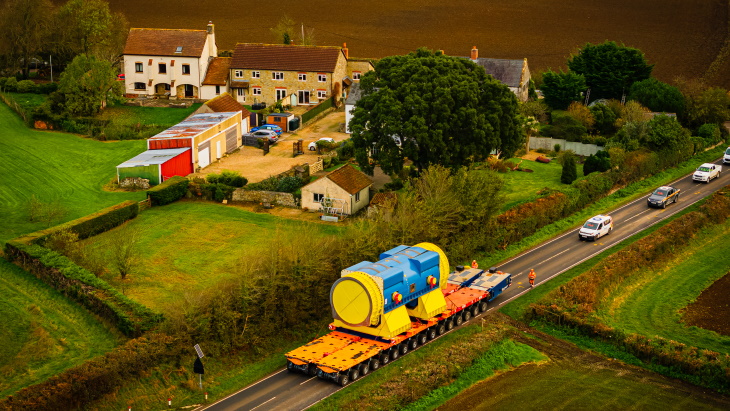
The turbine generator stator for the Hinkley Point C nuclear power plant under construction in Somerset, England, has been delivered from the manufacturing plant in Belfort, France.
The stator arrives at the construction site (Image: EDF Energy)
The stator - measuring 12 metres in length and weighing 450 tonnes - was supplied by EDF subsidiary Arabelle Solutions. It was delivered to the construction site on 17 November following a journey via road, rail and sea.
(Image: EDF Energy)
The stator is a key component of the turbine generator, serving as the stationary portion of an electric generator that converts the rotating magnetic field into electric current.
(Image: EDF Energy)
EDF completed its acquisition of a portion of GE Vernova's nuclear conventional islands technology and services, including its Arabelle steam turbines, in May this year. The transaction included the manufacturing of conventional island equipment for new nuclear power plants as well as related maintenance and upgrade activities for existing nuclear plants outside of the Americas. EDF's acquisition of the business - at that time, known as GE Steam Power - was first announced in early 2022 and the final agreement was signed in the November of that year.
Construction of Hinkley Point C - composed of two EPR pressurised water reactors of 1630 MWe each - began in December 2018, with unit 1 of the plant originally scheduled to start up by the end of 2025, before that was revised to 2027 in May 2022. In January, EDF announced that the "base case" was now for unit 1 being operational in 2030, with the cost revised from GBP26 billion (USD32.8 billion) to between GBP31-34 billion, in 2015 prices.
When complete, the two EPR reactors will produce enough carbon-free electricity for six million homes, and are expected to operate for as long as 80 years.
SMRs to help decarbonise Dutch energy system, study concludes
Monday, 18 November 2024
Small modular reactors could play an important role and contribute to the Dutch energy transition, a joint report by NRG-Pallas and TNO concludes. The study shows that there is room for more than 13 SMRs in 2050.
(Image: NRG-Pallas / TNO)
The study, the partners said, utilises "NRG-Pallas' expertise in innovative reactor technologies and TNO's energy system model OPERA".
Two scenarios drawn up by TNO were used in this study: ADAPT and TRANSFORM. These scenarios are based on different visions of the future for the Dutch energy system. In both visions, the aim is to reduce greenhouse gas emissions by 55% by 2030 and to achieve greenhouse gas neutrality by 2050.
In order to investigate the sensitivity of the results with respect to boundary conditions and assumptions, a few 'what-if' analyses were performed. These what-if analyses examined whether investment in and use of SMRs change when input parameters are varied.
"The results show that SMRs have a role to play in the Dutch energy transition," the study says. "The optimal contribution of SMRs to 2050 was calculated for various assumptions about future society. The results show that two to more than 13 SMRs (of 150 MWe) can be deployed with room for further expansion of this number in 2050."
It adds: "These results are contingent on policy objectives, expected market availability and realisation periods. If constraints on the potential deployment capacity are partially lifted, as is done in some of the what-if analyses, it is observed that there may even be room for more than 27 SMRs (of 150 MWe). This what-if analysis result can be interpreted as a more economically optimal solution, but is obviously conditional on the aforementioned aspects used to define the potential limits for the scenarios being sufficiently adjusted to allow for this to occur.
"On the other hand, with delayed introduction of SMRs or no nuclear at all, a carbon neutral energy system in 2050 is possible as well. The exact optimum depends mainly on the future of industry, and more specifically on the future heat demand from activities such as refineries and (bio-)aromatics production, and the degree of electrification in society. Nevertheless, it can be concluded that SMRs are an important option for decarbonisation of the industry by supplying process heat."
An earlier scenario study by TNO showed that in an energy system without new nuclear power plants, the system costs are 1% to 2.5% higher than with nuclear energy. "Although nuclear power plants are initially more expensive than wind turbines and solar panels, the loss of nuclear energy as an energy supply should be compensated for by greater use of more expensive flexibility options, such as energy storage," NRG-Pallas noted.
In April 2023, in its draft Climate Fund for 2024, the Dutch government budgeted funds totalling EUR320 million (USD352 million) for the development of nuclear energy. The funds will be used for the preparation of the operational extension of the existing Borssele nuclear power plant, the construction of two new large reactors, the development of small modular reactors and for nuclear skills development in the Netherlands.
In August 2022, the UK's Rolls-Royce SMR signed an exclusive agreement with ULC-Energy to collaborate on the deployment of Rolls-Royce SMR power plants in the Netherlands. ULC-Energy - established in 2021 and based in Amsterdam - aims to accelerate decarbonisation in the Netherlands by developing nuclear energy projects that efficiently integrate with residential and industrial energy networks in the country.
Chernobyl considered as site for new small modular reactors
Monday, 18 November 2024
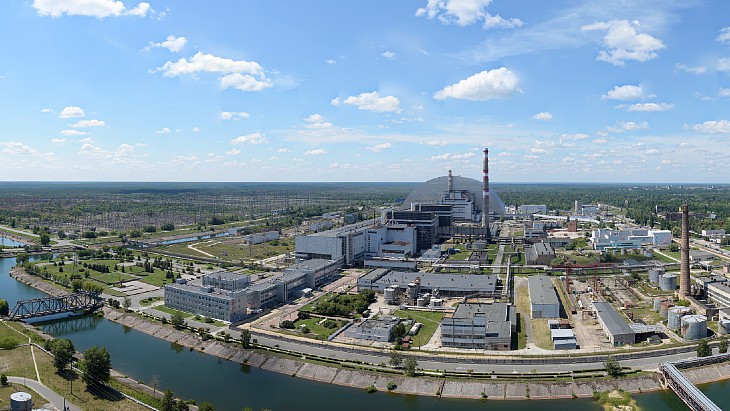
The area around the Chernobyl nuclear power plant is one of the places being looked at as potential locations for Ukraine's planned future wave of small modular reactors.
The former Chernobyl nuclear power plant is surrounded by an exclusion zone (Image: CHNPP
Representatives of the State Agency of Ukraine on Exclusion Zone Management and specialists from Ukraine's nuclear energy giant Energoatom, joined Chernobyl Nuclear Power Plant (CNPP) officials last month to visit several areas within the exclusion zone and around the plant, CNPP reported. "This was followed by a technical discussion on the suitability of these sites for future SMR construction," it added.
It was the second on-site meeting to "review potential locations for small modular reactors (SMRs) proposed by Chornobyl NPP and discuss land allocation matters".
The Chernobyl nuclear power plant lies about 130 kilometres north of Kiev and about 20 kilometres south of the border with Belarus. Following the 1986 accident, a 30-kilometre exclusion zone was created around it. (Read more: World Nuclear Association's guide to the Chernobyl accident)
Ukraine's big plans for SMRs
Ukraine has plans for as many as nine new Westinghouse AP1000 large reactors across the country, as well as developing a programme for SMRs. Progress on its new nuclear has continued amid the on-going war with Russia, which has seen its largest nuclear power plant - Zaporizhzhia NPP - under Russian military control since early March 2022.
Energoatom signed an agreement last year which could pave the way for up to 20 of Holtec's SMRs. It has also been exploring options with a number of other potential SMR providers.
On Saturday at the COP29 UN climate conference in Baku, Azerbaijan, US Under Secretary of State for Arms Control and International Security, Bonnie Jenkins, and Ukraine Minister of Energy Herman Halushchenko announced three project partnerships:
- To build a pilot plant in Ukraine to demonstrate production of clean hydrogen and ammonia "using simulated safe and secure small modular reactor technology". The project is being carried out by a multinational public-private consortium from Japan, South Korea, Ukraine, and the USA. - Project Phoenix funding to help facilitate the transition of Ukraine’s coal-fired power plants to SMR nuclear power plants, carrying out siting and feasibility studies. - To develop a roadmap and provide technical support to rebuild, modernise, and decarbonise Ukraine’s steel industry with SMRs. The roadmap will pave the way for using clean electricity, process heat, and hydrogen from SMRs for clean steel manufacturing and production
The American Society of Mechanical Engineers (AMSE) said it would be working to support the clean steel programme, with CEO Tom Costabile saying: "Small modular reactors are an important part of the clean energy future, as well as an economic redevelopment opportunity for Ukraine."
Russia places 'tit-for-tat' ban on US uranium exports
Monday, 18 November 2024
Russia has announced restrictions on exports of enriched uranium to the USA. The temporary ban is in response to US restrictions on imports of Russian uranium products which came into force earlier this year.
President Vladimir Putin said in September that Russia would consider placing restrictions on uranium exports (Image: Kremlin)
The Russian government announced the ban on its official website on 15 November as an amendment to Government Decree No 313 of 9 March 2022. It covers exports "to the United States or under foreign trade contracts concluded with persons registered in the jurisdiction of the United States". Exemptions will be made for deliveries under one-off licences issued by the Russian Federal Service for Technical and Export Control.
"The decision was made on the instructions of the President in response to the restriction imposed by the United States for 2024-2027, and from 2028 - a ban on the import of Russian uranium products," the Russian government said. "Vladimir Putin instructed to analyse the possibility of restricting supplies to foreign markets of strategic raw materials in September at a meeting with the Government."
According to the Tass news agency, Russian state nuclear corporation Rosatom said the ban was legal and the expected "tit-for-tat response to actions of the US authorities". Deliveries of Russian uranium to countries other than the USA "will continue without changes, on conditions agreed with customers and subject to requirements of national laws", Rosatom said.
Kremlin spokesperson Dmitry Peskov told Tass that "in cases where it serves our interests, Russia’s Federal Service for Technical and Export Control may decide to exclude certain items from this list of bans", but said the government had assessed the implications and consequences of the "absolutely reciprocal" countermeasures. "But the key point is that this should fully align with our interests and not undermine them. That is the basis for what has been done," he said.
US President Joe Biden signed the Prohibiting Russian Uranium Imports Act in May after the bill was passed unanimously by the US Senate. The prohibition came into effect in August, and will last until the end of 2040. Waivers may be granted to allow the import of limited amounts of Russian-origin LEU, under certain circumstances, until 1 January 2028.
US enrichment company Centrus received such a waiver from the US Department of Energy in July, allowing it to import low-enriched uranium from Russia for delivery to US customers in 2024 and 2025. Tenex - a Russian government-owned company - is Centrus' largest supplier of low-enriched uranium for delivery to its US and international customers pursuant to a 2011 contract.
Tenex has now notified Centrus that its general licence to export the material to the USA has been rescinded under the decree, "effective through December 31, 2025", and that it is now required to obtain a specific export licence from the Russian authorities for each of its remaining 2024 shipments to Centrus and for shipments in 2025.
"Tenex has informed Centrus of its plan to seek the necessary export licences, in a timely manner, to allow it to meet its delivery obligations for the pending Centrus orders," Centrus said in a filing to the US Securities and Exchange Commission. The US company said it will be in communication with its customers whose pending orders may be affected and is assessing actions to mitigate adverse impacts.
"If TENEX is unable to secure export licences for our pending or future orders, it would affect our ability to meet our delivery obligations to our customers and would have a material adverse effect on our business, results of operations, and competitive position," the company said.
According to US Energy Information Administration data, owners and operators of US nuclear power plants purchased a total of 51.6 million pounds U3O8 (19,848 tU) of deliveries from domestic and foreign suppliers in 2023. Most of this came from Canada (27% of total deliveries), Australia (22%) and Kazakhstan (22%): Russian-origin material accounted for 12% of total deliveries. Domestically produced material accounted for 5%. But while US facilities provided 28% of the uranium enrichment services - measured in separative work units, or SWU - purchased by US owners and operators in 2023, 27% came from Russia, more than any other foreign supplier.
(Stock image.) A new report by Rio Tinto Group showed 39% of workers surveyed by the world’s second-biggest miner had experienced bullying within a 12-month period, up from 31% in 2021.
Two years after Rio Tinto pledged to address toxic cultures that were deterring females and non-Whites from the mining industry, details from a survey of more than 10,000 employees have laid bare the challenges it still faces. The rates of sexual harassment and racism that respondents reported were unchanged from three years ago, affecting 7% of those surveyed from workers in nations including Australia, US, Canada, Mongolia and New Zealand.
“While reports of bullying increased across all genders, the largest increase between 2021 and 2024 was against women,” the report said. “This change can be explained by a range of factors including increasing retaliation in the form of gendered bullying as a response to Rio Tinto’s efforts to promote gender diversity and inclusion.”
Rio Tinto’s latest report comes after the government of Western Australia — the nation’s key resources state with massive iron ore and liquefied national gas projects — in June 2022 released its own landmark inquiry. The government report uncovered dozens of shocking cases of alleged sexual harassment and abuse of women workers at companies including BHP Group, Woodside Petroleum, Fortescue Metals Group, and Chevron Corp.
The industry has seen pressure increasing from investors, governments and society to address its impacts on local communities and the wider environment. A focus has been creating a safer work environment for women and minorities, particularly at remote mining sites where so-called Fly In-Fly Out (FIFO) staff are based for several weeks at a time.
Rio Tinto’s company-commissioned external review is the second of its kind. In 2022 it took the rare step of publishing detailed findings from a report conducted the year before that outlined a list of 26 recommendations. Now, 17 measures have been implemented, with the remaining nine still in progress.
Under-reporting issue
In its latest report, Rio Tinto said under-reporting of sexual harassment and racism remained a key issue, with just over 10% of respondents who had experienced the harmful behaviors within the 12-month period lodging a complaint.
Eight people reported experiencing actual or attempted sexual assault or rape in the year, compared with five people in 2021. Meanwhile, First Nations people continued to report a racism at a greater rate, particularly in Australia at 39%.
“We’re at the tip of the iceberg” in regards to getting victims to report their abuse, Kellie Parker, Rio Tinto’s chief executive for Australia, said in an interview. “We are changing by the fact that we’re being transparent. We haven’t got it all, it’s not all roses, but we are prepared to listen and we are prepared to change.”
While around half of respondents reported a perceived improvement in relation to bullying, sexual harassment and racism at Rio Tinto since the first report was conducted in 2021, several respondents also shared that they were regularly told that they only got their roles because they were women and therefore not qualified for the job.
The backlash highlights the complexities facing companies with historically male-dominated workforces as they implement policies aimed at increasing the number of women employees, who are at higher risk of being targeted. Women were more likely to report bullying and were the group that had the biggest increase in reported bullying since the first report, yet the proportion of women in the company’s workforce rose only marginally, to 25% from 22% in 2022.
The survey, conducted in April and May, was open to all Rio Tinto staff and had a response rate of 17.4%.
(By Sybilla Gross)
Paladin’s Fission Uranium takeover delayed by Canada security review
Fission Uranium’s Patterson Lake South facility, Saskatchewan. Fission Uranium photo
Canada’s federal government is extending a national security review of Paladin Energy Ltd.’s acquisition of Fission Uranium Corp., further delaying a deal that was supposed to close in September.
Australia’s Paladin Energy said Tuesday it received a notice from Canada’s industry ministry that the government’s review period for the transaction, proposed in June, will be extended until Dec. 30. The company also warned that the deal could fall apart.
“In light of the national security review of the arrangement, there can be no certainty that Paladin will be able to obtain ICA clearance in a timely manner or at all,” the company said in a filing, referring to the Investment Canada Act. “Failure to obtain ICA clearance would prevent the arrangement from being successfully completed.”
Paladin’s agreement to buy the Canadian company for C$1.14 billion ($817 million) in stock was announced amid a recovery in uranium prices that’s being driven by countries turning to nuclear energy to meet emissions reduction targets. The deal would make it the third-largest publicly traded uranium producer.
But the takeover has faced several hurdles, including a delayed shareholder vote in August and opposition from Fission’s largest investor, China’s CGN Mining Co. At the same time, Prime Minister Justin Trudeau’s government has increased scrutiny on critical-minerals deals involving foreign buyers.
The delay also threatens an agreement that would mark the first time since 2022 that a large foreign mining company listed its shares on the Toronto Stock Exchange. Canada’s bourse has ensured a yearlong dry spell in new corporate listings.
(The opinions expressed here are those of the author, Andy Home, a columnist for Reuters)
China’s announcement that it will end tax rebates on exports of aluminum semi-manufactured products caused market mayhem on Friday and may have major long-term ramifications for the global aluminum supply chain.
The Shanghai price sank and the London price surged as traders factored in the potential annual loss of over 5 million metric tons of Chinese products in the international market.
That’s a worst-case scenario and the reality may turn out to be less dramatic, depending on how China’s aluminum processors cope with what for many is a loss of vital income.
China’s exports of semi-manufactured products
Financial lifeline
The Ministry of Finance’s elimination of the 13% VAT refund effective Dec. 1 also applies to exports of copper products.
China’s shipments of copper products are not insignificant at around 700,000 tons a year but aluminum volumes are on a different scale.
The country’s exports of semi-manufactured products such as bars, sheet and tubes totalled a massive 5.2 million tons in 2023. They will be higher still this year. Outbound shipments grew by 17% in the first nine months of 2024.
Just about all of that tonnage qualifies for the VAT refund, which acts as a financial life-line for many smaller product manufacturers in a ferociously competitive market.
There will be a predictable rush to export before the Dec. 1 deadline and those processors that can will no doubt look to pass on some of the cost hit to international buyers.
The market reaction has been to open a financial arbitrage window to facilitate continued flows of aluminum product from east to west.
The most likely outcome is a sharp drop in export volumes next year followed by some stabilization as exporters adjust to the new financial reality. This is what happened to galvanized steel exports after the authorities eliminated the tax rebate for plate and sheet in 2020.
Much, though, will depend on Chinese processors’ ability to operate without the VAT lifeline.
China’s mid-stream aluminum processing sector is plagued by over-capacity with utilization rates typically below 65% and as low as 40% in some sectors, according to research house AZ Global.
Not everyone is going to survive.
LME and ShFE aluminum year-to-date rebased relative performance International tensions
Why has China pulled the tax trigger? And why now?
The decision appears to be motivated by both international and domestic considerations.
China’s exports of aluminum products have long been a point of tension with Western trading partners, who have accused the country of unfair subsidies and damaging trade practices.
Removing the tax export booster may be a pre-emptive concession at a time when the diplomatic heat is rising.
China has been locked in talks with the European Union over the bloc’s imposition of tariffs of up to 45% on Chinese exports of electric vehicles with both sides keen to avoid a broader trade war.
Meanwhile, the prospect of a new US administration promises more tariff trouble for China given Donald Trump’s threat to impose import duties of up to 60% on all Chinese products entering the United States.
It’s worth noting that Friday’s announcement also included a cut in the VAT refund for both photovoltaic cells and batteries, two other major sources of international trade tension. Domestic realignment
Reducing exports of aluminum products may also address a fundamental tension in China’s domestic supply chain.
The government has imposed a capacity cap of 45 million tons on its smelting sector. National output of primary metal is currently running at an annualized rate of 43.5 million tons, suggesting little further growth potential.
Yet China is going to need more aluminum, a metal that is closely tied to the clean energy revolution in the form of packaging for solar panels and electric vehicle bodies.
Rising demand and static output imply an ever tighter domestic market balance as long as 5 million tons of product are shipped overseas.
Incentivizing the sector for that material to stay at home is one way of ensuring self-sufficiency over the coming years, a key goal for Chinese policymakers across the commodities board. Global no more
The short-term impact of the tax rebate removal may not be as bad as the market fears, but it marks another big step in the fracturing of what was until recently a globalized marketplace.
The United States has been erecting ever higher trade barriers on Chinese aluminum, most recently in the form of a 25% import tariff. Canada has done the same while Mexican shipments to the United States must now come with evidence they haven’t been fabricated from Chinese metal.
The EU has imposed import tariffs on some Chinese aluminum products and a bigger barrier is coming in the form of the bloc’s carbon border adjustment mechanism.
China’s move to limit exports merely adds to the sense that the global aluminum market is breaking down into distinctive regional markets defined by trade barriers.
Western smelters, many of them shuttered due to low prices, and product manufacturers may be the eventual winners from a reduction in Chinese exports.
To what extent, however, depends on how hard the Ministry of Finance’s tweaks to its tax code hit China’s domestic operators.
(By Andy Home, Editing by Emelia Sithole-Matarise)
Citigroup cuts copper forecast on tariffs risk, China outlook
Citigroup Inc. cut its short-term outlook for copper prices by 11% as likely hikes in US trade tariffs under a Trump presidency and weaker-than-expected China stimulus would weigh on demand.
“Former President Donald Trump’s election for a second term marks a clear turning point in global trade tariff policy,” analysts at Citigroup wrote in a note. “And China’s lack of easing to date has surprised us.”
The bank sees prices dropping to $8,500 a ton over the next three months from its previous forecast of $9,500. The industrial metal has already slumped by nearly 10% since late September.
A resurgence in the dollar in anticipation of potentially inflationary policies that could limit US interest-rate cuts helped drive copper’s decline. A stronger greenback typically puts pressure on commodities priced in the currency.
A gauge of the dollar’s strength against a basket of currencies jumped Wednesday, extending the recent election-driven rally, after US inflation data showed the rate of price increases remained firm in October.
China also needs to deploy more economic stimulus if copper demand is to revive, according to a manager at Eagle Metal International Pte, which handles roughly 10% of refined copper imports to the country. Thus far the government has focused on the much-needed restructuring of local government debt, but stopped short of stimulus measures that would directly boost domestic demand.
Copper futures fell on the London Metal Exchange Wednesday, after the so-called core consumer price index — which excludes food and energy costs — increased 0.3% for a third straight month.
Copper futures dropped 1.1% to $9,038.00 a ton on the LME at 3:38 p.m. London time. Aluminum and nickel fell, while zinc rose.
(By Jack Ryan)
OUTLAW DEEP SEA MINING
Deep sea mining risks over $560 billion in countries’ annual export earnings — report
TMC has carried out exploratory mining expeditions to the Clarion-Clipperton Zone (CCZ) — a vast area between Hawaii and Mexico. (Image: TMC.)
Deep sea mining is expected to negatively affect terrestrial mining, risking over $560 billion in annual export earnings, a new report published by financial think tank Planet Tracker argues.
The study, titled Race to the Bottom, claims that the financial returns from mining the seafloor are negligible and urges governments and investors to prioritize environmental preservation and improvements in land-based mining practices
The findings follow US President-elect Donald Trump’s recent nomination of Elise Stefanik, to serve as the the country’s ambassador to the United Nations. Stefanik is a vocal supporter of securing critical minerals for local consumption from potato-sized rocks called “polymetallic nodules”.
These nodules lie on the ocean’s floor at depths of 4 to 6 km (2.5 to 4 miles) and are abundant in the CCZ, where Canada’s The Metals Company (NASDAQ: TMC), already has two exploration contracts.
Planet Tracker’s report also comes a day after the International Union for Conservation of Nature (IUCN) warned that over 40% of coral species face extinction as a result of human activities, including fishing activity, especially bottom trawling, deep sea mining, as well as drilling for oil and gas.
The reports and Stefanik’s nomination coincide with the International Seabed Authority’s (ISA) ongoing work towards the final version of a Mining Code to govern deep-sea mining, expected to be adopted in 2025.
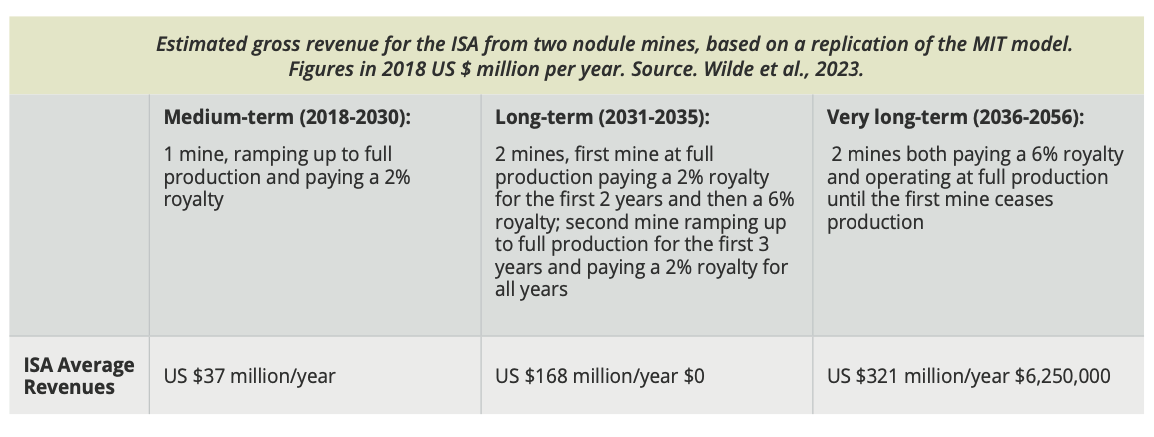
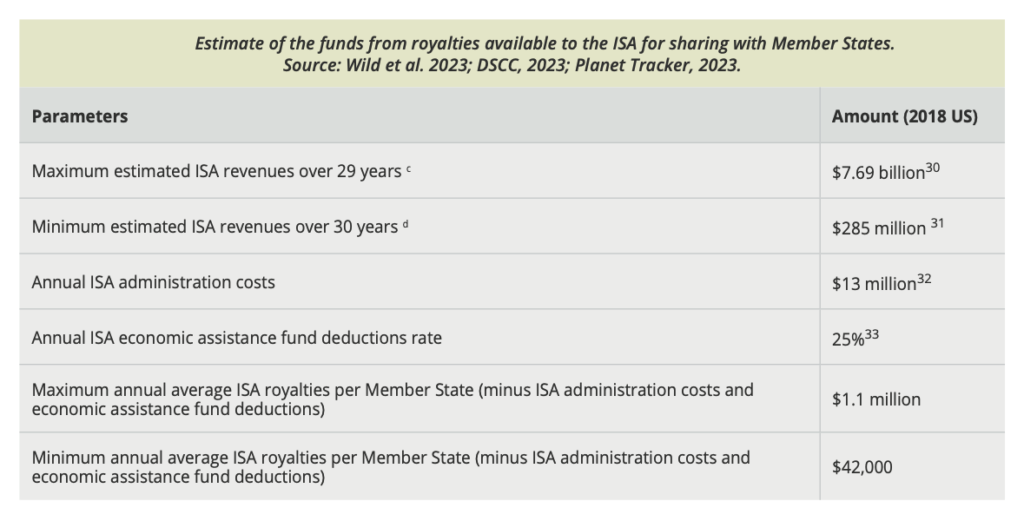
According to Planet Tracker, even in the most optimistic projections, countries involved in deep sea mining could see an annual corporate income tax revenue of just $6.25 million. For most nations, this contribution is inconsequential when measured against the potential environmental costs, the authors say.
“Deep sea mining is expected to offer minimal financial returns to ISA Member States,” Emma Amadi, Investment Analyst at Planet Tracker, wrote. “Countries do not own the mineral resources in international waters, and companies can choose sponsorship from any ISA member State, triggering a race to the bottom in corporate income tax rates.” “Overly simplistic“
The report calculates that royalties, another potential source of income for nations, would range from $42,000 to $1.1 million a year — an insignificant figure for all but the smallest economies. It also warns that these royalties could be subject to arbitrary reductions by the ISA, making it unlikely that member states will receive substantial payouts.
Deep-sea miner The Metals Company said the NGO’s calculations don’t fully capture the complexities involved in this matter.
“As the world’s largest economies gear up for responsible deep-sea mining, activists are throwing the whole misinformation kitchen sink at the public. Take Planet Tracker’s latest: speculating on a fixed annual tax revenue is overly simplistic,” a TMC spokesperson told MINING.COM.
TMC highlighted it has conducted a comprehensive SEC-compliant SK-1300 Initial Assessment for its NORI-D project, which includes detailed underlying assumptions regarding project size, project economics, ISA royalty rates, and onshore tax rates.
“This assessment indicates $7 billion in life-of-mine royalties for Nauru and ISA members, along with $9 billion in life-of-mine taxes,” the spokesperson said. “These figures exclude the majority of NORI’s estimated resource.” Unknown risks
A parallel report by Planet Tracker, Mining for Trouble, highlights the broader economic risks of deep sea mining. The report estimates that countries mining key minerals terrestrially—such as copper, cobalt, nickel and manganese—stand to lose a combined $560 billion in annual export revenues. The potential disruption to these established industries could have far-reaching consequences for global economies.
On the other side of the equation, there are peer-reviewed studies that show how producing battery metals from nodules could reduce emissions of CO² by 70%-75%, cut land use by 94% and eliminate 100% of solid waste.
Opponents to seafloor mining have long-warned that consequences of both exploration and extraction of minerals from the seabed are unknown and that more research should be conducted before going ahead.
Those that support the expansion of the activity believe deep-sea mining is central to meeting the increasing demand of mineral growth. The demand for copper and rare earth metals is predicted to grow by 40%, according to the International Energy Agency.
The Paris-based organization also expects that the demand share for nickel, cobalt and lithium from clean energy technologies alone will grow by 60%, 70% and 90%, respectively.
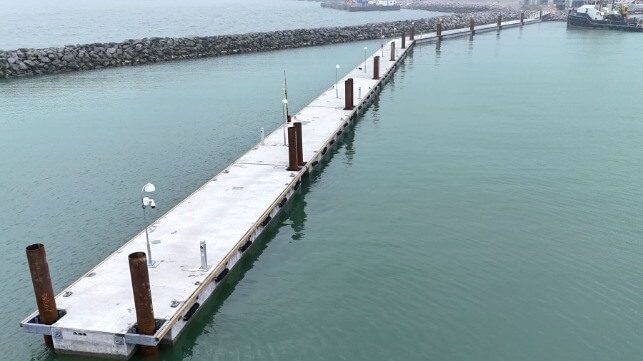
The 11-mile Fehmarn Belt Fixed Link tunnel will connect the Danish island of Lolland with the German island of Fehmarn, reducing travel time from 45 minutes by ferry to a mere 10 minutes, and seven by electric rail. SF Marina is playing an important role in this ambitious five-year development by supplying floating concrete dock pontoons for the project's tugboat pier.
The 705' pier is comprised of ten 65' x 16' SF1850 floating concrete pontoons and one 50'-long center section with a 28° end. This allows the array to gently angle away from the stone breakwater for double-sided docking. Heavy-duty SF1850 series pontoons are designed to handle the rigors of commercial use. Virtually unsinkable, they offer approximately 198 psf of buoyancy yet are extremely stable. SF Marina W400 Connectors deliver 2x10⁵ tons per joint of breaking strength. Internal corner pile guides allow the pier to maintain its 3' freeboard while 21 aluminum bull bollards provide ample tie up locations. Eight rescue ladders and three ring buoy/fire extinguisher pedestals help ensure worker safety.
The concrete pontoons were made at SF Marina's Wallhamn, Sweden facility and transported to the site by truck. The company has six precast manufacturing locations across the globe and a robust delivery network to keep construction schedules on time and logistics expenses low. Strengthening links between Scandinavia and Central Europe, the Fehmarn Belt Fixed Link tunnel is Denmark's largest infrastructure project. It is part of a growing green traffic corridor throughout Europe.
Since 1918, Gothenburg, Sweden-based SF Marina has engineered and manufactured floating breakwaters and concrete dock pontoons, and related marine structures that are built to withstand extreme weather events. With offices worldwide, it has completed commercial and recreational vessel projects around the globe.
The products and services herein described in this press release are not endorsed by The Maritime Executive.
Maersk Redeploys Maersk Halifax After First Conversion to Methanol
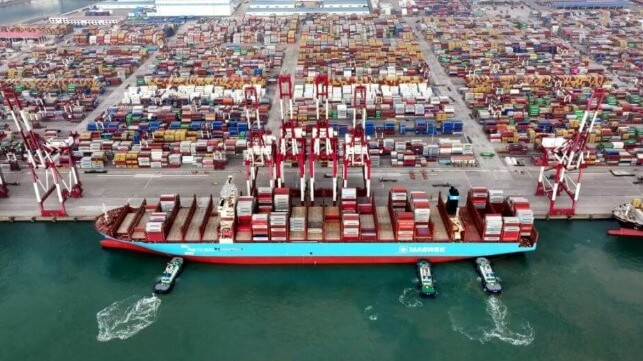
Converted Maersk Halifax starting its first voyage in China (Qingdao Port)
Maersk is reporting that it has successfully redeployed its first-ever methanol conversion containership back into the fleet. The Maersk Halifax is underway making its final call in Asia before crossing the Pacific to Mexico and Panama on its first post-conversion voyage.
“We are happy to announce that Maersk Halifax successfully has been retrofitted into a dual-fuel methanol vessel. Following the completion of the sea trials, Maersk Halifax has returned to operation and is now servicing our customers on the Trans-Pacific trade,” said Leonardo Sonzio, Head of Fleet Management and Technology at Maersk.
The conversion project, which required 88 days at the Zhoushan Xinya Shipyard in China and was completed at the end of October 2024. The ship underwent sea trials late last month with the official handover to Maersk on October 29. She left the anchorage on November 5 making port calls in Shanghai and loaded 5,532 TEUs of export containers at Qingdao Port before making a call in Busan, South Korea. After a call this week in Yokohama, Japan, she is due to depart on November 20 and arrive at the APM Terminals Lazaro Cardenas on December 2.
The project was more complex than other conversions. It was based on a 2017-built vessel, Maersk Honam that was part of the Hong Kong class built by Hyundai. She was originally built with an overall length of 1,158 feet (353 meters) and a capacity of 15,226 TEU. Maersk Honam suffered a tragic fire that killed five crewmembers in 2018 and heavily damaged the forward section of the vessel. The company decided to salvage the ship, cutting the vessel just aft of the deck house and bridge and putting a new forward section onto the ship. She returned to service, renamed Maersk Halifax, in April 2019.
She arrived in China for her special survey and the conversion in July 2024. The engine conversion was carried out by MAN Energy Solutions. Besides replacing machine parts and thereby making the engine able to operate on methanol, the retrofit operation at the yard involved adding new fuel tanks, a fuel preparation room, and a fuel supply system.
The hull was also been expanded to accommodate the fuel tanks. With this change, the length of the ship was extended by 15 meters (49 feet) to 368 meters (1,207 feet), increasing the capacity from around 15,000 to 15,690 TEU. The new dwt is listed at 185,000 tons for the Singapore-registered vessel.
Maersk calls the conversion a demonstration that will provide learning as they seek to expand the deployment of methanol and other green fuels. They said the intent was to convert a sister ship timed to a special survey due in 2027 while MAN said it has been contracted for the potential conversion of all 11 ships of the class.
“In the coming year, we will take learnings from this first conversion of a large vessel,” said Sonzio. “Retrofits of existing vessels can be an important alternative to newbuilds in our transition from fossil fuels to low-emission fuels.”
Maersk is also continuing to move forward with the deployment of its dual-fuel methanol containership newbuilds. The fifth vessel, Alexandra Maersk, was christened at Felixstowe in the UK at the beginning of October. It has a total of 18 large dual-fuel methanol vessels scheduled for delivery in 2024 and 2025.
The orderbook has grown for methanol dual-fuel containerships with DNV reporting a total of 22 are now in service including Express Feeders having launched its network of smaller methanol feeder vessels in Northern Europe. Others including Hapag-Lloyd working with Seaspan and COSCO have also contracted for conversions of existing ships to be converted to a dual-fuel configuration. DNV’s Alternative Fuels Insights database calculates a total of 218 methanol-fueled containerships are due for delivery by 2030.
Project to Build First Hydrogen-Power Containership Receives EU Funding
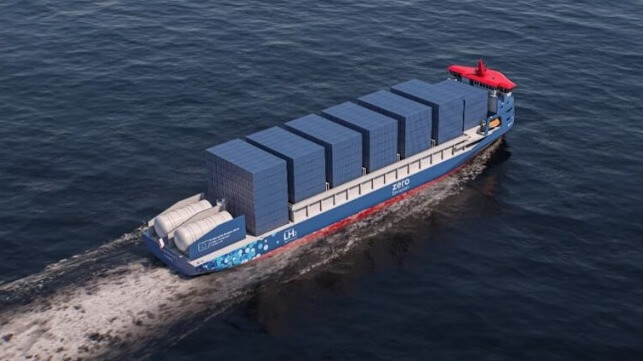
EO2 would carry 1,100 TEU and be powered by hydrogen fuel cells (Energy Observer)
Energy Observer’s efforts to build the world’s largest liquid hydrogen-powered cargo ship are being advanced with the support of the European Union’s Innovation Fund. The containership concept known as EO2 was selected from 85 applications to the fund and awarded €40 million (US$42 million) to advance the development of the vessel.
The current design of EO2 is a 160-meter (525-foot) containership with a carrying capacity of 1,100 TEU. Energy Observer started the project in 2022 with the ambition to develop a demonstration ship that would be the world’s lowest carbon-emitting cargo ship. Energy Observer launched in 2017 with a laboratory vessel using a combination of solar, wind, and hydropower along with storage systems of batteries and hydrogen to be self-sufficient in energy, with zero emissions, zero fine particles, and zero noise. They conducted a global demonstration voyage and now are focusing their ambitions on the containership.
“EO2 represents an exceptional challenge, turning laboratory research into reality,” said Didier Boix, Managing Director of EO Concept. “With an onboard power of 4.8 MW, it’s equivalent to managing a fleet of one hundred hydrogen-powered vehicles, which means we need to step up our skills and rigorous management. We’re working at 360 degrees to integrate the ship’s technologies, structure a port ecosystem dedicated to liquid hydrogen, and develop a digital twin, not forgetting team training.”
To complete the project, the initial investment is estimated at over €100 million. That will cover studies and construction of the vessel. The group submitted its application to the EU in April 2024 as part of the solicitation that sought to encourage the development of clean technologies in sectors that are difficult to decarbonize.
The initial concept for EO2 calls for a vessel with a range of 14 days and 1,600 nautical miles. They plan to equip the vessel with an electric propulsion system powered by hydrogen fuel cells with 12 modules each capable of 400 kW LH2 to provide an average speed target of 12.5 knots. Reserve power and boost capacity would provide the vessel with a maximum speed of 16 knots. The fuel cells are being developed by EODev and its industrial partner Toyota.
It will be approximately 12,000 dwt and operate with a crew of 18. They project the vessel could reduce CO2 emissions by 112,250 tons over 10 years. The current plan projects commercial operations beginning in 2029 on Europe’s Atlantic and Channel coasts.
Accor a French hospitality company provided initial seed funding. Others including CMA CGM, Air Liquid, Toyota, EODev, LMG Marin, Bureau Veritas, Dassault Systems, and recently Chart Industries, have participated over the past two years in the feasibility studies. The project explored the optimum techno-economic model. Energy Observer reports the project selected the technical and logistical solutions required for the pilot project.
The aim is to demonstrate the technical and economic viability of liquid hydrogen for maritime transport on short segments. They also hope to contribute to consolidating Europe’s position as a leader in the energy transition to clean technologies.