Wednesday, November 20, 2024

Russia’s Fleet is Wrecking Havoc on the Caspian Sea

By RFE/RL staff - Nov 13, 2024


Russia's use of the Caspian Sea for missile strikes against Ukraine and military exercises is raising concerns about environmental damage.

Local residents report increased pollution, dead fish, and a decline in the overall health of the Caspian Sea.

The long-term ecological consequences of Russia's military presence in the Caspian Sea remain uncertain.


Russian military forces in and around the Caspian Sea appear to be firing at Ukraine -- with as-yet-unmeasured impacts on the local environment, as well as untold death and destruction on hitting their targets.

Ukrainian officials reported Russian jets firing missiles from the sea in the first days of Moscow’s full-scale invasion in 2022 and have done so repeatedly since.

People living by the Caspian have also reported missile launches, in one case this year posting a video apparently showing a Kalibr cruise-missile launch.

Some locals have said military activity is causing pollution, while some journalists have suggested a link between the launches and die-offs of Caspian seals.


Russia has not confirmed its use of the Caspian for attacks on Ukraine, but it was not always so coy. In October 2015, official media quoted then-Defense Minister Sergei Shoigu as saying that the Caspian Sea Fleet had hit targets in Syria using Kalibr missiles. There was another such report the following year.

Reported attacks since 2022 have mostly come from the bombers cruising above the Caspian, firing X-55 cruise missiles.

It's possible the Caspian Fleet has fired Kalibr missiles, but the Ukrainian armed forces have said there's no clear evidence.

A video posted by local fishermen in June shows two missiles. The behavior of the tail unit is more like that of a Kalibr than an air-launched cruise missile.

But local concerns about the environmental impact of Russia’s Caspian Fleet predate the full-scale invasion. Moscow was already building a new base for the fleet at Kaspiisk, in Daghestan, and in June 2020 held a parade of ships there.

A local man told RFE/RL that the event, which has been held annually ever since, leaves the sea covered with oil and is followed by dead fish piling up on the shore.

"About 30 years ago, the sea was full of life. Not anymore. I swam out to the ships in the summer and saw what was going on. The Caspian Fleet is one of the factors," he said.


'A Terrible Atmosphere'

RFE/RL has been declared an "undesirable organization" by Moscow, so the man’s name cannot be revealed. Doing so could land him in jail.

A local woman, who must also remain anonymous, said she moved to Kaspiisk from the regional capital, Makhachkala, nine years ago, hoping the water would be cleaner.

She said the situation had "changed a lot" in that time and described the impact of the annual naval parades.


“[The ships] are not in port, they’re moored offshore. They burn fuel around the clock, there’s a constant roar of engines, and of course all the emissions go into the sea," she said.

"Then the ships start firing. There's a terrible atmosphere. The smell of burning comes in, even through closed windows...it’s impossible to breathe."

The fleet also holds exercises every September. This year, more than 30 vessels were involved.

The drills take place further out to sea, but our sources told us that fuel deposits and dead fish accumulate on the shore.

Journalists have linked both drills and actual combat activity with pollution and possibly mass seal deaths.


Both Kalibr and X-55 cruise missiles use toxic rocket fuel that may spill into the sea.

But no independent scientific data has been gathered in the Caspian to assess the impact of Russia's military activities on the environment there.

By RFE/RL


Russia and China Join Turkey in Call for UN Arms Embargo on Israel

By ZeroHedge - Nov 16, 2024,


Turkey's President Erdogan is leading a diplomatic push for a United Nations arms embargo on Israel, citing its actions in Gaza.

Russia and China have joined Turkey in supporting the proposed arms embargo, signaling a growing international concern.

Turkey has officially severed ties with Israel, marking a historic low in their relationship.


Earlier this month Turkey submitted a letter to the United Nations calling for a complete arms embargo on Israel, charging that its military is committing genocide against Palestinians in Gaza.

Turkish President Recep Tayyip Erdogan has presented a full blockade on weapons as an 'effective solution' for ending the war in Gaza and achieving peace. Notably, among at least 52 countries to cosign that letter are Russia and China.

Erdogan on Wednesday highlighted the importance of the UN letter, warning that Israel "will become more and more aggressive if arms and ammunition supplies continue."

He is lobbying the international community to sign onto the ban, and touting that powerful BRICS countries like Russia and China are leading the way.

In fresh comments made after visiting Saudi Arabia and Azerbaijan, Erdogan described, "China and Russia have both said that Israel's attacks are unjust and illegal. They also talk about the need to stop the attacks and settle the issue diplomatically."

"Russia and China have signed our joint initiative calling on the UN to take measures to stop the supply of arms and ammunition to Israel. This is an important step," he continued, as cited in Anadolu news agency.

"The humanitarian situation in Palestine and Lebanon will continue to deteriorate daily if Israel is not stopped. As long as humanitarian aid is not freely delivered, people will die there every day due to lack of medicine, hunger, thirst and merciless attacks," Erdogan added.

Turkey-Israel relations have fallen to their lowest point in modern history, and an extensive ban on Turkish exports to Israel has remained in place; however, some analysts have highlighted that some materials are getting through and that top Erdogan officials are looking the other way. Several Wednesday reports have said Turkey has officially cut ties with Israel altogether...

President Recep Tayyip Erdogan announced that Turkey has officially severed relations with Israel, according to reports in Turkish media.

News outlet Medya Ege reported Erdogan to have said, "We, as the State and Government of the Republic of Turkey, have cut off relations with Israel. We do not have any relationship with Israel at this point. Period." —Newsweek


Given that in the US, President-elect Trump is stacking his foreign policy apparatus with pro-Israel officials, Turkey is set to possibly have rocky relations with the US moving forward as well.

However, Erdogan has expressed hope that Trump will will take a significantly different approach to the Middle East during his second term. One key issue remains US support to the Kurds of northern Syria, and another is America's policy on Gaza.

"Our hope is that Trump takes very different steps towards the region this term because the messages being given from time to time concern us," Erdogan told reporters after leaving Baku.

But one area where Trump could work closely with Turkey in the near future and moving forward is Ukraine. Turkey has been key to the only successful negotiated deal of the war - the grain export deal allowing for Ukrainian products and Black Sea ships to safely reach global markets.

By Zerohedge.com
Nigeria's Richest Man Confronts ‘Oil Mafia’ With New $20B Refinery


By Alex Kimani - Nov 19, 2024

The $20 billion Dangote Refinery, with a capacity of 650,000 barrels per day, began producing gasoline in September 2024.

The refinery faces resistance from Nigeria’s entrenched "oil mafia," oil theft, and limited crude supply from NNPC.

Oil theft remains a major problem for the Nigerian energy sector, and could hinder the refinery from buying all of its crude locally.


Two months ago, Nigeria’s beleaguered energy sector witnessed a very significant event: the Dangote Oil Refinery began producing gasoline and selling it domestically to Nigeria's state oil firm, Nigerian National Petroleum Company (NNPC), marking the first time in decades Africa’s largest oil producer is refining its own crude. The state-of-the-art $20 billion refinery was launched in January 2024, but only began producing gasoline in September, expected to reach full operations in November. The giant refinery has a capacity to process 650,000 barrels of crude per day, more than enough for the country’s needs. To sweeten the deal further, the facility is buying crude and selling refined fuels in Nigeria in the local currency, saving the country’s much-needed foreign exchange, especially the US dollar.

Unfortunately for Aliko Dangote, Africa’s second richest man and owner of the refinery, his bold move has put him on a collision course with what he refers to as Nigeria's ‘oil mafia’.

"I knew there would be a fight. But I didn’t know that the mafia in oil, they are stronger than the mafia in drugs," Mr Dangote told an investment conference in June.

"They don’t want the trade to stop. It’s a cartel. Dangote comes along and he’s going to disrupt them entirely. Their business is at risk,” says Mr Emmanuel, a Nigerian oil expert.

According to the BBC, since oil was discovered in the West African nation in 1956, the country’s downstream sector has largely been a cesspit of shady deals with little accountability by the NNPC. For decades, Nigeria has been producing and exporting its crude which is then refined abroad. NNPC swaps Nigeria’s crude oil for refined products, including petrol, which are shipped back home. Incredibly, it only started publishing its accounts five years ago, despite the fact that oil revenue accounts for nearly 90% of Nigeria’s export earnings. In other words, until recently, only the NNPC knew exactly how much money changed hands and who was involved in these "oil swaps".

Dangote’s new refinery should definitely be a boon for the country. Unfortunately, its arrival has coincided with developments completely out of his control. Since the 1970s, the NNPC has been subsidizing fuel prices for local buyers. Every year, the state-owned firm has been gradually clawing this money back by depositing lower royalty payments with the Nigerian treasury. However, Nigeria’s new President Bola Tinubu was forced to scrap the subsidy in 2023 after it cost the government $10bn, more than 40% of the total money it collected in taxes. Further, he stopped the policy of artificially propping up the value of the naira, and let market forces determine its value. Nigerians are now paying ~$2.30 per gallon of gasoline, dirt-cheap by U.S. standards but triple what they were paying just a couple of years ago.

Only time will tell whether the Dangote Refinery is able to achieve its full potential. Nigeria is the home of the famous Bonny Light crude, a light-sweet crude oil grade produced at the Bonny oil hub and an important benchmark crude for all West African crude production. Bonny Light has particularly good gasoline yields, which has made it a popular crude for U.S. refiners, particularly on the U.S. East Coast. Two years ago, Nigerian National Petroleum Company Limited (NNPCGROUP) CEO Melee Kyari revealed that Nigeria is losing nearly all the oil output at oil hub Bonny,

“As you may be aware, because of the very unfortunate acts of vandals along our major pipelines from Atlas Cove all the way to Ibadan, and all others connecting all the 37 depots that we have across the country, none of them can take delivery of products today. The reason is very simple. For some of the lines, for instance, from Warri to Benin, we haven’t operated for 15 years. Every molecule of product that we put gets lost. Do you remember the sad fire incident close to Sapele that killed so many people? We had to shut it down, and as we speak, we have a high level of losses on our product pipeline,” he said.

Oil theft remains a major problem for the Nigerian energy sector, and could hinder the refinery from buying all of its crude locally.


“NNPC doesn’t have enough crude for Dangote. Despite all this instruction to give ample supply of crude to the refinery, NNPC can’t supply Dangote with more than 300,000 barrels per day," says Mr Akinosho of the Africa Oil+Gas Report told BBC.

Meanwhile, the oil and gas multinational divestment from the Niger Delta that kicked off over a decade has hit a peak. Numerous oil and gas majors have exited the Nigerian market over the past few years despite Africa’s largest economy opening its doors for wider exploration courtesy of the Petroleum Industry Act (PIA) 2021. Nigeria’s oil production has declined to 1.3 million barrels per day currently from around 2.1 million barrels per day in 2018.

By Alex Kimani for Oilprice.com

Australia’s Wealth Fund Told to Invest More in Domestic Assets

By Amy Bainbridge
November 20, 2024

Homes in Sydney, Australia. (Brendon Thorne/Bloomberg)

(Bloomberg) -- Australia’s sovereign wealth fund will be required to invest more money in domestic housing, energy and infrastructure projects under a new mandate issued by the government.

The directive accompanies a new statement of expectations for the A$230 billion ($150 billion) Future Fund, according to a statement. The government will also defer any withdrawals from the fund until at least 2032-33, by which time it’s projected to be worth A$380 billion.


“The Australian economy faces major structural shifts, including from the global net zero transformation, technological and demographic change, and global fragmentation,” Treasurer Jim Chalmers and Finance Minister Katy Gallagher said in the statement. “The Future Fund has made clear it can play a prominent role in capitalising on these economic opportunities.”

The new mandate requires the Future Fund to “consider Australia’s national priorities in its investment decisions” which include increasing the supply of residential housing, supporting the energy transition and improving infrastructure. The fund’s primary focus would still be to maximise returns, the government said.

The Future Fund returned 11.9% in the year to Sept. 30, according to an investment update earlier this month. Almost 40% of its portfolio comprises local and global equities and around 10% is held in infrastructure and timberland. Private investments make up more than 40% of the fund’s overall assets.

The government’s “priority areas are aligned with the Future Fund’s thinking as set out in its position papers and consistent with its investment focus on seeking more local currency exposure and protection against sustained higher inflation,” Future Fund Chair Greg Combet said in a separate statement.

©2024 Bloomberg L.P.

AUSTERITY BARGAINING

VW Labor Leaders Offer €1.5 Billion in Cuts Ahead of Talks

By Monica Raymunt
November 20, 2024
Daniela Cavallo ahead of negotiations between VW and unions in Hanover, Germany, on Sept. 25. 
(Yen Duong/Photographer: Yen Duong/Bloomber)

(Bloomberg) -- Labor leaders at Volkswagen AG offered €1.5 billion ($1.6 billion) in additional cost cuts as management pushes for broad savings to steady the beleaguered carmaker.

VW’s works council chief Daniela Cavallo on Wednesday called for lowering shareholder dividends and suspending portions of bonuses for workers, executives and board members as part of the proposal. She said management is currently targeting about €17 billion in overall cost reductions, of which labor is a small part.


Cavallo, speaking at a press conference a day before labor leaders sit down with VW management for a third round of negotiations, acknowledged the need for staff reductions but insisted that factory closures could be avoided under labor’s proposals. In offering the additional cuts, Cavallo said management needs to reinstate job security agreements and keep factories open.

The two sides remain divided over how to cope with a slump in demand for electric vehicles, high operation costs and increasing competition from Chinese manufacturers. VW management is pushing for unprecedented cuts at its namesake brand in Germany, including the closure of three plants, tens of thousands of layoffs, wage cuts, a two-year pay freeze and redrawing union pay tables.

VW, following Cavallo’s remarks on Wednesday, reiterated that factory closures can’t be ruled out.

In their counterproposal, labor leaders said some money earmarked for wage increases go into a fund that would help cover possible layoffs and short-term work measures.

If VW sticks to its demands including shuttering plants, then it needs to brace for “an industrial dispute over locations like this country hasn’t seen in decades,” Thorsten Gröger, the lead negotiator for the labor side, said at the same event.

Warning strikes are expected for early December if no agreement is reached by then.

(Updates with additional details throughout.)

©2024 Bloomberg L.P.
Euro-Zone Wage Growth Surges in Test for ECB Rate Cuts

By Mark Schroers
November 20, 2024 
Commuters in La Defense, Paris.
 Photographer: Zula Rabikowska/Bloomberg 

(Bloomberg) -- A key gauge of euro-zone wages jumped by the most since the common currency was introduced in 1999 — complicating the European Central Bank’s plans for interest-rate cuts as inflation eases.

Third-quarter negotiated pay rose 5.4% from a year ago, the ECB said Wednesday. That’s up from 3.5% in the previous three months and was largely driven by Germany.

The data come less than four weeks before the ECB’s final policy meeting of the year, with officials tipped to lower the deposit rate for a fourth time. The surge in pay, however, could damp expectations among investors and analysts for a spate of rate reductions in 2025.

While most officials have signaled that more cuts are likely, particularly as the economy struggles to gain traction, the pace and extent is becoming increasingly controversial.

Some policymakers want rapid moves to underpin activity and avoid an inflation undershoot. Others urge prudence, mainly because of sticky price pressures in the services sector, where wage growth remains strong.


What Bloomberg Economics Says...

“The sharp increase in negotiated wages for the euro area in 3Q24 will make for uncomfortable reading for the hawks on the Governing Council, but is unlikely to prevent the ECB from reducing rates again in December. Policymakers have already shifted their focus to more forward-looking indicators of pay growth and the broader inflation outlook is much less worrying.”

—David Powell, senior euro-area economist. 


The ECB forecasts a sharp slowdown in pay increases in 2025 and 2026, helping to return inflation sustainably to the 2% target.

In Germany, negotiated wages, including ancillary agreements, rose 8.8% from a year ago in the third quarter — the quickest rate since 1993, the Bundesbank reported on Tuesday.

But it also said the period may have marked the peak for wage increases, so that pace is unlikely to last.

Last week’s IG Metall key settlement for the manufacturing sector already locked in relatively moderate pay growth for the next two years.

While the ECB’s inflation assumption is based on a slowdown in salaries, it also doesn’t want the labor market and advances in pay to moderate too much.

Chief Economist Philip Lane said in October that a more robust jobs market “increases the likelihood of hitting the inflation target rather than being chronically below,” and that “wage increases would be more target-consistent in the coming years” than pre-pandemic.

(Adds Bloomberg Economics.)

©2024 Bloomberg L.P.
Alberta Doubles Down on U.S. Oil Exports


 Keystone XL might be back on the table


By Irina Slav - Nov 18, 2024

Canada is the biggest supplier of heavy crude oil to U.S. refiners.

Alberta’s government is in talks with energy infrastructure majors to construct more oil pipelines to the United States.

The Canadian oil industry is not particularly worried about the prospect of tariffs


When the expanded Trans Mountain pipeline came online earlier this year, some media reported U.S. refiners should start worrying about the supply of Canadian crude. With a bigger TMX, Canada could now export overseas. Yet now, with a pro-oil administration coming in, Canada’s top oil-producing province is looking south again.

Alberta’s government is in talks with energy infrastructure majors to construct more oil pipelines to the United States, the premier of the province told Bloomberg in a recent interview.

“I know the Americans have increased production pretty dramatically in the last 10 years, but it might not always be that way,” Smith told the publication, adding, “They need to know that if they’re looking for additional supply, they shouldn’t be looking to Iran or Venezuela. They should be looking to their friend up north.”

Indeed, Canada is the biggest supplier of heavy crude oil to U.S. refiners who need to blend it with local light crude to produce fuels. U.S. crude is predominantly light and sweet, which refiners cannot process on its own—and it’s getting lighter and sweeter, which might become a problem down the road. The solution to that problem would be more Canadian heavy.

Canada’s energy exports to the United States two years ago were worth close to $160 billion—most of that in the form of crude oil, refined products, and natural gas. A year later, crude oil exports alone hit a record of some 4 million barrels daily. Of those, 97% went to the U.S., the Canada Energy Regulator reported earlier this year. Speaking of this year, Canadian crude oil exports south of the border broke last year’s record to reach 4.3 million barrels daily in July, the most recent month, for which the Energy Information Administration has factual numbers.

“Since TMX came online in May, early data indicate that refiners on the U.S. West Coast have been key buyers of the new export volumes,” the EIA said in its report on Canadian oil imports. “Between June and September, the U.S. West Coast accounted for just over half of all maritime crude oil exports out of Western Canada, with the rest going to destinations in Asia, according to data from Vortexa Analytics,” the EIA also said.

So, it appears U.S. refiners had nothing to worry about really because even with the Trans Mountain pipeline with tripled capacity, most of Alberta’s heavy crude is going to them as the closest destination for the crude—and as alternative supply options remain challenging due to factors such as distance and sanctions. No wonder, then, that Alberta’s government wants to increase the flow of oil south.

Some observers point out Trump's tariff promise as a potential problem in this respect. “The one thing that's the big cloud that's hanging over in terms of uncertainty is Trump's proposed tax on all imports, anything between 10 to 20 per cent,” Al Salazar, head of macro oil and gas research at Enverus, told CBC. “It kind of doesn't make sense to tax crude imports into the U.S. because that's going to push up gasoline prices and be inflationary for U.S. citizens. But on the other hand … in terms of supply chain, that is really concerning.”

Reuters, however, reported last week that the Canadian oil industry is not particularly worried about the prospect of tariffs—because it is the biggest supplier of heavy crude to the U.S. and because of those abovementioned problems with potential alternative suppliers.

"If you were to slap on a bunch of tariffs for Canadian oil, it's not like there's an alternative readily available,” BMP Capital Markets analyst Jeremy McCrea told the publication. Other analysts agree that the chances of Trump taking his tariff promise literally and imposing import levies on every single commodity entering the U.S. were rather limited.

On the other hand, Trump may take action on a pipeline project that President Biden killed as soon as he entered office in 2020: Keystone XL. Dubbed unnecessary by the pro-transition Democratic federal government, whose term ends in January, the pipeline could significantly increase Canadian crude flows to the U.S. if built. And with Trump in the White House, it might get built.

“I think Keystone XL might be back on the table. It’s all about providing cost-effective energy,” the president of oil producer Ensign Energy Services told the Calgary Herald’s Chris Varcoe. “I don’t think they will hit Canadian oil and gas (with a tariff) … He won’t want to increase the cost of energy coming into the U.S,” Bob Geddes added.

So, it seems there is a will to boost the flow of Canadian crude oil to U.S. refiners on both sides of the border. There is a way as well, with an industry-friendly administration in office. Now, the big problem that remains for Albertan oil producers is how to respond to the planned 35% emission cut mandate that the Trudeau government announced earlier this month.

By Irina Slav for Oilprice.com
Newfoundland wind-to-hydrogen company eyes data centre as international market lags

By The Canadian Press
November 19, 2024

ST. JOHN’S, N.L. — A company hoping to build a multi-billion-dollar wind-to-hydrogen project in western Newfoundland is eyeing other options as Canada’s plans to supply Europe with green energy have not yet materialized.

Led by seafood mogul John Risley, World Energy GH2 is developing a concept for what it calls a “renewable energy campus,” which would use fuel produced from its operations, a company spokesperson confirmed in a recent email.

As first reported by news outlet allNewfoundlandLabrador.com, the campus would harness power from the planned wind turbines to power a data centre aimed at artificial intelligence companies.

“As the commercial-scale green ammonia market is taking longer to develop than expected, there are other opportunities for renewable energy that can combat climate change on a larger scale,” company spokesperson Laura Barron said in a recent email.

World Energy GH2 is angling to become Canada’s first commercial green hydrogen operation, but it has competition. Its Project Nujio’qonik includes plans for a plant in Stephenville, N.L., that would produce hydrogen and convert it to ammonia for shipping. Several onshore wind farms would power the plant.

It is one of at least four wind-to-hydrogen proposals registered with the Newfoundland and Labrador government for consideration, though it is the only one approved so far. The project has met with opposition from some western Newfoundland residents concerned about their region’s delicate ecosystem.

German officials flew to Stephenville in 2022 to sign a commitment with Canada to create an alliance that would see Canadian-produced green hydrogen shipped to German buyers by next year.

That goal may be too ambitious, said Amit Kumar, an engineering professor at the University of Alberta.

It’s still too expensive to produce green hydrogen in Canada and convert it to ammonia for shipment to Europe, where it would be converted back into hydrogen, Kumar explained in a recent interview. Each step in that process adds cost.

It will likely be at least another decade before the technology improves enough — and the proper infrastructure is built — to make green hydrogen produced in Canada cheap enough for German buyers, he said.

“We have not developed the infrastructure to export it, to convert it, to liquefy it — either we liquefy it or convert it to ammonia — and to export it to Germany,” Kumar said. “I think it’s going to happen, but it will take time.”

He agreed that a data centre powered by wind would likely make economic sense in the meantime.

In a recent email, the Newfoundland and Labrador government said it had not been formally advised of any data centre plans by World Energy GH2. Any such plans would need government approval, said a spokesperson for the Department of Industry, Energy and Technology.

Tom Rose, the mayor of Stephenville, said he, too, has not been informed of any data centre plans. However, he said he has met with companies interested in data centre opportunities in the region, given that World Energy GH2’s plans to develop renewable energy there.

“The economic footprint of where (artificial intelligence) is going, and its impact on on the globe, it’s just growing and growing and growing,” Rose said in a recent interview. “And here we are with an opportunity to have that data being driven by the best, greenest energy hub region in North America.”

Stephenville is home to roughly 7,300 people and a local College of the North Atlantic campus. Rose said he has no concerns that World Energy GH2 may not be able to find enough skilled workers for a data centre.

“I think it’ll be no problem to attract expatriate Newfoundlanders, people who want to immigrate into Canada and work in Stephenville, from all parts of the world,” he said.

This report by The Canadian Press was first published Nov. 19, 2024.

KEYSTONE PIPELINE REDUX

TC Energy CEO sees opportunity in Trump win as company refocuses on natural gas

November 19, 2024 

CALGARY — Donald Trump’s return to the White House is good news for Canada’s energy sector and an opportunity for TC Energy Corp., the CEO of the Calgary-based pipeline company said Tuesday.

François Poirier made the comments in a phone interview following TC Energy’s investor day presentation in Toronto. He said the former U.S. president’s re-election has been “top of mind” for the company, which has a network of natural gas pipelines in Canada, the U.S. and Mexico.

“He (Trump) is very focused on affordability. He understands the role that energy plays, and energy security, on the international stage,” Poirier said.

“Having the free flow of energy between the three countries in North America is very important. Natural gas and oil want to flow south, generally speaking. And having more supply of oil and gas from Canada will help contribute to lower prices in the U.S.”

As a company, TC Energy has already seen first-hand how business can flourish or be derailed by political winds south of the border.

Its Keystone XL project — a 1,900-kilometre proposed crude oil transportation pipeline that would have carried oil from the oilsands of northern Alberta to the major U.S. crude storage hub at Cushing, Okla. and then on to Gulf Coast refineries — was first proposed under the Obama administration, which rejected it on environmental grounds.

Keystone was then revived under the first Trump administration, before President Joe Biden killed it again by revoking the pipeline’s permit on his first day as president in 2021.


Last month, TC Energy completed the spinoff of its crude oil pipeline business into a new company called South Bow Corp., and as a result, TC is no longer the owner of the Keystone system.

South Bow “supports efforts to transport more Canadian crude oil to meet U.S. demand,” the company said in an emailed statement provided Tuesday by spokeswoman Katie Stavinoha.

“South Bow’s long-term strategy is to safely and efficiently grow our business,” the statement said.

But Poirier said the Alberta government has already reached out to TC in the wake of the U.S. presidential election, keen to see if that project could be revived or if there are other ways to increase Alberta’s oil and gas pipeline export volumes to the U.S.

Trump has proposed sweeping tariffs on all U.S. imports, but most experts believe Canadian oil and gas would be exempt from such a plan due to the highly integrated nature of the North American energy system. Trump has also been a vocal supporter of oil and gas generally, calling for more domestic drilling and tapping Liberty Energy CEO Chris Wright for secretary of the U.S. Department of Energy.

“We’ve had high-level conversations (with the Alberta government) around Keystone XL. We did mention that project is owned by South Bow ... and for conversations around increasing the export of crude oil from Alberta, that would be for South Bow to consider,” Poirier said.

“Our conversations have been more around expanding access to U.S. markets for natural gas — both for export to international markets as well as into the U.S. markets, particularly in the northwest and the Midwest of the U.S. where Canadian natural gas has important market share.”

For TC Energy, a second Trump administration is timely because it coincides with what is already a renewed focus on natural gas for the company. The spin-off of South Bow was designed to enable TC Energy to pursue a natural gas-focused strategy at a time when the company sees growing demand for the commodity.

TC believes a combination of factors — including the phase-out of coal-fired power, increased exports of liquefied natural gas, growing electrification, and the rise of power-hungry data centres to fuel the AI revolution — will lead to a dramatic increase in natural gas usage in North America in years to come.

It predicts North American natural gas demand rising to a total of 160 billion cubic feet per day by 2035, an increase of 40 billion cubic feet per day from today’s levels. The company also believes natural gas and electricity will account for 75 per cent of total growth in overall North American energy consumption by 2035.


“We have seen this developing for quite a number of years ... What I would say, however, is the degree of visibility that has developed over the last 12 months or so around data centres and around the importance of LNG exports has been more rapid,” Poirier said.

Approximately two-thirds of the 350 or so data centres currently proposed or under construction in North America are within 50 miles of TC Energy’s assets, Poirier said, meaning the company is uniquely poised to benefit from the AI boom by supplying much-needed natural gas infrastructure to the power-hungry industry.

While some hyperscale data centre operators south of the border have announced investments in nuclear or renewable power to reduce their emissions profile, Poirier said he is confident natural gas will play a major role in the industry’s growth.

“The issue with wind and solar is that on its own, you don’t have 100 per cent reliability because these data centres operate on a 24/7 basis,” he said.

“They consume energy on a 24/7 basis, which is why we’re so confident in the role that natural gas will play in empowering data centre growth.”

On Tuesday, TC Energy announced it has green-lit a total of about $1.5 billion in capital spending across four new projects, including two in the U.S. that will help with coal-to-gas conversion at two existing power plants as well as the sanctioning of a liquefied natural gas peaking project in southeast Virginia.

It also said its share of the capital required at an expansion at Bruce Power is about $175 million.

Poirier said the company is committed to remaining within its previously sanctioned $32 billion sanctioned capital growth program between now and 2027, but added the prospective opportunities related to natural gas right now are huge.

“We see probably twice the opportunity set that we can afford to spend our human and our financial capital on, based on all the opportunities in our footprint,” he said.

“Actually the skill that we’ve had to learn is how to say no, because we see so many good projects come across our desks.”

This report by The Canadian Press was first published Nov. 19, 2024.


Canadian Ports Face Large Backlogs After Dockworkers Resume Work

port of Vancouver
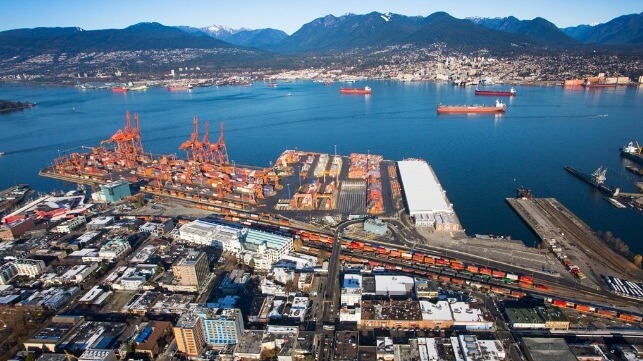
Work resumed but there are large backlogs at Canada's largest ports (Vancouver Fraser Port Authority)

Published Nov 19, 2024 2:48 PM by The Maritime Executive


Operations resumed at Canada’s West Coast ports and now Montreal with an uneasy labor peace after the federal government ordered the end of the lockouts for dockworkers in Montreal and foremen on the West Coast. The ports, carriers, and trade associations are warning that there will be long delays as they work to reduce the backlog.

The Retail Council of Canada advised members that “All the ports have cautioned that it will take weeks to process the backlogs created by the labor unrest.” The trade association is advising members to work with agents and port officials for updates on their containers. At the same time, the Vancouver Fraser Port Authority is encouraging supply chain partners to take steps to accelerate the movement of cargo by issuing a “notice of readiness” as vessels reach the coast to speed up processing and removal.

The Canada Industrial Relations Board ordered the 700 foremen at the West Coast ports to return to work as of the shifts late on Thursday, November 14, after a 10-day lockout. On the East Coast, Montreal’s 1,200 dockworkers were instructed to return to work Saturday morning, November 16, after they too had been locked out last week.

Operations resumed slowly in Montreal with the Montreal Port Authority reporting there are over 5,000 TEU currently on the ground, 55,000 linear feet of rail to handle, and 22 vessels either waiting at anchor or on their way. 

“It may take a few weeks to re-establish the fluidity of the supply chain and process all goods, both imports and exports, currently at the Port of Montreal or in transit and due to arrive in the next few days,” the port authority warned in an update on Monday, November 18. “Every effort will be made to handle these volumes quickly.”

Canada’s largest port, Vancouver, was showing as of Monday that there were still a total of 39 vessels in the anchorage. The port authority said it is using a priority system to begin to clear the backlog. Some ships were waiting nearly two weeks in the anchorage. In addition, the Vancouver Fraser Port Authority is still asking vessels to slow steam and take other steps to avoid a further pile-up in the port’s already highly utilized anchorages. 

MSC Mediterranean Shipping Company, which was impacted earlier in Montreal when the dockworkers struck the terminals the carrier uses, reported to customers that work has resumed. It said that it would “continue to monitor the situation closely,” and keep customers apprised. 

Maersk however is warning customers that it will “resume the demurrage & detention clock on the day gate operations restart at affected ocean terminals. For cargo being received at inland locations for loading at affected ocean terminals, we will resume the clock when equipment receipt restarts at those inland locations.” The carrier however said there could be considerations for customers that documented that they were unable to obtain a terminal or rail appointment during the re-start period.

The locals of both unions immediately objected to the federal government’s instructions to CIRB to implement final and binding arbitration to settle the contract disputes. Each has said it would seek to challenge the arbitration order in court, but work has resumed in the ports.