Friday, May 23, 2025

Ban on ousted ex-ruling party divides Bangladesh voters

By AFP
May 23, 2025


A decision by Bangladesh's interim government, led by Nobel laureate Muhammad Yunus, to ban the party of ousted ex-leader Sheikh Hasina from upcoming elections has divided voters - Copyright AFP/File Indranil MUKHERJEE

Sheikh Sabiha ALAM

The banning of fugitive ex-leader Sheikh Hasina’s party offers a sliver of justice for Bangladeshis demanding she face trial for crimes against humanity but also raises concerns about the inclusivity of elections.

“The government has taken the right decision,” said Jahangir Alam, whose 19-year-old son was killed during the mass uprising that forced Hasina into exile in August 2024, ending the 15 years of iron-fisted control by her once all-powerful Awami League party.

“Because of her, the Awami League is now ruined,” Alam said, demanding Hasina return from India to comply with the arrest warrant on charges related to the crackdown that killed at least 1,400 protesters.

“Who gave Sheikh Hasina the authority to kill my son?” said Alam, the father of Ibrahim Hossain Zahid, accusing 77-year-old Hasina of being a “mass murderer”.

Bangladesh’s oldest political party played a key role in the country’s liberation war from Pakistan in 1971 and was once led by Hasina’s late father, the nation’s founding figure, Sheikh Mujibur Rahman.

“People used to hang Mujib’s photo over their heads,” he said. “Because of Sheikh Hasina’s wrongdoing, that photo is now under our feet.”


– ‘Democratic space may shrink’ –


Political fortunes rise and fall quickly in Bangladesh.

Hasina’s government was blamed for extensive human rights abuses and protesters demanded that the interim government led by Nobel Peace Prize winner Muhammad Yunus take action.

The South Asian nation of some 170 million people last held elections in January 2024, when Hasina won a fourth term in the absence of genuine opposition parties.

Yunus promises that inclusive elections will be held by June 2026 at the latest.

Among those demanding the Awami League ban was the National Citizen’s Party made up of many of the students who spearheaded last year’s uprising.

Others were supporters of the Hefazat-e-Islam group and Jamaat-e-Islami, the largest Islamist political party.

Jamaat-e-Islami was banned during Hasina’s time in power and several of its leaders were tried and hanged. Unsurprisingly, its members were vocal supporters of the ban.

The government banned the Awami League on May 12 after protests outside Yunus’s home, pending the trial of Hasina.

“The oppressed have begun becoming oppressors,” said Latif Siddiqui, a veteran Awami League member and former minister, adding that the party was wider than Hasina alone.

“She is not the whole Awami League,” he said. “Many loved the party.”

Human Rights Watch issued stinging criticism on Thursday, warning that “imposing a ban on any speech or activity deemed supportive of a political party is an excessive restriction on fundamental freedoms that mirrors the previous government’s abusive clampdown”.

However, political analyst Farhad Mazhar, an ideological guru for many student protesters, said the ban was required.

“The democratic space may shrink, but the Awami League has shown no remorse,” Mazhar said.


– ‘Stripping the voting rights’ –


However, Jatiya Party chairman GM Quader said that banning any party stifled democracy.

“We believe in multi-party democracy,” he said.

His party had been close with the Awami League under Hasina, Quader said, but it had also opposed the ban on Jamaat-e-Islami.

“We don’t support banning any political party that… follows the rules,” Quader said.

Jamaat-e-Islami supported Islamabad during Bangladesh’s independence war from Pakistan in 1971. Rivals now question if it, too, should be restricted for its historical role.

“If the Awami League is banned for mass murder, then the question arises — what will happen to those parties that were involved in genocide, directly or indirectly?” Quader said.

“In the history of Bangladesh, the most people were killed during the Liberation War.”

The Bangladesh Nationalist Party (BNP), widely tipped to win the elections when they happen, has taken a more pragmatic approach.

Key leader Amir Khasru Mahmud Chowdhury has said there is no bar on former Awami League loyalists joining his party, so long as they had not previously worked to “suppress” the BNP.

Regardless, the upcoming vote will now take place without what was one of Bangladesh’s most popular parties.

Mamun Al Mostofa, professor of political science at Dhaka University, pointed out the party had been “banned before and went through severe crises… but it made a comeback”.

Shahdeen Malik, a Supreme Court lawyer and constitutional expert, said a strong opposition helped support democracy.

“AL had a vote bank of around 30 percent of the total electorate,” Malik said, noting that Hasina escalated her grip on power after crushing opponents in the 2008 election.

“Due to their atrocities, they may have lost some of that support — but it is still unlikely to drop below 20 percent,” he said.

“Stripping the voting rights of this 20 percent won’t benefit anyone.”
Japan shows off futuristic ‘railgun’ at defence expo


By AFP
May 22, 2025


Instead of using gunpowder to shoot an artillery shell, railgun technology uses electromagnetic energy to fire off a projectile along a set of rails at ultra-high velocity - Copyright Japan Maritime Self-Defense Force/AFP Handout

As Japan’s biggest defence exhibition kicked off this week, visitors got a close-up look at a model of its futuristic “railgun” that its makers hope will be able to shoot down hypersonic missiles.

Instead of gunpowder, railgun technology uses electromagnetic energy to fire a projectile along a set of rails at ultra-high velocity.

The round will then in theory destroy the target, which could be an enemy ship, drone or incoming ballistic missile, solely with its vast kinetic energy.

Other countries, including the United States, China, France and Germany, are also developing the technology, but Japan’s navy last year claimed a world first by test-firing a railgun on a ship.

“A railgun is a gun of the future that fires bullets with electrical energy, unlike conventional artillery,” an official from the Acquisition, Technology and Logistics Agency (ATLA) within Japan’s Ministry of Defence told AFP.

“It is expected that threats that can only be dealt with by railguns will emerge in the future,” said the official, who did not want to be named.

The three-day DSEI Japan Conference defence fair, which began on Wednesday, comes as Japan adopts a more assertive defence policy and looks to sell more military equipment to other countries.

In particular, Japan’s Mitsubishi Heavy Industries (MHI) and Germany’s Thyssen Krupp Marine Systems (TKMS) are competing for a major contract to supply the Australian navy with new warships.

Winning the multi-billion-dollar Project Sea 3000 contract to supply Australia with Mogami-class frigates would be Japan’s largest postwar military export order, according to Japanese media.
Pope’s call to tame AI sets tone for Christian leaders


By AFP
May 22, 2025


Image: — © AFP

Tom BARFIELD

Pope Leo XIV singled out the challenges of artificial intelligence as he took office this month, underscoring religious leaders’ hopes to influence a technology freighted with both vast hopes and apocalyptic fears.

The pope was cited by Protestant American Evangelical leaders who launched an open letter to President Donald Trump published Wednesday, calling for an “AI revolution accelerating responsibly” while warning of “potential peril”.

Leo XIV told cardinals on May 10 that he had taken his papal name in honour of Leo XIII (1878-1903). He had “addressed the social question in the context of the first great industrial revolution”, said the pope.

Today, “the Church offers to everyone the treasury of her social teaching in response to another industrial revolution and to developments in the field of artificial intelligence,” he added.

Wednesday’s letter from the Evangelicals called for the development of “powerful AI tools that help cure diseases and solve practical problems”.

But it also warned of “autonomous smarter-than-human machines that nobody knows how to control” — echoing the language of Silicon Valley’s so-called “AI doomers”.

– ‘Epochal change’ –


Leo XIV chose his papal name after Leo XIII who addressed the social issues raised by the first industrial revolution – Copyright GETTY IMAGES NORTH AMERICA/AFP/File TASOS KATOPODIS

Leo’s highlighting of AI follows years of interventions at different levels of the Catholic Church, said Paolo Benanti, 51, a priest with a PhD in engineering.

Benanti has advised both the Vatican and the Italian government on technology.

The late pope, Francis, wove his thinking about technology and AI into wider reflections on climate change and society.

In a January speech, he cited “concerns about intellectual property rights, the job security of millions of people, the need to respect privacy and protect the environment” as well as misinformation.

Such 21st-Century challenges animated Francis’s 2015 remark that “we are not living an epoch of change so much as an epochal change”, Benanti told AFP.

And he was at pains to say that the Vatican was not looking to hold back progress.

“Look at the huge improvement that AI can produce” in cases like assisting medical diagnosis in regions without enough doctors, he said.

“AI could be a wonderful tool but could be weaponised… this is something that could happen with every kind of technology, from the hammer… up to nuclear power,” Benanti added.

– Ethical algorithms –

Francis called for crafting a new “algor-ethics” (a portmanteau of “algorithm” and “ethics”) to govern emerging artificial intelligence.

One key moral concept in Church documents about technology is upholding “human dignity”.

This means avoiding “some kind of system that simply cannot recognise the uniqueness of the human being and respect it,” Benanti said.

He gave the hypothetical example of an automated process for deciding on asylum applications “based on correlation with other data and not with your own and unique story”.

Such technology would recall the Holocaust, “the darkest page of the last century” when “one piece of data” on whether a person was Jewish or not could condemn them, Benanti said.

In the world of work, the friar hopes to see “human-compatible AI innovation”, with people “putting something unique inside the process”.

Humans should “remain in a position to produce value” rather than being relegated to filling in the gaps around machine capabilities, he urged.

– ‘Reduce the risks’ –

Francis said in January last year that “highly sophisticated machines that act as a support for thinking… can be abused by the primordial temptation to become like God without God”.

“It’s very perilous when individuals assume for themselves godlike powers, to make decisions for the rest of us,” agreed Reverend Johnnie Moore, President of the US-based Congress of Christian Leaders and a lead signatory of Wednesday’s open letter.

Rather than allowing tech bosses and scientists to set the terms of the future, leaders should “go to the well” of religious thought’s “compounding wisdom over the centuries” to help chart the course, he told AFP by phone from Washington.

Where Pope Leo highlighted “new challenges for the defence of human dignity, justice and labour” from artificial intelligence, the Evangelical leaders went further.

They quoted OpenAI chief Sam Altman’s 2015 remark that “AI will most likely lead to the end of the world — but in the meantime, there’ll be great companies”.

“The current risk equation is just way too high to be tolerable,” Moore said. “We have to reduce the risk to human beings in this process.”
German court says Meta can use user data to train AI


By AFP
May 23, 2025


The court ruled Meta is 'pursuing a legitimate end' by training AI with Facebook and Instagram user data - Copyright AFP

 Mandel NGAN

A German court on Friday dismissed an injunction request brought by consumer protection groups to prevent US tech giant Meta from using user data from Facebook and Instagram to train artificial intelligence systems.

The higher regional court in Cologne concluded Meta, which owns both social media platforms, had not violated European Union law.

“Meta is pursuing a legitimate end by using the data to train artificial intelligence systems,” the court said in a statement.

Feeding user data into AI training systems was allowed “even without the consent of those affected”, it added.

Meta has announced plans to begin training AI models with data from Facebook and Instagram from Tuesday.

The court said the balance of interests between the parties was in favour of allowing Meta to process user data to develop AI.

The training of AI systems “cannot be achieved by other equally effective, less intrusive means”, the court said.

Among the reasons cited by judges was Facebook’s intention to only use publicly available data that could also be found via search.

Meta had also “taken effective measures to significantly mitigate the impact” on users, the court said, including communicating the plans via its mobile apps.

The North Rhine-Westphalia Consumer Advice Centre, which brought the case, said it still found the use of user data “highly problematic”.

“There are still considerable doubts about the legality,” the organisation’s chief, Wolfgang Schuldzinski, said in a statement.

The Vienna-based privacy campaign group Noyb said last week it had sent a cease-and-desist letter to Meta over the plans to use user data for AI training.

The letter was the first step ahead of a possible injunction request or class-action lawsuit against Meta, the group said.
Did George Floyd protesters miss their moment for change?

By AFP
May 22, 2025


Protests, such as this one in Minneapolis in June 2020, spread across the United States after George Floyd's death - Copyright GETTY IMAGES NORTH AMERICA/AFP/File 

Stephen Maturen

Ben Turner

Outrage over George Floyd’s killing by police catapulted Black Lives Matter into one of the largest protest movements in US history, with angry crowds chanting the slogan at rallies from Los Angeles to Washington.

But five years on, the protesters are gone and an iconic monument outside the White House has been erased, leaving many to wonder if the movement blew its chance for historic change by failing to win over the American public.

“It’s very easy to wear the T-shirt, utter the slogan, but then you looked at what they were asking for,” Yohuru Williams, who runs the Racial Justice Initiative at the University of St Thomas, told AFP.

Despite widespread revulsion at racism and police brutality in the wake of Floyd’s May 2020 death, many turned away when BLM activists broadened their message to calling for the defunding of law enforcement.

National support for the Black Lives Matter movement is now 52 percent, according to Pew Research, down 15 percentage points since June 2020, a month after police officer Derek Chauvin killed Floyd during an arrest in Minneapolis.

Initially, Floyd’s death was hailed as a catalyst for a national reckoning similar to the 1960s civil rights movement.

Protests, some turning into riots, spread across the country — right up to the gates of the White House, where Donald Trump was serving his first term.

Pent-up energy from Covid lockdowns fed the anger, which coalesced around BLM, until then a loose organization founded in 2013 to protest racially motivated violence.

Activists soon widened their focus to systemic racism, with monuments of slave owners removed and some companies investing in diversity initiatives to support ethnic minorities.


– Missed opportunity –


Despite the ambition, Williams said that BLM has achieved “very little.”

“The moral clarity of 2020 has not translated into enough political courage,” Phillip Solomon, a professor of African-American Studies and Psychology at Yale University, told AFP.

The George Floyd Justice in Policing Act, which proposed law enforcement reforms, including nationwide bans on dangerous chokeholds during arrests, has failed to pass US lawmakers.

Solomon said Floyd’s killing –- he called it a “lynching” -– opened an opportunity for change that was missed and is now facing a backlash.

The election of Trump to a second term — despite his racially charged rhetoric and heavy support from far-right figures –- reflects deep-rooted tensions, he said.

“I think this moment is a microcosm of America,” Solomon added.

Race inequality has long sparked protests in the United States, where segregation only legally ended in the 1960s after a relentless campaign of marches and civil disobedience.

Floyd’s death came in the context of dozens of other high-profile instances of police brutality against Black people –- something that smartphones and social media can now rapidly document and share.


– ‘Reversed with a vengeance’ –


There have been police reforms in some states primarily focused on limiting the amount of force officers can use, as well as local programs to send unarmed responders instead of police to selected callouts.

However, many say these measures are insufficient.

Medaria Arradondo -– serving as the first Black police chief of Minneapolis when Floyd died -– told AFP he was worried about the “grave consequences” of failing to enact more reforms.

“I hope and pray that we as a nation are not sleepwalking our way into the next critical crisis,” he said.

Civil rights group the National Urban League this month published a report warning that marginalized communities have been “pushed deeper into survival mode” after Floyd’s death.

League president Marc Morial said at a conference that steps to address racial injustices have “been reversed with a vengeance.”

Trump’s Justice Department has axed all outstanding civil rights investigations from the outgoing Joe Biden administration, ended police accountability agreements, and cracked down on diversity hiring.

Some of Trump’s more extreme supporters have gone as far as calling for Chauvin to be pardoned.

But Arradondo said he remains optimistic.

“History has shown we make incremental change,” he said, “We’re going to have a lot of hard work ahead of us, but I believe we will get there.”
THE TORY TELEGRAPH

UK newspaper The Telegraph set for US ownership


By AFP
May 23, 2025


US-Emirati consortium RedBird IMI struck a deal for The Telegraph in 2023, but the then Conservative government forced a resale - Copyright AFP Jim WATSON]


Ben PERRY

British right-wing newspaper The Telegraph has agreed a takeover by US investment group RedBird Capital Partners, ending a two-year saga marked by UK government intervention over press freedoms.

RedBird has struck an “in-principle agreement” to purchase The Telegraph Media Group (TMG), which comprises the 170-year-old paper’s print and online operations, for £500 million ($670 million), the pair announced in a statement on Friday.


It concludes a protracted sale that involved an intervention by the previous Conservative government.

US-Emirati consortium RedBird IMI, comprising Redbird Capital, had already struck a deal for TMG in late 2023.


However, the previous UK government triggered a swift resale amid concern over the potential impact on freedom of speech given Abu Dhabi’s press censorship record.

RedBird Capital Partners on Friday said the agreement struck with TMG makes it “the sole control owner” and “unlocks a new era of growth for the title” founded in 1855.

“RedBird’s growth strategy will include capital investment in digital operations, subscriptions and journalism as it looks to expand The Telegraph internationally.”

The US group added it is in “discussions with select UK-based minority investors with print media expertise and strong commitment to upholding the editorial values of” the paper.

It comes after the current Labour government recently struck a trade agreement with the United States, as Prime Minister Keir Starmer enjoys cordial relations with US President Donald Trump despite the latter’s tariffs blitz.

– ‘Cultural institution’ –

“We believe that the UK is a great place to invest, and this acquisition is an important part of RedBird’s growing portfolio of media and entertainment companies in the UK,” said RedBird’s founder and managing partner, Gerry Cardinale.

As for The Telegraph, he added that RedBird has “tremendous conviction in the growth potential of this incredibly important cultural institution”.

TMG chief executive Anna Jones said RedBird “will unlock” The Telegraph’s “full potential”.

“RedBird Capital Partners have exciting growth plans that build on our success,” she added.

The US group said it will look to expand The Telegraph’s global reach, particularly in the United States.

“RedBird’s growth strategy will include capital investment in… digital operations to continue driving subscriptions, using best in-class data analytics and Artificial Intelligence tools,” it added.

TMG last year agreed to sell British right-wing magazine The Spectator to hedge fund manager Paul Marshall for £100 million.

At the end of 2024, Britain’s Guardian Media Group struck a deal to sell the world’s oldest Sunday newspaper, The Observer, to online news company Tortoise Media.

Tortoise has carved out an online niche with in-depth reports, characterising its overall approach as not “breaking news but what’s driving the news” with investigations and podcasts.
Rare earth production outside China ‘major milestone’


By AFP
May 22, 2025


The rare earths sector is dominated by China, though several countries have significant reserves - Copyright AFP/File RODGER BOSCH


Sara HUSSEIN

An Australian firm’s production of a heavy rare earth, a first outside of China, is a “major milestone” in diversifying a critical supply chain dominated by Beijing, experts say.

But the announcement by Lynas Rare Earths also illustrates how much more needs to be done to broaden the supply of elements critical for electric vehicles and renewable technology.

What are rare earths?

Rare earth elements (REE) are 17 metals that are used in a wide variety of everyday and high-tech products, from light bulbs to guided missiles.

Among the most sought-after are neodymium and dysprosium, used to make super-strong magnets that power electric car batteries and ocean wind turbines.

Despite their name, rare earths are relatively abundant in the Earth’s crust. Their moniker is a nod to how unusual it is to find them in a pure form.

Heavy rare earths, a subset of overall REE, have higher atomic weights, are generally less abundant and often more valuable.

China dominates all elements of the rare earths supply chain, accounting for more than 60 percent of mining production and 92 percent of global refined output, according to the International Energy Agency.


What did Lynas achieve?

Lynas said it produced dysprosium oxide at its Malaysia facility, making it the only commercial producer of separated heavy rare earths outside of China.

It hopes to refine a second heavy rare earth — terbium — at the same facility next month. It too can be used in permanent magnets, as well as some light bulbs.

It “is a major milestone,” said Neha Mukherjee, senior analyst on raw materials at Benchmark Mineral Intelligence.

The announcement comes with China’s REE supply caught up in its trade war with Washington.

It is unclear whether a 90-day truce means Chinese export controls on some rare earths will be lifted, and experts say a backlog in permit approvals will snarl trade regardless.

“Given this context, the Lynas development marks a real and timely shift, though it doesn’t eliminate the need for broader, global diversification efforts,” said Mukherjee.

How significant is it?

Lynas did not say how much dysprosium it refined, and rare earths expert Jon Hykawy warned the firm faces constraints.

“The ore mined by Lynas contains relatively little of the heavy rare earths, so their produced tonnages can’t be that large,” said Hykawy, president of Stormcrow Capital.

“Lynas can make terbium and dysprosium, but not enough, and more is needed.”

The mines most suited for extracting dysprosium are in south China, but deposits are known in Africa, South America and elsewhere.

“Even with Lynas’ production, China will still be in a position of dominance,” added Gavin Wendt, founding director and senior resource analyst at MineLife.

“However, it is a start, and it is crucial that other possible projects in the USA, Canada, Brazil, Europe and Asia, also prove technically viable and can be approved, so that the supply balance can really begin to shift.”

What are the challenges to diversifying?

China’s domination of the sector is partly the result of long-standing industrial policy. Just a handful of facilities refining light rare earths operate elsewhere, including in Estonia.

It also reflects a tolerance for “in-situ mining”, an extraction technique that is cheap but polluting, and difficult to replicate in countries with higher environmental standards.

For them, “production is more expensive, so they need prices to increase to make any seriously interesting profits,” said Hykawy.

That is a major obstacle for now.

“Prices have not supported new project development for over a year,” said Mukherjee.

“Most non-Chinese projects would struggle to break even at current price levels.”

There are also technical challenges, as processing rare earths requires highly specialised and efficient techniques, and can produce difficult-to-manage waste.

What more capacity is near?

Lynas has commissioned more processing capacity at its Malaysia plant, designed to produce up to 1,500 tonnes of heavy rare earths.

If that focused on dysprosium and terbium, it could capture a third of global production, said Mukherjee.

The firm is building a processing facility in Texas, though cost increases have cast doubt on the project, and Lynas wants the US government to pitch in more funds.

US firm MP Materials has also completed pilot testing for heavy rare earth separation and plans to boost production this year.

Canada’s Aclara Resources is also developing a rare earths separation plant in the United States.

And Chinese export uncertainty could mean prices start to rise, boosting balance sheets and the capacity of small players to expand.

“The Lynas announcement shows progress is possible,” said Mukherjee.

“It sends a strong signal that with the right mix of technical readiness, strategic demand, and geopolitical urgency, breakthroughs can happen.”
US tariff tensions test Southeast Asian leaders at regional summit


By AFP
May 22, 2025


Leaders from the 10-member ASEAN bloc will discuss how to cope with the escalating trade showdown between China and the United States - Copyright AFP Mohd RASFAN


by Jan HENNOP in Kuala Lumpur and Martin ABBUGAO in Singapore

Southeast Asian leaders will express deep concern over US President Donald Trump’s tariff blitz when they meet at a summit Monday, warning that the unilateral move posed huge challenges to economic growth and stability in the region, according to a draft statement seen by AFP.

Trump’s tariffs has roiled global markets and upended international commerce, and left leaders from the 10-member ASEAN bloc scrambling for ways to limit the fallout on their trade-dependent economies.

The bloc is also caught between the trade battle between their biggest trading partners, the United States and China, on which Washington has heaped the highest tariffs.

According to a draft statement expected to be issued by ASEAN leaders after they meet on Monday, they express “deep concern… over the imposition of unilateral tariff measures”.

Trump’s measures “pose complex and multidimensional challenges to ASEAN’s economic growth, stability, and integration”, according to the draft of the ASEAN chairman’s statement seen by AFP.

The leaders also “reaffirmed ASEAN’s collective commitment” to the global free trading system, it said.

After the bloc’s meeting on Monday, the leaders are to hold a one-day summit with China and Middle Eastern oil producers.

The diplomatic dance continues later in the week in neighbouring Singapore, where the Shangri-La Dialogue forum is expected to draw defence chiefs including US Defence Secretary Pete Hegseth, while French President Emmanuel Macron was due to give the keynote speech.

ASEAN, with Malaysia holding its rotating chair this year, has traditionally kept a neutral stance in global power contests but that policy is under strain because of Trump’s protectionist moves, analysts say.

Malaysian Prime Minister Anwar Ibrahim has called for a joint ASEAN action plan to address the growing tariff threat.

Anwar said at a pre-summit briefing that, while bilateral talks between member states and the United States would continue, the bloc must present a united front.

“We also have one position as ASEAN in our talks,” he said.

The group, Anwar said, “had very practical policies… and what to me is of critical importance is to build that cohesion within ASEAN”.

The pressure to shift ASEAN’s “friend to all” posture will likely intensify during the follow-up summit on Tuesday when Chinese Premier Li Qiang joins the bloc’s leaders and officials from oil-rich Gulf states, observers said.


-‘Principled friend’ –


Beijing has been courting closer ties with Southeast Asia, positioning itself as a “reliable trading partner” despite tensions with ASEAN members over rival claims in the South China Sea.

Li will attend the first-time summit between ASEAN, Beijing and oil-producing nations including Bahrain, the United Arab Emirates, Qatar and Saudi Arabia.

That follows Chinese President Xi Jinping urging greater cooperation between Beijing and Malaysia “to safeguard the bright prospects of our Asian family” during a Southeast Asian diplomatic charm offensive in April.

Anwar said in return that Malaysia would “remain an unwavering and principled friend to China”.

However, anger over US tariffs also meant that ASEAN countries “won’t automatically fall in China’s arms”, a diplomatic source, who asked not to be identified, told AFP.

“It’s not a binary situation. ASEAN knows that China is just like the US in that it’s a big power which will bully them when it wants to,” the source said.

And “while the general consensus is that they are angry at the US… nobody wants to offend Washington either”.

James Chin, professor of Asian studies at the University of Tasmania, warned that playing to both the United States and China was a “high-risk strategy”.

The danger of staying neutral is “that every single foreign policy action that you take will then be scrutinised” by each opposing power, Chin said.

Others said ASEAN’s policy of neutrality remained valid.

“The rest of the world should not have any problem with ASEAN’s position to ‘be friends with everyone’,” said S. Munirah Alatas, a geopolitics specialist at the University of Malaya’s Allianz Centre for Governance.

However, she said the bloc still faced tough unresolved challenges, including “hostilities in Myanmar and recurring tensions in the South China Sea”.

“But successfully addressing these are not premised on ASEAN’s neutral geopolitical position,” she said.

 Trump fires new tariff threats at Apple and EU


By AFP
May 23, 2025


New Apple iPhone 16 models released late in 2024 boast generative artificial intelligence features - Copyright AFP Frederic J. BROWN

President Donald Trump ratcheted up the US trade war on Friday, threatening to impose a new 25 percent levy against Apple, and a 50 percent tariff on the European Union.

Lamenting that negotiations with the EU “are going nowhere,” Trump said on Truth Social that he is recommending “a straight 50% Tariff on the European Union, starting on June 1, 2025.”

If the new duties come into effect, they would dramatically hike the current US baseline levy of 10 percent, and raise economic tensions between the world’s biggest economy and its largest trading bloc.

In a separate message, the president said Apple had failed to move iPhone production to the United States despite his repeated requests, and he threatened new duties of “at least” 25 percent if they did not comply.

Stock futures on Wall Street fell on the news, with Apple’s share price plunging more than three percent in pre-market trading.

The VIX volatility index, known as Wall Street’s “fear gauge,” was up more than 20 percent.

– ‘Difficult’ negotiations –

Last month, Trump imposed sweeping tariffs against most countries, introducing steep duties for several trading partners — including the EU — and sector-specific measures on automobiles, steel and aluminum not produced in the United States.

Markets tanked following the announcement, and a few days later, the US president announced he would roll back the higher levies to 10 percent for a 90-day pause to allow for trade negotiations, while keeping the sector-specific measures in place.


US President Donald Trump has threatened to hike tariffs on goods from the European Union to 50 percent – Copyright AFP Jim WATSON

Since then, Trump has announced a deal to permanently roll back some sector-specific tariffs on Britain, and another agreement with China to reduce prohibitively-high levies and retaliatory measures for 90 days.

The talks between the United States and the EU have failed to make much progress, with Brussels recently threatening to hit US goods worth nearly 100 billion euros ($113 billion) with tariffs if it does not lower the duties on European goods.

In his early morning social media post on Friday, Trump said the EU had been “formed for the primary purpose of taking advantage of the United States on TRADE,” and took a swipe at the “difficult” negotiations taking place.

An EU spokesperson declined to comment on the threats of new tariffs, telling AFP that a call was set to take place later Friday between EU Trade Commissioner Maros Sefcovic and US Trade Representative Jamieson Greer.

– US-made iPhones ‘not feasible’ –

Trump’s fresh criticism of Apple revived the pressure on chief executive Tim Cook to do more to bring manufacturing jobs back to the United States from Asia.

The problem, according to Wedbush Securities analyst Dan Ives, is that reshoring iPhone production to the United States “is a fairy tale that is not feasible.”

“This would result in an iPhone price point that is a non-starter for Cupertino and translate into iPhone prices of ~$3,500 if it was made in the US,” he wrote in a note to clients.

This, he added, “is not realistic,” adding that it would take up to 10 years to shift production to the United States.

burs-da/bgs


'Discussions are going nowhere': Trump flips out and orders 50% tariff starting next week


Tom Boggioni
May 23, 2025 
RAW STORY

Donald Trump (Reuters)

As part of a flurry of posts on Truth Social on Friday morning, Donald Trump is now proposing slamming the European Union (EU) with a massive new tariff because of the "unacceptable" trade imbalance the U.S. has rung up.

Moments after threatening Apple and executive Tim Cook with a 25 percent tariff unless iPhones are made in the U.S., the president moved on to another threat certain to roil the stock market.

On Truth Social he wrote: "The European Union, which was formed for the primary purpose of taking advantage of the United States on TRADE, has been very difficult to deal with. Their powerful Trade Barriers, Vat Taxes, ridiculous Corporate Penalties, Non-Monetary Trade Barriers, Monetary Manipulations, unfair and unjustified lawsuits against Americans Companies, and more, have led to a Trade Deficit with the U.S. of more than $250,000,000 a year, a number which is totally unacceptable."

Complaining "Our discussions with them are going nowhere!" he announced, "Therefore, I am recommending a straight 50% Tariff on the European Union, starting on June 1, 2025. There is no Tariff if the product is built or manufactured in the United States. Thank you for your attention to this matter!"

You can see his post here.


Trump suggests 50% tariff on EU goods starting in June

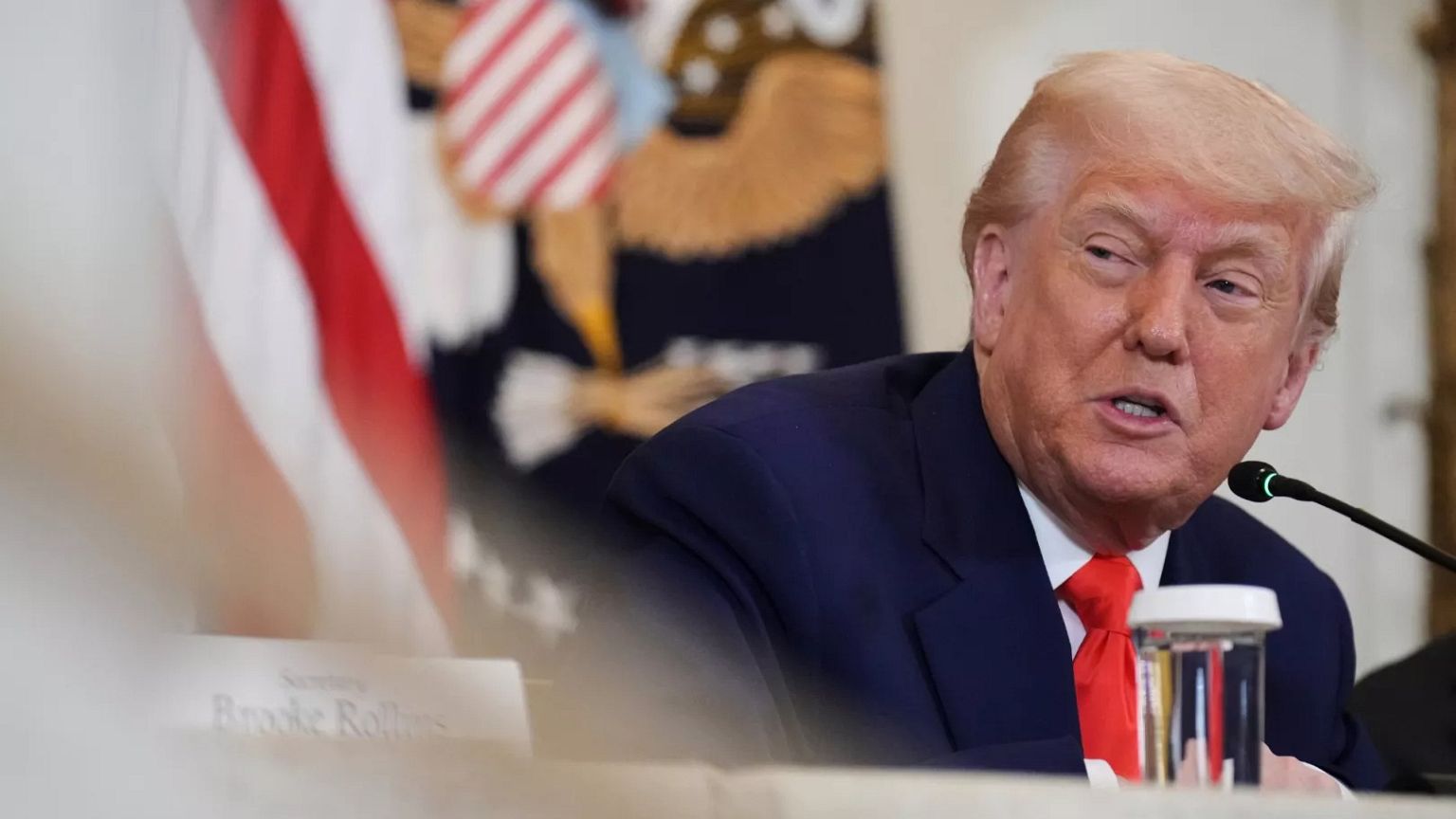
President Donald Trump attends a Make America Healthy Again (MAHA) Commission Event in the East Room of the White House, 22 May 2025
Copyright AP Photo

By Doloresz Katanich with AP
Published on 

US President Donald Trump on Friday threatened a 50% tax on all imports from the European Union, as the trade war intensifies.

US President Donald Trump has recommended Friday a 50% tariff on the European Union after complaining that negotiations were not going well and Brussels was “difficult to deal with”. 

Trump took to social media to share his thoughts, suggesting the elevated duty to start on 1 June, in less than a month. 

The US president said he wants to charge higher import taxes on goods from the EU, a long-standing US ally, than from China, a geopolitical rival that had its tariffs cut to 30% this month so Washington and Beijing could hold negotiations.

Trump was upset by the lack of progress in trade talks with the EU, which has insisted on cutting tariffs to zero even as the president has publicly insisted on preserving a baseline 10% tax on most imports.

“Our discussions with them are going nowhere,” Trump posted on Truth Social. “Therefore, I am recommending a straight 50% tariff on the European Union, starting on 1 June 2025. There is no tariff if the product is built or manufactured in the United States.

Truth Details

3423 replies

Avatar

@realDonaldTrump

The European Union, which was formed for the primary purpose of taking advantage of the United States on TRADE, has been very difficult to deal with. Their powerful Trade Barriers, Vat Taxes, ridiculous Corporate Penalties, Non-Monetary Trade Barriers, Monetary Manipulations, unfair and unjustified lawsuits against Americans Companies, and more, have led to a Trade Deficit with the U.S. of more than $250,000,000 a year, a number which is totally unacceptable. Our discussions with them are going nowhere! Therefore, I am recommending a straight 50% Tariff on the European Union, starting on June 1, 2025. There is no Tariff if the product is built or manufactured in the United States. Thank you for your attention to this matter!


The EU declined to comment on the US president’s words. 

The European Union and the United States have been negotiating a new trade agreement, and Euronews learnt that they have recently shared position papers that were radically apart. 

Apple also threatened

That post had been preceded by a threat of import taxes against the US tech giant Apple.

Apple now joins Amazon, Walmart and other major US companies in the White House's crosshairs as they try to respond to the uncertainty and inflationary pressures unleashed by his tariffs.

“I have long ago informed Tim Cook of Apple that I expect their iPhones that will be sold in the United States of America will be manufactured and built in the United States, not India, or anyplace else,” Trump wrote. “If that is not the case, a tariff of at least 25% must be paid by Apple to the US.”

In response to Trump’s tariffs on China, Apple and CEO Tim Cook were looking to shift iPhone manufacturing to India as the company adjusts its supply chains. That plan has become a source of frustration for Trump, who also brought it up last week during his Middle East trip.

Stock futures sold off after Trump's postings.

Helmsman of cargo ship run aground in Norway was likely asleep: reports


By AFP
May 23, 2025


Johan Helberg woke up to find the hulking cargo ship a little too close for comfort - Copyright GETTY IMAGES NORTH AMERICA/AFP/File Sophie Park

The helmsman of a huge container ship that ran aground in Norway just a stone’s throw away from a cabin as its owner slept was probably asleep as well at the time of the accident, Norwegian media reported Friday.

“Only one person was on the bridge at the time. He was steering the vessel, but didn’t change course when entering the Trondheim fjord as he should have,” the news agency NTB reported.

“Police have received information from others who were on board that he was asleep,” police official Kjetil Bruland Sorensen told NTB.

The 135-metre (443-foot) NCL Salten sailed up onto shore just metres from Johan Helberg’s wooden cabin around dawn on Thursday.

Helberg discovered the unexpected visitor only when a panicked neighbour who had rung his doorbell repeatedly to no avail gave up and called him on the phone.

“The doorbell rang at a time of day when I don’t like to open,” Helberg told television channel TV2.

His neighbour, Jostein Jorgensen, said he was roused at around 5:00 am by the sound of a ship heading at full speed toward land and immediately ran to Helberg’s house.

None of the cargo’s 16 crew members were injured, and Norwegian police have opened an investigation.

“We are aware of the police stating that they have one suspect, and we continue to assist the police and authorities in their ongoing investigation,” the NCL shipping group said Friday.

“We are also conducting internal inquiries but prefer not to speculate further,” it added.

Efforts to refloat the ship have failed so far, and the massive red and green container ship remained stuck, looming over the small cabin.
FacebookTwitterLinkedInEmailShare