Thursday, March 12, 2026


Trump’s Presidency and Iranian Missiles


The consequence of not facing consequences
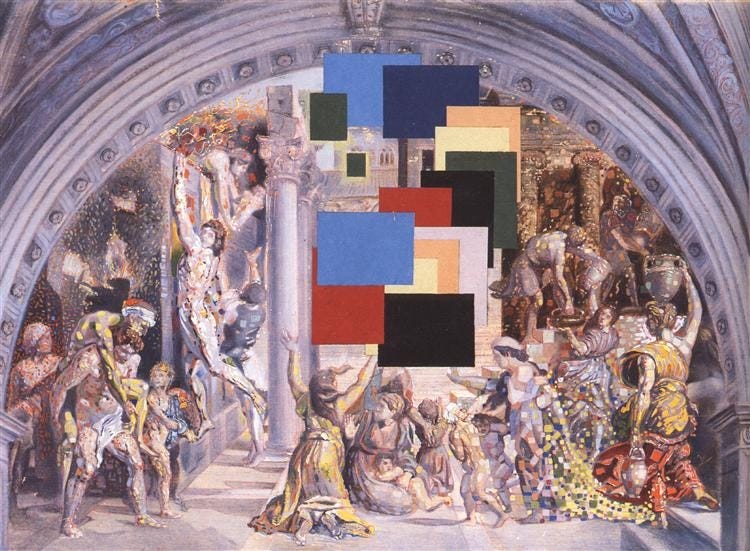

Athens Is Burning! The School of Athens and the Fire in the Borgo, 1979 - 1980 - Salvador Dali
Athens Is Burning! The School of Athens and the Fire in the Borgo, Salvador Dali

US hegemony is being dispatched to the landfill of history. Empires collapse, sometimes, slowly; sometimes, in rapid order. Trump’s war has proven to be an accelerant of the latter.

The following unnerves me as a Jewish person: Trump acting as the Zionist state’s errand boy for Greater Israel — all, as any objection to the machinations of Israel’s war provocateurs and genocide apologists are conflated not as a critique of Zionism’s odious to humanity agendas but the character of Jews in general i.e., the classic conflation of Zionism and Judaism bandied by Israel’s defenders. The cynical trope, in itself, is self-undermining in its inadvertent antisemitism.

Moreover, it opens both Zionist High Dollar elitist enablers of Israel as well as power and influence-bereft, anti-Zionist Jews (e.g., me and my family) to hoary Old World antisemitic lies (e.g., The Protocols of the Elders of Zion fables) of Jews ruling the world. The insidious storyline could go: You cannot afford gas and other necessities…Jewish machinations are to blame…and, granted, Jewish Jared Kushner and Steve Witkoff were key players in conniving the US into the present US empire-collapsing, US economy decimating war. Soon one expects to hear anti-semitic utterances at the hyper-inflation ridden gas pump and grocery store aisles.

Additional Historical Primary Sources
Dreyfus Petit Journal 1894, Credit: Bibliothèque nationale de France
In my IMO, the most propitious remedies would include: for anti-Zionist Jews to make our voices the most vocal and passionate insofar as calling for Israeli leaders to be tried as war criminals; for the Zionist state to be dismantled as an ethno-supremacist state, and for full reparations to be paid to Palestinians and Israel’s perpetually attacked neighbors in the Levant.

In the US, the billionaire class (Jews and Gentiles alike) must be made to pay reparations due to the exploitation inherent to the rigged capitalist system. A system cannot have both billionaires and democratic institutions. Withal, Zionist billionaire donors were crucial insofar as launching and sustaining Donald Trump’s political rise. If you want to know a defining reason Trump signed onto Netanyahu’s war, follow the money.

Please do — for the trail of filthy lucre will not lead to my meager bank account nor my mezuzah-adorned front door.

Iranian missiles and Hezbollah rockets are hitting Israel and will continue to do so with increased intensity.

Yet Israel was coming apart at its homicidal maniacal seams, even before its murder-suicidal attack on the people of Iran.

Mental illness rates were soaring; the economy was circling the drain; the Ashkenazi elite were clamoring for the exits; right-wing religious lunatics were all but running the asylum.

Rumors spread in Israel bomb shelters, Bibi is continent-hopping on a private jet while the Zionist thugocracy, masquerading as a government, has passed laws that carry a five year sentence for photographing the carnage inflicted by Iran’s counter offensive. As reports, leaking out of the country reveal, Iranian missiles are causing the Israelis real and increasing pain.

Of course, Israeli pain is not reaching the level that the jackbooted thugs of the IDF perpetrated on Gaza’s civilians yet there is growing fear, death, and suffering nonetheless throughout the Zionist state.

First the crack-up then the crash.

To state the painfully obvious, the tragedy is self-inflicted, and comes as a consequence of nearly 78 years of Israelis avoiding any abiding consequence for their perpetual war criminality. In fact, the Zionist state was established by ethnic cleansing terrorists, an endless Nakba is still playing out in the occupied West Bank as you are reading these very words.

Insofar as Israel and the US, must the road of blood and ashes be the only path forward? So it seems. Word is, Trump, in secret, has, on multiple occasions since the advent of the Israeli-US war of choice implored Iran for a cessation of hostilities. Numerous times betrayed, Iran has refused his entreaty. (A standard US/Israel ploy is waging sneak attacks in the middle of peace talks, even to the point of murdering principle negotiators.)

We are talking about psychopaths, with a lying proclivity for claiming the followers of Islam are inherently violent zealots. Crash-outs occur when reality descends upon those unable to apprehend the circumstance that they have placed their belligerently obtuse selves. While it is true that Israeli authoritarians can and will jail individuals attempting to convey the truth out of locked down and besieged Israel, it is also true that Israel, by means of brutal repression to the point of genocidal campaigns, have not destroyed the spirit of the Palestinian people (but no, hasbara-sputtering jerkopaths – your attempts to erase history regarding the existence of Palestine will fail too).

In classical, tragic trajectory, Israel, increasingly, as events unfold, will not be in any position to change, by their go-to means of lying, jailing, torturing, and killing the trajectory of fate that they have wrought upon themselves.

Israelis, indoctrinated from birth by Zionist propaganda, and history as told by Jewish self-aggrandizing legends, will experience the ontological shock that arrives when all mechanisms of control are rendered inaccessible while US Americans, as the economy totters, will face staring into the keening abyss that opens at one’s feet with the loss of the aura of exceptionalism.

Palestinians, like African and Indigenous peoples of America and othered outsider groups (the latter, the present targets of ICE predation) have never possessed the luxury of breaking the worlds of a militarily weaker people then leaving others to sift through the ashes and rubble of what was once their lives.

Israel, without consequence, other than aforementioned soaring national rates of mental illness and the economic elite abandoning the nation for safer shores, committed genocide in Gaza as the US gangster imperium perpetrated a strong arm/shakedown/extortion operation on Venezuela.

Thus the hubris was accrued to proceed to Iran. Yet all vanity is ash. Trump wears his war face with the veracity that his MAGA courtesans wear the Mar-a-Lago face.

Trump’s Presidency stares into Fate’s whirlwind.

Lies of the MAGA mind are churned to spittle. The Imperial Medicine Show of Grift faces its final curtain.

In Israel, Hasbara trolls amid the ashes. The Beast of Exceptionalism slouches towards Bethlehem to troll.

When I opine in regard to Israel, I have appropriated, on a regular basis, the phrase: Third Reich adjacent. I do not do so as hyperbole. The assertion is borne of historical and present day accuracy.

Withal, as was the case with the Third Reich, the Zionist state evinces an insular culture of nationalistic exceptionalism, raging xenophobia, and military aggression, the latter deployed with the agenda of land appropriation (okay, outright theft) — that tends to careen towards genocidal rampages.
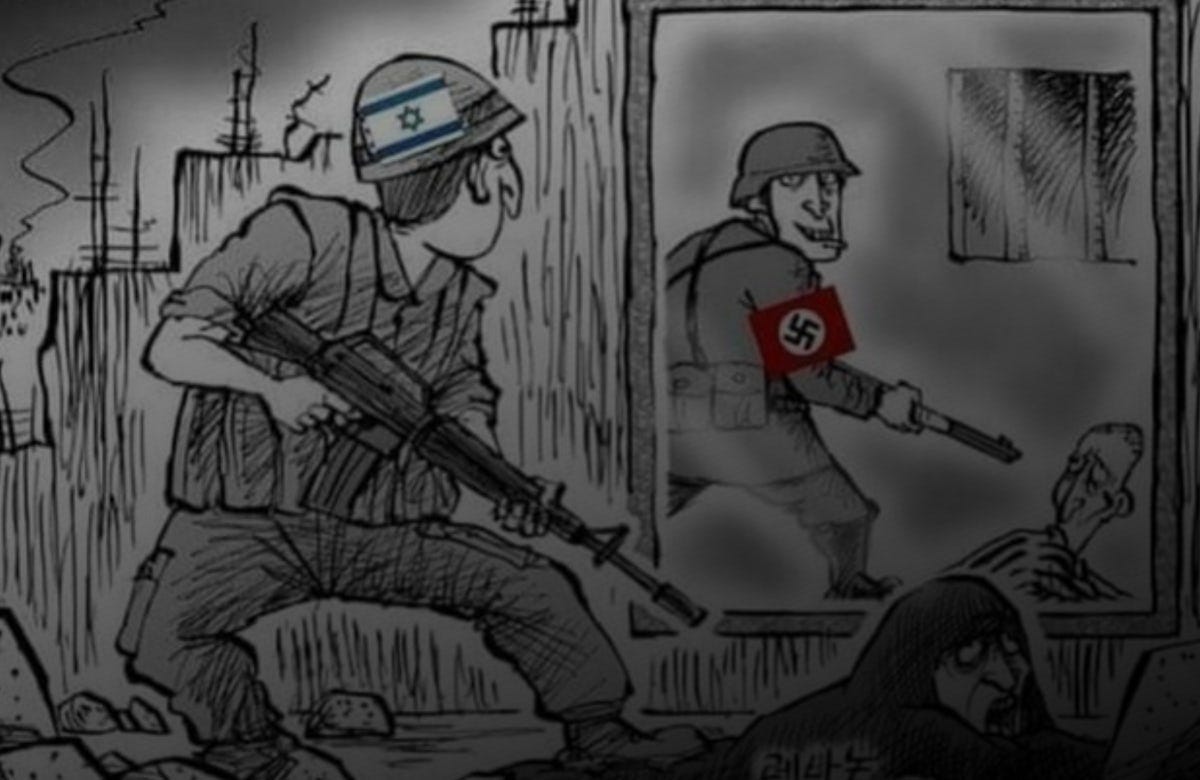
Antisemitism defined: Why drawing comparisons of contemporary Israeli policy to the Nazis is antisemitic - World Jewish Congress

Israelis, on a collective basis, as was the case with Third Reich-era Germans, view themselves, paradoxically, as superior Übermensch yet regard themselves as constant victims, even in danger of annihilation by forces, both interior and exterior, that are viewed, simultaneously, as both inferior and as an existential threat.

Palestinians, as were my Ashkenazi Jewish ancestors in Europe, are regarded as inferior beings but seen as being so dangerous and cunning they must live with the Zionist boot on their collective neck, and any and all attempts to gain wiggle room is met with annihilation level force by the all powerful/perpetual victimized Israeli authorities.

In the turned inside out, twisted backward, Zionist worldview, Palestinians — who resist their houses and property being stolen by Lebensraum-loopy, religious zealots are seen as the Nazis in the situation. To wit, we are confronted with a mindset that mirrors Third Reich-era German psychology: Every accusation is a confession, in which the villainous motives that Zionists psychologically project on their adversaries is, in reality, their own creed and modus operandi.
undefined
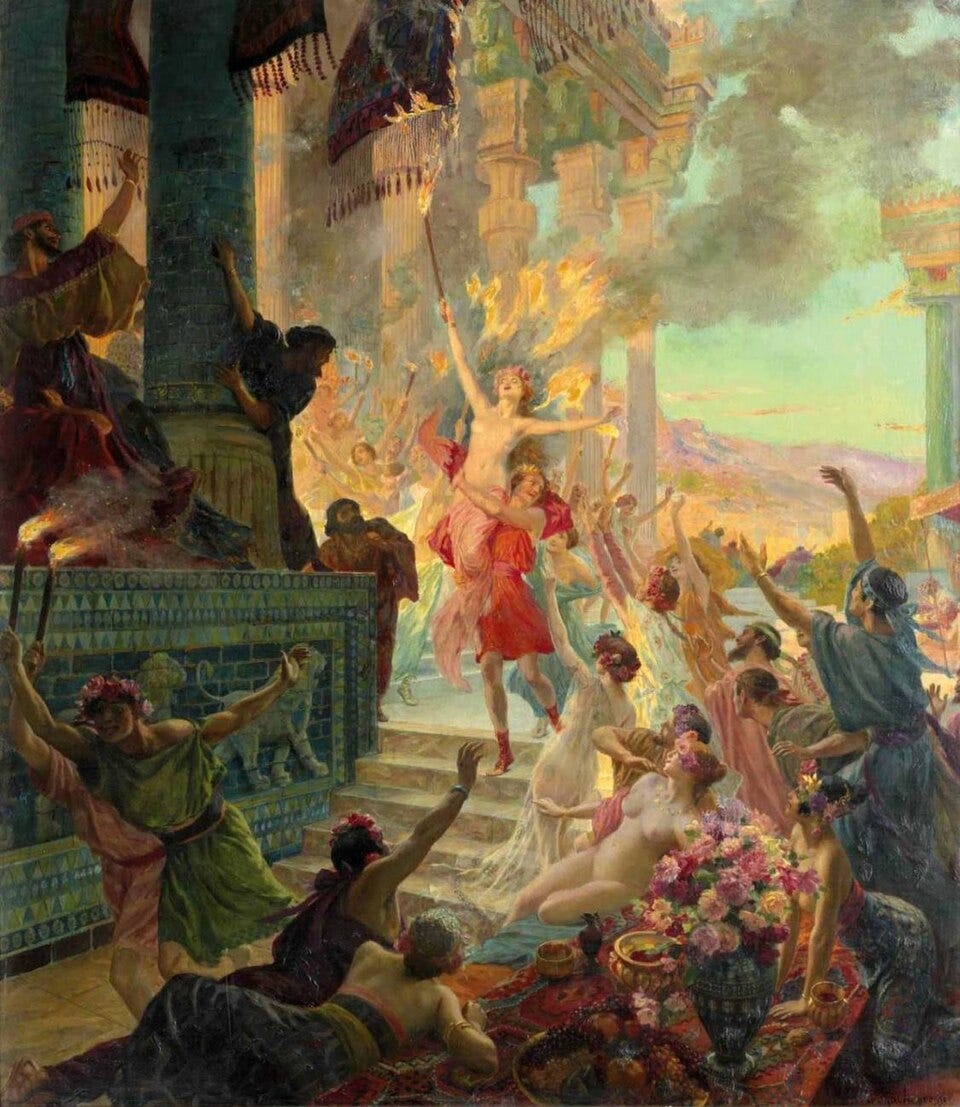
Alexander the Great lifting the torch-wielding Thaïs, who instigated the burning of the fallen Persian capital city Persepolis (1890 impression by French painter Georges Rochegrosse in L’incendie de Persepolis)

In Zionist culture, militarism is glorified; cruelty to those othered is deemed a virtue; war criminality is heroic. Mass slaughter of the innocent is not problematic because among Israelis no outsider other is innocent, all are subhuman and a menace to Israel as long as they breathe.

Moreover, Israel will not be safe until “Greater Israel” is realized. At which point, Israelis can ascend the mountains of corpses of their enemies and bask in the glory of the One True God who christened them as his chosen mass murders.

Hyperbole? Is it not the plan for “New Gaza” to be built upon the mass graves of slaughtered Palestinians? Are not the Israeli/US military operational tactics in Iran modeled on the IDF’s war criminality perpetrated on Gaza on stilts and steroids?

So this leaves us with the question: Will Israel be successful in its war criminal agenda to establish Greater Israel or will its Third Reich adjacent agenda prove hubristic overreach thus deliver the Zionist into a Levant version of the German *Wehrmacht1’s  Operation Barbarossa?2
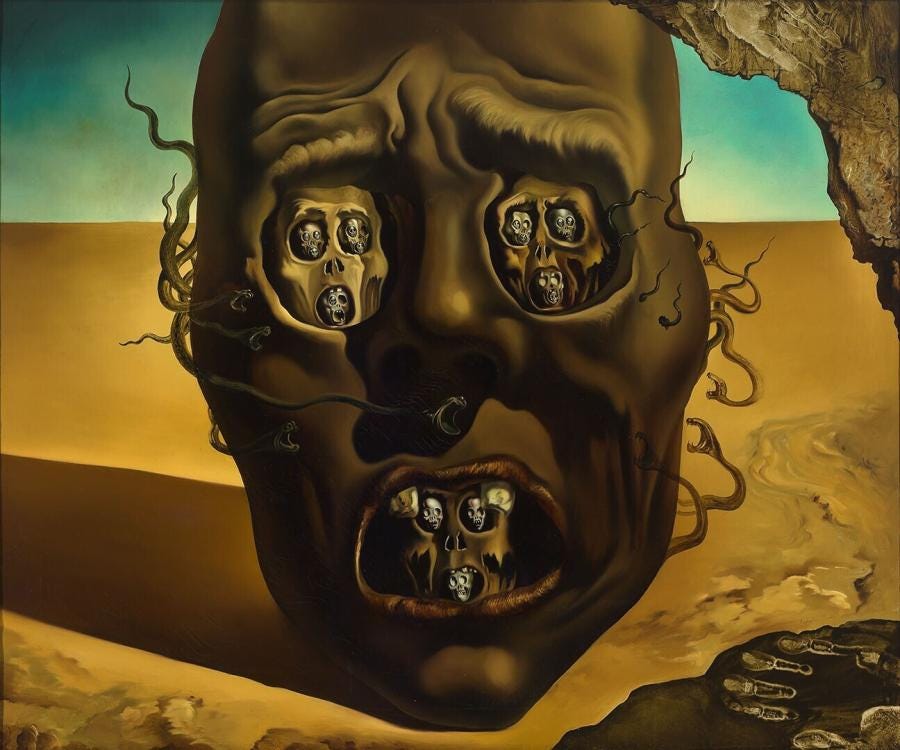
Le visage de la guerre - Museum Boijmans Van Beuningen
The Face of War (Le visage de la guerre) Salvador Dalí

ENDNOTES:

  • 1
    Translated from: German Defense Force — The dovetailing of euphemism appropriated to retail military aggression as self-defense with the IDF (Israeli Defense Force) should be too obvious to mention.
  • 2
    Operation Barbarossa launched by Nazi Germany on June 22, 1941, was the massive, surprise invasion of the Soviet Union during World War II, marking the opening of the deadly Eastern Front. Over 3.8 million Axis soldiers aimed to destroy Soviet communism, secure Lebensraum (living space), and capture resources within months, but the campaign failed by December 1941 due to fierce resistance and winter.
Phil Rockstroh is a poet, lyricist, and essayist. His poems, short fiction, poetry and essays have been published in numerous print publications and anthologies; his political essays have been widely posted on the progressive/left side of the internet.  Read other articles by Phil, or visit Phil's website.

Middle Power Nonsense: Australia, Canada and Capitulating to the Iran War


In his January speech at the World Economic Forum in Davos, Canadian Prime Minister Mark Carney gave the impression of a banker turned soothsayer, a Daniel coming to judgment. Here was a born-again man of international relations who would rally the middle powers (from the middle) and try to assert influence and power in a way deemed fit for this rule-torn world.

So far, the middling powers have not gotten far. In fact, they have shown themselves despicably fawning and incapable of taking a stance on the legality of the US and Israeli strikes on Iran. Even worse, acts of predation and villainy in breach of the United Nations Charter have received the seal of approval. Suggestions that they can also do things separately from the United States in some fictional coalition of law-abiding states are risible. It’s rather difficult to talk about sound and sober independence when your real estate is essentially part of a foreign imperium.

During his official visit to Australia earlier this month, Carney did little to address this corrupting blight on a program of independence that is compromised before it begins. He expressed admiration for the role played by Canada and Australia in developing a structure of international order after the Second World War without conceding that they had been complicit in undermining it. Cowardice can never be officially accepted as policy, though governments do their best in behaving along such lines.

His colleague and host, Australian Prime Minister Anthony Albanese, dared mention Iran in his welcoming address, not as a target and victim of the crime against peace – a grave offence in international law – but as a unilateral aggressor in firing missiles, in retaliation, against various countries either friendly or directly allied to the US with American military bases. These attacks had been “indiscriminate”, adding to the “orchestrated antisemitic attacks on a synagogue and a small business here in Australia in 2024.” (Evidence of Iranian involvement in those events has been skimpy at best.) And, as the Australian PM said in a joint press conference with Carney, “the possibility of Iran getting a nuclear weapon [was to be] removed once and for all”, a remark both disingenuous and politically illiterate.

Refusing to point any finger at the outlawry of Israel and the US, Albanese basked in middle power smugness. “Australia and Canada must seek and create new ways to stand with – and for – each other.” Both countries worked together as a “positive choice – not a necessity.” Peace, security and prosperity should not be seen as “the preserve of the great powers alone. They are our common cause – and our collective responsibility.”

The Australian opposition leader, Angus Taylor, proved sinister in his interpretation of the Davos speech as effectively warranting a continued trashing of the rules-based order precisely because the rules were a sham front to begin with. But instead of pointing out the brigands responsible for repudiating that order, Taylor swanned off with mentioning “autocratic regimes that behave with impunity”. (Now who could he have been referring to?)

In his address to Australia’s parliamentarians, Carney spoke of building something more positive from the “rupture” in the international order. “In an era of rupture in the global order, middle powers like ours must step up. By deepening our partnership, Canada and Australia can lead in creating resilient economies, secure supply chains, and a safer world for our citizens.” It was up to middle powers to “help write the new rules that will determine our security and prosperity” rather than leaving things to the “hegemons”. Multilateralism had not been abandoned so much as evolving.

These vague views about middle power heft as strategic gold dust are far from convincing. They have nothing of the resonance of the non-aligned movement born at Bandung in April 1955 when twenty-nine governments from Asia and Africa sought a third way that would involve no participation from member states in “collective defence agreements” favourable to the US or the Soviet Union. Neither Carney nor Albanese have even mentioned that salutary precedent. Given the security, military and economic ties shared by Australia and Canada with the United States, a third way of noble virtue and high principle is hardly tenable. The lamentably subservient conduct of both governments to the illegal predations of Washington against Iran are a case in point. When international law needed to be defended, it was smeared and distorted.

As if to illustrate the inability of middle powers to sever the yanking chain of superpower submission, it subsequently emerged that three Australian personnel were on board the US attack submarine responsible for the deaths of 87 sailors in the strike on the Iranian frigate IRIS Dena off the coast of Sri Lanka. Absurdly, Albanese asserted that Australian personnel did not participate “in any offensive action against Iran” despite being part of a crew responsible for the lethal exercise. There were “long-standing third-country arrangements that have been in place for long periods of time, and what they do is ensure that Australian Defence personnel, where there are embedded in third countries’ defence assets, they act in accordance with Australian law, Australian policy, and that is, of course, taking place across the board.” Middle power nonsense, at its best.

Binoy Kampmark was a Commonwealth Scholar at Selwyn College, Cambridge. He lectures at RMIT University, Melbourne. Email: bkampmark@gmail.comRead other articles by Binoy.


We’re Tired of Marco Rubio Speaking for Us


A New Cuban-American Movement


“Put three Cubans in a room together, you’ll have five different opinions,” a Cuban friend of mine likes to joke. He was referring to debates in the town-hall meetings during Cuba’s constitutional convention process of 2018. But I immediately thought, of course, of any Nochebuena celebration at my dad’s house, just a few hundred miles north. Siblings, cousins, babies, abuelas, family, and friends of all ages and political opinions gathered around a brilliant feast. Between the devouring of lechón, yuca, plátanos, and flan, a flurry of back and forth between English and Spanish. Everyone hugging, praying, laughing, and occasionally yelling. Well, maybe more than occasionally.

The existence of contradictory political opinions across generations will come as no surprise to diaspora families from all over, and my Cuban family is no exception. My abuelo participated in the Cuban Revolution against Batista before being turned off by what he saw as the horrors of communism. My family moved to Miami, and after being jailed for counterrevolutionary terrorism, my grandfather then defected and fought for the U.S. in the Bay of Pigs. (A Brigada 2506 flag hung on the wall of my childhood home.)

Like many Cuban-Americans growing up in Florida, I was taught countless criticisms and failures of the government of Cuba by family members. But my proudly capitalist father also raised his children to lobby against the U.S. embargo on Cuba. And as an adult, I learned about the positive aspects of Cuba’s policies, such as the nation’s historic biomedical achievements, or the remarkable advances of LGBTQ rights under the recent Families Code referendum. Today, my older brother and I are openly Marxists and organize as such for labor, social, and environmental justice. As you may guess, sometimes things get a little complicated!

Following the festivities this past December, one of mis primos worried to me about her brother who lives on the island. With increasing blackouts and energy strains, a stressed economy, and hawkish U.S. policies towards her first homeland, things were only getting harder. “The only people who pay attention to what’s happening in Cuba are Cubans,” we lamented. “Hopefully that will change.”

Then 2026 came. With it, the Trump administration’s war games: Kidnapping presidents, murdering leaders in other countries, seizing foreign oil, and threatening sovereignty. People were paying attention.

People are starting to learn about the 66 years of failed U.S. policy against Cuba. People are learning about the trade restrictions that prevent medicine, food, and fuel from getting to the island. People are learning about the starvation, pain, disease, and death that come from these policies. And people are also beginning to notice that Cubans across the political spectrum want something different than what the U.S. provides!

There has long been a particular image, a particular idea, of what it means to be Cuban-American. You know it well: “The Miami Cuban.” The man opposed the communist policies in Cuba so much that he’s willing to go to war with the island, that he’s willing to bomb, and destroy. And this hyper-machismo image, along with intergenerational trauma in Cuban families, has been used for decades to push US policies against Cuba that do nothing but harm the people of the island. That harms our family, our friends, and a country that we deeply love.

I’m tired of the extremist “Miami Cuban” propaganda machine. I’m tired of the Marco Rubios and Ted Cruzes of this country claiming to speak for Cuban-Americans.

I know, however varied our politics, what my family wants is this:

We want the embargo to end. We want the cruel, inhumane oil blockade by the Trump regime to end. We want the current administration’s posturing towards war games and invasion to end. We want engagement, not escalation. We want friendship. We want trade. We want to gather with our families, watch béisbol, and drink cafecitos by the Malecón.

Despite what the Marco Rubios, Maria Salazars, and Carlos Giménezes of the world try to tell people, this is what most Cubans in America want.

Ready to speak up, a group of us has come together to build the Cuban Americans for Cuba movement. We have launched an open letter against the current U.S. policies towards Cuba, so other Cubans can sign on and show the world the true values of Cuban-Americans. Our organization is growing, with members all over the United States, and we span a variety of opinions. What we share is the belief that the future of Cuba should be left to Cubans on the island to decide without U.S. interference and meddling. We work together across our differences to end the Embargo, knowing that this is the best way to allow for freedom for all to flourish.

And that is why a delegation of Cuban-Americans is going on the Nuestra América convoy later this month with other Cuba solidarity activists, a delegation which I am proud to join. We are going to deliver thousands of pounds of medical aid to the people and communities that we love. We are going to show that Cuba is not alone, and that the working people of the USA stand with them. We are going to build bridges of friendship and solidarity and a better world where we all have liberation. A world where we all have peace.

Some, including Republicans in the US Congress, have accused the convoy of being an anti-American venture and the participants of being communist agents. But just like Cubans and Cuban-Americans, the Nuestra América convoy and our supporters are made up of people across the political spectrum. The out-of-touch politicians who seek violence may not understand this, but here’s the truth: the only thing you need to be to oppose the US Embargo on Cuba and the Trump administration’s war games is a human being.

Justine Medina is a Cuban-American raised in Tampa, Florida, with over 15 years of experience as an electoral, labor, and community organizer. Collective work she is most proud to have participated in includes the movement to elect AOC to Congress, and the fight to win the first-ever US labor union election against Amazon via the Amazon Labor Union. Justine currently lives in Tucson, Arizona. Read other articles by Justine.

First Iran, Then Cuba: Trump Has Dropped the Peace-President Mask

by  | Mar 12, 2026 | 8 Comments

Donald Trump did not merely let slip a reckless aside when he said he wanted to “finish this one first” – meaning Iran – before turning to Cuba. He revealed a governing mindset. Countries become items in a queue. War becomes a scheduling matter. One theater before the next, one pressure campaign before the next, one performance of toughness before the cameras move on. That is not strategic restraint. It is imperial casualness masquerading as command. Reuters reported on March 5 that Trump said he wanted to finish the war in Iran first and that it would then be only “a question of time” before attention shifted to Cuba; two days later, Reuters reported him saying Cuba was already negotiating with him and Marco Rubio.

What makes the remark more damning is the promise it betrays. Trump sold himself to voters as the man who would stop wars, not start them. In his inauguration address, he said his “proudest legacy” would be that of a “peacemaker and unifier,” and that America’s success should be measured not only by the battles it wins but by the wars it ends and the wars it never gets into. Even in late February, the White House was still branding him the “President of Peace.” Yet the administration is now openly talking about winning the war with Iran, rejecting negotiations, and even asserting a right to shape Iran’s political future.

You do not have to praise the Iranian state to recognize the danger in that. The issue is not whether one approves of Tehran. The issue is whether an American president who campaigned against endless war is now normalizing the oldest and most discredited habits of Washington foreign policy: regime-change rhetoric, contempt for diplomacy, and the fantasy that bombing can substitute for strategy. When Trump says he is not interested in negotiating and muses that there may be nobody left to say “we surrender,” he is not sounding like a dealmaker. He is sounding like every hawk who has ever confused devastation with victory.

The Cuba remark matters for another reason as well. It suggests that Iran is not being treated as a singular emergency but as one stop in a broader politics of coercion. That is how permanent interventionism works. Every crisis is packaged as exceptional, urgent, and morally self-evident – until the language starts to slide. First this country, then that one. First “finish” Iran, then move on. First present force as a necessity, then sell the next confrontation as inevitable. Trump’s words make that rhythm impossible to miss. The vocabulary may shift from threat to negotiation to triumphalism, but the premise remains the same: Washington decides, others adjust.

Congress, meanwhile, is doing what Congress so often does when presidents discover a taste for undeclared war: almost nothing. On March 4, a Senate majority voted to block a bipartisan war-powers resolution that would have required congressional authorization for hostilities against Iran. That abdication is not a procedural footnote. It is one of the great mechanisms by which American wars become easier to start, harder to stop, and almost impossible to own. Presidents escalate. Legislators grumble. Then the war machine keeps moving.

And it is moving fast. Reuters reported this weekend that the administration used emergency authority to bypass Congress and expedite the sale of more than 20,000 bombs to Israel, just as the joint U.S.-Israeli air war against Iran entered its second week. This is what “peace through strength” usually means in practice: fewer restraints, more munitions, and a shorter distance between rhetoric and rubble. The slogan is designed to comfort Americans into believing that force is a form of stability. More often, it is simply the marketing language of escalation.

There is a bitter irony in all this. Trump built much of his political appeal on contempt for the failures of the foreign-policy establishment. He derided the disasters of Iraq and Afghanistan. He mocked the bipartisan class that treated military power as a substitute for political imagination. Many voters heard in that rhetoric a genuine break from the habits of intervention. What they are getting instead is something far more familiar: a White House that still speaks the language of swagger, still reaches first for coercion, and still assumes that violence proves seriousness. The branding changed. The reflex did not.

That is why Trump’s “Iran first, Cuba next” posture deserves to be taken seriously – not as a gaffe, but as a warning. It is the language of a president for whom war has become ordinary again, something to be managed, sequenced, and sold. The proper antiwar response is not to choose among Washington’s designated adversaries or to pretend that one target is more acceptable than another. It is to reject the premise itself: that American credibility depends on moving from one confrontation to the next. Iran should not be treated as a stepping stone to another showdown. Cuba should not be dangled as the next file on the desk. And the United States should not be asked, yet again, to mistake machismo for peace. Trump was marketed as a peace president. He now speaks like a man who cannot imagine power without war.

Alice Johnson is a policy analyst and writer focused on global affairs, peacebuilding, and social impact. She explores the intersection of diplomacy, human rights, and civic movements, aiming to highlight stories that bridge understanding across nations. She can be contacted at Itsjohnsonoriginal@gmail.com and followed on Twitter, @ImAliceJohnson.


Not a Third Party, a Third Force


Or, 21st Century Common Sense Part 5


In Part One of this planned series of articles, I wrote about the historical timeliness of a ‘third force’ strategy. I said, “This isn’t something pulled out of the air, or someone’s lofty dreams. It is grounded in historical experience in the United States over the last 60 or so years.”

A progressive “third force,” one that is both activist and electoral, that does day-do-day community, workplace and school organizing, that brings together those who see themselves as independents, who are critical of both the dominant sector of the Democratic Party and the Republican Party, those who have a critique of “the system,” combined with those who may have a similar critique but who have decided for practical reasons to carry on that fight in part within the Democratic Party—this is what is needed right now to defeat fascism and lay the basis for more positive change going forward over coming years and decades.

What “historical experience in the United States over the last 60 years” am I referring to?

In the early 1970’s, as the Vietnam War was coming to an end, a civil rights lawyer, Arthur Kinoy, wrote a 60-or-so page document, “Toward a Mass Party of the People,” which articulated his reasoning about why this was not just a good idea but a timely idea.

This was NOT the kind of direction seen as the right one by many of the Black Freedom, anti-war, women’s and other activists who had taken part in the movements of the 50s and 60s. Older Left groups criticized this idea and continued to work primarily within the Democratic Party. Younger people rejected the idea and, for a decent percentage of them, instead wrongly acted as if the USA was like Russia or China prior to their revolutions. These US revolutionaries created organizations which attempted to use similar approaches toward systemic change, ideologically and organizationally, as did revolutionaries from those two very different kinds of countries. By the early 80’s those approaches were revealing themselves to be political dead ends in the USA.

What WAS having an impact, however, were the Mayoral candidacies in 1983 of Mel King in Boston and Harold Washington in Chicago. Both were progressive, movement-oriented Black men with long histories in community organizing. King came in first in a multi-candidate primary but because he did not get a majority of the overall vote, lost in a runoff against the second place finisher, but Washington won in Chicago and became Mayor.

King called his campaign the Boston Rainbow Coalition, emphasizing its multi-racial character. In 1983 Jesse Jackson began to openly explore running for President to build a national “rainbow coalition.” His campaign consciously and openly brought together both progressive Democrats and those in the Mass Party group, Independent Bernie Sanders, the Vermont Progressive Coalition, and others who were NOT Democrats.

History has shown the relative success of this approach to politics. Jackson polled about 3.3 million votes in total in 1984 and about seven million votes in 1988. Unfortunately, he did not support the continued building of a nationwide Rainbow Coalition in 1989 despite it starting to take root and developing in many parts of the country.

Next up were groups like Campaign for a New Tomorrow, the Labor Party, the New Party (which became the Working Families Party), and the Green Party. CNT and the Labor Party died out but Working Families and Greens continued and still exist, with the Greens following a strategy of running for President every four years. Their high point with that strategy came in 2000 when Ralph Nader ran for President as a Green, but he polled only 2.7% of the vote. The Green Party nationally has been floundering ever since, with no Presidential candidate getting more than 1.1% of the vote.

So has anything worked over these many years of various efforts? Yes!

The two Bernie Sanders campaigns for President in 2016 and 2020 and the successful campaigns in Democratic primaries of many other more local candidates, people like AOC and Ilhan Omar as two major examples, have worked. They have without question strengthened the overall progressive movement, not just when it comes to elections but as far as other forms of organizing and activism that are non-electoral.

When Bernie was considering his first run for the Presidency in 2015, he openly asked for input into whether he should run as an Independent—the only way that he had run for office up to that point in time—or within the Democratic Party. I, along with Bill Fletcher, wrote an article with our ideas on this. We said, in part:

The political reality of the United States of America today is that the vast majority of strong progressives who run for political office, people with similar politics as Bernie’s, do so within Democratic primaries. We may wish it was different, but it is not. This has to be taken into account in determining the tactics of a strong progressive Presidential campaign…

The last ‘third party’ candidate to actually be elected was Abraham Lincoln, winning with 36% of the vote because there were four major Presidential candidates in 1860…

The bottom line for us, and we believe for Bernie, should be that he runs for President in a way which brings together, holds together and builds that broad progressive coalition. He should be very clear and forthright that this is the path to ultimate victory and social and economic transformation in this country and make his decisions accordingly.

Bernie’s national “third force,” not “third party,” strategic/tactical approach was right then, and it still is today. At some point in the future, particularly if there is significant growth in the number of progressive candidates running on non-two-party lines for local offices and winning, that could change, but until that happens history and experience are telling us: it’s time for a conscious Third Force!

Ted Glick has been a progressive activist and organizer since 1968. He is the author of the recently published books, Burglar for Peace and 21st Century Revolution, both available at https://pmpress.org. Read other articles by Ted, or visit Ted's website.

Breaking the Nuclear Taboo

In addition to the widening of the war on Iran to the whole Middle East and beyond, this conflict risks deliberate use of nuclear weapons.


President Trump has been on quite a roll.

Since just the beginning of the year, he has kidnapped the Venezuela president, threatened to invade Greenland and Colombia, and has in just the last week dragged the U.S.—and seemingly much of the Middle East—into a new war by joining with Israel to attack Iran, something that even the biggest hawks among recent U.S. presidents have managed to avoid. That’s on top of bombing seven countries in 2025.

The 2024 campaign promises of a peace president who will end the forever wars have evaporated, only to be replaced by unrestrained use of military force and a seeming disdain for diplomacy. As the U.S. comedy show Saturday Night Live put it, Trump, along with his UNreplacing Board of Peace, got “bored of peace.”

Breaking international law seems to be a feature, and not a bug, of Trump’s actions, consistent with his admission that he is expressly not guided by international law, norms, traditions, or common decency, but by “My own morality. My own mind. It’s the only thing that can stop me.”

In addition to hegemonic actions in the conventional military realm, Trump has been escalating when it comes to nuclear weapons. He rejected President Putin’s invitation to extend the New START treaty for another year, making possible an unconstrained nuclear arms race alongside an ongoing modernization race. He has also announced that the U.S. will resume nuclear testing. Even without the wars in Ukraine and the Middle East and tensions with China, these actions and threats would be destabilizing and dangerous.

Trump is the mean and out-of-control bully on the global playground. Except that this bully has the sole authority to launch thousands of nuclear warheads.

It would be the ultimate expression of Trump’s unbounded power for him to break the one remaining international taboo—which, despite far too many close calls, has persisted for more than 80 years—detonating a nuclear weapon. There are many indications that, despite the U.S. and Israel’s ability to bomb Iran at will, this war may not be going well for them. But that need not be the pretext for using a nuclear weapon. In Trump’s mind, the more unprovoked, outrageous, and unnecessary something is, the better. Given his fragile ego and rapidly deteriorating mental powers—going off on bizarre rants about poisonous snakes in Peru or the White House drapes—the more unhinged he is, the more he thinks it demonstrates his dominance.

Since the end of the Cold War, many people who pay attention have worried about an accidental or a miscalculated stumble into nuclear war. But with Trump breaking every taboo domestically and internationally, demonstrating that he is above the law and can do as he pleases at every turn, the ultimate taboo waiting to be broken is the nuclear one. This may in fact be part of the reason why Presidents Putin and Xi have muted their response to the attacks on Iran. They know how dangerous Trump is and they don’t want to provoke him.

There are now reports from Air Force veteran Mikey Weinstein, the head of the Military Religious Freedom Foundation, that his organization has received calls from more than 200 soldiers on over 50 military bases, that have one damn thing in freaking common…the unrestricted euphoria of their commanders and command chains as to how this new ‘biblically sanctioned’ war is clearly the undeniable sign of the expeditious approach of the fundamentalist Christian ‘end times’ as vividly described in the New Testament book of Revelation.” The commander of one combat unit told non-commissioned officers “that the Iran war is part of God’s plan and that President Donald Trump was ‘anointed by Jesus to light the signal fire in Iran to cause Armageddon and mark his return to Earth.’”

Director of National Intelligence Tulsi Gabbard warned in June that we were “closer to the brink of nuclear annihilation than ever before.” We might be a lot closer than even she realized.

Ivana Nikolic Hughes is President of the Nuclear Age Peace Foundation and a Senior Lecturer in Chemistry at Columbia University. She is a member of the Scientific Advisory Group to the United Nations Treaty on the Prohibition of Nuclear Weapons. Peter Kuznick is Professor of History and Director of the Nuclear Studies Institute at American University in Washington, D.C. He is the author of numerous books and co-author (with Oliver Stone) of The Untold History of the United States. Read other articles by Peter Kuznick and Ivana Nikolic Hughes.

How Can Iran Avoid a Nuclear Strike from Israel?


Benjamin Netanyahu is losing patience. Israel is being battered by Iran’s missiles and drones, while Israel’s defense shield is nearly depleted, and ineffective even when used. They can continue to attack Iran (although it’s often uncertain which attacks are Israeli and which American) but when it comes to Israeli airspace, they are even using anti-aircraft artillery which at least makes it appear that they are putting up a defense. This is despite the fact that Iran is apparently attacking incrementally, using its older, less advanced stocks of weapons before graduating to its latest, more advanced models, so that Israel will first use up its SAM.

In my February 11, 2026 piece, “Bibi to Don: You can’t use your nukes without starting Armageddon. But we can use ours,” I argued that Israel might preemptively strike Iran with nuclear weapons in the war that at that time had not yet begun. But it did not happen preemptively, and has not yet happened as I write, eleven days into the war. Of course, that does not mean that it will not happen at all. Alon Mizrahi believes that Iran is pursuing a strategy of patient incremental attacks on both the US and Israel (but especially the latter) in order to prevent overreaction by either of them. This would presumably include avoiding a tipping point at which Israel might be tempted to use its nuclear arsenal.

I share his Alon’s perception of Iran’s strategy, but I’m skeptical of its effectiveness in avoiding an Israeli nuclear attack. It’s a reasonable precaution, but it might nevertheless fail to dissuade Netanyahu and his most fanatical advisors. They are not interested in merely surviving the war with a damaged but still functioning Israeli state, and biding their time for another opportunity. No, they prefer to become part of Zionist hagiography like Herzl, Weizman, Ben-Gurion and Dayan, who advanced the Zionist dream in a dramatic and historically memorable ways. It’s why Iran was put on the list of countries to be disabled, as reported by retired General Wesley Clark in 2007 on the Democracy Now news hour. It’s also why they have tried to finish the job three times in the last year, and why they are unlikely to easily let go of their dream.

From their point of view, nuclear weapons are an option. It’s why the risk of the use of Israeli nukes is so high at the present time. With each passing day of the war, the stock of Israeli and US missiles and drones drops more precipitously, favoring Iran.

The option of a US ground invasion is also on the table at the present time, which may delay consideration of Israeli nukes. But how feasible is that option? Unlike the ground invasion of Iraq, which required months of logistics to put together an overwhelming force of 500,000 soldiers, such plans are only beginning to be made now. And Iraq is one fourth the size of Iran with half the population. Let us remember that even with the backing of the US, NATO and Arab oil wealth, Iraq was unable to defeat Iran in the Iran-Iraq war of 1980-88, a time when Iran’s revolutionary government was still in its infancy after overthrowing the shah, even though Iraq used chemical weapons, while Iran refused to do so. The chances of a US ground invasion succeeding against an Iranian ground force are doubtful in the extreme. The US failed after twenty years in Afghanistan, with a mere shadow of the military capacity of Iran. The only sensible choice for the US is the one it exercised when it failed to defeat Yemen. Just leave. If Trump is willing to swallow his pride, he might accept that solution.

The third option for the US — the use of nuclear weapons — seems unlikely. The US is a great power, and its use of nuclear weapons skirts the edges of global nuclear war. It’s not worth the risk. But Israel is hardly a great power, and might conclude that it can use its nukes without risking a wider war. Furthermore they may decide that it is the only way left to to achieve their objective.

They would probably be wrong. Even the use of nuclear weapons against Iran would not likely save Israel. By all accounts, Iran’s conventional weapons are sophisticated enough and numerous enough to cause major devastation upon Israel, and they are so deeply embedded that plenty would survive a nuclear attack on the vast Iranian homeland. But that doesn’t mean that Israel won’t resort to nukes anyway

Nevertheless, there’s still one tactic that Iran might be able to use to stop Israel. If Iran can refine enough its 460kg of 60% enriched uranium to around 90% weapons grade, and test even one nuclear device soon enough, that might be enough to end the war and prevent Israel from exercising its nuclear option. How fast can they do that? 60% enriched uranium does not require much further enrichment to reach 90%, and a ground detonation device is very simple to make. My guess is that it could be accomplished in less than two weeks.

This verifies Israel’s decades of warnings about Iran’s nuclear capabilities. The obstacle has never been technical. Rather, Iran has refused on moral and religious grounds. While I am sympathetic with the late Supreme Leader, Grand Ayatollah Ali Khamenei’s fatwa (prohibition) against nuclear weapons, possession is not the same as use. In fact, possession can hopefully even prevent use, which might be considered a decidedly moral application. It has certainly worked for countries like the DPRK (North Korea).

The new Supreme Leader, Grand Ayatollah Mojtaba Khamenei, will have to consider his predecessor’s fatwa in this light, and decide whether it deserves a sunset provision in the current circumstances. Either way, it will be a momentous time for him, for Iran, for Israel and for the US.

Paul Larudee is a retired academic and current administrator of a nonprofit human rights and humanitarian aid organization. Read other articles by Paul.