Saturday, May 16, 2026


Healthcare Outside Of Moscow Deteriorating Because Of Putin’s Policies – OpEd


By 

Russians in major cities live longer than those in poorer regions of the country at least in part because the latter cannot get the treatment they need locally, a problem that has increased because of Putin’s healthcare optimization program and cutbacks in services as a result of his war in Ukraine.

That is the conclusion of a Radio Liberty survey of healthcare across the Russian Federation, something that has always been unequal but now is more unequal than ever before (svoboda.org/a/geografiya-vyzhivaniya-pochemu-v-rossii-shans-na-lechenie-zavisit-ot-mesta-zhiteljstva/33742767.html).

Among the many examples the service gives is access to MRI technology, something that plays a critical role in the early detection and treatment of cancer. In Moscow, there are more than three times as many such apparatuses as there are in Tyva, and breakdowns in the latter thus create bottlenecks in diagnostics and treatment.

“The disparity in access to medical care between the capitals and the provinces,” the journalists say, “arises and is intensified due to the meager nature of most local budgets, which are simply incapable of contributing their fair share to healthcare funding at an adequate level,” Radio Liberty reports.

These regional budgetary problems have a particular impact on the treatment of diseases not covered under Russia’s mandatory health insurance scheme. “These include among others psychiatry, tuberculosis treatment, HIV care and the treatment of sexually transmitted diseases.”

The federal subjects also bear primary responsibility “for palliative care, rehabilitation services, and sanatorium-resort treatment.” As a result of Putin’s optimization and the costs of the war, Russians everywhere are receiving poorer healthcare, but those beyond the ring road are suffering the most.

Yermak consulted fortune-teller on key Ukraine government personnel appointments

Yermak consulted fortune-teller on key Ukraine government personnel appointments
Former head of Ukraine's presidential administration Yermak regularly consulted a fortune-teller when making key appointment decisions, it emerged during the ongoing corruption investigations. / bne IntelliNewsFacebook
By Ben Aris in Berlin May 14, 2026

In one of the more sensational details emerging from the unfolding corruption investigation into Ukraine’s elite, it emerged that former head of Ukraine’s presidential office, Andriy Yermak, consulted a fortune teller called Veronica Feng Shui before making all important decisions.

Yermak is being investigated by the National Anti-Corruption Bureau (NABU) who have officially issued a charge of suspicion in the so-called Dynasty real estate scandal concerning half a dozen luxury mansions in the Kozyn district of Kyiv. NABU accused Yermak of laundering UAH460mn ($10.5mn). Yermak has denied the charges.

Feng Shui, aka Veronika Anikiievych [Danylenko], is a Kyiv resident according to public records and close to Yermak as his chief fortune teller and black-magic guru, who reportedly had a front-row seat to top decision-making in President's Office.

“According to Ukraine's Special Anti-Corruption Prosecutor's office, Yermak sought advice from Veronika about several cabinet officials, including many still in office,” Financial Times correspondent Chrisotpher Miller said in a social media post. “He also asked the fortune teller about anti-corruption officials, politicians and journalists who he did not like. She advises him to get rid of his enemies while he has the protection of the president, according to prosecutors reading aloud texts between the two in court.”

During the court session where the tapes were being read out, the state prosecutor said: "[Yermak] is consulting on the appointment of the Minister of Health, the current minister. Regarding the appointment of Oleh Yuriyovych Tatarov as Deputy Head of the President's Office. Also regarding the appointment of Ihor Vasyliovych Lysyi as Head of the State Affairs Department... He is asking for advice on him, writing down his date of birth," the prosecutor said.

The prosecutor claims that Yermak turned to a fortune teller regarding the appointments of former Prosecutor General Iryna Venediktova and the Prime Minister Denys Shmyhal. The prosecutor's office believes that Yermak influenced appointments to senior state positions, in particular in law enforcement agencies, and may use this to obstruct the investigation. In particular, he may try to hide evidence or initiate an investigation into those involved in the pre-trial investigation, the prosecutor said.

Yermak charged

On May 11, prosecutors charged Andriy Yermak — once one of Zelenskiy’s closest confidantes — with corruption and money laundering.

Ukraine’s National Anti-Corruption Bureau (NABU) and the Specialized Anti-Corruption Prosecutor’s office described Yermak, who Zelenskiy dismissed in November, as “a member of an organized crime group, involved in laundering [$10.5mn] on elite construction near Kyiv.”

The so-called Dynasty development is a series of high end luxury villas in an exclusive gated community in the suburbs of Kyiv with half a dozen villas reportedly owned by members of Zelenskiy elite inner circle. One of the villas is reportedly being built for Zelenskiy himself, although Nabu itself has not made that accusation. On May 12 NABU Director Semen Kryvonos said that Zelenskiy himself has not been the subject of any probes, as investigating a sitting president is illegal under Ukrainian law.

The charges follow the release of more wiretap tapes of conversation amongst Zelenskiy friends that implicate them in money laundering and embezzlement schemes, released at the start of this week. The release came on top of a controversial interview given by Iuliia Mendel, Zelenskiy’s former press secretary, to US TV star Tucker Carlson on May 11, where she accused the government elite of corruption, but not Zelenskiy directly.

“The pattern suggests a leader who either tolerates or is insulated from a court of loyalists and oligarch-adjacent figures who treat state resources and positions as personal fiefdoms,” she told Carlson.

The new tapes implicate national-security aides and Zelenskiy’s friends in kickback schemes and influence-peddling scams, tied mostly to the energy and defence sectors and also to the recently nationalized Sense Bank, previously the Russian-owned Alfa-Bank Ukraine.

Former President Petro Poroshenko told Politico the scandal has important implications for Ukraine. “Unfortunately, corruption scandals of this kind during wartime create serious problems for the country,” he said. “They undermine defence capabilities, damage international reputation, and certainly do not help European integration.”

All those charged in the corruption scandal have denied guilt. Yermak told local journalists: “I have no mansions, I have only a flat and a car that you see.”

The new tapes are part of the so-called Operation Midas and the Energoatom corruption scandal that broke in November, a $100mn kickback scheme run by Zelenskiy personal friend Tymur Mindich, who fled the country and is now living in self-imposed exile in Israel. Yermak was forced to resign from his powerful job as head of the presidential administration at the time, after anti-corruption investigators raided his home and connected him to the scandal.

The timing of the expanding corruption scandal could not have been worse for Zelenskiy as he pushes for an accelerated EU accession process, first suggested by US President Donald Trump as part of the 27-point peace plan (27PPP) drawn up at the end of last year.

Fire Point controversy

Legendary Fire Point owner Denis Shtilerman told Ukraine’s temporary investigative commission that longtime Zelenskiy business partner and his friend Mindich, who held no government office, offered to buy 50% of the company for $1bn.

The offer was rejected because a sovereign fund from another country had already proposed $758mn for just 30%. Only one and half years earlier, Mindich had offered just $100mn for a stake — meaning the valuation supposedly grew tenfold in that short time.

Fire Point is a major maker of long-distance drones and one of the biggest contractors for the Defence Minister that was led by Ukrainian Rustem Umerov, who also appears in the NABU tapes talking about raising more money for the company. Last year, Fire Point received state orders for weapons worth $1bn, or around a tenth of the ministry’s entire arms procurement budget.

Separately, Mendel has alleged that some $7bn may have flowed from the state to the company to enrich the company’s shareholders.

Umerov reportedly also acted as the company’s “commercial representative,” according to NABU tapes published by journalist Mykhailo Tkach. On those recordings Mindich speaks with Umerov as someone directly connected to the company. Zelenskiy has put Mindich under four-year sanctions and Kyiv has requested his extradition from Israel – something that is banned under Israeli law and will be refused. Fire Point denies having any ties to Mindich.

0 = THE FOOL


Four peregrine falcon chicks join Dukovany nuclear family


A pair of falcons nesting on one of Dukovany Nuclear Power Plant's ventilation chimneys have hatched four healthy peregrine falcon chicks, continuing the environmental initiative begun in 2020.
 
(Image: CEZ)

The Czech plant says that the pair have now had 18 chicks at the plant, where an artificial nesting box has been installed at the sort of high levels - more than 120 metres - that the birds seek out.


(Image: CEZ)

Roman Havlín, Director of Dukovany Nuclear Power Plant, said: "The project demonstrates that the operation of strategic energy infrastructure can be successfully combined with the active protection of endangered species and a long-term sustainable approach to the surrounding landscape."


Aluminium rings are placed on the birds, which will identify them (Image: CEZ) 

The scheme is run by operator CEZ at a number of its power plants in collaboration with ALKA Wildlife, whose ornithologist Václav Beran said, after checking out the young birds: "The inspection confirmed that all the chicks are in very good condition and that the parents are taking appropriate care of them."

CEZ said that the young hatch at the end of April or early May and remain in the nest for about two months.

Ornithologists regularly monitor falcon pairs in CEZ locations - which also include Temelín Nuclear Power Plant. Since 2011, at least 206 peregrine falcon chicks have been raised at the sites.

According to the UK's Royal Society for the Protection of Birds, peregrine falcons require extensive open terrain for hunting, with traditional nesting sites being cliff-ledges, quarry faces and crags, but adds that they have "recently started to use man-made constructions, especially tall buildings".

The guide goes on to explain: "With their streamlined body, razor-sharp talons and incredible eyesight, peregrines are the ultimate high-speed hunters. They can reach speeds of around 200 miles per hour as they plummet out of the sky in pursuit of prey, making them the fastest animals on the planet. They tend to eat medium-sized birds, such as wading birds and pigeons, but have also been known to take smaller birds, and even bats. To help protect their delicate eyes from wind and dust as they hurtle through the air, peregrines have special built-in 'goggles' in the form of a third eyelid that they can draw across their eyes."

Their numbers dropped in the middle of the 20th Century in many countries, thought to be linked to the use of DDT as a pesticide on crops, but their numbers have been increasing since the end of DDT use, and with increased conservation measures.

IAEA warning over drones near Ukraine's nuclear plants


More than 160 drones were recorded flying in the vicinity of Ukraine's nuclear power plants within one 24 hour period, the International Atomic Energy Agency has said, as it issued fresh warnings of the risks posed by military action near to civil nuclear facilities.
 
IAEA experts have been stationed at the Zaporizhzhia plant since September 2022 (Image: IAEA)

The IAEA's Director General Rafael Mariano Grossi, in an update on the situation in Ukraine, also warned that the Zaporizhzhia Nuclear Power Plant had now been relying on its backup 330 kV Ferosplavna-1 line for external power for seven weeks, since its main 750 kV Dniprovska line was disconnected on 24 March.

Negotiations continue with both sides to secure a temporary localised ceasefire to allow essential repairs to take place. Previous repairs have taken place during such negotiated pauses in hostilities. The plant has been under Russian military control since March 2022.

Grossi said that although there had been no direct impact on nuclear safety "any military action in the vicinity of nuclear facilities significantly increases the risk of a nuclear accident" and he urged "maximum restraint" to be shown.

The IAEA also said the past week had seen the outbreak of a fire, covering 1,100 hectares, in the Chernobyl exclusion zone, "which was reportedly started by a drone impact. The IAEA team at the site was informed that the fire was brought under control and extinguished by early this week. The site confirmed that no abnormal radiation levels were detected during or after the incident".

Grossi said: "Although no abnormal radiation levels were detected, incidents like this could disturb contaminated materials and cause radiological risks."

The latest update from the IAEA follows one last week which expressed similar concerns about the dangers of drones after a drone damaged the External Radiation Control Laboratory, situated about 4 kilometres from the Zaporizhzhia Nuclear Power Plant's perimeter.


Zelenskyy Meets Palantir CEO as Ukraine Doubles Down on AI Warfare

  • Zelenskyy and Defense Minister Mykhailo Fedorov met Palantir CEO Alex Karp on Tuesday, expanding a partnership that now includes deep-strike planning and the Brave1 Dataroom AI platform.

  • More than 100 Ukrainian defense companies are training over 80 AI models on real combat data to detect and intercept Russian drones, including Shahed-type UAVs Russia is producing at 400 a day.

  • Palantir's footprint in Ukraine continues to grow even as scrutiny mounts. Switzerland's armed forces dropped Palantir in December over data-leak concerns flagged by an audit.

Ukrainian President Volodymyr Zelenskyy met with Palantir CEO Alex Karp on Tuesday as Kyiv pushes deeper into artificial intelligence to fight Russia, building on a months-old partnership that is already reshaping how Ukraine targets incoming drones and plans strikes inside Russian territory.

The meeting came as Ukraine's Defense Minister Mykhailo Fedorov, who took the role in January, said more than 100 companies are now training over 80 AI models to detect and intercept aerial targets through the Brave1 Dataroom, a secure platform Kyiv launched with Palantir earlier this year.

“Today, technology, AI, data analysis and the mathematics of warfare have a direct impact on the outcome on the battlefield,” Fedorov said on Telegram after meeting Karp.

Zelenskyy was more measured. “Palantir is a renowned global company with strong potential, and there certainly are areas where we can be useful to one another, strengthening the defense of Ukraine, America, and our partners,” he wrote on X.

The numbers explain the urgency. Ukrainian commander Oleksandr Syrskyi told lb.ua earlier this year that Russia can already produce more than 400 Shahed-type drones a day, with plans to scale toward 1,000. Manual interception cannot keep up. Brave1 Dataroom is designed to fix that, training algorithms on real combat footage that already includes visual and thermal datasets of Shahed strikes.

It is not only about defense. Fedorov said Palantir software has also been folded into Ukraine's deep-strike planning, the same long-range campaign that has hammered Russian energy infrastructure for the past 18 months. Ukrainian drones have hit Novorossiysk, Tuapse, and the 400,000 bpd Kirishi refinery in recent weeks, and crude deliveries to Russian refineries dropped to a 15-year low in 2025 as the strikes intensified.

Palantir has been embedded in Ukraine since June 2022, when Karp became the first Western CEO to visit Kyiv after the full-scale invasion. The company's MetaConstellation software has been used to fuse satellite, drone, and sensor data into a single targeting picture for nearly four years. Brave1 Dataroom is a step further. Palantir's software now sits underneath a dedicated AI training environment fed with battlefield data that, as Palantir EVP Louis Mosley put it at Davos in January, “no other country, sadly,” has access to.

The expanding role has not come without friction. Switzerland's armed forces ended their use of Palantir in December 2025 after an audit raised concerns that data could be leaked to U.S. government and intelligence agencies, concerns that have followed the company into the Ukrainian deployment.

For Palantir, the war remains the showcase. The company reported Q1 2026 revenue of $1.63 billion last week, up 85% year-over-year and the fastest growth since it went public. U.S. government revenue alone climbed 84%. Karp told CNBC he expects the U.S. business to double again in 2027.

Markets are still working through the valuation. PLTR is down 18% year-to-date despite blowout earnings. But the Ukraine work is exactly the kind of operational proof point investors and Pentagon buyers have been watching for years.

By Charles Kennedy for Oilprice.com 

Suriname’s Delayed Oil Boom Is Finally Ready for Takeoff


  • Suriname’s offshore oil sector rebounded after years of disappointing drilling results and delayed investment decisions.

  • The $10.5 billion Gran Morgu project is expected to produce 220,000 barrels per day starting in 2028.

  • Low breakeven costs, favorable contracts, and growing regional gas demand are attracting new investment into Suriname’s energy sector.


The tiny impoverished South American country of Suriname has been battling for six years to launch a petroleum boom, which pundits believe will replicate neighboring Guyana’s oil rush. A combination of poor drilling results, high gas-to-oil ratio, and mismatched seismic data delayed the emergence of what could be South America’s last great offshore oil boom. Suriname’s favorable regulatory environment and low break-even prices, coupled with the recent price shock following U.S. and Israeli strikes on Iran, will drive greater investment in the country’s oil boom.

After a slew of poor drilling results, including dry wells, during the 1960s and 70s Big Oil abandoned the offshore Guyana Suriname Basin, believing it held very little oil potential. Consequently, the United States Geological Survey (USGS) determined the sedimentary basin held very little petroleum. According to a May 2001 agency report, the Guyana Suriname Basin held somewhere between 2.8 and 32.6 million barrels of undiscovered oil resources with a mean estimate of 15.2 billion barrels. This saw Big Oil ignore the sedimentary basin, with drillers focusing on Atlantic coast Africa and Brazil.

Nonetheless, in a surprise development at the time during 2015, global supermajor ExxonMobil made a world-class oil discovery with the Liza-1 exploration well in Guyana’s 6.6-million-acre offshore Stabroek Block. That discovery, in the territorial waters of the contested Essequibo region, surprised Big Oil and the global petroleum industry after decades of poor drilling results. Liza-1 was the first of a swathe of high-quality oil discoveries in offshore Guyana, with over 35 made in the Stabroek Block alone. Exxon estimates the prolific oil acreage contains at least 11 billion barrels.

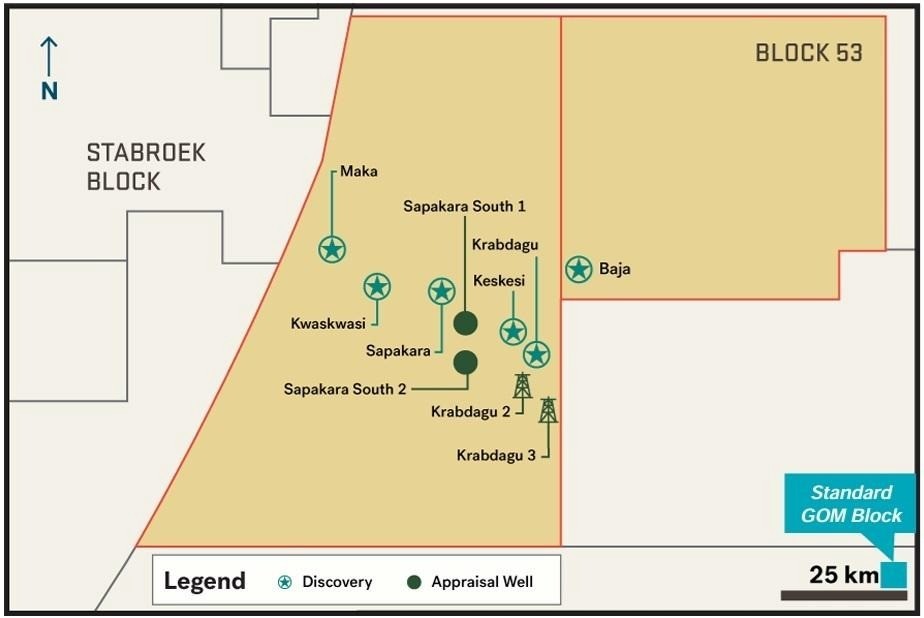
Suriname’s big moment came in January 2020, when APA Corporation discovered oil with the Maka Central 1 well in offshore Block 58. This was followed by four more commercial discoveries in the 1.4-million-acre oil block. 

APA corp
Source: APA Corporation.

By the end of 2022, however, it appeared that Suriname’s burgeoning oil boom had hit a major roadblock. TotalEnergies, which was now the operator of Block 58, chose to delay the final investment decision (FID). 

You see, a combination of a high gas-to-oil ratio at existing discoveries, poor drilling results, and mismatched seismic data deeply concerned the French supermajor. As a result, TotalEnergies and 50% partner in Block 58 APA Corporation delayed the FID in late 2022, alarming Suriname’s government in the capital Paramaribo. A rapidly deteriorating economy, coupled with rising civil unrest as the cost-of-living spiraled, sparked fears of a financial crisis for the deeply impoverished former Dutch colony.

That left Paramaribo hungrily eyeing neighboring Guyana’s massive oil boom, which catapulted the former British colony to South America’s wealthiest country based on gross domestic product (GDP) per capita. Nonetheless, in October 2024, TotalEnergies and partner APA announced the FID for the $10.5 billion Gran Morgu project in Block 58 offshore Suriname. The project is developing the Sapakara and Krabdagu discoveries, targeting a reservoir estimated to hold around 760 million barrels of crude oil.

Gran Morgu will be comprised of 16 production and 16 injection wells with a nameplate capacity of 220,000 barrels per day. As of April 2026, the project is reportedly 50% complete, with first oil expected in 2028. TotalEnergies is developing an all-electric low-emission facility, which is expected to have low greenhouse gas emissions of less than 16 kilograms of carbon dioxide emitted for every barrel of crude oil produced. This is lower than the estimated global average of 18 kilograms per barrel lifted and significantly less than heavy oil producers like Venezuela, where as much as 1,460 kilograms of carbon is produced for every barrel lifted in the Orinoco Belt.

Importantly for Paramaribo, Suriname’s national oil company, and industry regulator Staatsolie will control 20% of the Gran Morgu. The state-controlled oil company acquired a 20% operating interest in Gran Morgu for approximately $2.4 billion in 2025. This will significantly bolster the financial benefits received by Paramaribo once the project comes online and production reaches full capacity. It is estimated Gran Morgu will deliver up to $26 billion in income for the government, reinvigorating one of South America’s most impoverished countries, which, with a 2025 GDP per capita of $21,830, is the fifth poorest.

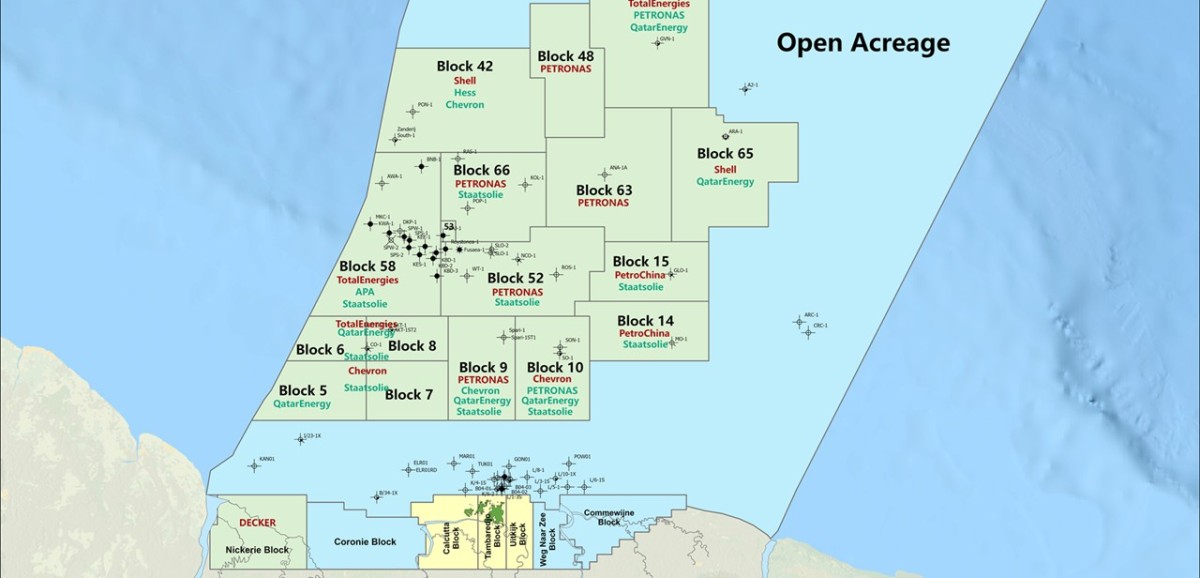
The Guyana Suriname sedimentary basin is proving to be one of the world's hottest offshore drilling locations, with Suriname shaping up to be potentially the last great oil frontier in South America. The Gran Morgu project and Block 58 are just the start of a larger hydrocarbon boom that will deliver a solid economic windfall for Suriname. There are currently 23 delineated and allocated oil blocks in offshore Suriname, as illustrated by the map below.

Suriname
Source: Staatsolie.

The low breakeven costs for new oil projects, estimated to be $40 to $45 per barrel, along with favorable production sharing agreements, which at 30 contract years are among the industry’s longest, bolster the attractiveness of investing in Suriname.

Suriname’s next major hydrocarbon project will be in offshore Block 52, where Malaysia’s national oil company Petronas is the operator and holds an 80% working interest, with the remainder held by Staatsolie. A major natural gas project centered on the 2020 Sloanea-1 discovery is currently being planned after the November 2025 declaration of commerciality. Petronas plans to make an FID by late 2026 for the multibillion-dollar project, which couldn’t arrive at a more opportune time. You see, major regional natural gas producer Trinidad and Tobago is experiencing a significant decline in reserves and output, threatening vital regional supply.

By Matthew Smith for Oilprice.com


StanChart Warns Physical Oil Premium Collapse May Be Temporary

  • Physical oil premiums have fallen sharply after spiking during the Hormuz crisis, as buyers delayed purchases, drew down inventories, reduced refinery runs, and relied on alternative non-Middle Eastern supplies.

  • Analysts at Standard Chartered expect physical crude prices to rebound once reserve releases end and refinery demand rises again, unless a geopolitical deal eases supply disruptions.

  • U.S. crude exports reached an all-time record high of 6.4 million barrels per day (bpd) for the week ending April 24, 2026, eclipsing the previous high of 5.3 million bpd set in late 2023.

Over the past couple of months, physical oil cargo premiums have surged as markets reacted to the threat of physical supply disruption, forcing buyers to pay significantly higher prices for guaranteed, prompt delivery of crude oil. As the conflict escalated and Iran blocked the Strait of Hormuz, buyers scrambled to secure immediate, non-Middle Eastern "prompt barrels", driving up the spot price premiums for available cargoes. North Sea Forties crude spiked to nearly $150 a barrel by mid-April, exceeding the 2008 peak. Many commodity experts predicted that oil futures would eventually trade up to the physical; however, we have lately been seeing just the opposite, with the physical trading down to the futures. Whereas physical prices still indicate market tightness, they have recently returned to a more normal range. Dated Brent (the primary physical benchmark for crude oil in the North Sea) settled just $0.43/bbl higher than front-month Brent on 11 May, good for a w/w fall of $11.31/bbl. Saudi Aramco’s official selling price (OSP) remains historically high; however, June saw m/m reductions to both Europe (~2/bbl) and Asia (~4/bbl) after May’s OSP recorded the largest ever m/m price increase. And now commodity experts at Standard Chartered have predicted that this downward adjustment will reverse before long.

According to StanChart, physical oil cargo premiums have collapsed--with some grades dropping 90%--due to a combination of intentional buyer restraint, increased reliance on inventory and increased supplies from non-disrupted regions. 

The sharp fall in the price of physical oil can be chalked up to buyers remaining hopeful the Iran conflict would be resolved rapidly, at least in terms of the Strait of Hormuz blockades, and were dissuaded from purchasing cargoes at extremely elevated prices. High volatility and regular price swings in excess of $10/bbl in a day (front-month Brent traded in a $35/bbl intraday range on 9 March ) have increased the risk of a VaR shock i.e., an acute increase in Value at Risk.

Deferring purchases in the near term has also allowed buyers to benefit from strategic reserve and inventory drawdowns, reduced refinery run rates (and adjustments to maintenance schedules), and alternative supply sources, which have cushioned oil price spikes.

StanChart says physical prices are likely to rise once more when purchases can no longer be deferred, refinery runs pick up and strategic reserve releases are complete, unless a deal to end the conflict can be agreed. This will likely eventually pull futures prices up towards elevated physical benchmarks.

U.S. producers continue to be among the primary beneficiaries of the ongoing energy crisis. According to the latest data from the U.S. Energy Information Administration (EIA), U.S. crude exports reached an all-time record high of 6.4 million barrels per day (bpd) for the week ending April 24, 2026, eclipsing the previous high of 5.3 million bpd set in late 2023. Combined U.S. crude oil and refined petroleum product exports hit a record peak of 12.9 million bpd in the same week. International refiners, particularly across Asia and Europe, are aggressively buying American light sweet shale oil to replace stranded Persian Gulf barrels.

Asian buyers, particularly in Japan, South Korea, and Taiwan, have sharply increased purchases. To meet this massive international demand, the U.S. has drawn heavily from commercial storage and the Strategic Petroleum Reserve (SPR), pulling down domestic inventories by over 2 million bpd. The Trump administration has initiated the sale of ~53 million barrels of crude oil from the SPR  to nine energy companies, and is working toward a total release of 172 million barrels.  This move is part of a coordinated international effort with the IEA to release roughly 400 million barrels worldwide following supply disruptions in the Middle East.

The European Union Aviation Safety Agency (EASA) recently authorized the broader use of US-grade Jet A fuel in Europe, over the standard Jet A-1 specification with “no regulatory obstacles”. By allowing the use of US-grade jet fuel, the supply pool has been effectively enlarged, removing some of the reliance on imports from the Middle East. However, Jet A has a higher freezing point than Jet A-1, meaning it’s mostly useful for lower altitude, short-to-medium haul flights. The development has allowed Jet fuel differentials to come off recent highs while front-month contracts are now in contango. The U.S. has maintained healthy jet fuel inventories, remaining above seasonal norms and in excess of the five-year range at 43.57 million barrels on 1 May. Meanwhile, inventories in Europe, as evidenced from measures in the larger Amsterdam-Rotterdam-Antwerp (ARA) region, have tightened quickly, falling from ~1.1 million metric tonnes (Mt) held from September to end-December 2025, to just 0.56Mt in the latest weekly data.

By Alex Kimani for Oilprice.com