Saturday, July 11, 2026


From Augustine to Jefferson, the idea of separating church and state has deep religious and secular roots
(The Conversation) — The Trump administration’s Religious Liberty Commission argues that religious freedom is under attack and blames the ‘wall of separation’ between church and state.
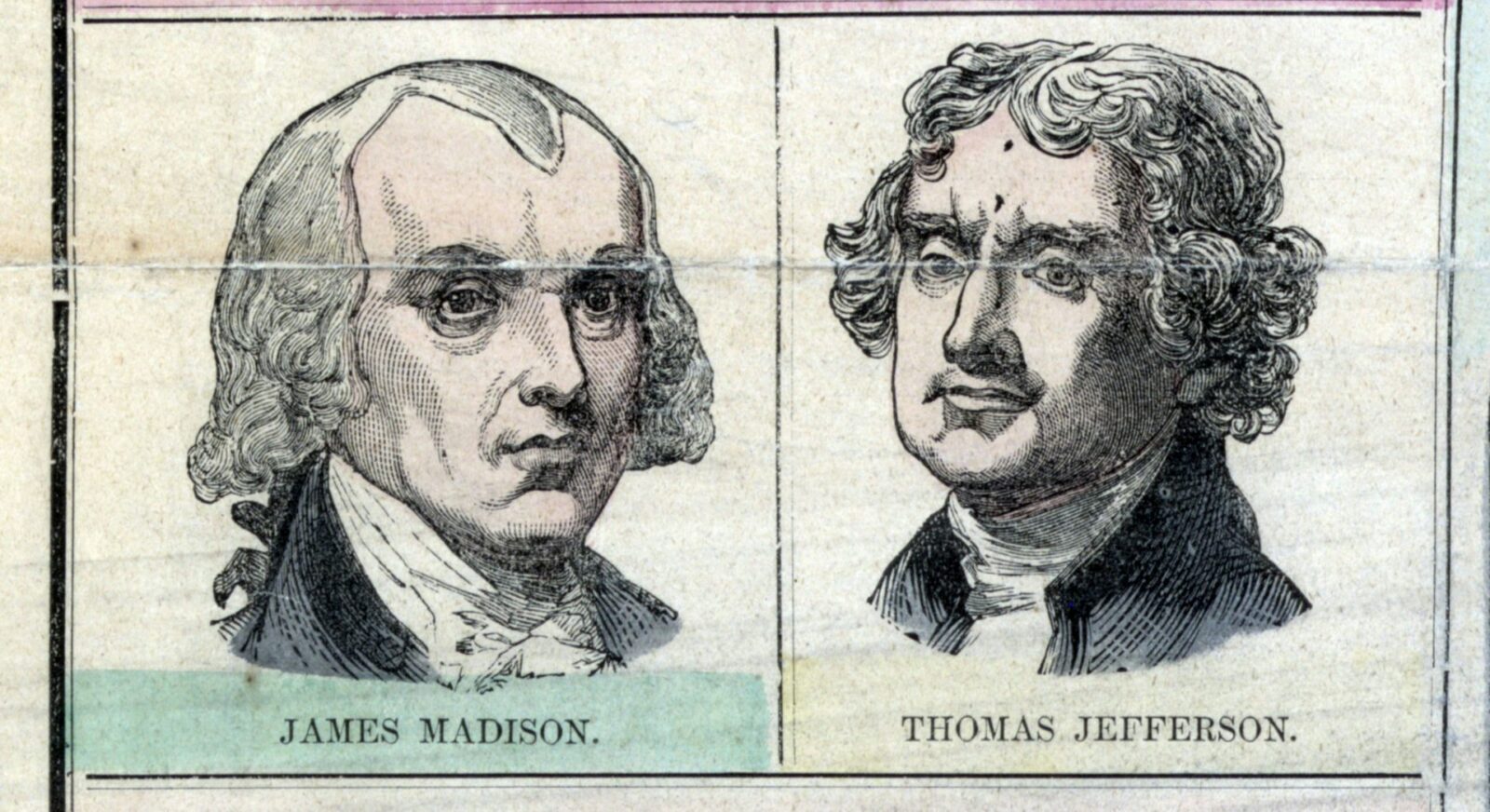
The founding generation: James Madison, left, and Thomas Jefferson, both proponents of the separation of church and state. (Photo12/Universal Images Group via Getty Images)

(The Conversation) — The Trump administration’s Religious Liberty Commission released its report on June 26, 2026, on the state of religious freedom in the United States, declaring it to be under attack.

The commission was established in May 2025 to identify and report on “emerging threats to religious liberty, uphold Federal laws that protect all citizens’ full participation in a pluralistic democracy, and protect the free exercise of religion.” Despite those altruistic goals, from the beginning, the commission faced criticism that the composition and agenda of the body were slanted toward a conservative Christian perspective.

The commission conducted seven hearings over the course of a year, taking testimony from approximately 100 witnesses.

The draft report recounts numerous incidents of reputed bias and mistreatment of people based on their religious faith, and it places the blame on bureaucrats who exhibit a disdain for demonstrations of religious conviction. The report attributes much of this to the use of “the metaphor ‘wall of separation of church and state’ to justify excluding religious Americans from equal participation in the public square.”

As author of the book “Separating Church and State: A History,” I argue that the commission’s broadside on the concept of separation of church and state is misplaced, but not new. Critics have portrayed the idea as anti-religious and ahistorical ever since the Supreme Court embraced it in 1947.

Jefferson’s ‘wall of separation’

In the 1947 landmark case of Everson vs. Board of Education, involving public financial aid for religious education, the justices announced that they would use the concept of church-state separation as a guide for interpreting the religion clauses of the First Amendment to the Constitution. Those clauses state “that Congress shall make no law respecting an establishment of religion, or prohibiting the free exercise thereof.”

In that same decision, the justices also employed the metaphor of “a wall of separation between church and state,” a phrase borrowed from an 1802 letter from President Thomas Jefferson to an association of Baptist churches in Connecticut. At the time, the Baptists were a minority in a state that still maintained a religious establishment. Jefferson sympathized with their plight, employing the wall of separation metaphor to emphasize that “religion is a matter which lies solely between man and his God” and not to “the legislative powers of government.”

Tradition of separation

The idea of separate spheres of spiritual and secular functions and authority was advanced by religious and secular thinkers to benefit both religion and the state.

In his fifth century work “City of God,” St. Augustine advanced the model of two entities, one spiritual and the other temporal or earthly, each with separate authority and functions. Augustine went so far as to use an image of two walled cities separated from each other as a means to protect the purity of the church.

During the Protestant Reformation of the 16th century, both Martin Luther and John Calvin distinguished spiritual from earthly authority and called for a division of labor between the two. Luther distinguished “two kingdoms” – a spiritual kingdom and a temporal kingdom that had separate authority.

Similarly, Calvin wrote that “Christ’s spiritual Kingdom and the civil jurisdiction are things completely distinct” and, as such, “must always be considered separately” because of the great “difference and unlikeness … between ecclesiastical and civil power.”

The metaphor of a ‘wall of separation’

At the same time, religious reformers were employing concepts of walls, hedges or other barriers to ensure that the secular and religious realms remained apart.

Protestant Anabaptists – Mennonites, Hutterites, Brethren – took the theological idea of separationism to heart, seeking to keep their communities apart from what they saw as the corruptions of the fallen world. They were declining to swear oaths of allegiance to civil authorities or otherwise participate in civic functions.

The early leader of the Mennonites, Menno Simons, used the term a “separating wall” to illustrate the degree of separateness their faith required from civil authority.

Finally, Roger Williams, the Puritan-turned-Baptist founder of Rhode Island, advocated for complete religious liberty. He called for maintaining a “hedge, or wall of separation, between the garden of the church and the wilderness of the world.”

Enlightenment figures, such as John Locke, also advanced notions of separation of church and state. In 1689, Locke wrote that the church must be “absolutely separate and distinct from the commonwealth and civil affairs. The boundaries on both sides are fixed and immovable.”

Influential British writer James Burgh called for building “an impenetrable wall of separation between things sacred and civil … the less the church and state had to do with one another, it would be better for both.” Scholars believe that this was likely one source for Jefferson’s famous 1802 letter to the Connecticut Baptists where he used the same metaphor.

A familiar concept

Thus, members of the America’s founding generation were familiar with the concept of distinct spheres of authority between religion and government and the necessity of keeping those functions separate.

Even though Jefferson used the wall metaphor only once, he worked assiduously throughout his life to advance religious freedom via church-state separation. James Madison employed similar imagery, such as calling for “a great barrier” between the two.

Church-state separation wasn’t just an imagery idea; it was a concept that many people embraced. As Madison wrote, “religion & Govt. will both exist in greater purity, the less they are mixed together.”

As a result, to this day, many denominations and religiously affiliated groups, such as many Baptists, Seventh-day Adventists and members of Reform Judaism, among others, support the separation of church and state as essential for maintaining religious freedom.

And church-state separation continues to receive popular support. According to the Pew Research Center, in 2026, 54% of Americans say the government should enforce church-state separation – a consistent percentage – whereas only 13% believe it should stop enforcing it, down from 19% in 2021.

Narrow view

Despite this pedigree, the Religious Liberty Commission’s report expresses particular disdain for the “wall” metaphor, stating that “the ‘wall of separation’ phrase does not appear in the First Amendment or anywhere else in the Constitution.” The report calls it a “belabored metaphor” that “can wrongly imply that church and state are opposed to one another and must remain completely separate.”

The report also takes a narrow view of what is prohibited by the religion clauses: “that the government may not officially prefer one religion over another, take over the functions of a church, or coerce religious observance,” which would otherwise allow for other types of church-state intermixing such as government funding of religious education.

In her final opinion as a Supreme Court justice in 2005, Sandra Day O’Connor – a judicial conservative – reflected on the importance of church-state separation to guarantee full religious freedom.

“The First Amendment expresses our Nation’s fundamental commitment to religious liberty by means of two provisions – one protecting the free exercise of religion, the other barring establishment of religion.”

She concluded with a challenge: “Those who would renegotiate the boundaries between church and state must therefore answer a difficult question: Why would we trade a system that has served us so well for one that has served others so poorly?”

That the commission’s report ignores the benefit of church-state separation to American society is troubling.

(Steven K. Green, Director of the Center for Religion, Law & Democracy, Willamette University. The views expressed in this commentary do not necessarily reflect those of Religion News Service.)


The Conversation

From ancient texts to modern practices, Daoism provides a profound framework for understanding the world not as broken but as naturally seeking balance

(The Conversation) — Daoism approaches the world not from the perspective that the world is broken or needs to be saved, but rather that it is naturally balanced.


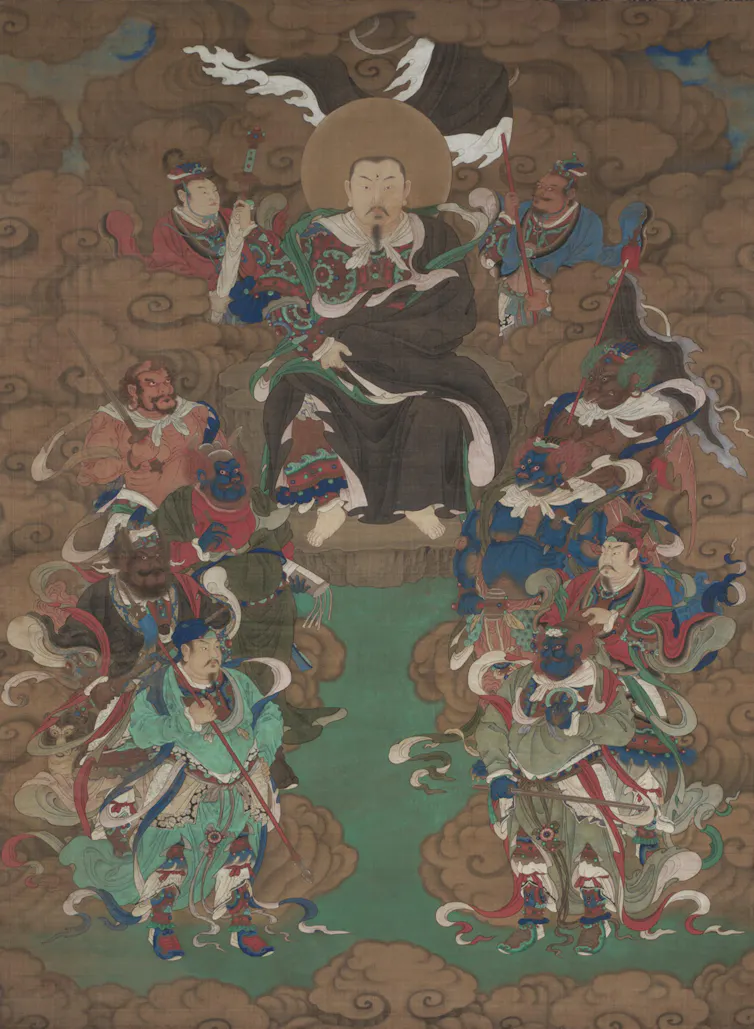
The 'Three Pure Ones,' the deities considered the most pure representation of the Dao. (Unknown author via Wikimedia Commons)

Michael Naparstek
July 7, 2026 
RNS

(The Conversation) — Daoism, China’s indigenous religion, is one of the country’s five officially recognized religions today. Practiced by millions of people in China and around the world, Daoism takes on many forms, stretching back from ancient roots to the modern world.

It challenges the conventions of how people often define religion. Unlike many other faiths, Daoism does not necessarily center on a deity, though there are many Daoist deities. Nor does it have a unified system of beliefs or follow a singular authoritative doctrine.

In fact, followers say the Dao, which literally means the “way,” cannot be truly explained. Rather, it is often viewed as something like a mysterious, balanced cosmic force. Daoist practices, then, are based on the premise that everything that makes up the world emanates from the Dao.

Daoism approaches the world not from the perspective that the world is broken or needs to be saved, but rather that it is naturally balanced. When things go wrong, Daoist, also referred to as Taoist, practice seeks to bring the world back into harmony with the Dao.

As a scholar of Daoist ritual, I am interested in the diversity of Daoism’s ideas and practices.
These include rituals related to cosmic realms, guidance for navigating the challenges of daily life and even the worship of powerful deities. Many of these practices stretch back thousands of years, offering a window into China’s religious and cultural past.
The Dao

Early textual sources describe the Dao not in terms of what it is but rather what it does.

The Daodejing – “The Classic of the Way and its Power” – is the first known text to articulate the Dao as the source of all things. Composed sometime during the fourth century B.C.E. by the legendary figure Laozi, it states, “The Dao begets the One, the One begets the Two, the Two begets the Three, the Three begets the 10,000 things.” In other words, everything we can see and know can be traced back to the Dao.

Intentionally vague and obscure, the Daodejing would go on to inspire various interpretations ranging from philosophical reflections to how to realize the Dao in everyday practice.

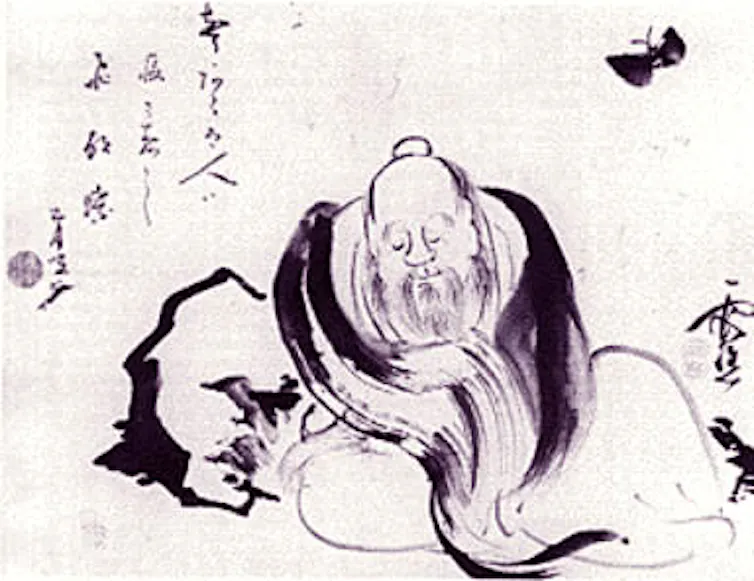
Other early texts describe the Dao through illustrative anecdotes. For example, the fourth century B.C.E. author Zhuangzi describes the Dao through often humorous anecdotes. One of the most well-known vignettes asks whether a dozing Zhuangzi dreams that he is a butterfly or whether he is a butterfly dreaming that he’s Zhuangzi.


Zhuangzi’s ‘Dreaming of a Butterfly,’ by 18th-century Japanese painter Ike no Taiga.
Ike no Taiga (1723–1776) via Wikimedia Commons

Through deceptively simple illustrations, the book attributed to Zhuangzi, which is also known as the “Zhuangzi,” artfully raises complicated questions on the relationship between our world and how we know what we think we know.
Balancing with the Dao

While Daoism asserts that the world is naturally balanced, it recognizes that sometimes it gets out of order. This is where Daoist practice steps in to help.

Daoist practice includes sophisticated rituals and visualization techniques to align one’s own body with the rhythms of the world. Practitioners understand their own bodies to be a microcosm of the entire cosmos based on the idea that everything stems from the same Dao.

Daoists believe these practices help their own longevity and also rebalance the world at large through their connection to the Dao.

Daoist ideas of alchemy play an important role in this relationship. In general, Daosist alchemy is understood as distilling elements of the world into potent spiritual essences. Daoist specialized practices aim to recombine those essences – known as “jing” – into spiritual potency.

In its earliest forms, beginning in the second century B.C.E., Daoist alchemical practices would mix rare ingredients from the earth to transform them into what they believed to be “elixirs of immortality.”

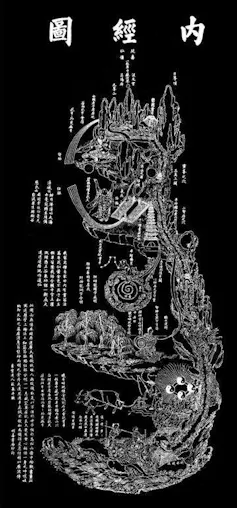
Subsequent centuries witnessed these practices moving away from physical ingredients, such as rare plants and minerals, to become more focused on visualization techniques. This form of “inner alchemy,” or “neidan,” does not use actual ingredients but rather focuses on distilling the spiritual essences within one’s own body to achieve immortality.


An illustration of the inner alchemy, or ‘neidan,’ depicting what Daoists believe to be the landscape inside one’s own body and how one can visualize the figures within.
Neidan via Wikimedia Commons

To do so, practitioners of “inner alchemy” would call upon new hosts of Daoist deities to aid them in their internal processes.
Daoist figures – deities and masters

There is no single, authoritative Daoist collection of deities. Rather, various Daoist traditions have their own preferred deities they revere based on their own particular histories and practices.

Still, some figures appear across pantheons. The Three Pure Ones, known as the Sanqing, are understood to be the most pure representation of the Dao. They consist of three figures, including Laozi, who often appear in rituals on painted ritual scrolls as Daoists seated on imperial thrones.

These three deities are thought to be personifications of the Dao who inhabit the highest realms of the Daoist cosmos, far from the dust of day-to-day life. To reach them, Daoists perform rituals to take the long journey all the way to the court of the Three Pure Ones in order to have an audience and report on the merits of the community.

Some Daoist communities refer to Laozi as “Lord Lao Most High,” or “Taishang Laojun.” The earliest Daoist community, known as the Celestial Masters, believed that their founder, Zhang Daoling, had made a special contract with the deified Laozi that would protect them through a cataclysmic end of times.

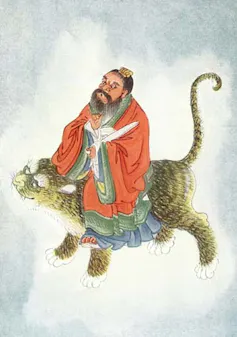
As the influence of the Daoism of Celestial Masters spread, Zhang Daoling would also come to be seen as a powerful deity in his own right, often depicted with bulging eyes and wearing a red robe, accompanied by a tiger.


Zhang Daoling.
Werner, E. T. C. (1864-1954) via Wikimedia Commons

One of the most mysterious Daoist deities is the popular Perfect Warrior, or Zhenwu. Zhenwu’s roots stretch back to ancient days as the god of the North, when he was often depicted as a turtle entwined with a snake.

Later on, Zhenwu took a human form, often shown wearing robes or armor, with long black hair flowing behind him, bare feet, and holding a sword or banner emblazoned with the Big Dipper.


Zhenwu, god of the North.
George and Mary Rockwell Collection, Herbert F. Johnson Museum of Art via Wikimedia

By the Ming dynasty, which ruled from 1368 to 1644, Zhenwu had become the patron deity of the imperial household. Known for his command of ferocious demon-quelling deities, Zhenwu remains a popular deity in Daoist exorcist rituals in places such as Taiwan.

Daoism also incorporates many deities from Chinese mythology and other religious traditions, such as Buddhism. Among the most prominent are the popular Eight Immortals, whose wild adventures often culminate with a lesson on the natural order.

Other ubiquitous Chinese deities, such as the regal Jade Emperor, the faithful warrior Guan Yu, the wondrous savior Mazu, and the demon-quelling Zhong Kui, fill both the popular imagination and the stuff of Daoist ritual.


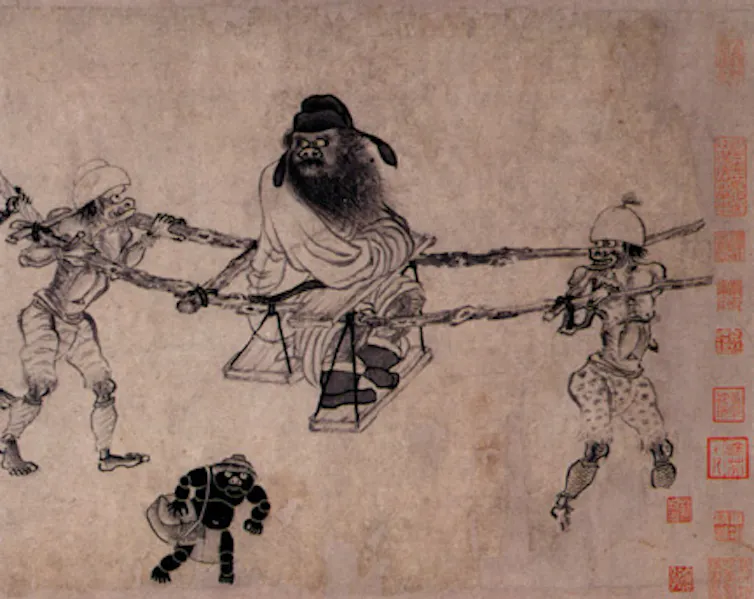
Portion of a scroll entitled ‘Zhong Kui Traveling with his Sister,’ by Gong Kai, an artist said to have lived from 1222-1304.
The University of Washington via Wikimedia

Many of these figures can now be found in movies, books and even video games, but they have their roots in the rituals and myths of Daoism.
The various forms of Daoism today

Throughout its history, Daoism never lost touch with the local traditions. Local gods and even vengeful ghosts come to be incorporated into Daoist pantheons, where they now serve to keep troublesome spirits from upsetting the community. As a result, Daoism continues to be an integral part of everyday life.

In places such as Taiwan, Daoist priests can be seen today conducting rituals at community temples and annual festivals. In mainland China, Daoism continues to be practiced in some of the most important and ancient sites of Chinese culture, such as the eighth-century “White Cloud Abbey” in Beijing.

Meanwhile, those outside China remain fascinated by Daoism, as well, with new translations of the Daodejing hitting the market every year.

As such, Daoism maintains its complex and diverse nature well into the modern era, still striving to bring it all back into balance with the Dao.

(Michael Naparstek, Associate Teaching Professor Religious Studies, University of Tennessee. The views expressed in this commentary do not necessarily reflect those of Religion News Service.)