It’s possible that I shall make an ass of myself. But in that case one can always get out of it with a little dialectic. I have, of course, so worded my proposition as to be right either way (K.Marx, Letter to F.Engels on the Indian Mutiny)
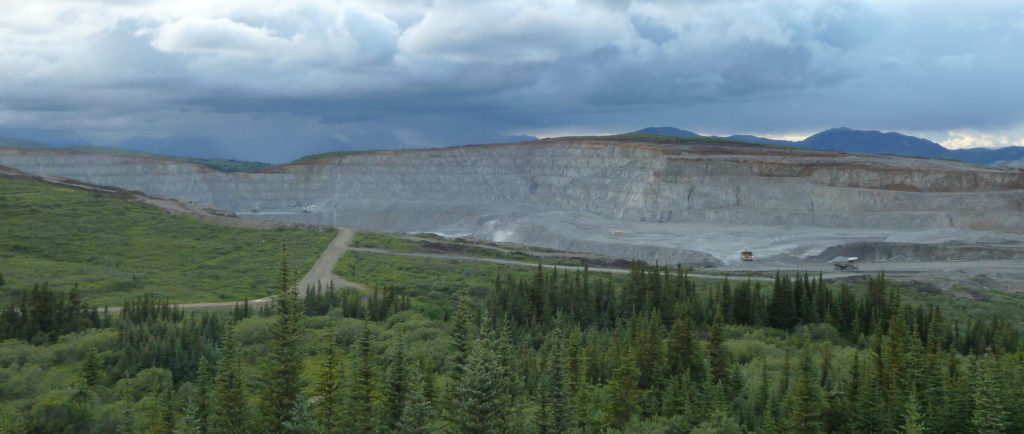
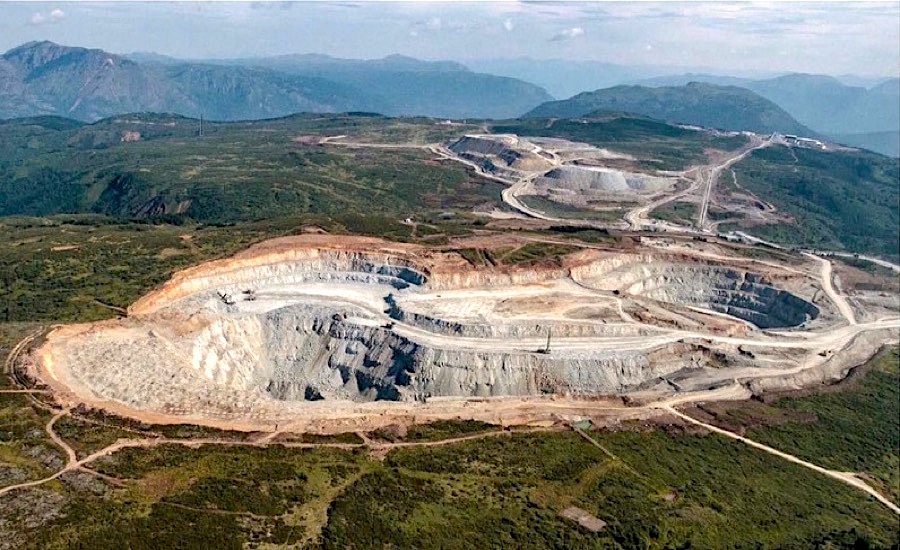
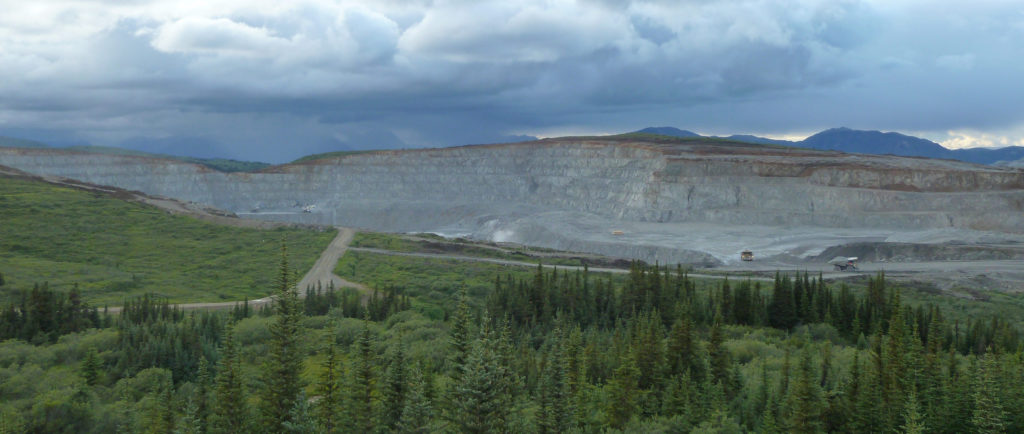
Newmont’s Red Chris copper-gold mine. Credit: Newmont
The Canadian government confirmed on Thursday C$500 million ($352 million) in financial support for the Red Chris Block Cave expansion project in British Columbia — part of a push to fast-track major mining projects in the country.
“We will invest $500 million to expand Red Chris mine, which will increase Canada’s annual copper production by more than 15%, support critical minerals demand for clean energy and manufacturing, and reduce greenhouse gas emissions by over 70% once operational,” it said in a statement.
The Red Chris porphyry deposit in BC’s Golden Triangle has a massive mineral endowment containing an estimated 20 million oz. of gold and 13 billion lb. of copper across its measured, indicated and inferred resources.
Newmont (NYSE: NEM, TSX: NGT), the world’s largest gold miner, holds a majority ownership and operates Red Chris in partnership with Canada’s Imperial Metals (TSX: III), which holds a 30% joint venture stake.
Last month, the project received crucial regulatory approvals, paving the way for a transition from open-pit mining to an underground operation and extending its lifespan into the mid-2040s.
“Newmont welcomes the government of Canada’s announcement of a C$500 million contribution to support the Red Chris Block Cave project,” the Colorado-based miner said in a statement.
“As we advance through our approval process toward a final investment decision, this commitment strengthens the business case for the development of a world-class copper-gold operation.”
Newmont is currently completing a definitive feasibility study for the project. The Red Chris Block Cave is expected to create more than 1,800 jobs during construction and sustain a total approximate workforce of 1,500 peak-season operational roles.
Sunday, June 20, 2021
B.C. to begin DRIPA-based negotiations with Tahltan First Nation on two northwest mining projects
The province of B.C is set to negotiate its first consent-based decision making agreement based on Section 7 of the Declaration of the Rights Of Indigenous Peoples Act (DRIPA) with Tahltan First Nation.
The province is holding talks with the Tahltan Central Government (TCG) – the political arm of the Tahltan First Nation – mining companies and stakeholders to reach an agreement related to environmental assessment approvals for two mining projects in Tahltan Territory.
These include the expansion of the Red Chris copper and gold mine located 80 kilometres south of Dease Lake and operated by Australian company Newcrest Red Chris Mining Ltd., and the Eskay Creek Mine operated by Skeena Resources Ltd.
The Tahltan Nation is also an investor in Skeena Resources and has developed a strong relationship with Newcrest Red Chris Mining Ltd. Both projects represent up to $3.3 billion in potential investment.
The Red Chris JV (Newcrest Red Chris Mining Ltd.) and Eskay Creek Revitalization Project (Skeena Resources) mining projects in the core Territory of the Tahltan Nation represent up to $3.3 billion in potential investment.
The provincial government’s move to table negotiations with TCG and mining stakeholders came a week after both governments signed a Shared Prosperity Agreement to achieve long-term land-use predictability on June 10. As part of this agreement, the province committed $20 million to TCG to support economic growth and reconciliation.
READ MORE: Tahltan Nation, B.C. government sign agreement for shared decision-making
Welcoming the agreement, TCG president Chad Norman Day said that it provides “an opportunity to meaningfully advance reconciliation grounded in the principles of respect and recognition of Tahltan rights and title.”
“The ongoing evolution and growth of the Tahltan Nation shows outside governments, industry and the world how working alongside the Tahltan Nation as true partners can help secure certainty, economic benefits and pride for everyone involved,” said Day.
Spread across 95,933 square kilometres of northwestern British Columbia Tahltan territory covers 11 per cent of the province and includes 70 per cent of B.C.’s resource rich ‘golden triangle’.
Along with Newcrest and Skeena Resources other stakeholders such as Regional District of Kitimat-Stikine, Mining Association of British Columbia, Association for Mineral Exploration and Business Council of British Columbia will also be part of the consultation.
The discussions are scheduled to take place under the framework of Section 7 of the DRIPA Act– which B.C. adopted in 2019– which sets out provisions for negotiating consent-based decision making agreements for the the purposes of reconciliation.
“If we are successful, the agreement would bring greater clarity in decision-making and forge a partnership with the Tahltan Nation on two projects. It would also support Tahltan self-government and promote significant economic development in the region,” said Murray Rankin, B.C.’s Indigenous Relations & Reconciliation Minister.
Binny Paul, Local Journalism Initiative Reporter, Terrace Standard
Wednesday, July 23, 2025
Three workers trapped in B.C.'s Red Chris mine have air, food, water, operator says
VANCOUVER — Three workers trapped underground in a refuge area at the Red Chris mine in northwestern British Columbia have enough air, water and food for an "extended stay," the mine's majority owner said Wednesday.
The statement from Newmont Corp. said it was working to assemble specialist teams from nearby mine sites to respond to the accident that occurred Tuesday.
A spokesperson for the company said the "contained refuge bays" are equipped to support about 16 people for three days, and the three workers have access to more than one of those bays in the area where they are trapped.
The workers became trapped after two "fall of ground" incidents blocked access, Newmont's statement said.
They were working more than 500 metres beyond the area affected by the first fall and had relocated to the refuge station before the second collapse blocked their escape, it said.
The statement said contact was established with the workers after the first incident, and they confirmed they had safely relocated to the station.
However, it said the second collapse of rock or soil "restricted" communication with the workers.
"All appropriate emergency response protocols were activated immediately," the statement said.
"Newmont is actively assessing all methods and technologies available to restore communication and safely bring our team members to surface."
Operations at the copper and gold mine have been stood down, the statement added.
B.C. Premier David Eby released the news at the end of the premiers' gathering in Ontario on Wednesday, telling media that to the best of his knowledge, the workers are uninjured.
He said two of the workers are from B.C. and another is from Ontario.
"B.C. miners are the best in the world. Our rescue teams are exceptional, and they will be working overtime to bring these workers home safely to their families," he said.
Eby said later on social media platform X that the government had sent a "senior geotechnical inspector" to support the company's efforts.
WorkSafeBC, the province's worker safety agency, said in a statement that mine safety falls under the jurisdiction of the Ministry of Mining and Critical Minerals.
Mining Minister Jagrup Brar issued a statement saying his ministry had dispatched a geotechnical inspector of mines to the site to work with Newmont and support rescue efforts.
The Transportation Ministry expedited a permit to allow heavy equipment to be moved from the nearby Brucejack mine to Red Chris to assist, he added.
"I'm heartened to see the immediate support that's been provided from others across the mining industry, in the form of supplies, equipment and expertise to assist with this situation," he said.
"Mining operators in B.C. — including Newmont — have highly trained mine rescue teams at the ready to respond in emergency situations."
Nolan Paquette, a business agent for United Steelworkers Local 1-1937, said the trapped workers are contractors.
They are trapped on the opposite side of the collapse, but they are safely in the refuge station underground, he said in an interview.
Eby said the province was in contact with the mine's owner, which was working with world-leading mining rescue experts.
The premier said he had spoken to Ontario Premier Doug Ford about the situation and was keeping Ford's government up to date.
"Obviously it's very concerning for the families, for the workers in the sector and British Columbians and Canadians and our thoughts are with the families and appreciation with the incredibly brave rescue teams that are working right now."
Eby told reporters later Wednesday that he didn't have details on how long the rescue was expected to take.
The province's ambulance service, meanwhile, said it was monitoring the situation.
The Red Chris mine is jointly owned by Newmont, which has a 70 per cent interest in the project, and Imperial Metals Corp.
The mine is mostly an open-pit operation, but Newmont said in an earlier statement that development of underground block-cave mining began in 2019, four years after its first production date.
The Canadian Mining Journal has said block caving can extend the life of an open pit operation, and the underground mass mining method allows for bulk extraction of lower-grade ore deposits.
This report by The Canadian Press was first published July 23, 2025.
Brenna Owen and Ashley Joannou, The Canadian Press
Friday, July 25, 2025
Three workers rescued after 60 hours trapped in British Columbia mine
Three workers who were trapped at Newmont’s (NYSE, ASX: NEM)(TSX: NGT) Red Chris mine in northwest British Columbia, Canada, have been safely rescued after more than 60 hours underground.
Newmont said that Kevin Coumbs, Darien Maduke and Jesse Chubaty — contractors for B.C.-based Hy-Tech Drilling — were in “good health and spirits” after being brought to the surface late Thursday night. The rescue followed two significant rockfalls that occurred early Tuesday morning, blocking their exit and later cutting off communication.
“This was a carefully planned and meticulously executed rescue plan,” the company said in a statement.
Newmont said that, before losing contact on Wednesday, the men had confirmed they were in one of the mine’s refuge chambers with steady access to food, water, and air. They were rescued at approximately 10:40 PM local time Thursday (1:40 AM ET Friday), following the complex operation.
Newmont halted all operations at Red Chris during the rescue efforts. The team used drones and a remote-controlled scoop, brought from the company’s Brucejack mine, also in B.C., to clear the massive debris—estimated at 20 to 30 metres long and up to eight metres high.
Newmont credited the successful outcome to “tireless collaboration, technical expertise, and above all, safety and care.”
B.C.’s Mining and Critical Minerals Minister Jagrup Brar said in a post on X he could not describe “the relief we all feel knowing that these three workers are going to be able to go home to their families.”
Red Chris, located about 80 km south of Dease Lake and 1,050 kilometres (652 miles) north of Vancouver, is a joint venture operated by Newmont (70%) and Imperial Metals (30%). The gold-copper mine has been in production since 2015.
A full investigation into the incident is underway.
Sunday, September 12, 2021
GOLD MINING IS NOT SUSTAINABLE
Spanish Mountain moves BC gold project forward with optimization and EA programs
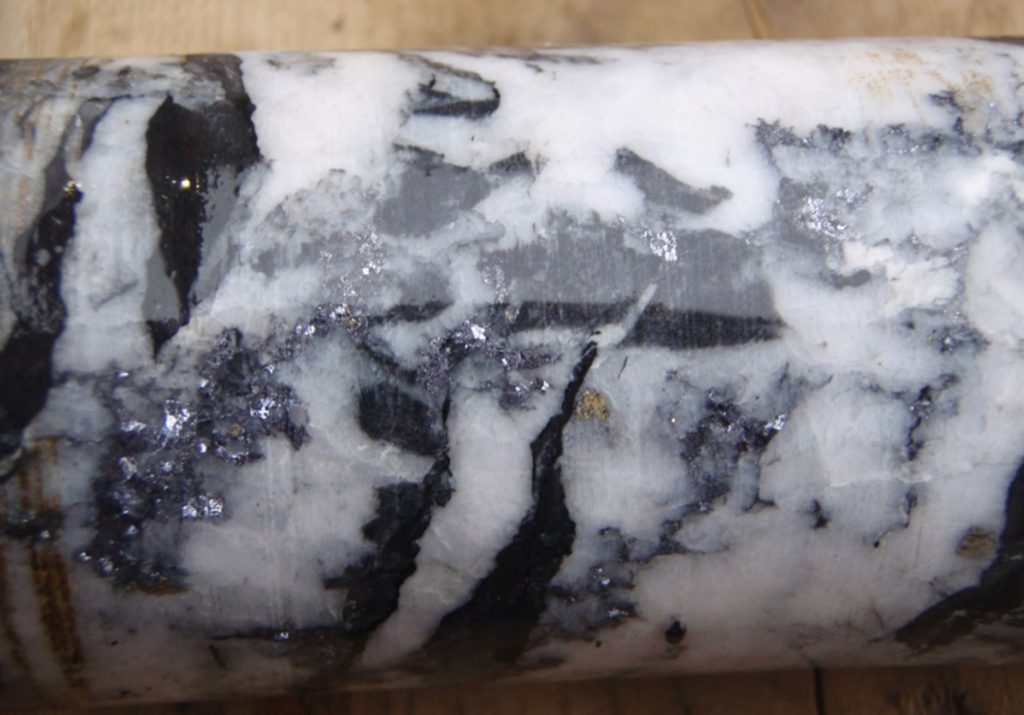
Canadian Mining Journal Staff | September 9, 2021 | Visible gold and silver in core from Spanish Mountain in B.C. Credit: Spanish Mountain Gold
After releasing a prefeasibility study in May, Spanish Mountain Gold (ESXV: SPA) is moving its Spanish Mountain gold project forward. The company has launched several optimization initiatives and the environmental assessment for the project, located 70 km northeast of Williams Lake, British Columbia. Williams Lake, BC Map & Directions - MapQuest
To optimize gold recovery, Spanish Mountain has hired Ausenco Engineering Canada to go over the mill flowsheet, further reducing capital and operating costs. Under consideration is piloting a direct flotation reactor (DFR), simplifying the flowsheet, and boosting gold recovery through a finer primary grind, and the inclusion of a primary gravity circuit.
Linkan Engineering has been engaged to design a passive water treatment system that would inhibit neutral sulphide oxidation and associated metal leaching. Spanish Mountain says water management and treatment is a high priority for the project.
The company also has its engineers assessing the route of a power line to the project.
As the baseline environmental assessment studies continue, Spanish Mountain is consulting with the three First Nations that signed memoranda for engagement a decade ago. The initial project description (IPD) is nearing completion, and it will be circulated to the First Nations for comment and input before it goes to the provincial and federal regulators. A site-wide water balance program to study groundwater flows near the planned pit and tailings management area is also underway.
The company has an active program of exploration drilling to expand the resources ahead of the feasibility study. The geological model of the project suggests that mineralization is open at depth and along strike.
The processing of gold scrap varies not only with the gold content but also with the amenability of the gold in the scrap to extraction. Thus, the bulk of the gold may be recovered by leaching techniques using cyanidation or aqueous chlorination, and the residue may then be treated by smelting to recover the balance.
2013-01-02 · The carbon-in-pulp process is used to treat low grade gold and/or silver ores. The ore is first ground in a ball mill which operates in closed circuit with a cyclone …
Expect the feasibility study for underground mining at Red Chris in the middle of next year. Credit: Imperial Metals
Imperial Metals (TSX: III) reports that drilling at the newly discovered East Ridge zone at the Red Chris copper-gold mine continues to return long and strong assays. The mine near Dease Lake, BC, is owned 70% by Australia’s Newcrest Mining (TSX: NCM; ASX: NSM) and 30% by Imperial.
Drill hole RD705 returned 254 metres of 1.1% copper and 1 g/t gold from a depth of 718 metres, including 80 metres of 1.4% copper and 1.6 g/t gold. Assays from this hole and the previously reported RC678 confirm the continuity of the mineralization over 300 metres vertically.
Drilling continues at the East Ridge zone, which is adjacent to the East zone, on a nominal 100 by 100 metre grid. Fourteen holes have been completed and six are in progress.
A stepout hole drilled 700 metres east of East Ridge returned 206 metres grading 0.5% copper and 0.2 g/t gold from 1,816 metres. This is one of the deepest intercepts on the property and extends the potential mineralization even further.
As operator, Newcrest is working on a prefeasibility study due this month of an underground block cave mine in addition to the open pit now being mined. Construction of an exploration decline into the East zone began earlier this year. Surface drilling has already confirmed the presence of several high grade pods in the zone, and development of a small underground producer would boost cash flow at the operation.
A full feasibility study for underground mining is due in mid-2022.
Last year the Red Chris mine produced 25,000 tonnes of copper and 39,000 oz. of gold.
How to save the red wolf from going extinct—for a second time
Meaghan Mulholland With a total population below 20 individuals, the world’s most endangered wolf lives only in a small area in and around the Alligator River and Pocosin Lakes National Wildlife Refuges in eastern North Carolina.
Called “America’s wolf,” the red wolf (Canis rufus) is the only large predator whose historic range is found entirely within the United States, stretching from Texas to New England. But hunting gradually reduced its range, and it was declared extinct in the wild in 1980. In a ground-breaking successful experiment, eight captive wolves were released in 1987 into North Carolina, eventually growing into a population over 100. But poaching and management changes enacted by the Fish and Wildlife Service resulted in their numbers plummeting.
In the spring, conservationists celebrated a small bit of good news when four captive-born pups were placed into a den and successfully adopted by a wild red wolf mother. Meanwhile, another four adults were released into the wild. The pups are thought to be still alive and healthy. But the adults didn’t fare as well. In the months after release, three were struck by cars and killed, and the fourth was fatally shot on private land.
To boost the population after these deaths, the U.S. Fish and Wildlife Service announced in November that it plans to release nine adult red wolves into their recovery area this winter, land within and surrounding two wildlife refuges. The service also recently announced it would withdraw a 2018 proposal to shrink the red wolves’ protected area in North Carolina by 90 percent, after a lawsuit accused the agency of violating the Endangered Species Act.
Ron Sutherland of the Wildlands Network, who is based in the red wolf’s last stronghold of North Carolina, says it’s crucial that the feds have abandoned this wrong-headed proposal. And yet “the situation now is even more urgent than it was in 2018—this should launch the conservation community in the U.S. into crisis mode to save this species and bring it back from the brink.”
“We are committed to continuing to work with stakeholders in identifying ways to encourage and facilitate more effective coexistence between people and red wolves,” Emily Weller, red wolf recovery lead for the Fish and Wildlife Service, said in an email to National Geographic.
In addition to the current small population in North Carolina, some 240 red wolves now live under human care at zoos and nature centers across the country. These facilities are part of the red wolf’s Species Survival Plan (SSP), which includes captive breeding to help rebuild their population and maintain genetic diversity. (Learn more: Eight red wolves released into wild provide hope for species.)
Chris Lasher, an animal management supervisor with the North Carolina Zoo in Asheboro and coordinator of the Red Wolf SSP, says that researchers would like to grow the captive population to a total of 400 individuals, an important step for preventing their extinction.
Next, more wolves need to be released, according to advocates like Sutherland and the Southern Environmental Law Center, whose lawsuit on behalf of conservation groups is what instigated the recent court-mandated releases. These releases need to continue, he says, “until the wild population hits 40 to 50 animals again and shows signs of taking off.” At this point, the red wolves can be best supported “by fostering captive pups into wild litters rather than releasing adult and adolescent wolves.”
This includes adults and pups. Perhaps the best way for red wolves to become savvy about their environment is from their parents, who ideally would pass on generations of learned wisdom about avoiding roads, how to hunt, and where to den. The process of pup fostering has a 100 percent success rate with red wolves and helps promote genetic diversity in the population.
It’s a difficult and time-sensitive procedure, however, and there must be wild litters on the landscape in order for it to be possible. 2019 and 2020 were the first years in the history of the red wolf recovery program—begun in 1987—in which no pups were born in the wild. But 2021’s foster effort appears to have been a success, and it remains to be seen if some of the pairs to be released this winter will produce more litters in the spring.
Better preparing wolves for release is another ongoing process. To do so, the animals are kept in large enclosures containing landscape features they would encounter in the wild. Roads are difficult to prepare them for—but keepers carefully experiment with potential forms of “negative enrichment,” which can be as simple as letting captive wolves associate car noises with semi-stressful experiences like health exams. In contrast, positive enrichment uses things like novel scents, natural objects, recorded animal sounds, hidden food and whole prey carcasses to provide mental and physical stimulation, says Regina Mossotti, Animal Director of the Endangered Wolf Center in Eureka, Missouri.
Feeding times are varied to prevent captive red wolves from associating humans with food. When possible they are also housed in family groups, Lasher says, “that would be similar to what they would experience in the wild.”
The Fish and Wildlife Service is also developing strategies to reduce vehicle strikes, working on things like motorist signage, wildlife crossings, road reflectors, and aversive conditioning—helping red wolves learn to avoid cars and roads, according to the agency. The Service plans also to modify the tracking collars of future red wolf releases to include orange reflective material, making them more visible on roadways at night, and more easily identifiable to hunters.
Like the ones slated for this winter, future releases will also take place outside the agricultural growing season, when there should be less traffic on nearby farm roads as well as on Highway 64, a main route to the Outer Banks, a popular vacation destination. Coordinating with the state’s Department of Transportation, the Fish and Wildlife Service purchased four portable electronic message boards to be used at various locations to urge people to drive with caution.
In November, the Senate passed, and President Biden signed, a $1.2 trillion infrastructure bill, which includes $350 million to help states fund the construction of wildlife crossings. The bill also calls for a nationwide study of wildlife-vehicle collisions and guidance on how to prevent or reduce them. Wildlife crossings go over or under existing roads and have been shown effective at reducing car-caused fatalities—but they are expensive. Newly designated federal funds may enable the state’s Department of Transportation to add some on Highway 64, which cuts through the refuge. Some have already been designed by the state. Staying alive
Red wolves are legally protected under the Endangered Species Act, but a recent study published in the journal Biological Conservation found that a small minority of humans in their recovery area are the main factor driving this species toward extinction. Despite a majority of locals reporting positive impressions of red wolves, eleven percent of area hunters said that if they encountered a wolf, they would kill it. Among other conservation groups, the Wildlands Network has been working for years to teach the truth about red wolves—that they aren’t dangerous to humans, and don’t harm local wildlife resources.
Federal agencies and conservation groups are hoping to work together through outreach programs, some of which have been hindered by pandemic restrictions. These include virtual information sessions, billboards and other publicity campaigns, as well as Prey for the Pack, a program in which local landowners are offered incentives in exchange for agreeing to create and maintain habitat beneficial for red wolves, and to allow red wolves on private property. The Fish and Wildlife Service now has around a thousand acres of privately owned land under agreements via Prey for the Pack, and is working to secure more, the agency said in an emailed statement.
The Fish and Wildlife Service recently assembled a team of experts to develop an updated recovery plan for the red wolf, which in large part will have to involve more successful reintroductions. The plan will also include research into other potential sites within the red wolf’s historic range—outside of eastern North Carolina—where a wild population could thrive.
The service also says they are recommitting to capturing and sterilizing coyotes to help red wolves hold territory and avoid hybridization—a successful measure that they had abandoned in recent years.
While red wolf recovery might seem in a sense to be “starting over,” as the nearly restored species once again teeters on the brink of extinction, biologists and experts have gained a wealth of insights over the past three decades about what must be done for the species to succeed.
Despite unfortunate missteps, setbacks, and challenges still ahead, Mossotti says it’s inspiring to see many people “working to help restore the species to its native range…and finding new reasons to hope.”
Tuesday, July 13, 2021
By Jove! Stunning New Images Show Jupiter’s Great Red Spot, Superstorms, and Gargantuan Cyclones
ByASSOCIATION OF UNIVERSITIES FOR RESEARCH IN ASTRONOMY (AURA)JULY 11, 2021
Three images of Jupiter show the gas giant in three different types of light — infrared, visible, and ultraviolet. The image on the left was taken in infrared by the Near-InfraRed Imager (NIRI) instrument at Gemini North in Hawaiʻi, the northern member of the international Gemini Observatory, a Program of NSF’s NOIRLab. The center image was taken in visible light by the Wide Field Camera 3 on the Hubble Space Telescope. The image on the right was taken in ultraviolet light by Hubble’s Wide Field Camera 3. All of the observations were taken on 11 January 2017. Credit: International Gemini Observatory/NOIRLab/NSF/AURA/NASA/ESA, M.H. Wong and I. de Pater (UC Berkeley) et al.
Stunning new images of Jupiter from Gemini North and the NASA/ESA Hubble Space Telescope showcase the planet at infrared, visible, and ultraviolet wavelengths of light. These views reveal details in atmospheric features such as the Great Red Spot, superstorms, and gargantuan cyclones stretching across the planet’s disk. Three interactive images allow you to compare observations of Jupiter at these different wavelengths and explore the gas giant’s clouds yourself!
Three striking new images of Jupiter show the stately gas giant at three different types of light — infrared, visible, and ultraviolet. The visible and ultraviolet views were captured by the Wide Field Camera 3 on the Hubble Space Telescope, while the infrared image comes from the Near-InfraRed Imager (NIRI) instrument at Gemini North in Hawaiʻi, the northern member of the international Gemini Observatory, a Program of NSF’s NOIRLab. All of the observations were taken simultaneously (at 15:41 Universal Time) on January 11, 2017.
These three portraits highlight the key advantage of multiwavelength astronomy: viewing planets and other astronomical objects at different wavelengths of light allows scientists to glean otherwise unavailable insights. In the case of Jupiter, the planet has a vastly different appearance in the infrared, visible, and ultraviolet observations. The planet’s Great Red Spot — the famous persistent storm system large enough to swallow the Earth whole — is a prominent feature of the visible and ultraviolet images, but it is almost invisible at infrared wavelengths. Jupiter’s counter-rotating bands of clouds, on the contrary, are clearly visible in all three views.
This infrared view of Jupiter was created from data captured on 11 January 2017 with the Near-InfraRed Imager (NIRI) instrument at Gemini North in Hawaiʻi, the northern member of the international Gemini Observatory, a Program of NSF’s NOIRLab. It is actually a mosaic of individual frames that were combined to produce a global portrait of the planet. In the image warmer areas appear bright, including four large hot spots that appear in a row just north of the equator. South of the equator, the oval-shaped and cloud-covered Great Red Spot appears dark. Credit: International Gemini Observatory/NOIRLab/NSF/AURA, M.H. Wong (UC Berkeley) et al., Acknowledgments: M. Zamani
Observing the Great Red Spot at multiple wavelengths yields other surprises — the dark region in the infrared image is larger than the corresponding red oval in the visible image. This discrepancy arises because different structures are revealed by different wavelengths; the infrared observations show areas covered with thick clouds, while the visible and ultraviolet observations show the locations of chromophores — the particles that give the Great Red Spot its distinctive hue by absorbing blue and ultraviolet light.
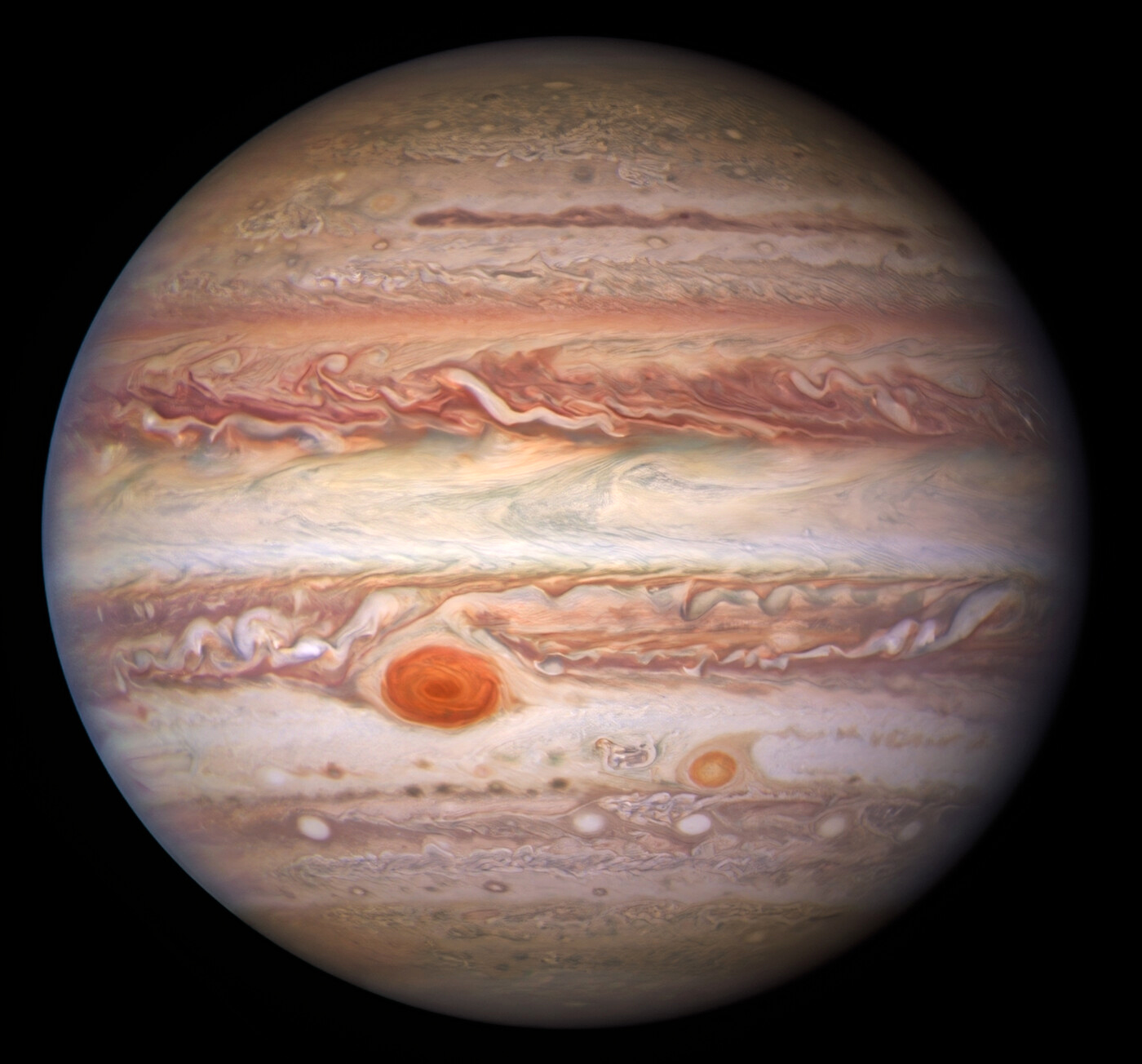
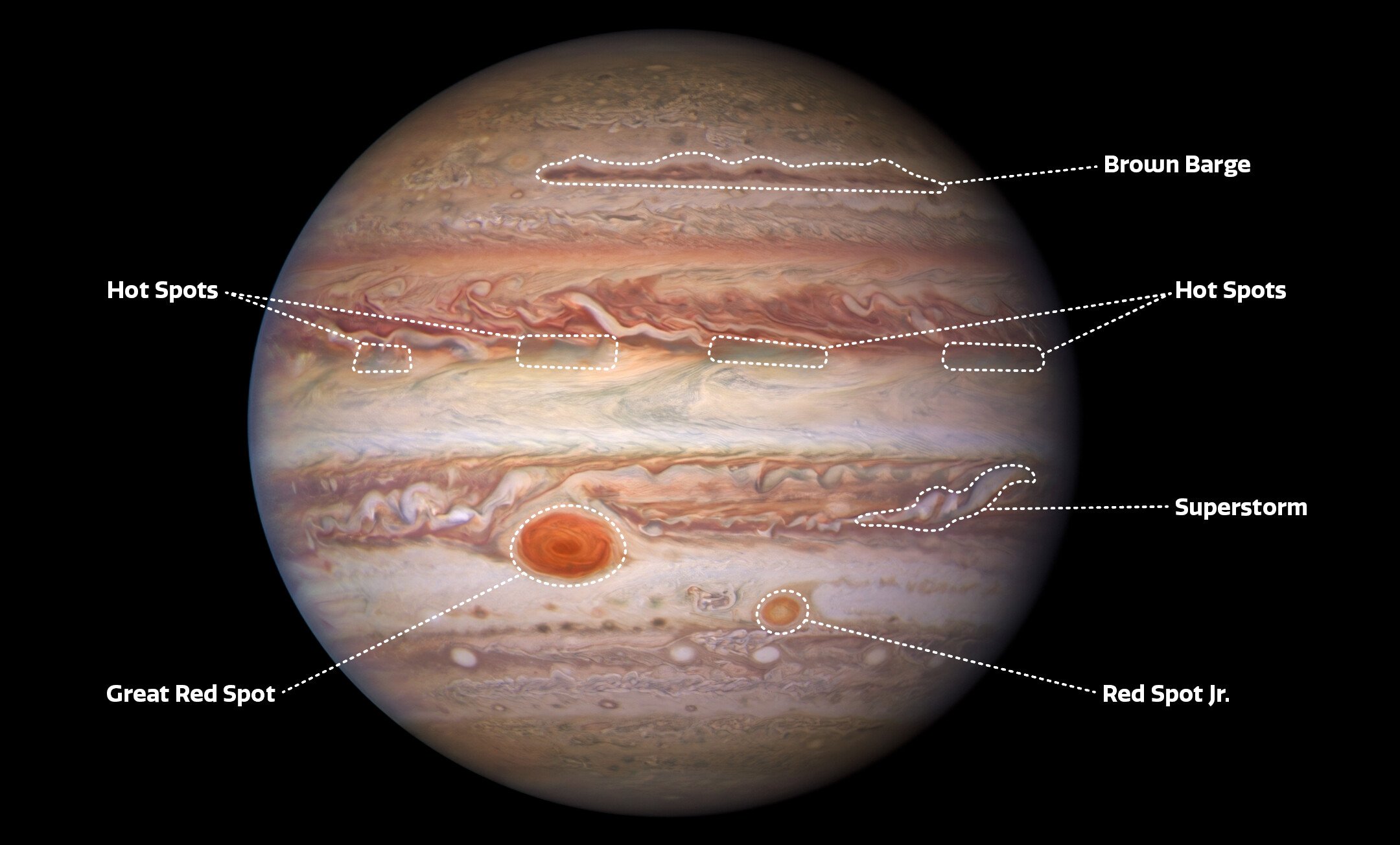
This visible-light image of Jupiter was created from data captured on 11 January 2017 using the Wide Field Camera 3 on the Hubble Space Telescope. Near the top, a long brown feature called a ‘brown barge’ extends 72,000 kilometers (nearly 45,000 miles) in the east-west direction. The Great Red Spot stands out prominently in the lower left, while the smaller feature nicknamed Red Spot Jr. (known to Jovian scientists as Oval BA) appears to its lower right. Credit: NASA/ESA/NOIRLab/NSF/AURA/M.H. Wong and I. de Pater (UC Berkeley) et al. Acknowledgments: M. Zamani
The Great Red Spot isn’t the only storm system visible in these images. The region sometimes nicknamed Red Spot Jr. (known to Jovian scientists as Oval BA) appears in both the visible and ultraviolet observations.[1] This storm — to the bottom right of its larger counterpart — formed from the merger of three similar-sized storms in 2000.[2] In the visible-wavelength image, it has a clearly defined red outer rim with a white center. In the infrared, however, Red Spot Jr. is invisible, lost in the larger band of cooler clouds, which appear dark in the infrared view. Like the Great Red Spot, Red Spot Jr. is colored by chromophores that absorb solar radiation at both ultraviolet and blue wavelengths, giving it a red color in visible observations and a dark appearance at ultraviolet wavelengths. Just above Red Spot Jr. in the visible observations, a Jovian superstorm appears as a diagonal white streak extending toward the right side of Jupiter’s disk.
This ultraviolet image of Jupiter was created from data captured on 11 January 2017 using the Wide Field Camera 3 on the Hubble Space Telescope. The Great Red Spot and Red Spot Jr. (also known as Oval BA) absorb ultraviolet radiation from the Sun and therefore appear dark in this view. Credit: NASA/ESA/NOIRLab/NSF/AURA/M.H. Wong and I. de Pater (UC Berkeley) et al., Acknowledgments: M. Zamani
One atmospheric phenomenon that does feature prominently at infrared wavelengths is a bright streak in the northern hemisphere of Jupiter. This feature — a cyclonic vortex or perhaps a series of vortices — extends 72,000 kilometers (nearly 45,000 miles) in the east-west direction. At visible wavelengths the cyclone appears dark brown, leading to these types of features being called ‘brown barges’ in images from NASA’s Voyager spacecraft. At ultraviolet wavelengths, however, the feature is barely visible underneath a layer of stratospheric haze, which becomes increasingly dark toward the north pole.
Similarly, lined up below the brown barge, four large ‘hot spots’ appear bright in the infrared image but dark in both the visible and ultraviolet views. Astronomers discovered such features when they observed Jupiter in infrared wavelengths for the first time in the 1960s.
As well as providing a beautiful scenic tour of Jupiter, these observations provide insights about the planet’s atmosphere, with each wavelength probing different layers of cloud and haze particles. A team of astronomers used the telescope data to analyze the cloud structure within areas of Jupiter where NASA’s Juno spacecraft detected radio signals coming from lightning activity.
Labels added to this visible-light Hubble Space Telescope image of Jupiter point out several atmospheric features on the planet, including a ‘brown barge’, four hot spots (which appear bright in the infrared image from Gemini North), a superstorm, the Great Red Spot, and Red Spot Jr. (also known as Oval BA). Credit: NASA/ESA/NOIRLab/NSF/AURA/M.H. Wong and I. de Pater (UC Berkeley) et al.
The scientific story behind these striking images is told in full in a new NOIRLab Stories blog post. As well as discovering the science behind these images, we invite you to inspect observations of Jupiter at home! Three interactive images let you compare observations of Jupiter at different wavelengths and peer beneath the gas giant’s clouds:
“The Gemini North observations were made possible by the telescope’s location within the Maunakea Science Reserve, adjacent to the summit of Maunakea,” acknowledges the observation team’s leader, Mike Wong of the University of California, Berkeley. “We are grateful for the privilege of observing Ka‘awela (Jupiter) from a place that is unique in both its astronomical quality and its cultural significance.”
While it appears red in Hubble’s visible-light image of Jupiter taken in January 2017, Red Spot Jr. does not always appear red. It was white when it first formed but turned red several years later. It has changed color since then and once again appears white.
The three storms that merged to form Red Spot Jr. in 2000 were similar in size to each other and similar in size to Red Spot Jr. Interestingly, Red Spot Jr. did not become much larger than any of the three individual storms after they merged.
References
“High-resolution UV/Optical/IR Imaging of Jupiter in 2016–2019” by Michael H. Wong, Amy A. Simon, Joshua W. Tollefson, Imke de Pater, Megan N. Barnett, Andrew I. Hsu, Andrew W. Stephens, Glenn S. Orton, Scott W. Fleming, Charles Goullaud, William Januszewski, Anthony Roman, Gordon L. Bjoraker, Sushil K. Atreya, Alberto Adriani and Leigh N. Fletcher, 1 April 2020, The Astrophysical Journal Supplement Series. DOI: 10.3847/1538-4365/ab775f
“First ALMA Millimeter-wavelength Maps of Jupiter, with a Multiwavelength Study of Convection” by Imke de Pater, R. J. Sault, Chris Moeckel, Arielle Moullet, Michael H. Wong, Charles Goullaud, David DeBoer, Bryan J. Butler, Gordon Bjoraker, Máté Ádámkovics, Richard Cosentino, Padraig T. Donnelly, Leigh N. Fletcher, Yasumasa Kasaba, Glenn S. Orton, John H. Rogers, James A. Sinclair and Eric Villard, 9 September 2019, The Astronomical Journal. DOI: 10.3847/1538-3881/ab3643
More information
NSF’s NOIRLab (National Optical-Infrared Astronomy Research Laboratory), the US center for ground-based optical-infrared astronomy, operates the international Gemini Observatory (a facility of NSF, NRC–Canada, ANID–Chile, MCTIC–Brazil, MINCyT–Argentina, and KASI–Republic of Korea), Kitt Peak National Observatory (KPNO), Cerro Tololo Inter-American Observatory (CTIO), the Community Science and Data Center (CSDC), and Vera C. Rubin Observatory (in cooperation with DOE’s SLAC National Accelerator Laboratory). It is managed by the Association of Universities for Research in Astronomy (AURA) under a cooperative agreement with NSF and is headquartered in Tucson, Arizona. The astronomical community is honored to have the opportunity to conduct astronomical research on Iolkam Du’ag (Kitt Peak) in Arizona, on Maunakea in Hawaiʻi, and on Cerro Tololo and Cerro Pachón in Chile. We recognize and acknowledge the very significant cultural role and reverence that these sites have to the Tohono O’odham Nation, to the Native Hawaiian community, and to the local communities in Chile, respectively.
The Hubble Space Telescope is a project of international cooperation between NASA and the European Space Agency (ESA). NASA’s Goddard Space Flight Center in Greenbelt, Maryland, manages the telescope. The Space Telescope Science Institute (STScI) in Baltimore, Maryland, conducts Hubble science operations. STScI is operated for NASA by AURA.
Thursday, August 11, 2022
Imperial Metals records $29.3M net loss in Q2 as it works to reopen Mount Polley
Jackson Chen | August 9, 2022 | A feasibility study for the Red Chris underground is expected early next year.
Credit: Imperial Metals
Imperial Metals (TSX: III) racked up further losses during the second quarter of 2022, recording an adjusted net loss of $29.3 million compared with $5.1 million for the 2021 comparative quarter. This was despite a slight revenue increase of $2.2 million from the second quarter 2021.
Contributors to the higher net loss include a $1.4 million decline in mine operations income, over $30 million of spending on the Mount Polley mine restart, a $4.6 million rise in idle mine costs, and an additional $3.5 million in tax recovery. Capital expenditures including leases also rose to $39.6 million in the June 2022 quarter, up from $23.8 million in the 2021 comparative quarter.
Imperial’s mining operations, specifically the Red Chris mine that is 70% owned by Newcrest Mining, helped to lift up the company’s revenue in the second quarter 2022. Metal production from the northwest B.C. mine totalled 22 million lb. of copper and 19,540 oz. of gold, which respectively were 25.2% and 26.5% higher than the 2021 quarter.
Exploration drilling at Red Chris remains underway, with up to eight drills in operation during the second quarter, focusing on expanding the East Ridge zone and gathering geotechnical information for infrastructure related to the development of a block cave. The exploration decline had advanced 1,717 metres as of July 20, 2022. Work on the block cave feasibility study is ongoing and is targeted to be released in the first half of 2023.
At Mount Polley, Imperial first began the required work to reopen the copper-gold mine during the fourth quarter of 2021. Initial mill commissioning and operations began on June 25, 2022. Commissioning work continues into the third quarter, with six of the eight mills in the grinding circuit now in operation. During the second quarter, 62,775 tonnes were milled and 6.3 million tonnes were mined, achieving a day rate of 69,013 t/d. By the end of the second quarter, approximately 1.3 million tonnes had been stockpiled for future milling.
The restart of the facilities took approximately three months longer than planned due to difficulties in hiring operating personnel, certain supply chain challenges and unanticipated electrical and mechanical work that needed to be completed in order to get the plant operating. Also, the failure of a key electrical component two weeks after the restart of mill operations caused a 10-day delay in the ramp up of mill operations. As a result, Imperial has sought additional funding for the Mount Polley restart budget.
Additional information about the Mount Polley mine restart is posted on www.ImperialMetals.com.
Imperial Metals’ Mount Polley restart facing budget shortfall
Staff Writer | August 8, 2022 | Credit: Imperial Metals
Imperial Metals (TSX: III) said it intends to secure additional financing for the restart of its Mount Polley mine by way of a convertible debenture financing totalling C$45 million ($35m).
The Mount Polley mine, which has been on care and maintenance since 2019, is currently operating at targeted production rates. The company had previously aimed to reopen the mine operation by the end of June.
However, the mine restart took longer than planned due to difficulties in hiring operating personnel, supply chain challenges and unanticipated electrical and mechanical work. This, together with lower copper prices, caused a shortfall in revenues compared to budget. In addition, Imperial Metals’ previously announced rights offering was not fully subscribed, resulting in a shortfall in budgeted equity financing. Due to these reasons, the company is now seeking additional funding via debt financing.
The convertible debentures will have a five-year term ending August 31, 2027. Each C$3.20 of the principal amount will be convertible into one common share of Imperial Metals. Up to 14.06 million common shares are expected to be issued if all the convertible debentures issuable were converted.
Murray Edwards, the company’s largest shareholder, has advised that he intends to purchase between C$30 million and C$35 million of the debentures. Located about 56 km northeast of Williams Lake in south-central British Columbia, the Mount Polley copper-gold underground mine was first shut down in 2014 after a massive tailings pond collapse. Imperial Metals had to rebuild the mine’s tailings and spent more than C$70 million in environmental rehabilitation. Operations resumed two years later, but was halted again in 2019 due to a slump in copper prices.
Aiming to restart the operation once again, Imperial Metals has spent around C$22.4 million in one year, dating back to the end of the March 2021 quarter. This includes C$21.7 million in operating costs and C$700,000 in depreciation expense. Exploration, development and capital expenditures on Mount Polley rose by C$2 million in the March 2022 quarter in comparison to the 2021 quarter.
In the week following the repair of a key electrical component on July 27, the concentrator at Mount Polley produced concentrate containing approximately 336,000 lb. of copper and 550 oz. of gold against the budget for the initial week following start-up of 188,403 lb. of copper and 495 oz. of gold.


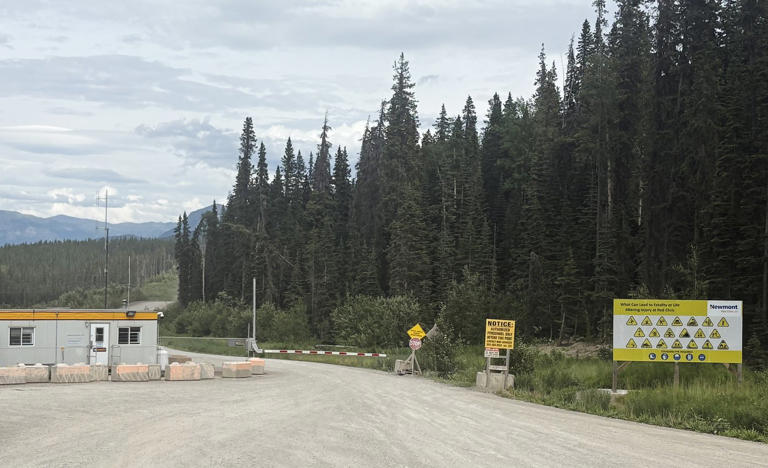
 Related video: Miners trapped underground at B.C. copper and gold mine (Global News)
 Global News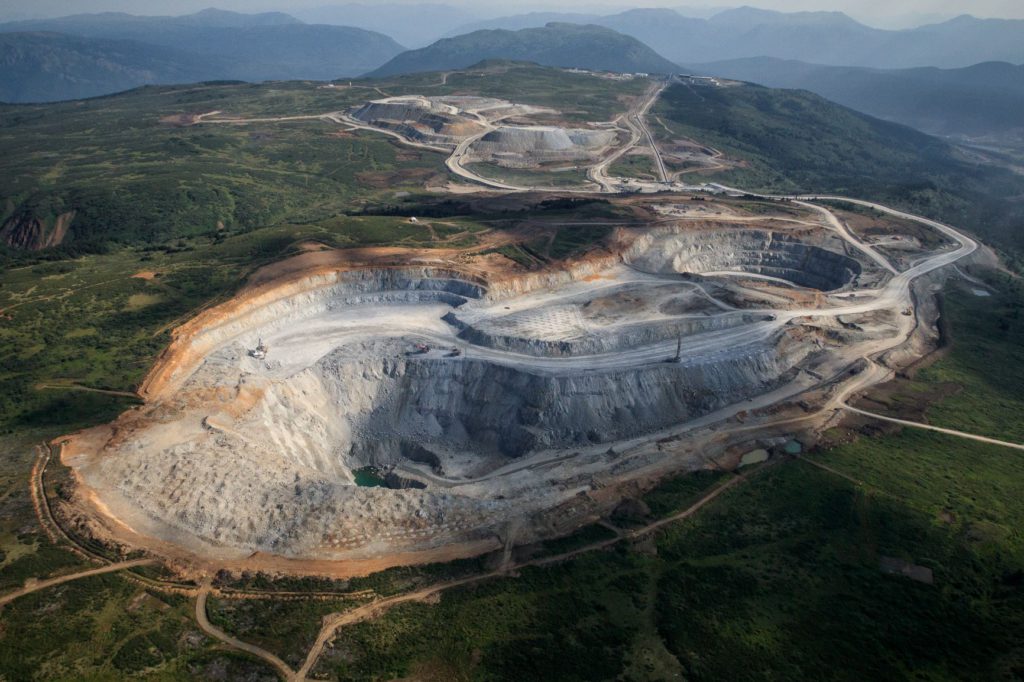




 © Photograph by Jessica A. Suarez Damaged radio collars with GPS capability were collected by the U.S. Fish and Wildlife Service from red wolves killed in vehicle collisions in eastern North Carolina during 2021. Vehicle strikes are one of the leading causes of death for wild red wolves.