“As families struggle to keep food on the table, Congress must prioritize work on efforts to lower costs and help Americans stay afloat,” said the Washington Democrat.
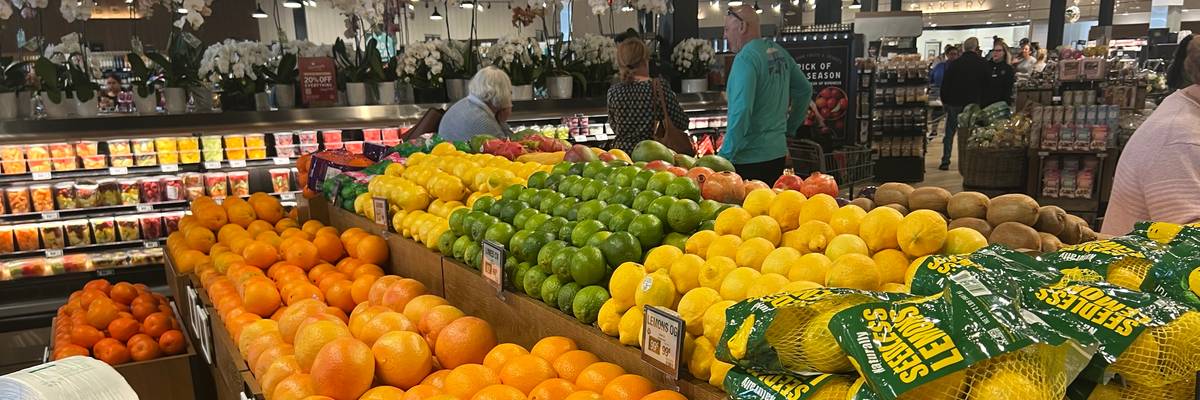
Shoppers browse the produce section of a Fresh Market grocery store in Wethersfield, New York
(Photo by Luther Turmelle/Connecticut Post via Getty Images)
Jessica Corbett
Jul 02, 2026
COMMON DREAMS
As Americans face rising grocery prices under President Donald Trump and rally behind progressive policies and primary candidates, US Rep. Pramila Jayapal on Thursday introduced a bill that shows what kind of proposals could become reality with more Democrats like her in Congress.
Inspired by a program in her own district in Washington state, the chair emerita of the Congressional Progressive Caucus introduced the Fresh Bucks for Fresh Produce Act, which would create a pilot program at the US Department of Agriculture (USDA) that gives households earning 80% or less of their area’s median income $60 per month to buy fruits and vegetables.
The USDA pilot would be modeled on Seattle’s Fresh Bucks initiative, in which enrolled households “experience a 31% higher rate of food security and consume at least three daily servings of fruits and vegetables 37% more often than those assigned to a program waitlist,” according to University of Washington (UW) research published last August.
“I would classify both of those numbers as pretty large,” study co-author Jessica Jones-Smith a professor at UW and University of California, Irvine, said at the time. “We don’t routinely see interventions that work that well. It’s a pretty big impact on diet in terms of what we can do from a policy perspective and expect to make a difference in food insecurity.”
In Seattle—generally ranked as an expensive but livable metropolis—a single person living within city limits on a monthly income of $7,070, or $84,850 a year, can apply for the program. For a family of four, it’s $10,095 per month, or $121,150 annually. In January, the city the welcomed over 4,500 more local households off its waitlist and increased monthly benefits from $40 to $60.
Those enrolled in Seattle’s program can buy “fresh fruits and vegetables at supermarkets, and fresh, frozen, canned, and dried fruits and vegetables (with no added fats, sugars, or salt) at farmers markets and independent grocers” that accept Fresh Bucks cards.
Adam Porter, who directs the Meals on Wheels program at the Seattle-based Sound Generations, said Thursday that “older adults across King County are facing impossible choices as grocery prices continue to rise. Seattle’s Fresh Bucks program has had a substantial impact on our clients’ health and quality of life: We have seen firsthand how a targeted produce benefit can increase health equity, improve food security, and keep food dollars circulating locally.
“A USDA pilot modeled on that success would be a meaningful step toward healthier households and stronger community food systems nationwide,” Porter continued. In addition to his organization, groups endorsing Jayapal’s bill include the Center for Biological Diversity, Coalition for Organic and Regenerative Agriculture, Farm Action Fund, Food & Water Watch, National Education Association, Southern Poverty Law Center, White Center Community Development Association (WCCDA), and over a dozen more.
“In White Center and historically underinvested communities across King County, we see every day how rising grocery costs continue to strain working families, seniors, immigrants, and households already navigating increasing housing and living expenses,” said WCCDA executive director Aaron Garcia. “Access to healthy, culturally relevant food should not be determined by income—it should not be considered a luxury.”
“At WCCDA, we believe thriving communities require systems that make healthy food accessible, affordable, and attainable—and that investments in food access are investments in community health, economic stability, and opportunity,” Garcia said. “We strongly support Congresswoman Jayapal’s leadership in advancing innovative solutions that respond to the realities families face today while strengthening local food systems and neighborhood businesses that give us our vibrancy.”
“Expanding the proven Seattle Fresh Bucks model through a federal pilot offers an opportunity to increase food security, support local producers and retailers, and help communities across the country build healthier, more resilient futures,” he added.
Jayapal has celebrated recent primary wins by leftists in New York, and on Thursday, with the November midterms just four months away, she called out her Republican colleagues—who are trying to hang on to their narrow majorities in both chambers of Congress after using them to pass cuts to federal food and healthcare programs while giving more tax breaks to the rich.
“As families struggle to keep food on the table, Congress must prioritize work on efforts to lower costs and help Americans stay afloat,” said Jayapal, who is joined in sponsoring the bill by Democratic Reps. Alma Adams (NC), Nanette Barragán (Calif.), Chris Deluzio (Pa.), Shomari Figures (Ala.), Jahana Hayes (Conn.), Eleanor Holmes Norton (DC), Andrea Salinas (Ore.), Adam Smith (Wash.), and Shri Thanedar (Mich).
“While Republicans in Congress enacted legislation to raise food prices and are hell-bent on cutting food assistance, Seattle is once again leading the way with the Fresh Bucks program, which is successfully keeping people fed with nutritious food and reducing hunger,” she said. “We must pass this legislation to expand the program nationwide and get families in every corner of the country healthy produce they can afford.”
As Americans face rising grocery prices under President Donald Trump and rally behind progressive policies and primary candidates, US Rep. Pramila Jayapal on Thursday introduced a bill that shows what kind of proposals could become reality with more Democrats like her in Congress.
Inspired by a program in her own district in Washington state, the chair emerita of the Congressional Progressive Caucus introduced the Fresh Bucks for Fresh Produce Act, which would create a pilot program at the US Department of Agriculture (USDA) that gives households earning 80% or less of their area’s median income $60 per month to buy fruits and vegetables.
The USDA pilot would be modeled on Seattle’s Fresh Bucks initiative, in which enrolled households “experience a 31% higher rate of food security and consume at least three daily servings of fruits and vegetables 37% more often than those assigned to a program waitlist,” according to University of Washington (UW) research published last August.
“I would classify both of those numbers as pretty large,” study co-author Jessica Jones-Smith a professor at UW and University of California, Irvine, said at the time. “We don’t routinely see interventions that work that well. It’s a pretty big impact on diet in terms of what we can do from a policy perspective and expect to make a difference in food insecurity.”
In Seattle—generally ranked as an expensive but livable metropolis—a single person living within city limits on a monthly income of $7,070, or $84,850 a year, can apply for the program. For a family of four, it’s $10,095 per month, or $121,150 annually. In January, the city the welcomed over 4,500 more local households off its waitlist and increased monthly benefits from $40 to $60.
Those enrolled in Seattle’s program can buy “fresh fruits and vegetables at supermarkets, and fresh, frozen, canned, and dried fruits and vegetables (with no added fats, sugars, or salt) at farmers markets and independent grocers” that accept Fresh Bucks cards.
Adam Porter, who directs the Meals on Wheels program at the Seattle-based Sound Generations, said Thursday that “older adults across King County are facing impossible choices as grocery prices continue to rise. Seattle’s Fresh Bucks program has had a substantial impact on our clients’ health and quality of life: We have seen firsthand how a targeted produce benefit can increase health equity, improve food security, and keep food dollars circulating locally.
“A USDA pilot modeled on that success would be a meaningful step toward healthier households and stronger community food systems nationwide,” Porter continued. In addition to his organization, groups endorsing Jayapal’s bill include the Center for Biological Diversity, Coalition for Organic and Regenerative Agriculture, Farm Action Fund, Food & Water Watch, National Education Association, Southern Poverty Law Center, White Center Community Development Association (WCCDA), and over a dozen more.
“In White Center and historically underinvested communities across King County, we see every day how rising grocery costs continue to strain working families, seniors, immigrants, and households already navigating increasing housing and living expenses,” said WCCDA executive director Aaron Garcia. “Access to healthy, culturally relevant food should not be determined by income—it should not be considered a luxury.”
“At WCCDA, we believe thriving communities require systems that make healthy food accessible, affordable, and attainable—and that investments in food access are investments in community health, economic stability, and opportunity,” Garcia said. “We strongly support Congresswoman Jayapal’s leadership in advancing innovative solutions that respond to the realities families face today while strengthening local food systems and neighborhood businesses that give us our vibrancy.”
“Expanding the proven Seattle Fresh Bucks model through a federal pilot offers an opportunity to increase food security, support local producers and retailers, and help communities across the country build healthier, more resilient futures,” he added.
Jayapal has celebrated recent primary wins by leftists in New York, and on Thursday, with the November midterms just four months away, she called out her Republican colleagues—who are trying to hang on to their narrow majorities in both chambers of Congress after using them to pass cuts to federal food and healthcare programs while giving more tax breaks to the rich.
“As families struggle to keep food on the table, Congress must prioritize work on efforts to lower costs and help Americans stay afloat,” said Jayapal, who is joined in sponsoring the bill by Democratic Reps. Alma Adams (NC), Nanette Barragán (Calif.), Chris Deluzio (Pa.), Shomari Figures (Ala.), Jahana Hayes (Conn.), Eleanor Holmes Norton (DC), Andrea Salinas (Ore.), Adam Smith (Wash.), and Shri Thanedar (Mich).
“While Republicans in Congress enacted legislation to raise food prices and are hell-bent on cutting food assistance, Seattle is once again leading the way with the Fresh Bucks program, which is successfully keeping people fed with nutritious food and reducing hunger,” she said. “We must pass this legislation to expand the program nationwide and get families in every corner of the country healthy produce they can afford.”
Experts Say Trump Cuts to Food Aid Have ‘Completely Subsumed’ RFK Jr.’s MAHA Agenda
A new report argues it is “impossible to reconcile” the Trump administration’s Make America Healthy Again rhetoric with unprecedented cuts to federal nutrition assistance.
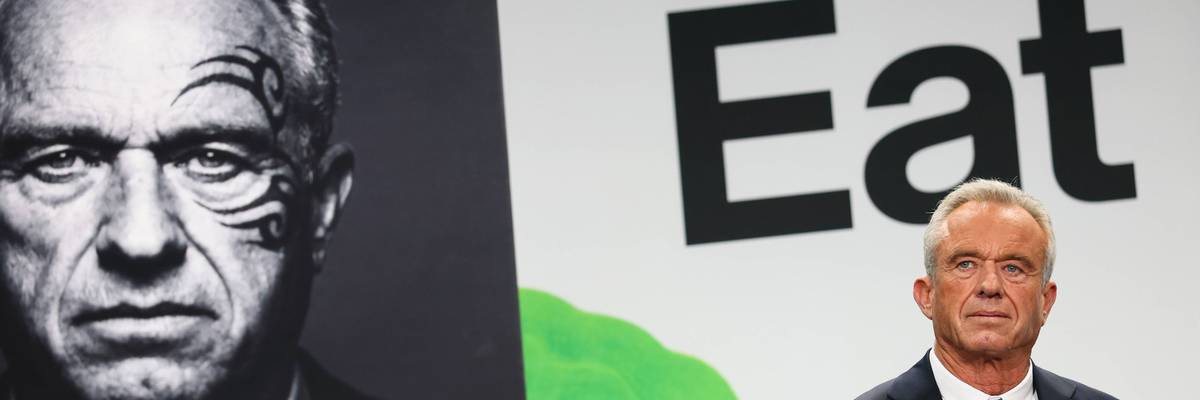
US Secretary of Health and Human Services Robert F. Kennedy Jr. stands silently next to a poster depicting him with legendary boxer Mike Tyson’s face tattoo during an event on February 11, 2026.
Jake Johnson
Jul 02, 2026
COMMON DREAMS
The unprecedented cuts to federal nutrition assistance that President Donald Trump and congressional Republicans enacted nearly a year ago directly undermine the administration’s “Make America Healthy Again” initiative, argues a new report by a pair of food policy experts.
The so-called MAHA project, spearheaded by Health and Human Services Secretary Robert F. Kennedy Jr., emphasizes the importance of a healthy diet to childhood development. But the new white paper, published Wednesday and authored by Joelle Johnson of the Center for Science in the Public Interest and Priya Fielding-Singh of George Washington University’s Global Food Institute, notes that research shows the Supplemental Nutrition Assistance Program (SNAP) “reduces food insecurity—which is itself linked to increased risk of poorer diets among children—and may improve health outcomes among households with low incomes.”
“How the administration’s health objectives can be achieved alongside policies that reduce both food access and nutrition education is a question these dual agendas do not resolve,” the report states. “Understanding this tension also helps explain why the administration’s MAHA messaging has at times appeared disconnected from the SNAP policies it has simultaneously pursued.”
The GOP’s One Big Beautiful Bill Act (HR 1) will inflict nearly $190 billion in cuts to SNAP over the next decade—the largest in the program’s history—and expand work reporting requirements, despite evidence showing that such mandates do virtually nothing to boost employment or reduce poverty. According to one estimate, the expanded SNAP work reporting requirements could cause nearly 70,000 avoidable deaths by 2040.
The Republican law also forces states to pay a portion of SNAP benefits for the first time, straining budgets and potentially forcing deeper food aid cuts.
Millions of people across the US—including more than 800,000 children—have lost SNAP benefits since Trump signed the Republican budget package into law on July 4, 2025. It is well established that food insecurity, which is on the rise across the US, is associated with chronic disease.
“It is impossible to reconcile the administration’s MAHA rhetoric on reducing chronic disease in childhood with the cruel cutbacks to SNAP brought about by HR 1,” Johnson, who serves as deputy director for healthy food access at the Center for Science in the Public Interest (CSPI), said in a statement. “Whatever MAHA initiatives CSPI might have otherwise supported are completely subsumed by the biggest cut to SNAP in the program’s history.”
“Cutting off food assistance for millions of families undermines MAHA’s stated goals of improving diet quality and preventing chronic disease.”
The new report stresses the “ripple effects” of the Trump-GOP SNAP cuts across the food safety net, pointing to negative impacts on kids’ eligibility for school meals and the Special Supplemental Nutrition Program for Women, Infants, and Children (WIC).
“Approximately 16 million children live in households that rely on SNAP to meet their basic food needs, and many will face cascading losses of access to other nutrition programs as a result of HR 1’s cuts,” the report warns. “Children who lose SNAP also risk losing automatic enrollment in WIC and free school meals, forcing families already stretched thin to navigate multiple re-enrollment processes with no guarantee of restored access.”
Trump and the GOP are not finished attacking nutrition assistance for low-income families. Last month, House Republicans approved legislation that would slash fruit and vegetable benefits for millions of young children and pregnant and postpartum women—a cut consistent with the White House’s budget proposal for the coming fiscal year.
“If we are serious about improving Americans’ health, we need policies that make healthy food more accessible, not less,” said Fielding-Singh, director of policy and programs at the Global Food Institute. “Cutting off food assistance for millions of families undermines MAHA’s stated goals of improving diet quality and preventing chronic disease. Food security and public health go hand in hand.”
A new report argues it is “impossible to reconcile” the Trump administration’s Make America Healthy Again rhetoric with unprecedented cuts to federal nutrition assistance.
US Secretary of Health and Human Services Robert F. Kennedy Jr. stands silently next to a poster depicting him with legendary boxer Mike Tyson’s face tattoo during an event on February 11, 2026.
(Photo by Michael M. Santiago/Getty Images)
Jake Johnson
Jul 02, 2026
COMMON DREAMS
The unprecedented cuts to federal nutrition assistance that President Donald Trump and congressional Republicans enacted nearly a year ago directly undermine the administration’s “Make America Healthy Again” initiative, argues a new report by a pair of food policy experts.
The so-called MAHA project, spearheaded by Health and Human Services Secretary Robert F. Kennedy Jr., emphasizes the importance of a healthy diet to childhood development. But the new white paper, published Wednesday and authored by Joelle Johnson of the Center for Science in the Public Interest and Priya Fielding-Singh of George Washington University’s Global Food Institute, notes that research shows the Supplemental Nutrition Assistance Program (SNAP) “reduces food insecurity—which is itself linked to increased risk of poorer diets among children—and may improve health outcomes among households with low incomes.”
“How the administration’s health objectives can be achieved alongside policies that reduce both food access and nutrition education is a question these dual agendas do not resolve,” the report states. “Understanding this tension also helps explain why the administration’s MAHA messaging has at times appeared disconnected from the SNAP policies it has simultaneously pursued.”
The GOP’s One Big Beautiful Bill Act (HR 1) will inflict nearly $190 billion in cuts to SNAP over the next decade—the largest in the program’s history—and expand work reporting requirements, despite evidence showing that such mandates do virtually nothing to boost employment or reduce poverty. According to one estimate, the expanded SNAP work reporting requirements could cause nearly 70,000 avoidable deaths by 2040.
The Republican law also forces states to pay a portion of SNAP benefits for the first time, straining budgets and potentially forcing deeper food aid cuts.
Millions of people across the US—including more than 800,000 children—have lost SNAP benefits since Trump signed the Republican budget package into law on July 4, 2025. It is well established that food insecurity, which is on the rise across the US, is associated with chronic disease.
“It is impossible to reconcile the administration’s MAHA rhetoric on reducing chronic disease in childhood with the cruel cutbacks to SNAP brought about by HR 1,” Johnson, who serves as deputy director for healthy food access at the Center for Science in the Public Interest (CSPI), said in a statement. “Whatever MAHA initiatives CSPI might have otherwise supported are completely subsumed by the biggest cut to SNAP in the program’s history.”
“Cutting off food assistance for millions of families undermines MAHA’s stated goals of improving diet quality and preventing chronic disease.”
The new report stresses the “ripple effects” of the Trump-GOP SNAP cuts across the food safety net, pointing to negative impacts on kids’ eligibility for school meals and the Special Supplemental Nutrition Program for Women, Infants, and Children (WIC).
“Approximately 16 million children live in households that rely on SNAP to meet their basic food needs, and many will face cascading losses of access to other nutrition programs as a result of HR 1’s cuts,” the report warns. “Children who lose SNAP also risk losing automatic enrollment in WIC and free school meals, forcing families already stretched thin to navigate multiple re-enrollment processes with no guarantee of restored access.”
Trump and the GOP are not finished attacking nutrition assistance for low-income families. Last month, House Republicans approved legislation that would slash fruit and vegetable benefits for millions of young children and pregnant and postpartum women—a cut consistent with the White House’s budget proposal for the coming fiscal year.
“If we are serious about improving Americans’ health, we need policies that make healthy food more accessible, not less,” said Fielding-Singh, director of policy and programs at the Global Food Institute. “Cutting off food assistance for millions of families undermines MAHA’s stated goals of improving diet quality and preventing chronic disease. Food security and public health go hand in hand.”

No comments:
Post a Comment