“That hugely consequential cases are decided with no transparency,” said one civil rights lawyer, “only adds to the court’s illegitimacy and further decreases the public’s confidence.”
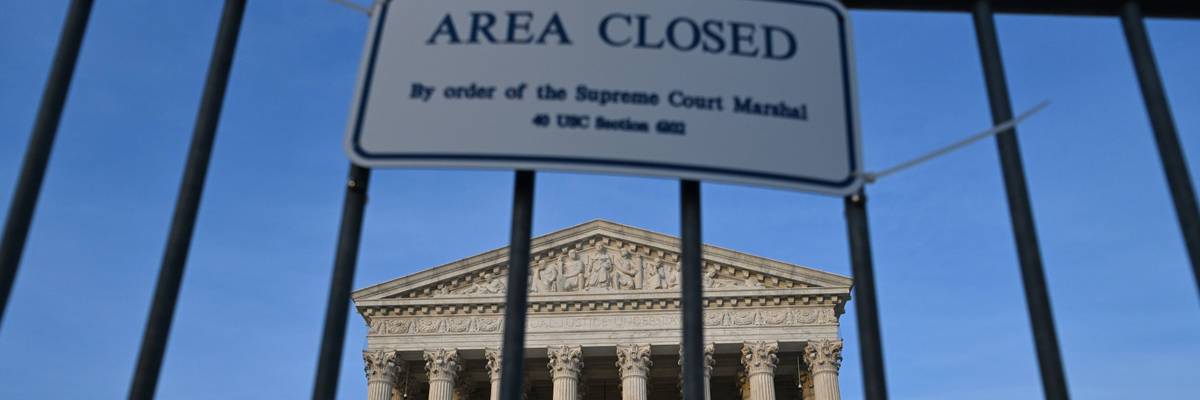
The area in front of the US Supreme Court in Washington, DC, is gated off on June 30, 2026.
(Photo by Li Rui/Xinhua via Getty Images)
Stephen Prager
Jul 02, 2026
COMMON DREAMS
As its conservative majority showed unprecedented deference to President Donald Trump, the US Supreme Court passed what ProPublica described as a “troubling milestone” during the term that ended last October.
For the first time in its modern history, an analysis published Wednesday found, the court decided more cases using its secretive “shadow docket” than using the regular process.
Unlike the so-called “merits docket,” in which cases undergo lengthy periods of review, parties file briefs and make oral arguments for their side, and the justices issue extensive signed rulings explaining their reasoning, shadow docket decisions are expedited and offer little mechanism for accountability.
They are often unsigned, with no final vote count or explanation of the court’s decision, and are often issued within hours of legal action being taken, leaving no time for deliberation or public input.
These cases are meant to be reserved for emergency or temporary interventions. But as Trump has attempted to exert unprecedented executive authority that often brazenly pushes legal boundaries, ProPublica found that the court’s use of the shadow docket has exploded.
The analysis found that during the last Supreme Court term, the court issued 63 decisions on the shadow docket, compared with just 56 on the merits docket. Analyzing more than two decades of decisions by the high court, they found that the court has never come close to issuing this many secret decisions in any previous term.
This is due largely to the Trump administration’s unprecedented petitioning to have cases decided on the shadow docket after elements of the president’s agenda were stymied by lower courts.
As ProPublica explained, the court “has repeatedly green-lit policies of his that lower courts have blocked—and has done so with little to no explanation,” and often the decisions have been highly consequential and “have thrown lower courts’ processes into turmoil and have sometimes directly contradicted longstanding legal precedent.”
On June 23, 2025, after a lower court had ruled that eight men being deported to South Sudan should have due process, the Supreme Court intervened after a request from the administration to stop that order. The men were deported. The majority didn’t issue an opinion justifying its ruling.
Three months later, the Supreme Court voted to allow immigration agents to stop people based on racial or ethnic characteristics while still-ongoing litigation against it proceeded. To justify the decision, Justice Brett Kavanaugh wrote a rare shadow docket opinion that people who were in the country legally would be “free to go after the brief encounter.” These became known as “Kavanaugh stops.” Last year, ProPublica found more than 170 citizens who had been stopped and detained by ICE agents. The more than 50 Americans held even after agents learned of their citizenship were almost all Latino.
And in May, while an election in Louisiana was already underway, the justices allowed the state to immediately redraw its electoral map, removing one of the two majority-Black voting districts. Louisiana can now use that map for the 2026 midterms as part of a nationwide redistricting battle for control of the House of Representatives—an effort touched off by Trump’s call for Republican-led states to create more safe seats for themselves.
An analysis by the legal group Court Accountability in October found that the Supreme Court sided with Trump 90% of the time in the 23 orders included in its analysis of his second administration through October 2025, nearly all of which were issued on the shadow docket.
“The patterns show a court going out of its way to enable Trump,” Stephen Vladeck, a law professor at Georgetown University and a Supreme Court analyst, told ProPublica.
Noting that the American public’s approval of the high court has fallen substantially in recent years, Leslie Proll, a civil rights lawyer and the former director of voting rights at the Leadership Conference on Civil and Human Rights, called the court’s unprecedented secrecy “utterly disgraceful.”
“That hugely consequential cases are decided with no transparency,” she said, “only adds to the court’s illegitimacy and further decreases the public’s confidence.”
Alito's influence on the Supreme Court may be reaching an all-time high

FILE PHOTO: U.S. Supreme Court Associate Justices Samuel Alito (L) and Clarence Thomas (Photo: Chip Somodevilla/Pool via REUTERS)
FILE PHOTO: U.S. Supreme Court Associate Justices Samuel Alito (L) and Clarence Thomas (Photo: Chip Somodevilla/Pool via REUTERS)
July 04, 2026
ALTERNET
One of the most dangerous power players in the U.S. Supreme Court is at it again, wrote the New York Times in a report about the conservative Justice Samuel Alito.
Alito recalled in his youth his father tapping away on a calculator, trying to redraw electoral maps. All of that came to a head on Tuesday when Alito penned the landmark decision that struck another harmful blow to the Voting Rights Act. The decision ultimately makes it more difficult to bring racial discrimination challenges to districts.
But the end of Alito's career is leaving questions about whether he will retire, allowing President Donald Trump to appoint another far-right justice to stack the courts. According to those close to Alito, he has no desire to retire. But if Democrats take over Congress in the 2026 midterms, there could be a renewed call.
"People who know him say that he may not want to jeopardize the chance to have a successor who aligns with his ideology, and that he is mindful of what unfolded when Justice Ruth Bader Ginsburg died in September 2020," the report said. "Her death set off a confirmation scramble that allowed Mr. Trump to appoint her successor, the conservative Justice Amy Coney Barrett, shifting the makeup of the court."
While Alito was quiet in 2024, the past year brought more of his opinions to the bench. It appears Chief Justice John Roberts has assigned decisions for Alito to author when the court intends to hand Trump a "win," said Stanford law school professor Pamela Karlan.
“It’s hard to think of an area where Justice Alito’s views do not align completely with the conservative legal movement,” she added.
In his opinions on the Voting Rights Act and anything to do with race relations, the Times explained that those appearing before him "will have to provide evidence of intentional race discrimination to prevail. The ruling prompted a Republican scramble to redistrict across the South, and likely handed the GOP an edge ahead of the midterm elections."
Alito, a constitutional law professor at Yale, Akhil Reed Amar said it's simply that Alito has greater seniority on the court and his outsized role is easily explained by that.
“It’s a seniority system, and you don’t get the plum assignments in your early years,” Professor Amar said. “The longer you’re around, the more you get to write opinions in big cases.”
Those close to Alito maintain that he remains engaged with the court, despite checking out a day early for their summer break.
One of the most dangerous power players in the U.S. Supreme Court is at it again, wrote the New York Times in a report about the conservative Justice Samuel Alito.
Alito recalled in his youth his father tapping away on a calculator, trying to redraw electoral maps. All of that came to a head on Tuesday when Alito penned the landmark decision that struck another harmful blow to the Voting Rights Act. The decision ultimately makes it more difficult to bring racial discrimination challenges to districts.
But the end of Alito's career is leaving questions about whether he will retire, allowing President Donald Trump to appoint another far-right justice to stack the courts. According to those close to Alito, he has no desire to retire. But if Democrats take over Congress in the 2026 midterms, there could be a renewed call.
"People who know him say that he may not want to jeopardize the chance to have a successor who aligns with his ideology, and that he is mindful of what unfolded when Justice Ruth Bader Ginsburg died in September 2020," the report said. "Her death set off a confirmation scramble that allowed Mr. Trump to appoint her successor, the conservative Justice Amy Coney Barrett, shifting the makeup of the court."
While Alito was quiet in 2024, the past year brought more of his opinions to the bench. It appears Chief Justice John Roberts has assigned decisions for Alito to author when the court intends to hand Trump a "win," said Stanford law school professor Pamela Karlan.
“It’s hard to think of an area where Justice Alito’s views do not align completely with the conservative legal movement,” she added.
In his opinions on the Voting Rights Act and anything to do with race relations, the Times explained that those appearing before him "will have to provide evidence of intentional race discrimination to prevail. The ruling prompted a Republican scramble to redistrict across the South, and likely handed the GOP an edge ahead of the midterm elections."
Alito, a constitutional law professor at Yale, Akhil Reed Amar said it's simply that Alito has greater seniority on the court and his outsized role is easily explained by that.
“It’s a seniority system, and you don’t get the plum assignments in your early years,” Professor Amar said. “The longer you’re around, the more you get to write opinions in big cases.”
Those close to Alito maintain that he remains engaged with the court, despite checking out a day early for their summer break.
Trump's humiliation is tinged by stark signs of Supreme Court insanity
Robert Reich
June 30, 2026

U.S. Supreme Court Associate Justices Samuel Alito (L) and Clarence Thomas wait for their opportunity to leave the stage at the conclusion of the inauguration ceremonies in the Rotunda of the U.S. Capitol on January 20, 2025 in Washington, DC. Chip Somodevilla/Pool via REUTERS
Today, the Supreme Court struck down Trump’s Day One executive order canceling the right to birthright citizenship. Good. That executive order declared that children born in the U.S. would not be considered citizens if their parents were living in the country illegally or were visiting the country on temporary visas.
The executive order never took effect. It was quickly blocked by multiple lower courts because it appeared to directly conflict with the 14th Amendment, which states that “all persons born or naturalized in the United States, and subject to the jurisdiction thereof, are citizens of the United States.”
The Trump regime appealed the lower-court rulings, contending that the 14th Amendment’s citizenship provision had been misunderstood for more than a century. The administration argued that the drafters of the amendment were focused on guaranteeing citizenship for the children of former slaves—and that the amendment was never intended to extend citizenship to the children of people who weren’t living in the country legally.
Trump and his Solicitor General, who argued this case before the Court, also said that narrowing birthright citizenship was necessary to prevent “birth tourism” — the practice of immigrants coming to the U.S. to give birth here and obtain citizenship for their child.
Trump has been vowing to try to change the law since entering politics in 2015, arguing the 14th Amendment was written specifically to enshrine the rights of freed slaves. His critics have countered that it was always designed to apply to the children of immigrants too. An 1898 Supreme Court decision confirmed that U.S.-born children of immigrant parents are entitled to American citizenship.
Today, Chief Justice John Roberts wrote that the deeply-rooted understanding that virtually everyone born on American soil is automatically a U.S. citizen was enshrined in the Constitution with the passage of the 14th Amendment in 1868: “Citizenship, then and now, was the right to have rights — to freely participate in our political community,” Roberts wrote. “The Framers of the Fourteenth Amendment extended that promise to every free-born person in this land. We keep that promise today.”
In another era, this would have been a no-brainer. No constitutional lawyer I know thought the Court would decide otherwise. The lower federal courts had consistently and unanimously ruled against Trump.
Had Trump won, it would have probably caused panic among recent immigrants and their families. Although Trump has insisted his policy would apply only to future births, it was far from clear that the logic of any win for Trump wouldn’t apply retrospectively if a future president (JD Vance? perish the thought) wanted to go there.
What I find troubling is that the decision was 5 to 4 rather than unanimous or nearly so, as it should have been.
Only five of the nine justices ruled against Trump on constitutional grounds. Brett Kavanaugh dissented on statutory grounds; while agreeing that Trump’s executive order was unlawful, he argued that the court should have resolved the case under federal immigration law rather than the Constitution.
The Court’s three most conservative justices — Clarence Thomas, Neil Gorsuch, and Samuel Alito — dissented. Thomas wrote for the group: “The Court adds to the sad history of the Fourteenth Amendment, which was designed and understood to secure equal rights for the freed Blacks but has instead been repurposed for political projects that the Reconstruction Congress did not support.”
Pure and utter claptrap.
Thomas, Gorsuch, and Alito are so far to the right of America that their views on this case and other matters should be presumed bonkers. Yet what’s particularly sobering is that Trump is only one justice away from having a Supreme Court majority that would have gone his way on this absurd reading of the 14th Amendment.
Clearly, the Supreme Court must be changed — either by expanding the number of justices or by invoking term limits on Supreme Court justices. The Constitution would permit both remedies.
Perhaps the best thing about today’s majority decision is that it’s such a direct repudiation of Trump, who has long taken a personal interest in the issue. During his 2024 campaign, he made curtailing birthright citizenship a key element of his immigration platform.
When the high court heard arguments on the case in April, Trump took the unprecedented step of showing up in person for the hearing, making him the first sitting president ever to attend a Supreme Court argument. For the Court to so directly reject his position today is surely a humiliation for Trump.
Robert Reich
June 30, 2026
U.S. Supreme Court Associate Justices Samuel Alito (L) and Clarence Thomas wait for their opportunity to leave the stage at the conclusion of the inauguration ceremonies in the Rotunda of the U.S. Capitol on January 20, 2025 in Washington, DC. Chip Somodevilla/Pool via REUTERS
Today, the Supreme Court struck down Trump’s Day One executive order canceling the right to birthright citizenship. Good. That executive order declared that children born in the U.S. would not be considered citizens if their parents were living in the country illegally or were visiting the country on temporary visas.
The executive order never took effect. It was quickly blocked by multiple lower courts because it appeared to directly conflict with the 14th Amendment, which states that “all persons born or naturalized in the United States, and subject to the jurisdiction thereof, are citizens of the United States.”
The Trump regime appealed the lower-court rulings, contending that the 14th Amendment’s citizenship provision had been misunderstood for more than a century. The administration argued that the drafters of the amendment were focused on guaranteeing citizenship for the children of former slaves—and that the amendment was never intended to extend citizenship to the children of people who weren’t living in the country legally.
Trump and his Solicitor General, who argued this case before the Court, also said that narrowing birthright citizenship was necessary to prevent “birth tourism” — the practice of immigrants coming to the U.S. to give birth here and obtain citizenship for their child.
Trump has been vowing to try to change the law since entering politics in 2015, arguing the 14th Amendment was written specifically to enshrine the rights of freed slaves. His critics have countered that it was always designed to apply to the children of immigrants too. An 1898 Supreme Court decision confirmed that U.S.-born children of immigrant parents are entitled to American citizenship.
Today, Chief Justice John Roberts wrote that the deeply-rooted understanding that virtually everyone born on American soil is automatically a U.S. citizen was enshrined in the Constitution with the passage of the 14th Amendment in 1868: “Citizenship, then and now, was the right to have rights — to freely participate in our political community,” Roberts wrote. “The Framers of the Fourteenth Amendment extended that promise to every free-born person in this land. We keep that promise today.”
In another era, this would have been a no-brainer. No constitutional lawyer I know thought the Court would decide otherwise. The lower federal courts had consistently and unanimously ruled against Trump.
Had Trump won, it would have probably caused panic among recent immigrants and their families. Although Trump has insisted his policy would apply only to future births, it was far from clear that the logic of any win for Trump wouldn’t apply retrospectively if a future president (JD Vance? perish the thought) wanted to go there.
What I find troubling is that the decision was 5 to 4 rather than unanimous or nearly so, as it should have been.
Only five of the nine justices ruled against Trump on constitutional grounds. Brett Kavanaugh dissented on statutory grounds; while agreeing that Trump’s executive order was unlawful, he argued that the court should have resolved the case under federal immigration law rather than the Constitution.
The Court’s three most conservative justices — Clarence Thomas, Neil Gorsuch, and Samuel Alito — dissented. Thomas wrote for the group: “The Court adds to the sad history of the Fourteenth Amendment, which was designed and understood to secure equal rights for the freed Blacks but has instead been repurposed for political projects that the Reconstruction Congress did not support.”
Pure and utter claptrap.
Thomas, Gorsuch, and Alito are so far to the right of America that their views on this case and other matters should be presumed bonkers. Yet what’s particularly sobering is that Trump is only one justice away from having a Supreme Court majority that would have gone his way on this absurd reading of the 14th Amendment.
Clearly, the Supreme Court must be changed — either by expanding the number of justices or by invoking term limits on Supreme Court justices. The Constitution would permit both remedies.
Perhaps the best thing about today’s majority decision is that it’s such a direct repudiation of Trump, who has long taken a personal interest in the issue. During his 2024 campaign, he made curtailing birthright citizenship a key element of his immigration platform.
When the high court heard arguments on the case in April, Trump took the unprecedented step of showing up in person for the hearing, making him the first sitting president ever to attend a Supreme Court argument. For the Court to so directly reject his position today is surely a humiliation for Trump.
Robert Reich is an emeritus professor of public policy at Berkeley and former secretary of labor. His writings can be found at
https://robertreich.substack.com/. His new memoir, Coming Up Short, can be found wherever you buy books. You can also support local bookstores nationally by ordering the book at bookshop.org

No comments:
Post a Comment