Surely, if it exists, it should be released, but where our attention might better be focused is in supporting candidates who are refusing to accept pro-Israel PAC contributions and running on platforms challenging failed policies of the past.
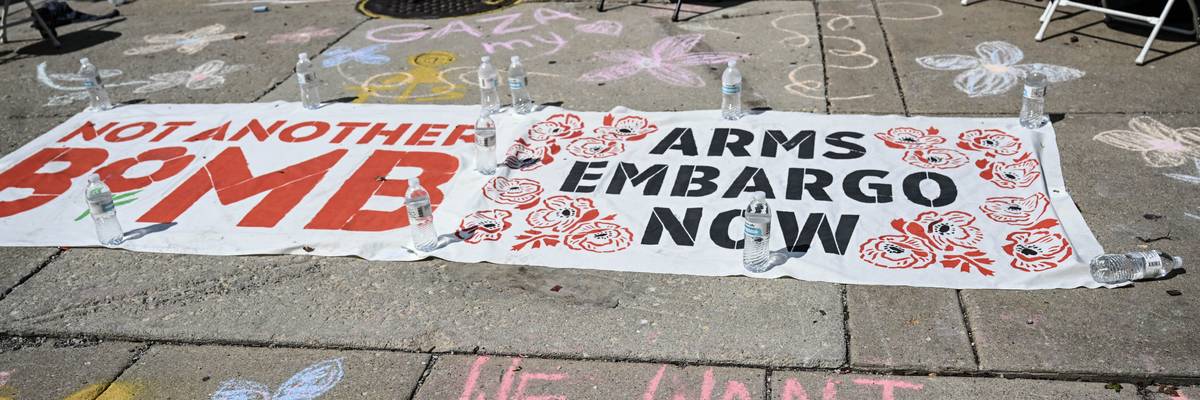
Uncommitted’ Democratic delegates from several US states, holds a press conference right next to the United Center where the convention is held, in Chicago, United States on AUgust 22, 2024.
(Photo by Fatih Aktas/Anadolu via Getty Images)
James Zogby
Mar 02, 2026
Common Dreams
A mini-brouhaha has erupted over whether or not the Democratic National Committee has buried an “autopsy” report on its party loss in the 2024 presidential election. Some fear that the report isn’t being released because it suggests the defeat was the Harris campaign’s failure to break with the Biden administration’s disastrous policy that enabled Israel’s sustained genocidal assault on Palestinians in Gaza. As a result, some groups are charging the DNC with a coverup and demanding that the autopsy report be released.
I’ve been on the DNC for more than three decades and am no stranger to how the party handles, or avoids handling, issues involving Palestine/Israel. In 1988, I spoke from that year’s convention podium introducing Jesse Jackson’s platform plank calling for “mutual recognition, territorial compromise, and self-determination” for both Israelis and Palestinians. For my efforts, I was asked to withdraw from the DNC—because “party leaders” were concerned that Republicans would use my membership as an issue in the campaign. (I was reinstated in 1993). I served 16 years on the party’s Executive Committee and 11 as co-chair of its Resolutions Committee. On eight occasions, I presented testimony arguing that the party needed to acknowledge Palestinian rights. And in 2016 I was appointed to serve on the Convention Platform Drafting Committee. Having argued and lost this many times, I am well aware of the party establishment’s fear of addressing Palestinian rights. Finally, this past year, I was appointed by Chair Ken Martin to serve on a Middle East Working Group, which he created to sort out how our party deals with America’s policies in the Middle East.
And yet, I believe that for those of us who support Palestinian rights and are concerned that leading Democrats have been on the wrong side of this issue for too long, the fight over whether an autopsy report exists and, if it exists, what it might say, is not where we need to be focusing our energy.
I say this because we already have all the evidence we need to write our own autopsy report that demonstrates conclusively that voters, especially Democrats and Independents, are fed up with blind support for Israeli policies. This is a fact. And while we have hard polling data to prove it, establishment Democrats and political consultants reject this reality and continue to operate from an outdated playbook.
But the changes are real and can’t be ignored. A wide range of polls have established just how extensive they are. A recent Gallup poll shows that for the first time more Americans sympathize with Palestinians (41%) than with Israelis (35%). This is especially pronounced among Democrats where sympathy for Palestinians is three times greater than it is for Israelis. And a John Zogby Strategies poll from February shows that a plurality of Americans now view the US relationship with Israel as more of a liability (45%) than an asset (34%). Again, among Democrats the margin is three to one (57% to 19%).
This growing antipathy toward Israel translates in shifting attitudes toward policy. In August of 2025, The Economist found:
• 43% of voters favor decreasing military aid to Israel, with only 13% wanting to see an increase in such aid. Among Democrats the decrease/increase ratio is 58% to 4%. Among Independents, it’s almost the same.
• Is Israel committing genocide? Among all voters, 44% say “yes” and 28% say “no.” Among Democrats, the ratio is 68% “yes” and just 8% “no.” And among Independents, it’s 45% to 19%.
Other polls show voters affirming that they’re more likely to support candidates who advance such positions and less likely to vote for those who defend Israeli policies and want to maintain current levels of military aid to Israel.
For further evidence of this shift, with just months before the midterm elections, it’s striking to note that more than three dozen congressional candidates have already declared their intent to reject PAC contributions from AIPAC and other pro-Israel groups. This includes a number of sitting members of Congress, all of whom have previously been strong supporters of Israel and have, in previous elections, been the recipients of millions of dollars from pro-Israel sources, including PACs and dark money independent expenditures. One of these members of Congress recently spoke at the US Holocaust Memorial Museum in which she termed Israel’s actions in Gaza as genocide and announced her support for cutting US military arms to Israel.
While these changes in attitudes toward Israel have been brewing for several years now, they were dramatically accelerated by Israel’s more than two-year assault on Palestinians in Gaza. While the horrors accompanying Hamas’ October 7th attack generated an initial flush of support for Israel, as the toll of Palestinian civilian casualties grew and the extent of Israel’s gratuitous mass devastation of Gaza became clear, support for Israel collapsed.
This was clearly in evidence in the 2024 presidential contest. Post-election analyses showed that Vice President Kamala Harris lost the backing of a wide range of Democratic and Independent voters because she refused to make a decisive break with President Biden’s support for Israel. Instead of listening to her own instincts and being more critical of Israeli practices and more vocal in support of Palestinian rights, she listened to the establishment political consultants who cautioned against “rocking the boat” on this “sensitive issue.”
The consultants, campaign operatives, and media analysts didn’t get the changes that were afoot then, and they still don’t get it now. They are caught in a time warp that views the US politics of the Middle East as if the last two years of Israel’s genocidal war hadn’t occurred. But they did happen and they have been transformative.
It used to be said that criticism of Israel was akin to touching the “third rail” in American politics—avoid it or get burned. In a way, it still is but in reverse. Support for Israel was once the issue sine qua non for candidates for Congress. Polls now show that voters are less likely to vote for candidates who refuse to criticize Israel or who take money from pro-Israel PACs.
As we get closer to the 2026 midterm elections, we can expect more candidates to publicly distance themselves from Israeli policies. We can also expect that pro-Israel groups will panic and up the ante by pouring tens of millions into defeating candidates who are critical of Israel. My sense is that this may backfire, as it did with the recent special House election in New Jersey, because in 2026 what will be controversial are Israeli policies and pro-Israel campaign contributions, not the opposite. The sooner the analysts, consultants, and media figure that out, the better our politics will be.
Given this background, fighting for the party to release an autopsy, is less important. Surely, if it exists, it should be released, but where our attention might better be focused is in supporting candidates who are refusing to accept pro-Israel PAC contributions and running on platforms challenging failed policies of the past. We should also join the growing number of Democratic National Committee members who are calling on the party to ban dark money in elections. This is an instance where looking forward, not backward, will help to bring the change we need—and to be where Democratic voters are already.
Our work is licensed under Creative Commons (CC BY-NC-ND 3.0). Feel free to republish and share widely.
James Zogby
Dr. James J. Zogby is the author of Arab Voices (2010) and the founder and president of the Arab American Institute (AAI), a Washington, D.C.-based organization which serves as the political and policy research arm of the Arab American community. Since 1985, Dr. Zogby and AAI have led Arab American efforts to secure political empowerment in the U.S. Through voter registration, education and mobilization, AAI has moved Arab Americans into the political mainstream. Dr. Zogby has also been personally active in U.S. politics for many years; in 1984 and 1988 he served as Deputy Campaign manager and Senior Advisor to the Jesse Jackson Presidential campaign. In 1988, he led the first ever debate on Palestinian statehood at that year's Democratic convention in Atlanta, GA. In 2000, 2008, and 2016 he served as an advisor to the Gore, Obama, and Sanders presidential campaigns.
Full Bio >
A mini-brouhaha has erupted over whether or not the Democratic National Committee has buried an “autopsy” report on its party loss in the 2024 presidential election. Some fear that the report isn’t being released because it suggests the defeat was the Harris campaign’s failure to break with the Biden administration’s disastrous policy that enabled Israel’s sustained genocidal assault on Palestinians in Gaza. As a result, some groups are charging the DNC with a coverup and demanding that the autopsy report be released.
I’ve been on the DNC for more than three decades and am no stranger to how the party handles, or avoids handling, issues involving Palestine/Israel. In 1988, I spoke from that year’s convention podium introducing Jesse Jackson’s platform plank calling for “mutual recognition, territorial compromise, and self-determination” for both Israelis and Palestinians. For my efforts, I was asked to withdraw from the DNC—because “party leaders” were concerned that Republicans would use my membership as an issue in the campaign. (I was reinstated in 1993). I served 16 years on the party’s Executive Committee and 11 as co-chair of its Resolutions Committee. On eight occasions, I presented testimony arguing that the party needed to acknowledge Palestinian rights. And in 2016 I was appointed to serve on the Convention Platform Drafting Committee. Having argued and lost this many times, I am well aware of the party establishment’s fear of addressing Palestinian rights. Finally, this past year, I was appointed by Chair Ken Martin to serve on a Middle East Working Group, which he created to sort out how our party deals with America’s policies in the Middle East.
And yet, I believe that for those of us who support Palestinian rights and are concerned that leading Democrats have been on the wrong side of this issue for too long, the fight over whether an autopsy report exists and, if it exists, what it might say, is not where we need to be focusing our energy.
I say this because we already have all the evidence we need to write our own autopsy report that demonstrates conclusively that voters, especially Democrats and Independents, are fed up with blind support for Israeli policies. This is a fact. And while we have hard polling data to prove it, establishment Democrats and political consultants reject this reality and continue to operate from an outdated playbook.
But the changes are real and can’t be ignored. A wide range of polls have established just how extensive they are. A recent Gallup poll shows that for the first time more Americans sympathize with Palestinians (41%) than with Israelis (35%). This is especially pronounced among Democrats where sympathy for Palestinians is three times greater than it is for Israelis. And a John Zogby Strategies poll from February shows that a plurality of Americans now view the US relationship with Israel as more of a liability (45%) than an asset (34%). Again, among Democrats the margin is three to one (57% to 19%).
This growing antipathy toward Israel translates in shifting attitudes toward policy. In August of 2025, The Economist found:
• 43% of voters favor decreasing military aid to Israel, with only 13% wanting to see an increase in such aid. Among Democrats the decrease/increase ratio is 58% to 4%. Among Independents, it’s almost the same.
• Is Israel committing genocide? Among all voters, 44% say “yes” and 28% say “no.” Among Democrats, the ratio is 68% “yes” and just 8% “no.” And among Independents, it’s 45% to 19%.
Other polls show voters affirming that they’re more likely to support candidates who advance such positions and less likely to vote for those who defend Israeli policies and want to maintain current levels of military aid to Israel.
For further evidence of this shift, with just months before the midterm elections, it’s striking to note that more than three dozen congressional candidates have already declared their intent to reject PAC contributions from AIPAC and other pro-Israel groups. This includes a number of sitting members of Congress, all of whom have previously been strong supporters of Israel and have, in previous elections, been the recipients of millions of dollars from pro-Israel sources, including PACs and dark money independent expenditures. One of these members of Congress recently spoke at the US Holocaust Memorial Museum in which she termed Israel’s actions in Gaza as genocide and announced her support for cutting US military arms to Israel.
While these changes in attitudes toward Israel have been brewing for several years now, they were dramatically accelerated by Israel’s more than two-year assault on Palestinians in Gaza. While the horrors accompanying Hamas’ October 7th attack generated an initial flush of support for Israel, as the toll of Palestinian civilian casualties grew and the extent of Israel’s gratuitous mass devastation of Gaza became clear, support for Israel collapsed.
This was clearly in evidence in the 2024 presidential contest. Post-election analyses showed that Vice President Kamala Harris lost the backing of a wide range of Democratic and Independent voters because she refused to make a decisive break with President Biden’s support for Israel. Instead of listening to her own instincts and being more critical of Israeli practices and more vocal in support of Palestinian rights, she listened to the establishment political consultants who cautioned against “rocking the boat” on this “sensitive issue.”
The consultants, campaign operatives, and media analysts didn’t get the changes that were afoot then, and they still don’t get it now. They are caught in a time warp that views the US politics of the Middle East as if the last two years of Israel’s genocidal war hadn’t occurred. But they did happen and they have been transformative.
It used to be said that criticism of Israel was akin to touching the “third rail” in American politics—avoid it or get burned. In a way, it still is but in reverse. Support for Israel was once the issue sine qua non for candidates for Congress. Polls now show that voters are less likely to vote for candidates who refuse to criticize Israel or who take money from pro-Israel PACs.
As we get closer to the 2026 midterm elections, we can expect more candidates to publicly distance themselves from Israeli policies. We can also expect that pro-Israel groups will panic and up the ante by pouring tens of millions into defeating candidates who are critical of Israel. My sense is that this may backfire, as it did with the recent special House election in New Jersey, because in 2026 what will be controversial are Israeli policies and pro-Israel campaign contributions, not the opposite. The sooner the analysts, consultants, and media figure that out, the better our politics will be.
Given this background, fighting for the party to release an autopsy, is less important. Surely, if it exists, it should be released, but where our attention might better be focused is in supporting candidates who are refusing to accept pro-Israel PAC contributions and running on platforms challenging failed policies of the past. We should also join the growing number of Democratic National Committee members who are calling on the party to ban dark money in elections. This is an instance where looking forward, not backward, will help to bring the change we need—and to be where Democratic voters are already.
Our work is licensed under Creative Commons (CC BY-NC-ND 3.0). Feel free to republish and share widely.
James Zogby
Dr. James J. Zogby is the author of Arab Voices (2010) and the founder and president of the Arab American Institute (AAI), a Washington, D.C.-based organization which serves as the political and policy research arm of the Arab American community. Since 1985, Dr. Zogby and AAI have led Arab American efforts to secure political empowerment in the U.S. Through voter registration, education and mobilization, AAI has moved Arab Americans into the political mainstream. Dr. Zogby has also been personally active in U.S. politics for many years; in 1984 and 1988 he served as Deputy Campaign manager and Senior Advisor to the Jesse Jackson Presidential campaign. In 1988, he led the first ever debate on Palestinian statehood at that year's Democratic convention in Atlanta, GA. In 2000, 2008, and 2016 he served as an advisor to the Gore, Obama, and Sanders presidential campaigns.
Full Bio >

No comments:
Post a Comment