“If this goes on... this is going to become a political disaster,” said one foreign policy expert.
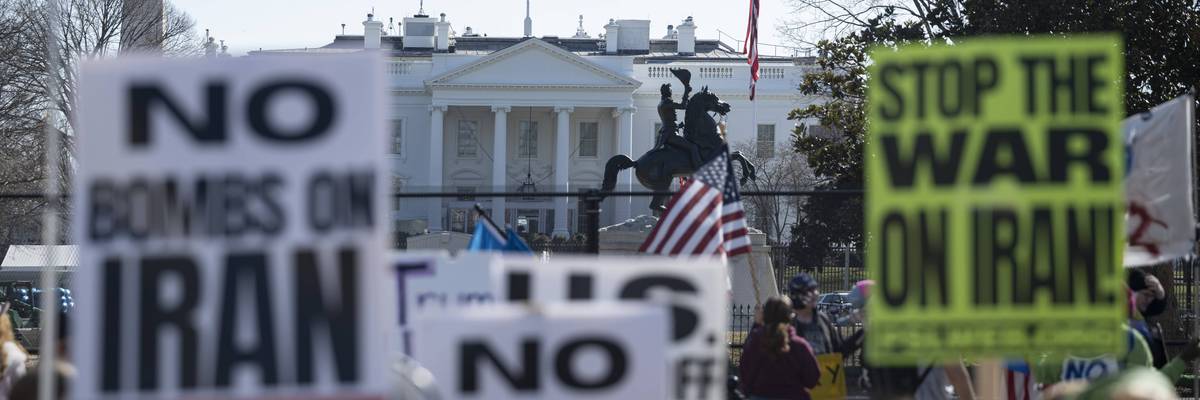
Demonstrators gathered outside the White House in Washington DC on February 28, 2026 to protest US and Israeli strikes on Iran.
(Photo by Celal Gunes/Anadolu via Getty Images)
Stephen Prager
Mar 02, 2026
COMMON DREAMS
President Donald Trump’s war in Iran is extraordinarily unpopular, according to a poll conducted shortly after the US and Israel carried out massive strikes on the country Saturday.
The survey, conducted by Reuters/Ipsos, found that just 27% of voters approved of the strikes, which have killed at least 555 Iranians as of Monday morning and resulted in retaliation from Iran that has killed at least four US service members, with more casualties expected according to a spokesperson for the US Joint Chiefs of Staff.
Meanwhile, 43% of respondents disapproved of the military action, while 29% said they were not sure.
A majority of Republicans said they approved of the strikes, with 55% expressing support. Still, 13% disapproved, and a noteworthy 31% said they were unsure.
Approval is dismal with nearly everyone else. Only 19% of independents expressed support compared to 44% who disapproved. And though Democratic leaders in Congress have done little to stand in the way of the strikes, their voters are overwhelmingly against them: 74% said they disapproved, while just 7% approved.
The poll reflects a wider skepticism of US military intervention, with 56% of respondents saying the president was too quick to deploy military force in recent months, including in Venezuela, Syria, and Nigeria.
Compared with previous US military interventions in the Middle East, such as the invasions of Iraq and Afghanistan, which—at least at their outset—enjoyed broad support from the American public following intense government efforts to drum up support, there has been little effort by the Trump administration to define the purpose of war with Iran.
Trump’s justification for launching the war has shifted wildly since he began amassing troops in the region. Trump has most recently said the strikes were intended to stop an “imminent threat” from Iran; meanwhile, the Pentagon has told Congress there was no sign Iran was planning an attack unless the US did so first.
The president previously said his push for war was to prevent Iran from developing a nuclear weapon, an assertion at odds with his claim that his strikes in June “obliterated” the country’s nuclear capabilities.
Trita Parsi, executive vice president of the Quincy Institute for Responsible Statecraft, told Al Jazeera that Trump’s shifting explanations reek of “desperation.”
“It’s very clear that Trump has a tremendous difficulty finding a justification for this war of choice that he’s embarked on,” he said. “The reality is that if this goes on for another week or two, this is going to become a political disaster.”
“So now he’s suddenly, desperately, using all kinds of justifications: Liberating the Iranian people, Iran is fighting against civilization,” Parsi said. “If he actually had a case, he would have stuck to that point and made it clearly. But he doesn’t have one.”

No comments:
Post a Comment