By AFP
March 11, 2026

A satellite image of Iran's Kharg Island, which hosts the country’s main crude export terminal - Copyright EUROPEAN SPACE AGENCY/AFP -
Susannah Walden
Kharg Island, a scrubby stretch of land in the northern Gulf, handles almost all of Iran’s crude exports and any attempt to seize it would mark a major escalation in the conflict, analysts say.
The US and Israel have so far treaded carefully around the island, but an Axios report over the weekend cited Trump administration officials saying capturing Kharg was on the table as the war in the Middle East persists.
The island, located around 30 kilometres (19 miles) off the Iranian mainland, handles roughly 90 percent of Iran’s crude exports, according to a JP Morgan note released Sunday.
Any move on the territory, which is about one-third the size of Manhattan, would have swift repercussions, experts say.
“A direct strike would immediately halt the bulk of Iran’s crude exports, likely triggering severe retaliation in the Strait of Hormuz or against regional energy infrastructure,” JP Morgan said.
Iranian strikes have all but halted maritime traffic in the Strait of Hormuz — through which a fifth of global crude oil and liquefied natural gas normally pass — and have also impacted oil infrastructure in other Gulf states.
But Iranian energy assets have not been degraded so far and targeting the island would be “a very risky move”, Farzin Nadimi, senior fellow at the Washington Institute for Near East Policy, told AFP.
Iran is not only “experienced in using alternatives” in wartime, it could “cause a lot more damage on the Gulf oil and gas installations if they want to and they can do a lot more very quickly, and everybody knows that”.
“I don’t think that seizing the island will go any further than US Congressional debates,” he added — the prospect having been discussed in Washington since the hostage crisis that started in 1979 during the foundation of the Islamic republic.
Kharg underwent key developments during Iran’s oil expansion in the 1960s and 1970s, with much of the country’s coast too shallow for supertankers.
Iran has looked to diversify its export capabilities by opening the Jask terminal outside the Strait of Hormuz chokepoint in the Gulf of Oman in 2021, but Kharg remains “a critical vulnerability” for Iran, JP Morgan said.
“It is a cornerstone of Iran’s economy and a major source of revenue for the Iranian Revolutionary Guard,” JP Morgan added, referring to the well-resourced ideological branch of the Islamic republic’s army.
– ‘Very difficult’ –
The war has sent oil prices soaring, although US President Donald Trump’s suggestion on Monday that the conflict could end soon has calmed the market.
Over the weekend, the director of the White House National Energy Dominance Council Jarrod Agen told Fox News that “what we want to do is get such massive oil reserves in Iran out of the hands of terrorists”.
Also in recent days, the Washington Post reported heightened speculation that US ground forces could be being prepared to deploy, citing analysts saying Kharg Island would be an early target.
Nadimi said Washington could move to seize the island when hostilities end, but that it was “not a wise move” during combat when Kharg is “almost an entire island of oil facilities and pipelines and tank farms”.
“It is very difficult to wage a military operation on that particular island,” he said.
But other oil infrastructure could be in the crosshairs, with Trump repeatedly referencing his operation to topple Venezuelan president Nicolas Maduro and gain access to the country’s oil reserves in January as a blueprint.
Iran — the fourth-biggest crude producer within the Organization of the Petroleum Exporting Countries (OPEC) — vowed not one litre of oil would be exported from the Gulf while the war continues.
Any attack on its infrastructure would get an “eye for an eye” response, it said.
On Saturday, Israel launched its first attack of the war on oil facilities in Iran, but it said they were used “to operate military infrastructure”.
The same day, Israeli opposition leader Yair Lapid argued for stronger steps, saying in an X post: “Israel needs to destroy all of Iran’s oil fields and energy industry on Kharg Island; that’s what will crush Iran’s economy and bring down the regime.”
Thai-Owned Bulker Ablaze in the Straits of Hormuz With Three Crew Missing
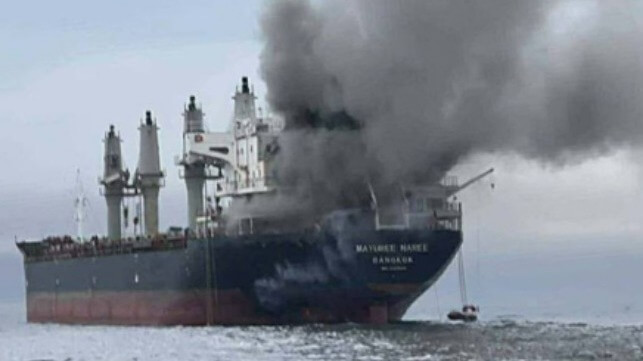
The Thai-owned bulker Mayuree Naree (30,193 dwt) was set ablaze off the coast of Oman on Wednesday morning, March 11, as one of possibly four commercial ships attacked by Iran. Rescue efforts are underway as Iran's Islamic Revolutionary Guard Corps (IRGC) released a statement saying ships must request permission before attempting to enter the Straits.
The Royal Oman Navy responded to the Mayuree Naree while the Royal Thai Navy said it was coordinating and monitoring the rescue operations. The vessel reported being struck by two projectiles in the stern and the engine room, which caused explosions and a fire. The ship was traveling with ballast from the United Arab Emirates and was approximately 11 nautical miles off the coast of Oman.
The vessel’s owners, Precious Shipping, reported that the engine room was damaged and that 20 crewmembers had abandoned the ship in a lifeboat. They were rescued by the Omani Navy and taken ashore.
Three crewmembers are reported still aboard the ship, with the vessel’s owner saying that it believed they were trapped in the engine room. The Royal Thai Navy said additional rescue operations were underway, while at least one report said the crewmembers had stayed aboard the vessel to aid with the salvage efforts. UK Maritime Trade Operations later reported that the fires had been extinguished.
The shipping company asserts it was following the protocols and had strict safety measures in place. It said it was in constant contact with the UKMTO before the ship attempted the transit. It reports the ship is covered under War Risk Insurance.
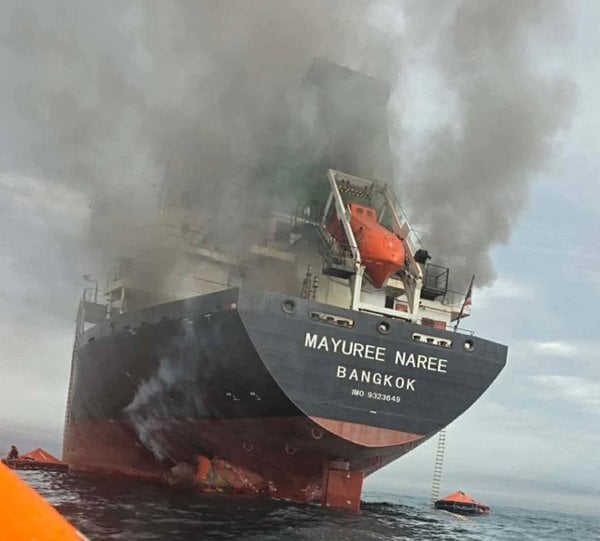
The attack on the Mayuree Naree was the most serious of those reported by UKMTO. The containership One Majesty (79,443 dwt) owned by Mitsui OSK Lines and operated by Ocean Network Express (ONE) also reported being struck. It was about 25 nautical miles northwest of Ras Al Khaimah in the UAE. Vanguard Tech reports the ship suffered a 10-centimeter hole and was heading to a safe anchorage. The bulker Star Gwyneth (82,790 dwt) was struck by an unknown projectile approximately 50 nautical miles northwest of Dubai.
The IRGC said the Thai vessel had ignored warnings and attempted to pass through the Straits without permission. Iran had earlier said it would permit international shipping that had no ties to the United States or Israel to transit the Strait. It calls ships from the U.S., Israel, or their allies, or carrying oil cargo from these countries, “legitimate targets.” It is also claiming to have attacked another vessel, the containership Express Rome (122,961 dwt), which it alleges was also attempting to enter the Straits of Hormuz. It associated the vessel with Israel. The ship’s last AIS signal shows it is anchored along with a large grouping of vessels northeast of Dubai.
U.S. Central Command (CENTCOM) issued a warning this morning (March 11) to civilians that the Iranian regime is using civilian ports along the Strait of Hormuz to conduct military operations. It urges civilians in Iran to immediately avoid all port facilities where Iranian naval forces are operating. Iranian dockworkers, administrative personnel, and commercial vessel crews, CENTCOM says, should avoid Iranian naval vessels and military equipment. The U.S. yesterday reported it was increasing its attacks on smaller Iranian vessels capable of laying mines in the Straits of Hormuz.
U.S. Warns of Impending Strikes on Iran's Seaports
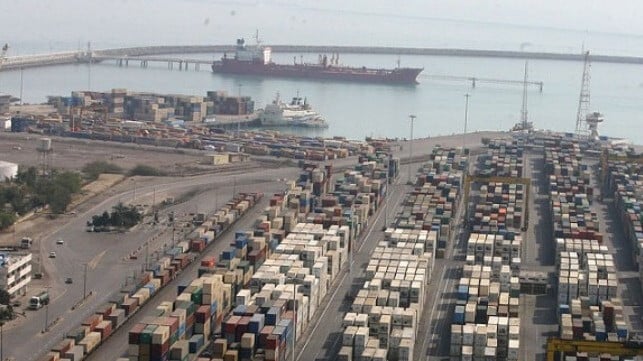
On Wednesday, U.S. Central Command warned civilian personnel to stay clear of Iran's commercial seaports along the Strait of Hormuz, indicating the likely onset of a bombing campaign. CENTCOM accused Iranian forces of using the ports as staging grounds for Iran's limited, asymmetric naval operations.
"CENTCOM urges civilians in Iran to immediately avoid all port facilities where Iranian naval forces are operating. Iranian dockworkers, administrative personnel, and commercial vessel crews should avoid Iranian naval vessels and military equipment," the command warned. "Although the U.S. military also cannot guarantee civilian safety in or near facilities used by the Iranian regime for military purposes, American forces will continue taking every feasible precaution to minimize harm to civilians."
The most prominent port in the Strait of Hormuz area, Bandar Abbas, is the principal container and breakbulk port for Iranian consumers. As they are strategic infrastructure, major seaports are often used for dual civilian and military purposes, and Bandar Abbas is no exception: it has been used before for receiving consignments of rocket fuel ingredients from China, among other military cargoes. As a practical matter, civilian ports are commonly targeted in the course of prolonged hostilities, as seen in recent events in Yemen, Ukraine and Russia.
Iran has likewise conducted its share of strikes on port infrastructure in neighboring nations. On Wednesday, imagery of burning fuel tanks at the port of Salalah, Oman began circulating on social media, indicating Iran's willingness to strike even neutral nations that have facilitated peace negotiations. The port of Fujairah has also reportedly limited its bunker barge loading operations after damage from Iranian strikes; Fujairah is one of the world's leading bunker ports, alongside Singapore and Rotterdam.
Report: Saudi Aramco Shuts Down Two Supergiant Offshore Oil Fields
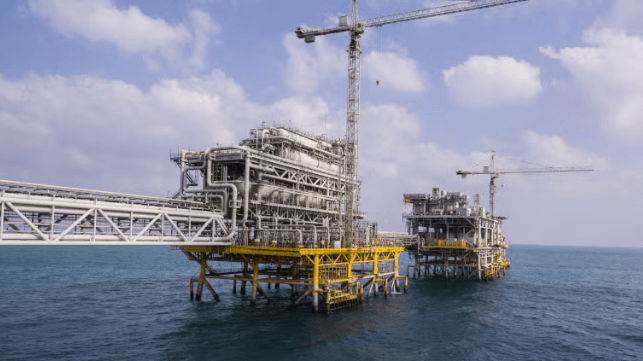
Saudi Arabia has joined Kuwait and Iraq in beginning the process of drawing down oil production, a response to the closure of the Strait of Hormuz and a shortage of storage options. The Wall Street Journal has confirmed that Saudi Aramco has shut down the Safaniya and Zuluf fields, taking two million barrels per day of production offline.
Safaniya is the world's largest offshore oil field, containing more than 30 billion barrels of oil in proven reserves, and Saudi Aramco has invested heavily in a program to modernize its extraction infrastructure to sustain production at levels exceeding one million barrels per day. Zuluf is another supergiant estimated at about 30 billion barrels, and has a nameplate production capacity in excess of one million bpd.
Iraq has already shut in enough production to match the sudden stoppage in exports caused by the closure of the Strait of Hormuz, and is producing just enough to satisfy domestic demand. Kuwait has signaled that it is slowing production as storage fills up, but it is hoping to preserve the ability to restart quickly once the transport situation normalizes.
Saudi Arabia has more extensive tank storage options than its neighbors, and while it is normally dependent on Hormuz shipping for exports, it has another alternative. The Saudis operate a 750-mile pipeline connection from Gulf oil fields to a terminal at Yanbu, on the Red Sea. This circumvents the risks at Hormuz, though the Red Sea has security challenges of its own. The Saudi East-West pipeline can handle 7 million barrels per day and the Yanbu terminal can load up to 4.5 million barrels, according to Kpler - nearly half of all Saudi production, but not all of it.
The ongoing conflict has had other effects on offshore operations. Contractor Borr Drilling has suspended operations on three of its jackup rigs in the Arabian Gulf amidst ongoing hostilities, the company said.
Two rigs in Qatari waters and another rig off the UAE have been downmanned to reduce risk, the company said. The action follows an unspecified incident aboard a customer-owned platform, which prompted Borr to shut down and evacuate the rig Arabia III.
All of the rigs remain under contract and covered by insurance, the firm said.

No comments:
Post a Comment