John Caravello is facing decades in prison for an anti-ICE protest. He needs labor to build a national defense campaign.
By Blanca Missé ,
March 11, 2026
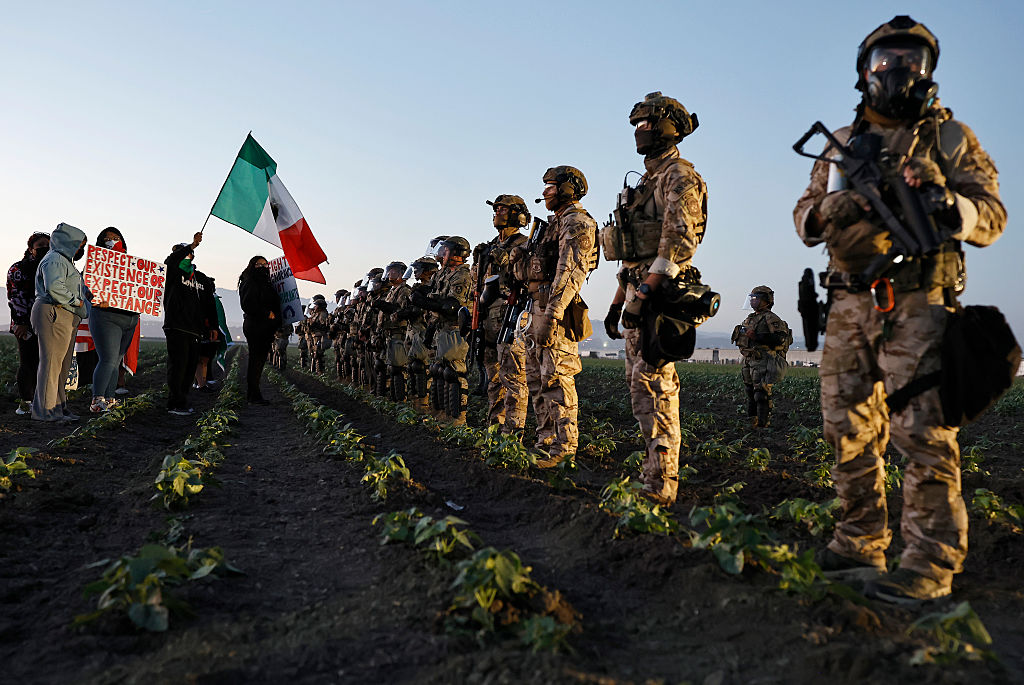
Federal agents block people protesting an ICE immigration raid at a nearby licensed cannabis farm on July 10, 2025, near Camarillo, California.Mario Tama / Getty Images
On July 10, 2025, as federal agents stormed cannabis farms in Ventura County, California, community members rushed to protest what they saw as yet another sweeping Immigration and Customs Enforcement (ICE) raid. Among them was Jonathan Caravello, a 37-year-old philosophy lecturer at California State University Channel Islands. Today, he faces a federal felony charge that could send him to prison for up to 20 years.
At a time when anti-immigrant enforcement is intensifying and protest is increasingly reframed as criminal conspiracy, Caravello’s prosecution poses a strategic question: Will unions and solidarity movements remain defensive and fragmented, or will they organize a public campaign that makes repression politically costly?
What Happened in Camarillo
The ICE operations in Camarillo, California, led to hundreds of arrests and tense confrontations between agents and community members who had gathered in protest. The night before, Caravello had spoken at the Camarillo City Council, asking the community to peacefully rally against the impending raids: “It’s my responsibility to protect them, and so I’ve been patrolling the city streets following armed, masked thugs trying to kidnap my neighbors.”
On July 10, Caravello was present at the site, and, according to witnesses, he was arrested directly after he attempted to dislodge a tear gas canister from underneath a protester’s wheelchair. Federal authorities allege that earlier in the protest, Caravello picked up a canister and threw it toward Border Patrol agents, characterizing the act as assaulting a federal officer with a “deadly weapon” under 18 U.S.C. § 111.
Fired for “Crime” of Speaking at Socialism Summit, Texas Professor Speaks Out
Professor Tom Alter is appealing to Texas’s Board of Regents after being temporarily reinstated and then fired again. By Ashley Smith , Truthout October 31, 2025
He was initially charged with a misdemeanor and released on July 14 on a $15,000 surety bond (which allows a defendant to be released with a partial payment of bail that only must be paid in full if the defendant fails to arrive at court). Caravello told me that his release came with restrictive conditions: electronic monitoring, an 8:00 pm to 5:00 am curfew, travel limitations to the Central District of California, mandatory drug testing, and therapy requirements.
If protest can expose participants to decades-long felony sentences, the chilling effect will spread well beyond campus activists.
The most disturbing development came on September 3, when a federal grand jury drastically escalated the stakes by indicting Caravello on a felony charge under the same statute. The tear gas canister — deployed by federal agents — was now described as a “deadly weapon,” allowing prosecutors to pursue a charge carrying a potential 20-year sentence. Caravello pleaded not guilty at his November 6 arraignment. His trial is currently set for March 24, 2026.
Supporters argue there is no credible evidence of a violent assault and that prosecutors are treating a chaotic protest incident as a federal felony to send a chilling message to others who act in solidarity with immigrant communities
On July 10, 2025, as federal agents stormed cannabis farms in Ventura County, California, community members rushed to protest what they saw as yet another sweeping Immigration and Customs Enforcement (ICE) raid. Among them was Jonathan Caravello, a 37-year-old philosophy lecturer at California State University Channel Islands. Today, he faces a federal felony charge that could send him to prison for up to 20 years.
At a time when anti-immigrant enforcement is intensifying and protest is increasingly reframed as criminal conspiracy, Caravello’s prosecution poses a strategic question: Will unions and solidarity movements remain defensive and fragmented, or will they organize a public campaign that makes repression politically costly?
What Happened in Camarillo
The ICE operations in Camarillo, California, led to hundreds of arrests and tense confrontations between agents and community members who had gathered in protest. The night before, Caravello had spoken at the Camarillo City Council, asking the community to peacefully rally against the impending raids: “It’s my responsibility to protect them, and so I’ve been patrolling the city streets following armed, masked thugs trying to kidnap my neighbors.”
On July 10, Caravello was present at the site, and, according to witnesses, he was arrested directly after he attempted to dislodge a tear gas canister from underneath a protester’s wheelchair. Federal authorities allege that earlier in the protest, Caravello picked up a canister and threw it toward Border Patrol agents, characterizing the act as assaulting a federal officer with a “deadly weapon” under 18 U.S.C. § 111.
Fired for “Crime” of Speaking at Socialism Summit, Texas Professor Speaks Out
Professor Tom Alter is appealing to Texas’s Board of Regents after being temporarily reinstated and then fired again. By Ashley Smith , Truthout October 31, 2025
He was initially charged with a misdemeanor and released on July 14 on a $15,000 surety bond (which allows a defendant to be released with a partial payment of bail that only must be paid in full if the defendant fails to arrive at court). Caravello told me that his release came with restrictive conditions: electronic monitoring, an 8:00 pm to 5:00 am curfew, travel limitations to the Central District of California, mandatory drug testing, and therapy requirements.
If protest can expose participants to decades-long felony sentences, the chilling effect will spread well beyond campus activists.
The most disturbing development came on September 3, when a federal grand jury drastically escalated the stakes by indicting Caravello on a felony charge under the same statute. The tear gas canister — deployed by federal agents — was now described as a “deadly weapon,” allowing prosecutors to pursue a charge carrying a potential 20-year sentence. Caravello pleaded not guilty at his November 6 arraignment. His trial is currently set for March 24, 2026.
Supporters argue there is no credible evidence of a violent assault and that prosecutors are treating a chaotic protest incident as a federal felony to send a chilling message to others who act in solidarity with immigrant communities
A Broader Pattern of “Lawfare”
Caravello’s case is not an isolated legal dispute. It reflects a pattern of escalation by the state to criminalize dissent, particularly activism in solidarity with immigrants and Palestine, as well as environmental activists, as federal authorities stretch statutes to curb protest. Like other cases stemming from last summer’s mobilizations in Southern California, prosecutors have pursued inflated charges, often relying largely on ICE agents’ accounts, in ways that appear designed to intimidate movements and deter protest.
There are already a number of reports that confirm that U.S. immigration agents included inaccurate and deceptive claims in several official reports concerning a number of Los Angeles demonstrators detained during the large-scale protests that shook the city in June, and several felony cases have been dismissed because they were relying on false testimonies.
The case of Alejandro Orellana is illustrative. Orellana was federally indicted on charges of conspiracy to commit civil disorder and aiding and abetting civil disorder for allegedly distributing protective face shields during anti-ICE protests in downtown Los Angeles. On July 29, 2025, a federal judge dismissed the case without prejudice. This victory followed a broad solidarity campaign led in part by the Committee to Stop FBI Repression’s organizing efforts, which raised national awareness and generated public pressure.
After the June mobilizations led by the Community Self-Defense Coalition and other groups, the federal government launched an aggressive prosecutorial push in Southern California. Sen. Josh Hawley (R-Missouri), chair of the Senate Judiciary Subcommittee on Crime and Counterterrorism, sent letters to several organizations announcing an investigation into the funding behind protests in Los Angeles.
In addition, under Attorney General Pam Bondi’s direction, U.S. Attorney Bill Essayli stretched legal limits to seek dozens of grand jury indictments against immigrant solidarity protesters, filing 38 felony charges but securing only seven indictments.
The Los Angeles Times reported that Essayli berated a grand jury for refusing to indict protesters and quoted a prosecutor anonymously describing internal pressure to approve charges: “If Bill asks you to jump, you ask how high.” In a July radio interview, Essayli complained of “hostile judges” and an office “with left-leaning attorneys” who needed to be “reoriented.” Meanwhile Bondi publicly praised him as a “champion for law and order.”
Campaigns that rely on elite allies or quiet legal maneuvering narrow their scope. Durable defense must be rooted in unions and grassroots organizations.
In this context, the escalation of Caravello’s charge from a misdemeanor to a felony appears less isolated than strategic. Supporters argue that the case is meant to set an example, particularly against a union-active professor who is outspoken on immigrant rights and solidarity with Palestine. As Sang Hea Kil, a San José State University professor, said at a union-sponsored free speech forum at California State University, Los Angeles: “The prosecution is political, not based on real proof of assault. His real ‘crime’ was joining other university and community members in protesting the raids and advocating democratic rights.”
The Role of Unions in Defending Civil Rights
When Caravello was arrested on July 10, his family and colleagues did not know his whereabouts for several days. The California Faculty Association (CFA) launched an urgent campaign to locate him and secure his release, condemning what it described as his “abduction and disappearance.”
Sustained union pressure through public rallies and calls to legislators contributed to his release on July 14. CFA President Margarita Berta-Ávila stated, “Professor Caravello’s freedom is the result of collective action. Faculty, students, labor unions, and immigrant rights advocates across the country stood together to demand justice.” It also started this petition to demand that the charges be dropped.
But release on bond is not exoneration. The March 2026 trial looms, with implications beyond one individual. If throwing back a tear gas canister during a protest can be reframed as a 20-year felony, union members participating in solidarity actions may face serious criminal exposure. That is why CFA President Berta-Ávila is urging “all members and the community to attend the trial and rally outside to show their support.” In an interview with me, she added, “John exemplifies who we are as a union; we not only fight for our students, but we also defend our communities. It is our responsibility to support him and those facing similar charges for standing in solidarity with immigrants.”
This case echoes that of David Huerta, president of SEIU California and SEIU-USWW, representing 50,000 janitors and service workers, many of whom are first- and second-generation immigrants. Huerta was arrested on June 6, 2025, while protesting a federal immigration raid, where he allegedly sat in front of a gate, urging others to block law enforcement. He was charged with felony conspiracy to impede a federal officer. The union called for his release, secured three days later, and demanded “the release of all people unjustly detained and an end to the raids,” insisting detainees have access to legal representation and constitutional rights.
Huerta, like Caravello, awaits trial but faces a lighter sentence after the original felony conspiracy charge was reduced to a misdemeanor obstruction count carrying up to one year in prison.
Defending Huerta and Caravello — and other labor activists arrested in Southern California and Minneapolis, Minnesota — is not only about securing fair trials. It is also about protecting the political space unions need to oppose government policy and stand with targeted communities. As anti-immigrant enforcement expands and protests are recast as conspiracies, movements must decide whether to treat these prosecutions as isolated misfortunes or as part of a coordinated pattern demanding resistance.
Lessons From History
The United States has seen this pattern before. From the Haymarket prosecutions to the trial of Sacco and Vanzetti and the McCarthy-era witch hunts, immigrant activists and labor organizers have faced criminalization for political activity.
Nicola Sacco and Bartolomeo Vanzetti, Italian immigrant anarchists, were arrested in 1920 and tried in a climate of anti-immigrant fervor during the Red Scare. Despite weak evidence and global protest, they were executed in 1927. Their case became emblematic of the use of courts to punish radical dissent.
In response, socialists founded the International Labor Defense (ILD) in 1925 as a permanent organization for workers’ defense. The ILD combined courtroom advocacy with mass mobilization — organizing rallies, publishing the Labor Defender, raising funds through unions, and building local defense committees. As James P. Cannon wrote, “The defense committee was not an auxiliary — it was the movement itself under fire.” Within a year, the ILD had expanded nationwide, organizing Labor Defense Day events in dozens of cities and building 156 branches with tens of thousands of members and affiliates. It openly challenged racist prosecutions, anti-labor injunctions, and the class bias of the courts.
The ILD model offers three enduring lessons.
First, class independence matters. Campaigns that rely on elite allies or quiet legal maneuvering narrow their scope. Durable defense must be rooted in unions and grassroots organizations.
Second, mass mobilization is indispensable. Courtroom arguments alone rarely defeat politically motivated prosecutions. Public pressure — rallies, teach-ins, solidarity statements, fundraising, and coordinated messaging — shifts the terrain.
Third, the ongoing repression must be understood as a designed plan to chill dissent. These prosecutions are not aberrations but recurring features of the authoritarian turn of the Trump administration, and treating them as isolated misjudgments obscures their purpose.
A visible, united-front defense campaign rooted in labor, immigrant organizations, and civil liberties advocates would make clear that criminalizing solidarity will not go unchallenged.
Recent efforts, such as the ongoing national tour organized by the Committee to Defend Tom Alter — a tenured history professor at Texas State University, fired for his public speech at a conference on socialism — suggest the beginnings of renewed class-based defense structures. Bringing together the cases of Tom Alter, Sang Hea Kil (who is fighting her dismissal for her support for Palestine), and John Caravello, the recent forum on free speech at California State University, Los Angeles, called for expanding this defense model and establishing a national coordination — linking academic freedom, immigrant justice, and labor solidarity. Hea Kil explained that “the attack on civil liberties and academic freedom is not over. NSPM-7, Trump’s presidential memorandum that claims to focus on ‘Countering Domestic Terrorism and Organized Political Violence’ but is in fact a declaration of war against all who disagree with Trump’s ideology, is coming for us all. It ties Tom’s, John’s, and my case, and its potential to be unleashed on higher ed faculty and programs should not be underestimated.”
What Is at Stake
The stakes extend far beyond a handful of professors. If protest can expose participants to decades-long felony sentences, the chilling effect will spread well beyond campus activists, reaching unions, immigrant communities, and solidarity networks nationwide. History shows that silence invites the state to escalate. A visible, united-front defense campaign rooted in labor, immigrant organizations, and civil liberties advocates would make clear that criminalizing solidarity will not go unchallenged.
The question is not simply whether John Caravello will be acquitted. It is whether movements will defend the political space necessary for dissent itself, before that space narrows further. As Huerta stated in a recent interview, it is time for labor to move out of a “defensive posture” — that is, the necessary “know your rights” trainings and rapid response for workers who are detained. To go on offense, we must start organizing for labor action.
This article is licensed under Creative Commons (CC BY-NC-ND 4.0), and you are free to share and republish under the terms of the license.
Blanca Missé
Blanca Missé is an associate professor of French at San Francisco State University, a member of the executive board of the San Francisco State University Chapter of the California Faculty Association, a member of California Scholars for Academic Freedom, and a militant of Workers’ Voice.

No comments:
Post a Comment