The people “want to rebuild it with their own hands — without foreign pressure or intervention,” said one Gazan.
March 11, 2026
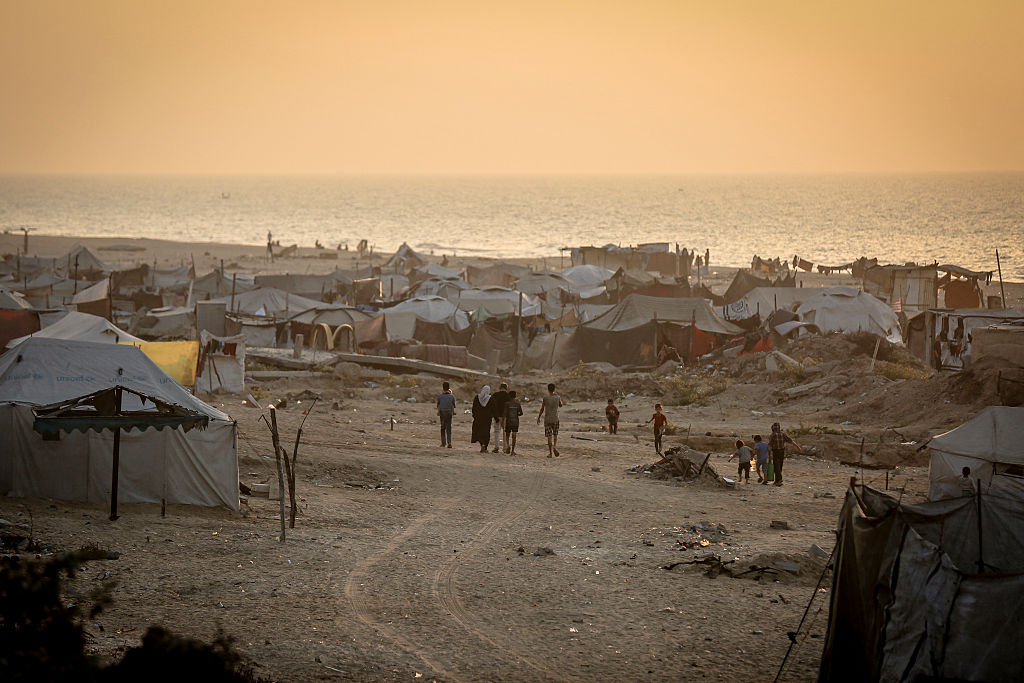 People walk through a camp of makeshift tents along Gaza's coastline in Gaza City, Gaza Strip, on November 10, 2025.SAEED JARAS / Middle East Images / AFP via Getty Images
Coastal tourism sites, 180 gleaming skyscrapers, business and industrial centers, new urban cities, more than 100,000 housing units, over 200 schools, more than 75 medical facilities, and a colossal number of job opportunities. This is Jared Kushner’s futuristic master plan for Gaza.
Kushner — Donald Trump’s son-in-law and former U.S. special envoy — presented his master plan in Davos at the World Economic Forum in the form of a computer-generated, color-coded map of what he described as a “new Gaza.”
“I know it’s a little risky to be investing in a place like this, but come, take faith. Invest in the people,” Kushner said. Two years of genocide have altered Gaza into a flattened wasteland, with over 90 percent of residential buildings lying in ruins. Yet, despite the so-called ceasefire, the interests that are profiting from its collapse and exploiting its devastation have never truly withdrawn.
Trump had proposed clearing the area of its inhabitants and turning it into the “Riviera of the Middle East,” a vision depicted in an AI-generated video shared by the U.S. president in 2025. It is an unoriginal approach to imposing free-market economy principles on Gaza: Shimon Peres had previously envisioned the transformation of Gaza into another Singapore, as if both were once poor, backward, and demolished cities. If Singapore was turned into modern city, Gaza has the same potential, according to Peres.
Referring to his own plan, Trump reasserted, “I’m a real estate person at heart, and it’s all about location.”
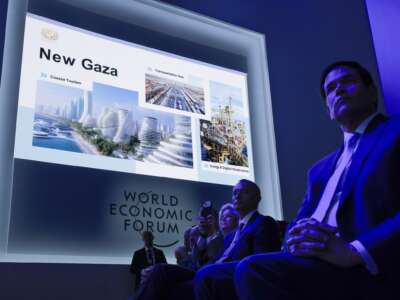
Kushner Reveals Dystopic Plan to Build Data Centers on Ruins of Gaza Genocide
The plan appears to be to finish Israel’s bulldozing of Gaza to make real estate opportunities for investors. By Sharon Zhang , Truthout January 22, 2026
Aligning with these free-market interests, Kushner set a $25 billion budget to reconstruct Gaza within three years, under specific frameworks and conditions. He also called on the private sector to invest confidently in his plan, which many of us who live here see as an imminent Vegas-ification of Gaza.
The redevelopment plan encompasses four phases. Phase one is set to begin in Rafah and parts of Khan Younis, while phase two will expand to the rest of Khan Younis. Phase three involves cramming displaced families into refugee camps in central Gaza, while phase four transforms Gaza City into an industrial zone. Yet, the entire plan is conditioned on Hamas’s full disarmament.
“We are all aspiring to see Gaza rebuilt and thriving, but not at the cost of plundering Palestinian sovereignty and statehood.”
Mohammed Johar, a young, educated father in his twenties who lives in Gaza, described Kushner’s plan as a “sword with two edges.” He continued, “We are all aspiring to see Gaza rebuilt and thriving, but not at the cost of plundering Palestinian sovereignty and statehood.”
Johar, like many other Gazans, has long suffered from unemployment and suffocating living conditions. Reflecting on the plan, he said, “The lofty promises of job opportunities, dignified lives, and sustainable necessities feel like a breakthrough compared to what Gaza has been buried beneath.”
Johar added, “Beyond the physical reconstruction, this will erase Palestinian culture, history, and identity.” Pouring into details, he continued, “Separating Gaza from the West Bank under the pretext of a ‘new Gaza’ poses a serious and growing threat of creating a new generation caught in glitzy towers and lavish, advanced sites, rather than being well-grounded in the decades-long struggle for freedom and educated about our historical landmarks that have been either stolen or erased.”

Mohammed Johar reflecting on the Gaza master plan during his interview.
Hend Salama Abo Helow
“Beyond the physical reconstruction, this will erase Palestinian culture, history, and identity.”
Kushner’s plan necessitates a flat, ready-to-build surface to embark on the investment project from scratch. Johar remarked, “This means wiping out what is left of Gaza’s physical body — clearing the rubble, then robbing Palestinians of their land and property.” In a muted voice, he continued, “This will not only strip Palestinians of their land and force them to submit to U.S.-Israeli backed control, but also revive the old myth of ‘a land without people for a people without land.’ It will further fuel domestic conflicts among Gazans over original land ownership and present residential allocations.”
Ibrahim Faris Abu Ammar, a 68-year-old retired teacher who lost his home and several family members, told me the plan seems vague, and unsettling. He said, “People are feeling perplexed about Gaza’s master plan — fearful of its consequences, yet cautiously hopeful about rebuilding Gaza.”
He bowed his head, then added, “They have successfully and undeniably engineered our society. It has all been contrived upon us without any prior consultation, and whatever happens, we are left with no choice but to accept it, unopposed.” Abu Ammar continued, putting it plainly, “The U.S. and Israel are treating us as the defeated side, and the defeated are expected to woefully submit to the victor’s order.”
“The U.S. and Israel are treating us as the defeated side, and the defeated are expected to woefully submit to the victor’s order.”
Yet, the newly established National Committee for the Administration of Gaza, under the so-called “Board of Peace,” has not been engaged in Kushner’s talks. Abu Ammar commented: “Neglecting the role of the Palestinian Authority, Palestinian factions, and the National Committee for the Administration of Gaza in decision-making on such watershed matters of self-determination is deeply concerning.”
He reflected bitterly: “This reminds me most of the Gaza Humanitarian Foundation — a death trap dressed up as salvation. This, too, is an investment-driven expropriation plan masquerading as a beneficial reconstruction project for the public good.”
Mohamed J. Abu Safia, a journalist from Gaza, sees the plan as “profoundly dangerous.” He stated critically, “No one has the right to decide on behalf of Palestinians. No one has the right to invest in land they do not own.”
He then questioned:
If the intention to turn Gaza into an investment project existed long ago, weren’t they able to intervene and stop a killing machine that raged for over two years unabated? If they truly care about Gaza, then rather than forging systematic plans for shiny skyscrapers and tourism destinations, they should think about lifting the blockade and ending the occupation — and rebuilding Gaza meaningfully for its people, not for tourists, and not in ways that implicitly force migration.
One of the plan’s promotional hooks was the promise of building a seaport and an airport. But Abu Safia interrupted me and said, “We once had a seaport and an airport — and Israeli forces demolished them. So why not grant Palestinians the space and sovereignty to improve their lives in the way they see fit?”
Abu Safia lost his home in northern Gaza, and another piece of his land recently fell behind the so-called “Yellow Line.” He recounted:
My grandparents were expelled from Hamama village, thinking naively it would only be a matter of days. But look — it has been decades. Yet I will never relinquish my own rights. Even if they offered me skyscrapers or palaces, I do not want them. I do not want either. I want my home — even if it is in ruins. My land. I want to be the one who rebuilds it, who decides where the car garage stands and where to plant olives and roses in the garden. And I will not compromise that right.
Through his work, Abu Safia has learned that his perspective widely shared. “I meet people. I conduct interviews. This is not just my sole opinion,” he said. “People are determined to return and rebuild their homes once Israeli forces fully withdraw. They are not relinquishing a single centimeter of their land.”
He has been displaced to Rafah — a city that satellite images show as almost entirely destroyed. It is the same city Kushner envisaged as a “new Rafah.”
“Rafah was once bustling and vibrant with its people. Now it is barren terrain,” Abu Safia stated. “Nevertheless, the ones, and the only ones who have the right to be stakeholders in its future are Rafah’s inhabitants.”
“The best plan for Gaza is the full withdrawal of Israeli forces and the facilitation of reconstruction materials and equipment for its people and architects to rebuild it with their own hands — without foreign pressure or intervention.”
Abu Ammar challenged Kushner’s claims. “It is impossible to complete this in three years,” he said. “Delays and the prolonged stagnation of reconstruction will force many to leave, seeking life beyond Gaza’s perils — my family and I among them.”
Yet Abu Safia added, “I think it is impossible to even implement such a plan, and I hope it fails.”
But Johar put it plainly: “The best plan for Gaza is the full withdrawal of Israeli forces and the facilitation of reconstruction materials and equipment for its people and architects to rebuild it with their own hands — without foreign pressure or intervention.”
Abu Safia called on the world to expedite the engine of reconstruction — but not to “steal our land in return for rebuilding.”
This article is licensed under Creative Commons (CC BY-NC-ND 4.0), and you are free to share and republish under the terms of the license.
“Beyond the physical reconstruction, this will erase Palestinian culture, history, and identity.”
Kushner’s plan necessitates a flat, ready-to-build surface to embark on the investment project from scratch. Johar remarked, “This means wiping out what is left of Gaza’s physical body — clearing the rubble, then robbing Palestinians of their land and property.” In a muted voice, he continued, “This will not only strip Palestinians of their land and force them to submit to U.S.-Israeli backed control, but also revive the old myth of ‘a land without people for a people without land.’ It will further fuel domestic conflicts among Gazans over original land ownership and present residential allocations.”
Ibrahim Faris Abu Ammar, a 68-year-old retired teacher who lost his home and several family members, told me the plan seems vague, and unsettling. He said, “People are feeling perplexed about Gaza’s master plan — fearful of its consequences, yet cautiously hopeful about rebuilding Gaza.”
He bowed his head, then added, “They have successfully and undeniably engineered our society. It has all been contrived upon us without any prior consultation, and whatever happens, we are left with no choice but to accept it, unopposed.” Abu Ammar continued, putting it plainly, “The U.S. and Israel are treating us as the defeated side, and the defeated are expected to woefully submit to the victor’s order.”
“The U.S. and Israel are treating us as the defeated side, and the defeated are expected to woefully submit to the victor’s order.”
Yet, the newly established National Committee for the Administration of Gaza, under the so-called “Board of Peace,” has not been engaged in Kushner’s talks. Abu Ammar commented: “Neglecting the role of the Palestinian Authority, Palestinian factions, and the National Committee for the Administration of Gaza in decision-making on such watershed matters of self-determination is deeply concerning.”
He reflected bitterly: “This reminds me most of the Gaza Humanitarian Foundation — a death trap dressed up as salvation. This, too, is an investment-driven expropriation plan masquerading as a beneficial reconstruction project for the public good.”
Mohamed J. Abu Safia, a journalist from Gaza, sees the plan as “profoundly dangerous.” He stated critically, “No one has the right to decide on behalf of Palestinians. No one has the right to invest in land they do not own.”
He then questioned:
If the intention to turn Gaza into an investment project existed long ago, weren’t they able to intervene and stop a killing machine that raged for over two years unabated? If they truly care about Gaza, then rather than forging systematic plans for shiny skyscrapers and tourism destinations, they should think about lifting the blockade and ending the occupation — and rebuilding Gaza meaningfully for its people, not for tourists, and not in ways that implicitly force migration.
One of the plan’s promotional hooks was the promise of building a seaport and an airport. But Abu Safia interrupted me and said, “We once had a seaport and an airport — and Israeli forces demolished them. So why not grant Palestinians the space and sovereignty to improve their lives in the way they see fit?”
Abu Safia lost his home in northern Gaza, and another piece of his land recently fell behind the so-called “Yellow Line.” He recounted:
My grandparents were expelled from Hamama village, thinking naively it would only be a matter of days. But look — it has been decades. Yet I will never relinquish my own rights. Even if they offered me skyscrapers or palaces, I do not want them. I do not want either. I want my home — even if it is in ruins. My land. I want to be the one who rebuilds it, who decides where the car garage stands and where to plant olives and roses in the garden. And I will not compromise that right.
Through his work, Abu Safia has learned that his perspective widely shared. “I meet people. I conduct interviews. This is not just my sole opinion,” he said. “People are determined to return and rebuild their homes once Israeli forces fully withdraw. They are not relinquishing a single centimeter of their land.”
He has been displaced to Rafah — a city that satellite images show as almost entirely destroyed. It is the same city Kushner envisaged as a “new Rafah.”
“Rafah was once bustling and vibrant with its people. Now it is barren terrain,” Abu Safia stated. “Nevertheless, the ones, and the only ones who have the right to be stakeholders in its future are Rafah’s inhabitants.”
“The best plan for Gaza is the full withdrawal of Israeli forces and the facilitation of reconstruction materials and equipment for its people and architects to rebuild it with their own hands — without foreign pressure or intervention.”
Abu Ammar challenged Kushner’s claims. “It is impossible to complete this in three years,” he said. “Delays and the prolonged stagnation of reconstruction will force many to leave, seeking life beyond Gaza’s perils — my family and I among them.”
Yet Abu Safia added, “I think it is impossible to even implement such a plan, and I hope it fails.”
But Johar put it plainly: “The best plan for Gaza is the full withdrawal of Israeli forces and the facilitation of reconstruction materials and equipment for its people and architects to rebuild it with their own hands — without foreign pressure or intervention.”
Abu Safia called on the world to expedite the engine of reconstruction — but not to “steal our land in return for rebuilding.”
This article is licensed under Creative Commons (CC BY-NC-ND 4.0), and you are free to share and republish under the terms of the license.

Hend Salama Abo Helow
Hend Salama Abo Helow is a researcher, writer and medical student at Al-Azhar University in Gaza. She is also a writer with We Are Not Numbers and has published in the Washington Report on Middle East Affairs, Institute for Palestinian Studies, Mondoweiss and Al Jazeera. She believes in writing as a form of resistance, a silent witness to atrocities committed against Palestinians, and a way to achieve liberation.

No comments:
Post a Comment