Showing posts sorted by relevance for query EUROPEAN FASCISM. Sort by date Show all posts

Sunday, December 20, 2020


POLITICS

The Long Shadow of Racial Fascism

Recent debates have centered on whether it’s appropriate to compare Trump to European fascists. But radical Black thinkers have long argued that racial slavery created its own unique form of American fascism.

ALBERTO TOSCANO

In the wake of the 2016 election, public intellectuals latched onto the new administration’s organic and ideological links with the alt- and far right. But a mass civic insurgency against racial terror—and the federal government’s authoritarian response—has pushed hitherto cloistered academic debates about fascism into the mainstream, with Peter E. GordonSamuel Moyn, and Sarah Churchwell taking to the pages of the New York Review of Books to hash out whether it is historically apt or politically useful to call Trump a fascist. The F-word has also been making unusual forays into CNN, the New York Times, and mainstream discourse. The increasing prospect that any transfer of power will be fraught—Trump has hinted he will not accept the results if he loses—has further intensified the stakes, with even the dependable neoliberal cheerleader Thomas Friedman conjuring up specters of civil war.

Is it historically apt or politically useful to call Trump a fascist? The long history of Black radical thinking about fascism and anti-fascist resistance provides direction in this debate.

Notwithstanding the changing terrain, talk of fascism has generally stuck to the same groove, namely asking whether present phenomena are analogous to those familiar from interwar European dictatorships. Sceptics of comparison underscore the way in which the analogy of fascism can either treat the present moment as exceptional, papering over the history of distinctly American forms of authoritarianism, or, alternatively, be so broad as to fail to define what is unique about our current predicament. Analogy’s advocates point to the need to detect family resemblances with past despotisms before it’s too late, often making their case by advancing some ideal-typical checklist, whether in terms of the elements of or the steps toward fascism. But what if our talk of fascism were not dominated by the question of analogy?

Attending to the long history of Black radical thinking about fascism and anti-fascist resistance—to what Cedric Robinson called a “Black construction of fascism” alternative to the “historical manufacture of fascism as a negation of Western Geist”—could serve to dislodge the debate about fascism from the deadlock of analogy, providing the resources to confront our volatile interregnum.

section separator

Long before Nazi violence came to be conceived of as beyond analogy, Black radical thinkers sought to expand the historical and political imagination of an anti-fascist left. They detailed how what could seem, from a European or white vantage point, to be a radically new form of ideology and violence was, in fact, continuous with the history of colonial dispossession and racial slavery.

Black radical thinkers have long sought to expand the historical and political imagination of an anti-fascist left, revealing fascism as a continuation of colonial dispossession and racial slavery. 

Pan-Africanist George Padmore, breaking with the Communist International over its failure to see the likenesses between “democratic” imperialism and fascism, would write in How Britain Rules Africa (1936) of settler-colonial racism as “the breeding-ground for the type of fascist mentality which is being let loose in Europe today.” He would go on to see in South Africa “the world’s classic Fascist state,” grounded on the “unity of race as against class.” Padmore’s “Colonial Fascism” thus anticipated Aimé Césaire’s memorable description of fascism as the boomerang effect of European imperialist violence.

African American anti-fascists shared the anti-colonial analysis that the Atlantic world’s history of racial violence belied the novelty of intra-European fascism. Speaking in Paris at the Second International Writers Congress in 1937, Langston Hughes declared: “We Negroes in America do not have to be told what fascism is in action. We know. Its theories of Nordic supremacy and economic suppression have long been realities to us.” It was an insight that certainly would not have surprised any reader of W. E. B. Du Bois’s monumental reckoning with the history of U.S. racial capitalism, Black Reconstruction in America (1935). As Amiri Baraka would suggest much later, building on Du Bois’s passing mentions of fascism, the overthrow of Reconstruction enacted a “racial fascism” that long predated Hitlerism in its use of racial terror, conscription of poor whites, and manipulation of (to quote the famous definition of fascism by Georgi Dimitrov) “the most reactionary, most chauvinistic, and most imperialist sector of finance capital.”

In this view, a U.S. racial fascism could go unremarked because it operated on the other side of the color line, just as colonial fascism took place far from the imperial metropole. As Bill V. Mullen and Christopher Vials have suggested in their vital The US Antifascism Reader (2020):

For people of color at various historical moments, the experience of racialization within a liberal democracy could have the valence of fascism. That is to say, while a fascist state and a white supremacist democracy have very different mechanisms of power, the experience of racialized rightlessness within a liberal democracy can make the distinction between it and fascism murky at the level of lived experience. For those racially cast aside outside of liberal democracy’s system of rights, the word ‘fascism’ does not always conjure up a distant and alien social order.

Or, as French writer Jean Genet observed on May 1, 1970, at a rally in New Haven for the liberation of Black Panther Party chairman Bobby Seale: “Another thing worries me: fascism. We often hear the Black Panther Party speak of fascism, and whites have difficulty accepting the word. That’s because whites have to make a great effort of imagination to understand that blacks live under an oppressive fascist regime.”

It was largely thanks to the Panthers that the term “fascism” returned to the forefront of radical discourse and activism in the late 1960s and early 1970s. The United Front Against Fascism conference held in Oakland in 1969 brought together a wide swathe of the Old and New Lefts, as well as Asian American, Chicano, Puerto Rican (Young Lords), and white Appalachian (Young Patriots Organization) activists who had developed their own perspectives on U.S. fascism—for instance, by foregrounding the experience of Japanese internment during World War II. In a striking indication of the peculiarities and continuities of U.S. anti-fascist traditions, among the chief planks of the conference was the notionally reformist demand for community or decentralized policing—to remove racist white officers from Black neighborhoods and exert local checks on law enforcement.

Political prisoners close to the Panthers theorized specifically about what we could call “late fascism” (by analogy with “late capitalism”) in the United States. At the same time that debates about “new fascisms” were polarizing radical debate across Europe, the writing and correspondence of Angela Y. Davis and George Jackson generated a theory of fascism from the lived experience of the violent nexus between the carceral state and racial capitalism. Davis, the Black Marxist and feminist scholar, needs little introduction, her 1970 imprisonment on trumped-up conspiracy charges having rocketed her to the status of household name in the United States and an icon of solidarity worldwide. Fewer remember that the conspiracy charge against Davis arose from an armed courtroom attack by her seventeen-year-old bodyguard, Jonathan Jackson, with the goal of forcing the release of the Soledad Brothers, three African American prisoners facing the death penalty for the killing of a white prison guard. Among them was Jonathan’s older brother, the incarcerated Black revolutionary George Jackson, with whom Davis corresponded extensively. Jackson was killed by a prison sniper during an escape attempt on August, 21, 1971, a few days before the Soledad Brothers were to be tried.

In one of his prison letters on fascism, posthumously collected in Blood in My Eye (1972), Jackson offered the following reflection:

When I am being interviewed by a member of the old guard and point to the concrete and steel, the tiny electronic listening device concealed in the vent, the phalanx of goons peeping in at us, his barely functional plastic tape-recorder that cost him a week’s labor, and point out that these are all manifestations of fascism, he will invariably attempt to refute me by defining fascism simply as an economic geo-political affair where only one party is allowed to exist aboveground and no opposition political activity is allowed.

Jackson encourages us to consider what happens to our conceptions of fascism if we take our bearings not from analogies with the European interwar scene, but instead from the materiality of the prison-industrial complex, from the “concrete and steel,” from the devices and personnel of surveillance and repression.

In their writing and correspondence, marked by interpretive differences alongside profound comradeship, Davis and Jackson identify the U.S. state as the site for a recombinant or even consummate form of fascism. Much of their writing is threaded through Marxist debates on the nature of monopoly capitalism, imperialism and capitalist crises, as well as, in Jackson’s case, an effort to revisit the classical historiography on fascism. On these grounds, Jackson and Davis stress the disanalogies between present forms of domination and European exemplars, but both assert the privileged vantage point provided by the view from within a prison-judicial system that could accurately be described as a racial state of terror.

Angela Y. Davis and George Jackson saw the U.S. state—the carceral state and racial capitalism—as the site of fascism. This fascism originated from liberal democracy itself. 

This both echoes and departs from the Black radical theories of fascism, such as Padmore’s or Césaire’s, which emerged from the experience of the colonized. The new, U.S. fascism that Jackson and Davis strive to delineate is not an unwanted return from the “other scene” of colonial violence, but originates from liberal democracy itself. Indeed, it was a sense of the disavowed bonds between liberal and fascist forms of the state which, for Davis, was one of the great lessons passed on by Herbert Marcuse, whose grasp of this nexus in 1930s Germany allowed him to discern the fascist tendencies in the United States of his exile.

Both Davis and Jackson also stress the necessity to grasp fascism not as a static form but as a process, inflected by its political and economic contexts and conjunctures. Checklists, analogies, or ideal-types cannot do justice to the concrete history of fascism. Jackson writes of “the defects of trying to analyze a movement outside of its process and its sequential relationships. You gain only a discolored glimpse of a dead past.” He remarks that fascism “developed from nation to nation out of differing levels of traditionalist capitalism’s dilapidation.”

Where Jackson and Davis echo their European counterparts is in the idea that “new” fascisms cannot be understood without seeing them as responses to the insurgencies of the 1960s and early 1970s. For Jackson, fascism is fundamentally a counterrevolutionary form, as evidenced by the violence with which it represses any consequential threat to the state. But fascism does not react immediately against an ascendant revolutionary force; it is a kind of delayed counterrevolution, parasitic on the weakness or defeat of the anti-capitalist left, “the result of a revolutionary thrust that was weak and miscarried—a consciousness that was compromised.” Jackson argues that U.S.-style fascism is a kind of perfected form—all the more insidiously hegemonic because of the marriage of monopoly capital with the (racialized) trappings of liberal democracy. As he declared:

Fascism has established itself in a most disguised and efficient manner in this country. It feels so secure that the leaders allow us the luxury of a faint protest. Take protest too far, however, and they will show their other face. Doors will be kicked down in the night and machine-gun fire and buckshot will become the medium of exchange.

In Davis’s concurrent theorizing, the carceral, liberationist perspective on fascism has a different inflection. For Davis, fascism in the United States takes a preventive and incipient form. The terminology is adapted from Marcuse, who remarked, in an interview from 1970, “In the last ten to twenty years we’ve experienced a preventative counterrevolution to defend us against a feared revolution, which, however, has not taken place and doesn’t stand on the agenda at the moment.” Some of the elements of Marcuse’s analysis still resonate (particularly poignant, in the wake of Breonna Taylor’s murder by police, is his mention of no-knock warrants):

The question is whether fascism is taking over in the United States. If by that we understand the gradual or rapid abolition of the remnants of the constitutional state, the organization of paramilitary troops such as the Minutemen, and granting the police extraordinary legal powers such as the notorious no-knock law which does away with the inviolability of the home; if one looks at the court decisions of recent years; if one knows that special troops—so-called counterinsurgency corps—are being trained in the United States for possible civil war; if one looks at the almost direct censorship of the press, television and radio: then, as far as I’m concerned, one can speak with complete justification of an incipient fascism. . . . American fascism will probably be the first which comes to power by democratic means and with democratic support.

Davis was drawn to Marcuse’s contention that “fascism is the preventive counter-revolution to the socialist transformation of society” because of how it resonated with racialized communities and activists. In the experience of many Black radicals, the aspect of their revolutionary politics that most threatened the state was not the endorsement of armed struggle, but rather the “survival programs,” those enclaves of autonomous social reproduction facilitated by the Panthers and more broadly practiced by Black movements. While nominally mobilized against the threat of armed insurrection, the ultimate target of counterinsurgency were these experiments with social life outside and against the racial state—especially when they edged toward what Huey P. Newton named “revolutionary intercommunalism.”

Race, gender, and class determine how fascist the country might seem to any given individual.

What can be gleaned from Davis’s account is the way that fascism and democracy can be experienced very differently by different segments of the population. In this regard, Davis is attuned to the ways in which race and gender, alongside class, can determine how fascist the country seems to any given individual. As Davis puts it, fascism is “primarily restricted to the use of the law-enforcement-judicial-penal apparatus to arrest the overt and latent revolutionary trends among nationally oppressed people, tomorrow it may attack the working class en masse and eventually even moderate democrats.” But the latter are unlikely to fully perceive this phenomenon because of the manufactured invisibility of the site of the state’s maximally fascist presentation, namely, prisons with their “totalitarian aspirations.”

The kind of fascism diagnosed by Davis is a “protracted social process,” whose “growth and development are cancerous in nature.” We thus have the correlation in Davis’s analysis between, on the one hand, the prison as a racialized enclave or laboratory and, on the other, the fascist strategy of counterrevolution, which flow through society at large but are not experienced equally by everyone everywhere. As Davis has written more recently:

The dangerous and indeed fascistic trend toward progressively greater numbers of hidden, incarcerated human populations is itself rendered invisible. All that matters is the elimination of crime—and you get rid of crime by getting rid of people who, according to the prevailing racial common sense, are the most likely people to whom criminal acts will be attributed.


CONTINUE READING HERE 

Wednesday, December 31, 2025

Understanding the relationship between Zionism and Fascism

Despite the mutual admiration between Zionists and fascists, they are usually seen as separate political movements. However, when viewed through the lens of Western racism, colonialism, and imperialism, the connections become clear.
 December 28, 2025
MONDOWEISS

Israeli lawmaker Itamar Ben-Gvir takes part in a march in Jerusalem, on April 20, 2022. (Photo: Jeries Bssier / APA Images)

Editor’s Note: The following paper was presented during the online seminar, “Is Zionism fascist? What will judges think?” hosted by Riverway Law on December 9, 2025.

Despite the mutual admiration of Zionists and fascists, both historically and in the present, it is generally considered unhelpful to characterize Zionism as fascism. However, viewing fascism from the perspective of the Black radical tradition, with its emphasis on racialism, colonialism and imperialism, rooted in supremacist ideas of western civilization, helps make fascism a useful concept for understanding Zionism.

In popular definitions of fascism it is detached from nationalism and associated most strongly with authoritarianism. Israel’s self-presentation as a liberal democracy, the result of a national self-determination project, and even an anticolonial Indigenous manifestation, conflicts with dominant ideas of what fascism is. But this approach to fascism is elusive by design.The history of fascism is dominated by liberal historians who mainly do not see racialism, colonialism and imperialism as central to it. Rather, they tend to see fascism as an aberration of the European/western political project.

In contrast, the revolutionary Black imprisoned intellectual, George Jackson, wrote in 1972 that the definition of fascism is not settled because of ‘our insistence on a full definition… looking for exactly identical symptoms from nation-to-nation.’ In fact, fascism is still under development. For the Black radical political scientist, Cedric Robinson, speaking in 1990, because Black political thought is treated as derivative, Black theories of fascism have generally not been considered ‘worthy of investigation’. Rather, popular culture and mass media are informed by mainstream academic fascist studies which constructs fascism as ‘right-wing extremism’ and ‘neurotic authoritarianism’, and ‘fascism proper… restricted to Europe between the First and Second World Wars.’ These western theorists found it very difficult to see fascism as anything other than the ‘dark side of Western civilization’, briefly flirted with but ultimately rejected.

Black theorists, Robinson goes on to say, based themselves on the experiences of the Black masses. They therefore did not see fascism as the ‘inherent national trait’ of Spain, Italy or Germany, but as ‘composed from the ideological, political and technological materials’ of the entirety of Western civilization. Their approach to fascism was shaped by the ‘crushing defeats’ Black people had already sustained in Cuba, Haiti and Liberia well before Mussolini invaded Libya and East Africa. Indeed, they mobilized en masse against Mussolini’s invasion of Ethiopia in 1935 because, as the Black radical intellectual, W.E.B. Du Bois wrote they recognized that ‘other nations have done exactly what Italy is doing’. Italy wanted a slice of the colonial pie that other European powers had kept for themselves. Italian colonization of East Africa was seen as the latest in a litany of attacks on Black life up to and including enslavement which many descended from directly. ‘Anti-fascism,’ Robinson remarks, ‘was thus spontaneously extended throughout the Black world.’

Not all Black intellectuals took the same approach to fascism. For example, C.L.R James tended to side with Marxists who saw fascism as the result of the clash between capitalism and Communism. Fascism was seen by capitalists as their salvation from a workers’ movement with revolutionary potential. But when the Trinidadian intellectual George Padmore returned to the question in 1956, he saw that something more than the crisis of capitalism within Europe was at stake: fascism was the sign of ‘a new aggression of Europeans in Africa.’

W.E.B. Du Bois already saw this in the early 1930s writing later, ‘I knew that Hitler and Mussolini were fighting Communism, and using race prejudice to make some white people rich and all colored peoples poor. But it was not until later that I realized that the colonialism of Great Britain and France had exactly the same object and methods as the fascists and the Nazis were trying clearly to use.’ This echoes Aimé Césaire’s famous remark that Nazism was the manifestation of what had already been done to non-Europeans before being brought to the Continent and turned inwards.

What Dan Tamir calls, a ‘genuine fascist movement’ also existed in Palestine in the 1920s and 30s, especially within the virulently anti-Communist Revisionist Zionist movement’ of Jabotinsky which opposed the supposedly more gradualist approach of Labor Zionism. Tamir suggests that because fascism emerges in periods of crisis, it is unsurprising that it also emerged in what he calls ‘modern Hebrew society’ in Palestine in the 1920s and 30s, a society riven by deep in crisis. However, like most mainstream fascism scholars, and from a perspective that almost totally ignores the existence of Palestinians, he sidesteps the emphasis placed by Black radicals on race.

For many, it was – and continues to be – unthinkable that Zionists could be fascists because of the centrality of antisemitism to fascism in Europe. However, Zionist fascists, like Abba Ahimeir, an admirer of the authoritarian philosopher Oswald Spengler, believed that fascism had no inherent connection to antisemitism, and that therefore Zionists could be fascists. However, more consistent with the Black radical approach is that the European Zionists – Christian but also Jewish – were in fact antisemites, in addition to being racists. Theodor Herzl famously declared antisemites Zionism’s ‘most dependable friends’ and opposed Jewish immigration, arguing they carried ‘the seeds of anti-Semitism into England; they have already introduced it into America.’ In 1897 he depicted the anti-Zionist caricature, ‘Mauschel’, ‘a distorted, deformed and shabby fellow’ who he did not see as belonging to the same race as the Jewish Zionist who must be freed from association with Mauschel.

It is well-known additionally that Zionists actively thwarted the saving of European Jews from the Nazis. Ralph Schoenman documents that ‘From 1933 to 1935, the WZO turned down two-thirds of all the German Jews who applied for immigration certificates’ because they were seen as of little use to the requirements of the Zionist colony.

Despite this, the dominant tendency to exceptionalize antisemitism leads many to downplay the role of race for Zionism. But there is no colonial project that is not founded on racial rule. Thus, Zionism enacts racial domination over Palestinians. The ability to colonize another’s land is based on the belief that the people are inferior at best, less than human and utterly killable at worst. Statements and actions to that effect are made constantly by Zionists throughout the current genocide.

The case of Zionist collusion with Italian fascism demonstrates the centrality of race to both fascism and Zionism. Mainstream interpreters of Italian fascism have tended to downplay race, for example citing the fact that Mussolini did not enact racial laws until 1938, and only to side with Hitler. However, as Robinson shows, Mussolini believed in Italian racial supremacy before this pivot, but more important than his personal attitudes were his ambitions in Africa. Mussolini’s relationship with Zionists, according to an article by Michael Ledeen discussed by Robinson, was because they ‘could be useful agents’ to destabilize the British mandate in Palestine and to ‘enlist Jewish populations in Libya and east Africa in the “pacification” of colonized populations.’ Mussolini kept Jews on side in various ways, for example allowing a rabbinical school to transfer from Germany.

Jews in Italy and beyond were widely favorable to Mussolini. However, this was not only because of the protection offered them up to 1938, but also because Italian Jews believed in Mussolini’s colonial project, considering, as Shira Klein notes, ‘that Italy’s pride and reputation depended on its colonial conquests.’ There was thus no reason why Jewish Zionists would not see Italy’s ambitions in East Africa and the Levant as consistent with their aspirations in Palestine.

Zionist obsessions with what Max Nordau called ‘muscular Judaism’ echoed Nazi practices, but also the eugenicist beliefs that were widespread among Europeans, US Americans and practiced throughout the colonized world, including by those with ostensibly social democratic views. Medical experiments carried out on Arab Jews were part of the quest to trace the genetic line of Homo Israelensis to Biblical times. Medical experimentation has also been carried out on Palestinian prisoners. Zionist eugenics cannot be detached from its aim to ‘form a portion of a rampart of Europe against Asia, an outpost of civilization as opposed to barbarism’ as Herzl put it in The Jewish State, as European is synonymous with whiteness. This is expressed in Palestine via the appeal to a messianic Jewish destiny, but contra the worrying trend of white nationalist attempting to capture the Palestinian liberation struggle in the west, this should be seen as consistent with all settler colonial visions of manifest destiny.

Indeed, it was the ambition of Zionist founders such as Arthur Ruppin to be accepted as wholly European, something they could only achieve by emulating European Herrenvolk nationalism in Palestine.

Zionism is fascist because it is the tip of the spear of European, western, white supremacist racialism, settler colonialism, and imperialism in the current conjuncture. But it is not unique in that regard. In the context out of which it emerged and of which it is a product – European civilizational supremacism, driving colonialism and imperialism – it is no surprise that Zionists admired and emulated fascism and continue to do so, building ever stronger ties to fascist movements globally, from Trump to Millei and Orban. It is also no surprise that Zionism embodies the ambitions of white supremacist nationalists everywhere.

Fascism’s global nature was remarked upon by George Jackson who noted that ‘we have been consistently misled by fascism’s nationalistic trappings. We have failed to understand its basically international character.’ Zionism can be seen as part of an international movement whose acute manifestations resulted from the crisis of capitalism. But as Black radicals showed, it never developed without its core defining feature: racial supremacism.

Just as Black radicals identified that fascism was a manifestation of their everyday experiences under colonialism and slavery, Zionism’s fascism goes far beyond its most extremist proponents, from Jabotinsky to Kahane to Ben-Gvir. From the perspective of the Black radicals, beyond these figures, it is the fact that almost the entire Israeli population is in lockstep with its genocidal colonial project which makes Zionism fascist in all its dimensions.

Thursday, January 23, 2020

The Fascist Kernel of Ukrainian Genocidal Nationalism


 The Carl Beck Papers in Russian & East European Studies, Number 2402. Pittsburgh: The Center for Russian and East European Studies 2015.


This study briefly presents the history of the radical form of Ukrainian nationalism, paying special attention to the geopolitical circumstances which formed this movement. Then, it analyzes some aspects of this phenomenon, such as its main ideologists, racism, antisemitism, religion, rituals, leaders, concepts of revolution, and the ethnic, political and mass violence conducted before, during, and after the Second World War. This short monograph argues that the extreme and genocidal form of Ukrainian nationalism did have a fascist kernel and should be considered a form of European or East-Central European fascism. Nevertheless, because of the specific cultural, social, and political Ukrainian circumstances the radical form of Ukrainian nationalism differed from better-known fascist movements such as German National Socialism or Italian Fascism, and thus it requires a careful and nuanced investigation.

Volume: 2402
Publisher: The Carl Beck Papers
Publication Date: 2015


Inter-Fascist Conflicts in East Central Europe: The Nazis, the “Austrofascists,” the Iron Guard, and the Organization of Ukrainian Nationalists


Arnd Bauerkämper and Grzegorz Rossoliński-Liebe, Fascism without Borders: Transnational Connections and Cooperation between Movements and Regimes in Europe from 1918 to 1945 (Oxford: Berghahn, 2017), 168-191.


The history of European fascism is characterized by both cooperation
and conflicts between movements, regimes, and individuals. Hypernationalism and racism, two intrinsic elements of fascism, simultaneously united and divided the leaders, members, and adherents of movements and regimes. The Italian Fascists, the German Nazis, and a number of other similar movements and regimes wanted to unite and create Europe on their terms. They usually called it “New Europe,” but they did not agree on which countries ought to be included as self-governing nationstates, and which ones should be subordinated to the major regimes. A huge problem for the creation of a fascist Europe and also of a fascist European community was the obsession with violence, including the belief that conflicts should be resolved by war. Nevertheless, it was neither violence nor the ultranationalist and racist nature of fascism that caused the most brutal conflicts between fascists. As this chapter will demonstrate, inter-fascist clashes frequently resulted from pragmatic subjects, the desire to keep “order” in particular parts of Europe, and sometimes also from cultural and political misunderstandings.

Publication Name: Arnd Bauerkämper and Grzegorz Rossoliński-Liebe, Fascism without Borders: Transnational Connections and Cooperation between Movements and Regimes in Europe from 1918 to 1945 (Oxford: Berghahn, 2017), 168-191.


Fascism without Borders: Transnational Connections and Cooperation between Movements and Regimes in Europe, 1918–1945


Arnd Bauerkämper and Grzegorz Rossoliński-Liebe, Fascism without Borders: Transnational Connections and Cooperation between Movements and Regimes in Europe from 1918 to 1945 (Oxford: Berghahn, 2017), 1-38.

Fascist movements and regimes have usually been conceived as and
presented themselves as national political forces. In fact, contemporaries as well as scholars have highlighted hyper-nationalism as one of the most important features of fascism which separated fascist movements and regimes from each other. Not accidentally, all attempts to forge a “Fascist International” foundered between the two world wars. Many historians have therefore dismissed or failed to recognize crossborder cooperations between fascists. In fact, the hyper-nationalism of fascist movements and their social Darwinist doctrines, as well as the expansionist and racist policies of the Third Reich and Fascist Italy, have led most experts to argue that fascist internationalism or international fascism was merely a camouflage and a sham. The interpretation that “international fascism is unthinkable, a contradiction in terms” has received broad support from most historians. As a corollary, fascism has largely been investigated in the framework of national history. Beyond volumes that have collected national case studies, few systematic comparative studies have been published. In particular, cross-border interactions between fascist movements and regimes have largely been dismissed in historical scholarship.

Publication Name: Arnd Bauerkämper and Grzegorz Rossoliński-Liebe, Fascism without Borders: Transnational Connections and Cooperation between Movements and Regimes in Europe from 1918 to 1945 (Oxford: Berghahn, 2017), 1-38.


Saturday, June 08, 2024

Fascism in the 2020s


 N JACOBS
JUNE 7, 2024


Facebook

In 1976, the philosopher Herbert Marcuse wrote that:

 “American fascism will probably be the first which comes to power by democratic means and with democratic support.” 

A few years earlier, in a series of letters between Black Panther George Jackson, Angela Davis and Jackson’s attorney John Thorne, Jackson wrote: 

“Fascism was the product of class struggle. It is an obvious extension of capitalism, a higher form of the old struggle — capitalism versus socialism. I think our failure to clearly isolate and define it may have something to do with our insistence on a full definition — in other words, looking for exactly identical symptoms from nation to nation. We have been consistently misled by fascism’s nationalistic trappings.” (Blood in My Eye)

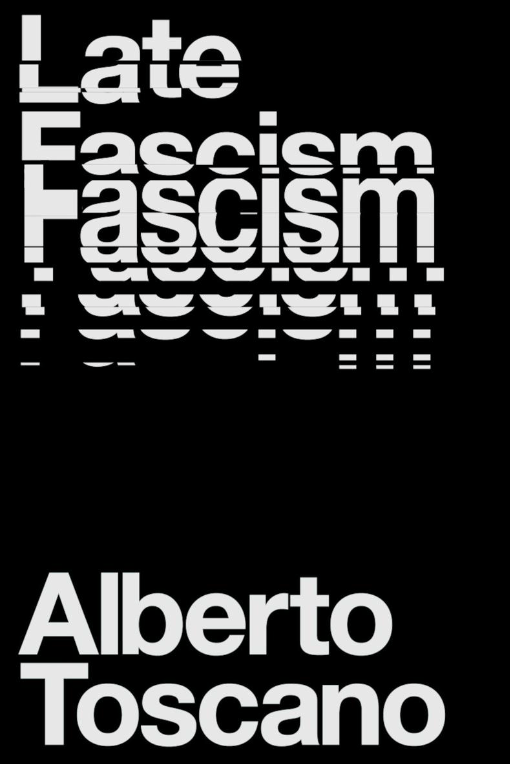
Both of these statements are fundamental to the discussion of contemporary fascism that is the essence of Alberto Toscano’s recent book titled Late Fascism. As the world watches the potential re-election of Donald Trump to the White House, the genocidal war against the Palestinians being waged by Israel with full support from the United States and the Biden administration, and the ongoing popularity of numerous far right movements around the globe, the question of fascism is both relevant and frighteningly current. Despite this, there seems to be no generalized understanding of fascism’s modern manifestations or how to fight and prevent its potential rule, especially in the so-called West.

A very important, but often ignored or dismissed element of fascism is that it is a culmination of a certain direction capitalism can take. It is a direction that is directly related to certain crises that are built into the chaos that defines capitalism; a chaos that upends the working classes and those Marx called the petit bourgeoisie—small business people, technocrats and professionals—while enhancing the economic and political power of the capitalist class. The turmoil experienced by the former two strata mentioned above is such that it forces them towards political responses outside the comfortable choice presented by the bourgeois electoral system.

In the Europe between the two great wars of the twentieth century, those choices were communism and fascism. Given communism’s fundamental opposition to the economy and politics of the bourgeoisie, fascism became the politics of the formerly democratic bourgeois class. As Toscano points out, nothing makes this clearer than that fascism was invited in by the king and by Hindenburg in Germany. Indeed, it was the hatred of the communists that convinced Hindenberg to hand the chancellorship to Hitler and the Nazis. It was also that fear that convinced the ruling classes, their banks and corporations to support that handover. This fact left me with the thought that even if Trump loses in 2024, his followers will force the issue well beyond the stolen vote campaign of 2020, perhaps creating a compromise whereby he moves back into the White House to forestall major civil unrest.

Beyond the economics that leads capitalist countries to fascism are race and racial politics. Toscano discusses this in detail, reminding the reader of WEB DuBois’ observation that European fascism in the twentieth century was born in colonialism. The treatment of the Roma, the Jews and others deemed undesirable by the Nazis and (in different degrees and with different foci) the Italian fascists had been honed over decades of European colonialism in the Americas, Africa and Asia. It is an oft-repeated trope that Hitler acknowledged the US genocidal wars against the indigenous peoples of North America that provided him with the template for what became known as the Holocaust. Richard Rubenstein’s classic work, The Cunning of History, expands on this idea by linking the Nazi work camps to US and Brazilian slavery and its mechanization of humanity.

A couple of the more interesting and important additions to the ongoing discussion of fascism one finds in Late Fascism is Toscano’s assertion that fascism does not completely obliterate freedom. Indeed, Toscano argues that fascism actually increases freedom, not only of those at the top and in the Party, but also those whose interests it represents—white supremacists (Hindus in India), the petit bourgeoisie and others who benefit from its relaxation of environmental and labor regulations put in place by the liberal state. Of course, like all manifestations of capitalism, the only unquestioned rights belong to property and those who own it. Capital’s response to challenges to this fundamental right have been temporary at best. One need only look at the history of the global north since the end of World War Two to understand this. Social democracy and its manifestation as the welfare state began to be seriously dismantled with the advent of neoliberalism in the late 1970s. The ongoing social upheaval caused by the privatization and ultimate destruction of most government support systems has not only caused massive inequality, it has as its ultimate goal the reduction of the government to its essential roles: war and repression. Given this, a fascist government is the ideal means to produce such a system.

Late Fascism takes a deep look at fascism. It considers its inherent contradictions and its various manifestations in the modern world. Instead of insisting definition that relies on a detailed set of conditions taken from history, the author incorporates those historical manifestations into various contemporary movements and conditions in a valiant and important attempt to define current future fascisms. The Italian fascist Benito Mussolini once noted that fascism is anti-socialist, that is to say liberal. (57) That, I believe, is an essential truth not only fundamental to Toscano’s text, but to any genuine understanding of fascism and how to fight it.

Ron Jacobs is the author of Daydream Sunset: Sixties Counterculture in the Seventies published by CounterPunch Books. He has a new book, titled Nowhere Land: Journeys Through a Broken Nation coming out in Spring 2024.   He lives in Vermont. He can be reached at: ronj1955@gmail.com

Sunday, April 14, 2024

Two Stupid Titles, a Deflating Anthology, and the Remarkable Persistence of Academic Fascism Denial


 APRIL 12, 2024
Facebook

Image by Jon Tyson.

Daniel Steinmetz-Jenkins, Did It Happen Here? Perspectives on Fascism and America (New York: WW Norton, “2024”)

But something is happening here and you don’t know what it is, do you, Mr. Jones?

+ Bob Dylan, 1965

Now that the Trump era has officially ended…it seems clear that there are still many social and psychological variable to map.

* Professor Moira Weigel, 2022

Never underestimate the lethal buffoonery of academics who can’t take the menace of Amerikan fascism seriously until it’s too late.

Here is a useful definition of “the F-word” from the website of Refuse Fascism, an organization that was formed in the immediate wake of Trump’s first election victory with the goal of forcing out the Trump-Pence regime through mass pressure in the streets and public squares:

“Fascism foments and relies on xenophobic nationalism, racism, misogyny, and the aggressive re-institution of oppressive ‘traditional values.’ Fascist mobs and threats of violence are unleashed to build the movement and consolidate power. What is crucial to understand is that once in power fascism essentially eliminates traditional democratic rights…Fascism has direction and momentum. Dissent is piece by piece criminalized. The truth is bludgeoned. Group after group is demonized and targeted along a trajectory that leads to real horrors. All of this took dramatic leaps under the Trump Regime. History has shown that fascism must be stopped before it becomes too late.”

The first three chapters of my 2021 book This Happened Here: Neoliberals, Amerikaners, and the Trumping of America (London: Routledge, 2021) explained in detail how Donald “Vermin” Trump, Trumpism, and the first Trump presidency were fundamentally fascist. It wasn’t difficult to detect core fascist tendencies and the essential fascist goal – the elimination of democracy and rule of law –in the Trump phenomenon and presidency. The main challenge in This Happened Here was empirical: keeping up with and documenting the plentiful fascistic conduct of Trump and his allies and supporters.

Any doubts as to the fascist nature and ambitions of the Trump phenomenon and presidency should have ended with the Trump-sparked January 6th Capitol Riot, the bloody culmination of a long rolling Republifascist coup attempt dedicated to first subverting and then reversing the outcome of the 2020 presidential election. After the attack on the US Capitol, only an academic fool could have denied the obviously fascist nature of Trump and Trumpism.

Refusing to Acknowledge Fascism, 2019-2020

Speaking of ivory towered idiocy, the fourth chapter of This Happened Here was titled “The Anatomy of Fascism Denial,” a turn of phrase suggested by my fellow Refuse Fascism Editorial Board member Coco Das. This was a play on the title of historian Robert Paxton’s oft-cited book on 20th Century European fascism The Anatomy of Fascism. Paxton was a leading name among a roster of academics who went on record mistakenly denying the fascist nature of Trump and Trumpism as late as October 2020. Some if not most of these academics persisted in sticking their heads in the historical sand even after January 6. To his credit, Paxton changed his mind after Donald “Take Down the Metal Detectors” Trump sent his frothing mob to “get wild” on Nancy Pelosi and Mike Pence and try to block the Electoral College certification of Joe Biden’s presidential election victory.

The “Anatomy of Fascism Denial” chapter presented a parade of elite professors who assured us that Trump, Trumpism and the Trump presidency didn’t really merit designation with “the F-word.” This pompous club included Eliah Bures, historian and Senior Fellow at the University of California-Berkely’s Center for Right Wing Studies, Bruce Neuborne, the Norman Dorsan Professor of Civil Liberties at NYU’s Law School (who prefaced his denialism with accurate reflections on Trump’s strong parallels with Adolph Hitler!), pre-January 6 Paxton, Mellon Professor Emeritus of Social Science in the Department of History at Columbia University, Stanley Payne, the Jaune Vicens Vives Hillsdale professor emeritus of history at the University of Wisconsin, Oxford historian Roger Griffin, Columbia University political scientist Sheri Berman, University of Texas government professor Jason Brownlee, NYU political scientist Cory Robin, and Samuel Moyn, the Henry R. Luce Professor of Jurisprudence and history professor at Yale University. Even the NYU historian Ruth Ben-Ghiat (who knew very well that Trump and Trumpism were essentially fascist) stated (somewhat unconvincingly) a preference for not upsetting her fellow academics by using the “F-word” to describe the “authoritarian” Trump.

Below I summarize leading denialist narratives of the time in italics and mention in boldface the problems with each narrative:

The United States did not become a fully consolidated fascist regime with a rapid shutdown of democracy and political thugs in the streets when Trump became presidentas if anybody was arguing that full fascist consolidation had taken place in the US. (Look at the RF statement above: “All of this [took] dramatic leaps under the Trump Regime. History has shown that fascism must be stopped before it becomes too late.” There was and is no sense here that fascism consolidated power in the US under Trump; just that it advanced dramatically and must be halted before such consolidation occurs, with grave consequences. )

Trump rose to power through an election, not through violenceas if fascism can’t and hasn’t in the past risen through elections!

The clownish narcissist and grifter Trump did not exhibit have a strong intellectual grasp of classic fascist doctrineas if that was required for him to channel fascist political ideas and stand atop a movement that checked off all the boxes defining fascist politics and ideology – and as if fascism is about intellectual rigor and coherence.

Trump didn’t wage a giant territorial war meant to kill and/or enslave masses of people deemed biologically unworthy and to organize the world on hierarchical racial linesas if a politician, movement, and presidency can’t be fascist until a nation goes full Third Reich and launches a replica of World War II.

Trump didn’t show any desire to carry out state management and command of the economy, as if such command and control was a defining feature of fascist ideology and politics.

Trump’s rhetoric and clowning persona was loaded with self-admiring and bizarre performative theateras if that somehow negated his fascist essence and the fascist nature of the politics and movement he represented.

Trump as president was just a pockets-lining wheeler and dealer… as if that’s all he was and as if fascism hasn’t always contained abundant space for financial corruption and deal-making.

Trump was a “populist,” not fascistas if populism is about the attempt to overthrow previously normative bourgeois democracy and establish capitalist rule with a boot on the peoples’ necks and in the name of racial purity, fierce patriarchy, and palingenetic ultra-nationalism.

Trump lost the election and his 2020-21 attempt failed to block the ascendancy of Joe Bidenas if fascism can’t be fascist unless it succeeds in its nefarious designs.

The European fascism analogy does not work in the US-American historical context”…as if the United States does not have (as some writing in the Black radical tradition most especially remind us) its own rich fascist characteristics and traditions that provided critical inspiration for the classic European fascism and fascist regimes that academic Trumpism-as-fascism-deniers reserve for legitimate application of “the F-word” – and as if the United States did not undergo its own dry run of at least proto-fascism during and right after World War One, as Adam Hochschild shows in his remarkable book American Midnight: The Great War, a Violent Peace, and Democracy’s Forgotten Crisis.

Much of what the denialist narratives came down to was a stubborn refusal to see fascism without doctrinaire and mustachioed early-mid-20th Century European dictators in full militarized state power readying and waging inter-imperialist war and exterminating masses deemed racially and otherwise biologically inferior and dangerous at home and abroad. The deniers believed that fascism was an in-the-books historical phenomenon, something that happened only in mid-20th Century Western Europe and that therefore could not happen in the 21st Century USA.

The fourth chapter of This Happened Here tore these narratives to shreds, showing that none of them remotely negated the obvious fact – well understood from the start by a number of astute thinkers of various liberal and radical orientations (including Henry Giroux, Robert Reich, Cornel West, Jason Stanley, Bob Avakian, Sunsara Taylor, Adam Gopnik, to name a handful) – that Trump and Trumpism and hence the first Trump presidency were fundamentally fascist.

Channeling Hitler, 2023-24

The denialism continues even now, three years and three months after the Capitol Riot, as we stare into the abyss of a distinctly possible second Trump administration. How pathetic. If Donald “Take Down the Metal Detectors” Trump and Trumpism passed the “F-word” entrance exam during his first presidency (as I showed in exhausting detail in the third chapter of This Happened Here), he is now promising to earn his fascism degree with honors during his next stay in the White House. Ex-POTUS Trump has: called for the “termination of all rules, regulations, and articles, even those found in the Constitution;” openly donned the symbols and language of the neo-Nazi QAnon cult; hosted Kyle Rittenhouse (the teenage fascist militia member who killed two people with an illegally owned AR-15 at a Back Lives march in Kenosha, Wisconsin in August of 2020) and the neo-Nazi Nick Fuentes at Mar-a-Lago; advocated the extra-judicial execution of suspected shoplifters and suggested that former Joint Chiefs of Staff chair Mark Milley should be executed for reaching out to China’s military command (to reassure them that Trump would not start a nuclear war after losing the 2020 election). Trump is now openly channeling Hitler and otherwise revealing his fascist essence by: saying that nonwhite immigrants are “poisoning the blood of our country;” promising to undertake a giant immigrant round-up, detention and deportation program; swearing to rid the country of Marxist “vermin;” pledging “retribution” against his political enemies; intimidating witnesses, prosecutors, and judges who dare to try to uphold the rule of law against him; threatening to invoke the Insurrection Act on the day of his 2025 inauguration; claiming that he will end urban crime “in one day” (a not-so veiled call for military executions in ghetto neighborhoods); announcing his desire to be a “dictator… “for one day;” portraying himself as a messianic figure who alone can save and redeem a once great nation ruined by “the left;” claiming to possess king-like immunity from prosecution for any and all crimes he has committed during and since his tine in the White House; posing as a victim of “radical left” persecution; calling his incarcerated January 6 putschist thugs “political hostages” and “unbelievable patriots” and promising to pardon them. Three weeks ago, Trump told one of his hate rallies in Ohio that nonwhite immigrants are “not people” and said that the US will descend into mass violence if he is not re-elected: “Now, if I don’t get elected, it’s going to be a blood bath for the whole country.”

All of which renders ridiculous the title of a recent widely read Andrew Marantz essay in The New Yorker: “Why We Can’t Stop Arguing About Whether Donald Trump is a Fascist,” by Andrew Marantz. The “we” in the title is liberal and “left” intellectuals whose “argument” is on with a debate about whether Mookie Betts is a baseball player.[1]

Did ..It Happen Here?

Meanwhile, the Republi-fascist cult leader and leading 2024 presidential contender Donald “Poisoning the Blood of Our Country” Trump continues with the Big Hitlerian Lie that the 2020 election was stolen, an openly preposterous and multiply and legally disproven claim that goes unchallenged by anyone who wants to stay afloat in a post-republican Republi-fascist Party that has bowed completely before its orange-hued Dear Leader. And this time, unlike in 2016, Herr Donald has a vast “mainstream” Republikan policy network on board. Led by the Heritage Foundation, this right-wing army of revanchist ideologues, hacks, and wonks has worked up Project 2025, a massive, detailed, detailed and ambitious program for the Christian white nationalist/neofascist takeover and makeover of American government and society. The Trump mission this time includes filling the executive branch from top to bottom with functionaries whose primary qualification for “serving” is loyalty to the Master in the Orange, I mean White House. The Supreme Court is in Republi-fascist hands and the lineup for the 2024 Senate elections strongly favor the nation’s right-/Reich-most major party.

Out across the country, Trumpist Republi-fascists rule half the country’s powerful state governments and are wreaking revanchist havoc both inside and outside of government. They have undertaken a literal physical-military nullificationist challenge to the federal government on the southern Texas border They harass and intimidate teachers, school boards, librarians, public health workers, election officials, election workers, voters. A recent report from Religion Dispatches details the lethal threat posed to voting rights, fair elections and social justice activism and public assembly by far-right white nationalist/Trumpist militias that are collaborating with county boards of supervisors and sheriffs. They stand ready to be activated for political violence by their tangerine-tinted Fuhrer, who is running well ahead of the hapless warmonger “Genocide Joe” Biden in the handful of contested states that absurdly determine presidential outcomes under the archaic slaveowners’ Electoral College. A spate of county resolutions seeking formal legal recognition of these paramilitary bodies “are part of a larger far-right plan to take control of county governments and put them on a war footing—as guerillas when Democrats are in control, and as pro-state paramilitaries when MAGA Republicans are in charge.”

A second Trump presidency – distinctly possible at the current Biden-burdened stage of bourgeois-democratic collapse – will significantly transcend the first one when it comes to making “dramatic leaps” (see the RF definition of fascism above) toward American fascist rule.

“It” vs. “This”

Which brings us to a second foolish title…With all this terrifying history as background, let us try to fathom the idiocy of the name of a new book of mostly academic essays edited by the historian Daniel Steinmetz-JenkinsDid It Happen Here? Perspectives on Fascism and America – the book reviewed in Marantz’s essay.

What is meant by the “It” in Did It Happen Here? The title is a play on Sinclair Lewis’ 1935 dystopian novel It Can’t Happen Here. Lewis portrayed the takeover of the United States by a fascist president who outlaws dissent, disembowels Congress, incarcerates political enemies in concentration camps, trains and arms a paramilitary force that terrorizes citizens, imposes regressive corporatist polices, and cancels women’s and minority rights. Political enemies are sent before kangaroo courts presided over by military judges.

Neither me nor anyone else among those commentator and activists who consider Trump, Trumpism, and the first Trump presidency to have been legitimately fascist ever argued that “it” – fully consolidated fascist power across US government – happened during the first Trump presidency. We think rather and only that, to quote Refuse Fascism (RF) again (see my third paragraph above) “all of this” – with “this” meaning fascist ideology, politics, movement, and to some degree policy – “took dramatic leaps under the Trump Regime. History,” RF adds “has shown that fascism must be stopped before it becomes too late.”

My 2021 book on the Trump phenomenon and presidency was titled This Happened Here, NOT It Happened Here. My “This” was the takeover of the White House (for four years) and the (post-republican) Republican (Republi-fascist) Party (this is ongoing and has in fact deepened under Biden) by a fascist leader atop a movement animated by fascist narratives, ideology, and politics. My fellow student of 21st Century Amerikaner fascism and occasional past co-author Anthony DiMaggio’s book on the Trump years is titled Rising Fascism in America: It Can Happen Here.

“Did”? – a Historiographical Debate About the Past?

And what’s with the past tense in Steinmetz-Jenkins’ title?! Did it? Did? Really? What, as if the country’s fascism problem is in the dead past? Seriously, as if it’s now all about a historiographical debate over a long-ago period and phenomenon across the Atlantic Ocean? Have Steinmetz-Jenkins, his editor, and his publisher been paying attention to current US events and politics?

Tellingly enough, all but one of the essays collected Did It Happen Here? were first published before 2023. More than twenty of the thirty essays included in the anthology originally came out between 2020 and 2022 and a handful were published long before Trump was first elected. I only found one solitary primary or secondary source dated after 2022 in the book’s endnotes. Even Steinmetz-Jenkins’ introduction to a “2024”anthology cites sources just from 2017 to 2021, with one exception (Bruce Kuklick’s condescending and denialist volume Fascism Comes to America: A Century of Obsession in Politics and Culture.)

“Now That the Trump Era Has Ended”!

Here is a remarkable and sadly outdated statement from Mora Weigel, one of Steinmetz-Jenkins’ contributors, near the end of an essay whose endnotes contain no sources later than 2020: “Now that the Trump era has officially ended, and yet stochastic acts of racist violence and the macabre strangeness of [fascist] Q’Anon persist, it seems clear that there are still many social and psychological variable to map” (p. 269 in Did It Happen Here?)

What the F*#k (if I might use the original F-word)! “Map” away, professors, but here’s a news flash in 2024: the Trump era has NOT ended, officially or otherwise and academic denialism is party of why.

Leanings and Angles

Can “it” – consolidated across-the-broad fascism – happen here? We are about to find out, and to his credit Steinmetz-Jenkins includes a few essays (from liberal academics Paxton, Ben-Ghiat, Sarah Churchwell, and Jason Stanley) arguing with obvious accuracy that fascism is alive and well in America today. But Steinmetz-Jenkins and his favorite two contributors, the Trunmpenleftish Yale law professor/historian and high academic priest of “progressive” fascism-denial Samuel Moyn, and NYU political “scientist” Cory Robin (who has smart things to say about the right-leaning Minority Rule US constitutional governance order) prefer to help the petty-bourgeois professoriate stick its head in the sand and thereby avoid sticking its neck out on real dangers afoot. As Ben-Ghiat said in July of 2020, explaining to Salon’s Chauncy de Vega why she felt pressured to “use the word ‘fascistic’ instead of ‘fascist’ to describe Trump…one of the things that so many people are scared is that to admit the truth about Trump ….means they would have to do something about it. Many people do not want to take that leap.” It’s not too much of a leap to suggest that the primary “people” to which Ben-Ghiat was referring at the time were her fellow academics and, further, that their reluctance to “take that leap” was about the danger doing so would pose to their careers. (Look at the new McCarthyism terrorizing students and academics who dare to speak up for Palestine and the people of Gaza today.)

Academics have their leanings,” writes Marantz, “and Steinmetz-Jenkins angles his volume so that it inclines away from alarmism and toward what can be called deflationism.” Marantz is right about “leanings” but wrong on “angle”: the correct formulation is “angles his volume so that it inclines away from the reality of the American fascist menace and toward what can be called denialism!

The lead, Yale-minted “deflationist” Moyn’s essay in Did it Happen Here? is based on a false dichotomy between (a) seeing the obviously fascist Trump and Trumpism as an “abnormal” departure (with what call the modern bourgeois-democratic record of major party US politics) and (b) seeing Trump and Trumpism as “quintessentially American, the expression of enduring indigenous syndromes” and the product of the pre-Trump “status quo ante.” Both (a) and (b) can be and are in fact true. Recent US sociopolitical history in the long Neoliberal era has brought the longstanding main racist/white supremacist, patriarchal, cultist, authoritarian, nativist, anti-intellectual, fundamentalist, violent, ultra-nationalist and fascist currents of US-American politics and society to open predominance atop one of the two viable US capitalist-imperialist political parties – a party that is deeply favored by the right-tilted structure of the archaic US governance orderThis ugly process is both quintessentially American and a radical departure from what was previously normal in modern US politics.

Notice the subtitle of Steinmetz-Jenkins’ Moynian-“deflationist” anthology: Perspectives on Fascism and America, not Perspectives on American Fascism, a reflection of the denier-deflators’ refusal or inability to see fascism as meaningfully American.

The “Way Forward” is to Call Serious Analysts “Neurotic”

This is the actual conclusion of Steinmetz-Jenkins’ introduction to Did It Happen Here?:

“The way forward is to put the fascism debate to rest, even as we try to come to terms with the neurosis it revealed in us – a purpose that this anthology serves. ‘The past may live inside the present,’ observes the historian Matt Karp, ‘but it does not govern our growth.’ Instead of letting fear distort politics, the goal now should be to push forward with the hope of building a better society for a new age.”

Read that again. As Marantz observes, the “put the fascism debate to rest” line at end of an introduction to an anthology dedicated at the “fascism debate” is “a bit like welcoming guests to a dinner party by promising them it will be over soon.”

But that’s hardly the worst thing about Steinmetz-Jenkins’ wrap-up. Considerably more insulting and lethal are Steinmetz-Jenkins’ presumptions that fascism is essentially a thing of “the past,” that observing a real and present fascist danger in the contemporary US is a sign of a negative mental condition (“neurosis”!), and that our politics and hopes for a better world – how about a revolutionary socialist one in which the social and political conditions that give rise to fascism are overcome and overthrown? – are enhanced rather than undermined by sticking our heads in the sand (the metaphor bears repeating) about 21st Century US-Amerikaner Trumpism-fascism.

Steinmetz-Jenkins might want to send notes of apology to the minority of his contributors who explicitly (Jason Stanley, Ruth Ben-Ghiat, Geoff Mann, and Robert Paxton) or implicitly (Sarah Churchwell, Robin D.G. Kelley, and Kathleen Belew) take seriously the American fascist menace in 2024. After all, his introduction suggests that they are “neurotics” stuck in the past and unable to properly move forward in life! The contributors who push back on the denialist take could easily counter that it is Steinmetz-Jenkins and Moyn et al. who are stuck in the past when it6 comes to understanding fascism today.

“Plenty of Marxist Thinkers”

On a happier note, Marantz and Steinmetz-Jenkins deserve credit for shooting down a fatuous confusion advanced by many of the disproportionately old, white, and male Trumpenlefties I have encountered in the last eight years – the moronic notion that to identify Trump and Trumpism as fascist is necessarily to mark oneself as an ally, defender, and enabler of the capitalist-imperialist Democrats. “Like everything else,” Marantz notes, the “fascism debate” has “passed through the negative polarization filters of American politics…Once mainstream Democrats started talking about Trump as a unique threat to democracy…the question of whether Trumpism represented a democratic emergency got al mixed up with the question of whether you wanted to be the kind of person who agrees with mainstream Democrats.”

Steinmetz-Jenkins drills down deeper on this question, noting the tendency of some portside-aligned commentators and activists to “see the fascism debate as the continuation of the debate between those who supported Hillary Clinton being the Democratic presidential nominee in 2016 versus those who preferred the socialist candidate Bernie Sanders [it should be “and those,” not “versus those” and “the social-democratish candidate Bernie Sanders,” not “the socialist candidate Bernie Sanders – Street].” Through this (distorted) lens, Steinmetz-Jenkins grasps, “those who invoke charges of fascism against Trump are viewed by their critics on the left as part of the political establishment that has dominated the Democratic Party for decades.” Steinmetz-Jenkins correctly notes that this “left” take on the matter “telescopes the fascism debate into a narrow political perspective that does not do justice to its diverse perspectives and concerns.” Further:

“It also doesn’t map onto key figures of the fascism debate when it presumably should. Alexandria Ocasio-Cortez (AOC), a key figure of the fascism debate [really? – P.S] along with plenty of Marxist thinkers critical of liberalism, for instance, think that the United States has a real problem with fascism. At the same time, many liberal thinkers…and conservatives are equally critical of comparing the present to Europe’s fascist past.”

(Fun fact: AOC had to be shamed into calling Trump and the Republi-fascists fascist by RF activists back in the day)

But this raises a question for Steinmetz-Jenkins: where the F are any of those “plent[iful] Marxist thinkers” who take the Amerikaner Trumpist fascist menace seriously in his anthology?! I am talking about contemporary socialist and communist analysts of the US today, not the ancient essays by Leon Trotsky (1940) and Angela Davis (1971) that Steinmetz-Jenkins includes in Part 1 (titled “Classic Texts”) of his badly titled new book. Good grief, but did Steinmetz-Jenkins think to reach out to Henry Giroux, Anthony DiMaggio, me, John Bellamy Foster, the revolutionary communist leader and writer Bob Avakian, Carl Boggs, Refuse Fascism, the Revolutionary Communist Party, the Socialist Equality Party (whose World Socialist Website has been strong in characterizing Trump and Trumpism as fascist)? How about the left presidential candidate Cornel West, an early backer of RF? None of these names or organizations (Refuse Fascism? Hello?) appear anywhere in Steinmetz-Jenkins’ index even when some of those names have published polished academic historical and social science monographs on precisely the topics covered in Steinmetz-Jenkins’ anthology. This omission is creepy but less than surprising in the self-protective bourgeois racket that is so-called higher education in the neoliberal era.

Notes

1. It’s a bit ironic to see Marantz’s denialist essay in The New Yorker. That journal was the venue for an early concise and on point (if less than comprehensive) Adam Gopnik essay breaking down some key aspects of Trump’s obviously fascist nature in May of 2016, six months before Trump defeated the dismal neoliberal imperialist Hillary Clinton. “There is a simple formula for descriptions of Donald Trump,” Gopnik wrote:

“add together a qualification, a hyphen, and the word ‘fascist’ …his personality and his program belong exclusively to the same dark strain of modern politics: an incoherent program of national revenge led by a strongman; a contempt for parliamentary government and procedures; an insistence that the existing, democratically elected government…is in league with evil outsiders and has been secretly trying to undermine the nation; a hysterical militarism designed to no particular end other than the sheer spectacle of strength; an equally hysterical sense of beleaguerment and victimization; and a supposed suspicion of big capitalism entirely reconciled to the worship of wealth and ‘success.’… The idea that it can be bounded in by honest conservatives in a Cabinet or restrained by normal constitutional limits is, to put it mildly, unsupported by history.” (Adam Gopnik, “Going There with Donald Trump,” The New Yorker, May 11, 2016)

Paul Street’s latest book is This Happened Here: Amerikaners, Neoliberals, and the Trumping of America (London: Routledge, 2022).