Showing posts sorted by relevance for query LL COOL J. Sort by date Show all posts

Saturday, July 05, 2025


LL Cool J refuses to perform at Philadelphia’s 4th of July concert until workers’ strike ends

LL Cool J is standing in solidarity with striking Philadelphia municipal workers, refusing to “cross a picket line” to perform

Inga Parkel
Fri, July 4, 2025


LL Cool J is standing in solidarity with striking Philadelphia municipal workers, refusing to “cross a picket line” to perform at the city’s Wawa Welcome America Fourth of July Concert.

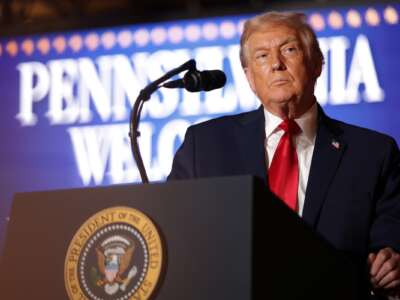
The 57-year-old rapper was scheduled to headline the annual holiday event on Benjamin Franklin Parkway on Friday evening, but has pulled out due to the ongoing strike led by AFSCME District Council 33, the largest of four major unions representing city workers.

“Yo, so, I understand there’s a lot going on in Philadelphia right now, and I never, ever, ever want to disappoint my fans, especially Philadelphia, y’all mean too much to me,” LL Cool J said in an Instagram video posted Thursday.

“But there’s absolutely no way that I can perform, cross a picket line, and pick up money when I know that people are out there fighting for a living wage. I’m not doing that, you know what I’m saying? I’ve been coming to Philly my whole life, you know?” he added.

“I have respect for the city, you know what I’m saying? Of course, I hope, I hope, I hope that the mayor and the city can make a deal, I hope it works out.”

The “Mama Said Knock You Out” artist clarified that he’s not completely ditching the event.

“I’m still going to come to Philly in case it works out,” he said. “I’m going to be in town, y’all. I’m just letting you know, I’m not going to cross a picket line and perform for money when people are hurting. That’s it, so I love y’all. I’m on my way to Philly. Peace and love.”

Thousands of Philadelphia city workers are currently on strike to demand better pay. The strike, which began Tuesday, has stretched nearly a week after the latest talks between the city and leaders of District Council 33 ended late Wednesday without a deal.


No new talks were scheduled for Thursday; however, both sides remain willing to continue negotiatins.

Leaders of District Council 33, which represents a majority of the city’s blue-collar workers, including trash collectors, security guards, and street maintenance employees, have said that while economic matters remain the major issue, there are also “a lot of work rule situations that we still have not worked through.” The union is also seeking some flexibility on the city residency requirement for workers.


Friday’s Fourth of July concert was originally supposed to open with performances from Grammy-nominated pop and R&B star JoJo and Latin trap sensation Alvaro Diaz.

LL Cool J was then expected to close out the show alongside DJ Z-Trip and Philadelphia’s own Grammy-winning R&B singer-songwriter Jazmine Sullivan before the start of the city’s annual fireworks display.

Thursday, December 16, 2021

B.C.’s ‘southern resident’ orcas have been wandering far from home. Could this be the end?

Bill Donahue 13 hrs ago

© Provided by Maclean's Orcas in the Southern Resident Killer Whale endangered J Pod play in the Salish Sea at sunset on Aug. 4, 2018, off Vancouver Island, B.C. (Richard Ellis/Alamy)

Orcas in the Southern Resident Killer Whale endangered J Pod play in the Salish Sea at sunset on Aug. 4, 2018, off Vancouver Island, B.C. (Richard Ellis/Alamy)
It’s one of the most jubilant rites of summer. When the world’s most famous contingent of killer whales, the J pod, comes swimming through the Salish Sea, off the southern tip of Vancouver Island, the animals churn along in a tight pack, the water frothing about them as they arc low under the surface and then vault skyward, their giant black-and-white torsos glistening and dapper, as though they’d donned tuxedos for the cotillion.There are currently 24 whales in the J pod, a group cohered by lifelong ties and led in procession, almost always, by its eldest females. Weighing over four tonnes apiece and still possessed of a Fred Astaire grace, these creatures chitter and call to one another as they ride the cold sea. Nearby, on sandy shorelines packed with tourists bearing binoculars, on docks and on ferries bound for Vancouver, the whales’ adoring public scans the water for rock stars. For each J podder has an almost human charisma. These whales are sociable like us, and they’re defined by their stories. According to legend, J2, also known as Granny, lived to the age of 105 before her 2017 death. (It’s a scientifically weak legend: she was actually more like 65, but still.) In 2018, J35, also known as Tallequah, grieved by towing her dead calf through the water for 17 days and 1,000 miles.

For decades, J-pod observers have relied on the whales to appear on the Salish almost daily from May through September. Last summer, though, the pod was absent from the area for an unprecedented 108 straight days, raising fraught questions: would they ever come back? Will we see the J pod plying the waters off Vancouver Island in 2022?

RELATED: Arctic narwhals have a new enemy: the clamour of passing ships

The short answer to both questions is yes, the beloved whales will surely be back this coming summer. Late in the summer, that is—if Vegas were taking bets, you’d do well to predict an Aug. 31 arrival. But how many more years they’ll be around is in question, while another population of killer whales will be on the sea as well. To the uninitiated, the transient orcas look the same as the residents. They too are black-and-white giants, but half again as big, with pointier dorsal fins and a more sinister aura. They move in small packs of three to six, stealthily, making almost no noise so that they can swoop into coves and bays and catch seals and sea lions unawares. The transients are well-fed and thriving.

The J pod, meanwhile, faces an uncertain future. It seems unlikely that they’ll be on the Salish Sea 30 or 40 years from now, and the group may perish altogether by the end of the century. It is, in any case, perilously small these days, for reasons pertaining to diet. The J pod, which ranges as far south as southern Oregon, subsists exclusively on the Pacific coast’s most iconic fish, the oily, fat-rich salmon. Indeed, an average J podder needs to gobble about 20 chinook salmon a day, and the chinook—an anadromous fish that grows up in rivers, then migrates to the sea—is in steep decline.

The rivers the chinook live in, the veins of British Columbia and the U.S. Northwest, are bruised. Over the past century, intensive logging has robbed them of cool, shaded backwaters in which salmon spawn. Climate change has exacerbated the water’s warming and, worst of all, hundreds of hydroelectric dams, most of them built amid the mid-20th-century craze for taming nature, now choke the region’s river system, restricting the chinook’s movement to and from the ocean.

READ: What does it take to move a rotting whale carcass? Glute strength and Vicks VapoRub.

Since 2013, the J pod has been straying from the Salish Sea because its largest adjacent river, the Fraser, has all but gone dry of spring and early summer chinook. As other rivers likewise lose salmon, despair thickens amid the J-pod faithful. It settles most heavily on perhaps the whales’ oldest human advocate.

Ken Balcomb, 81, has been tracking killer whales on the Salish Sea since 1976. He founded the Center for Whale Research in 1985, and for 35 years the group’s headquarters was Balcomb’s ramshackle cedar-shingled house on Washington’s San Juan Island, just across the binational Salish from Victoria.

White-bearded and hulking, with a quiet, scratchy voice, Balcomb arrived on the Salish after the whales had endured carnage. Up until the 1960s, salmon fishers shot at the sea’s southern resident whales—along with the J pod, this includes their close cousins in the genetically distinct K and L pods. Marine parks rounded up the orcas for stunt shows. They employed chase boats to corral the whales into bays, and then drove them into nets by throwing underwater “seal bombs” behind them.

MORE: An abandoned U.S. dam is blocking fish from B.C.’s Similkameen River—and key spawning ground

In Balcomb’s early years on the Salish Sea, the combined population of the J, K and L pods actually climbed. It stood at 98 in 1995. Now it’s at 74. “We’re looking at the bottom of the barrel,” Balcomb says. “The whales are skinny now. Have you ever been around a horse that’s nothing but skin and bones? That’s how they look.”

It’s the gauntness that worries Balcomb most, not the J pod’s semi defection from the Salish Sea. As he describes it in his trademark plain language, J-pod fans are a bit misguided, nostalgically connecting the pod to the Salish Sea, for the animals have never carried any particular loyalty to that body of water. “They go there for the food,” Balcomb says, “not the sights.” Another whale researcher, Michael Weiss, also with the Center for Whale Research, explains the J pod’s early summer absence on the Salish this way: “If all the grocery stores and restaurants in your town closed, you’d probably move too.”

The J pod is now desperately improvising. Early last summer, it was spotted several times on Swiftsure Bank, a spot in the open ocean that straddles the U.S.-Canada border just west of Vancouver Island, and is aswim during the summers with chinook travelling to and from disparate rivers. The whales returned to the Salish Sea on Aug. 31 because the Fraser’s late-summer chinook run is still doing OK, and for a little over half of September, the Salish was able to float the J-pod meal plan.

© Provided by Maclean's The J-pod resident orcas gather in the Salish Sea ( Marli Wakeling/Alamy)

Over the coming years, the J pod could travel anywhere between northern Vancouver Island and southern Oregon in its search for food. In so doing, it would be emulating the K and L pods, which have always been less “resident” on the Salish Sea. And at least one cetologist thinks there could be hope in the whales’ adaptability. “They’re doing what they need to do to find fish,” says Monika Wieland Shields, director of the Washington-based Orca Behavior Institute. “We hope their new patterns help them to grow their population, but we don’t know if they have found something better to sustain them, and we’re waiting to see how effective their geographical shift will be at helping them increase the population.”


READ: The goldfish invasion of Hamilton Harbour

Meanwhile, a dark music plays in the background. In their current emaciated state, the J pod’s females are having great difficulty bringing calves to term. Roughly two-thirds of J pod pregnancies have failed since 2000, and of the 19 calves that have been born since 2010, only six have been female. The lopsided sex ratio may be caused by pollution. “There are PCBs in the food chain,” Shields explains, referencing a family of chemicals that still lingers in nature, even though it was banned in the late 1970s. “These toxins accumulate in whales’ blubber, and when they don’t have enough food, they survive on the fat stores in the blubber. That affects the endocrine system, so the whales have a bias toward male offspring.”

Shields continues: “We’re at the tipping point. If we fail to give these whales the fish they need to successfully reproduce, we will not get the next generation of breeders.”

In 2018, Ottawa pledged to spend $61.5 million to help the southern residents, and since then it’s been building chinook hatcheries, restoring habitat for the fish and hiring Coast Guard enforcement officers to make ships slow down on the Salish Sea to mitigate whale stress as well as ship strikes on these marine mammals. “They’re spending a lot of money,” Shields says, “with very little results.”


MORE: At the Calgary Zoo, the camels watch the people

Whale experts concur that the optimal fix for the J pod’s woe? is a radical one: widespread dam removal, a freeing up of rivers so that chinook can once again gush into the sea. In his wildest dreams, Ken Balcomb envisions the detonation of all 14 of the hydroelectric dams constricting the region’s mightiest river, the Columbia, where up to 16 million salmon and steelhead once spawned every year.

But the Columbia’s dams are fixtures of the U.S. Northwest economy. They’re not moving anytime soon, so the J pod’s hopes lie upstream, on the Columbia’s largest tributary, the Snake River, whose lower reaches are home to four aging concrete dams, all of them situated in the high desert of eastern Washington state. In 2019, Idaho Republican Congressman Mike Simpson joined environmentalists in calling for their removal. Simpson released a $42.7-billion demolition plan.

Shields says, “I can see those dams coming down in 10 to 20 years.” But a freed Snake River is far from inevitable, and it wouldn’t bring the J pod back to the Salish Sea anyway. It would shift these whales south, toward where the Columbia River meets the Pacific; it would also leave them hungry, if it happened in isolation.

READ: A B.C. mountain goat was the unlikely champion in a match against a grizzly

The J pod needs many more miracles to happen before it can fatten up and flourish. It needs other rivers to shed their dams, too, and it needs rivers like the Fraser to somehow shrug off the scars of development—the vast parking lots by the banks, the car washes trickling toxic suds down into what was once salmon habitat.

For now, this storied pod of whales, once the Salish Sea’s home team, has become a lean and hungry gang of freelancers searching the ocean for food that, increasingly, may not be there. And last September, as the days became shorter and the nights cooler—and as the J pod’s fans scooped up their binoculars and took to the seashore—a sad question lingered: could we be nearing the end for the J pod? Have these vaunted whales already commenced their long goodbye?

Monday, February 15, 2021

Fela Kuti Becomes 1st African Artist
 to Get Nod At Rock Hall of Fame


FelaKuti/Facebook
Fela Kuti

13 FEBRUARY 2021
Leadership (Abuja)

The Rock & Roll Hall of Fame midweek announced its long list of nominees for the class of 2021and it was a surprise that the late Afrobeat legendary artiste, Fela Kuti made the list.

Hiphop mogul, Jay-Z and Foo Fighters got nominated in their first year of eligibility. Other first-time nominees include Mary J. Blige, Fela Kuti, the Go-Go's, Iron Maiden, and Dionne Warwick.

To be eligible, an individual artiste or band must have released its first commercial recording at least 25 years prior to the year of nomination.

If the Afrobeat legend Fela gets inducted, he will be the first African artiste in the Rock and Roll Hall of Fame. The top five inductees are selected by public vote and the vote is now open till April 30 via rockhall.com. According to the organisers, the inductees will be announced in May, and the Rock Hall is planning to throw a live ceremony in Cleveland, OH.


Fela Kuti who had almost four decades of an active career with several albums, made Afrobeat genre of music popular gaining international reputation. As regards this feat, visual artist, illustrator and designer of repute, Lemi Ghariokwu who designed original cover images of Fela's songs and albums said, "His (Fela) nomination into the Rock Hall of Fame means that Fela is so well recognised to be nominated at all with all those foreign artistes. It cements his global greatness."

The Rock & Roll Hall of Fame's Class of 2020 included Nine Inch Nails, Whitney Houston, the Notorious B.I.G., Depeche Mode, T. Rex, and the Doobie Brothers. Due to COVID-19, the live show was delayed and the traditional live ceremony was scrapped in favour of a filmed HBO special.

Rock & Roll Hall of Fame class of 2021 nominees are: Mary J. Blige, Kate Bush, Devo, Foo Fighters, The Go-Go's, Iron Maiden, JAY-Z, Chaka Khan, Carole King, Fela Kuti, LL Cool J, New York Dolls, Rage Against the Machine, Todd Rundgren, Tina Turner and Dionne Warwick


The Hall of Fame Foundation was established on April 20, 1983, by Ahmet Ertegun, founder and chairman of Atlantic Records.

English guitarist, singer and songwriter, Eric Clapton, is the only three-time inductee to the Rock and Roll Hall of Fame

The first group of inductees, inducted on January 23, 1986, included Elvis Presley, James Brown, Little Richard, Fats Domino, Ray Charles, Chuck Berry, Sam Cooke, the Everly Brothers.


Read the original article on Leadership.


HERE IS WHY HE SHOULD BE IN THE
R&R HALL OF FAME
THIS IS FROM 1971 WHEN I FIRST HEARD HIM
  

Wednesday, May 03, 2023

George Michael and Kate Bush among Rock & Roll Hall of Fame inductees

3 May 2023

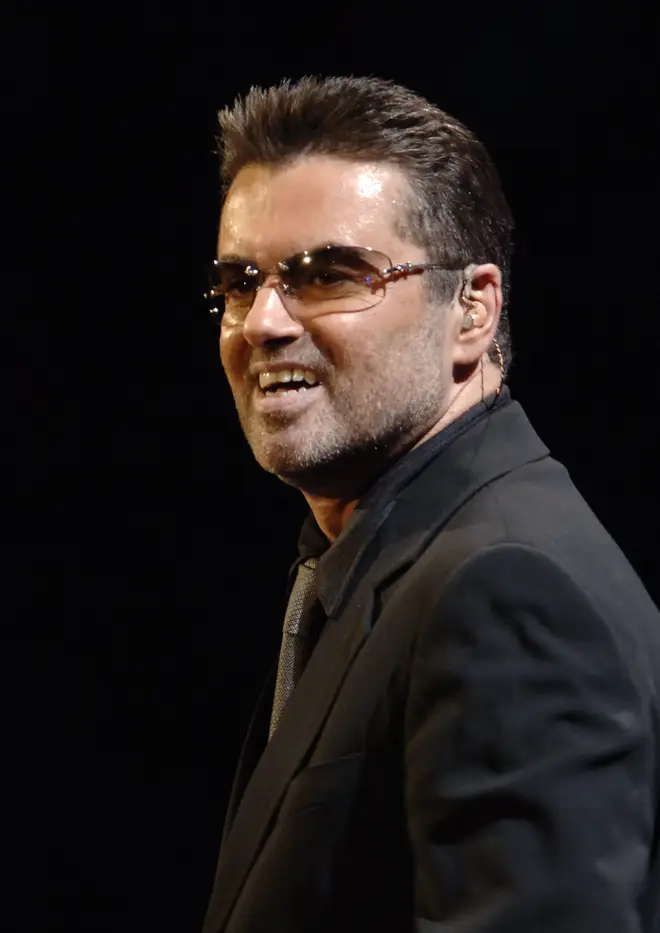
George Michael
Smooth Radio’s All Time Top 500 poll. Picture: PA

The Cleveland-based institution has announced the artists and groups entering the hall as the class of 2023.

Missy Elliott, Willie Nelson, Sheryl Crow, Chaka Khan and the late George Michael have been inducted into the Rock & Roll Hall of Fame, with Kate Bush also finally reaching the top of that hill.

The Cleveland-based institution on Wednesday announced the artists and groups entering the hall as the class of 2023, including The Spinners, Rage Against the Machine, DJ Kool Herc, Link Wray, Al Kooper, Soul Train creator Don Cornelius and Sir Elton John’s longtime co-songwriter Bernie Taupin.

“When you can go from Link Wray, who was one of the early influencers, to Missy Elliott and Kate Bush and The Spinners and Rage Against the Machine and Willie Nelson, you have a very diverse body of work,” said Joel Peresman, president and chief executive of the Rock & Roll Hall of Fame Foundation ahead of the unveiling.

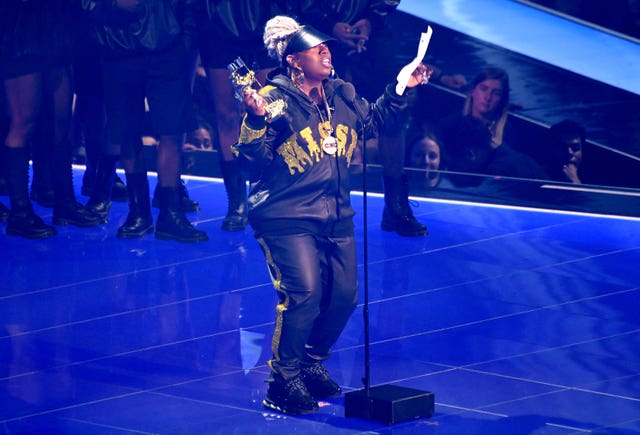
MTV Video Music Awards 2019 – Show – New Jersey
Missy Elliott (PA)

“What we are always trying to show is that rock ‘n’ roll is a big tent and a lot of people belong,”

Elliott, the first female rapper inducted into the Songwriters Hall of Fame, an MTV Video Vanguard Award recipient and a four-time Grammy Award winner, is the first female hip-hop artist in the rock hall, which called her “a true pathbreaker in a male-dominated genre”.

Artists must have released their first commercial recording at least 25 years beforehand to be eligible for induction. Eight out of 14 nominees were on the ballot for the first time, including Crow, Elliott, Michael and Nelson. This is the first year of eligibility for Elliott.

Bush was a nominee last year but did not make the final cut. She got in this year due to a new wave of popularity after the show Stranger Things featured her song Running Up That Hill (A Deal With God).

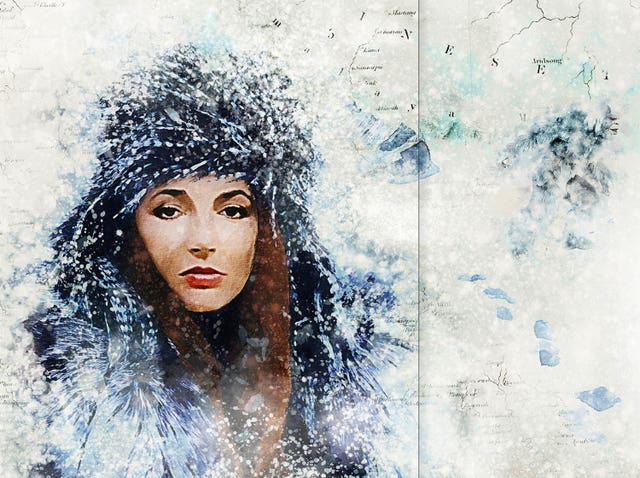
Kate Bush
Kate Bush (Michael Byrne/PA)

The hall hailed her for “using lush soundscapes, radical experimentation, literary themes, sampling and theatricality to captivate audiences and inspire countless musicians”.

Michael, first as a member of Wham! and then as a solo artist, was cited for “paving the way for a generation of proud LGBTQIA+ artists, from Sam Smith to Lil Nas X to Troye Sivan” and 90-year-old Nelson was simply described as “an American institution”.

Crow was recognised for key 1990s songs like All I Wanna Do and Every Day Is A Winding Road, while Rage Against the Machine “forged brazen protest music for the modern world”.

The hall called DJ Kool Herc “a founding father of hip-hop music” who “helped create the blueprint for hip-hop”, and Chaka Khan was described as “one of the mightiest and most influential voices in music” – a “streetwise but sensual hip-hop-soul diva” who paved the way for women like Mary J Blige, Erykah Badu and Janelle Monae.

Bernie Taupin with Sir Elton John
Bernie Taupin with Sir Elton John (Jennifer Graylock/PA)

The Spinners became a hit-making machine with four No 1 R&B hits in less than 18 months, including I’ll Be Around and Could It Be I’m Falling In Love. Rock guitarist Wray was said to be ahead of his time, influencing Jeff Beck, Jimmy Page, Eric Clapton, Jimi Hendrix and Bruce Springsteen.

Taupin, who made it into the Songwriters Hall of Fame in 1992 and has a Golden Globe and an Oscar for (I’m Gonna) Love Me Again from the biopic Rocketman, makes it into the rock hall 29 years after writing partner Sir Elton.

Cornelius was celebrated for creating a nationally televised platform for African American music and culture. He “became a visionary entrepreneur who opened the door — and held it open — for many others to follow him through”.

“Does a Willie Nelson fan know anything about Missy Elliott? Probably not, and vice versa,” said Mr Peresman. “But this is an opportunity for someone who is into one of these artists to take a look at it and say, ‘Gee, I love Missy Elliott’ or ‘I love Rage Against the Machine. But The Spinners, who were they? Let me check that out’. If that can open some minds and open some attitudes, then we’ve done our job.”

Nominees Iron Maiden, Cyndi Lauper, A Tribe Called Quest, The White Stripes, Warren Zevon, Joy Division/New Order and Soundgarden did not earn a spot in the hall this time.

The induction ceremony will take place November 3 at the Barclays Centre in New York City.

Nominees were voted on by more than 1,000 artists, historians and music industry professionals. Fans could vote online or in person at the museum, with the top five artists picked by the public making up a “fans’ ballot” that was tallied with the other professional ballots.

By Press Association


Missy Elliott becomes first female hip-hop artist to be inducted into the Rock & Roll Hall of Fame

By Mawunyo Gbogbo

Grammy award-winning artist Missy Elliott has been inducted into the Rock & Roll Hall of Fame.(REUTERS/Mike Blake)

Referring to Missy "Misdemeanor" Elliott as "a true path breaker in a male-dominated genre", The Rock & Roll Hall of Fame Foundation has named Elliott as one of its 2023 inductees.

Key points:

Missy Elliott is the first female hip-hop artist to be inducted into the Rock & Roll Hall of Fame
It was her first year of eligibility
Other inductees include Kate Bush who experienced a resurgence off the back of Stranger Things


It's an honour the celebrated artist doesn't take lightly. She took to social media to acknowledge just how monumental an occasion this is saying it was "huge not for just me but all my sisters in hip hop".

By the time Elliott had released her groundbreaking debut album Supa Dupa Fly in 1997, she was already a force to be reckoned with.

She had long joined Timbaland to co-write and co-produce songs for artists such as Aaliyah and Jodeci and was already a performer and label executive.

Possessing a knack for music production, writing, rapping and singing, Elliott's first album went platinum and was nominated for a Grammy.

Her second album Da Real World was released in 1999 and stayed on the Billboard R&B chart for almost a year.

But it was perhaps with 2001's Miss E… So Addictive and the crossover dance track Get Ur Freak On when the rest of the world came to learn what hip hop heads already knew: Elliott's talent, originality and creativity make her a powerhouse across genres.

With trendsetting music videos featuring, among other things, Elliot with a retractable head and busting out dance moves that others would later adopt, Elliott's place on the Rock & Roll Hall of Fame is being welcomed by fans and peers.

YOUTUBE Get Ur Freak On by Missy Elliott official music video.

This was the first year of eligibility for Elliott. Artists need to have released their first record 25 years prior to Induction.

Fellow hip-hop royalty and 2021 inductee LL Cool J announced the 2023 inductee class, which also includes, in the Musical Influence Award category, the founding father of hip hop DJ Kool Herc, who planted a potent seed in 1973 that would grow into the enormous global force hip hop is today.

The Chairman of the Rock & Roll Hall of Fame Foundation John Sykes pointed out that November's induction ceremony coincides with two milestones in music culture: the 90th birthday of Willie Nelson, who was also inducted, and the 50th anniversary of hip hop.

"This year's incredible group of Inductees reflects the diverse artists and sounds that define rock & roll," Sykes said.
Kate Bush inducted after a Stranger Things resurgence, Bernie Taupin writes his way into history

English singer songwriter Kate Bush responded to her induction by expressing surprise.


"I have to admit I'm completely shocked at the news of being inducted into the Hall of Fame!," Bush wrote on her website.

"It's something I just never thought would happen."

Stranger Things introduced Kate Bush to a whole new audience.
(Supplied: katebush.com)

Bush experienced a resurgence after her 1985 hit Running Up That Hill (A Deal With God) re-entered the charts after it was featured in the Netflix sci-fi series Stranger Things.

The visionary is said to have inspired countless musicians with her radical experimentation.

Bernie Taupin, whose songwriting partnership with Elton John has produced hit after hit after hit including Rocket Man, Your Song and I'm Still Standing was inducted in the Musical Excellence Award category.

Taupin and John began collaborating in 1967 and the Foundation described their partnership as "one of the most successful in rock & roll history."

George Michael, who died in 2016, was posthumously inducted.

The 38th Annual Rock & Roll Hall of Fame Induction Ceremony will take place on Friday, November 3 in Brooklyn, NY.

The Rock & Roll Hall of Fame 2023 Inductees

Performer Category
Kate Bush
Sheryl Crow
Missy Elliott
George Michael
Willie Nelson
Rage Against the Machine
The Spinners

Musical Influence Award
DJ Kool Herc
Link Wray

Musical Excellence Award
Chaka Khan
Al Kooper
Bernie Taupin

Ahmet Ertegun Award
Don Cornelius

Monday, August 21, 2023

HIP HOP CAPITALI$M
How hip-hop spurred the growth in Black businesses and financial empowerment

REVOLT COMMODIFIED

Ronda Lee
Sun, August 20, 2023

The 50th anniversary of hip-hop coincides with the national Black business month in August, and the former has been a driver of growth and empowerment for the latter, according to leaders in the music genre’s industry.

Hip-hop is an industry with an economic impact of $16 billion and has launched Black-owned businesses in music, film, fashion, and advertising for creatives that curated the culture.

Rappers have turned into entrepreneurs, spurring growth for other Black-owned businesses, building generational wealth, and investing in the communities that nurtured them.

"Hip-hop went from being a fad to commercialized and monetized in technology, fashion, sports and business," Detavio Samuels, CEO of REVOLT, told Yahoo Finance. "In the beginning, we weren’t owners, just brand ambassadors, not accumulating wealth from a genre and culture that we created. We’ve gone from making others rich to wealth accumulators."


Rashad Bilal and Troy Millings of Earn Your Leisure, host REVOLT's Assets Over Liabilities, with the premiere episode featuring entrepreneur, producer, and artist Swizz Beatz.

Overall, there are around 3 million Black-owned businesses in America now, generating about $206 billion in annual revenue with 36% of those led by Black women. But the road to these successes was far from easy.

The history of Black businesses in the US is rife with violence and racism.

In what was known as the Red Summers of 1917-1919, many Black-owned businesses in Washington, D.C., Chicago, St. Louis, Houston, Tulsa, and Omaha were decimated during mob violence and racial terrorism.

In the decades that followed, many Black-owned businesses closed due to racially biased eminent domain proceedings, with the government taking land in Black business districts like Bruce’s Beach in Los Angeles and Beale Street in Memphis.

Hip-hop itself was its own economic battleground. When the genre was born, recording studios — more often owned by white executives — controlled the process from radio air time, marketing, ownership interests, and rights.

But they did not control the culture, which spawned more and more businesses.

For instance, Dapper Dan and 5001 FLAVORS were favorite designers for hip-hop artists that disrupted the fashion industry. Some of 5001 FLAVORS clients include Salt-n-Pepa, Heavy D, Sean P. Diddy Combs, Dr. Dre, DMX, Tupac, The Notorious BIG, Jay-Z, Beyonce, and Blue Ivy.

"Hip-hop allowed Black creatives and artists to create brands that wouldn’t have existed without hip-hop and allowed us to engage in collective economics, supporting other Black businesses," Sharene Wood, president and CEO of 5001 FLAVORS and Harlem Haberdashery, told Yahoo Finance. "Hip-hop opened the door to a lot of Black brands, like 5001 FLAVORS."


August 5, 2023. Ashlee Muhammad, Guy Wood Sr., Sharene Wood, Kells Barnett, and Guy Wood Jr. are featured at New York Public Library's "The Rap-Up" celebrating 50 years of hip-hop featuring Harlem Haberdashery and 5001 FLAVORS.

What started with $600 in Wood’s college dorm room has expanded 30 years later into a family business with a retail store (Harlem Haberdashery), a bespoke spirits line (HH Bespoke Spirits), and a 501(c)(3) that gives back to the community that raised them — #TakeCareofHarlem.

Designs by 5001 FLAVORS are archived at the Smithsonian, Grammy museum, and the Rock-n-Roll Hall of Fame museum honoring hip-hop.

"People wanted to build their own economy, and Biggie said it best: 'Never thought hip-hop would take us this far,'" Wood said. "Hip-hop creatives and the businesses that sprung from them didn’t have corporate grooming or business degrees when we started, but now Queen Latifah, LL COOL J, and Diddy are multi-hyphenates — rappers, actors, and entrepreneurs."

Sean "Diddy" Combs went from rapper-producer to CEO of Bad Boy Entertainment, owning a fashion line, and founder and chairman of REVOLT. This year is Bad Boy Entertainment’s 35th anniversary and the 10th anniversary of REVOLT.

REVOLT originally started as music video television in response to MTV’s embrace of reality television over music videos. However, when none of the genres outside of hip-hop showed up for the platform, REVOLT decided to embrace hip-hop culture as the storytelling agent.

"The narrative others tell about hip-hop is sex, love, drugs, and materialism," Samuels said. "REVOLT isn’t a media company, but an engine for transformative change for Black people to build generational wealth with culturally relevant information to turn financial whispers into shouts as to how Black billionaires have done it."

This resonates with the Black community. A Pew Research study found that 58% of Black adults say supporting Black businesses, or "buying Black" is an effective strategy for moving Black people toward equality in the United States.

"Social justice and empowerment has always been part of the DNA of hip-hop culture," Samuels said.

Financial empowerment


In another effort to empower the Black community and businesses, REVOLT partnered with Rashad Bilal and Troy Millings, founders of the viral platform Earn Your Leisure (EYL) that turned into a TV network on financial literacy, to host Assets Over Liabilities, a television series that bridges the gap between the world of finance and the hip-hop community, making financial literacy a focal point.

This season’s premiere episode is a sit-down with producer Swizz Beatz discussing his investment in Black artwork, selling his company Verzuz for $28 million, and his investment strategy for building generational wealth.

"Partnering with REVOLT to integrate hip-hop into the conversation removes stigmas and increases accessibility to financial literacy," Rashad Bilal and Troy Millings, co-hosts and co-founders of Earn Your Leisure, said. "We're empowering the community to break down financial walls and master their money with knowledge."

REVOLT is using its platform to highlight Black businesses and marketplace disruptors like Assets over Liabilities and Bet on Black.

Hip-hop’s influence on Black businesses and the idea of collective economics is rooted in empowering Black communities.

"Collective economics is not just about money, it’s a social responsibility to invest in the community because you can’t just consume from the community, you need to nurture it in order for business to thrive," Wood said. "Companies like the Fearless Fund exist because we’ve been historically underrepresented, underfunded, and systematically shut out of opportunities."

Ronda is a personal finance senior reporter for Yahoo Finance and attorney with experience in law, insurance, education, and government. Follow her on Twitter @writesronda

Monday, January 01, 2024

Hip Hop at 50: From Subculture to the Mainstream


 DECEMBER 29, 2023

As hip hop turns 50, many mainstream outlets have highlighted how it has utterly transformed U.S. popular culture. And they’re right: look around, and it’s hard to see or hear something that hasn’t been influenced by the young people of color who fashioned, developed, and championed hip hop culture. From Snoop Dogg hosting the Puppy Bowl to Kendrick Lamar winning the Pulitzer Prize, from the global popularity of K-pop boy band BTS’s rapped verses to country artists incorporating trap beats while maintaining some vocal twang, and from rap soundtracking almost every sports arena to breakdancing making its Olympic debut next year: hip hop isn’t so much part of today’s mainstream as it is the mainstream.

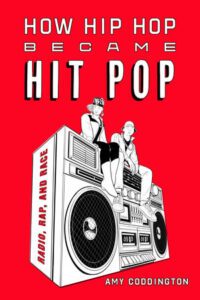
How exactly did this happen? How did this minority subcultural movement find its way out of the block and community center parties of the South Bronx and into the ears, eyes, and hearts of people across the United States? My book How Hip Hop Became Hit Pop: Radio, Rap and Race responds to these questions by looking at how one of hip hop’s musical elements, rap, came to be broadcast on U.S. commercial radio stations in the 1980s and early 1990s. In the early 1980s, most commercial radio stations ignored rap, in large part because the genre had come to be synonymous with young, poor Black Americans. But in the late 1980s, previously cautious radio stations began to play the genre, turning LL Cool J, MC Hammer, Bell Biv Devoe, and —yes— Vanilla Ice, into household names. By the 1990s, rapping was everywhere, soundtracking feature films like The Addams Family and House Party, teaching viewers about conflict resolution on the show Kids Incorpo­rated, promoting household products like Sprite and Pillsbury in television advertisements, helping kids learn their multiplication tables on educational cassettes, and entertaining families when they sat down for game night.

Rap changed the commercial radio industry, as its multiracial and multiethnic appeal required those working at radio stations to rethink their programming practices. But the radio industry also changed rap, reframing the genre’s style and substance. For many stations that came to play the genre, rap couldn’t just be the voice of marginalized Black Americans. It also had to fit on their stations broadcasting the sound of young, hip, and majority-white America. Artists grappled with pressure to conform to the mostly white-controlled commercial radio industry’s musical preferences and struggled to maintain the genre’s identity as the radio industry took control of its main­streaming.

As we celebrate hip hop passing this milestone, it’s important to acknowledge the flipside of its mainstream success. While the mainstreaming of rap has put money into the hands of Black musicians and businesspeople, Greg Tate notes that it has failed to change the material realities of most Black Americans and has not “fully dismantled the prevalent, delimiting mythologies about Black intelligence, morality, and hierarchical place in America.” Instead, hip hop becoming mainstream meant that anyone, regardless of race, could profit from the genre, as the culture was quickly assimilated into the mostly white-owned profit-seeking media industries.

Rap can be revolutionary: it acts as a megaphone for marginalized artists to express their inimitable identities. But like all other popular music genres, it does this while selling records, and subsidizing the extractive music industries that were built on the unpaid labor of colonized people worldwide and Black musicians in the United States. Understanding just how hip hop became the mainstream force it is today helps us make sense of this duality, allowing us to comprehend just how rap became the most popular genre in the world without enacting substantive change to make that world more equitable.

Amy Coddington is an Assistant Professor of Music at Amherst College. Her work has appeared in the Journal of the Society for American Music and The Oxford Handbook of Hip Hop Music. She is the author of How Hip Hop Became Hit Pop: Radio, Rap, and Race.

Saturday, April 03, 2021

Biden launches community corps to boost COVID vaccinations

WASHINGTON — Seeking to overcome vaccine hesitancy, the Biden administration on Thursday stepped up its outreach efforts to skeptical Americans, launching a coalition of community, religious and celebrity partners to promote COVID-19 shots in hard-hit communities.
© Provided by The Canadian Press

The administration's “We Can Do This” campaign features television and social media ads, but it also relies on a community corps of public health, athletic, faith and other groups to spread the word about the safety and efficacy of the three approved vaccines. The campaign comes amid worries that reluctance to get vaccinated will delay the nation’s recovery from the coronavirus pandemic — and is kicking off as the U.S. is anticipating a boost in vaccine supply that will make all adult Americans eligible for vaccines by the beginning of May.

President Joe Biden encouraged more than 1,000 faith leaders on Thursday to continue their efforts to promote vaccinations in their communities. “They’re going to listen to your words more than they are to me as president of the United States,” Biden said.

Vice-President Kamala Harris and Surgeon General Vivek Murthy held a virtual meeting with the more than 275 inaugural members of the community corps on Thursday to kick off the effort. The Department of Health and Human Services was also encouraging other groups, as well as everyday Americans, to join the effort.

“You are the people that folks on the ground know and rely on and have a history with,” Harris said. “And when people are then making the decision to get vaccinated, they’re going to look to you.”

A White House official said Harris plans to take on a larger role in promoting the uptake of vaccines, in addition to her efforts selling the president's $1.9 trillion COVID-19 relief bill and working to address the root causes of migration driving an increase in unaccompanied minors entering the U.S. along the southern border.

The focus on trusted validators stems from both internal and public surveys showing those skeptical of the vaccines are most likely to be swayed by local, community and medical encouragement to get vaccinated, rather than messages from politicians.

Courtney Rowe, the White House's COVID-19 director of strategic communications and engagement, briefed governors on the new initiative Tuesday, telling them that people “want to hear from those they know and trust.” She added that the initiative would be “empowering the leaders people want to hear from."

A new poll from The Associated Press-NORC Center for Public Affairs Research conducted late last month finds that three-quarters of American adults now say they have or will get a vaccine, compared with 13% who say they probably will not, while 12% say they definitely will not. The share saying they probably or definitely will not has ticked down since January, when a combined 32% said that.

The coalition includes health groups like the American Medical Association and the National Council of Urban Indian Health, sports leagues like the NFL, NASCAR and MLB, rural groups, unions and Latino, Black, Asian American Pacific Islander and Native American organizations, as well as coalitions of faith, business and veterans leaders.

The community corps will receive fact sheets and social media messages to share with members of their communities, as well as regular updates from the Biden administration with the latest vaccine confidence resources.

The Centers for Disease Control and Prevention announced last week that it will devote $3 billion to support outreach by community leaders and groups to boost vaccine confidence.

HHS was also launching its first national ad campaign promoting vaccinations, aimed at senior, Latino and Black Americans, with the roughly $250 million initial ad campaign. And in partnership with Facebook, it was deploying social media profile frames so that ordinary Americans could share their intent to get vaccinations and their experience with the shots to their peers.

The White House is also deploying Dr. Anthony Fauci, the nation's top infectious-disease expert, and Dr. Marcella Nunez-Smith, who chairs Biden's COVID-19 equity task force, to speak directly to the public about the benefits of the vaccines. On Wednesday, the pair conducted an interview with rapper and actor LL Cool J and DJ Jazzy Jeff.

By the end of May, the U.S. will have enough supply of COVID-19 vaccine to cover all adults in the country. Dr. Anthony Fauci, the nation's top infectious-disease expert, has estimated that 70% to 85% of the population needs to be immune to the virus to reach herd immunity.

___

Associated Press writer Emily Swanson contributed to this report from Washington.

Zeke Miller, The Associated Press


Thursday, December 11, 2025


Venezuela Says US Oil Tanker Seizure Is “Piracy” as Trump Says US Will Keep Oil

Experts say the seizure is likely illegal and represents an expansion of US sanctions enforcement.

December 11, 2025

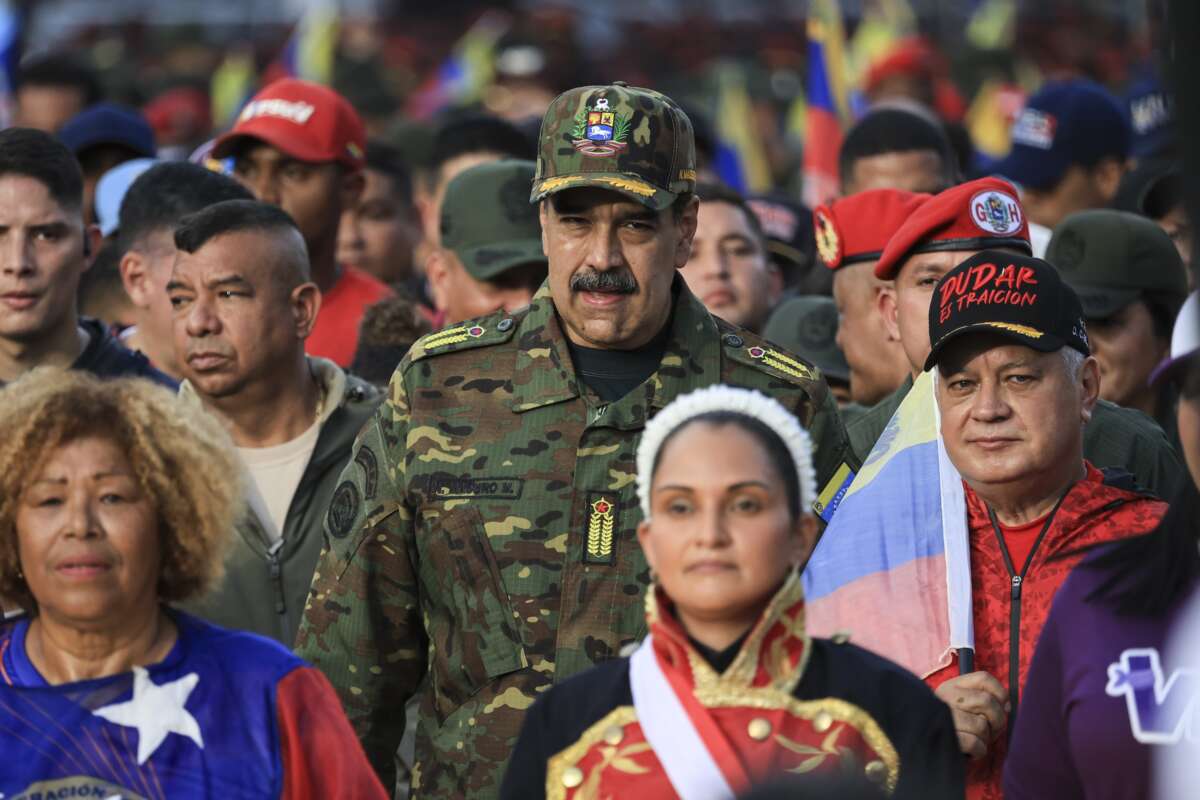
President of Venezuela Nicolás Maduro participates in a civic-military rally on November 25, 2025, in Caracas, Venezuela.Jesus Vargas / Getty Images

The Venezuelan government has condemned the U.S.’s seizure of an oil tanker off its coast as “piracy,” as President Donald Trump says that the U.S. is keeping the oil.

In a statement, the Venezuelan government said the seizure “constitutes a blatant theft and an act of international piracy.” It added that the move shows that the U.S.’s recent aggression “has always been about our natural resources, our oil, our energy, the resources that belong exclusively to the Venezuelan people.”

Trump told reporters that the tanker was “seized for a very good reason,” and claimed that it was the “largest [tanker] ever seized.” When asked what the U.S. would do with the oil aboard the tanker, he said, “​​We keep it, I guess.”

Attorney General Pam Bondi said that the U.S. “executed a seizure warrant” for the tanker, which was “used to transport sanctioned oil from Venezuela and Iran.”

“For multiple years, the oil tanker has been sanctioned by the United States due to its involvement in an illicit oil shipping network supporting foreign terrorist organizations,” Bondi said in a post on X. Attached to the post was a video supposedly depicting the seizure, showing grainy footage of U.S. troops descending on the vessel from a helicopter and storming it, guns in hand.

Related Story

Trump Says Maduro’s “Days Are Numbered” as Admin Prepares “Day After” Plans
Administration officials are reportedly preparing plans for various potential scenarios involving Maduro’s ouster.  By Sharon Zhang , Truthout  December 10, 2025


The Department of Homeland Security also posted a video of the seizure, bragging that it was a “KNOCKOUT,” adding a song by LL Cool J to the footage.

Experts have cast doubt as to whether it is legal for the U.S. to seize the tanker, noting that it is highly unusual to do so in international waters.

“This action marks a significant escalation not only of the U.S.–Venezuela conflict but also of the extraterritorial enforcement of sanctions by the United States. From a strictly legal standpoint, the U.S. has no jurisdiction to impede Venezuela from selling its oil to non-U.S. parties as long as the transaction happens outside of U.S. territory,” said Francisco Rodríguez, senior fellow for the Center for Economic and Policy Research.

“What the U.S. is doing is using the law of the sea concerning stateless vessels, which allows it to approach, board, and inspect vessels without a national registration, as an entryway to justify enforcing U.S. sanctions outside of U.S. territory,” Rodríguez added, saying that a prolonged campaign like this could deepen Venezuela’s economic woes.

In a speech on the Senate floor on Wednesday, Sen. Chris Van Hollen (D-Maryland) pleaded with Congress to exercise its war powers to stop the Trump administration from further escalation with Venezuela.

“Trump is bringing us to the brink of war — a regime change war — and we are running out of time to stop it,” Van Hollen said.

Trump Escalates in Venezuela With ‘Illegal’ US Seizure of Oil Tanker


“Millions of civilians will be at risk if the economy deteriorates and tensions rise,” warned one anti-war group.


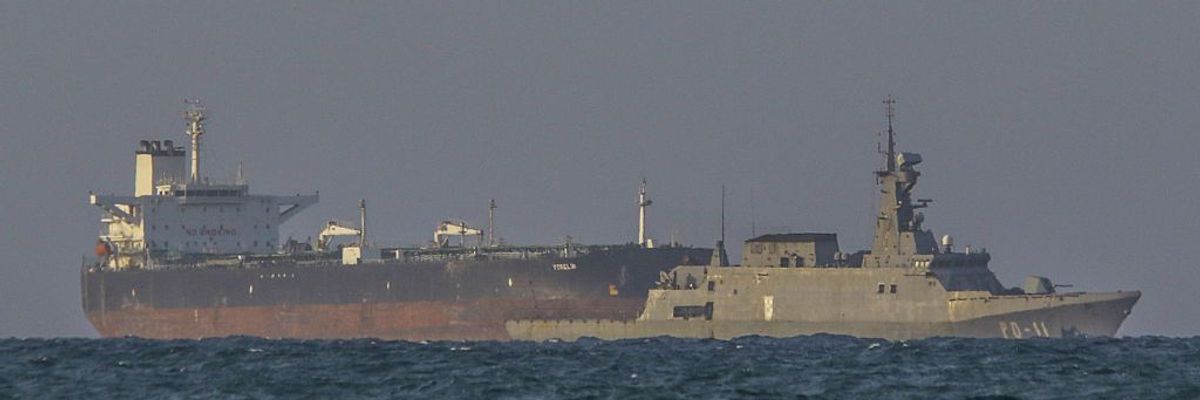
A Venezuelan navy patrol boat escorts Panamanian flagged crude oil tanker Yoselin near the El Palito refinery in Puerto Cabello, Venezuela on November 11, 2025.
(Photo by Juan Carlos Hernandez/AFP via Getty Images)


Brad Reed
Dec 10, 2025
COMMON DREAMS


The US military on Wednesday seized an oil tanker off the coast of Venezuela in the latest act of aggression against a nation that President Donald Trump has been openly threatening for several weeks.

Bloomberg, which described the move as a “serious escalation” in tensions between the US and Venezuela, reported that the seizure of the tanker by US forces “may make it much harder for Venezuela to export its oil, as other shippers are now likely to be more reluctant to load its cargoes.”

The seizure was described to Bloomberg by a Trump administration official as a “judicial enforcement action on a stateless vessel” that had been docked in Venezuela.

Shortly after the seizure occurred, Trump boasted about it during a meeting with business leaders at the White House, declaring that the tanker was the “largest one ever seized.”


Just Foreign Policy, a progressive think tank and advocacy group, condemned the seizure of the tanker, describing it as an “illegal US move to take control of Venezuela’s natural resources and strangle the economy, which is already struggling under indiscriminate US sanctions,” and warning that “millions of civilians will be at risk if the economy deteriorates and tensions rise.”

The seizure of the oil tanker is just one of many aggressive maneuvers that the Trump administration has been making around Venezuela.

Starting in September, the administration began a series of murders of people aboard boats in the Caribbean Sea off the coast of Venezuela and in the Pacific Ocean.

The Trump administration has claimed those targeted for extrajudicial killing are drug smugglers and accused Venezuelan President Nicolás Maduro of leading an international drug trafficking organization called the Cartel de los Soles, despite many experts saying that they have seen no evidence that such an organization formally exists.

Trump late last month further escalated tensions with Venezuela when he declared that airspace over the nation was “closed in its entirety,” even though he lacks any legal authority to enforce such a decree. Trump has also hinted that strikes against purported drug traffickers on Venezuelan soil would occur in the near future.


US seizes oil tanker off Venezuela as Caracas condemns 'act of piracy'

Kayla Epstein; Ione Wells
Thu, December 11, 2025 


U.S. forces abseil onto an oil tanker during a raid described by U.S. Attorney General Pam Bondi as its seizure by the United States off the coast of Venezuela, December 10, 2025, in a still image from video. U.S. Attorney General/Handout via

US forces have seized an oil tanker off the coast of Venezuela, marking a sharp escalation in Washington's pressure campaign against Nicolás Maduro's government.

Speaking at the White House on Wednesday, President Donald Trump said the tanker was "the largest one ever seized".

Footage released by the US government showed armed soldiers boarding the vessel, which Attorney General Pam Bondi said was used to transport sanctioned oil from Venezuela and Iran.

Caracas swiftly denounced the action, calling it an act of "international piracy". Earlier, President Nicolás Maduro declared that Venezuela would never become an "oil colony".

The Trump administration accuses Venezuela of funnelling narcotics into the US and has intensified its efforts to isolate President Maduro in recent months.

Venezuela - home to some of the world's largest proven oil reserves - has, in turn, accused Washington of seeking to steal its resources.

Brent crude prices inched higher on Wednesday as news of the seizure stoked short-term supply concerns. Analysts warn the move could threaten shippers and further disrupt Venezuela's oil exports.

On Thursday, the Kremlin said Russian President Vladimir Putin had spoken with Maduro and reassured him of Moscow's support "in the face of growing external pressure".

Venezuelan opposition leader makes first public appearance after months in hiding


US jets tracked circling Gulf of Venezuela as tensions mount


Why is Trump threatening Venezuela's Maduro?

Bondi, who leads the US Department of Justice, said the Federal Bureau of Investigation, Department of Defense, Department of Homeland Security, and the US Coast Guard co-ordinated the seizure.

"For multiple years, the oil tanker has been sanctioned by the United States due to its involvement in an illicit oil shipping network supporting foreign terrorist organizations," the nation's top prosecutor wrote on X.

Footage shared by Bondi showed a military helicopter hovering over a large ship, and troops descending on to the deck using ropes. Uniformed men were seen in the clip moving about the ship with guns drawn.

A senior military official told the BBC's US partner CBS that the helicopters used in the operation launched from the USS Gerald Ford, the world's largest aircraft carrier, which was sent to the Caribbean last month.

It involved two helicopters, 10 Coast Guard members and 10 Marines, as well as special forces.

Defence Secretary Pete Hegseth was aware of the operation, and the Trump administration was considering more actions like this, a source told CBS.

When asked by reporters what the US would do with the oil on the tanker, Trump said: "We keep it, I guess... I assume we're going to keep the oil."

Maritime risk company Vanguard Tech identified the vessel as the Skipper and said it believed the ship had been "spoofing" its position - or broadcasting a false location - for a long time.

BBC Verify has since confirmed that the vessel in the footage released by the Department of Homeland Security is the Skipper.

The US treasury department sanctioned the Skipper in 2022, CBS reported, for alleged involvement in oil smuggling that generated revenue for Hezbollah and the Islamic Revolutionary Guard Corps-Quds Force.

BBC Verify also located this tanker on MarineTraffic, which shows it was sailing under the flag of Guyana when its position was last updated two days ago.

A statement from Guyana's Maritime Administration Department on Wednesday evening, however, said that the Skipper was "falsely flying the Guyana Flag as it is not registered in Guyana."

The Skipper's port of call log shows it called in Iran, Iraq, and the UAE from 30 June to 9 July this year. Its most recent stop, according to MarineTraffic, was at Soroosh port in Iran on 9 July.

That does not mean that it has not called at multiple other ports since then.

MarineTraffic shows it was last near Iran in mid-September before arriving off the coast of Guyana at the end of October and making minimal further movement since then. This data may be partial or incorrect because of spoofing.

MarineTraffic lists the beneficial owner and operator as Nigeria-based Thomarose Global Ventures Ltd and it lists the registered owner as Marshall Islands-based Triton Navigation Corp.

The Venezuelan government issued a statement denouncing the seizure as a "grave international crime".

Interior Minister Diosdado Cabello called the US "murderers, thieves, pirates".

He referred to Pirates of the Caribbean, but said that while that film's lead character Jack Sparrow was a "hero", he believed "these guys are high seas criminals, buccaneers".

Cabello said this was how the US had "started wars all over the world".

Speaking at a rally earlier on Wednesday, Maduro had a message for Americans opposed to war with Venezuela. It came in the form of a 1988 hit song.

"To American citizens who are against the war, I respond with a very famous song: Don't worry, be happy," Maduro said in Spanish before singing along to the lyrics of the 1988 hit.

"Not war, be happy. Not, not crazy war, not, be happy."

It's unclear if Maduro knew about the seizure of the tanker before this rally.

In recent days, the US has ramped up its military presence in the Caribbean Sea, which borders Venezuela to the north.

The build-up involves thousands of troops and the USS Gerald Ford being positioned within striking distance of Venezuela, BBC Verify reported.

The move has sparked speculation about the potential for some kind of military action.

Since September, the US has conducted at least 22 strikes on boats in the region that the Trump administration says are smuggling drugs. At least 80 people have died in these attacks.

[BBC]


Follow the twists and turns of Trump's second term with North America correspondent Anthony Zurcher's weekly US Politics Unspun newsletter. Readers in the UK can sign up here. Those outside the UK can sign up here.