Frank Lloyd Wright and the Mass Murderer at Taliesen
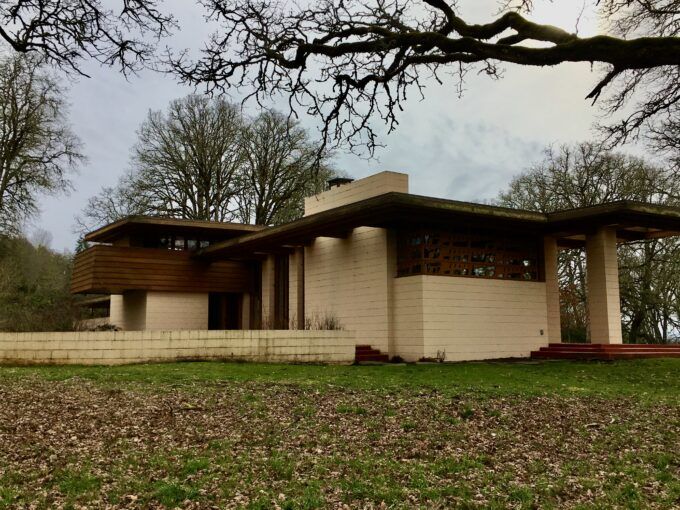
Frank Lloyd Wright’s Gordon House, Silverton, Oregon. Photo: Jeffrey St. Clair.
Midwesterner, architect, iconoclast. A new nonfiction book, The Killer and Frank Lloyd Wright, by seasoned true crime writer Casey Sherman (“Helltown”, “A Murder in Hollywood”, “Blood in the Water”) takes readers back over 125 years to the exploits of Frank Lloyd Wright, American original.
Sherman sets the action in two principal locations: Chicago and its leafy suburb of Oak Park, and the idyllic small town of Spring Green, Wisconsin, where Wright had family background/ ties. Timelines for Wright and his married lover, Mamah (pronounced MAY-mah) Borthwick Cheney, follow quickly after initial chapters on his formative years, brief college days, and early adulthood/first marriage after he puts down roots in Chicago. Remarkably, at age 19, Wright worked as a draftsman for established architects Lyman Silsbee, and later, Louis Sullivan.
When Wright meets Mamah, both had spouses and families, yet this did not deter him from leaving his wife (Catherine, known as Kitty) and children to run away to Europe, to Japan, and back to his beloved unglaciated southern Wisconsin 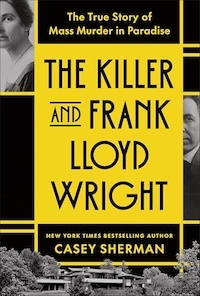 environs with Mamah to build a structure where they could live together away from the city’s hubbub. This house and property are called Taliesin (“shining brow” in Welsh), and it is still standing today.
The book’s narrative is edgy, stark, and, not to state the obvious, transpires well before the advent of the rise of modern mores and customs. Due to Wright’s growing fame for designing buildings such as Midway Gardens in Chicago and the Imperial Hotel in Tokyo, journalists from many national and regional publications were eager to jump on the story of married Wright and the woman who entranced him, ensuring shock value to their readers. Wright’s wife, Kitty and Mamah’s husband, Edwin (a client of Wright’s), remained tight-lipped when the media hounded them for sordid details. In Kitty’s case, she was more inclined to issue statements that made her seem like a victim than was Edwin. Neither spouse wanted a divorce. Eventually, Edwin agreed to grant his wife one after a couple of years of Mamah taking up with Wright. Kitty did not follow suit immediately in this regard, but did so after a number of years.
Furthermore, author Sherman details how Wright won and completed many new commissions while Mamah translated several of the Swedish feminist writer Ellen Key’s works. The two lovers (who eventually had a private civil ceremony of marriage) were unaware that tragedy would soon strike to end their affair, as well as Mamah’s life (along with six other individuals, including her two children).
In August 1917, a male worker at Taliesin, in a fit of rage, attacked Mamah, her two children, and several others present with a hatchet. He also set the structure on fire before being captured and held for trial. Wright was away in Chicago at the time but returned immediately upon hearing the news.
The culprit, Julian Carlton, a married man but also one who was mentally unstable, was recommended to Wright by a colleague, along with his wife Gertrude, to be employed as houseworkers. However, there were complaints about his demeanor, and even Carlton’s wife reportedly felt deathly frightened of him and eventually fled the situation after the attacks. Carlton may have deduced rightly that working at Taliesin was going to be short-lived, but not short enough that he didn’t break out in an absolute rampage that summer. He later died before going to trial from refusing to eat while captive for several weeks.
The book includes material that happened after this tragic event, namely Wright’s continuation of work on Taliesin (later Taliesin West in Arizona), two additional marriages, and his further noteworthy commissions, such as the Guggenheim Museum in New York City. Numerous quotes from source material, such as newspaper articles, personal letters, and even Wright’s autobiography, are woven throughout.
Sherman has penned a thorough look at Wright’s life and relationships leading up to his death at age 91. The Killer and Frank Lloyd Wright is both a compelling read, and a worthy addition to the existing literature about the rebellious inventor of the world-renowned Prairie Style of architecture.

No comments:
Post a Comment