UK
Eat the Bond Traders!
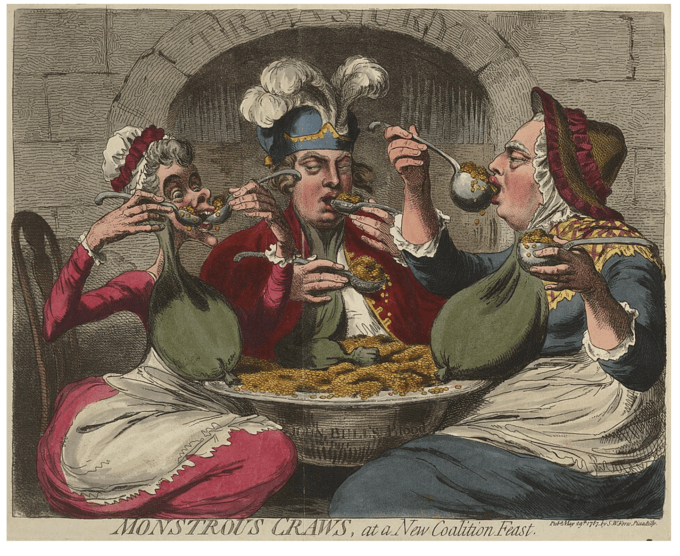
James Gilray, Monstrous craws, at a new coalition feast. 1787. Photo: Library of Congress.
The recent U.K. election
The political gloom lifted here just a bit this week, when it became clear there will soon be a leadership contest in the British Labour Party. Last week’s municipal and “devolved” (Scottish and Welsh parliament) election results were like a 16-ton weight dropped on Britain’s hapless Prime Minister Keir Starmer. Labour received the worst drubbing in its history: 1400 municipal council seats lost, including 450 in London; loss of control of the Welsh Senedd (the quasi-independent, unicameral legislature); and an equally large defeat in Scotland. In London, Labour surrendered votes to the Greens – now, under Zack Polanski, a socialist alternative – and ceded control of half the borough councils.
The biggest winner in England, unfortunately, was Reform U.K., led by the racist, corrupt, and irrepressible Nigel Farage. It captured 1500 seats nationwide and gained control of 14 municipal councils. Extrapolated to parliamentary elections in 2029, Reform would become the largest party in the U.K. and its leader prime minister. Farage is currently under investigation by a parliamentary committee for not reporting a £5 million gift from Christopher Harborne, a British crypto billionaire living in Thailand. Farage said he didn’t have to register the gift because it was purely personal, intended to pay for a lifetime of security services. Apparently informed that protection services for a politician aren’t “personal,” he quickly changed his story and said the money was “a reward for campaigning for Brexit.” The only difference between Farage and his friend Trump’s corruption, is that the latter’s is on a bigger scale.
In Scotland and Wales, the nationalist parties dominated. The Scottish National Party, led by the charisma-challenged John Swinney, maintained control of Holyrood (that’s the name of the Scottish Parliament in Edinburgh), and in Wales, Rhun ap Iorwerth, leader of Plaid Cymru, another independence party, was elected First Minister, the first time a non-Labour minister has held the position. Neither the SNP nor Plaid is likely to press for independence immediately, but if Farage seems likely to gain power, they will quickly pivot for autonomy.
The political upshot of all this is that the current leader of U.K. Labour, Prime Minister Starmer, is a zombie, a stiff, a dead man walking – choose your terminal metaphor. There would be reason to pity the poor man, if he weren’t so self-righteous. By historic standards, and certainly by comparison with the Tories, his first two years in office haven’t been terrible. He’s reduced child poverty, restricted the sale of council houses (an insidious practice that dates to Margaret Thatcher), increased the provision of free childcare, raised the minimum wage, provided renters more rights, and reduced (marginally) the length of waiting lists for treatments from the National Health Service.
But the biggest issues remain unaddressed. Prices have risen faster here than almost anywhere else in Europe, and salaries have lagged. There’s more poverty (including child poverty) and homelessness, worse health and lower life expectancy in the U.K. than most other European countries. Public transportation is more costly and less extensive than the rest of Europe and higher education is more expensive and less available. Many hospitals are in a deplorable condition, and the waits for elective surgery – like knee and hip replacements – can be years long. The U.K. has far less open space than almost anywhere else in Europe – indeed, it’s one of the most nature-depleted countries in the world. The water quality of lakes and rivers is especially bad because of runoff from animal agriculture. There are 35 million pigs, sheep and cows in the U.K.
If you travel, like my wife Harriet and I have, from Norwich to Amsterdam, Netherlands (a 35-minute flight) you discover there a train and bus system that takes you almost anywhere in the country you want to go at very low cost. And as you sit on those Dutch trains or buses, watching unfold a landscape of well-maintained homes and businesses, manicured gardens, and well-paved roads, you wonder, “why are the Dutch so rich while the British are so poor?”
The short answer is that during the two generations following the Second World War, the Dutch embraced a model of development that prioritized the general good at the expense of those who would amass great, individual wealth. The Dutch established a durable welfare state with low poverty and high taxes, while the British – especially after 1980 – rejected welfarism, embraced privatization of formerly publicly held industry and housing, and encouraged financialization and public austerity. When it comes to GDP, salaries, wealth, and health, the Dutch score much higher than the British.
Instead of addressing these deficits, which most Brits believe have reached crisis proportion, Starmer has focused on small wins that can be achieved within the Tory-established budget guidelines now enforced by him and his harried Chancellor, Rachel Reeves. Rather than taxing the very rich and distributing the windfall to the very poor, he’d prefer to flatter and cajole the tech and finance barons in the hope they will invest more in British industry. (Fat chance.) Rather than support the NHS with the billions it needs for its resuscitation, he’d prefer to build up U.K. armaments to placate his master in Mar-a-Lago. Or is Starmer worried Russia will invade and take over the NHS, trainlines, and water systems?
Starmer has in addition, selectively criminalized protest, fed Israel the weapons it needs to continue waging a genocidal war in Gaza, and proposed the elimination of jury trials for large classes of offenses, gutting the single institution that is the envy of much of the world. He has also appeased the far right by demonizing immigrants and purged his party’s progressive ranks, including the hundreds of thousands of idealistic young members who joined when Corbyn was leader. Starmer has earned his legion of enemies.
There are so far, two men who have announced they will seek to replace Starmer as party leader. The first is Wes Streeting, the crew-cut straight arrow of the center right. Until his resignation last week, he was Secretary of State for Health and Social Care. He’s reputed a good speaker, though it seems to me he’s just a fast talker. In recent days, he has tacked left, calling for higher taxes on the rich and for the U.K. to rejoin the E.U. The second candidate is Andy Burnham, the current mayor of Manchester, and judged by some a miracle worker for taking control and revamping the Manchester’s public transit systems. He has lately tacked right – demurring on rejoining the E.U. and pledging allegiance to the sacrosanct “fiscal rules”, the better to gain the support of conservative, local voters who must first elect him to parliament so he can then run for leader. If he’s elected (a big if), the leadership contest will play out in late June or July. It’s possible Angela Raynor, who speaks with a working-class accent and represents the “soft left” may join the contest.
A modest proposal
The fly in the ointment of British Labour politics today – what prevents essential investments in health, infrastructure, housing, energy and education — is the class of bond traders in the City or Canary Wharf. They are the ones who in 2022 brought down the hapless but un-mourned Tory Liz Truss, whose prime ministry famously lasted no longer than the shelf life of a head of cabbage (49 days). When she cut taxes (on the rich, naturally) without also cutting spending, the bond markets screamed “INFLATION,” dumping bonds (also known as “gilts”) and requiring the government to raise interest rates on new bonds. This higher pricing then filtered through the system, raising interest rates on car loans, credit cards and worst of all, mortgages, forcing homeowners with variable rate products (the majority) to make higher monthly payments. Even small rises in mortgages, energy bills, transport costs or anything else can drag a working-class family into crisis. Speaking Truss’s name aloud today is like saying Voldemort; its mere mention summons images of darkness, danger and even catastrophe. Invocation of her legacy is enough to freeze timorous Labour politicians in their tracks, making them eschew spending increases and demand belt-tightening instead.
So, what to do? There’s no question that fixing the many harms suffered by the British people requires significant spending. The NHS probably needs another £40 billion per year (on top of the existing £200 billion) to significantly reduce waiting lists, repair failing infrastructure and improve the pay of doctors and nurses, while social care – support for the elderly and disabled out of hospital – an extra £15 billion. The cost of upgrading water, sanitation and electric power infrastructure is currently borne by the private utilities that own them – passed on to ratepayers of course – but a significant proportion of this investment goes into the pockets of shareholders in the form of profit. The industries are essential to public well-being and should be re-nationalized, but even if they are, significant investment will need to be made. Where will the money come from?
In addition to raising taxes on the rich, a new Labour government must find a way to borrow without allowing the bond vigilantes to punish the state and consumers with higher borrowing costs. That means just one thing: Eat the bond traders! Here’s how: The new Labour Prime Minister – Andy Burnham, Wes Streeting, Angela Raynor or someone else — must appoint a Chancellor willing to deploy Section 19 of the Bank of England Act of 1998 to declare an economic emergency, allowing the government to order the bank to act as a buyer of unlimited U.K. debt. This would enable the Chancellor to lock in long-term interest rates with a low, stable cap, for example 3.5%. The bond traders would be instantly disabled. They can’t strike (refuse to lend) or force borrowing costs up because the central bank sets the price of money, not them. They would in fact, make a fortune up front since the value of their bonds would skyrocket. (But they can be taxed.)
In order to assure the public and ministers that increased spending by itself won’t increase inflation, the government could then announce a capital/operational budget division, that is, two spending ledgers. The first, capital investment, would use borrowed funds to build tangible national assets such as new hospitals and care facilities, schools, water and green energy infrastructure, and social housing. Because this builds physical capacity and raises productivity, rather than driving consumer spending, it doesn’t cause consumer inflation. To make extra sure, the government can offer the public tax-free individual savings accounts (ISAs), to raise money for capital expenditures. These would be fully secured by the government and offer the British public better interest rates than commercial banks. (There would be a balance limit – perhaps £100,000, to ensure ISAs are not used as a tax dodge by the very wealthy.) The result would be billions of pounds pulled from exiting private banks and put directly to use for capital investment. State rebuilding would now be funded by citizens themselves, who receive a high, guaranteed return paid for by the productivity yields they funded!
The second, operational budget would cover general, government running costs, for example, salaries and pensions, nurse and teacher pay increases, and infrastructure maintenance. It’s transparently paid for by domestic taxes. Increased revenue if needed, can come from popular new wealth taxes, better graduated inheritance taxes (again, only impacting the wealthiest few), increased marginal taxes rates on the highest incomes, taxes on capital gains and dividends, and a financial transaction tax on City (U.K. stock market) trading, perhaps 0.1% on short-term, speculative trades. (The tax would be based on the nationality of the asset, to prevent traders from selling in a different market.)
The way ahead
Any future prime minister and chancellor will need to do something like the above if they want to improve the prospects of British people, fend off Reform, and prevent the rapid break-up of the United Kingdom into England, Scotland, Wales and Northern Ireland. (There were no municipal elections last week in Northern Ireland.) To be sure, the struggle to break the conservative hold on the Bank of England, eat the bond traders, and fend off court challenges will require energy, organization and a willingness to fight. But the British public is clearly fed up with austerity and the shame and spectacle of national decline; it will reward politicians who act boldly and in their interest. The same is true in the U.S., but there, the opportunity for a rapid change of fortune is much less. It will probably have to await elections in 2026 and ’28.

No comments:
Post a Comment