Showing posts sorted by relevance for query ROBOT DOG. Sort by date Show all posts

Saturday, July 23, 2022

Robot dog outfitted with machine gun in Russia brings us closer to real-life ‘Black Mirror’


Jane Nam
Fri, July 22, 2022

A robot dog modified to include a machine gun on the top half of its body has captured the attention of the internet with its sophisticated design resembling something out of a sci-fi thriller.

As shown in the video, which has garnered over 7.3 million views on Twitter, a silver-colored robot dog runs along a firing range as it opens fire on various targets.

All the people who laughed off the “worrywarts” years ago for freaking out about the Funny Dancing Robot Dogs (tm) should be forced to watch this video once a day for the remainder of the year. pic.twitter.com/WBIrlGah3w
— Sean Chiplock (@sonicmega) July 20, 2022

More from NextShark: South Korean researchers develop first-ever computer that can save data without power

The gunfire is scarily powerful, with bullets coming out in short, sharp staccatos. Despite the snowy terrain, the robot dog is able to move around fairly quickly.


On July 17, NowThis News released a clip of Boston Dynamic’s 5-feet-tall, 190-pound “humanoid robot” named Atlas running and leaping over obstacles, causing many netizens to connect the robot dog to the U.S. company’s designs.

More from NextShark:  Robot Dogs Now Patrol Singapore to Tell People to Social Distance

While the author of the Twitter post, @sonicmega, also references the “Funny Dancing Robot Dogs” made by U.S. company Boston Dynamics, other users noted that the design closely resembles that of China’s Unitree Robots.

According to Cybernews, Sophos Senior Threat Researcher Sean Gallagher likens the model seen in the video to the Hangzhou-based company and its Go1 robot dog model, which retails for around $3,000.

When one user claimed the robot to be fake, one netizen responded by tracing the video back to the original post in March by Russian businessman Alexander Atamanov, the founder of a hoverbike company.

The clip of the robot dog appears to have been taken in Russia, as its left flank bears the Russian flag and the other side a wolf’s head, which is an insignia commonly used by the Russian Special Operations Forces.

A parked armored vehicle seen in the video can be identified by its distinct triangular door as a BRDM-2, which has been recently spotted in Ukraine.

Featured Image via Alexander Atamanov


Monday, April 06, 2020

How Google is teaching a robot dog to learn to move like a real dog

YOU KNOW ITS REAL WHEN IT LEARNS TO SNIFF BUTTS

How Google is teaching a robot dog to learn to move like a real dog
Robot imitating various skills from a dog. Credit: Google
A team of researchers at Google's AI lab is seeing results in its effort to develop a dog-like robot quadruped that learns dog behavior by studying how real dogs move. The team has posted an outline of the work they are doing on the Google AI blog.
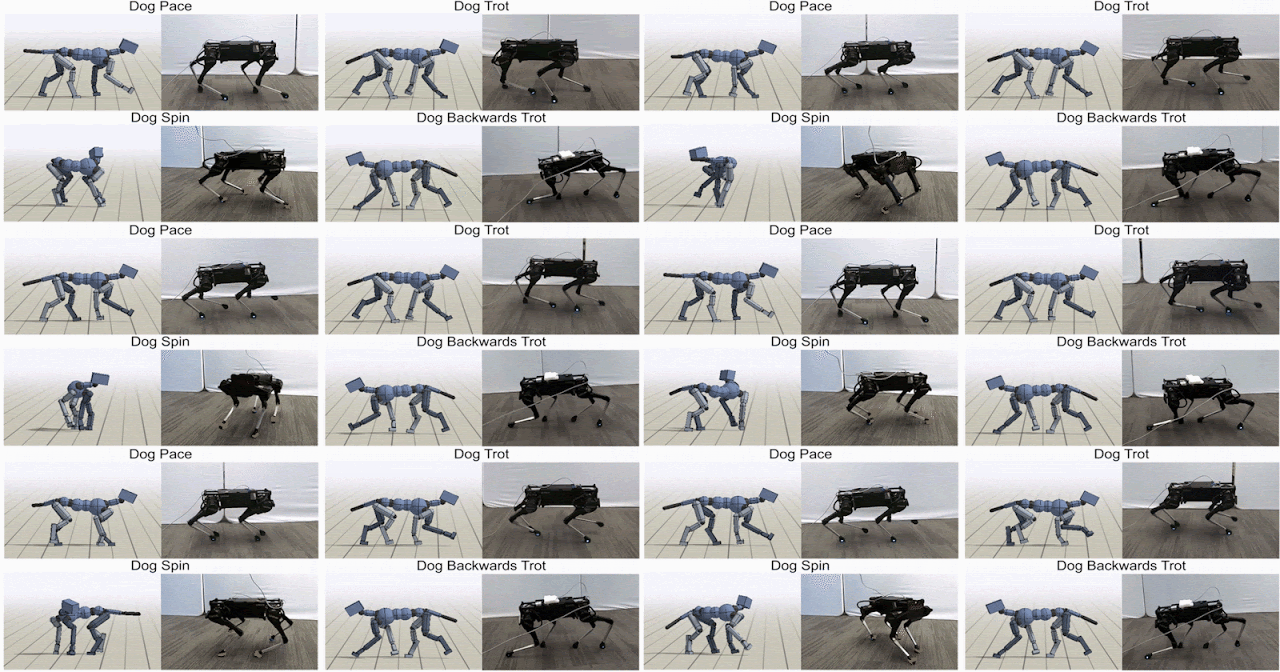
Training a  to perform tasks by mimicking the movements of a living creature is not new— that build cars, for example, are taught how to spot weld or tighten bolts by mimicking the desired action as performed by a human arm. But teaching a robot by showing it video of a real dog is definitely new. And that is just what Google is doing. The robot in this case is a quadruped called Laikago (after Laika, the first dog in space)—it is being trained to walk, run and even chase its tail like a real dog by showing it motion-capture footage of a real dog in action.
In practice, the video is actually first processed by an AI system that translates the action in the video into an animated version of Laikago. To work out possible interpretation errors (because the digital dog is made from metal and wire and motors instead of bones, muscles and sinews), the team shows the AI system multiple stop-action videos of a real dog in action. The AI system builds up a toolset of possible moves depending on scenarios that might be encountered in the real world. Once the simulation has built up a , its "brain" is uploaded to Laikago, who then uses what the simulation has learned as a starting point for its own behavior.
Video of Laikago in action shows that the technique works—the robotic dog is able to walk and trot very much like a real dog—and even simulates chasing its tail. But it also has some deficiencies compared to other advanced robotic animals, such as those from Boston Dynamics,which get their skills through programming—getting back on its feet after stumbling or tripping, for example, is still troublesome. But the researchers at Google are undaunted, believing more research will lead to ever more lifelike behavior by their robot.
Researchers use gait primitives from real animals to simulate movement in robots (w/ video)

More information: ai.googleblog.com/2020/04/expl … d-robot-agility.html
Learning Agile Robotic Locomotion Skills by Imitating Animals, arXiv:2004.00784 [cs.RO] arxiv.org/abs/2004.00784

Tuesday, November 23, 2021

Telus Spark's new robotic dog Flint leading kids to science and technology

'All day, every day, it’s roaming around the science centre. Basically wherever you are in the building, the robot can go'

Article content

It may not be furry, cute or cuddly, but Flint the robot dog is still inspiring the kind of interest and attention from kids that one would expect from any young pup.

Advertisement

Article content

“Whenever I’m in the building, anytime I see a crowd from my office, I can usually identify exactly where the robot is,” said Brian Murray, production manager at the Telus Spark science centre.

Flint is a “Spot Explorer” model robot built by Boston Dynamics, the Massachusetts-based company famous for making robots in both human and dog form.

Murray said the purchase of Flint was made possible by an anonymous donation from a Calgary benefactor who “cares deeply about the possibilities in technology” and who wants to get underprivileged kids involved in coding and digital literacy.

Flint cost US$56,650 and arrived in Calgary this August. After some time behind the scenes, it is now making regular appearances around the Telus Spark building every day, which is currently open Wednesday through Sunday.

Ad

Article content

Murray said they’ve built a small home and fenced-in yard where Flint lives. It often takes a break at lunch, but is otherwise walking throughout the building most days.

Brian Murray poses with Flint the robot dog made by Boston Dynamics. Flint is a quadruped robot that can walk up stairs and across uneven surfaces.
Brian Murray poses with Flint the robot dog made by Boston Dynamics. Flint is a quadruped robot that can walk up stairs and across uneven surfaces. Brendan Miller/Postmedia

“All day, every day, it’s roaming around the science centre,” said Murray. “Basically wherever you are in the building, the robot can go.”

Flint can be controlled via remote control by its handlers, but it also has five onboard cameras and is capable of self-navigating to waypoints. It can walk up stairs or across uneven terrain.

It can also be programmed to dance elaborate routines to music with special software provided by Boston Dynamics.

Advertisement

Article content

The science centre invited science communication ambassadors and actual dogs Bunsen and Beaker from Red Deer to meet Flint earlier this month.

Jason Zackowski is the voice of Bunsen and Beaker, and their account is one of the biggest science communication accounts on Twitter. He said the robot dog was a bit puzzling for the pooches — especially the younger dog Beaker.

“She kept trying to sniff its butt and get its attention,” said Zackowski. “She was trying to follow it and try to maybe play with it.”

Advertisement

Article content

Zackowski, who is also a high school chemistry teacher, said Flint will no doubt help inspire kids on the incredible possibilities of technology and robotics.

“I can only imagine how excited kids are when they see it,” he said. “If you can engage kids, that’s when you can teach them and that’s when the learning happens.”

Murray said they have big plans for Flint in the coming months. Beyond just wandering around and meeting people, they hope to include the robot in programming workshops.

They also hope to eventually hack Flint to accomplish new tasks. The robot has cargo rails that will allow them to add on homemade accessories.

brthomas@postmedia.com

Twitter: @brodie_thomas

Monday, October 26, 2020


Dog training methods help JHU teach robots to learn new tricks

JOHNS HOPKINS UNIVERSITY

Research News

IMAGE

IMAGE:  "THE QUESTION HERE WAS HOW DO WE GET THE ROBOT TO LEARN A SKILL? " SAID LEAD AUTHOR ANDREW HUNDT, A PHD STUDENT WORKING IN JOHNS HOPKINS' COMPUTATIONAL INTERACTION AND ROBOTICS... view more 

CREDIT: WILL KIRK/JOHNS HOPKINS UNIVERSITY

With a training technique commonly used to teach dogs to sit and stay, Johns Hopkins University computer scientists showed a robot how to teach itself several new tricks, including stacking blocks. With the method, the robot, named Spot, was able to learn in days what typically takes a month.

By using positive reinforcement, an approach familiar to anyone who's used treats to change a dog's behavior, the team dramatically improved the robot's skills and did it quickly enough to make training robots for real-world work a more feasible enterprise. The findings are newly published in a paper called, "Good Robot!"

"The question here was how do we get the robot to learn a skill?" said lead author Andrew Hundt, a PhD student working in Johns Hopkins' Computational Interaction and Robotics Laboratory. "I've had dogs so I know rewards work and that was the inspiration for how I designed the learning algorithm."

Unlike humans and animals that are born with highly intuitive brains, computers are blank slates and must learn everything from scratch. But true learning is often accomplished with trial and error, and roboticists are still figuring out how robots can learn efficiently from their mistakes.

The team accomplished that here by devising a reward system that works for a robot the way treats work for a dog. Where a dog might get a cookie for a job well done, the robot earned numeric points.

Hundt recalled how he once taught his terrier mix puppy named Leah the command "leave it," so she could ignore squirrels on walks. He used two types of treats, ordinary trainer treats and something even better, like cheese. When Leah was excited and sniffing around the treats, she got nothing. But when she calmed down and looked away, she got the good stuff. "That's when I gave her the cheese and said, 'Leave it! Good Leah!'"

Similarly, to stack blocks, Spot the robot needed to learn how to focus on constructive actions. As the robot explored the blocks, it quickly learned that correct behaviors for stacking earned high points, but incorrect ones earned nothing. Reach out but don't grasp a block? No points. Knock over a stack? Definitely no points. Spot earned the most by placing the last block on top of a four-block stack.

The training tactic not only worked, it took just days to teach the robot what used to take weeks. The team was able to reduce the practice time by first training a simulated robot, which is a lot like a video game, then running tests with Spot.

"The robot wants the higher score," Hundt said. "It quickly learns the right behavior to get the best reward. In fact, it used to take a month of practice for the robot to achieve 100% accuracy. We were able to do it in two days."

Positive reinforcement not only worked to help the robot teach itself to stack blocks, with the point system the robot just as quickly learned several other tasks - even how to play a simulated navigation game. The ability to learn from mistakes in all types of situations is critical for designing a robot that could adapt to new environments.

"At the start the robot has no idea what it's doing but it will get better and better with each practice. It never gives up and keeps trying to stack and is able to finish the task 100% of the time," Hundt said.

The team imagines these findings could help train household robots to do laundry and wash dishes - tasks that could be popular on the open market and help seniors live independently. It could also help design improved self-driving cars.

"Our goal is to eventually develop robots that can do complex tasks in the real world -- like product assembly, caring for the elderly and surgery," Hager said. "We don't currently know how to program tasks like that -- the world is too complex. But work like this shows us that there is promise to the idea that robots can learn how to accomplish such real-world tasks in a safe and efficient way."

###

The team and co-authors included Johns Hopkins graduate students Andrew Hundt, Benjamin Killeen, Nicholas Greene, Heeyeon Kwon, and Hongtao Wu; former graduate student Chris Paxton; and Gregory D. Hager, the Mandell Bellmore Professor of Computer Science.


Wednesday, July 03, 2024

Robot dog simulates heat stroke symptoms and warns of the dangers of a hot car

By Dr. Tim Sandle
DIGITAL JOURNAL
July 2, 2024

Robotic dog on show at the Barbican. — © Image by Tim Sandle.

Many people think it is fine to leave their dog in the car if they are parked in the shade or the windows are open. However, a car can become as hot as an oven, even when the weather does not feel that warm.

Dogs with their fur coats are prone to heat strokes even in milder temperatures. Dogs should never be left alone in the car during summer, because the temperature inside a car can get dangerously high even on cloudy days.

A Nordics petcare brand called Musti Group has launched a campaign warning dog owners to never leave their dog alone in a hot car. The campaign features a custom-made robotic dog that simulates the symptoms of a heat stroke.

The robot is placed inside a car and its movements are triggered by changes in temperature.

With the new campaign, Musti Group seeks to educate both dog owners and passers-by, who might come across dogs left in a car during summer. The campaign features a fully functioning robotic dog, which shows how fast a car turns into a death trap for pets.

The robot simulates the symptoms of a heat stroke, and its movements are triggered by the temperature inside the car it is placed in.

According to Eveliina Rantahalvari, Musti Group’s Head of Nordic Marketing: “When it comes to recognising dangerous situations, real life experience is the best form of education.”

In terms of the aims, Rantahalvari says: “By creating a tangible, cautionary example that people witness with their own eyes, we hope to increase awareness of how and when to act in these situations both as a dog owner and a passer-by.”

Rantahalvari also states that dogs have a higher risk of suffering a heat stroke, because they are not able to regulate their body temperature by sweating through the skin.

“The temperature inside the car rises dangerously high faster than many people realise. Even leaving the car’s windows open is not enough to ensure the dog is not at risk,” she adds.

In terms of best advice, Rantahalvari proposes: “If you notice a dog left in a hot car, the first thing you should do is try to get in contact with the owner. For example, in a store or shopping centre, you can ask the staff to make an announcement to try and alert the owner”.

The symptoms of a dog’s heat stroke include, among other things, severe lethargy, dark redness of the tongue and oral mucosa, convulsions and tremors. The situation might be very serious, if the dog is no longer panting or showing signs of restlessness, but instead lies still apathetically. If the owner of the car cannot be found quickly, the helper must contact the emergency centre and ask for instructions to help the dog.

Thursday, April 09, 2026

These AI-powered guide dogs don’t just lead – they talk


Large language models help robots plan routes and guide the visually impaired


Binghamton University

Robot dog with user 

image: 

Scientists at Binghamton University have developed a robot guide dog system that communicates with the visually impaired and provides real-time feedback during travel. 

view more 

Credit: Binghamton University, State University of New York


Guide dogs are powerful allies, leading the visually impaired safely to their destinations, but they can’t talk with their owners — until now.

Using large language models, a team of researchers at Binghamton University, State University of New York has created a talking robot guide dog system that determines an ideal route and safely guides users to their destination, offering real-time feedback along the way. 

“For this work, we’re demonstrating an aspect of the robotic guide dog that is more advanced than biological guide dogs,” said Shiqi Zhang, an associate professor at the Thomas J. Watson College of Engineering and Applied Science’s School of Computing. “Real dogs can understand around 20 commands at best. But for robotic guide dogs, you can just put GPT-4 with voice commands. Then it has very strong language capabilities.”

Zhang and his team had previously trained robot guide dogs to lead the visually impaired by responding to a tug on the leash. This new system takes their work a step further, creating a spoken back-and-forth between user and dog, and providing more control and situational awareness. The robot offers information about a route before departure (what the researchers call plan verbalization) and information during travel (scene verbalization.) 

“This is very important for visually impaired or blind people, because situational and scene awareness is relatively limited without vision,” Zhang said. 

To test the system, the team recruited seven legally blind participants to navigate a large, multi-room office environment. The robot would ask the user where they wanted to go (in this experiment, a conference room) and then present possible routes to the room and the time it would take to reach it. Once the user selected a preferred route, the robot would guide them to the conference room, verbalizing the surroundings and obstacles along the way (such as “this is a long corridor”) until it reached the destination. 

Following the test, the users completed a questionnaire about their experience, rating the system’s helpfulness, ease of communication, and usefulness. Overall, a combined approach — which included planning explanations and real-time narration from the robot — was preferred among participants. A simulated study of the system also showed that this approach was successful.

Going forward, the team plans to conduct more user studies, increase the system’s autonomy, and have the robots navigate longer distances, both indoors and outdoors. 

The goal of this research is to help integrate robotic guide dogs into everyday life. The study participants were enthusiastic about this possibility.

“They were super excited about the technology, about the robots,” Zhang said. “They asked many questions. They really see the potential for the technology and hope to see this working.”
The paper, “From Woofs to Words: Towards Intelligent Robotic Guide Dogs with Verbal Communication,”  was presented at the 40th Annual AAAI Conference on Artificial Intelligence, one of the largest academic AI conferences in history.]

Robot dog video [VIDEO] |

Saturday, January 31, 2026

Artist chains up thrashing robot dog to expose AI fears


By AFP
January 30, 2026


Robot dogs on display at Unitree's retail store in Beijing 
- Copyright AFP/File Adek BERRY


Katie Forster

The agile robot dog springs up on all fours, takes a step forward and charges at the tense crowd at a Tokyo exhibit, held back by a simple yet strong metal chain.

The silver mechanical creature then starts thrashing around violently, to gasps and exclamations from spectators at the installation, designed to probe humanity’s relationship with increasingly realistic machines.

The Japanese media artist behind it told AFP he hoped the audience would consider the dangers posed by artificial intelligence but also feel “pity” for the struggling robot.

“Our future is going to be stressful, because people treat robots as objects, but we feel empathetic stress with these movements and reactions,” said Takayuki Todo, 40.

Global tech giants are investing vast sums into humanoid and other lifelike robots, with grand plans for factory automation, home help and other futuristic “physical AI” services.

But so far actual use cases remain scarce and fully automated robots are still a rare sight, with most impressive displays — including Todo’s — relying on remote operators to control the robot’s movements.

For the artist, the point of the three-day installation at the Tokyo Prototype festival is to provoke thought.

Like the metal leash, “we are protected by an unreliable, thin chain of ethics. And if it’s cut off, we will be killed by this technology,” said Todo.

– ‘Robot abuser’ –

For his installation, titled “Dynamics of a Dog on a Leash” and first shown last year, Todo purchased three robot canines made by Chinese startup Unitree, costing thousands of dollars each.

One is already broken and repairs are needed for another, as the dogs often get tangled in the chain and end up crashing onto the floor.

Todo, who said he had been attacked online “as a robot abuser”, visited Unitree in China last year to excuse himself for the unconventional treatment of their device.

The short hourly display, on show through Saturday in a business district skyscraper, is drawing large crowds, with many spectators including children curious to see a robot of this kind for the first time.

“It gave me the chills,” said 34-year-old student and food service worker Kimie Furuta.

“Imagining it actually attacking like that… it could be terrifying to face.”

On the brighter side, robots and AI could one day help ease staff shortages, including in the catering sector, she said.

Anatol Ward, a Tokyo resident in his 50s, said the robot reminded him of a guard dog.

“In some sense it was scary. But also it was fascinating — like, what the robot was capable of.”

Todo said that “of course” he was afraid of military uses for such robots, but noted it is not just a future concern.

“Robots and drones are killing soldiers in Ukraine or Palestine,” he said.

“We feel it’s a distant place, but as an artist we have to imagine it’s in front of us.”

Monday, January 01, 2024

‘Robot Dreams’ Review: Androids Dream of Disco Beats In Pablo Berger’s Sweetly Sorrowful Buddy Movie


Guy Lodge
Variety
Sun, 31 December 2023 


Android or artificial intelligence isn’t the enemy in “Robot Dreams,” Pablo Berger’s gently whimsical fantasy of a loner finding manufactured friendship in a scuzzy vision of 1980s New York City. Indeed, one takeaway from this portrait of a shabby-happy Big Apple populated solely with anthropomorphic animals and surprisingly sensitive automatons is that the world might be a better place without humans in it. Like “Blancanieves,” his silent, flamenco-styled spin on Snow White, Berger’s fourth feature dispenses with dialogue in favor of cheerfully expressive, faux-naive visual storytelling. In all other respects, however, “Robot Dreams” is a significant left turn for the Spanish writer-director, beginning with an entirely fresh medium for him: simple, sharp-lined 2D animation in the manner of a pastel-softened “BoJack Horseman.”

Both the film’s aesthetic and its wordless approach, however, are rooted in American author and illustrator Sara Varon’s 2007 graphic novel of the same name. Where Varon’s work was primarily targeted at young readers, the audience for Berger’s film — suffused with nostalgia for a Reagan-era New York of roller discos and boomboxes on the sidewalks — is a little harder to pin down. It’s certainly clean enough for kids, with little of the snark or cynicism that drives similarly hip-looking adult animation, though small fry might be perplexed by its drifting, low-incident narrative and overriding air of melancholy. Still, it’s in such odd, in-between niches that cult items can bloom; already well-received at such festivals at Cannes and Annecy, “Robot Dreams” should build a sufficient following to prove its own message to the lonely and forlorn: when it comes to love, quality trumps quantity.

More from Variety

Annecy Prizes: 'Chicken for Linda!,' 'Robot Dreams,' 'Pebble Hill' Take Top Honors


Top Titles from Spain at Cannes 2023


Neon Makes First Cannes Acquisition With Pablo Berger's Animated 'Robot Dreams'


What kind of love, exactly, is the most intriguing question in a tale that hints at a degree of queer companionship between its two seemingly (though not definitively) male-gendered principals, all while remaining wholesomely chaste. (Given they’re a dog and a mechanical robot, it’s hard to imagine how things could be otherwise.) Unnamed protagonist Dog is introduced living a solitary life in the East Village, following a fixed routine of work, walks and glumly microwaved TV dinners — paid no mind by anyone, save the pigeons crowding around his apartment window. He’s a stoic soul, but everyone has a limit: Late one night, inspired by an infomercial on his ever-blaring television set, he orders a flatpack build-your-own-robot-kit, promoted in much the same manner as a set of Ginsu steak knives.

Whatever it costs, it’s worth it. From the moment of assembly, the unnamed Robot improbably turns out to be a most affectionate and responsive compadre, forever fixated on his canine owner with a metallic grin and perma-wide eyes. He’s not much of a conversationalist, but then neither is Dog. Their summer days are spent sightseeing, sunbathing, hotdog-eating, rollerskating through Central Park — generally taking Manhattan in more or less the manner Cole Porter described decades before, though their special song is Earth, Wind and Fire’s “September.” That ever-elastic disco nugget soundtracks multiple buddy montages of varying mood and motion: Its ebullience matches the effervescent early stages of their friendship, only to gradually become an ironic counterpoint in a story of loss and subconscious yearning.

For September comes, and with it, separation: After a day’s gambolling at Coney Island, Robot’s sea-soaked joints swiftly rust, rendering him immobile. Unable to carry his pal home, and with the beach thereafter closed for the winter, Dog must endure the winter alone — all while the abandoned Robot withers and freezes in the cold, his parts plundered by piratical critters. Only in multiple dream sequences (thus part-answering Philip K. Dick’s burning question about androids, though no electric sheep are in evidence) can he attempt a reunion with Dog. Spring will come, as will some manner of closure, though it’s fair to say the uncompromised joys of the film’s opening acts are never regained. Counter to happily-ever-after endings of the Disney variety, “Robot Dreams” embraces the pleasingly mature philosophy that there can be more than one soulmate in an individual’s life, and that a finite relationship isn’t a failed one.

It’s a poignant arc that perhaps isn’t quite robust enough to power a 100-minute feature given to rhythmic and narrative repetition. “Robot Dreams” would have been no less effective or affecting as a short subject, though that format would have admittedly kerbed the gleeful volume of nifty visual gags that Berger packs around his sweet, slender story — many of them wittily attuned to the period (frozen food and advertising trends of the era come in for a good ribbing) and the anything-goes street life of New York itself. Above all else, Berger’s film delights in the kind of eccentric, incidental sights and sounds from which dreams — human, animal or android — can spring.