Wednesday, January 05, 2022

ORWELLIAN POSTMODERN STALINISM
Hong Kong's Lam: Media closures unrelated to press freedom


 Hong Kong Chief Executive Carrie Lam listens to reporters' questions during a news conference in Hong Kong, Thursday, Dec. 30, 2021. Lam on Tuesday said that the recent closure of two media outlets in the city cannot be associated with the state of press freedom in Hong Kong as the decisions were made by the outlets themselves. Her comments came almost a week after authorities arrested seven people associated with pro-democracy online news outlet Stand News over sedition, with the outlet announcing that it would cease operations. Days later, another online site Citizen News also said it would stop operating. (AP Photo/Vincent Yu, File)

ZEN SOO
Mon, January 3, 2022

HONG KONG (AP) — Hong Kong leader Carrie Lam on Tuesday said the recent closure of two media outlets in the city does not indicate a decline in press freedom as the decisions were made by the outlets themselves.

Her comments came almost a week after authorities arrested seven people associated with pro-democracy online news site Stand News for alleged sedition, with the outlet then announcing it would cease operations. Days later, another online site, Citizen News, also said it would stop operating.

“For none of the media outlets, we did not do anything. They were never approached by law enforcement agencies,” Lam said during a news conference Tuesday.

“But if they decided to cease operation out of their own concerns, I think this is nothing out of the ordinary." She added that Hong Kong authorities do "not seek to crack down on press freedom.”

Lam said the government follows the rule of law in Hong Kong, and that when she first assumed office, she opened up government news conferences to online sites and met with the Hong Kong Journalists Association.

In response to charges that the closure of the online media indicates the “extinction” of press freedom in Hong Kong, Lam said she “cannot accept that sort of allegations.”

“Nothing is more important than the rule of law,” she said. She also said that as long as news outlets do not engage in illegal acts, they can continue to report news in Hong Kong.

She said there was an increase of 5.4% in local news outlets registered in the city, and a jump of 9.4% for overseas outlets since a sweeping National Security Law was enacted in the city in June 2020.

“So you cannot say that the freedom of press is eroded due to the closing of the two media outlets,” Lam said.

Since the security law came into effect, over a hundred people have been arrested, including many pro-democracy activists and some journalists who previously worked for the now-defunct Apple Daily and Stand News.

On Tuesday, a pro-democracy activist and key member of the now-disbanded Hong Kong Alliance in Support of Patriotic Democratic Movements of China, Chow Hang-tung, was sentenced to 15 months in prison after being convicted of inciting people to join a banned vigil last year commemorating the 1989 crackdown on pro-democracy demonstrators in Beijing's Tiananmen Square.

She was told to serve an additional 10 months of top of a current 12-month sentence she is serving for her role in the vigil in 2020, which was also banned.

Separately, Lam said the city will tighten vaccine requirements to cover not only entertainment venues but also places such as libraries, schools and museums.

The requirement will be tightened from Feb. 24, and will require those entering such venues to have at least one vaccine dose against COVID-19.

The expansion of the vaccine mandate comes days after Hong Kong reported its first omicron COVID-19 cluster, linked to several Cathay Pacific crew members who broke isolation rules and visited dining spots and bars across the city before later testing positive for omicron.

The city was largely able to keep the delta variant from causing local outbreaks through strict quarantine rules. Hong Kong currently designates all countries with local omicron outbreaks as “high-risk” countries, requiring arrivals from those countries to serve a 21-day quarantine.


Hong Kong leader says she cannot accept claims press freedom faces 'extinction'


FILE PHOTO: Hong Kong Chief Executive Carrie Lam speaks at a news conference in Beijin

Mon, January 3, 2022

HONG KONG (Reuters) - Hong Kong leader Carrie Lam said on Tuesday she could not accept suggestions that press freedom in the city faces "extinction", just days after police raided an online media outlet and arrested seven people including senior editors.

Lam was speaking at a weekly news conference as another independent online outlet, Citizen News, ceased operations in the face of what it described as a "deteriorating" media environment in the Chinese-ruled former British colony.

"This morning I read news about, because of the closure of online medium, press freedom in Hong Kong faces extinction ... I just cannot accept that sort of allegations," Lam said, adding that nothing was more important than rule of law.


Hong Kong returned to Chinese rule in 1997 with the promise that wide-ranging individual rights, including a free press, would be protected. But rights groups and some Western governments say freedoms have been eroded, in particular since Beijing imposed a national security law on Hong Kong in 2020.

The government has repeatedly denied targeting the media and curbing freedoms in the global financial hub. China says rights advocacy is being used as an attempt to disrupt Hong Kong's progress after the national security law restored stability.

Officers raided the office of the Stand News online publication last week, froze its assets and arrested seven current and former senior editors and former board members. Two editors have been charged with sedition.

Lam has hit back at foreign governments demanding the release of the seven, saying such a move would be against the former British colony's rule of law.

The police operation against Stand News came a day after Hong Kong prosecutors laid an additional charge of sedition against jailed media tycoon Jimmy Lai, 74, of the now-shuttered, pro-democracy newspaper Apple Daily.

On Monday, online publication Citizen News said its decision to cease operations from Tuesday was triggered by the closure and arrests at Stand News and to ensure the safety of its staff.

(Reporting By Edmond Ng and Donny Kwok, Writing by Anne Marie Roantree; Editing by)
USA
Established pension plans aren’t dying – they’re thriving, one study says

Alessandra Malito - Monday, JAN 3,2022

Corporate pension plans are not as common as they were decades ago, but some of the largest ones that still exist “improved significantly” in 2021, according to a new analysis.

Investment returns and rising interest rates drove funding status for the largest corporate defined-benefit pension plans to their highest levels since before the financial crisis in 2008, consulting firm Willis Towers Watson found. The researchers analyzed 361 of the Fortune 1000 companies. The Fortune 1000 list includes the U.S. companies with the highest revenue that year.

Pension plan assets equaled $1.67 trillion at the end of 2021, with an average 8.9% investment return, according to the analysis. The aggregate funding status for these companies’ pension plans was 96%, up 8 percentage points in 2021, and up from 77% in 2008. In 2007, the aggregate funding level was 107% – the last year these plans had been fully funded. Ideally, plans would always be fully funded.

“Since 2008, many sponsors have better positioned their plans relative to market risk, primarily through changes in investment allocation and settlement activity,” Joseph Gamzon, managing director of retirement at Willis Towers Watson, said in a statement.

See: Why are pension funds investing in hedge funds?

The funding deficit also diminished last year, Willis Towers Watson found. The deficit is now expected to have been $63 billion by the end of 2021, compared to $232 billion at the end of 2020.

Public pensions are also doing much better in recent years, another study found. The estimated aggregate level of funding for public pensions was 74.7% in 2021, up from 72.8% in 2020, according to the Center for Retirement Research at Boston College.

Lack of funding in a pension plan can spell trouble for workers, many of whom expect to rely on this money in their old age. There are safeguards to prevent catastrophes if a company can’t continue to support the retirement plan, however. When a corporation can no longer foot the bill for pensions, the Pension Benefit Guaranty Corporation can fund a portion of the benefit promised to workers.
Foxconn India plant unlikely to reopen until Jan 7, says government official


Private security guards stand at the entrance of a closed plant of Foxconn India, near Chennai

Mon, January 3, 2022, 
By Sudarshan Varadhan

CHENNAI (Reuters) - Apple Inc supplier Foxconn is unlikely to reopen its shuttered iPhone manufacturing facility in southern India until January 7, a senior government official familiar with the matter told Reuters.

The Foxconn plant, located in the state of Tamil Nadu, was closed on Dec. 18, following protests over 250 of its workers being treated for food poisoning. Apple has since placed the factory on probation after discovering that some dormitories and dining rooms did not meet required standards.

The company, officially known as Hon Hai Precision, had told the Tamil Nadu state government it was working to address Apple's concerns over workers' living conditions, the official said.

"Foxconn is still working with Apple to ensure compliance, which they expect to take up to two days. Bringing back workers could also more than a day," the official said, adding that the state government had cleared restarting the plant for production.

Foxconn and Apple officials did not immediately respond to requests for comment.

Officials at two staffing agencies contracted by Foxconn to hire workers said the company had not communicated to them when production at the factory will resume.

Two workers at the factory said neither Foxconn, nor the staffing contractors had communicated the date of reopening.

The government official declined to be named as talks between the government and Foxconn were private. The staffing agency officials and workers declined to be named as they are not authorized to talk to the media.

(Reporting by Sudarshan Varadhan; Editing by Muralikumar Anantharaman and Raju Gopalakrishnan)
Patients line up for Louisiana's first smokable medical marijuana; balk at prices
Greg Hilburn, Lafayette Daily Advertiser
Tue, January 4, 2022

Photos of seedlings from the first crop of medical marijuana being grown in Louisiana.

Medical marijuana patients packed Louisiana's nine cannabis pharmacies on Monday, the first day of the expansion of the state's program to include the raw, smokable form of the medicine as an option, though many complained about the cost of the raw buds.

Until Monday Louisiana's only two legal growers — LSU AgCenter, Southern AgCenter and their private partners — could only produce the medicine in processed form like tinctures and edible gummies.

"It's an exciting day; it feels like the first day again from August 2019 when the first products became available," said John Davis of Good Day Farms, LSU AgCenter's private partner and grower.

There were some long lines and waits at the nine pharmacies across the state, according to media reports.

More: Louisiana lawmakers chide ag commissioner for slow pace of medical marijuana expansion

Business was brisk at Delta MedMar, northeastern Louisiana's cannabis pharmacy in West Monroe, though patients there were disappointed by the cost of the flower product.

"They said it would be cheaper, but it's not," said Corbet King, who drove an hour from Wisner and said the medicine treats both his pain from back and neck injuries suffered in a car wreck and his bipolar disorder.

"I've been waiting on the flower option," King said. "But this more than double the street price (of illegal weed)."

Delta MedMar was charging between $440 and $480 an ounce, according to a price sheet provided to USA Today Network by two patients. One ounce is generally enough for 84 pre-rolled cigarettes.

More: Waitr: Marijuana delivery plan moves forward, rebranding as ASAP | Business Buzz

The cost for one-eighth of an ounce of the flower product sold by the state's nine, regional monopoly pharmacies ranged from $35 in Lake Charles to $60 in West Monroe to $80 in New Orleans, according to various reports.

When the Louisiana Legislature voted last year to expand the program to include the raw product as an option for patients, one of the arguments was that it would be more affordable for patients because it bypasses processing.

Inhaling the medicine provides patients with faster relief for their medical conditions — 5 to 10 minutes compared to as much as an hour for ingestable forms like gummies.

Though neither Good Day Farms nor Ilera Holistic Healthcare has provided USA Today Network with their wholesale prices, Davis said the growers "are very focused on making sure the wholesale pricing is consistent with other states even though we aren't yet a mature market."

Davis said research shows if the retail price isn't within 20% of the illegal market, most people will continue to buy from the illegal market.

But the wholesale growers have no control over retail pricing by the pharmacies and Louisiana's medical cannabis law places no price restraints on the products.

"I feel like we were lied to," King said.

Greg Morrison, one of the owners of Delta MedMar, said retail pricing will likely drop as the market matures.

"When there are more patients and more products prices are going to be more affordable," Morrison said.

Republican state Rep. Tanner Magee of Houma, whose legislation expanded the program to include the flower product, said he was concerned about early pricing reports but wanted more information.

"It's the first day, but I'm going to monitor it and see if there needs to be adjustments moving forward," said Magee, who is also the No. 2 leader in the House as speaker pro-tem. "One of the primary reasons to expand the options in the program was to make the medicine more affordable and accessible."

Greg Hilburn covers state politics for the USA TODAY Network of Louisiana. Follow him on Twitter @GregHilburn1.

This article originally appeared on Lafayette Daily Advertiser: Louisiana's first smokable medical cannabis sold; patients balk at cost

Oldest Lion in Kenya Captured in Stunning Photos

A photo of Morani, the oldest lion in Kenya

Professional wildlife photographer Leighton Lum was shooting in Kenya when he came across a lion known as Morani. At 14 years old, Morani is the current title holder for the oldest known lion in a national reserve in the East African country

A photo of Morani, the oldest lion in Kenya

The 33-year-old photographer captured a series of gorgeous photos of Morani as the big cat relaxed in Maasai Mara, a large national game reserve in the county of Narok that is world-famous for its populations of lions, leopards, cheetahs, and elephants.

The reserve, also known simply as The Mara (which means “spotted” in the local Maasai language), also hosts the annual Great Migration of wildebeest from Tanzania to Kenya, and it’s often named one of the great Wonders of the World.

Lum is based in Hawaii and was visiting Africa for a photography workshop when he shot his portraits of Morani.

“Just by looking at his face, you can tell this guy has been through a lot,” Lum says. “He went from a young stud leader of a pride, a king, to a retired old man who still fights for survival in the Mara.”

A photo of Morani, the oldest lion in Kenya

Morani was once part of a group of aging male lions, but he has outlived the others.

“Morani was a part of a coalition of four males and he’s the only one remaining out of the four,” Lum says. “He is a lone male who has been pushed out of the pride by younger, stronger males which is a natural process in lions as the strongest males will control the pride.”

Getting a sharp photo of Morani is not difficult once you locate him, as his level of physical activity is quite low, especially at his advanced age.

A photo of Morani, the oldest lion in Kenya

“In general, adult male lions are lazy by nature and can sleep for 20 hours a day!” Lum says. “We spotted him in the morning, then went back at the very end of the day only to find him no more than 15 feet from where we left him.

“Even when he does get up and sit down, it is a rather slow process.”


Image credits: Photographs by Leighton Lum / Caters News

CALIFORNIA

Clean Tech Startup Mote Unveils Plans for $100M Carbon Capture Plant

Mote says it’s the world’s first carbon removal project converting biomass to hydrogen.

Mote says it’s the world’s first carbon removal project converting biomass to hydrogen.

There’s a new local entrant in the global decarbonization race: Culver City-based cleantech startup Mote Inc.

On Dec. 15, Mote unveiled plans for a $100 million gasification plant on 5 acres of land in unincorporated Kern County to extract carbon dioxide from wood waste.

 
To build the plant, Mote intends to team up with Irving, Texas-based engineering and construction firm Fluor Corp. and SunGas Renewables, a subsidiary of Des Plaines, Ill.-based GTI International Inc. that makes gasification systems.


Assuming the project team is able to secure financing and obtain the necessary government approvals and permits, construction could begin toward the end of 2022, and the plant could start operations sometime in 2024.


For Mote, this will be the first real-world application for its approach to decarbonization, one that goes beyond just capturing and storing carbon and tries to tap into multiple markets.

 
Some of the carbon dioxide would be stored underground, where it could generate credits that industrial companies could buy to meet carbon emission reduction mandates. The company is also looking to sell some of the carbon dioxide to concrete producers, who would inject it into their concrete.

 
Mote also intends to sell one of the byproducts of this carbon extraction process — hydrogen gas — to hydrogen fuel station operators.


Multiple markets

Many other carbon extraction companies have arisen over the past decade or so, with several — including Westwood-based CarbonBuilt Inc. — targeting markets to reuse and store the extracted carbon. But Mote is one of a few that aim to target several markets at once.

Mote co-founder and Chief Executive Patrick “Mac” Kennedy sees the hydrogen fuel market as the company’s most unique niche.
“As the world’s first carbon removal project converting biomass to hydrogen, we are addressing the ever-growing demand for renewable hydrogen with a carbon-negative approach,” Kennedy said in the company’s announcement.


In an interview with the Business Journal, Kennedy, a serial entrepreneur, said he first launched a carbon extraction business under the Mote name in 2017, which targeted the heavy-duty truck market.


But after a series of discussions Kennedy had with his friend, Joshuah Stolaroff, an environmental scientist who ran the carbon capture program at the Lawrence Livermore National Laboratory in Livermore, Kennedy pivoted to the current multimarket approach for carbon extraction products in early 2020. Stolaroff year joined the fledgling venture earlier this as chief technology officer.


The pair looked around for a carbon-based source that could serve as the input for the carbon extraction and found a cheap, plentiful one in wood waste. There’s plenty of manmade wood waste, including a supply from building demolitions and agricultural operations. But by far, the most common wood waste source is dead trees in forests in California and elsewhere.

 
In California alone, nearly 150 million trees died between 2010 and 2019 because of drought, bark beetle infestations, wildfires and other causes, according to the University of California’s journal “California Agriculture.” These dead trees have become an increasingly urgent concern for both state officials and electric utility executives who are trying to reduce the risk of massive and devastating wildfires.

“We hope to create a market for unburned wood waste coming from forests,” Kennedy told the Business Journal.

 
Burned wood waste is unusable for carbon extraction purposes since the act of burning releases the carbon.

In Mote’s gasification process, the wood waste is heated to nearly 1,500 degrees, which releases the carbon dioxide and hydrogen gases. Then, a chemical solvent is used to separate out the carbon dioxide and hydrogen from each other. The carbon dioxide gas is then piped either to an underground storage facility or directly into trucks for transport to concrete producers. The hydrogen gas is piped into specialized trucks for transport to hydrogen fueling stations.


When operating at full capacity, the plant is expected to produce approximately 7,000 metric tons of hydrogen and remove 150,000 metric tons of carbon dioxide from the air annually. That’s equivalent to removing more than 32,000 cars off the road.


Funding for fuel

Mote must still obtain a number of government approvals for the project and then will need to obtain construction financing. The company in the fall raised $1.1 million in seed funding for its own operations as it goes through these next steps.

Among the investors were San Francisco-based socially conscious investment firm Preston-Werner Ventures and London-based Counteract Partners Ltd., which invests in carbon removal technologies. Kennedy said the company is in discussions with these and other investors for follow-on funding.


The company also hopes to win funding from a $50 million hydrogen fuel generation fund set up last year by the state and administered through Pasadena’s Calstart, a nonprofit dedicated to promoting clean transportation technologies. And the $1 trillion federal infrastructure bill that was enacted this past fall contains $8 billion in support for “clean hydrogen hubs” around the nation.


Kennedy also said Mote plans to seek out customers for the carbon and hydrogen products from the gasification plant among the industrial companies that tap into the state’s carbon credit market to meet state-mandated carbon-emission reduction targets. Among these industrial companies are concrete and cement producers.


He said the company is in talks with Halifax, Nova Scotia-based Carbon Cure Technologies Inc., a company similar to CarbonBuilt that is developing a technology to inject carbon dioxide into concrete, thereby locking in the carbon. If a deal could be worked out, Carbon Cure could become a regular customer for the carbon dioxide extract produced at the Kern County plant.


“CarbonCure applauds Mote as it enters the market with its innovative hydrogen production process. Curbing climate change requires creative, complementary solutions to scale up carbon removal rapidly,” Robert Niven, CarbonCure’s chief executive, said in the Dec. 15 announcement. “We look forward to an ongoing collaboration,” he added.


As for the hydrogen fuel, Kennedy said that the fact that it is produced in a process that removes carbon dioxide gives it a negative carbon score, which helps fuel station operators meet the state’s low carbon fuel standard.


“This is what separates our hydrogen fuel out from other producers,” Kennedy said.
Besides obtaining construction financing, Mote’s biggest challenge is likely to be coordinating supply chains on both ends of its planned business model.


“Their biggest challenge is supply chains: They are bringing two different businesses together into a single supply chain,” said Roger Aines, chief scientist of the energy program at Lawrence Livermore National Laboratory.

 
“On the input side, they will have to get large quantities of wood from dead trees in forests under contract and then transport that wood waste to their Kern County plant,” Aines said. “Then, once the wood has been gasified, they have to have contracts to transport those gases either to a storage site or to a (hydrogen) fuel station. That’s a tremendous amount of coordinating of supply chains.”


Aines said this all might be made easier as more government funding pours into this sector.

“The state is definitely interested in making all these things happen,” he said.


Every US-Based Cruise Ship With Passengers Has Reported COVID-19 Cases

portmiami
Cruise ships at PortMiami, 2016 (Corey Seeman / CC BY-NC-SA 2.0)

PUBLISHED JAN 4, 2022 6:38 PM BY THE MARITIME EXECUTIVE


With just 11 days to go until the expiration of the CDC's COVID-19 rules for cruise ships, the agency says that the epidemic has reached every vessel in the actively-operating U.S. cruise fleet. 

97 out of the 110 cruise ships that the agency tracks have reported COVID-19 cases on board within the past week, including every ship listed in a passenger-carrying voyage status, according to the latest numbers on the agency's website on January 4.

The CDC does not rank infection events by size, and all recently-reported U.S.-based cruise outbreaks have affected about one percent or less of the total onboard complement. The overwhelming majority of passengers and crew are fully vaccinated before boarding, and most of those who test positive experience no symptoms or light symptoms, according to initial industry reports. 

The 13 ships that have not reported any COVID cases recently are all in "crew-only" voyage status, including Carnival Horizon; Carnival Paradise; Carnival Sensation; Ovation of the Seas; Vision of the Seas; Celebrity Eclipse; Celebrity Solstice; Noordam; Crown Princess; Norwegian Sun; Regatta; Seven Seas Navigator; and Silver Muse. 

Last week, the CDC advised the public to avoid cruise ships due to the emergence of the highly-contagious omicron variant, which has proven resistant to immunity in vaccinated and unvaccinated populations. “The virus that causes COVID-19 spreads easily between people in close quarters on board ships, and the chance of getting COVID-19 on cruise ships is very high, even if you are fully vaccinated and have received a COVID-19 vaccine booster dose," CDC cautioned in an advisory note. 

A handful of cruise ships have altered their itineraries due to COVID-driven disruption on board, but the bulk of the U.S.-based industry continues to operate largely as before under the rules of the CDC's Conditional Sailing Order (CSO). That order has been extended until January 15, but it will expire shortly - along with CDC's onboard testing and reporting requirements - unless it is renewed. 

So far, evidence suggests that omicron is more infectious but less harmful than previous variants. It is spreading rapidly on shore, but it is not driving significantly higher rates of hospitalization (except among children). At the current rate of spread, it could peak in some states - including the leading U.S. cruise state of Florida - before the end of the month, according to epidemiologists.  

The shoreside pattern appears to be mirrored in cruise lines' experiences with omicron so far. At the end of last month, Royal Caribbean reported that it has had 41 COVID hospitalizations since it restarted operations in June, and none of them have been omicron cases, despite a recent rise in the number of positive test results. "Our case count has spiked, but the level of severity is significantly milder. We will remain nimble and in constant contact with health authorities," said the group's chief medical officer, Dr. Calvin Johnson. 


Icelandic Coast Guard Carries Out Lava-Field Rescue

iceland
Courtesy Icelandic Coast Guard

PUBLISHED JAN 3, 2022 7:31 PM BY THE MARITIME EXECUTIVE


The Icelandic Coast Guard has search and rescue responsibilities for a challenging stretch of the North Atlantic, but it also gets called out periodically to help people in distress on a different surface - lava. Iceland is one of the few parts of the world where fresh lava flows are within reach of the general public, and visitors occasionally get into trouble by walking out onto the surface of recently-cooled rock. This is hazardous for several reasons: the rock may be crumbly or unstable, and even solid surfaces may turn out to be hot enough to cause burns. 

On Friday, a mountain search and rescue squad was called out to help a hiker in distress at Fagradasfjall on the Reykjanes Peninsula, where a recent volcanic eruption occurred about 10 miles from the country's main airport. The individual had walked out onto new lava but did not feel safe following the same path back. 

The mountain SAR squad brought advanced thermal cameras and other specialized equipment, and they attempted to find a safe path to reach the individual by foot. After walking a short distance out onto the surface, they determined that it was not safe to continue, and they called for an Icelandic Coast Guard helicopter aircrew to hoist the individual to safety.

The Fagradasfjall lava flow has been a particularly popular draw for visitors, as it is within easy reach of both the airport and the Icelandic capital, Reykjavik. The volcanic eruption began in March 2021 and ended in mid-September, and its light could be seen from the city at night. It was the largest eruption the island has seen in 50 years, and the scenic attraction drew more than 350,000 visitors, according to the Islandic Tourist Board.

Risk management has occasionally been a challenge at the site, with uncautious visitors frequently walking up to the edge of active lava flows. Though the eruption has ended, heavy seismic activity at the site continues, raising the risks for anyone venturing out onto the surface. Given the potential for a renewed eruption, the local chief of police has advised hikers to stay clear of the area. 


Photos: Greek ROV Company Finds Lost WWII Submarine Off Mykonos

jantina
The wreck of the Jantina (Kostas Thoctarides)

PUBLISHED JAN 2, 2022 8:52 PM BY THE MARITIME EXECUTIVE


A research team headed up by Greek explorer Kostas Thoctarides has discovered the wreck of an Italian WWII submarine off the coast of Mykonos. 

The submarine Jantina was a 1932-built Argonauta-class attack sub, a diesel-electric design of about 650 tonnes displacement. On July 5, 1941, she was under way on a surface transit from the Greek island of Leros when she was attacked by a British submarine, HMS Torbay.

The Torbay was operating submerged and spotted Jantina on the surface at a distance of about four nautical miles. Torbay fired a spread of six torpedoes at a range of about 1,500 yards, and several found their target, sinking Jantina and killing 42 out of 48 crewmembers. Six survivors managed to swim to shore on Delos, a small island to the west of Mikonos. 

Thoctarides and his crew discovered the location of the Jantina during an ROV sonar sweep, and they sent down a second ROV to get images of the sub and confirm its identity. The video survey showed that the sub sank with periscopes down and a deck hatch open. 

Marina Militare / Kostas Thoctarides

Kostas Thoctarides

Kostas Thoctarides

Thoctarides' company, Planet Blue ROV Services, normally uses its submersibles for subsea pipeline inspections. The firm has nine of the high-spec devices, and wreck-hunting is a long-time side project. Jantina is his fourth find, Thoctarides told CNN Greece, and he has published several books on the subject. His daughter, Oceanis, has joined him in his work. 

As for HMS Torbay, she went on to a successful wartime career, sinking 24 coasters, 17 merchant ships and five warships, including Jantina. She survived the war and was scrapped in 1945.

HMS Torbay (Royal Navy)


Accusing Carriers of Profiteering, BIFA Calls for UK Government Review

BIFA calls for government review of business practicies of ocean carriers
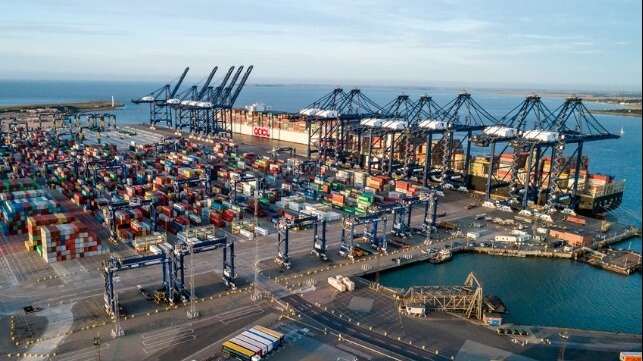
Freight association is calling for a review if the business practiices of ocean carriers (Felixstowe file photo)

PUBLISHED JAN 5, 2022 2:50 PM BY THE MARITIME EXECUTIVE


The British International Freight Association has become the latest trade association to call for a government investigation into the business practices of the global shipping lines and the state of competition in the industry. Citing complaints of “dreadful service levels, and hugely inflated rates” the association accuses the ocean carriers of profiteering with little regard to the needs of their customers.

In a letter to Robert Courts MP, Parliamentary Under Secretary of State at the Department for Transport, BIFA's Director General Robert Keen expresses the trade association’s concern that during a period of well-documented chaos within the container shipping sector, commercial power is becoming increasingly concentrated, resulting in diminished market choice and competition, and distorted market conditions.

“BIFA members fully accept that a free market economy is open to all, but are increasingly concerned that the activities of the container shipping lines, and the exemptions from legislation from which they benefit, are distorting the operations of that market to the shipping lines’ advantage, whilst adversely and unfairly affecting their customers, especially freight forwarders and SME businesses,” writes Keen. “Drewry recently issued a profit forecast of more than $150 billion for 2021 for the main container shipping lines. To put that into perspective, this is more than has been achieved in the previous 20 years combined, and many BIFA members consider it to be a case of blatant profiteering.”

BIFA points to the consolidation in the shipping industry as well as the growth of the three dominant alliances between the lines. “In 2015, there were 27 major container shipping lines carrying global containerized trade, with the largest having a 15.3 percent market share. Today, there are 15 shipping lines, organized into three major alliances carrying that trade, with some analysts observing that the market share of a single alliance on certain key routes could be over 40 percent.”

The association does not single out any carriers but instead focuses on the overall industry. The port of Felixstowe, which is Britain’s largest container port, like many of the world’s ports suffered from extended backlogs and congestion in 2021. During the summer, executives from Maersk confirmed in media interviews that the shipping giant had begun skipping the U.K. port diverting some of its larger containerships to the continent due to the backlogs. Maersk reported that it was using feeder vessels to deliver containers into the U.K. port to avoid congestion and maintain better schedule integrity on its primary liner routes.

In mid-December, the 2M Alliance, announced plans to rationalize its schedules to better manage challenges at the terminals in Felixstowe. They said that going forward they would be replacing a call at the U.K. port with increased time in Rotterdam while combining service from two routes into a single call at Felixstowe. Port officials at Felixstowe responded saying they welcome the change as a means to provide a faster, more efficient, and more reliable service for shippers citing that volumes at the port were up 10 percent year-over-year.

BIFA highlighted that it is joining a growing number of organizations, including its European counterparts CLECAT and FIATA, as well as the U.S. Federal Maritime Commission, and the Australian Productivity Commission, in calling for governments and regulators to give careful consideration to the evolving business arrangements in the container shipping market to see whether they are in breach of competition law.