Middle-income households were “squeezing more life out of every dollar before deciding to spend it” last month, while low-income families and individuals “showed greater financial strain.”
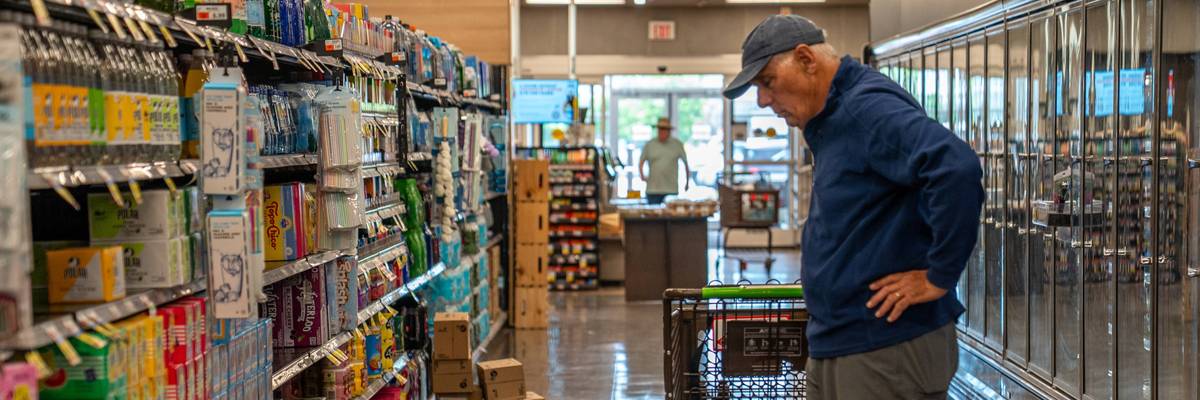
A shopper looks at a beverage display on June 4, 2026 at a supermarket in South Burlington, Vermont. Food prices have increased nearly 30% since 2020 according to the Bureau of Labor Statistics.
(Photo by Robert Nickelsberg/Getty Images)
Julia Conley
Jun 05, 2026
COMMON DREAMS
The Beige Book, a monthly report on consumer spending, labor markets, and inflation from the Federal Reserve’s 12 districts across the country, offers an up-to-date look on how the US economy is impacting households across the US—and this week, the report for May showed a continuation of the trend that accelerated after President Donald Trump joined Israel in attacking Iran more than three months ago.
“This month’s report, the third since the escalation of the conflict in the Middle East, reveals that soaring input costs are triggering price hikes for consumers,” said the progressive think tank Groundwork Collaborative.
The report notes that regional contacts at the Federal Reserve’s districts described middle-income households as “squeezing more life out of every dollar before deciding to spend it,” while low-income families and individuals “showed greater financial strain.”
“Overall, there were reports of increased credit card usage, fewer retail visits, and stronger demand for necessities,” reads the Beige Book.
“Higher-income households remained resilient and less sensitive to price increase,” the Federal Reserve reported, indicating a “K-shaped economy”—in which wealthy Americans are represented by the top angled line and middle- and lower-income households are represented by the line angled toward the lower right.
The report comes as peace talks with Iran are stalled and the Strait of Hormuz—a key waterway for trade, particularly for the world’s oil supply, remains effectively closed following the US-Israeli invasion. Iran’s retaliatory move has sent global oil prices soaring, with gas now costing $4.22 per gallon on average.
“High prices for essentials like groceries and a tank of gas are busting household budgets and eliminating breathing room for middle- and low-income families.”
“Numerous contacts mentioned the conflict in the Middle East as a source of cost pressures and heightened business uncertainty,” reads the Beige Book. “Higher energy and fertilizer prices contributed to a moderate increase in food prices, especially for fresh produce.”
Manufacturers and retailers are also facing increased shipping costs, while auto repair rates and used-car financing rates “remained very high” in parts of the country.
The report was released days after the administration launched new strikes against Iran last weekend, and as Iran announced it was suspending peace talks with the US over Israel’s continued targeting of Lebanon.
Alex Jacquez, Groundwork’s chief of policy and advocacy, said that “Trump is choosing to keep prices high for working families.”
“High prices for essentials like groceries and a tank of gas are busting household budgets and eliminating breathing room for middle- and low-income families,” said Jacquez. “Despite his own party’s opposition, the president is forging ahead with his reckless, costly war—and leaving working Americans in the dust.”
The Beige Book also describes a “low-hire, low-fire” job market, “with workers increasingly reluctant to change jobs because of economic uncertainty.”
“Widespread economic uncertainty from continued tariffs and persistent inflation means businesses are delaying expansion, leading cautious employees to remain in their current roles—even if it means staying in worse-paying jobs,” said Groundwork.
The Federal Reserve pointed to a contact in the construction industry in Cleveland, Ohio who said employees are “nervous and stressed, as well as a human resources firm in Richmond, Virginia that reported ”that clients have explicitly slowed hiring for new roles due to uncertainty, while their existing employees seemed reluctant to leave ‘something stable’ for new opportunities.“
Jacquez said that based on the report, “Americans lucky enough to be employed full-time are losing faith in their ability to keep up with inflation as paychecks lag and the labor market stalls out.”
Jim Cramer calls out Trump official to his face for ignoring 'struggling Americans'
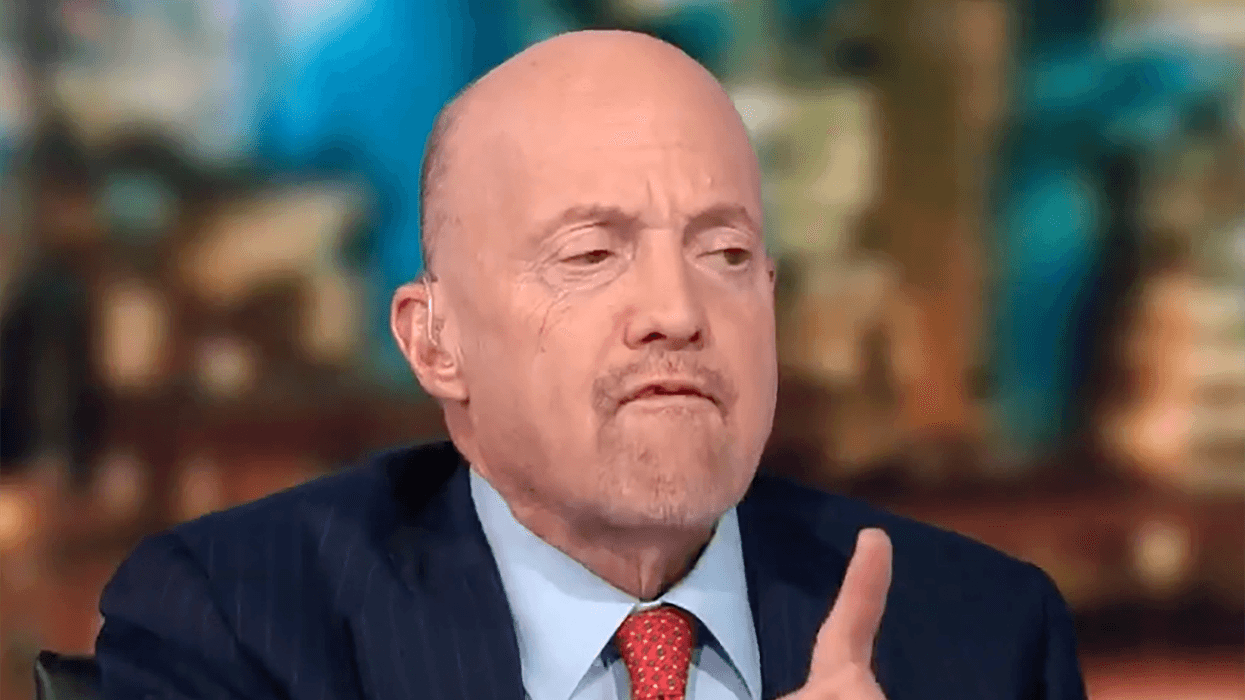
Jim Cramer, Image via Screengrab.
Jim Cramer, Image via Screengrab.
June 05, 2026
COMMON DREAMS
Longtime financial pundit Jim Cramer is worried. While President Donald Trump and his allies applaud Friday’s positive jobs report, Cramer thinks they’re not paying enough attention to the economic needs of “struggling Americans.”
While the news that job numbers have increased by 172,000 is theoretically good, Cramer posted that he is “concerned that the administration is not sensitive to the huge number of people who are struggling because of gasoline and higher rates.”
He specifically called out National Economic Council Director Kevin Hassett, who had appeared on Cramer’s CNBC show Friday morning, where the official seemed to suggest that the positive jobs report means the Fed should increase interest rates. Cramer did not like what he heard.
“Kevin, I’m a little surprised at you,” Cramer replied. “You sound like you’re part of that group which says we have to have rate hikes, and that’s a little disappointing. And I say it’s disappointing because if you’re listening to the Dollar General Call […] you’re going to hear things that are quite different from what you say, which is there’s a group of people in this country, if you listen to the people who make homes and try to sell them, a group of people in this country that are very disenfranchised.”
Hassett then tried to backpedal on his rate hike suggestion, but Cramer wasn’t having it, taking issue with the official’s assertion that “everybody’s doing well.”
“What you’re saying is that everybody’s doing well,” argued Cramer. “There’s a considerable part of the people who are not doing well in this country, and they need the help of the Fed, and I’m surprised that you’re not addressing those people — the people who make less than forty thousand dollars in this country who need help, have seen SNAP benefits decline, who have the higher gasoline prices because of the war with Iran. What about them?”
While much of their debate spotlighted interest rates, as Cramer noted, focusing on what positive economic indicators there are also ignores gas prices, which have skyrocketed due to Trump’s decision to launch war with Iran. While gas prices have come down slightly from the peak in mid-May, they’re still up by over 40 percent versus February.
What’s more, on Thursday, oil industry leaders warned Trump that prices are likely to increase significantly over the coming weeks. In the U.S., the worst of the oil cost climbs have been staved off by digging into reserves, but those stockpiles are “at dangerously low levels already” and about to run dry. Complicating matters further, even if Trump were to secure a deal to end the war and open the Hormuz Strait tomorrow, it would still take months for production to ramp back up and bring costs back down.
When Cramer pressed Hassett on these everyday issues hitting American pocketbooks, the latter could do little but resort to bluster.
“Well, obviously, we care about everybody,” Hassett claimed.
“Oh?” Cramer replied skeptically.
Longtime financial pundit Jim Cramer is worried. While President Donald Trump and his allies applaud Friday’s positive jobs report, Cramer thinks they’re not paying enough attention to the economic needs of “struggling Americans.”
While the news that job numbers have increased by 172,000 is theoretically good, Cramer posted that he is “concerned that the administration is not sensitive to the huge number of people who are struggling because of gasoline and higher rates.”
He specifically called out National Economic Council Director Kevin Hassett, who had appeared on Cramer’s CNBC show Friday morning, where the official seemed to suggest that the positive jobs report means the Fed should increase interest rates. Cramer did not like what he heard.
“Kevin, I’m a little surprised at you,” Cramer replied. “You sound like you’re part of that group which says we have to have rate hikes, and that’s a little disappointing. And I say it’s disappointing because if you’re listening to the Dollar General Call […] you’re going to hear things that are quite different from what you say, which is there’s a group of people in this country, if you listen to the people who make homes and try to sell them, a group of people in this country that are very disenfranchised.”
Hassett then tried to backpedal on his rate hike suggestion, but Cramer wasn’t having it, taking issue with the official’s assertion that “everybody’s doing well.”
“What you’re saying is that everybody’s doing well,” argued Cramer. “There’s a considerable part of the people who are not doing well in this country, and they need the help of the Fed, and I’m surprised that you’re not addressing those people — the people who make less than forty thousand dollars in this country who need help, have seen SNAP benefits decline, who have the higher gasoline prices because of the war with Iran. What about them?”
While much of their debate spotlighted interest rates, as Cramer noted, focusing on what positive economic indicators there are also ignores gas prices, which have skyrocketed due to Trump’s decision to launch war with Iran. While gas prices have come down slightly from the peak in mid-May, they’re still up by over 40 percent versus February.
What’s more, on Thursday, oil industry leaders warned Trump that prices are likely to increase significantly over the coming weeks. In the U.S., the worst of the oil cost climbs have been staved off by digging into reserves, but those stockpiles are “at dangerously low levels already” and about to run dry. Complicating matters further, even if Trump were to secure a deal to end the war and open the Hormuz Strait tomorrow, it would still take months for production to ramp back up and bring costs back down.
When Cramer pressed Hassett on these everyday issues hitting American pocketbooks, the latter could do little but resort to bluster.
“Well, obviously, we care about everybody,” Hassett claimed.
“Oh?” Cramer replied skeptically.
Top executives warn Trump that even worse price hikes are coming – and soon
Thomas Kika
Thomas Kika
June 04, 2026
ALTERNET
At a time when voters are ready to hand Republicans a midterm revolt over the economy, Politico reported this week that top executives warned President Donald Trump that prices are about to get much worse if he does not solve the war in Iran.
Trump remains embroiled in negotiations for a lasting ceasefire and resolution to the war, which he started, with Iran's new hardline leadership refusing his demands. As that situation continues to spiral, the Strait of Hormuz remains either closed off or dangerous, depending on the day, sending global oil prices surging as a result.
According to a Thursday report from Politico, oil executives have warned Trump and his administration that, as bad as things are now, they are about to get much worse if the Strait is not reopened in a matter of weeks, citing sources close to the discussions. Without the oil that gets shipped through the body of water, global oil reserves will start to dwindle to a dangerous degree, sending prices to new heights.
"Industry executives have flagged the issue to senior White House officials and Cabinet members in recent weeks as part of the Trump administration’s ongoing dialogue with the U.S. energy industry, the people said," the report detailed. "The warnings came as recently as late last month as data from the U.S. Energy Information Administration and other sources began showing that fuel makers were increasingly relying on oil and fuel from their storage tanks to replace products no longer arriving from the Middle East."
It added later: "Some of the conversations have been general warnings while others have focused on tight inventories of specific fuel types in particular locations, such as jet fuel on the West Coast, a second person involved in the conversations said."
In response to Politico's query about the supposed warnings, the White House gave only a terse response blasting the outlet for citing anonymous sources.
“We’re at dangerously low levels already,” one of those sources, an anonymous industry executive, told Politico. “We have shared those concerns at the highest levels of government about what’s coming in mid-to-late June. … I hope they are paying attention to inventories right now. You’re hitting tank bottom.”
Exxon executive Neil Chapman recently told investors that crude barrels could reach $150-160 in two or three weeks. Another anonymous executive told Politico that the White House has already been made aware of that and warned of the crunch coming for consumers during the big holiday travel rush.
“Don’t think that an open strait is going to mean your July 4 gasoline bill isn’t going to be higher than what it is today," they said. "It’s going to be.”

At a time when voters are ready to hand Republicans a midterm revolt over the economy, Politico reported this week that top executives warned President Donald Trump that prices are about to get much worse if he does not solve the war in Iran.
Trump remains embroiled in negotiations for a lasting ceasefire and resolution to the war, which he started, with Iran's new hardline leadership refusing his demands. As that situation continues to spiral, the Strait of Hormuz remains either closed off or dangerous, depending on the day, sending global oil prices surging as a result.
According to a Thursday report from Politico, oil executives have warned Trump and his administration that, as bad as things are now, they are about to get much worse if the Strait is not reopened in a matter of weeks, citing sources close to the discussions. Without the oil that gets shipped through the body of water, global oil reserves will start to dwindle to a dangerous degree, sending prices to new heights.
"Industry executives have flagged the issue to senior White House officials and Cabinet members in recent weeks as part of the Trump administration’s ongoing dialogue with the U.S. energy industry, the people said," the report detailed. "The warnings came as recently as late last month as data from the U.S. Energy Information Administration and other sources began showing that fuel makers were increasingly relying on oil and fuel from their storage tanks to replace products no longer arriving from the Middle East."
It added later: "Some of the conversations have been general warnings while others have focused on tight inventories of specific fuel types in particular locations, such as jet fuel on the West Coast, a second person involved in the conversations said."
In response to Politico's query about the supposed warnings, the White House gave only a terse response blasting the outlet for citing anonymous sources.
“We’re at dangerously low levels already,” one of those sources, an anonymous industry executive, told Politico. “We have shared those concerns at the highest levels of government about what’s coming in mid-to-late June. … I hope they are paying attention to inventories right now. You’re hitting tank bottom.”
Exxon executive Neil Chapman recently told investors that crude barrels could reach $150-160 in two or three weeks. Another anonymous executive told Politico that the White House has already been made aware of that and warned of the crunch coming for consumers during the big holiday travel rush.
“Don’t think that an open strait is going to mean your July 4 gasoline bill isn’t going to be higher than what it is today," they said. "It’s going to be.”

No comments:
Post a Comment