Wednesday, September 21, 2022

Economic stimulus should have stopped earlier to tame inflation, Bank of Canada says

At the same time, Beaudry said the stimulus measures contributed to a faster-than-expected bounceback for the economy, with labour markets recovering six months sooner than after the global financial crisis.


OTTAWA — Bank of Canada deputy governor Paul Beaudry said in hindsight, governments and central banks should have withdrawn stimulus measures earlier as economies recovered from the COVID-19 pandemic, which likely would have kept a lid on inflation.


In a speech at the University of Waterloo on Tuesday, Beaudry said a faster global withdrawal of fiscal and monetary stimulus during the recovery from the pandemic would have likely resulted in lower inflation.

Beaudry said fiscal and monetary policy in one country has spillover effects in other nations that are not always accounted for.

One of the lessons from the global financial crisis in 2008-2009, he said, was that countries would have benefited from a more gradual withdrawal of stimulus because of spillover effects.

This lesson, he said, influenced policy decisions during the pandemic. However, Beaudry noted that the COVID-19 economic crisis was different and public health measures meant supply in many sectors couldn’t keep up as demand began rebounding.

“Bottlenecks occurred in these sectors because of demand surges driven by a combination of stimulus policies, shutdowns and re-opening, as well as by consumers shifting away from services."

The deputy governor said the stimulus delivered simultaneously by countries through government support programs and lower interest rates had spillover effects globally and contributed to supply chain bottlenecks.

“It’s likely a somewhat faster global (stimulus) withdrawal process could have made all countries better off,” he said.

At the same time, Beaudry said the stimulus measures contributed to a faster-than-expected bounceback for the economy, with labour markets recovering six months sooner than after the global financial crisis.


Canada's inflation rate slows to 7%

“Fiscal policy measures clearly prevented a worse outcome."

Moving forward, Beaudry said the Bank of Canada is focused on clear communications with the public on its policy decisions to ensure Canadians don’t expect high inflation to persist for long.

Central banks generally worry when people and businesses expect inflation to remain high because those expectations can feed into even higher prices.

Beaudry also addressed concerns raised by some that the central bank would need to engineer a substantial economic slowdown, or even a recession, to bring inflation down.

Beaudry said the Bank of Canada believes people set their inflation expectations partly based on past inflation and partly on communication of central banks about where monetary policy is headed.

Statistics Canada released its consumer price index report for August earlier on Tuesday, which showed inflation slowed to 7.0 per cent. Beaudry said while inflation is headed in the right direction, it's still "too high."

The deputy governor said the bank is leaning into effective communication with the public on monetary policy to help alleviate some of the heightened concern about inflation persisting.

“The bank is committed to keeping its communications during this difficult period clear, simple and focused on our inflation mandate,” he said, adding that the more effective the bank is with its communications, the more likely a recession can be avoided.

The deputy governor concluded by reiterating the bank’s commitment to bring inflation back to its two per cent target and thereby fulfilling its mandate.

“We will continue to take whatever actions are necessary to restore price stability for households and businesses.”

This report by The Canadian Press was first published Sept. 20, 2022.

The Canadian Press

Note to readers: This is a corrected story. A previous version gave the wrong day of the week for Beaudry's speech.
Mass stranding kills 14 whales in Australia

AFP - Yesterday 


Australian wildlife investigators were on Wednesday trying to piece together why more than a dozen young male sperm whales died in a mass stranding on a remote beach in the state of Tasmania.


The 14 whales were discovered beached on King Island earlier this week, off Tasmania's north coast.

Biologists and a veterinarian from the state's conservation agency have travelled to the small island to investigate, with an aerial survey finding no other stranded whales.

The young whales' deaths may be a case of "misadventure", wildlife biologist Kris Carlyon from the state government conservation agency told the local Mercury newspaper.

"The most common reason for stranding events is misadventure, they might have been foraging close to shore, there might have been food and possibly they were caught on a low tide," Carlyon said.

"That's the theory at the moment."

He said the whales likely beached themselves on Sunday, before being found dead on Monday.

Mass strandings of whales were "infrequent but certainly not unexpected" in the region, Carlyon told The Mercury.

In 2020, Tasmania experienced Australia's largest-ever mass stranding when 470 whales became stuck in the state's west.

More than 300 pilot whales died during that stranding, despite the efforts of dozens of volunteers who toiled for days in Tasmania's freezing waters to free them.

The reason for mass whale strandings remains mysterious, but some experts theorised the 2020 pod may have gotten lost after feeding close to the shoreline or by following one or two whales that strayed.

mmc/arb/qan
Montana to allow transgender people to change birth record

“Appeal is what you contemplate — not that you can nullify a judge’s orders. Otherwise, people just wouldn’t obey the law,”  “The system can’t work that way.”′


HELENA, Mont. (AP) — After months of defiance, Montana’s health department said Monday it will follow a judge’s ruling and temporarily allow transgender people to change the gender on their birth certificates.


Montana to allow transgender people to change birth record© Provided by The Canadian Press

The judge issued a scathing order Monday morning saying health officials made “calculated violations” of his order, which had told them to temporarily stop enforcing a law blocking transgender people from changing their gender on their birth certificates unless they had undergone surgery.


District Court Judge Michael Moses said Monday he would promptly consider motions for contempt based on continued violations of his April order, which he clarified in a verbal order at a hearing on Thursday. Just hours after that hearing, the Republican-run state said it would defy the order and keep in place a rule that disallowed any changes to birth certificates unless they were due to a clerical error.

On Monday afternoon, the Department of Public Health and Human Services issued a statement saying it would comply with the order, despite disagreeing with it.

During Thursday's hearing, attorneys for the state had argued that blocking the law did not prevent the health department from promulgating new administrative rules.

The state, Moses wrote, engaged “in needless legal gymnastics to attempt to rationalize their actions and their calculated violations of the order." He called the state's interpretation of his earlier order “demonstrably ridiculous.”

“The department stands by its actions and analysis concerning the April 2022 preliminary injunction decision, as set forth in its rulemaking that addressed critical regulatory gaps left by the court,” said Jon Ebelt, spokesperson for the health department. The agency is considering its next steps in the litigation, the statement said.

“It's unfortunate that it has taken two very clear court orders and many months to comply with the law,” said Alex Rate, an attorney with the ACLU of Montana. The ACLU represents the plaintiffs, two transgender people who want to change their birth certificates.

“But from the perspective of transgender Montanans who are seeking to obtain accurate identity documents, today's announcement is certainly progress," Rate said.


Judge orders state to allow transgender Montanans to change their sex marker, state says no
Duration 2:42    View on Watch


Ebelt did not respond to an email asking when the state might start processing applications. Rate did not know how many people have sought to correct their birth certificate in recent months, but he was aware of people who had contacted the court after the April injunction and up through Monday.

In April, Moses temporarily blocked a law passed by the Republican-controlled 2021 Legislature that would require transgender residents to undergo a surgical procedure and obtain a court order before being able to change the sex on their birth certificate. He said the law was unconstitutionally vague because it did not specify what kind of surgery would be required.

Rather than returning to a 2017 rule that allowed transgender residents to file an affidavit with the health department to correct the gender on their birth certificate, the state instead issued a rule saying a person's sex could not be changed, even after having surgery.

The health department “refused to issue corrections to birth certificates for weeks in violation of the order,” Moses wrote. The state did not appeal Moses' ruling either.

The ACLU of Montana had requested the judicial clarification due to the state's inaction.

Moses' order on Monday included a copy of the 2017 rules.

“If defendants requires further clarification, they are welcome to request it from the court rather than engage in activities that constitute unlawful violations of the order,” Moses wrote.

Such open defiance of a judge’s order is very unusual from a government agency, said Carl Tobias, a former University of Montana Law School professor now at the University of Richmond. When officials disagree with a ruling, the typical response is to appeal to a higher court, he said.

“Appeal is what you contemplate — not that you can nullify a judge’s orders. Otherwise, people just wouldn’t obey the law,” Tobias said Thursday. “The system can’t work that way.”′

The legal dispute comes as conservative lawmakers in numerous states including Montana have sought to restrict transgender rights, including banning transgender girls from competing in girls school sports. A different Montana judge last week determined a law passed by state lawmakers seeking to ban transgender women from participating on female collegiate sports teams was unconstitutional.

___

Associated Press reporter Matthew Brown in Billings, Montana, contributed to this story.

Amy Beth Hanson, The Associated Press
Q&A: Amanda Gorman talks UN poem, fame, future presidency

Monday

LOS ANGELES (AP) — When Amanda Gorman was invited to read a newly developed poem at the U.N. General Assembly, the young sensation took a deep look at how several societal issues — such as hunger and poverty — have impacted Earth’s preservation.

Provided by The Canadian Press

Just like her stirring inauguration poem last year, Gorman felt compelled to express the impact of unity through her poetic words on the opening day of the 77th session Monday in New York. The 24-year-old poet created “An Ode We Owe” in hopes of bringing all nations together to tackle various issues of disparity along with preserving the planet.

Gorman once again graced center stage in front of world leaders. Her fame exploded after she recited her poem “The Hill We Climb” at President Joe Biden’s inauguration, which made her the youngest inaugural poet in U.S. history. Her poem quickly topped bestsellers lists and made her one of the most in-demand poets, putting her on other big stages like the Super Bowl and in an interview with Oprah Winfrey.

In an exclusive interview with The Associated Press on Sunday, Gorman talked about her hopes for the U.N. poem, her future presidency plans, resentment she’s gotten toward her commercial success and wanting to someday write a novel.

Remarks have been edited for clarity and brevity.

AP: What do you want listeners to take away from your poem?

GORMAN: What I hope people can garner from the poem is that while issues of hunger and poverty and illiteracy can feel Goliath and are so huge, it’s not necessarily that these issues are too large to be conquered. But they’re too large to be stepped away from.

AP: How important is having a young voice like yourself to speak at the General Assembly?

GORMAN: When I was writing this poem, I kept getting flashbacks of several years ago when I came to New York for the first time. I was 16 and I was coming as the United Nations delegate for the Commission on the Status of Women. That was the first time I’d really ever engaged the U.N. as a space in any way. I just remember not seeing people who looked as young as me. I also looked like I was 11 at the time. I started marinating on this idea of “I want to come back someday in the future. I don’t just want to be a delegate. I want to be a presenter.” I’m not here to speak on behalf of young people, but to speak alongside and with them.

AP: Why did you touch on Sustainable Development Goals in your poem?

GORMAN: I actually think that there’s swaths of the population which has yet to be engaged or kind of told or activated around the Sustainable Development Goals. So much of what I like to do in the poem is making sure that we raise awareness around these issues and show that these goals do exist.

AP: How have you managed the transition to being a high-level celebrity?

GORMAN: I’m still learning and growing so much. I think one of the things that changed so much for me was just privacy. All of a sudden I became someone — which I never really necessarily expected — who gets recognized on the street. If I go to a restaurant, even if I’m wearing a mask, people are very good at spotting my face and or my voice. I’m very grateful for that type of visibility, even though sometimes I do miss individual privacy because it means that I have a platform that I can use for good.

AP: How have people approached you while in public?

GORMAN: I had an experience (Saturday) night. I was eating at a restaurant and a woman just came up to me and started crying and saying how much my poetry meant to her. It’s flabbergasting to me. That’s not a rare occurrence in my life anymore. My friends started crying around me seeing this woman’s emotion. I had a great conversation with that woman before she moved on, and me having to take a moment, sit with the fact that there were so many people around the world who probably have this person’s same response that haven’t gotten to me. I want to do justice by them when I write. I want to honor them when I write. That’s a really hefty ask. But I also think it’s a deep seated privilege of mine. I think that’s the thing that I wrestle with and draw power from when I write.

AP: Has the fame changed your writing?

GORMAN: I think it hasn’t changed my writing in the sense that my voice and style is still the same because the roots of where I come from are still there. But I do think it makes me think more creatively and imaginatively about ways in which I can get those poems in the world.

AP: Is it much harder to write these days?

GORMAN: I think the main difficulty in writing poetry for me nowadays is, yes, that there’s a lot going on. But even if I’m able to carve out time and space to write, I think the biggest challenge that I can face sometimes is just my own self-sabotage in the sense that I feel so much pressure and so many eyes on me.

AP: How do you keep out the distractions?

GORMAN: I’m like a 70-year-old in an 11-year-old body. I have muscles from that of pulling away from technology and pretending like it’s not there. Like it doesn't exist. When I write, I tend to put all my devices on “Do Not Disturb.”

AP: Have you had to deal with any resentment from the poetry community, who sometimes don’t look kindly upon commercial success?

GORMAN: The only type of trolling that I experience is actually not from other poets. It’s from people who don’t write poetry. I hear those kind of like “What Amanda Gorman does isn’t that difficult. I don’t understand why she’s famous.” I have no ill will towards those people. I actually, in a sense, feel bad for them because more often than not, these are people who haven’t been exposed to a lot of poetry in their lives, who haven’t been either encouraged or challenged to write poetry in their lifetimes.

AP: What are your thoughts toward those skeptics?

GORMAN: I think the one thing I have to say to those people would be if you’re reading my work and you’re saying, “Amanda Gorman's writing is so easy for me to do and I can do better.” Oh, my God. We need you. We need you to pick up a pen and write. That means you’re going to be the next great voice of literature. I would love for you to find a way to, for lack of a better term, dethrone me.

AP: Do you still plan to run for president someday?

GORMAN: Yes, that’s still the case. I obviously have a long way to go — not just in terms of years, but in terms of learning.

AP: Is there a timetable?

GORMAN: No, I’m just living and enriching my life with the understanding of “Wow, girl you are a weapon of cultural and poetic power. Here’s where you decide what to do with it.” Whether that follows a specific table that’s explicit for the presidency or whether it’s one that’s a bit more unorthodox and nontraditional than we’ve seen, I think remains to be seen.

AP: Do you aspire to write something besides poetry?

GORMAN: I love poetry, but I love all forms of writing. When I was younger, I actually wanted to be a novel writer. But novels just take — for me — a longer amount of time than a single poem. That’s just how my brain and writing works. But I would love to get out some more prose, some more essay writing. You’ll definitely get more than just a verse for me.

AP: What kind of novels?

GORMAN: I really like to draw from what I consider to be my literary ancestors Zora Neale Hurston or Toni Morrison, who wrote this beautiful prose, which I think came out a culture of language that they drew from the African American community. I think about the titans of writing whose footsteps I would love to dance in.

___

Text of Amanda Gorman’s poem, “An Ode We Owe,” first read to the U.N. General Assembly on Monday:

How can I ask you to do good,

When we’ve barely withstood

Our greatest threats yet:

The depths of death, despair and disparity,

Atrocities across cities, towns & countries,

Lives lost, climactic costs.


Related video: U.S. poet Amanda Gorman opens 2022 U.N. General Assembly week
Duration 4:12  View on Watch


0:56
Poet Amanda Gorman hopes to unite the world with 'An Ode We Owe' poem at United Nations


Exhausted, angered, we are endangered,

Not because of our numbers,

But because of our numbness. We’re strangers

To one another’s perils and pain,

Unaware that the welfare of the public

And the planet share a name–

–Equality

Doesn’t mean being the exact same,

But enacting a vast aim:

The good of the world to its highest capability.

The wise believe that our people without power

Leaves our planet without possibility.

Therefore, though poverty is a poor existence,

Complicity is a poorer excuse.

We must go the distance,

Though this battle is hard and huge,

Though this fight we did not choose,

For preserving the earth isn’t a battle too large

To win, but a blessing too large to lose.

This is the most pressing truth:

That Our people have only one planet to call home

And our planet has only one people to call its own.

We can either divide and be conquered by the few,

Or we can decide to conquer the future,

And say that today a new dawn we wrote,

Say that as long as we have humanity,

We will forever have hope.

Together, we won’t just be the generation

That tries but the generation that triumphs;

Let us see a legacy

Where tomorrow is not driven

By the human condition,

But by our human conviction.

And while hope alone can’t save us now,

With it we can brave the now,

Because our hardest change hinges

On our darkest challenges.

Thus may our crisis be our cry, our crossroad,

The oldest ode we owe each other.

We chime it, for the climate,

For our communities.

We shall respect and protect

Every part of this planet,

Hand it to every heart on this earth,

Until no one’s worth is rendered

By the race, gender, class, or identity

They were born. This morn let it be sworn

That we are one one human kin,

Grounded not just by the griefs

We bear, but by the good we begin.

To anyone out there:

I only ask that you care before it’s too late,

That you live aware and awake,

That you lead with love in hours of hate.

I challenge you to heed this call,

I dare you to shape our fate.

Above all, I dare you to do good

So that the world might be great

___

For more on the U.N. General Assembly, visit
 https://apnews.com/hub/united-nations-general-assembly

Jonathan Landrum Jr., The Associated Press
UN warns of humanitarian needs still persisting in Pakistan due to floods

Nearly a month after Pakistan suffered the worst floods in its recent history, UN agencies have warned that the humanitarian situation remains complex in a country where nearly 8 million people remain out of their homes.


Aerial view of a waterlogged area in Jiber Pakhtunkhwa province, Pakistan. - UNICEF/ASAD ZAIDI

More than 1,500 people died in the storm, including more than 550 children. "If support does not increase significantly, we fear that many more will lose their lives," said Gerida Birukila, head of operations of the United Nations Children's Fund (UNICEF) in Balochistan.

More than 30 million people were affected in some way by the floods, which to this day still have large areas flooded by water and damaged or washed away infrastructure, especially in the province of Sindh. Birukila has warned that in some parts "families have no food, clean water or medicine".

Related video: Pakistan Floods Spark Humanitarian Crisis
Duration 1:00 View on Watch


"The lack of food means that many mothers are now anemic and malnourished, and have underweight babies," she added.

A spokesman for the UN High Commissioner for Refugees (UNHCR), Babar Baloch, agreed that "the situation remains complicated" in Pakistan, where authorities and humanitarian agencies have embarked on a "race against time" to try to avoid new deaths, for example due to outbreaks of new diseases.

Pakistan faces a "colossal challenge," said Baloch, who appealed for help from the international community. "UNHCR reiterates its call for more support for this country and its citizens," he added.

For her part, the head of UNICEF believes that "the world must unite and help the children of Pakistan". However, she recalled that of the 39 million dollars (38.9 million euros) requested, the agency has so far covered less than a third.
Swiss activists drop campaign against F-35 fighter deal

Activists have withdrawn their campaign to stop Switzerland from buying 36 Lockheed Martin LMT.N F-35A Lightning II fighter jets after the government signed a $5.5 billion procurement deal without waiting for a referendum.


By REUTERS - Yesterday 

Switzerland and fighter jets

Switzerland chose the F-35 last year as its next-generation fighter jet, angering opponents who said they would ensure a referendum to overturn what they called an unnecessary "Ferrari" option.

Related video: Big dogfight: Switzerland avoids F-35 referendum despite 1 lakh ( a hundred thousand:) signatures for public vote | Duration 3:18  View on Watch

Parliament approved the deal last week, and a contract was signed on Monday even as opponents were gathering signatures to force a referendum under the Swiss system of direct democracy.


"The Alliance against the F-35 will not lend a hand for a pseudo-referendum in which the electorate cannot decide on the actual purchase decision," the group said on Tuesday.


Two F35 fighter jets from the Vermont Air National Guard's 134th fighter squadron, which are for the first time part of NATO's security policy, stand parked at Skopje Airport, North Macedonia June 17, 2022.
 (credit: REUTERS/OGNEN TEOFILOVSKI)

"A vote after the contract has been signed is nothing but a democratic farce. For this reason, the Alliance against the F-35 will withdraw its popular initiative, but remains convinced that the F-35 is a bad purchase and a billion-dollar risk for Switzerland."
GOOD NEWS
Raisi meets with Macron on the sidelines of UN General Assembly in view of reactivating nuclear deal

Iranian President Ebrahim Raisi has held a meeting with French President Emmanuel Macron on the sidelines of the United Nations General Assembly in New York in a bid to unblock the Iranian nuclear deal.


Iranian President Ebrahim Raisi on his arrival in New York. - -/
ZUMA Press Wire/dpa

The meeting, of which for the moment only photographs have been released, marks the beginning of a round of contacts within the framework of the UN General Assembly, which brings together representatives of all the countries participating in the nuclear pact.

The diplomatic process, sponsored by the EU, seeks to restore an agreement that, although still in force, is badly damaged after the United States withdrew unilaterally during the Donald Trump era. Iran, for its part, breached the agreed limits on its nuclear activity.

Tehran called weeks ago for "stronger guarantees" from Washington for the reactivation of the 2015 nuclear deal, while stressing that one of the conditions for the return is for the International Atomic Energy Agency to focus "solely on its duties and responsibilities."

Meanwhile, the U.S. has rejected these requests, by labeling the response as "not constructive" and has assured that it will formulate its own response. For the EU, the proposal put on the table by Borrell on August 8 is a final document that the participants in the nuclear agreement must subscribe to or reject, after a 17-month process of talks, mainly in Vienna.

Upon his arrival in New York, Raisi explained that the meeting in the United States will serve the country to explain its points of view, while pointing out that it is a platform to discuss the problems of today's world and find collective solutions to solve them.

"Sanctions are harmful to nations and are in conflict with peace and security," he has stated, adding that such actions are "manifestations of unilateralism," a stance that "causes suffering to human societies."

Raisi has previously clarified that he does not intend to meet with US officials as part of his five-day visit, which is, according to the Iranian side, a "big stage" for expressing Tehran's stance.

"This trip is an opportunity to express actions that are sometimes not heard because the world's media space is dominated by the big powers," he stressed on Monday, adding that "there is no reason for negotiations or meetings with the Americans."


Show of support for Ukraine takes ugly turn outside Russian Consulate in Montreal

RUSSIAN CONSULATE SECURITY WAS RUDE
THIS IS CANADA AFTER ALL

CBC/Radio-Canada - Yesterday

Serge Sasseville lives across the street from the Russian Consulate in Montreal and has been wheeling a stroller covered in red paint out his door nearly every day at noon since mid-March.

He then stands in front of the consulate, usually with fellow demonstrators at his side, and blasts the Ukrainian anthem with a wireless speaker while yelling support for a country that was invaded by Russia in February.

The anthem is preceded by the sounds of sirens and gunshots so the people inside the consulate can hear what it's like in Ukraine, Sasseville said.

And even though he tested positive for COVID-19 on Sunday, the anthem was still played Monday as his fellow demonstrators took over the daily ritual.

Everything was going as planned until Sasseville's phone rang.

It was Claude Fournier and Fournier's sister-in-law calling to say something had gone terribly wrong.
Altercation over speaker

Sasseville, a Montreal city councillor for the Peter-McGill district of the Ville-Marie borough, went to his doorstep.

Sasseville's friends told him that a man from the consulate was harassing them. The man was insisting they stop playing the anthem and threatening to throw their speaker to the ground.

"Which he did," Sasseville said.

But Fournier, who has been demonstrating in front of the consulate since the war's start, recovered the scuffed up speaker and continued playing the anthem.


Claude Fournier, renowned Canadian filmmaker, says a man tossed his Bose speaker to the ground in front of the Russian Consulate before physically assaulting his sister-in-law.© Sharon Yonan-Renold/CBC

"Mostly he was saying, 'get out of here or else I'll get you out of here!'" Fournier recounted. "At one point, I faced him, and he said, 'I am giving you five seconds to get out of here or else!'"

Fournier is 91 years old and has a pacemaker.

He decided it wasn't safe to stand up to the man. He stepped into the street. His sister-in-law took out her phone and tried to film the altercation, but the man went after her, Fournier said.

"He grabbed and held her. And tried to get her phone. So she started yelling," Fournier said.

Undeterred demonstrator plans return

They called the police. Officers came about five minutes later and took witness reports.

According to a spokesperson with the Service de police de la Ville de Montréal (SPVM), officers did respond to a call at the consulate, but no complaint was filed. The spokesperson said there is no law prohibiting music from being played on a public sidewalk.

Fournier said the man who confronted them spoke French like a Quebecer, and he wonders if the man was hired to intimidate demonstrators. It wasn't his first altercation with consulate employees, he said, and he suspects it won't be the last.


Sasseville says he will continue to display Ukrainian flags on his house for as long as the war continues.© CBC

He plans to be better prepared when he goes back to play the anthem at noon on Tuesday, he said, this time with a camera ready and the speaker attached to him rather than on the ground so it can't be easily tossed.

"It was a bit scary, especially because I wasn't at all prepared for that," Fournier said. "[Tuesday] it will be OK because I am going to proceed differently."

He will continue to fight for Ukrainians because, he explained, no matter what happens here, "it's nothing compared to their suffering."
Continuing to fight for Ukraine

Sasseville said his friends, interrupted by the confrontation, never completed the ritual. So after they left, he went out to his car which was parked in the driveway.

"Even though it was raining, I rolled the windows down and played three times that recording of the Ukrainian anthem," said Sasseville.

"They have to understand, we will not stop doing what we are doing because they are threatening us."


Sasseville has been demonstrating almost daily in front of the Russian Consulate since March.
© Paul Chiasson/The Canadian Press

Sasseville said a consulate employee attacked him in early June as well, and he filed a complaint with the Montreal police.

But he is undeterred. As long as the war continues, he said Ukrainian flags will be displayed on his house and the anthem will be played every day by him or his friends.

"No threat from the Russians will stop me," he said.

He said the intimidation has to stop, and that's why he is in contact with Canadian Foreign Affairs Minister Mélanie Joly, insisting the consulate and all its employees be expelled from the country.

"It's unacceptable. You have citizens who are committed to demonstrating their opposition to a genocidal war and you have employees from a consulate who are attacking them," he said.

"They are not only killing people in Ukraine. They are attacking Canadians."

In a written statement, the consulate said none of its staff was involved or even present during the demonstration.

"We feel we are not entitled to comment on what seems to be a dispute between Canadian residents," the statement said.
BECAUSE OF COURSE HE DOES
Bolsonaro uses his UN loudspeaker to attack Lula two weeks before Brazil’s elections

The president of Brazil, Jair Bolsonaro, used his lectern on Tuesday at the start of the 77th session of the United Nations General Assembly to attack, without naming him, his rival in the elections in two weeks, former president Luiz Inácio Lula da Silva.


Archive - Jair Bolsonaro speaks at the UN General Assembly - UN PHOTO/CIA PAK© Provided by News 360

"During my administration we have put an end to the systemic corruption that existed in the country. Between 2003 and 2015, the period in which the left presided over Brazil, the level of indebtedness of Petrobas (...) reached 170 billion dollars. The person responsible has been convicted," he said in reference to Lula, exonerated of the charges due to the malpractice of the courts.

After the UN Secretary General, António Guterres, Bolsonaro was the next to take the floor, as is the tradition in the United Nations Assembly, and he took the opportunity to highlight the economic policies of his government, especially during the coronavirus health crisis.

Bolsonaro defended that they have sufficient "authority" to give their opinion on the world health agenda "since no effort was spared in saving lives and guaranteeing jobs", at the same time that "a broad vaccination program" against COVID-19 was implemented.

"With more than 210 million people, more than 80 percent are fully vaccinated. All of them voluntarily, respecting their individual freedom," said Bolsonaro, who blamed his government's economic measures for the fall in poverty generated by the pandemic in Brazil.

"The denounced have returned a billion dollars and we have paid to the US stock market another billion due to the losses of investors", all this, he said, while continuing to invest in public services and in science and technology.

DEVELOPMENT AND ENVIRONMENT 

Bolsonaro highlighted Brazil's role as one of the world's leading food exporters. This, he has pointed out, is due to the "huge investments" that have been allocated to science and innovation. "If it were not for Brazilian agriculture, the planet would go hungry," he has said.

Regarding the environment, Bolsonaro has assured that "Brazil is part of the solution and an example for the world," thus responding to criticism of his policies in the Amazon. "More than 80 percent of the forests have not been touched, contrary to what the media mentions," he has protested.

INTERNATIONAL CONFLICTS

 The Brazilian president also pointed out that while the current United Nations has served to restore peace after World War II, the current conflict in Ukraine has served as a "warning" and advocated "a reform" to find world peace "After 25 years of debates in the Security Council, we have to look for innovative solutions. Brazil approaches the issue based on experience dating back to the beginnings of the United Nations. We have tried our best to offer negotiated solutions to pacify conflicts," he said.

Among those solutions, he has explained, is the opening of its borders for all those fleeing conflicts, mentioning the case of the 350,000 Venezuelan brothers and sisters who have found shelter in Brazilian territory since 2018. "We have also welcomed Haitians, Syrians, Afghans and Ukrainians."

As far as Ukraine is concerned, Bolsonaro wanted to thank countries such as Poland, Hungary or Slovakia for their help in evacuating Brazilian citizens when Russia started the invasion seven months ago now.

In reference to the conflict itself, he has pointed out that Brazil is governed by the principles of international law and the United Nations Charter. "We advocate for an immediate ceasefire, for the protection of non-combatant civilians, the safeguarding of infrastructures to help the population and the maintenance of all channels of the parties to the conflict."

"These are the first steps towards finding a lasting and sustainable solution. We have worked in this sense in the United Nations and other places, we have tried to avoid hindering the channels of dialogue by the polarization of the conflict", said Bolsonaro "That is why we oppose diplomatic and economic isolation, as it is felt in the world prices of food, fuel and other raw materials (...) We do not think that the best way is to adopt unilateral and selective sanctions that are not in line with international law", he insisted.

Bolsonaro has said that these restrictions have damaged the economies of many countries and that the conflict in Ukraine will only be resolved through dialogue. "Let's not waste any opportunity to resolve the conflict," he demanded.


Bolsonaro fined almost 1,000 euros for early electioneering propaganda

Brazil's Superior Electoral Court (TSE) has fined the campaign of the president, Jair Bolsonaro, 5,000 reais (about 975 euros) for carrying out advance electoral propaganda last April during an event in the city of Cuiabá, in the west of the country, where he participated in a motorcycle caravan.


Jair Bolsonaro. - PAULO LOPES / ZUMA PRESS / CONTACTOPHOTO

"Under the pretext of fulfilling his official agenda, he participated in a motorcycle caravan with a large number of people. It was an event of great electoral impact. Our jurisprudence is based on the electoral character of this type of events. The previous organization and the presence of the candidate prove it", explained the vice-president of the TSE, Ricardo Lewandowski, in the ruling.

During that multitudinous motorcycle ride, Bolsonaro and his team would have asked in advance the vote for his candidacy for reelection in the next elections on October 2, in which the president, in the best case scenario, would reach the second round far behind the favorite, former president Luiz Inácio Lula da Silva.

The ruling comes as a result of a petition by the Workers' Party (PT), against a previous decision by Judge Maria Claudia Bucchianeri, who first considered that Bolsonaro's campaign team did not explicitly ask for the vote for him, recalls the newspaper 'O Globo'.

The latest survey published by the IPEC and Datafolha institutes this Monday, Lula continues to lead the presidential race with 47 percent of Brazilians' voting intention, just three percentage points away from winning in the first round. Bolsonaro remains with 31 percent.

At the state level, Tuesday's polls show how Lula has managed to take the lead in voting intention in Rio de Janeiro, with 41 percent, which means four points more than Bolsonaro. In Sao Paulo the situation is also favorable to the PT leader, with a lead that reaches ten percentage points, a distance that reaches 15 points in Minas Gerais.


Lula acknowledges that Brazil’s image in the organization of the 2014 World Cup was that of a corrupt country

Brazil's former president and candidate for the October elections, Luiz Inácio Lula da Silva, has regretted that the organization of the 2014 World Cup left the image that "everyone stole" from the construction of the stadiums and acknowledged that they almost "destroyed" themselves with the organization of the event.


The former Brazilian president Luiz Inácio Lula da Silva. 
- MATHEUS PE / ZUMA PRESS / CONTACTOPHOTO

"We almost destroyed ourselves," he has acknowledged during a campaign event, in which he has also admitted that "the image of the country was that of a corrupt world championship organizer," local media reports.

"I confess my frustration with the World Cup, if I could do like an ostrich and put my head in the ground and not take it out, I would do it", confessed Lula, who during the soccer event was no longer president.

He pointed out that suspicions of corruption in the construction of the stadiums damaged the atmosphere of the tournament, despite the fact that the Court of Auditors of the Union only pointed out irregularities in the construction of the Maracana stadium in Rio de Janeiro.

Lula, who governed Brazil between 2003 and 2010, aspires to return to the Planalto Palace on October 2, when Brazilians are called to the polls. Since he recovered his political rights after his convictions for corruption were annulled, the leader of the Workers' Party (PT) is comfortably leading the polls, so much so that it is not ruled out that he could win in the first round.
WAITING FOR U$A TO CATCH UP
UN applauds abolition of death penalty in Equatorial Guinea

The acting United Nations High Commissioner for Human Rights, Nada Al Nashif, has applauded the abolition of the death penalty in Equatorial Guinea, a country that had not carried out such sentences since January 2014.


Parliament of Equatorial Guinea - PARLAMENTO DE GUINEA ECUATORIAL

"With the signing of the new Penal Code by the President, Equatorial Guinea becomes the 25th African State to abolish the death penalty, further reinforcing the global trend towards universal abolition and contributing to the improvement and development of Human Rights," she said in a statement.

Thus, 170 states have already abolished or introduced moratoriums against the death penalty, a practice "incompatible with the fundamental principles of human rights and dignity" that are disseminated by the United Nations.

The president of Equatorial Guinea, Teodoro Obiang Nguema Mbasogo, signed on Monday the repeal of the death penalty, a step that the vice president and son of the president, Teodorin, has described as "historic" for the country.

The new law 4/2022, within the Penal Code, which was announced two months before the local, legislative and presidential elections, will come into force 90 days after its publication in the Official State Gazette.

The measure had been in the drawer since 2014, when the country joined the Community of Portuguese Language Countries (CPLP) and pledged to abolish the death penalty, as well as to end torture and extrajudicial detentions by "the organs of the State."


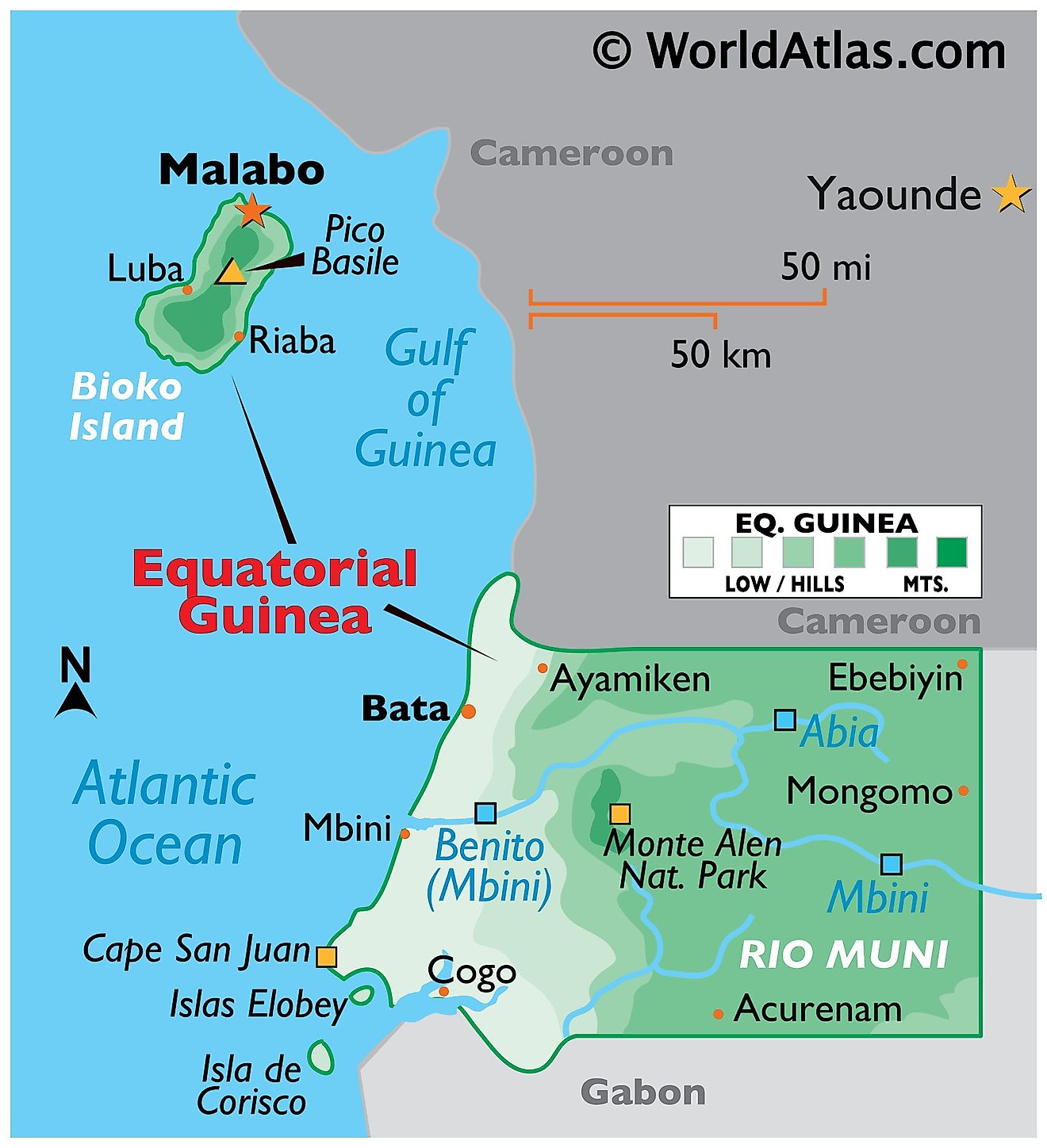
Map Of Equatorial Guinea

As observed on the physical map above, Equatorial Guinea in west-central Africa has two distinct regions, a mainland region, and an insular region. The country has a total land area of 28,051 sq. km.

The mainland of Equatorial Guinea begins on a narrow coastal plain, edged by mangrove swamps. From there, the land rises into an elevated plateau of thickly forested hills to its border with Gabon, reaching (in a few places) upwards of 1,219 m above sea level.

The major river, the Uola, snakes its way across the center of the country.

The offshore island of Bioko, volcanic in origin and very fertile, is dominated by three extinct volcanoes. Its coastline is steep and rugged south, but there are scenic beaches and harbors along the northern coast.

The highest point of Equatorial Guinea is Pico Basile at 3,008 m; the lowest point of the country is the Atlantic Ocean (0 m).