It’s possible that I shall make an ass of myself. But in that case one can always get out of it with a little dialectic. I have, of course, so worded my proposition as to be right either way (K.Marx, Letter to F.Engels on the Indian Mutiny)
Friday, May 19, 2023
Even weak traffic noise has a negative impact on work performance
IMAGE: THE CHALMERS RESEARCHERS' STUDY HAS DEMONSTRATED A DECLINE IN WORK PERFORMANCE AT NOISE LEVELS AS LOW AS 40 DB. NEAR BUSY ROADS, IT IS DIFFICULT TO ACHIEVE GOOD INDOOR SOUND ENVIRONMENTS, EVEN WITH WELL-INSULATED BUILDINGS AND WINDOWS.view more
CREDIT: PIXABAY
Researchers at Chalmers’ Division of Applied Acoustics have conducted a laboratory study in which test subjects took concentration tests while being exposed to background traffic noise. The subjects were asked to look at a computer screen and react to certain letters, then to assess their perceived workload afterwards. The study shows that the subjects had significantly poorer results on the performance test, and also felt that the task was more difficult to carry out, with traffic noise in the background.
“What is unique about our study is that we were able to demonstrate a decline in performance at noise levels as low as 40 dB, which corresponds to the regular noise level in an office environment or a kitchen,” says Leon Müller, Doctoral student at the Division of Applied Acoustics in the Department of Architecture and Civil Engineering.
The background noise consisted of two audio sequences simulating trucks passing by at a distance of ten and fifty metres. Both sequences were normalised to the same total indoor level of 40 dB.
“The audio sequence simulating the closer passages, where the sound changes significantly as the vehicle passes by, was usually the one that bothered the test subjects the most,” Müller says. “This could be because traffic that is further away is perceived as a more constant drone.”
Housing is built closer to roads now The new results emphasise an already problematic situation of negative impact on health and job performance due to traffic noise. In recent years, the distance between roads and newly built housing in Swedish cities has been allowed to shrink – a trend that can also be seen internationally.
Put somewhat simplistically, the Swedish regulations for where construction is permitted are based on the average outdoor noise level over a 24-hour period – meaning that they do not take individual pass-bys into account. In addition, current regulations do not cover the peaks of low-frequency noise indoors, which is difficult to avoid and is, according to research, more disruptive and therefore more impacting on human health.
In one study modelling low-frequency noise, Jens Forssén, Professor of applied acoustics at Chalmers, showed that such noise is primarily generated by heavy traffic at low speeds, and is difficult to shut out even with well-insulated windows and buildings that comply with all the construction norms and guidelines for sound insulation.
Reduced vehicle speed can increase the noise exposure indoors “The calculations for different types of facades show that it is difficult to achieve ideal indoor sound environments near heavily trafficked roads,” Forssén says. “Reducing speeds is not a solution, as our calculations show that the indoor noise exposure can even increase at lower speeds.”
Further, Forssén says that noise and the sound environment are a factor that is often considered too late in the planning process, and that there are advantages that could be achieved if adjustments were made in order to better utilise the space in terms of noise pollution.
The researchers also agree that the most effective solution would be to avoid urban densification in areas where traffic noise would have too great an impact on health and wellbeing.
More about the research The laboratory environment at Chalmers where the research was conducted looks like a living room with furniture and textiles, but behind the ceiling panels and windows is an advanced speaker system that allows the researchers to simulate various sounds, such as road traffic noise.
In the tests, the 42 participants were asked to conduct a continuous performance test (CPT) during each sound sequence. They watched a computer monitor where individual letters were displayed in sequences and were instructed to press a button for all letters except X. Additionally, the subjects filled in a form called the NASA task load index (NASA TLX), a tool for measuring a person’s subjective assessment of their workload when completing a task. The subjects rated their perceived workload based on six dimensions: perceived mental workload, physical workload, time pressure, effort, performance and degree of frustration.
The laboratory environment at Chalmers where the research was conducted looks like a living room with furniture and textiles, but behind the ceiling panels and windows is an advanced speaker system that allows the research team to simulate various sounds, such as road traffic noise.
The laboratory environment at Chalmers where the research was conducted looks like a living room with furniture and textiles, but behind the ceiling panels and windows is an advanced speaker system that allows the research team to simulate various sounds, such as road traffic noise.
CREDIT
Chalmers University of Technology
JOURNAL
International Journal of Environmental Research and Public Health
Traffic Noise at Moderate Levels Affects Cognitive Performance: Do Distance-Induced Temporal Changes Matter?
New conservation tool aims to inspire action to tackle the toll of road networks on global primate populations
A new database, compiled by researchers from Oxford Brookes University and experts from around the world reveals the deadly consequences of road networks and traffic on primates globally
A new database, compiled by researchers from Oxford Brookes University and experts from around the world reveals the deadly consequences of road networks and traffic on primates globally.
The Global Primate Roadkill Database details thousands of incidents of primates being killed by vehicles on roads over the past 30 years. Conservationists say the expanding human population has resulted in an increase in infrastructure such as roads and railways in countries throughout the tropics - where most wild primate populations are found.
Researchers documented 2,815 individual primate roadkills from 41 countries – representing 107 species of primate – collecting evidence from published papers, un-published databases, anecdotal reports, news reports and social media posts.
While most of the species recorded are not at risk of extinction, the team found incidents involving Endangered and even Critically Endangered primates such as the Tana River red colobus, San Martin titi monkey and Raffles’ banded langur.
Lead author, and alumna of the Primate Conservation MSc course at Oxford Brookes University, Laura Praill, said: “The impact that primate vehicular collisions have on the persistence of primate populations has not been widely studied in many primate range countries. This database can be used as a tool for primate conservation and act as a starting point for researchers who want to discover more about this threat.”
Dr Andie Ang, Head of Mandai Nature, a conservation organisation based in Singapore, works with Critically Endangered Raffles’ banded langurs. In December 2022, two Raffles’ banded langurs were found dead one day apart at the same location on an expressway in Singapore, reducing their population to just 73. Dr Ang said: “Given the density of road networks in cities, road collisions present a serious risk to wildlife which need to navigate between their fragmented habitats. It is important to document primate roadkill incidents and quantify the impact, so as to implement effective mitigation measures to help these animals move safely.”
According to the International Union for the Conservation of Nature, 19.4% of primate species are listed as threatened by roads and railroads.
Dr Magdalena Svensson, MSc Primate Conservation Lecturer at Oxford Brookes University, said: “While roads may appear as a small risk to primate populations compared to other risk factors, little research has been done in this area. Discovering the true extent of the threats vehicular collisions pose to primates is important to then inform decision makers that can influence mitigation measures.
“We encourage conservationists and citizen scientists to contribute to the Global Primate Roadkill Database so that together we can better understand the impact road infrastructure has on primates.”
Ends
Note to editors:
The database is publicly available online, and is intended to be a free, open access tool to advance primate conservation.
IMAGE: RESEARCH THEMES DEFINING NASA’S CLEVER CENTER WHICH WILL BE LED BY GEORGIA TECH PROFESSOR THOMAS ORLANDO.view more
CREDIT: GEORGIA INSTITUTE OF TECHNOLOGY
Georgia Tech researchers have been selected by NASA to lead a $7.5 million center that will study the lunar environment and the generation and properties of volatiles and dust. The Center for Lunar Environment and Volatile Exploration Research (CLEVER) will be led by Thomas Orlando, professor in the School of Chemistry and Biochemistry.
CLEVER is the successor to Orlando’s pioneering REVEALS (Radiation Effects on Volatiles and Exploration of Asteroids and Lunar Surfaces) center, and both are part of NASA’s Solar System Exploration Research Virtual Institute (SSERVI) program.
REVEALS and CLEVER look ahead to the return of humans to the moon for sustained periods — a key part of NASA’s plan for space exploration in the coming decade. Volatiles such as water, molecular oxygen, methane, and hydrogen are crucial to supporting human activity on the moon. Dust is also important since the space-weathered particles can pose health effects to astronauts and hazards to the technology and hardware.
The interdisciplinary group of researchers supported by CLEVER will study how the solar wind and micrometeorites produce volatiles, research how ice and dust behave in the lunar environment, develop new materials to deal with potential dust buildup, and invent new analysis tools to support the upcoming crewed missions of the Artemis program.
“The resources and knowledge that CLEVER will produce will be useful for the sustainable presence of humans on the moon,” Orlando says. “We have the correct mix of fundamental science and exploration — real, fundamental, ground-truth measurements; very good theory/modeling; and engineering — an easy mix with Georgia Tech and outside partners.”
Orlando adds that CLEVER adopts a unique perspective on the challenges of understanding how to operate on Earth’s moon. “The atomic and molecular view of processes with angstrom distances and femtosecond time scales can help unravel what is happening on planetary spatial scales and geological time frames,” he says. “We can also translate our knowledge into materials, devices, and technology pretty quickly, and this is necessary if we want to help the Artemis astronauts.”
CLEVER includes investigators from Georgia Tech, University of Georgia, the Florida Space Institute, University of Hawaii, Auburn University, Space Sciences Institute, the Johns Hopkins University Applied Physics Laboratory, Lawrence Berkeley National Laboratory, NASA Ames, NASA Kennedy Space Center, and partners in Italy and Germany. In addition to pursuing a blend of fundamental science and mission support, CLEVER will also emphasize the research and career development of students and young investigators, another important goal of the SSERVI system.
Art: Brice Zimmerman, Georgia Institute of Technology
About Georgia Institute of Technology
The Georgia Institute of Technology, or Georgia Tech, is a public research university developing leaders who advance technology and improve the human condition. The Institute offers business, computing, design, engineering, liberal arts, and sciences degrees. Its nearly 44,000 students representing 50 states and 149 countries, study at the main campus in Atlanta, at campuses in France and China, and through distance and online learning. As a leading technological university, Georgia Tech is an engine of economic development for Georgia, the Southeast, and the nation, conducting more than $1 billion in research annually for government, industry, and society.
Academy students blast off to international space competition
WMG Academy for Young Engineers is preparing for lift-off after being named UK national champions in the European Space Agency’s CanSat competition. Having launched themselves to the top spot in the UK, WMG Academy’s Team Phoenix 2 will soon blast off to the European finals.
Inspired by NASA’s Phoenix Mars Lander mission, the young space explorers from Team Phoenix 2 have designed and manufactured a suborbital satellite capable of measuring and collecting temperature and air pressure data whilst looking for signs of life on a planet by sampling surface dust – all contained within the size and shape of a soft-drinks can. Launched to a height of 1,000 feet, the satellite descends, launching an integrated parachute before transmitting data back to the team at the command centre.
As part of the competition, the students, all aged between 14 and 17 years old and studying a combination of maths, science and engineering, have produced designs and prototypes, submitted testing data and launch reports, and presented to a team of experts, setting themselves apart from over 250 other entries and 12 finalists to take the title of UK national champions.
WMG is based at the University of Warwick.
Commenting on the team’s success, WMG Academy Chief Executive, Stewart Tait, said,“Our students are clearly high-flyers with ambitions that are out of this world.We could not be more proud of Oliver, Joshua, Callum, Amneet, Timurs and George who have worked so hard to design an innovative and successful can-sized satellite.
“This year’s CanSat project was launched by Bob Hodge who has been an integral part of WMG Academy since we opened in 2014. Unfortunately, after a long illness, Bob sadly passed away just a few weeks ago and there is no better way to pay tribute to the time and energy Bob invested in the lives of our young engineers than continuing his legacy of inspiring the next generation through projects like CanSat.
“We are looking forward to taking Team Phoenix2 to the European finals to showcase the incredible engineering talent of WMG Academy students on the international stage.”
Researchers have observed the X-ray emission of the most luminous quasar seen in the last 9 billion years of cosmic history, known as SMSS J114447.77-430859.3, or J1144 for short. The new perspective sheds light on the inner workings of quasars and how they interact with their environment. The research is published in Monthly Notices of the Royal Astronomical Society.
Hosted by a galaxy 9.6 billion light years away from the Earth, between the constellations of Centaurus and Hydra, J1144 is extremely powerful, shining 100,000 billion times brighter than the Sun. J1144 is much closer to Earth than other sources of the same luminosity, allowing astronomers to gain insight into the black hole powering the quasar and its surrounding environment. The study was led by Dr Elias Kammoun, a postdoctoral researcher at the Research Institute in Astrophysics and Planetology (IRAP), and Zsofi Igo, a PhD candidate at the Max Planck Institute for Extraterrestrial Physics (MPE).
Quasars are among the brightest and most distant objects in the known universe, powered by the fall of gas into a supermassive black hole. They can be described as active galactic nuclei (AGN) of very high luminosity that emit vast amounts of electromagnetic radiation observable in radio, infrared, visible, ultraviolet and X-ray wavelengths. J1144 was initially observed in visible wavelengths in 2022 by the SkyMapper Southern Survey (SMSS).
For this study, researchers combined observations from several space-based observatories: the eROSITA instrument on board the Spectrum-Roentgen-Gamma (SRG) observatory, the ESA XMM-Newton observatory, NASA’s Nuclear Spectroscopic Telescope Array (NuSTAR), and NASA’s Neil Gehrels Swift observatory.
The team used the data from the four observatories to measure the temperature of the X-rays being emitted from the quasar. They found this temperature to be around 350 million Kelvin, more than 60,000 times the temperature at the surface of the Sun. The team also found that the mass of the black hole at the quasar’s centre is around 10 billion times the mass of the Sun, and the rate at which it is growing to be of the order of 100 solar masses per year.
The X-ray light from this source varied on a time scale of a few days, which is not usually seen in quasars with black holes as large as the one residing in J1144. The typical timescale of variability for a black hole of this size would be on the order of months or even years. The observations also showed that while a portion of the gas is swallowed by the black hole, some gas is ejected in the form of extremely powerful winds, injecting large amounts of energy into the host galaxy.
Dr. Kammoun, lead author of the paper, says “We were very surprised that no prior X-ray observatory has ever observed this source despite its extreme power.”
He adds, “Similar quasars are usually found at much larger distances, so they appear much fainter, and we see them as they were when the Universe was only 2-3 billion years old. J1144 is a very rare source as it is so luminous and much closer to Earth (although still at a huge distance!), giving us a unique glimpse of what such powerful quasars look like.”
“A new monitoring campaign of this source will start in June this year, which may reveal more surprises from this unique source”.
JOURNAL
Monthly Notices of the Royal Astronomical Society
First observed radio waves from a type Ia supernova
IMAGE: ARTIST’S IMPRESSION OF HELIUM-RICH MATERIAL FROM A COMPANION STAR ACCRETING ONTO A WHITE DWARF. BEFORE THE EXPLOSION, A LARGE AMOUNT OF MATERIAL IS STRIPPED FROM THE COMPANION. THE RESEARCH TEAM HOPES TO CLARIFY THE RELATIONSHIP BETWEEN THE EMITTED STRONG RADIO WAVES AND THIS STRIPPED MATERIAL.view more
CREDIT: ADAM MAKARENKO/W. M. KECK OBSERVATORY
For the first time, astronomers have observed radio waves emitted by a Type Ia supernova, a type of explosion originating from a white dwarf star. This provides important clues to understand how white dwarfs explode.
A Type Ia (One-A) supernova is the nuclear explosion of a white dwarf star. This type of supernova is well known; these supernovae are used by astronomers to measure cosmological distances and the expansion of the Universe. But the explosion mechanism of Type Ia supernovae is not well understood. Solitary white dwarfs don’t explode, so it is thought that mass accretion from a neighboring companion star plays a role in triggering the explosion. The accreted mass is the outer layer of the companion star, so it is normally composed mostly of hydrogen, but it was thought that it should also be possible for a white dwarf to accrete helium from a companion star which had lost its outer layer of hydrogen.
As the white dwarf strips matter from its companion star, not all of the material falls onto the white dwarf; some of it forms a cloud of circumstellar material around the binary star system. When a white dwarf explodes in a cloud of circumstellar material, it is expected that the shockwaves from the explosion traveling through the circumstellar material will excite atoms, causing them to emit strong radio waves. However, although many Type Ia supernovae have been observed exploding within a cloud of circumstellar material, so far astronomers had yet to observe radio wave emissions associated with a Type Ia supernova.
An international team of researchers, including members from Stockholm University and the National Astronomical Observatory of Japan, performed detailed observations of a Type Ia supernova which exploded in 2020. They revealed that this supernova was surrounded by circumstellar material consisting mainly of helium, and also succeeded in detecting radio waves from the supernova. Comparing the observed radio wave strength with theoretical models revealed that the progenitor white dwarf star had been accreting material at a rate of about 1/1000 the mass of the Sun every year. This is the first confirmed Type Ia supernova triggered by mass accretion from a companion star with an outer layer consisting primarily of helium.
It is expected that this observation of radio waves from a helium-rich Type Ia supernova will deepen our understanding of the explosion mechanism and the conditions before a Type Ia supernova. Now the team plans to search for radio emissions from other Type Ia supernovae to elucidate the evolution which leads to the explosion.
THE HENRYK NIEWODNICZANSKI INSTITUTE OF NUCLEAR PHYSICS POLISH ACADEMY OF SCIENCES
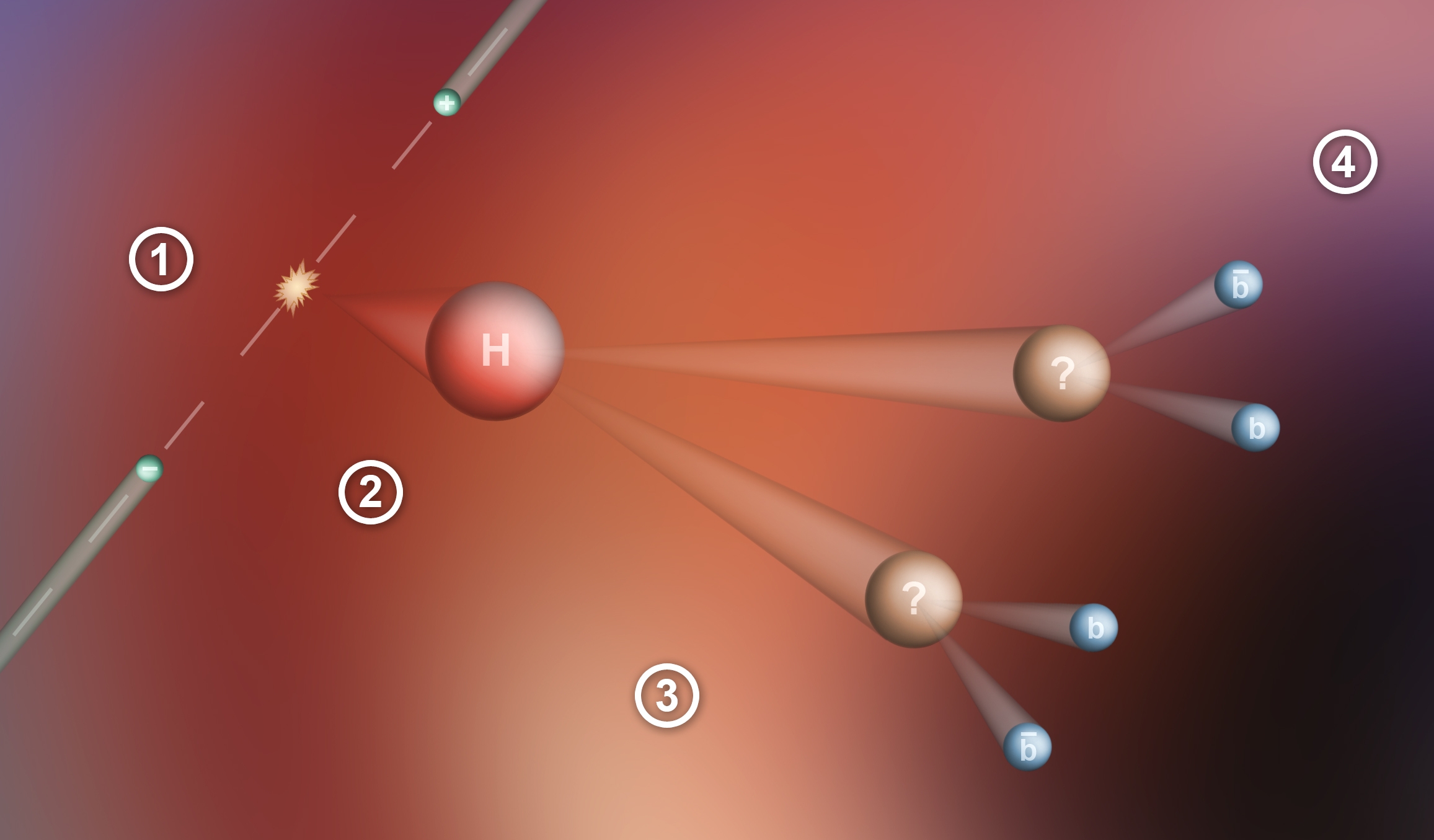
IMAGE: THE SEARCH FOR EXOTIC HIGGS BOSON DECAYS IN FUTURE LEPTON COLLIDERS: 1) AN ELECTRON AND A POSITRON FROM OPPOSING BEAMS COLLIDE; 2) THE COLLISION PRODUCES A HIGH-ENERGY HIGGS BOSON; 3) THE BOSON DECAYS INTO TWO EXOTIC PARTICLES MOVING AWAY FROM THE AXIS OF THE BEAMS; 4) EXOTIC PARTICLES DECAY INTO PAIRS OF QUARK-ANTIQUARK, VISIBLE TO DETECTORS.view more
CREDIT: SOURCE: IFJ PAN
It may be that the famous Higgs boson, co-responsible for the existence of masses of elementary particles, also interacts with the world of the new physics that has been sought for decades. If this were indeed to be the case, the Higgs should decay in a characteristic way, involving exotic particles. At the Institute of Nuclear Physics of the Polish Academy of Sciences in Cracow, it has been shown that if such decays do indeed occur, they will be observable in successors to the LHC currently being designed.
When talking about the 'hidden valley', our first thoughts are of dragons rather than sound science. However, in high-energy physics, this picturesque name is given to certain models that extend the set of currently known elementary particles. In these so-called Hidden Valley models, the particles of our world as described by the Standard Model belong to the low-energy group, while exotic particles are hidden in the high-energy region. Theoretical considerations suggest then the exotic decay of the famous Higgs boson, something that has not been observed at the LHC accelerator despite many years of searching. However, scientists at the Institute of Nuclear Physics of the Polish Academy of Sciences (IFJ PAN) in Cracow argue that Higgs decays into exotic particles should already be perfectly observable in accelerators that are successors to the Large Hadron Collider – if the Hidden Valley models turn out to be consistent with reality.
“In Hidden Valley models we have two groups of particles separated by an energy barrier. The theory is that there could then be exotic massive particles which could cross this barrier under specific circumstances. The particles like Higgs boson or hypothetic Z’ boson would act as communicators between the particles of both worlds. The Higgs boson, one of the most massive particle of the Standard Model, is a very good candidate for such a communicator,” explains Prof. Marcin Kucharczyk (IFJ PAN), lead author of an article in the Journal of High Energy Physics, which presents the latest analyses and simulations concerning the possibility of detecting Higgs boson decays in the future lepton accelerators.
The communicator, after passing into the low energy region, would decay into two rather massive exotic particles. Each of these would, in picoseconds – that is, trillionths of a second – decay into another two particles, with even smaller masses, which would then be within the Standard Model. So what signs would be expected in the detectors of future accelerators? The Higgs itself would remain unnoticed, as would the two Hidden Valley particles. However, the exotic particles would gradually diverge and eventually decay, generally into quark-antiquark beauty pairs visible in modern detectors as jets of particles shifted from the axis of the lepton beam
“Observations of Higgs boson decays would therefore consist of searching for the jets of particles produced by quark-antiquark pairs. Their tracks would then have to be retrospectively reconstructed to find the places where exotic particles are likely to have decayed. These places, professionally called decay vertices, should appear in pairs and be characteristically shifted with respect to the axis of the colliding beams in the accelerator. The size of these shifts depends, among other things, on masses and average lifetime of exotic particles appearing during the Higgs decay”, says Mateusz Goncerz, M.Sc. (IFJ PAN), co-author of the paper in question.
The collision energy of protons at the LHC, currently the world's largest particle accelerator, is up to several teraelectronvolts and is theoretically sufficient to produce Higgs capable of crossing the energy barrier that separates our world from the Hidden Valley. Unfortunately, protons are not elementary particles – they are composed of three valence quarks bound by strong interactions, capable of generating huge numbers of constantly appearing and disappearing virtual particles, including quark-antiquark pairs. Such a dynamic and complex internal structure produces huge numbers of secondary particles in proton collisions, including many quarks and antiquarks with large masses. They form a background in which it becomes practically impossible to find the particles from the exotic Higgs boson decays that are being sought.
The detection of possible Higgs decays to these states should be radically improved by accelerators being designed as successors to the LHC: the CLIC (Compact Linear Collider) and the FCC (Future Circular Collider). In both devices it will be possible to collide electrons with their anti-material partners, the positrons (with CLIC dedicated to this type of collision, while FCC will also allow collisions of protons and heavy ions). Electrons and positrons are devoid of internal structure, so the background for exotic Higgs boson decays should be weaker than at the LHC. Only will it be sufficiently so to discern the valuable signal?
In their research, physicists from the IFJ PAN took into account the most important parameters of the CLIC and FCC accelerators and determined the probability of exotic Higgs decays with final states in the form of four beauty quarks and antiquarks. To ensure that the predictions cover a wider group of models, the masses and mean lifetimes of the exotic particles were considered over suitably wide ranges of values. The conclusions are surprisingly positive: all indications are that, in future electron-positron colliders, the background of exotic Higgs decays could be reduced even radically, by several orders of magnitude, and in some cases could even be considered negligible.
The existence of particle-communicators is not only possible in Hidden Valley models, but also in other extensions of the Standard Model. So if the detectors of future accelerators register a signature corresponding to the Higgs decays analysed by the Cracow researchers, this will only be the first step on the road to understanding new physics. The next will be to collect a sufficiently large number of events and determine the main decay parameters that can be compared with the predictions of theoretical models of the new physics.
“The main conclusion of our work is therefore purely practical. We are not sure whether the new physics particles involved in Higgs boson decays will belong to the Hidden Valley model we used. However, we have treated this model as representative of many other proposals for new physics and have shown that if, as predicted by the model, the Higgs bosons decay into exotic particles, this phenomenon should be perfectly visible in those electron and positron colliders which are planned to be launched in the near future”, concludes Prof. Kucharczyk.
The research in question was funded by an OPUS grant from the Polish National Science Centre.
The Henryk Niewodniczański Institute of Nuclear Physics (IFJ PAN) is currently one of the largest research institutes of the Polish Academy of Sciences. A wide range of research carried out at IFJ PAN covers basic and applied studies, from particle physics and astrophysics, through hadron physics, high-, medium-, and low-energy nuclear physics, condensed matter physics (including materials engineering), to various applications of nuclear physics in interdisciplinary research, covering medical physics, dosimetry, radiation and environmental biology, environmental protection, and other related disciplines. The average yearly publication output of IFJ PAN includes over 600 scientific papers in high-impact international journals. Each year the Institute hosts about 20 international and national scientific conferences. One of the most important facilities of the Institute is the Cyclotron Centre Bronowice (CCB), which is an infrastructure unique in Central Europe, serving as a clinical and research centre in the field of medical and nuclear physics. In addition, IFJ PAN runs four accredited research and measurement laboratories. IFJ PAN is a member of the Marian Smoluchowski Kraków Research Consortium: "Matter-Energy-Future", which in the years 2012-2017 enjoyed the status of the Leading National Research Centre (KNOW) in physics. In 2017, the European Commission granted the Institute the HR Excellence in Research award. As a result of the categorization of the Ministry of Education and Science, the Institute has been classified into the A+ category (the highest scientific category in Poland) in the field of physical sciences.
SCIENTIFIC PUBLICATIONS:
“Search for exotic decays of the Higgs boson into long-lived particles with jet pairs in the final state at CLIC”
The search for exotic Higgs boson decays in future lepton colliders: 1) an electron and a positron from opposing beams collide; 2) the collision produces a high-energy Higgs boson; 3) the boson decays into two exotic particles moving away from the axis of the beams; 3) exotic particles decay into pairs of quark-antiquark, visible to detectors. (Source: IFJ PAN)
Search for exotic decays of the Higgs boson into long-lived particles with jet pairs in the final state at CLIC
ARTICLE PUBLICATION DATE
17-Mar-2023
Demystifying vortex rings in nuclear fusion, supernovae
A mathematical model linking these vortices with more pedestrian types, like smoke rings, could help engineers control their behavior in power generation and more
Better understanding the formation of swirling, ring-shaped disturbances—known as vortex rings—could help nuclear fusion researchers compress fuel more efficiently, bringing it closer to becoming a viable energy source.
The model developed by researchers at the University of Michigan could aid in the design of the fuel capsule, minimizing the energy lost while trying to ignite the reaction that makes stars shine. In addition, the model could help other engineers who must manage the mixing of fluids after a shock wave passes through, such as those designing supersonic jet engines, as well as physicists trying to understand supernovae.
"These vortex rings move outward from the collapsing star, populating the universe with the materials that will eventually become nebulae, planets and even new stars—and inward during fusion implosions, disrupting the stability of the burning fusion fuel and reducing the efficiency of the reaction," said Michael Wadas, a doctoral candidate in mechanical engineering at U-M and corresponding author of the study.
"Our research, which elucidates how such vortex rings form, can help scientists understand some of the most extreme events in the universe and bring humanity one step closer to capturing the power of nuclear fusion as an energy source," he said.
Nuclear fusion pushes atoms together until they merge. This process releases several times more energy than breaking atoms apart, or fission, which powers today's nuclear plants. Researchers can create this reaction, merging forms of hydrogen into helium, but at present, much of the energy used in the process is wasted.
Part of the problem is that the fuel can't be neatly compressed. Instabilities cause the formation of jets that penetrate into the hotspot, and the fuel spurts out between them—Wadas compared it to trying to squish an orange with your hands, how juice would leak out between your fingers.
Vortex rings that form at the leading edge of these jets, the researchers have shown, are mathematically similar to smoke rings, the eddies behind jellyfish and the plasma rings that fly off the surface of a supernova.
Perhaps the most famous approach to fusion is a spherical array of lasers all pointing toward a spherical capsule of fuel. This is how experiments are set up at the National Ignition Facility, which has repeatedly broken records for energy output in recent years.
The energy from the lasers vaporizes the layer of material around the fuel—a nearly perfect, lab-grown shell of diamond in the latest record-setter in December 2022. When that shell vaporizes, it drives the fuel inward as the carbon atoms fly outward. This generates a shockwave, which pushes the fuel so hard that the hydrogen fuses.
While the spherical fuel pellets are some of the most perfectly round objects humans have ever made, each has a deliberate flaw: a fill tube, where the fuel enters. Like a straw stuck in that crushed orange, this is the most likely place for a vortex-ring-led jet to form when the compression starts, the researchers explained.
"Fusion experiments happen so fast that we really only have to delay the formation of the jet for a few nanoseconds," said Eric Johnsen, an associate professor of mechanical engineering at U-M, who supervised the study.
The study brought together the fluid mechanics expertise of Wadas and Johnsen as well as the nuclear and plasma physics knowledge in the lab of Carolyn Kuranz, an associate professor of nuclear engineering and radiological sciences.
"In high-energy-density physics, many studies point out these structures, but haven’t clearly identified them as vortex rings," said Wadas.
Knowing about the deep body of research into the structures seen in fusion experiments and astrophysical observations, Wadas and Johnsen were able to draw on and extend that existing knowledge rather than trying to describe them as completely new features.
Johnsen is particularly interested in the possibility that vortex rings could help drive the mixing between heavy elements and lighter elements when stars explode, as some mixing process must have occurred to produce the composition of planets like Earth.
The model can also help researchers understand the limits of the energy that a vortex ring can carry, and how much fluid can be pushed before the flow becomes turbulent and harder to model as a result. In ongoing work, the team is validating the vortex ring model with experiments.
The research is funded by Lawrence Livermore National Laboratory and the Department of Energy, with computational resources provided by the Extreme Science and Engineering Discovery Environment through the National Science Foundation and the Oak Ridge Leadership Computing Facility.