Thursday, September 07, 2023

U$A
Landlords start nickel-and-diming tenants with fees

David Lazarus
Tue, September 5, 2023 


It’s already very expensive to rent in a hot housing market like Southern California. Now landlords have found a way to make things even worse.

A growing number of property owners and managers are hitting tenants with extra fees each month — a nickel-and-diming of people that the airlines, for one, have made a core aspect of their business model.

It’s been common for years for landlords to charge more for a parking space or having a pet.

The new fees being levied — which might run an additional $5 or $10 each — cover a wide range of once-gratis services, including trash pickup, pest control, use of a mailbox and routine maintenance requests.

“A lot of this stuff used to just be called ‘rent,'” Mike Vraa, a Minnesota tenant attorney, told the Wall Street Journal.

Now, apparently, it’s gravy.

Just as airlines once doled out pillows, blankets and other amenities as a free service, now these goodies are a revenue source.

Landlords, many of whom faced financial challenges during the pandemic, apparently think a few new revenue streams would work for them as well.

As a result, some now charge fees for moving in and moving out. Some have fees for “lease administration” (whatever that is). One Minnesota landlord collects a $100 “January fee” on the first month of the year.

A January fee!

In suburban Phoenix, a number of buildings are instructing tenants to leave their garbage near the front door and then slapping them with a $30 monthly fee for someone to schlep the garbage to a dumpster.

“I can carry the trash 50 feet to the dumpster,” tenant Debbie Giannecchini complained to the Journal. She said she moved out of a building that started imposing a valet fee for trash.

Rents rose by 25% from early 2021 to summer of 2022 as landlords sought to make up for pandemic losses.

For many people, therefore, added fees are just another kick in teeth.

An executive at one Midwest apartment company told the Journal that the firm more than doubled its income from fees at nearly two-dozen rental properties.

“People pay it,” the executive said.

That’s because people need a place to live.

It doesn’t justify the practice.

DESANTISLAND
Former State Attorney Monique Worrell sues Gov. DeSantis, asks Florida Supreme Court to reverse suspension

Amanda Rabines, Orlando Sentinel
Wed, September 6, 2023 

Ricardo Ramirez Buxeda/Orlando Sentinel/TNS


Monique Worrell, the former Orange-Osceola state attorney, has filed a lawsuit against Florida Gov. Ron DeSantis, asking the Florida Supreme Court to reverse his order removing her from office.

Worrell is accusing DeSantis of citing vague allegations against her in his case for her suspension, which has rattled community organizers and people in the legal community who rallied Tuesday, calling the governor’s action “unconstitutional” at a series of press conferences in Orange County, Tampa and Miami.

DeSantis suspension of Worrell follows a string of criticism from law enforcement leaders accusing her of not prosecuting crime aggressively enough.

Filed Wednesday, the lawsuit claims the executive order fails to identify any conduct by Worrell that would support suspension and counters data cited in the executive order as evidence of “neglect of duty” or “incompetence” while she was serving at Ninth Judicial Circuit.

On Aug. 9, DeSantis replaced her with Orange County Judge Andrew Bain, who is a member of the Federalist Society, a conservative legal organization.

Worrell is the second Democratic state attorney suspended by DeSantis. Last summer, the governor suspended Andrew Warren, a twice-elected state attorney for Hillsborough County, who pledged not to prosecute doctors who provide abortions.

In the lawsuit, Worrell attempts to set her case apart from executive orders issued against Warren and her predecessor, Aramis Ayala, who in 2017 found herself in a feud with then-Gov. Rick Scott over her opposition to seeking the death penalty in all cases.

In Worrell’s case, the lawsuit says the governor has not alleged any practice or policy that could constitute a refusal to exercise prosecutorial discretion.

“The order vaguely refers to Ms. Worrell’s ‘practices and policies’ throughout but notably fails to identify a single, specific policy or practice, making the order distinguishable from recent cases involving other Florida state attorneys, where the executive orders identified specific policies alleged to constitute a neglect of duty,” the lawsuit reads.

Much of the scrutiny Worrell faced followed several high-profile shootings in Orange County, including one in Pine Hills that resulted in the killings of three people, including a child and a TV news reporter.

Brazil cyclone, Europe flooding, another Earth heat record: What to know in extreme weather now

The Associated Press
Wed, September 6, 2023 

Residents walks amid destroyed houses after floods caused by a deadly cyclone in Mucum, Rio Grande do Sul state, Brazil, Wednesday, Sept. 6, 2023. An extratropical cyclone in southern Brazil caused floods in several cities.
 (AP Photo/Wesley Santos)

Families perched atop houses pleading for help to escape the deadly flooding after a cyclone hammered southern Brazil, with the region's governor calling it “an absolutely out of the ordinary event.”

The world's latest extreme weather disaster killed at least 31 people and left at least 1,600 homeless, authorities said Wednesday. The scope of the damage was enormous: Rio Grande do Sol Gov. Eduardo Leite said it was his state's highest death toll from a climate event, with “entire cities that were completely compromised.”

The toll included at least 15 bodies in a single house.

Flooding also wracked Greece, Turkey and Bulgaria on Tuesday, fed by fierce rainstorms and killing at least seven people. The toll included at least two in Istanbul, Turkey's largest city, where streets and homes were flooded in two neighborhoods.

Here’s what else is happening related to extreme weather, climate and the environment right now:

—The World Meteorological Organization announced another heat record in a year full of them: Earth sweltered through its hottest Northern Hemisphere summer ever measured. Scientists blame human-caused climate change, along with the natural El Nino phenomenon.

— Tropical Storm Lee was moving through the open Atlantic and expected to become a hurricane as it nears the Caribbean. In the Pacific, Jova had grown into a Category 2 hurricane far off the southwest coast of Mexico.

—The first African Climate Summit ended Wednesday with a call for world leaders to rally behind a global carbon tax on fossil fuels, aviation and maritime transport, and it seeks reform of the world financial system that forces African nations to pay more to borrow money.

—In sub-Saharan Africa, clean electricity from solar is catching on in several large countries. Much of it is off the grid, meaning the solar powers a handful of buildings but isn't part of a larger system.

—Environmental groups are suing the state of Utah over management of the Great Salt Lake, saying officials have pushed it to the brink of collapse by allowing upstream water to be diverted to farmers for decades.

— Crab fishermen in Alaska have been scrambling to stay afloat after two years of the Bering Sea fishery being closed or severely curtailed due to plummeting crab numbers. And they’re concerned that more of the same awaits this October when officials decide on catch limits for the upcoming season.

—Good news for salmon lovers: The last wild Atlantic salmon that return to U.S. rivers have had their most productive year in more than a decade, according to a count in Maine, raising hopes they may be weathering several ecological threats.

—The U.S. Environmental Protection Agency is delaying plans to tighten air quality standards for ground-level ozone — better known as smog — despite a recommendation by a scientific advisory panel to lower air pollution limits to protect public health. The decision pushes an update of one of the agency's most important air quality regulations beyond the 2024 presidential election.

— Tennis players at the U.S. Open, where Wednesday's highs were expected near 95 degrees Fahrenheit (35 Celsius) seek relief from heat via ice-stuffed bags or from cold air blown through tubes on the sideline. An Associated Press analysis found the average high temperatures felt during the U.S. Open and the three other major tennis tournaments steadily have gotten higher and more dangerous in recent decades, reflecting the climate change that created record heat waves around the globe this summer.

QUOTABLE:

“It does feel like and probably will continue to feel like we’re just hopping from one emergency to another based on climate change." — Jared Meyers, a resort owner whose locations include four in Florida. Meyers is among small business owners who have had to deal with extreme weather — and he fears hurricane intensities are getting worse.

___

Associated Press climate and environmental coverage receives support from several private foundations. See more about AP’s climate initiative here. The AP is solely responsible for all content.

CRIMINAL CAPITALI$M
Vivek Ramaswamy's 'anti-woke' investment firm now manages assets worth more than $1 billion

Joseph Wilkins
Wed, September 6, 2023

Republican presidential hopeful Vivek Ramaswamy at a Fox News debate last month.
Morry Gash/AP


  • Republican presidential candidate Vivek Ramaswamy is the cofounder of an "anti-woke" ETF firm. 

  • The company was set up last year and now manages assets worth more than $1 billion. 

  • Ramaswamy's firm is a riposte to the ESG-centric policies of some big investment firms.  

The anti-activism investment fund cofounded by Republican presidential hopeful Vivek Ramaswamy is now managing assets worth more than $1 billion.

Strive Asset Management was set up in 2022 as a riposte to big fund managers such as BlackRock that have increasingly pursued a strategy of environmental, social and governance-focused, or ESG, investing.

Its mantra of encouraging companies to "focus on excellence" over ESG concerns has struck a chord with some investors.

Ramaswamy's GOP bid is also bringing more funds to Strive, according to Bloomberg Intelligence.

The firm's most popular fund is the Strive US Energy ETF, which tracks the same portfolio as BlackRock's iShares US Energy ETF.

Strive aims to use its voting power to pressure the companies it invests in to "drill more and frack more," Ramaswamy said last August, per Bloomberg.

"It is a rare feat for any indie issuer to hit $1 billion in the first year, let alone one that is largely a pushback to ESG as many of those ETFs have flopped," said Bloomberg Intelligence analyst Eric Balchunas.

The milestone comes as two former Strive employees sue the cofounders, accusing Ramaswamy and Anson Frericks of mistreating staff and pressuring staff to break securities law.

Strive said in a statement to Bloomberg last month it would "vigorously defend itself" against the claims.

The company declined to comment further when approached by Insider.

It's not the first time Ramaswamy has taken aim at what he called the financial sector's "woke" agenda. Last month he said the "big three" investment firms – BlackRock, State Street, and Vanguard – represented "arguably the most powerful cartel in human history."

"They're the largest shareholders of nearly every major public company (even of each other)," he wrote.

"And they use *your* own money to foist ESG agendas onto corporate boards - voting for "racial equity audits" & "Scope 3 emissions caps" that don't advance your best financial interests. This raises serious fiduciary, antitrust, and conflict-of-interest concerns."

Ramaswamy is vying with Florida governor Ron DeSantis for second place in opinion polls, but both lag some distance behind former President Donald Trump in the race for the Republican presidential nomination.

Business Insider

Court orders Texas to remove anti-migrant Rio Grande barriers

Rafael Bernal
Wed, September 6, 2023 
RAZOR WIRE AND FLOATING BARRIER

A federal judge in Texas on Wednesday ordered the state to remove buoys it set up in the Rio Grande to deter migration as part of its Operation Lone Star.

The order came as part of a lawsuit filed by the Biden administration against Texas, arguing in large part that the state had no right to install structures in federal navigable waterways.

“Governor [Greg] Abbott [R] announced that he was not ‘asking for permission’ for Operation Lone Star, the anti-immigration program under which Texas constructed the floating barrier,” District Judge David Alan Ezra wrote.

“Unfortunately for Texas, permission is exactly what federal law requires before installing obstructions in the nation’s navigable waters.”

Texas is ordered to remove the buoys by Sept. 15, but Abbott indicated just minutes after the ruling that the state plans to appeal the decision and will continue to use other “strategic barriers.”

The floating buoys cover 1,000 feet in the Rio Grande with anchors in the riverbed. They are arranged in a chain stretching up- and down-river, each separated by a rounded blade with serrated edges similar to a circular saw.

The buoys were put in place around July 10, installed just days after four migrants, including an infant, drowned trying to cross the river.

The installation was one of several measures taken by Abbott as part of Operation Lone Star, but it has proven the most controversial, creating significant tensions with Mexico.

Ezra noted Mexico’s formal diplomatic complaints on the matter in his decision as a factor in establishing the harm caused to the plaintiff justifying an injunction.

The ruling was deeply critical of Texas’s arguments to defend the installation, in particular the idea that the state is allowed any means to respond to any act it considers an “invasion.”

“And all Texas’s new argument does is ask the Court to take the additional step — beyond the nonjusticiable question of whether the federal government has failed to protect Texas from invasion — of sanctioning Texas’s assertion of plenary power to declare and respond to ‘all types of invasions, including invasions from non-state or quasistate actors,'” Ezra wrote.

“Under this logic, once Texas decides, in its sole discretion, that it has been invaded, it is subject to no oversight of its ‘chosen means of waging war.’ Such a claim is breathtaking.”

Abbott said Wednesday Texas would continue to use other shows of force at the border and criticized President Biden, claiming, “Texas is rightfully stepping up to do the job that he should have been doing all along.”

“This ruling is incorrect and will be overturned on appeal. We will continue to utilize every strategy to secure the border, including deploying Texas National Guard soldiers and Department of Public Safety troopers and installing strategic barriers,” Abbott said.

“Our battle to defend Texas’ sovereign authority to protect lives from the chaos caused by President Biden’s open border policies has only begun. Texas is prepared to take this fight all the way to the U.S. Supreme Court.”

The Department of Justice in late July had urged a judge to order the buoys removed within 10 days.

“Governor Abbott’s suggestion that Texas can violate the [Rivers and Harbors Act] in service of its own policy priorities inverts the Supremacy Clause and controverts Supreme Court precedent recognizing the federal government’s plenary power over immigration and foreign affairs,” the Justice Department wrote in the filing.

— Updated at 5:32 p.m.

Tourists swim with 2 humpbacks — then more join in. ‘How many whales can you count?’


Moira Ritter
Wed, September 6, 2023 


Photo by Ben Carless on Unsplash


A boat full of eager tourists was cruising through the waters of Western Australia in hopes of spotting some whales, and, if they were lucky, the opportunity to swim alongside the massive creatures.

That’s when the group spotted two humpbacks, according to an Aug. 31 Facebook post from Ningaloo Whaleshark Swim, the tour agency operating the boat. Equipped with fins and scuba gear, the tourists jumped in alongside the creatures.

Soon, the group was treated to another surprise as another group of whales joined them, bringing the total number of humpback to 15, the post said.

“The most mind-blowing encounter on our humpback whale interaction tour today,” the tour agency posted. “After jumping in with two humpback whales to begin with, they merged into a larger pod of humpback whales passing by and even picked up a few more stragglers along the way!”

A video shared by the agency on Instagram shows the whales swimming below and next to the tourists.

Jasmine O’Brien, an underwater photographer for the tour agency, was aboard the boat at the time of the encounter.

“How many whales can you count?” she wrote in a Facebook post. “I am absolutely shooketh by this insane encounter today! The sea was thick with whales, as our small pod suddenly turned into a super pod of 15 whales!”

“Unbelievable experience,” a passenger from the boat commented on Facebook. “Didn’t know where to look there were whales it seemed in every direction.”

Social media users shared their shock about the encounter.

“MAGIC!!!!” one person commented on Facebook.

“Mind blowing,” another Facebook user wrote.

“How beautiful,” another commenter said.

Russia in Africa: Prigozhin's death exposes Putin's real motives on the continent

Joseph Siegle, Director of Research, Africa Center for Strategic Studies, University of Maryland
THE CONVERSATION
Tue, September 5, 2023 

The apparent assassination of Yevgeny Prigozhin in the crash of his private jet between Moscow and St. Petersburg represents an inflection point in Russian-African relations. Prigozhin, as leader of the notorious Wagner Group, had been the point man for Russia in Africa since Wagner first began operations on the continent in 2017. More than a single entity, the Wagner Group is an amalgamation of shell companies deploying paramilitary forces, disinformation and political interference in Ukraine, Syria and Africa. Its leaders have been sanctioned by 30 countries for the group’s destabilising activities.

Prigozhin was believed to be living on borrowed time after he led a short-lived insurrection – part of a power struggle with the Russian military leadership – in June. While he quickly backed down, the action embarrassed Russian president Vladimir Putin and triggered chatter that Putin’s perceived weakness would embolden other challengers to his authority.

Prigozhin advanced Russian influence in Africa by propping up politically isolated and unpopular authoritarian leaders. As a result of Wagner’s support, these leaders were beholden to Russian interests. Wagner’s backing took a variety of irregular forms, like paramilitary forces, disinformation campaigns, election interference, intimidation of political opponents, and arms for resources deals. Prigozhin referred to this interlocking set of influence operations as “The Orchestra”, which he conducted.

Wagner deployed forces to Libya, the entral African Republic, Mali and Sudan. It has also been interfering in domestic politics and information narratives in some two dozen African countries.

I research the role of governance in advancing security and development as well as the influence of external actors in Africa, including Russia. Democratic transitions and institutions of democratic accountability are among my interests.

The breadth of Russian political interference in Africa points to Russia’s strategic objectives for the continent. It aims to secure a foothold in North Africa and the Red Sea, undermine western influence, normalise authoritarianism and displace the UN-based international system.

None of these objectives are about making Africa more prosperous or stable. Rather, the continent is primarily a theatre to advance Russia’s geostrategic interests.

Attempting to maintain the lucrative and influential operations of the Wagner Group in Africa after Prigozhin’s death will make it hard for Russia to deny that it uses irregular and illegal actions to extend its influence.

Maintaining Wagner without Prigozhin


The Wagner model has seen Russian influence expand rapidly in Africa. That’s despite Russia investing very little on the continent. Most of Wagner’s costs have been covered through cash and mineral concessions provided by host regimes. By some accounts revenues from mining operations in the Central African Republic and Sudan generate billions.

It is no surprise that Russia would want to keep the Wagner enterprise going. Tellingly, on the day of Prigozhin’s plane crash, deputy defence minister Yunus-Bek Yevkurov was in Libya to reassure warlord Khalifa Haftar of Russia’s ongoing support. Yevkurov later visited the military juntas in Mali and Burkina Faso to deliver the same message.

The question will be whether the Russian military has the capacity. Russia needs soldiers in Ukraine. So, it may not have experienced fighters to spare in Africa. It is also an open question whether Wagner troops will agree to sign contracts with the Russian defence ministry, given the way their leader was dispatched.

The Russian government would also need to recreate the multidimensional dealings that made Wagner’s operations effective in shoring up client regimes. For years, Russia has promoted hybrid warfare – the fusion of conventional and subversive tools. Synchronising this across multiple African contexts will require greater dexterity than the Russian security bureaucracy is likely capable of, however.

Finally, Russia has benefited from the plausible deniability that Wagner has provided while doing Putin’s bidding. In every context in which Wagner forces have been deployed, they have been credibly accused of human rights abuses including rape, torture and extrajudicial killings. In Mali, Wagner is linked to more than 320 incidents of human rights abuses and hundreds of civilian deaths. Wagner has also been accused of driving away local communities where it has secured mining concessions, effectively annexing African territory.

By directly taking over the mantle of Wagner operations in Africa, the Russian government can no longer claim ignorance or impotence to do anything about these unlawful and destabilising actions. Russia has largely escaped serious reputational costs for Wagner’s thuggish activities in Africa. But this will change when it owns the repressive tactics Wagner has deployed.

Reassessments in Africa

What of Wagner’s African clients? Leaders of these regimes have come to power through extraconstitutional means. They restrict opposition voices and media. They are isolated internationally. Simply put, they cannot survive without Moscow’s support. So, we should not expect a change in receptivity from the military juntas in Mali, Sudan, Burkina Faso, the co-opted leadership in the Central African Republic, or the Libyan warlord, Haftar.

What will be telling is the reaction from other governments on the continent. Some will continue to see value in flirting with Russia as a way of hedging against international criticism.

Russia’s reach in Africa may be exceeding its grasp, however. There is a growing awakening on the continent of how little Russia actually brings to Africa in terms of investment, trade, jobs creation or security. Its deployment of mercenaries, disinformation, political interference and arms for resources deals mean it actually amplifies instability on the continent.

The symbolism of this was vividly brought home in the days before the Russia-Africa Summit at the end of July. Russia pulled out of the Black Sea grain deal that had enabled 33 million tonnes of grain to get from Ukraine to Africa and other parts of the world. The deal had eased supply chain restrictions caused by Russia’s invasion of Ukraine in 2022. Not only did Russia scuttle the deal: it bombed the Ukrainian ports that were exporting the grain, wasting 180,000 tonnes in the process. The contempt Putin showed for African interests by this action was hard to ignore.

This disregard, coupled with recognition that Russia offers relatively little to Africa, contributed to only 17 African heads of state attending the St. Petersburg summit. By comparison 43 African heads of state attended the Russia-Africa Summit in Sochi in 2019.

The way that Prigozhin was eliminated must also give African leaders pause.

Putin speaks often of his desire to create a new international order. Russia’s lawlessness at home and abroad is bringing into sharp focus what his world order would look like. And that’s not a vision many African leaders share.

This article is republished from The Conversation, a nonprofit news site dedicated to sharing ideas from academic experts. If you found it interesting, you could subscribe to our weekly newsletter.

It was written by: Joseph Siegle, University of Maryland.

Read more:


Ukraine recap: fallout from death of Yevgeny Prigozhin will be felt far beyond Moscow


Wagner Group: what Yevgeny Prigozhin’s death means for stability in Africa


Brics: African countries face opportunities and risks in alienating China or the US - an expert weighs in
‘There’s No Plan B’: Oil Chiefs Sound Alarm on Refining Woes

Elizabeth Low, Yongchang Chin and Sharon Cho
Wed, September 6, 2023 

(Bloomberg) -- An increasingly stretched global refining system means fuel-price volatility is set to become more common, according to top oil executives.

A lack of spare crude-processing capacity due to under-investment, and shutdowns happening more frequently with refiners ramping up on better margins and deferring planned work were common themes at the APPEC by S&P Global Insights conference in Singapore this week. That’s left fuels like diesel and gasoline vulnerable to sudden swings when there are unplanned outages.

There have been unplanned plant shutdowns almost every week or two in Europe, Frederic Lasserre, global head of research & analysis at Gunvor Group Ltd., said in an interview. Many refiners have postponed regular maintenance, leaving them open to technical issues that lead to surprise outages, he said.

“The market is overly sensitive to any unexpected supply disruption anywhere,” Lasserre said. “Everyone knows there’s no plan B. We have no stocks, and we have no excess capacity anywhere.”

The recent spate of unplanned outages and tightness in refining capacity highlight the challenges as the world transitions from fossil fuels to cleaner energy. In the US, gasoline is at the highest seasonal level in more than a decade, with the rise partially due to extreme heat limiting refinery output.

“Refining capacity is very tight,” Vitol Group Chief Executive Officer Russell Hardy said. A lot of plants closed during Covid-19 and Western markets are lacking sufficient oil products, he said.

The price of diesel — the fuel that powers the global economy — has outpaced the rise in crude after a slew of refinery outages partly due to excessive heat.

Read More: Diesel in Rare Summertime Rally Amid Heat Waves, Supply Crunch

Low stockpiles are driving an “incredibly strong” diesel structure, signaling market tightness, said Ben Luckock, co-head of oil trading at Trafigura Group.

It’s becoming more expensive to fund normal refining projects, Alex Grant, senior vice president for crude, products and liquids at Equinor SA, said in an interview. Existing refineries will operate at the highest rates they can, with refining margins staying high, he said.

The refining system is “crying out” for fresh investment with oil demand still growing, especially in Asia, said Sri Paravaikkarasu, director of market analysis at Phillips 66. Refiners need to cater to it, while also accounting for the green energy transition, she added.

 Bloomberg Businessweek

Aditya-L1: India's solar mission sends first photos on way to Sun

Geeta Pandey - BBC News, Delhi
Thu, September 7, 2023 

One photograph shows the Earth and the Moon in a single frame


The Indian space agency Isro has shared the first images sent by the country's solar observation mission as it makes its way towards the Sun.

Aditya-L1 lifted off on Saturday and is on a journey that will take it 1.5 million km (932,000 miles) from the Earth - 1% of the Earth-Sun distance.

It will take four months to reach its destination, Isro says.

India's maiden solar mission came just days after the country became the first to land near the Moon's south pole.

On Thursday morning, Isro shared two photographs taken on 4 September by a camera mounted on Aditya-L1.

One of the images shows the Earth and the Moon in one frame - while the Earth looms large, the Moon is a tiny speck in the distance. The second photograph is a "selfie" that shows two of the seven scientific instruments the solar mission is carrying.

India's first space-based mission to study the solar system's biggest object is named after Surya - the Hindu god of Sun who is also known as Aditya.

And L1 stands for Lagrange point 1 - the exact place between the Sun and Earth where the Indian spacecraft is heading.

According to the European Space Agency, a Lagrange point is a spot where the gravitational forces of two large objects - such as the Sun and the Earth - cancel each other out, allowing a spacecraft to "hover".

Once Aditya-L1 reaches this "parking spot", it would be able to orbit the Sun at the same rate as the Earth. This means the satellite will require very little fuel to operate.

A "selfie" taken by Aditya-L1 shows two of the scientific instruments the solar mission is carrying

Since its launch on Saturday, Aditya-L1 has already completed two manoeuvres around the Earth. After going around the Earth three more times, it will be launched towards L1.

From this vantage position, it will be able to watch the Sun constantly and carry out scientific studies.

Isro has not said how much the mission would cost, but reports in the Indian press put it at 3.78bn rupees ($46m; £36m).


Aditya-L1's trajectory

The orbiter carries seven scientific instruments that will observe and study the solar corona (the outermost layer); the photosphere (the Sun's surface or the part we see from the Earth) and the chromosphere (a thin layer of plasma that lies between the photosphere and the corona).

The studies will help scientists understand solar activity, such as the solar wind and solar flares, and their effect on Earth and near-space weather in real time.

Scientists say Aditya will help us better understand the star on which our lives depend.

Solar Orbiter: Sun mission blasts off

Probe makes historic pass through Sun's atmosphere

If Aditya-L1 is successful, India will join the select group of countries that are already studying the Sun.

US space agency Nasa has been watching the Sun since the 1960s; Japan launched its first mission in 1981 to study solar flares and the European Space Agency (ESA) has been observing the Sun since the 1990s.

In February 2020, Nasa and ESA jointly launched a Solar Orbiter that is studying the Sun from close quarters and gathering data that, scientists say, will help understand what drives its dynamic behaviour.

And in 2021, Nasa's newest spacecraft Parker Solar Probe made history by becoming the first to fly through the corona, the outer atmosphere of the Sun.

SPACE RACE 2.0
Japan joins Moon race with successful rocket launch

Derek Cai - BBC News, Singapore
Thu, September 7, 2023 


Japan on Thursday successfully launched a rocket with a lunar lander at its fourth try this year, after previous attempts were foiled by bad weather.

The lander, dubbed the "moon sniper", is expected to attempt a Moon landing in February if all goes well.

Japan has twice failed to reach the lunar surface in the past year, amid setbacks for its space programme.

It is bidding to become only the fifth country to land on the Moon, after the US, Russia, China and India.

Two weeks ago, India made history when it successfully landed a spacecraft near the south pole of the Moon.

The Japanese spacecraft is projected to land within 100m (328ft) of a location near the Shioli crater, on the near side of the Moon.

It is expected to enter the Moon's orbit within four months. It will then spend a month circling the Moon before attempting a landing in February.

The $100m (£59m) mission is meant to demonstrate Tokyo's ability to land a lightweight, low-cost spacecraft on the Moon.

The rocket was also carrying the X-Ray Imaging and Spectroscopy Mission (XRISM) satellite, a joint project between the Japanese, American and European space agencies.

The satellite, containing a telescope the size of a bus, has parted ways with the lunar lander to orbit around the Earth. It will now begin studying space phenomena such as black holes.

The successful launch follows a series of failures over the past year.

Last November, JAXA lost contact with its OMOTENASHI spacecraft and aborted the Moon landing mission.

More recently in April, a private Japanese start-up, iSpace, failed to land its Hakuto-R lander after it too lost contact with the spacecraft.

Two test rocket launches have also failed this year, the latest in July when engine failure caused an explosion.

Japan launches 'moon sniper' lunar lander SLIM into space


Kantaro Komiya
Updated Thu, September 7, 2023 


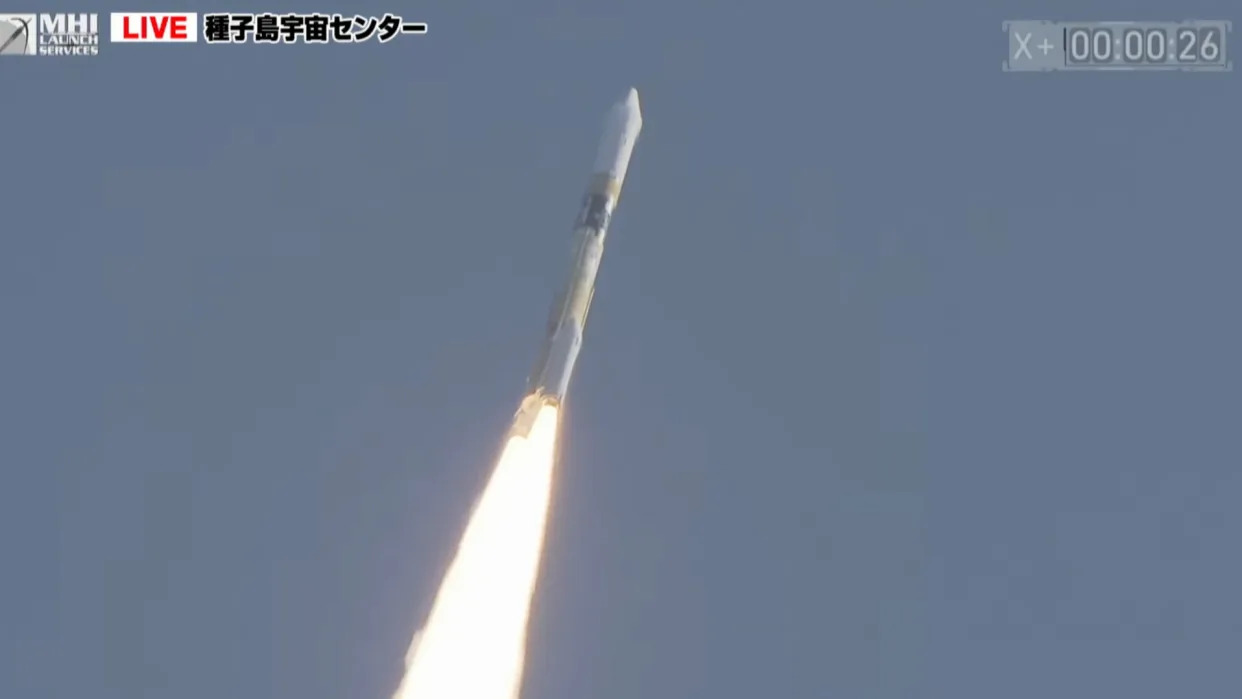
Japan launches 'moon sniper' lunar lander SLIM into spaceH-IIA rocket carrying the national space agency's moon lander is launched at Tanegashima Space Center on the southwestern island of Tanegashima


By Kantaro Komiya

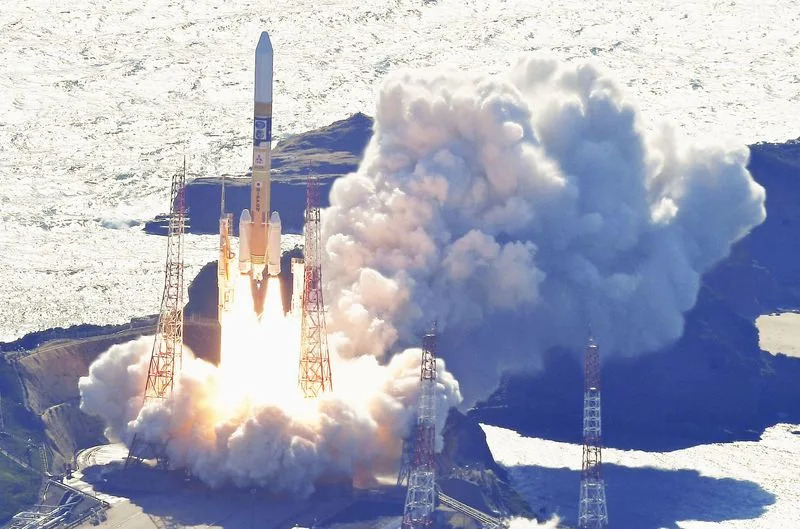
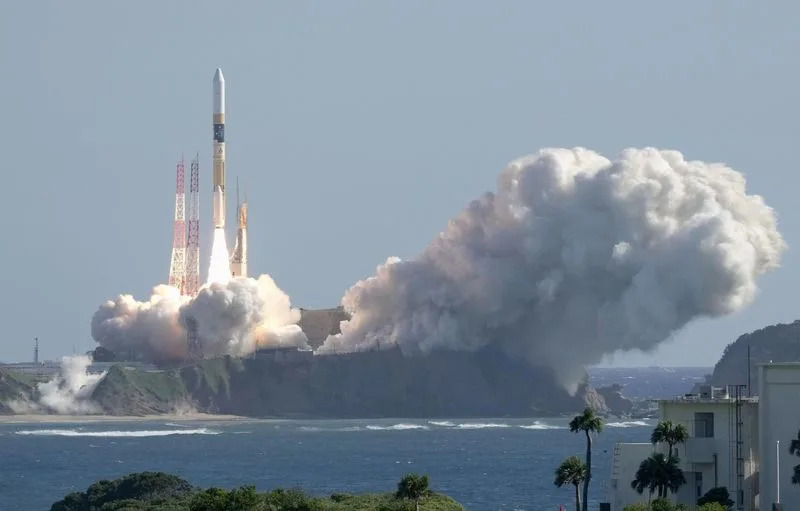
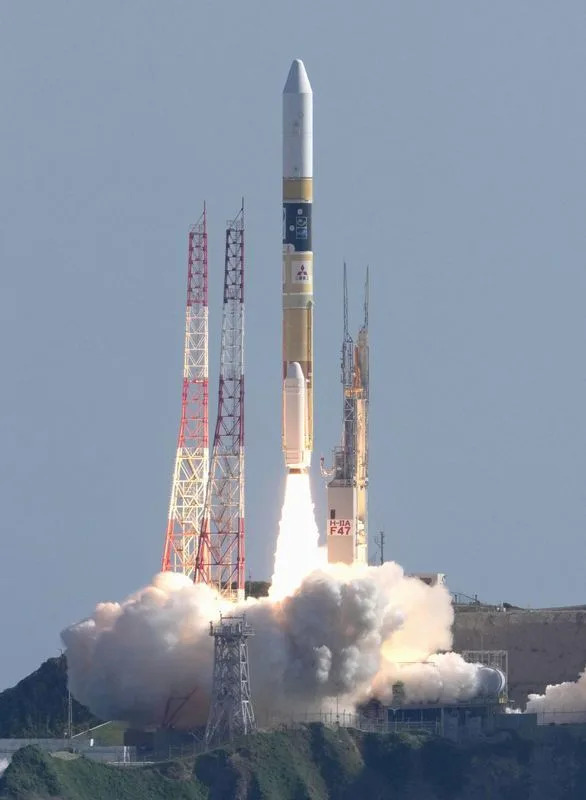
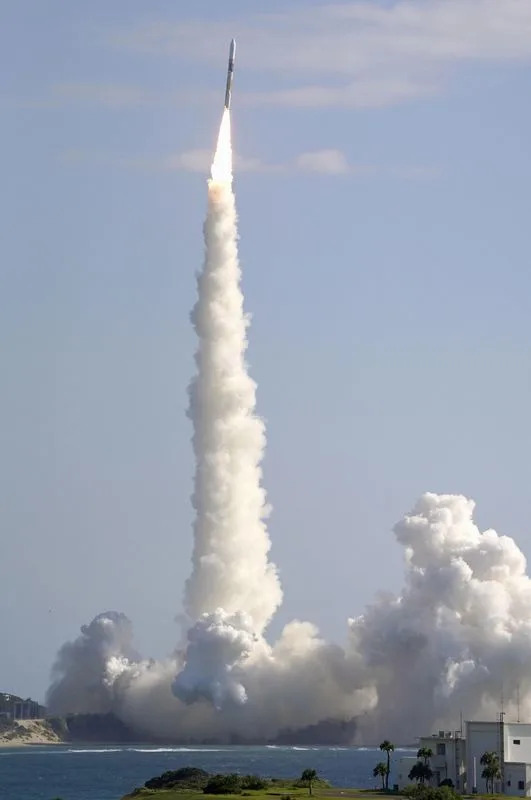
TOKYO (Reuters) -Japan launched a lunar exploration spacecraft on Thursday aboard a homegrown H-IIA rocket, hoping to become the world's fifth country to land on the moon early next year.

Japan Aerospace Exploration Agency (JAXA) said the rocket took off from Tanegashima Space Center in southern Japan as planned and successfully released the Smart Lander for Investigating Moon (SLIM). Unfavourable weather led to three postponements in a week last month.

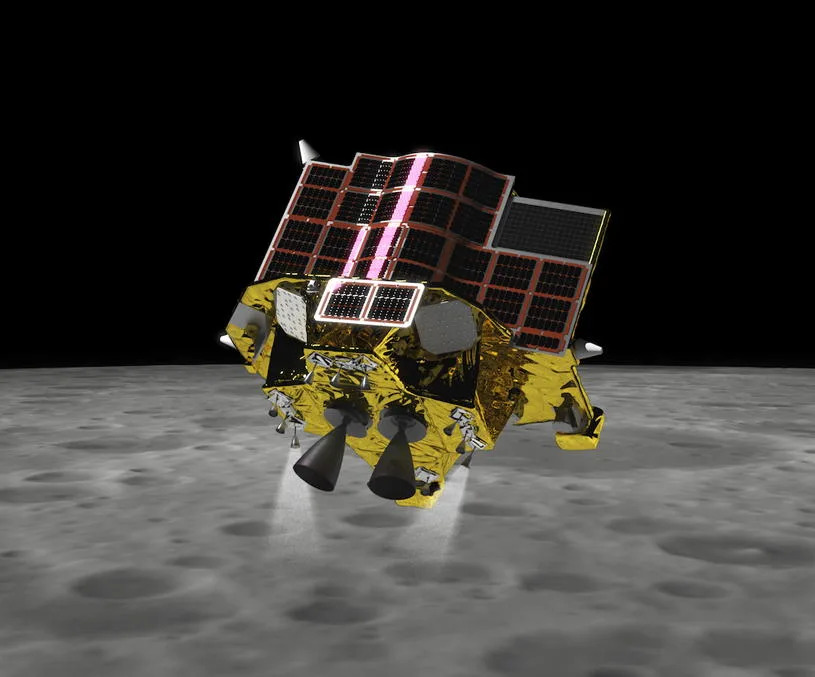
Dubbed the "moon sniper", Japan aims to land SLIM within 100 metres of its target site on the lunar surface. The $100-million mission is expected to start the landing by February after a long, fuel-efficient approach trajectory.


"The big objective of SLIM is to prove the high-accuracy landing ... to achieve 'landing where we want' on the lunar surface, rather than 'landing where we can'," JAXA President Hiroshi Yamakawa told a news conference.

Hours after launch on Thursday, JAXA said it picked up signals from SLIM showing it was operating normally.

The launch comes two weeks after India became the fourth nation to successfully land a spacecraft on the moon with its Chandrayaan-3 mission to the unexplored lunar south pole. Around the same time, Russia's Luna-25 lander crashed while approaching the moon.

Two earlier lunar landing attempts by Japan failed in the last year. JAXA lost contact with the OMOTENASHI lander and scrubbed an attempted landing in November. The Hakuto-R Mission 1 lander, made by Japanese startup ispace, crashed in April as it attempted to descend to the lunar surface.

SLIM is set to touch down on the near side of the moon close to Mare Nectaris, a lunar sea that, viewed from Earth, appears as a dark spot. Its primary goal is to test advanced optical and image processing technology.

After landing, the craft aims to analyse the composition of olivine rocks near the sites in search of clues about the origin of the moon. No lunar rover is loaded on SLIM.

Thursday's H-IIA rocket also carried the X-Ray Imaging and Spectroscopy Mission (XRISM) satellite, a joint project of JAXA, NASA and the European Space Agency. The satellite aims to observe plasma winds flowing through the universe that scientists see as key to helping understand the evolution of stars and galaxies.

Ground stations in Hawaii and Japan received signals from XRISM soon after the launch confirming that the satellite's solar panels successfully deployed, JAXA said.

Mitsubishi Heavy Industries manufactured the H-IIA rocket and operated the launch, which marked the 47th H-IIA Japan has launched since 2001, bringing the vehicle's success rate close to 98%.

JAXA had suspended the launch of H-IIA carrying SLIM for several months while it investigated the failure of its new medium-lift H3 rocket during its debut in March. Japan plans to retire the H-IIA after its 50th launch in 2024.

Japanese Prime Minister Fumio Kishida said in a social media post after the launch on Thursday that developing flagship rockets is essential to Japan's independent space activities.

"We'll build up the momentum toward the successful re-launch of the H3 rocket," Kishida posted on the social media X, previously known as Twitter.

Japan's space missions have faced other recent setbacks, with the launch failure of an Epsilon small rocket in October 2022, followed by an engine explosion during a test in July.

JAXA plans a joint Lunar Polar Exploration Mission (LUPEX) with the Indian Space Research Organisation beyond 2025, in which Japan's H3 rocket will carry India's next lunar lander into space.

The country also aims to send an astronaut to the moon's surface in the latter half of the 2020s as part of NASA's Artemis programme.

(Reporting by Kantaro Komiya; Editing by Tom Hogue and Gerry Doyle)
View comments (2)

Japan launches SLIM moon lander, XRISM X-ray telescope on space doubleheader 

Mike Wall
SPACE.COM
Wed, September 6, 2023 

a white rocket launches into a blue sky.


Japan sent two ambitious missions soaring into the heavens today (Sept. 6) — a pioneering lunar lander and a powerful X-ray space telescope.

A Japanese H-2A rocket carrying the SLIM moon lander and the XRISM space telescope lifted off from Tanegashima Space Center today (Sept. 6) at 7:42 p.m. EDT (2342 GMT; 8:42 a.m. Japan time on Sept. 7). That was about 10 days later than originally planned, thanks to weather delays.

Both spacecraft were deployed on schedule, sequentially less than an hour after liftoff. If all goes according to plan, a few months from now, SLIM ("Smart Lander for Investigating Moon") will attempt to pull off Japan's first-ever soft lunar landing — a pinpoint touchdown that will pave the way for even more ambitious feats down the road.

SLIM "aims to achieve a lightweight probe system on a small scale and use the pinpoint landing technology necessary for future lunar probes," officials with the Japan Aerospace Exploration Agency (JAXA) wrote in a mission description.

"The project will aim to cut weight for higher-function observational equipment and to land on resource-scarce planets, with an eye towards future solar system research probes," they added.

Related: Missions to the moon: Past, present and future

Shooting for the moon


SLIM is a small spacecraft, measuring just 7.9 feet (2.4 meters) high, 8.8 feet (2.7 m) long and 5.6 feet (1.7 m) wide. At liftoff, it tipped the scales at about 1,540 pounds (700 kilograms), but roughly 70% of that weight was propellant.

SLIM will take a long, looping and fuel-efficient route to the moon, finally reaching lunar orbit three to four months from now. It will then eye the lunar surface for another month or so before attempting a touchdown inside Shioli Crater, a 1,000-foot-wide (300 m) impact feature that lies at 13 degrees south latitude, on the moon's near side.

The probe aims to land within 330 feet (100 m) of a target point within Shioli Crater — a more precise touchdown than previous lunar landers have attempted. The goal is to demonstrate pinpoint-landing tech that could open the moon, and other celestial bodies, to more extensive exploration.

"By creating the SLIM lander, humans will make a qualitative shift towards being able to land where we want and not just where it is easy to land, as had been the case before," JAXA officials wrote in the mission description. "By achieving this, it will become possible to land on planets even more resource-scarce than the moon."

SLIM also carries two miniprobes, which will be ejected onto the lunar surface following touchdown. Those two little craft will help the mission team monitor the status of the larger lander, take photos of the landing site and provide an "Independent communication system for direct communication with Earth," according to JAXA's mission press kit.

SLIM isn't the first lunar lander that JAXA has built. The agency's tiny OMOTENASHI craft was one of 10 cubesats that launched with NASA's Artemis 1 moon mission in November 2022. While Artemis 1 succeeded, OMOTENASHI did not; its handlers could not establish communications with the little probe in time for its planned touchdown try. (Several of the other Artemis 1 cubesats failed in their missions as well.)

And a Japanese lander has tried its hand at a lunar touchdown before. The Tokyo-based company ispace's Hakuto-R lander reached lunar orbit — a huge accomplishment for a private spacecraft — but crashed during its touchdown attempt this past April.

Success by SLIM would therefore be historic. Just four nations have soft-landed a probe on the moon to date — the Soviet Union, the United States, China and India. India put its name on this exclusive list just last month, when its Chandrayaan-3 mission touched down near the lunar south pole.


An X-ray space telescope, too


As exciting as SLIM is, it's merely the secondary payload on Sunday's launch. The main spacecraft is XRISM, which is headed for a perch in low Earth orbit.

XRISM (short for "X-Ray Imaging and Spectroscopy Mission") is a collaboration involving JAXA, NASA and the European Space Agency (ESA). As its full name suggests, the telescope will study the universe in high-energy X-ray light.

"X-ray astronomy enables us to study the most energetic phenomena in the universe," Matteo Guainazzi, ESA project scientist for XRISM, said in a statement.

"It holds the key to answering important questions in modern astrophysics: how the largest structures in the universe evolve, how the matter we are ultimately composed of was distributed through the cosmos, and how galaxies are shaped by massive black holes at their centers," he added.

The observatory will focus particularly on the super-hot gas surrounding galaxy clusters.

"JAXA has designed XRISM to detect X-ray light from this gas to help astronomers measure the total mass of these systems," ESA officials wrote in the same statement. "This will reveal information about the formation and evolution of the universe."

XRISM won't be the only X-ray telescope studying the heavens from Earth orbit. Also up there right now, for example, are NASA's Chandra X-Ray Observatory and ESA's XMM-Newton, both of which launched in 1999, as well as NASA's NuSTAR, which lifted off in 2012.


India's Moon Lander Just Took Off Again and Landed in a Different Place

Victor Tangermann
Wed, September 6, 2023 


Second Landing

After safely landing on the lunar surface last month, India's Vikram Moon lander just pulled off its next daring stunt.

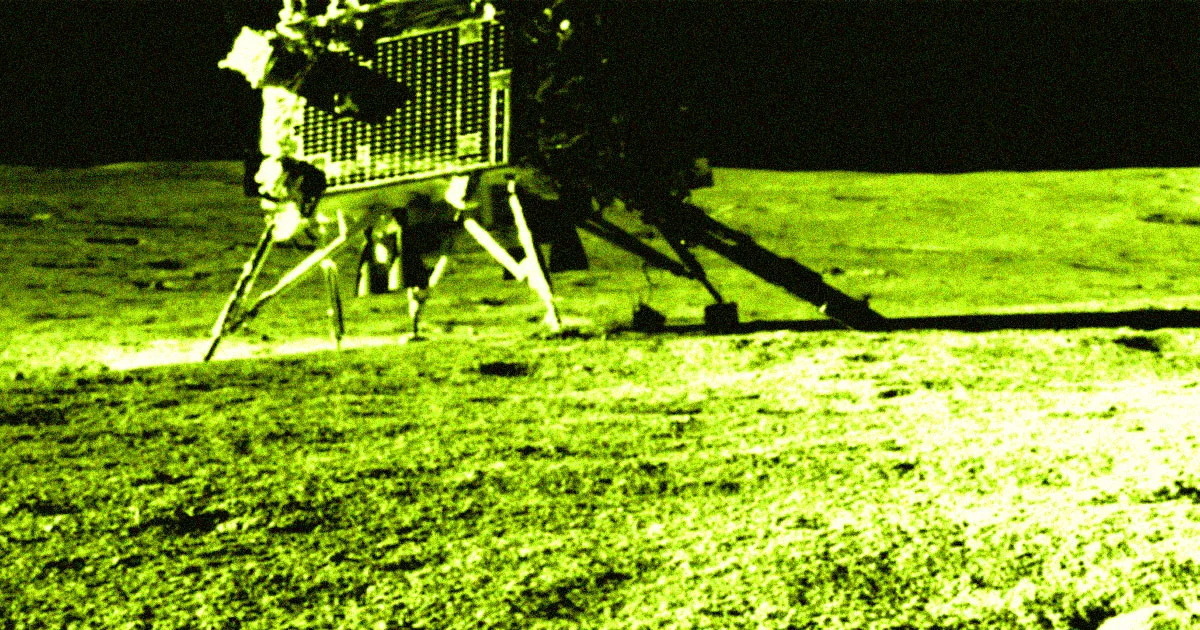
The lander fired up its engines, causing it to float 15 inches above the lunar surface, then moved laterally. Moments later it landed again, roughly 11 to 15 inches away from where it was sitting previously.

A clip shared by the Indian Space Research Organization shows the view from the lander as the cratered lunar surface goes up in a cloud of dust. Seconds later, the lander's view clears up again, showing a slightly altered landing spot.

"Vikram soft-landed on the Moon again!" the ISRO's update reads.

It's an impressive feat that again demonstrates India's growing off-world prowess.

"All systems performed nominally and are healthy," the ISRO wrote.

https://twitter.com/isro/status/1698570774385205621

Goodnight Moon

Shortly after landing on the lunar surface two weeks ago, Vikram released a smaller, six-wheeled rover dubbed Pragyaan, which has been exploring the surrounding area for signs of water ice since.

Vikram's successful flight was performed shortly before it and its rover cousin were scheduled to take a prolonged nap. Early Monday morning, the lander entered sleep mode.

"Vikram will fall asleep next to Pragyan once the solar power is depleted and the battery is drained," the ISRO tweeted on Monday. "Hoping for their awakening, around September 22, 2023."

The stakes are pretty high. If Vikram fails to get up from its slumber, it could be game over for the mission.

"Hoping for a successful awakening for another set of assignments!" the ISRO tweeted over the weekend. "Else, it will forever stay there as India's lunar ambassador."

Australian moon rover to hitch a ride on NASA’s giant moon rocket


Andrew Wulfeck
Wed, September 6, 2023 

Australia is aiming to become one of only a handful of countries to operate a rover on the Moon and said it could reach the lunar surface by 2026.

The Australian Space Agency is working with NASA to design and launch the rover that will depend on an Artemis launch to make it to the Moon.

The agency said the first attempt could occur as soon as 2026, when NASA is expected to launch the Artemis III crew to the Moon’s surface.

"Drawing on Australia’s world-leading remote operations expertise, the rover will collect lunar soil, known as regolith. NASA will attempt to extract oxygen from the sample. This is a key step towards a sustainable human presence on the Moon," the ASA said in a statement.

SEE THE OBJECT HUMANS LEFT BEHIND ON THE MOON


Australian Space Agency moon rover

Russia recently attempted to put a spacecraft on the surface of the Moon, but the mission is believed to have ended in spectacular fashion, with a massive crater now seen from satellites near the expected landing site.

If Roscosmos, Russia’s space agency, had been successful with the Luna-25 mission, it would have been the first time since the 1970s that the country had successfully landed a spacecraft on the lunar body.

India, the Soviet Union, China and the United States are the only countries to have successfully operated a spacecraft on the Moon, with several other countries eyeing to achieve the historic feat.

SPACECRAFT CAPTURES PHOTOS OF NEW CRATER ON MOON LIKELY CREATED BY FAILED MISSION

Australia has yet to determine a name for the rover but said it is turning to its citizens for help.

The space agency has opened a website for Australians to submit potential names that will one day come to a public vote.

The winner is expected to be announced in December, and the name will be placed on the robot for the universe to see.

Original article source: Australian moon rover to hitch a ride on NASA’s giant moon rocket