Monday, December 30, 2024

Kurds Seek Federal Solution as Tensions Rise in Syria and Beyond

Kurds wave independence-era flags during a demonstration in support of the US-backed, Kurdish-led Syrian Democratic Forces in the northeastern city of Qamishli, on Dec. 19, 2024. (DELIL SOULEIMAN/AFP via Getty Images)

GIORGIA VALENTE
MEDIALINE
12/29/2024

Kurds face oppression across the Middle East, battling for recognition and autonomy while resisting extremism, Turkey's aggression, and regional political challenges

The Kurdish people, often referred to as the largest stateless ethnic group in the world, have faced centuries of marginalization and persecution. Scattered across Turkey, Syria, Iraq, and Iran, the Kurds share a cultural, linguistic, and historical bond but remain divided by political borders imposed after World War I. In Syria, their plight has been particularly stark with decades of oppression under the Arab nationalist Baath regime.

“The Kurds are native to Turkey, Syria, Iraq, and Iran. Today, they are probably the largest ethnic group that does not have a state of its own. There are about 20 million in Turkey, 10 [million] in Iraq, 6 [million] in Iran, and 3 or 4 [million] in Syria. We do not have exact numbers. It’s all estimates,” Henri Barkey, adjunct senior fellow for Middle East Studies at CFR, said to The Media Line.

Kurds in Syria have long been treated as second-class citizens. Stripped of citizenship rights in the 1960s, many were rendered stateless and denied access to education, property ownership, and other fundamental rights.


I was perhaps one of the few Kurds who did not belong to the ruling party in Syria and still had the opportunity to work academically in Syrian universities, despite being classified as an opponent of the regime. When I earned my doctorate with distinction, the regime’s security agencies issued a secret order banning me from teaching in all public and private universities.

“I was perhaps one of the few Kurds who did not belong to the ruling party in Syria and still had the opportunity to work academically in Syrian universities, despite being classified as an opponent of the regime,” said to The Media Line, Serbest Nabi, a Syrian Kurdish political philosophy professor, currently living in Erbil, Kurdistan. However, his achievements came at a cost. “When I earned my doctorate with distinction, the regime’s security agencies issued a secret order banning me from teaching in all public and private universities,” he said.

This marginalization was rooted in the Baathist ideology, which sought to suppress ethnic diversity in favor of Arab nationalism. For Kurds, asserting their identity or demanding rights was met with suspicion and repression. “The suspicion of being an extreme Kurdish nationalist followed me everywhere and throughout my academic life,” he shared.

Many Syrian Kurds facing these issues, like Nabi, had to escape to Iraq, a country where Kurds achieved autonomy as part of a federal state. As of January 2024, the UN High Commissioner for Refugees reported that approximately 270,000 Syrian refugees were residing in Iraq, with the majority being Syrian Kurds.


I sought refuge in Iraqi Kurdistan. My family joined me here later. My children, who grew up here, know nothing about their homeland and their father’s birthplace.

“I sought refuge in Iraqi Kurdistan. My family joined me here later. My children, who grew up here, know nothing about their homeland and their father’s birthplace,” Nabi addressed.

Since the Syrian Civil War in 2011, Kurdish forces, primarily the Syrian Democratic Forces (SDF), have played a crucial role in fighting ISIS and controlling key territories in northern Syria.

“The Kurds in Syria alone have faced the culture of religious extremism and the racism of the Arab Baathist regime. Fate has forced them to confront groups like ISIS, Al-Nusra, and others with takfiri ideologies,” Barkey stated.

“The Kurds are responsible for holding 40,000 ISIS prisoners, including fighters, women, and children. If Turkey keeps pushing militias to obstacle them, these prisoners could escape, spreading across the Middle East and reigniting the ISIS threat in Syria like in the past,” he added.

SDF historically allied with the US against ISIS, but this has led to tensions with Turkey, which views the group as an extension of the PKK (Kurdistan Workers’ Party), a designated terrorist organization.

“Turkey has invaded Syrian territory controlled by the Kurds three times since 2016, shrinking Kurdish-held areas under the pretext of fighting terrorism. Turkey, a NATO member, has been attacking Kurdish forces with impunity while the US did very little to protect them. Kurds were betrayed by allies,” Barkey said.

By supporting extremist factions, like Hay’at Tahrir al-Sham (HTS), and creating proxy forces like the Syrian National Army, Ankara has sought to prevent any form of Kurdish autonomy along its borders.


Turkey is strategically afraid of Kurdish autonomy. If the Syrian Kurds negotiate something similar to Iraq’s federal structure, it raises the possibility that Turkish Kurds will demand the same. For Erdogan, this is a red line.

“Turkey is strategically afraid of Kurdish autonomy. If the Syrian Kurds negotiate something similar to Iraq’s federal structure, it raises the possibility that Turkish Kurds will demand the same. For Erdogan, this is a red line,” explained Barkey.

“Erdogan wants to bring back Ottoman thoughts—control Egypt, the Mediterranean Sea, Greece, and Cyprus. It’s all for pipelines and regional dominance, but the Kurds are an obstacle to this plan,” Juan Saadoun, a Syrian Kurd media activist currently living in Canada, said to The Media Line.

He also highlighted the hypocrisy in the West’s position these days. “The irony is that while the West normalized HTS, which originated from Al-Qaeda, they label Kurds as terrorists for past PKK ties,” he said.

Turkey’s aggression also aims to prevent solidarity between Kurds across borders. “We, along with the Kurds of Turkey, represent a shared social, cultural, and historical extension. Political borders cannot separate our common consciousness of belonging to our identity,” Saadoun noted.

He emphasized how Turkey’s proxy forces exacerbated the plight of civilians. “The Turkish-backed factions in Afrin and other areas in Syria commit atrocities, prevent families from returning, and enforce extremist practices like Jizya taxation,” he stated.

Personal stories of loss underscore the gravity of the situation and point out the fear of an ISIS comeback. “My brother Yusuf led fierce battles against ISIS and was martyred resisting the Turkish invasion in 2019 in Ras al-Ain (Sere Kaniye). My cousin, Haji, was martyred in the battles to liberate Raqqa from ISIS. We must prevent this from happening again,” Nabi shared.

Despite these challenges, the Kurds remain resilient, united by a shared vision for self-determination. “The Kurdish tragedy cannot continue in this manner. A solution must transcend the colonial-imposed borders of the Middle East after World War I to ensure the rightful place of the Kurds in this geography,” Barkey stated.

We want a federal region, like the Kurdistan region in Iraq. We want safety and protection for Alawites, Druze, and other minorities as well.

Saadoun shared this view: “We want a federal region, like the Kurdistan region in Iraq. We want safety and protection for Alawites, Druze, and other minorities as well.”

Yet, achieving this dream is fraught with obstacles. “I aspire to return to my country and participate in political life,” Nabi said. “However, I find it very difficult to return to a country ruled by an Islamic political-religious movement. I will most likely be on the side of the opposition, continuing to confront any tendency toward establishing a tyrannical religious authority in Syria.”, he claimed.

The Kurdish struggle for recognition, equality, and safety continues, a testament to their enduring spirit in the face of adversity. As Nabi pointed out, “The current situation requires resilience and global solidarity. Without it, the Kurds will remain caught in a cycle of war and marginalization, their sacrifices overshadowed by regional and international politics.”


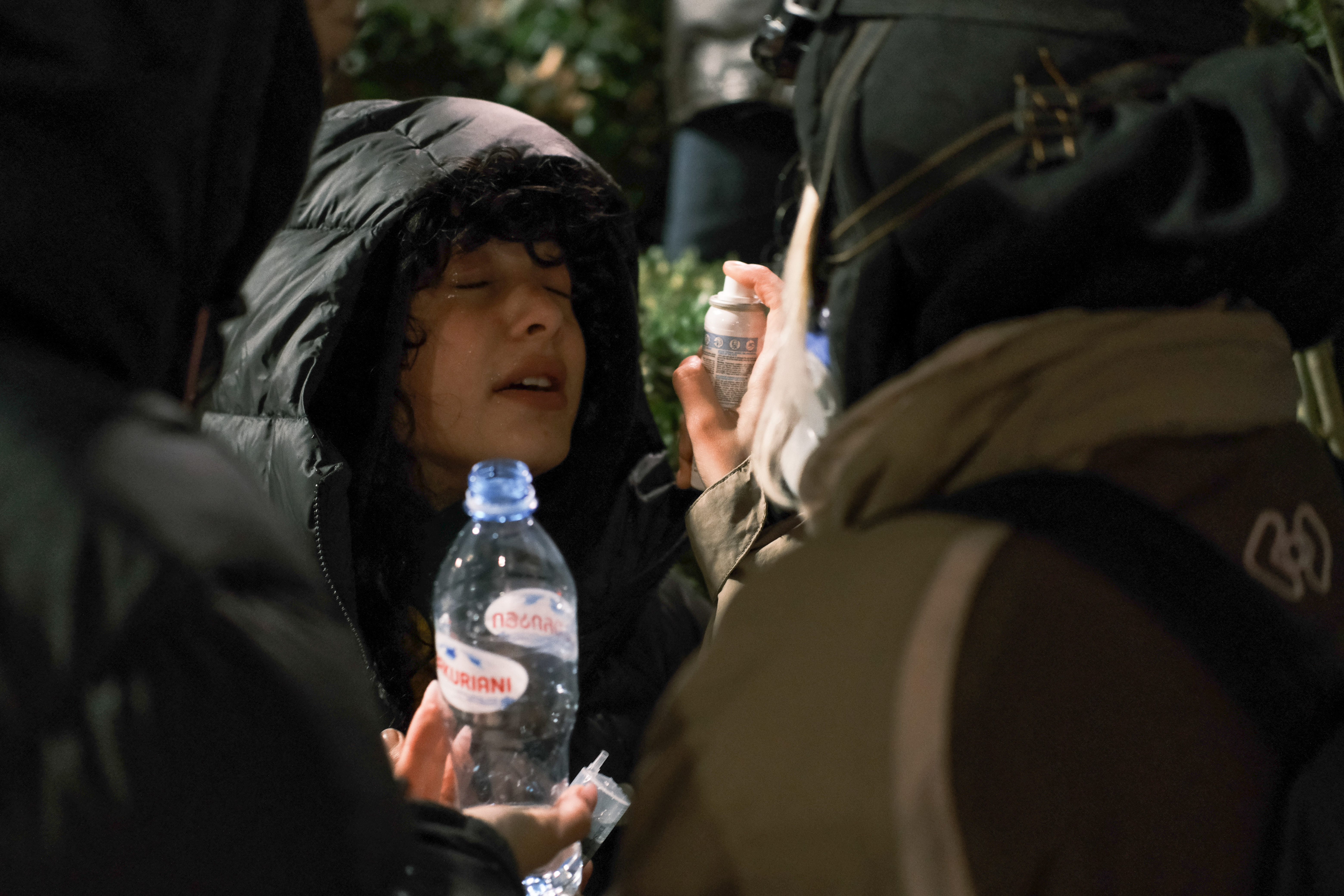
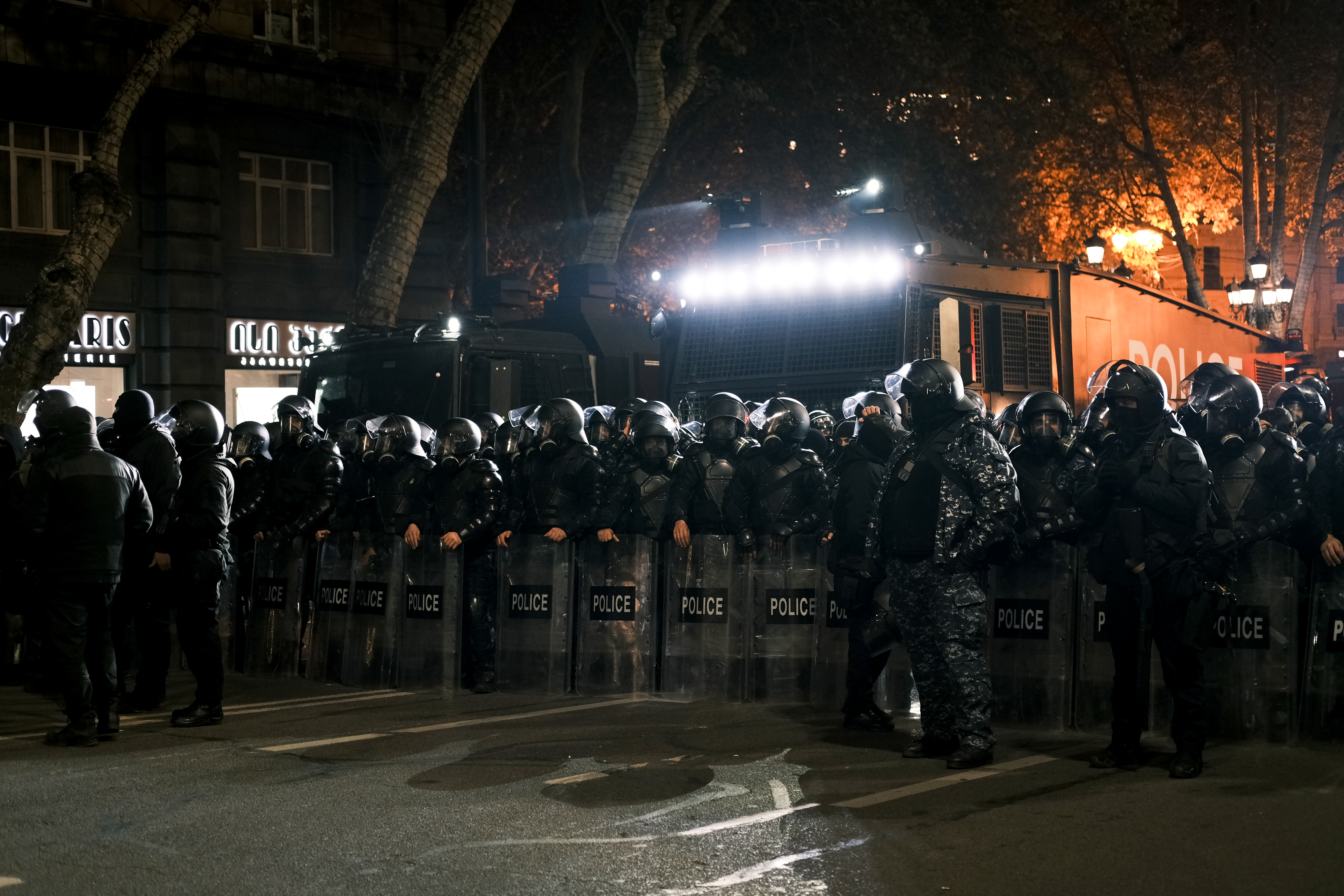
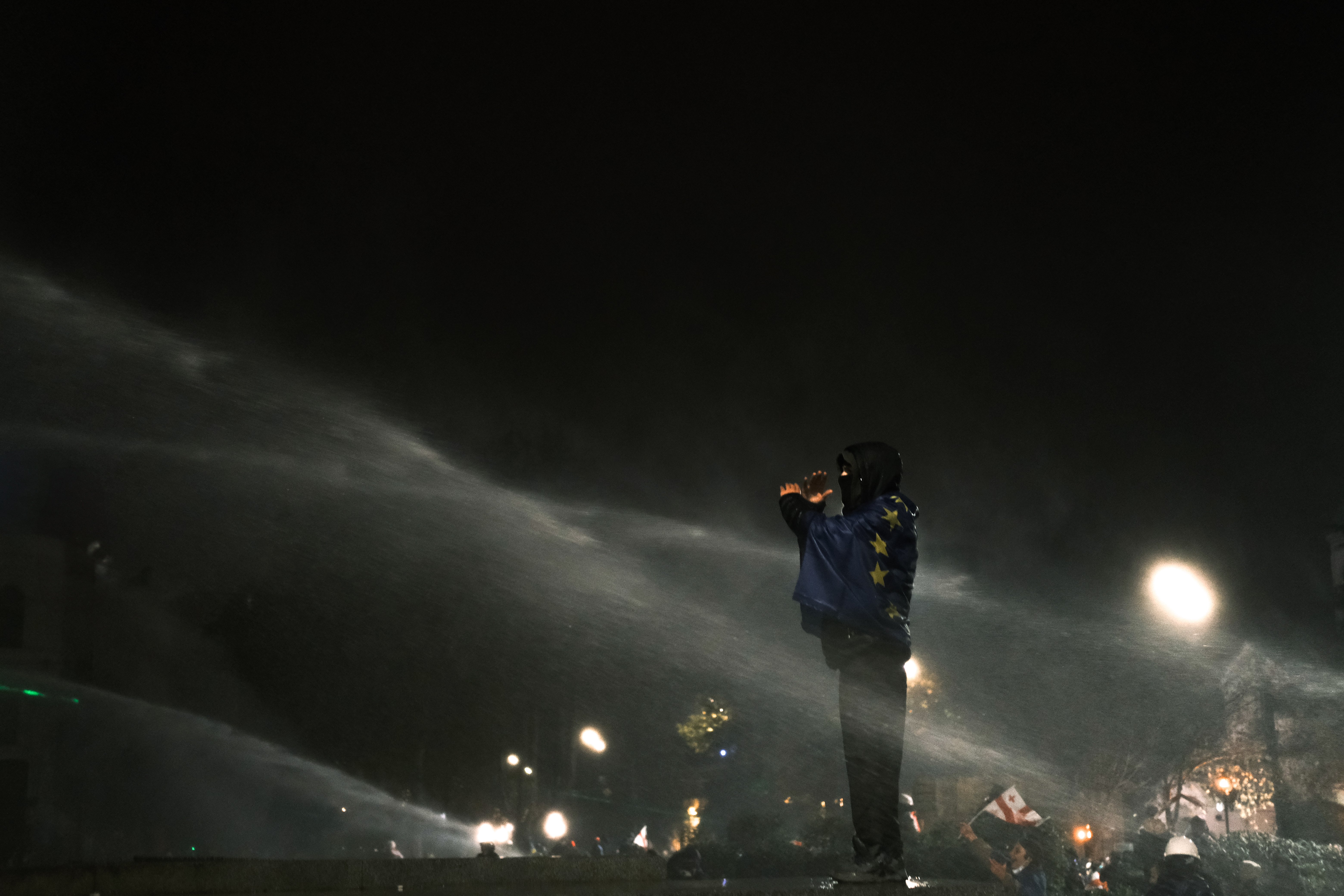
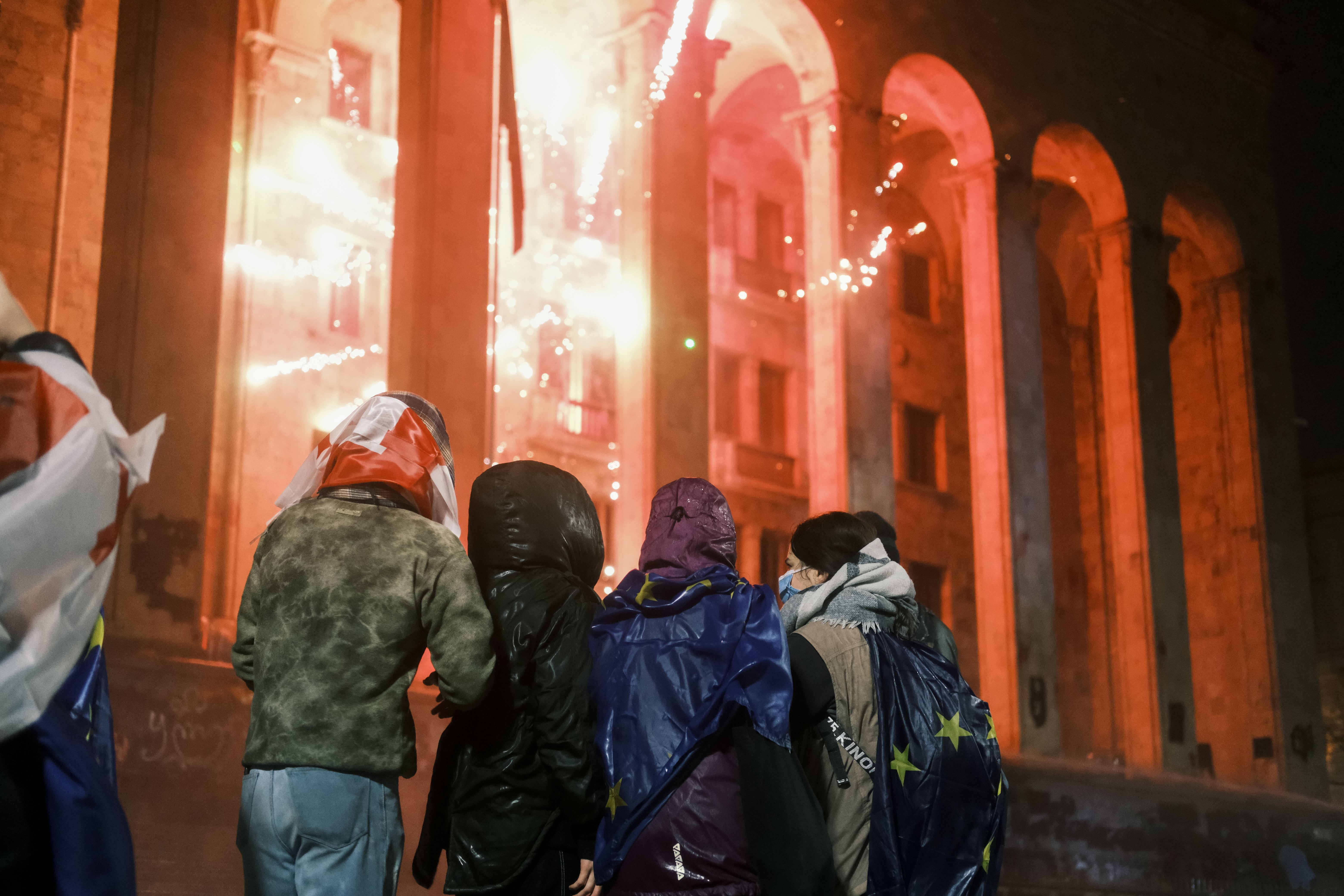
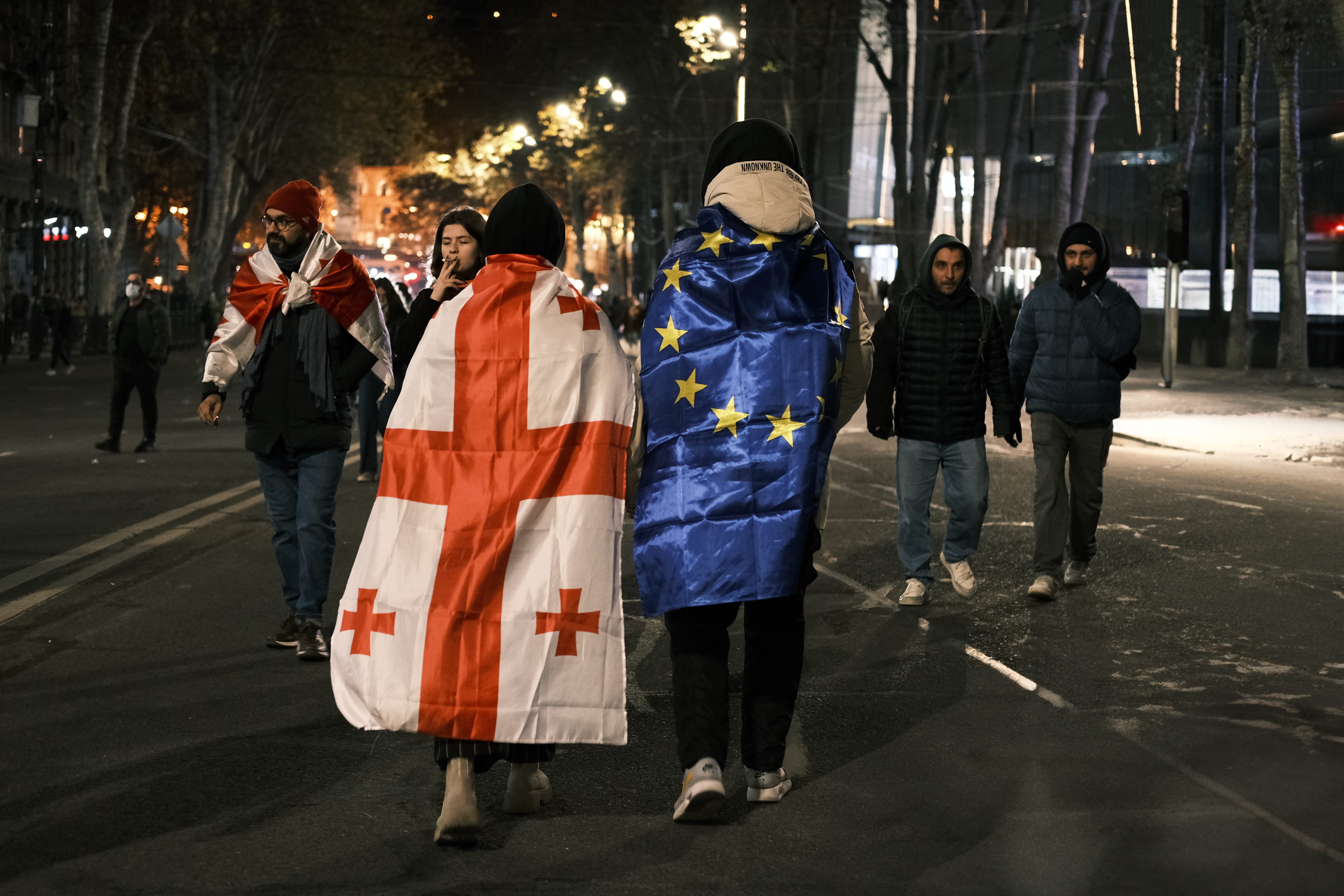
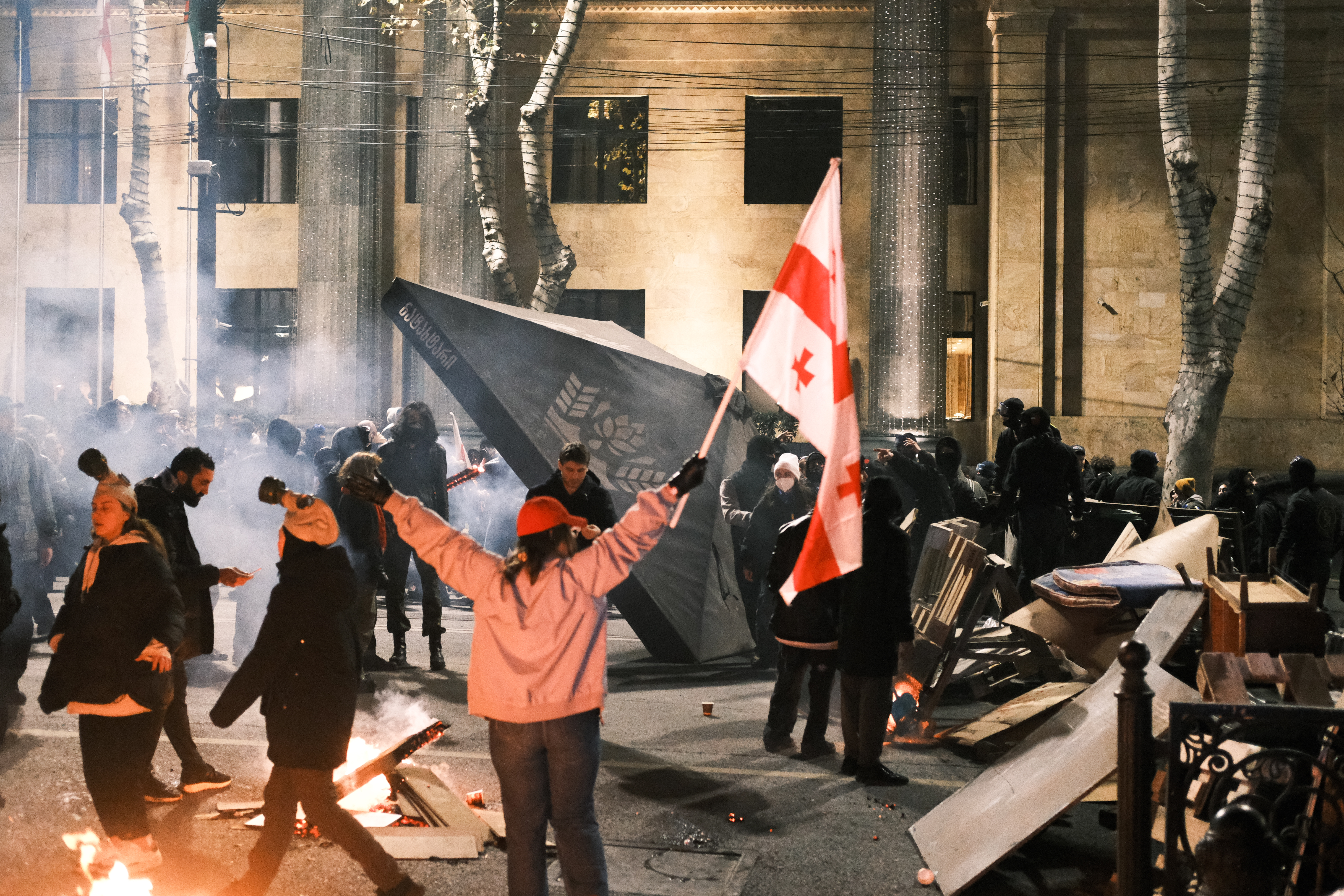
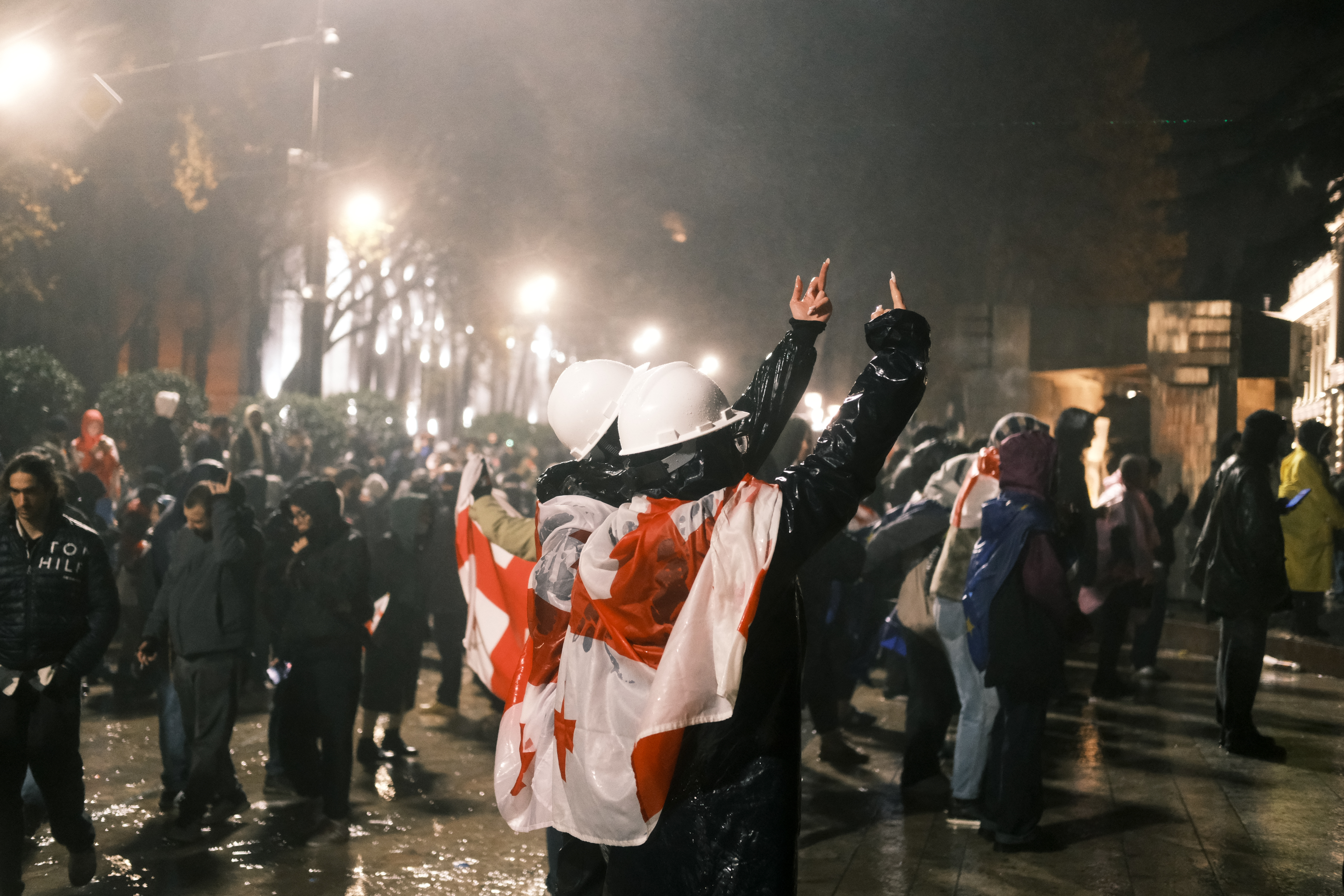
'My brother is fighting on frontlines in Ukraine—how can I not protest in Georgia?'

Content by JAMnews’ partner Donbas News   30.12.2024
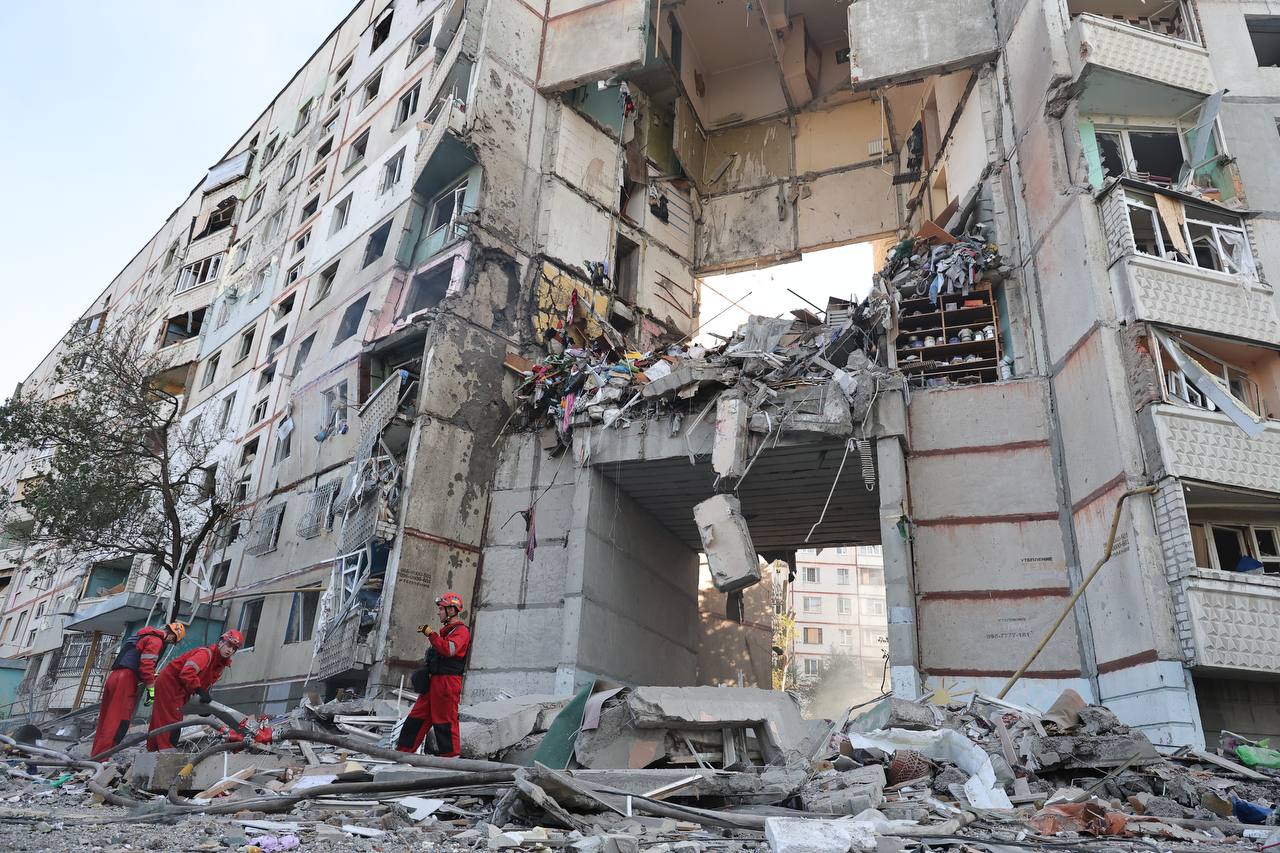
In Ukraine's Kharkiv region, aid workers risk lives to keep residents warm

December 29, 2024 
By Anna Kosstutschenko

As harsh winter weather descends on Ukraine, UNICEF and other aid organizations are helping communities in eastern Ukraine's Kharkiv region prepare for the cold season. Many locals have lost jobs and reliable income sources because of the war and cannot afford heating. Among them is the Malakey family, whose two children have disabilities. Anna Kosstutschenko has the story. VOA footage and video editing by Pavel Suhodolskiy.

Stolen Lives: Inside Russia’s Abduction of Ukrainian Children

Returned Ukrainian children in Truskavets, Ukraine. (Provided by Aksana Filipishyna)

VERONICA NEIFAKH
MEDIALINE
12/29/2024

Nearly 20,000 Ukrainian children have been forcibly taken to Russia or occupied territories since the war began. Experts describe Russia's efforts to erase their identities and Ukraine's struggle to bring them home.

Since the outbreak of the war in 2022, nearly 20,000 Ukrainian children have been forcibly taken to Russia or Russian-occupied territories without the consent of their families, Ukrainian officials say. Independent research, including research by Yale University, suggests a policy of systemic deportation of Ukrainian youth.

The harrowing consequences of that policy became clear in January 2024, when an 18-year-old Ukrainian who had been sent to a foster family in Russia took his own life. Shortly before his death, he sent a voice message to his friends expressing his despair over the relocation.

Ukraine says these actions meet the UN’s definition of genocide and last year, the International Criminal Court issued arrest warrants for Russian President Vladimir Putin and his children’s rights commissioner, Maria Lvova-Belova, accusing them of unlawfully deporting Ukrainian children.

Russia denies these allegations. Lvova-Belova has acknowledged that 730,000 Ukrainian children fled Ukraine for Russia since the start of the war but said that most of them came with their families. She said that Russia had taken about 2,000 children from Ukrainian orphanages, but she did not mention other allegations of widespread forced displacement.

Ukrainian human rights advocates who spoke to The Media Line described a harrowing, calculated effort to undermine Ukraine’s future through the use of its youngest and most vulnerable citizens. They noted that the true extent of the abductions likely surpasses the 20,000 figure.

The Fate of Ukraine’s Abducted Children

Olena Kuvaieva, a lawyer with the Strategic Litigation Center of the Ukrainian Helsinki Human Rights Union, traced the roots of the abducted children crisis back to at least 2014, when Ukraine raised the alarm that Russia was abducting Ukrainian children from orphanages.


Olena Kuvaieva. (Courtesy)

By 2015, Russia had launched the “trains of hope” initiative, encouraging Russian citizens to travel to occupied Ukrainian territories and adopt Ukrainian children. “Ukraine raised this issue on the international stage and appealed to the European Court of Human Rights,” Kuvaieva told The Media Line, noting that those actions were carried out under the auspices of Pavel Astakhov, then the presidential envoy for children’s rights in Russia.

Russia’s own public records reveal how the policy of child relocation has taken off since the 2022 invasion. From 2022 to mid-2023, Russian authorities openly published data on government websites detailing the arrival of Ukrainian orphans in over 70 localities across 42 regions. “The geography is vast, from border regions to deep inside Russia,” Kuvaieva said, describing a deliberate dispersion of Ukrainian children across the country.

These boys, displaying pro-Ukrainian sentiments, were to be sent to such institutions in Grozny

She cited a 2023 public event where Chechen leader Ramzan Kadyrov and Putin’s envoy Maria Lvova-Belova discussed “reeducation facilities” for Ukrainian teenagers who resisted Russian assimilation. “These boys, displaying pro-Ukrainian sentiments, were to be sent to such institutions in Grozny,” the capital city of Russia’s Chechen Republic, Kuvaieva said.

Kuvaieva noted that Ukraine had tried to clear out its state-run child care institutions on the border regions leading up to the 2022 Russian invasion to prevent children from being kidnapped.

“Most children from state institutions were successfully evacuated,” Kuvaieva said. But an estimated 4,000 children remained in orphanages, foster care, or other guardianships in areas like Donetsk, Luhansk, Kherson, Zaporizhzhia, and Kharkiv. As Russia moved in, those regions saw widespread violence, civilian casualties, forced detentions, and abductions.

She pointed to the 2022 siege of Mariupol as another example of how Ukrainian children have been forcibly relocated. Before the siege, Mariupol’s civilian population was over 250,000, one-fifth of whom were children. The city’s infrastructure was almost entirely destroyed by relentless shelling and bombings, leaving 90% of it in ruins.

“When Russian forces entered the devastated city, they brought buses and systematically cleared out neighborhoods,” Kuvaieva said. Civilians were forced out of bomb shelters and basements under the threat of complete annihilation. “People were told they had 30 minutes before the area would be completely cleared—meaning everything that moved would be destroyed. Those seeking survival had no choice but to board the transport, which took them to so-called filtration camps in Russia,” she continued.

In those camps, families with children were held for three to five days under grueling conditions. Adults underwent a rigorous “filtration” process, and suspicions of pro-Ukrainian sentiment often led to devastating separations.

“If parents were found with pro-Ukrainian information on their phones, tattoos, or laptops—or identified as local officials, activists, or human rights defenders—they were immediately detained,” Kuvaieva said. Those parents’ children were separated from them and transferred to orphanages or health camps in Russia.

Kuvaieva said that the figure of 20,000 forcibly relocated children from across Ukraine is likely understated. “In Mariupol alone, where 51,000 children lived before the invasion, we suspect many remain unaccounted for—especially those whose families perished or whose parents were executed or detained by Russian forces,” she said.

Other children were vulnerable to forced relocation after being left with grandparents or other relatives when their parents joined the military or were taken prisoner, Kuvaieva said.

The fate of the abducted children varies—some remain in orphanages, others have been placed with foster families, and a significant number have been adopted within Russia. Research by Yale University and Ukrainian human rights groups confirms the widespread and systematic nature of these transfers.

Kuvaieva said her own research has found that the abductions take a serious mental toll on their victims, with the potential for lasting harm. “Children who spent extended periods in the Russian Federation endured significant psychological manipulation,” she said.

Abducted Ukrainian children are often forcibly humiliated, banned from speaking Ukrainian, and made to participate in singing Russian anthems. Ties to their families are cut off, including by confiscating their phones, and some are even confined to basements.

“Children faced punishment for expressing hope that Ukraine would return or for showing any positive sentiments toward their homeland,” Kuvaieva said. She added that many children reported being told by their captors that Ukraine had forgotten about them and that only Russia could offer them a future.

The harsh conditions left many children, particularly teenagers, vulnerable to suicidal thoughts. “These were children who remembered an independent, democratic Ukraine—where dignity and human rights mattered, where they could speak freely,” Kuvaieva said. She emphasized that the totalitarian environment was hard to tolerate for adults, let alone children.

“It’s no surprise that some were pushed to the brink,” she said.

Fast-Tracked Russian Citizenship for Ukrainian Children

Kuvaieva detailed how Russia systematically altered its citizenship laws since May 2022 in order to facilitate the integration of Ukrainian children. The most recent changes, effective January 4, 2024, allow almost any adult to apply for citizenship on behalf of a child from occupied Ukrainian territories, she said.

“This adult could be a hospital director, a school principal, the head of an orphanage, or even a temporary guardian,” Kuvaieva said. The individual merely needs to state that the child is unaccompanied and has no established connection with relatives.

“Of course, no one attempts to establish such connections or inform Ukraine about the child’s whereabouts,” Kuvaieva noted, adding that the child’s opinion is also not taken into account in the process.


This policy isn’t just about assimilation; it’s a calculated effort to erase Ukrainian identity

After the Ukrainian child is recognized as unaccompanied, Russia replaces the child’s birth certificate and makes the child eligible for adoption. “The system is designed to close the loop and make these children untraceable,” Kuvaieva said. “This policy isn’t just about assimilation; it’s a calculated effort to erase Ukrainian identity.”

Kuvaieva described the policy of child abduction as “another facet of a systematic strategy to strip Ukraine of its future by targeting its children.” “Children represent the future and hope of any nation. By erasing Ukrainian identity among these children, Russia seeks to weaken Ukraine’s future,” she said.

She added that Russia is also hoping to benefit demographically from the introduction of Ukrainian children, who are seen as “intelligent, curious, and industrious.”

The Challenges of Returning Ukraine’s Abducted Children

Ukraine wants to rescue abducted children, but so far, it hasn’t managed to do so in any large-scale way, Kuvaieva said.

“The full procedure envisioned by the Geneva Conventions has not been implemented, and this leaves us with slow progress on bringing these children back home,” she explained.

Under the Geneva Conventions, both Ukraine and Russia are obligated to create national information bureaus to document civilians displaced by war, including children. “Ukraine compiles lists of those we seek to locate and believe were unlawfully taken, while Russia is required to maintain a registry of individuals it has transferred or detained in occupied territories,” Kuvaieva said.

Ukraine’s registry, established in 2022, gathers information from sources including families, law enforcement officers, orphanage directors, and other officials.

According to the Geneva Conventions, both Ukraine and Russia were required to identify at least four trusted states to act as mediators in negotiations about returning displaced civilians. “Ideally, if both sides agreed on a mediator country, intermediary bodies would form under its auspices, potentially involving organizations like the International Red Cross or the UN,” Kuvaieva said. But this process has not been realized.

Instead, the fate of Ukraine’s children rests with various isolated efforts. “What we see are small-scale or individual cases of family reunifications, rather than the systematic return of orphans or children deprived of parental care,” Kuvaieva said.

Most cases of returned children involve families separated during the invasion, such as children who were sent to stay with grandparents in Kherson when their mother was working in Kyiv. “Very few children have been retrieved from deep within Russia—these are not hundreds but merely dozens,” Kuvaieva explained.

Aksana Filipishyna, an analyst with the Ukrainian Helsinki Human Rights Union, highlighted the involvement of international mediators in facilitating the return of abducted Ukrainian children. “Countries like Qatar, the Vatican, and South Africa have expressed willingness to assist, with Qatar already achieving some success,” she explained. But for now, the efforts of the Ukrainian Helsinki Human Rights Union have resulted in the return of just 210 children.


Returned Ukrainian children in Truskavets, Ukraine. (Provided by Aksana Filipishyna)

“Children from Mariupol, for example, were first taken to Donetsk and later moved to Moscow suburbs. Parents and guardians began reaching out to us, but retrieving children is extremely difficult,” she said.


Even mothers must gather extensive documentation to prove parental rights. Grandmothers, if the parents are deceased, are often forced to apply for guardianship under Russian law, which is absurd.

In many cases, legal hurdles arise. “Even mothers must gather extensive documentation to prove parental rights. Grandmothers, if the parents are deceased, are often forced to apply for guardianship under Russian law, which is absurd,” Filipishyna added. Getting a child back to Ukraine is even more difficult if a child had no legal guardian in Ukraine or if their documents were confiscated.

Rescuing abducted children is even more challenging when the children have been taken to Russian-occupied territories. “Occupied territories are harder to access due to military equipment and numerous checkpoints,” Filipishyna said, noting that many children fear prolonged interrogations at border crossings.

She emphasized the need for streamlined international mechanisms, as the current system places significant barriers on families trying to reunite. “It’s an incredibly challenging process that leaves many children in legal limbo, unable to return home,” she said.

For the few children who manage to return to Ukraine, vast challenges remain. These children, who sometimes have no parents to return to, undergo a careful reintegration process involving long-term psychological support upon their return to Ukraine.


Returned Ukrainian children in Truskavets, Ukraine. (Provided by Aksana Filipishyna)

Filipishyna recounted the story of one boy who was left stranded at a Russian hospital after his parents were killed during their escape from occupied territory. In another case, a 12-year-old girl was coerced into accepting Russian citizenship and witnessed the rape and murder of a childhood friend by a Russian soldier.

Even those children who don’t experience violence are deeply psychologically affected by the abduction and by having to give up their sense of being Ukrainian. “They return deeply scarred, needing to unlearn the falsehoods forced upon them and rebuild their identities,” Filipishyna said.
Born from necessity: A new Russian self propelled howitzer

December 30, 2024

The Russian army introduced a new self propelled artillery system to the Ukrainian battlefields.


Mystery SPG (Photo: mil.in.ua)

Ukrainian journal Mil.in.ua speculates that it is based on the Uraltranshmash 2S43 Malva wheeled SPG, that is basically a rear mounted 152mm A64 gun from the MSTA-S out in the open.


2S43 Malva


The new system has an independently rotating turret, but still an open turret. The layout is much closer to the Titan-Barrikady A-222 Bereg 130mm coastal artillery SPG, which has also seen combat in the Ukrainian southern front. A-222 Bereg isn’t a viable candidate for further production, as its non-standard caliber limits the available ammunition stocks and isn’t currently being produced in Russia.


A-222 Bereg

Russia is also suffering extremely hard attrition on all of its artillery systems, both from the Ukrainian counter battery fires and simply by barrels wearing out. There is a limited amount of machinery in Russia that is capable of producing a decent quality artillery barrel in the 152mm range. This limits the amount of newly built SPGs like 2S35 Koalitsiya, a replacement for the MSTA-S. MSTA-S is being phased out as its chassis is a T-80 derivative, while the Koalitsiya is based on the much easier to produce T-72/T-90 chassis.


2S35 Koalitsiya-SV

Russia is also losing vast quantities of main battle tanks of all imaginable types. The combination of refurbishing the increasingly worse tanks from the deep storage facilities and the manufacture of new T-72/T-90 tanks puts a lot of strain on both MBT parts and companies capable of working with tank systems like Uraltransmash.

On the other hand Titan-Barrikady, with its wheeled vehicle production, isn't under that heavy burden. From the industrial standpoint, it would make sense that the new SPG is a simplified and army use adapted variation of the A-222 Bereg system, that is being manufactured from available components. The Bryansk Automobile Plant is capable of producing enough base vehicles for the production and by the use of the Giazint-B barrels the new SPG also sidesteps the barrel shortage.

While the new vehicle, being based off of an older towed howitzer, is a downgrade from the more automated MSTA-S, Koalitsiya and even the Malva, it has some improvements over them too.

The new SPG has a longer range than either Malva or MSTA-S. It’s faster to deploy and more flexible to use than the Malva. It also has much better drone protection and thermal signature reduction than any of the precious Russian artillery systems.

This new SPG is the best that Russia can actually produce in meaningful numbers, under the current industrial and battlefield constraints.

Video of the system can be found on Telegram.
Xiplomacy: A glimpse of Xi's global insights through 3 maxims quoted in 2024

(Xinhua)  December 30, 2024

With those maxims, Xi reaffirmed China's commitment that the country welcomes all parties to continue riding the "express train" of its development, grow together with the Chinese economy, and jointly contribute to peaceful development, mutually beneficial cooperation, and common prosperity.

BEIJING, Dec. 28 (Xinhua) -- Throughout the year of 2024, Chinese President Xi Jinping attended three major diplomatic events hosted in China and made four significant overseas visits, consistently calling for stronger win-win cooperation to build a better world.

Esteemed a masterly communicator, Xi incorporated into his talks, speeches and articles a string of well-known Chinese and foreign maxims, which offer a unique glimpse into his international insights and global vision.


STRATEGIC INDEPENDENCE


"A man of true moral integrity is one who is both friendly but independent, and who does not compromise his principles, and who is independent without any bias or taking sides. How unflinchingly firm he is in his strength!"

In a signed article published prior to his visit to France in May, Xi quoted the saying by ancient Chinese philosopher Confucius, which was recorded in "The Doctrine of the Mean," one of the hallowed Four Books of classical Chinese philosophy.

In a conversation with one of his most faithful disciples millenniums ago, Confucius uttered those words to emphasize the importance of independence besides affability, moderation, and other virtues.

Over 2,000 years later, Confucius' teaching was echoed by French writer Romain Rolland, whose observation was also cited in Xi's article: "It is so much easier to allow oneself to be guided than it is to think for oneself. This abdication is the kernel of the mischief."

Quoting both Confucius and Rolland, the Chinese leader stressed that both China and France value independence as two major countries. French President Emmanuel Macron, for his part, has on many occasions also repeated his country's adherence to independence.

As Xi said in the article, now with the two countries standing at a new historical starting point, it is time for them to join hands to push for greater progress in bilateral relations and more benefits for the two nations and the broader world.

TRUE FRIENDS NEVER APART


The 2024 Summit of the Forum on China-Africa Cooperation (FOCAC), held in Beijing in September, marked a significant milestone in China-Africa relations.

In his toast at the welcoming banquet of the summit, Xi quoted a Chinese poem written by Tang Dynasty poet Zhang Jiuling: "True friends always feel close to each other, no matter the distance between them."

Reflecting on his heartwarming interactions with African leaders over the years, Xi commended the enduring China-Africa bond. "China-Africa friendship remains robust and is growing stronger through generations, no matter how the world changes," he said.

"The China-Africa community with a shared future is deeply rooted in our traditional friendship. Since the mid-20th century, we have been fighting shoulder to shoulder imperialism, colonialism, and hegemonism, and advancing hand in hand along the path of development, revitalization, and modernization," Xi noted.

The following day, in his keynote speech at the summit's opening ceremony, Xi referred to an African proverb: "A friend is someone you share the path with," highlighting that no country should be left behind on the journey to modernization.

During the summit, China proposed 10 partnership actions to be implemented over the next three years, and forged or elevated strategic partnerships with 30 African countries, underscoring its commitment to further deepening cooperation and friendship with Africa.

TOWARD SHARED PROSPERITY TOGETHER

"A man of virtue, while establishing himself and pursuing success, also works to help others establish themselves and succeed," Xi said at the 31st APEC Economic Leaders' Meeting in Lima, citing Confucius. Then he continued to quote a similar Latin American adage: "The only way to be profitably national is to be generously universal."

With those maxims, Xi reaffirmed China's commitment that the country welcomes all parties to continue riding the "express train" of its development, grow together with the Chinese economy, and jointly contribute to peaceful development, mutually beneficial cooperation, and common prosperity.

As he pointed out, the third plenary session of the 20th Communist Party of China Central Committee, held earlier this year, laid out systematic plans to advance Chinese modernization, which will not only boost China's development but provide new opportunities for the Asia-Pacific region and the world at large.

Over the past decades since it adopted the policy of reform and opening up, China has made remarkable progress. Now as the world's second-largest economy, it has been actively working with its global partners to boost shared development.

Addressing the conference marking the 70th anniversary of the Five Principles of Peaceful Coexistence in June, Xi referred to three maxims from different cultures to urge the international community, particularly the Global South, to work together in pursuit of shared prosperity.

Besides the Latin American one he mentioned months later at the APEC meeting, a Chinese saying goes, "The benevolent treat others with love, and the wise share with others benefits," and an Arab proverb teaches, "With unity, the fire grows; without unity, the fire extinguishes."

"In the era of economic globalization," Xi stressed at the event, "what is needed is not gaps of division but bridges of communication, not iron curtains of confrontation but highways of cooperation."

(Web editor: Zhang Kaiwei, Zhong Wenxing)
Chinese youth flock to civil service, but slow economy puts ‘iron rice bowl’ jobs at risk
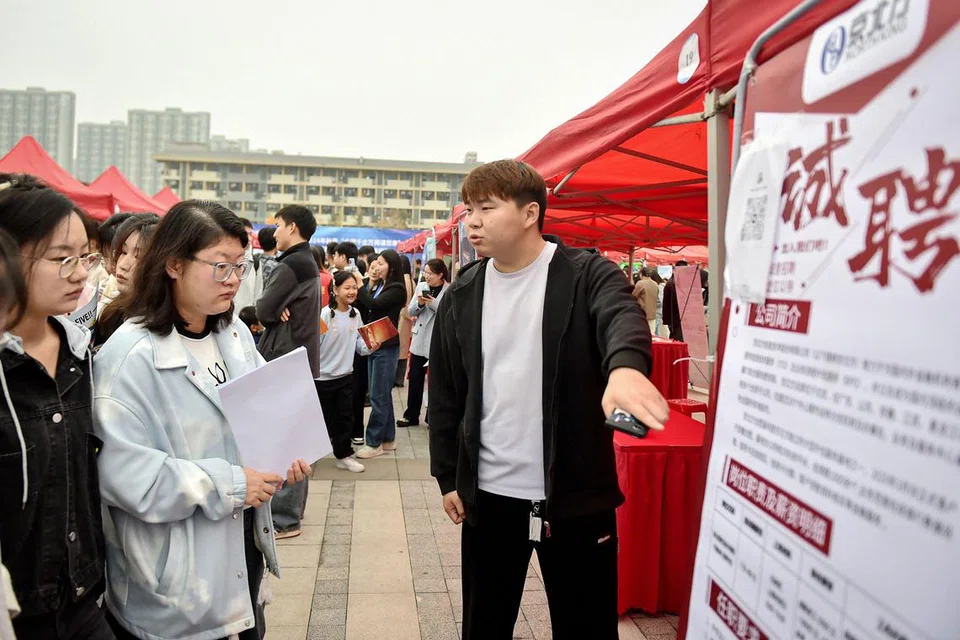
Students attending a job fair in Hefei, in eastern China's Anhui province. 
PHOTO: AFP

UPDATED Dec 30, 2024, 

BEIJING – A record 3.4 million young Chinese flocked to the civil service exam in 2024, lured by the prospect of lifetime job security and perks including subsidised housing as an economic slowdown batters the private sector and youth unemployment remains high.

Applicant numbers, which surged by more than 400,000 from 2023 and have tripled since 2014, reflect the huge demand for stability from disillusioned Gen Z Chinese and the lack of attractive options in the private sector even though local governments are struggling to pay wages due to a fiscal crisis.

Ms Klaire, a master’s student in Beijing, took the notoriously competitive exam in early December, studying for nine hours a day and spending 980 yuan (S$180) on online tutoring.

She cited social prestige and stability as major factors to why she was applying only for government or state-owned enterprise jobs. Ms Klaire has also seen colleagues get laid off during a previous tech internship.

“I only want to pass the exam and not worry about what happens next,” said the 24-year-old, withholding her surname for privacy reasons.

“Despite personally knowing civil servants who haven’t been paid for months, I still applied because I don’t wish to make lots of money.”

If she passes the exam, she will have a further interview as well as political background and physical checks, with the final outcome expected around April.

Layoffs are rare in China’s civil service, earning it the “iron rice bowl” moniker, though individuals can be dismissed for disciplinary violations.

Associate Professor Alfred Wu from the National University of Singapore said: “The current leadership has no intent of reducing the size of public sector workers, who are the backbone of regime stability.”

Most civil service openings have an age limit of 35 and offer subsidised housing and social insurance, a major attraction for graduates disillusioned by the paucity of private sector job opportunities.

Youth unemployment rates, which fell slightly in recent months, remain elevated compared with pre-pandemic figures as China’s economy struggles to recover amid a prolonged property sector crisis and frail consumption.

Many Gen Z Chinese “feel a strong sense of burnout and don’t know what is meaningful” after having their university years defined by the pandemic and China’s economic slowdown, said a Chinese sociology professor on condition of anonymity.

As the present generation of Chinese graduates have not experienced the mass state sector layoffs of the 90s, many have an idealised view of government work, he said, noting an apt summation in a social media meme: “Becoming a civil servant is the endpoint of the universe”.

But rare interviews with ten public sector employees across four Chinese provinces paint a different picture: widespread bonus reductions and pay cuts of up to 30 per cent in 2024 have prompted some to consider resigning, while local government austerity drives have led to sporadic staff cuts.

Some civil servants say they have been unpaid for months. Others survive on as little as 4,000 yuan monthly while supporting families and paying off loans. Many asked for anonymity to avoid retribution.

Despite these obvious woes, high nationwide youth unemployment has fed strong demand for civil service roles, which have surged from 2019’s 14,500 to 39,700 in 2024.

Ms Katherine Lin quit her civil service job in the southern megacity of Shenzhen in July after her 15,000 yuan salary dropped by a quarter, bonuses were scrapped and managers hinted at further downsizing.

“Some departments chose to either cut salaries by 30 per cent or fire people in response to cost-cutting policies,” she said.

At least three Shenzhen district-level bureaux were merged, and nine employees dismissed in 2024, public notices show.

In her housing bureau role, she handled an unprecedented number of migrant worker protests in December 2023, when they normally demand wages before Chinese New Year.

Another civil servant in rural Guangdong province described his salary of 4,000 yuan as “stable poverty” after monthly bonuses of 1,000 yuan stopped in June.

In Shandong, civil servants complained on social media in September about being paid only one month per quarter, part of a policy called “guarantee four (months’ salary), strive for six”.

The State Council and Shenzhen government did not reply to faxed requests for comment.

Downsizing pressure

Beijing has long-faced calls to reform its bloated state sector.

Despite repeated downsizing campaigns, China’s civil service jobs swelled from 6.9 million in 2010 to eight million currently, with at least a further 31 million public employees such as school and hospital workers who have fewer employment protections than civil servants.

Chinese provinces have quietly cut tens of thousands of public sector positions since 2020, mostly through hiring reductions and attrition.

Wage arrears are “systematic and universal across the country, and are impossible to solve substantially in the short term”, said a governance professor at an elite Chinese university on condition of anonymity, adding that this could increase corruption as officials supplement their salaries through tips and bribes, as well as increased administrative fines for citizens.

“The most pressing issue now is social stability,” the professor said. “Therefore, the lesser of two evils will cause the expansion of civil service hiring and the neglect of institutional reform.”

REUTERS


UK

'There aren't enough jobs to go round for everyone'


Sarah-May Buccieri
BBC News
30/12/2024
James Harrison
James Harrison believes the graduate job market is "overly saturated"

Law graduate James Harrison left university with high hopes of landing a role in the sector he trained for.

But reality soon sank in, as James's inbox became littered with no's from legal roles to coffee shop work.

In November seven million people watched James's video on Instagram detailing his rejection from a role as a barista.

"Nine out of 10 people I know didn't enter a role within nine months of graduating," James explained.

During his struggle to find a job, James started posting online with advice and tips about life after university.

"It went a bit crazy," James laughed.

James thought the viral video was slightly controversial and it received a mixed reaction.

"A lot of people said I shouldn't feel entitled to get a job just because I have a degree whilst a lot of other people are said they were in the same position," James said.


The 22-year-old started his law degree at The University of Lincoln in 2020 and graduated in 2023.

"It was extremely hard, I took a year out to focus on applications," he said.

Applying for roles became a daily routine; from applications, tests and video interviews, he became immersed in finding a job.

But he was getting turned down for everything.

'Overly saturated'


James believes the sparkle of degrees has faded a little and they are now "overly saturated".

"Thousands of people are leaving university with great experience and amazing grades.

"There are not enough jobs to go round for everyone."

"I'd gone through three years of a law degree and got experience at law firms," he added.

James Harrison
James hopes to normalise rejection after university

Data from the ONS shows the number of graduates aged 21-30 in highly skilled jobs has fallen from 61.7% in 2022 to 60.4% in 2023.

Stephen Isherwood, joint-CEO at the Institute of Student Employers, said it had always been a challenge to land a graduate job.

Mr Isherwood said many students experienced a "wake-up call" when leaving university as course places often did not correlate to the amount of industry positions.

"The number of applications students are making means there's a lot more competition for jobs," Mr Isherwood explained.

"Most employers do not limit who can apply, which means more students can apply for jobs, which means more students will be rejected," he added.

After a 15-month job search James secured a role as a paralegal at a law firm in Hull.

He still posts on social media, in the hope of helping people who are in his position and feel "lost".

"Social media paints this picture with law where you go to university and you come out with a training contract," he said.

He advises graduates struggling to find roles to "not take rejection personally".

"Take it in your stride."