It’s possible that I shall make an ass of myself. But in that case one can always get out of it with a little dialectic. I have, of course, so worded my proposition as to be right either way (K.Marx, Letter to F.Engels on the Indian Mutiny)
Friday, May 23, 2025
Systematic Starvation: Genocide and the Engineered Collapse of Gazan Society
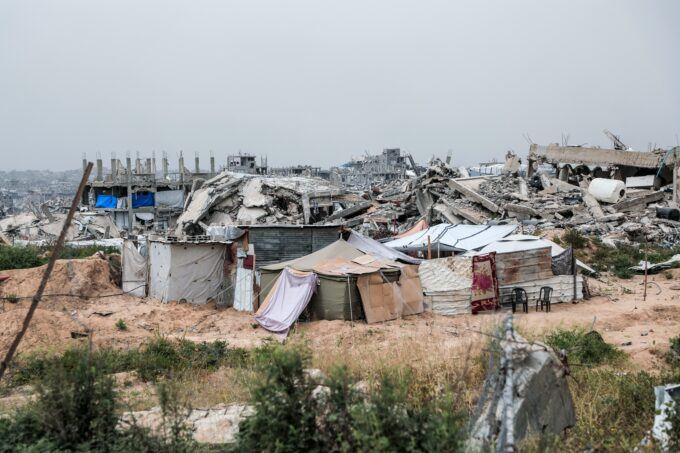
Consequent to the escalated Zionist genocide of Indigenous Palestinian people, and after a blockade of all goods since the beginning of March 2025, Gaza is experiencing a severe humanitarian crisis, with widespread food scarcity and starvation among its population. Human rights organizations and international agencies report the Israeli blockade has led to catastrophic levels of hunger, particularly affecting children and vulnerable groups.
The Integrated Food Security Phase Classification (IPC) indicates approximately 244,000 people in Gaza face the most severe level of food insecurity, with nearly 71,000 children under five at risk of acute malnutrition. The World Food Program warns famine is imminent, affecting nearly the entire population of 2.3 million.
Human Rights Watch has accusedIsrael of using starvation as a weapon of war, a gross violation of international law, while noting children have died from starvation-related complications due to the blockade.
The United Nations and other organizations have called for immediate, unrestricted humanitarian access to prevent further deterioration. In addition, aid groups have criticized the proposed systems for potentially facilitating distribution of food and other essentials as being inadequate to meet the urgent needs.
Now, seemingly under pressure from the United States and conveniently using its mercenaries, Israel will allow “minimal” food and supplies into the besieged Palestinian enclave, while intensifying its devastating military assault.
In a recent press conference, Netanyahu ally and Israeli Finance Minister Bezalel Smotrich demonically said Israeli forces are engaged in a campaign to force Palestinians into the south of Gaza “and from there, God willing, to third countries, as part of President [Donald] Trump’s plan. This is a change of the course of history—nothing less.”
Other than a tool to move the population southward as part of a brazen criminal displacement campaign, which Smotrich openly admits, the starvation of Gaza has another insidious deliberate objective—methodical, socially engineered atomization of the people in Gaza, designed to create extreme deprivation, societal chaos, and internal strife, particularly through food scarcity and lack of control, and subsequently as a pretext for further genocide, expulsion, theft, and domination.
Research in Chimpanzees
Renowned Primatologist Jane Goodall documented a prolonged conflict (1974–1978) between two chimpanzee groups, the Kasakela and the Kahama, in Gombe Stream National Park, Tanzania. This “Gombe Chimpanzee War” saw the Kasakela community systematically attack and eliminate the Kahama group. Goodall’s findings were widely reported as support for the idea that warfare and territorial violence are natural elements of human behavior, inherited from our closest primate relatives.
Notably, reactionaries have co-opted these notions on so-called human nature to justify colonialism, falsely depicting Indigenous tribes as inherently violent “savages” to legitimize land theft and genocide.
AnthropologistBrian Ferguson has challenged Goodall’s interpretation. In a painstakingly thorough analysis of each case of documented aggression during the “Gombe Chimpanzee War,” he argues that the violence observed was not natural or inevitable. Rather, it was the result of external influences, primarily human interference by Goodall, her team, and others. Ferguson points to changes in provisioning (feeding) practices by these researchers, which disrupted social dynamics and led to unnatural group fragmentation. He also cites ecological pressures, such as resource scarcity due to nearby human activity, which may have exacerbated tensions.
Ferguson contends these factors, rather than innate aggression, better explain the conflict, emphasizing violence is context-dependent and can be negatively affected by human interference, and not a fixed part of primate and human nature. Drawing on primate studies, archaeology and anthropology, Ferguson argues war in human behavior is not innate—i.e.“human nature”—it emerged as a cultural construct when social inequalities were introduced with sedentary, agricultural life which enabled resource hoarding. Thus, he cautions against simplistic evolutionary (and reactionary) narratives which use such cases to justify human violence.
Where is the Palestinian Mandela?
The same dynamics are now unfolding in Gaza, where Israeli and American strategies of siege, blockade, and forced starvation create the very social fragmentation they later cite as proof of Palestinian dysfunction and innate barbarity.
The deliberate destruction of food systems, water infrastructure, medical systems, and communal cohesion is not incidental, it is an intentional form of warfare aimed at inducing despair, division, and eventual displacement.
Starvation is a tool of colonization, weaponized to weaken bodies, fracture bonds, undermine social cohesion, fuel internal aggression, weaken resistance, and turn survival into an isolating struggle. These conditions are neither natural nor inevitable; they are constructed and inflicted deliberately to serve a white supremacist goal—to manufacture potentially lethal chaos within Palestinian society and shift blame for genocide onto the victims themselves.
As internal conflict escalates, Zionist forces can portray Palestinians as irredeemably violent “savages,” justifying further domination under the guise of civilizing and evicting them “for their own good.” This was reflected by Trump in his immoral plan to turn Gaza into a resort.
This strategy mirrors decades of Zionist colonial tactics—assassination, imprisonment, torture, and psychological warfare—all deployed to reinforce the false narrative that Palestinian anti-colonial resistance is proof of inherent barbarism, rather than adefensive response to European invasion, oppression, and dispossession.
With classical colonial sleight of hand, liberal Zionists then ask, with feigned bewilderment: “Where is the Palestinian Mandela?” as if peace depends on the emergence of a more palatable victim. This notion ignores how many “Palestinian Mandelas” have emerged, only to be systematically assassinated and imprisoned by Zionist forces for embodying the possibility of peace and reconciliation through justice and decolonization. Likewise, the first Palestinian Intifada, a largely women-led uprising, and the “March of Return” were largely nonviolent—a strategy Zionists found more threatening than armed resistance and thus met with brutal, disproportionate force.
The deliberate starvation of Palestinian people in Gaza is an abominable nadir in an ongoing 77-year symphony of Israeli genocide and war crimes. However, it is possible to anticipate Zionist tactics and accompanying propaganda and to respond with foresight and strategy.
The cynical ploy by Israel and the United States to engineer conditions for forced displacement while blaming the Palestinian people they are starving should be rejected and serve as further impetus for boycott, divestment and sanctions (BDS) and other protests by all those opposing U.S.-led white supremacist colonialism, instead of allowing it to weaken, dishearten, and fracture resistance. This is the bare minimum for anyone who sees the predatory U.S.-led Zionist experiment in Palestine as a threat to the existence of the Palestinian people and to the rest of humanity.
Yoav Litvin is a Doctor of Psychology/ Behavioral Neuroscience. For more info, please visit yoavlitvin.com/about/
Joshua Frank is an award-winning California-based journalist and co-editor of CounterPunch. He is the author of the new book Atomic Days: The Untold Story of the Most Toxic Place in America (Haymarket Books). Ted Griswold is a filmmaker and activist who aims to tell stories that build working class power. His work has been published by The New Yorker, aired on PBS & HBO, and screened in dozens of international film festivals. He lives in Long Beach, CA and can be reached at ted.griswold4@gmail.com.
Israeli Hatred for Children in Gaza Is Shocking
The hatred of some in Israel for the people of Gaza – even for little children – is just astounding. If they have even a tiny bit of belief in God, they should pray for forgiveness.
Unfortunately, NPR reported last Thursday (May 15) on “deadly airstrikes, killing more than 150 people in the past day, including dozens of children.”
On May 9 the Israeli newspaper Haaretz and many other publications reported on a meeting of a subcommittee of Israel’s Foreign Affairs and Defense Committee.
The hearing in the Knesset, Israel’s Parliament, was not about concern for children who were starving or who had to have amputations without anesthesia. It was about concern over the public relations harm to Israel.
One of the witnesses was Dr. Sharon Shaul from NATAN, a worldwide humanitarian aid charity.
Dr. Shaul said, “I believe that none of the people sitting around this table are concerned that a suffering child cannot receive painkillers or even minimal medical treatment.”
Then the story said that Knesset member Amit Halevi from Netanyahu’s Likud Party “interrupted her angrily saying, ‘I’m not sure you’re speaking for us when you say we want to treat every child and every woman.’”
The doctor then replied that she hoped the member would not oppose “a four-year-old child” undergoing an amputation receiving pain medication. “I hope you have that compassion,” Dr. Shaul said.
However, Knesset member Limor Son Har-Melech “pointed at the doctor and said ‘the only treatment that should be given is to you.’” Another member shouted, “You are the sickest doctor I have ever seen.”
Elad Barashi, a producer at Israel’s Channel 14, surpassed even this hatred by writing on social media in early May: “Good morning. Let there be a holocaust in Gaza.”
In another post, he wrote: “I can’t understand the people here in the State of Israel who don’t want to fill Gaza with gas chambers … or train cars… and finish this story. Let there be a holocaust in Gaza.”
He added: “Men, women and children – by any means necessary we must simply carry out a Shoa against them – yes, read that again – H-O-L-O-C-A-U-S-T!”
He said there were 2.6 million terrorists in Gaza and wrote: “Without fear, without weakness – just Crush. Eliminate. Slaughter. Flatten. Dismantle. Smash. Shatter.”
The fanatic Netanyahu has been indicted for war crimes and crimes against humanity, yet he is a hero in our Congress because of campaign contributions. The rest of the world is overwhelmingly against the genocide in Gaza.
In my column two weeks ago, I wrote of the letter signed by the 36 members of the Board of Deputies of British Jews, which criticized what it called this “most extremist of Israeli governments” and said, “We stand against the war.”
Even more significant – in fact, almost shocking – is the column Thomas Friedman, the longtime New York Times columnist, published on May 9 entitled “This Israeli Government Is Not Our Ally.”
Friedman said Netanyahu has placed personal political survival before his nation’s and U.S. interests and wrote, “Netanyahu is not our friend.”
He added that “a permanent Israeli military occupation, whose unstated goal will be to pressure all Palestinians to leave is a prescription for a permanent insurgency – Vietnam on the Mediterranean.”
Israel has never had any prominent media voice more supportive than Friedman has been over the years. He has been writing for the New York Times since 1981.
President Trump wrote that the release of the American hostage Edan Alexander a few days ago was “a step taken in good faith toward the United States and the efforts… to put an end to this very brutal war…”
Axios reported that “Israel was not directly involved… and initially learned about it from its intelligence services who spy on Hamas.” This gives credence to the many reports that Trump is tired of being manipulated by Netanyahu.
CNN reported on May 12 that Trump “blindsided Israel several times already – announcing talks with Iran, a deal with Yemen’s Houthi rebels, and direct talks with Hamas,” plus not stopping there on the president’s latest Middle East trip.
Maybe Friedman’s column and some of the statements and actions by Trump will finally give some members of Congress the courage to speak out against Israel’s cruelty in Gaza.
Reprinted with author’s permission from the Knoxville Focus.
John James Duncan Jr. is an American politician who served as the U.S. representative for Tennessee’s 2nd congressional district from 1988 to 2019. A lawyer, former judge, and former long serving member of the Army National Guard, he is a member of the Republican Party.
Why the Wall of Silence on the Gaza Genocide Is Finally Starting To Crack
Who could have imagined 19 months ago that it would take more than a year and a half of Israel slaughtering and starving Gaza’s children for the first cracks to appear in what has been a rock-solid wall of support for Israel from western establishments.
Finally, something looks like it may be about to give.
The British establishment’s financial daily, the Financial Times, was first to break ranks last week to condemn “the West’s shameful silence” in the face of Israel’s murderous assault on the tiny enclave.
In an editorial – effectively the paper’s voice – the FT accused the United States and Europe of being increasingly “complicit” as Israel made Gaza “uninhabitable”, an allusion to genocide, and noted that the goal was to “drive Palestinians from their land”, an allusion to ethnic cleansing.
Of course, both of these grave crimes by Israel have been evidently true not only since Hamas’ violent, single-day breakout from Gaza on 7 October 2023, but for decades.
So parlous is the state of western reporting, from a media no less complicit than the governments berated by the FT, that we need to seize on any small signs of progress.
Next, the Economist chimed in, warning that Israeli Prime Minister Benjamin Netanyahu and his ministers were driven by a “dream of emptying Gaza and rebuilding Jewish settlements there”.
At the weekend, the Independent decided the “deafening silence on Gaza” had to end. It was “time for the world to wake up to what is happening and to demand an end to the suffering of the Palestinians trapped in the enclave.”
Actually much of the world woke up many, many months ago. It has been the western press corps and western politicians slumbering through the past 19 months of genocide.
Then on Monday, the supposedly liberal Guardian voiced in its own editorial a fear that Israel is committing “genocide”, though it only dared do so by framing the accusation as a question.
It wrote of Israel: “Now it plans a Gaza without Palestinians. What is this, if not genocidal? When will the US and its allies act to stop the horror, if not now?”
The paper could more properly have asked a different question: Why have Israel’s western allies – as well as media like the Guardian and FT – waited 19 months to speak up against the horror?
And, predictably bringing up the rear, was the BBC. On Wednesday, the BBC Radio’s PM program chose to give top billing to testimony from Tom Fletcher, the United Nation’s humanitarian affairs chief, to the Security Council. Presenter Evan Davis said the BBC had decided to “do something a little unusual”.
Unusual indeed. It played Fletcher’s speech in full – all 12 and a half minutes of it. That included Fletcher’s comment: “For those killed and those whose voices are silenced: what more evidence do you need now? Will you act – decisively – to prevent genocide and to ensure respect for international humanitarian law?”
We had gone in less than a week from the word “genocide” being taboo in relation to Gaza to it becoming almost mainstream.
Growing cracks
Cracks are evident in the British parliament too. Mark Pritchard, a Conservative MP and life-long Israel supporter, stood up from the back benches to admit he had been wrong about Israel, and condemned it “for what it is doing to the Palestinian people”.
He was one of more than a dozen Tory MPs and peers in the House of Lords, all formerly staunch defenders of Israel, who urged British Prime Minister Keir Starmer to immediately recognise a Palestinian state.
Their move followed an open letter published by 36 members of the Board of Deputies, a 300-member body that claims to represent British Jews, dissenting from its continuing support for the slaughter. The letter warned: “Israel’s soul is being ripped out.”
Pritchard told fellow MPs it was time to “stand up for humanity, for us being on the right side of history, for having the moral courage to lead.”
Sadly, there is no sign of that yet. Research published last week, based on Israeli tax authority data, showed Starmer’s government has been lying even about the highly limited restrictions on arms sales to Israel it claimed to have imposed last year.
Despite an ostensible ban on shipments of weapons that could be used in Gaza, Britain has covertly exported more than 8,500 separate munitions to Israel since the ban.
This week more details emerged. According to figures published by The National, the current government exported more weapons to Israel in the final three months of last year, after the ban came into effect, than the previous Conservative government did through the whole of 2020 to 2023.
So shameful is the UK’s support for Israel in the midst of what the International Court of Justice – the World Court – has described as a “plausible genocide” that Starmer’s government needs to pretend it is doing something, even as it actually continues to arm that genocide.
More than 40 MPs wrote to Foreign Secretary David Lammy last week calling for him to respond to allegations that he had misled the public and parliament. “The public deserves to know the full scale of the UK’s complicity in crimes against humanity,” they wrote.
There are growing rumblings elsewhere. This week France’s President Emmanuel Macron called Israel’s complete blockade on aid into Gaza “shameful and unacceptable”. He added: “My job is to do everything I can to make it stop.”
“Everything” seemed to amount to nothing more than mooting possible economic sanctions.
Still, the rhetorical shift was striking. Italy’s prime minister, Giorgia Meloni, similarly denounced the blockade, calling it “unjustifiable”. She added: “I have always recalled the urgency of finding a way to end the hostilities and respect international law and international humanitarian law.”
“International law”? Where has that been for the past 19 months?
There was a similar change of priorities across the Atlantic. Democratic Senator Chris van Hollen, for example, recently dared to call Israel’s actions in Gaza “ethnic cleansing”.
CNN’s Christiane Amanpour, a bellwether of the Beltway consensus, gave Israel’s deputy foreign minister, Sharren Haskel, an unusually tough grilling. Amanpour all but accused her of lying about Israel starving children.
Meanwhile, Josep Borrell, the recently departed head of European Union foreign policy, broke another taboo last week by directly accusing Israel of preparing a genocide in Gaza.
“Seldom have I heard the leader of a state so clearly outline a plan that fits the legal definition of genocide,” he said, adding: “We’re facing the largest ethnic cleansing operation since the end of the Second World War.”
Borrell, of course, has no influence over EU policy at this point.
A death camp
This is all painfully slow progress, but it does suggest that a tipping point may be near.
If so, there are several reasons. One – the most evident in the mix – is US President Donald Trump.
It was easier for the Guardian, the FT and old-school Tory MPs to watch the extermination of Gaza’s Palestinians in silence when it was kindly Uncle Joe Biden and the US military industrial complex behind it.
Unlike his predecessor, Trump too often forgets the bit where he is supposed to put a gloss on Israeli crimes, or distance the US from them, even as Washington ships the weapons to carry out those crimes.
But also, there are plenty of indications that Trump – with his constant craving to be seen as the top dog – is increasingly annoyed at being publicly outfoxed by Netanyahu.
This week, as Trump headed to the Middle East, his administration secured the release of Israeli soldier Edan Alexander, the last living US citizen in captivity in Gaza, by bypassing Israel and negotiating directly with Hamas.
In his comments on the release, Trump insisted it was time to “put an end to this very brutal war” – a remark he had very obviously not coordinated with Netanyahu.
Notably, Israel is not on Trump’s Middle East schedule.
Right now seems a relatively safe moment to adopt a more critical stance towards Israel, as presumably the FT and Guardian appreciate.
Then there is the fact that Israel’s genocide is reaching its endpoint. No food, water or medicines have entered Gaza for more than two months. Everyone is malnourished. It is unclear, given Israel’s destruction of Gaza’s health system, how many have already died from hunger.
But the pictures of skin-and-bones children emerging from Gaza are uncomfortably reminiscent of 80-year-old images of skeletal Jewish children imprisoned in Nazi camps.
It is a reminder that Gaza – strictly blockaded by Israel for 16 years before Hamas’ 7 October 2023 breakout – has been transformed over the past 19 months from a concentration camp into a death camp.
Parts of the media and political class know mass death in Gaza cannot be obscured for much longer, not even after Israel has barred foreign journalists from the enclave and murdered most of the Palestinian journalists trying to record the genocide.
Cynical political and media actors are trying to get in their excuses before it is too late to show remorse.
The ‘Gaza war’ myth
And finally there is the fact that Israel has declared its readiness to take hands-on responsibility for the extermination in Gaza by, in its words, “capturing” the tiny territory.
The long-anticipated “day after” looks like it is about to arrive.
For 20 years, Israel and western capitals have conspired in the lie that Gaza’s occupation ended in 2005, when Israel’s then prime minister, Ariel Sharon, pulled out a few thousand Jewish settlers and withdrew Israeli soldiers to a highly fortified perimeter encaging the enclave.
In a ruling last year, the World Court gave this claim short shrift, emphasising that Gaza, as well as the Palestinian territories of the West Bank and East Jerusalem, had never stopped being under Israeli occupation, and that the occupation must end immediately.
The truth is that, even before the 2023 Hamas attacks, Israel had been besieging Gaza by land, sea and air for many, many years. Nothing – people or trade – went in or out without the Israeli military’s say-so.
Israeli officials instituted a secret policy of putting the population there on a strict “diet” – a war crime then as now – one that ensured most of Gaza’s young became progressively more malnourished.
Drones whined constantly overhead, as they do now, watching the population from the skies 24 hours a day and occasionally raining down death. Fishermen were shot and their boats sunk for trying to fish their own waters. Farmers’ crops were destroyed by herbicides sprayed from Israeli planes.
And when the mood took it, Israel sent in fighter jets to bomb the enclave or sent soldiers in on military operations, killing hundreds of civilians at a time.
When Palestinians in Gaza went out week after week to stage protests close to the perimeter fence of their concentration camp, Israeli snipers shot them, killing some 200 and crippling many thousands more.
Yet, despite all this, Israel and western capitals insisted on the story that Hamas “ruled” Gaza, and that it alone was responsible for what went on there.
That fiction was very important to the western powers. It allowed Israel to evade accountability for the crimes against humanity committed in Gaza over the past two decades – and it allowed the West to avoid complicity charges for arming the criminals.
Instead, the political and media class perpetuated the myth that Israel was engaged in a “conflict” with Hamas – as well as intermittent “wars” in Gaza – even as Israel’s own military termed its operations to destroy whole neighbourhoods and kill their residents “mowing the lawn”.
Israel, of course, viewed Gaza as its lawn to mow. And that is precisely because it never stopped occupying the enclave.
Even today western media outlets collude in the fiction that Gaza is free from Israeli occupation by casting the slaughter there – and the starvation of the population – as a “war”.
Loss of cover story
But the “day after” – signalled by Israel’s promised “capture” and “reoccupation” of Gaza – brings a conundrum for Israel and its western sponsors.
Till now Israel’s every atrocity has been justified by Hamas’ violent breakout on 7 October 2023.
Israel and its supporters have insisted that Hamas must return the Israelis it took captive before there can be some undefined “peace”. At the same time, Israel has also maintained that Gaza must be destroyed at all costs to root out Hamas and eliminate it.
These two goals never looked consistent – not least because the more Palestinian civilians Israel killed “rooting out” Hamas, the more young men Hamas recruited seeking vengeance.
The constant stream of genocidal rhetoric from Israeli leaders made clear that they believed there were no civilians in Gaza – no “uninvolved” – and that the enclave should be levelled and the population treated like “human animals”, punished with “no food, water or fuel”.
Finance Minister Bezalel Smotrich reiterated that approach last week, vowing that “Gaza will be entirely destroyed” and that its people would be ethnically cleansed – or, as he put it, forced to “leave in great numbers to third countries”.
Israeli officials have echoed him, threatening to “flatten” Gaza if the hostages are not released. But in truth, the captives held by Hamas are just a convenient pretext.
Smotrich was more honest in observing that the hostages’ release was “not the most important thing”. His view is apparently shared by the Israeli military, which has reportedly put that aim last in a list of six “war” objectives.
More important to the military are “operational control” of Gaza, “demilitarization of the territory” and “concentration and movement of the population”.
With Israel about to be indisputably, visibly in direct charge of Gaza again – with the cover stories stripped away of a “war”, of the need to eliminate of Hamas, of civilian casualties as “collateral damage” – Israel’s responsibility for the genocide will be incontestable too, as will the West’s active collusion.
That was why more than 250 former officials with Mossad, Israel’s spy agency – including three of its former heads – signed a letter this week decrying Israel’s breaking of the ceasefire in early March and its return to “war”.
The letter called Israel’s official objectives “unattainable”.
Similarly, the Israeli media reports large numbers of Israel’s military reservists are no longer showing up when called for a return to duty in Gaza.
Ethnic cleansing
Israel’s western patrons must now grapple with Israel’s “plan” for the ruined territory. Its outline has been coming more sharply into focus in recent days.
In January Israel formally outlawed the United Nations refugee agency Unrwa that feeds and cares for the large proportion of the Palestinian population driven off their historic lands by Israel in earlier phases of its decades-long colonization of historic Palestine.
Gaza is packed with such refugees – the outcome of Israel’s biggest ethnic cleansing program in 1948, at its creation as a “Jewish state”.
Removing UNRWA had been a long-held ambition, a move by Israel designed to help rid it of the yoke of aid agencies that have been caring for Palestinians – and thereby helping them to resist Israel’s efforts at ethnic cleansing – as well as monitoring Israel’s adherence, or rather lack of it, to international law.
For the ethnic cleansing and genocide programs in Gaza to be completed, Israel has needed to produce an alternative system to UNRWA’s.
Last week, it approved a scheme in which it intends to use private contractors, not the UN, to deliver small quantities of food and water to Palestinians. Israel will allow in 60 trucks a day – barely a tenth of the absolute minimum required, according to the UN.
There are several catches. To stand any hope of qualifying for this very limited aid, Palestinians will need to collect it from military distribution points located in a small area at the southern tip of the Gaza strip.
In other words, some two million Palestinians will have to crowd into a location that has no chance of accommodating them all, and even then will have only a tenth of the aid they need.
They will have to relocate too without any guarantee from Israel that it won’t continue bombing the “humanitarian zones” they have been herded into.
These military distribution zones just so happen to be right next to Gaza’s sole, short border with Egypt – exactly where Israel has been seeking to drive the Palestinians over the past 19 months in the hope of forcing Egypt to open the border so the people of Gaza can be ethnically cleansed into Sinai.
Under Israel’s scheme, Palestinians will be screened in these military hubs using biometric data before they stand any hope of receiving minimum calorie-controlled handouts of food.
Once inside the hubs, they can be arrested and shipped off to one of Israel’s torture camps.
Just last week Israel’s Haaretz newspaper published testimony from an Israeli soldier turned whistleblower – confirming accounts from doctors and other guards – that torture and abuse are rife against Palestinians, including civilians, at Sde Teiman, the most notorious of the camps.
War on aid
Last Friday, shortly after Israel announced its “aid” plan, it fired a missile into an UNRWA center in Jabaliya camp, destroying its food distribution center and warehouse.
Then on Saturday, Israel bombed tents used for preparing food in Khan Younis and Gaza City. It has been targeting charity kitchens and bakeries to close them down, in an echo of its campaign of destruction against Gaza’s hospitals and health system.
In recent days, a third of UN-supported community kitchens – the population’s last life line – have closed because their stores of food are depleted, as is their access to fuel.
According to the UN agency OCHA, that number is rising “by the day”, leading to “widespread” hunger.
The UN reported this week that nearly half a million people in Gaza – a fifth of the population – faced “catastrophic hunger”.
Predictably, Israel and its ghoulish apologists are making light of this sea of immense suffering. Jonathan Turner, chief executive of UK Lawyers for Israel, argued that critics were unfairly condemning Israel for starving Gaza’s population, and ignoring the health benefits of reducing “obesity” among Palestinians.
In a joint statement last week, 15 UN agencies and more than 200 charities and humanitarian groups denounced Israel’s “aid” plan. The UN children’s fund UNICEF warned that Israel was forcing Palestinians to choose between “displacement and death”.
But worse, Israel is setting up its stall once again to turn reality on its head.
Those Palestinians who refuse to cooperate with its “aid” plan will be blamed for their own starvation. And international agencies who refuse to go along with Israeli criminality will be smeared both as “antisemitic” and as responsible for the mounting toll of starvation on Gaza’s population.
There is a way to stop these crimes degenerating further. But it will require western politicians and journalists to find far more courage than they have dared muster so far. It will need more than rhetorical flourishes. It will need more than public hand-wringing.
Are they capable of more? Don’t hold your breath.
Jonathan Cook is the author of three books on the Israeli-Palestinian conflict, and a winner of the Martha Gellhorn Special Prize for Journalism. His website and blog can be found at www.jonathan-cook.net. This originally appeared in the Middle East Eye.
Netanyahu’s Endgame: Isolation and the Shattered Illusion of Power
There was a time when Benjamin Netanyahu appeared to have all the cards. The Palestinian Authority was largely passive, the occupied West Bank was relatively calm, Israel’s diplomatic reach was expanding, and the United States seemed ready to bend international law to accommodate Israel’s desire for complete control over Palestine.
The Israeli prime minister had also, at least in his own estimation, succeeded in subduing Gaza, the persistently defiant enclave that had for years struggled unsuccessfully to break the suffocating Israeli blockade.
Within Israel, Netanyahu had been celebrated as the nation’s longest-serving prime minister, a figure who promised not only longevity but also unprecedented prosperity. To mark this milestone, Netanyahu employed a visual prop: a map of the Middle East, or, in his own words, “the New Middle East.”
This envisioned new Middle East, according to Netanyahu, was a unified green bloc, representing a future of ‘great blessings’ under Israeli leadership.
Conspicuously absent from this map was Palestine in its entirety – both historic Palestine, now Israel, and the occupied Palestinian territories.
Netanyahu’s latest unveiling occurred at the United Nations General Assembly on September 22, 2023. His supposedly triumphant address was sparsely attended, and among those present, enthusiasm was notably absent. This, however, seemed of little consequence to Netanyahu, his coalition of extremists, or the broader Israeli public.
Historically, Israel has placed its reliance on the support of a select few nations considered, in their own calculus, to be of primary importance: Washington and a handful of European capitals.
Then came the October 7 assault. Initially, Israel leveraged the Palestinian attack to garner Western and international support, both validating its existing policies and justifying its intended response. However, this sympathy rapidly dissipated as it became apparent that Israel’s response entailed a campaign of genocide, the extermination of the Palestinian people in Gaza, and the ethnic cleansing of Gaza’s population and West Bank communities.
As images and footage of the devastating carnage in Gaza surfaced, anti-Israeli sentiment surged. Even Israel’s allies struggled to justify the deliberate killing of tens of thousands of innocent civilians, predominantly women and children.
Nations like Britain imposed partial arms embargoes on Israel, while France attempted a balancing act, calling for a ceasefire while suppressing domestic activists advocating for the same. The pro-Israel Western narrative has become increasingly incoherent, yet remains deeply problematic.
Washington, under President Biden, initially maintained unwavering support, implicitly endorsing Israel’s objective – genocide and ethnic cleansing.
However, as Israel failed to achieve its perceived objectives, Biden’s public stance began to shift. He called for a ceasefire, though without demonstrating any tangible willingness to pressure Israel. Biden’s staunch support for Israel has been cited by many as a contributing factor to the Democratic Party’s losses in the 2024 elections.
Then, Trump arrived. Netanyahu and his supporters, both in Israel and Washington, anticipated that Israel’s actions in Palestine and the wider region – Lebanon, Syria, etc. – would align with a broader strategic plan.
They believed Trump’s administration would be willing to escalate further. This escalation, they envisioned, would include military action against Iran, the displacement of Palestinians from Gaza, the fragmentation of Syria, the weakening of Yemen’s Ansarallah, and more, without significant concessions.
Initially, Trump signaled a willingness to pursue this agenda: deploying heavier bombs, issuing direct threats against Iran, intensifying operations against Ansarallah, and expressing interest in controlling Gaza and displacing its population.
However, Netanyahu’s expectations yielded only unfulfilled promises. This raises the question: was Trump deliberately misleading Netanyahu, or did evolving circumstances necessitate a reassessment of his initial plans?
The latter explanation appears more plausible. Efforts to intimidate Iran proved ineffective, leading to a series of diplomatic engagements between Tehran and Washington, first in Oman, then in Rome.
Ansarallah demonstrated resilience, prompting the US on May 6 to curtail its military campaigns in Yemen, specifically the Operation ‘Rough Rider’. On May 16, a US official announced that the USS Harry S. Truman would withdraw from the region.
Notably, on May 12, Hamas and Washington announced a separate agreement, independent of Israel, for the release of US-Israeli captive Edan Alexander.
The culmination occurred on May 14, when Trump delivered a speech at a US-Saudi investment forum in Riyadh, advocating for regional peace and prosperity, lifting sanctions on Syria, and emphasizing a diplomatic resolution with Iran.
Conspicuously absent from these regional shifts was Benjamin Netanyahu and his strategic ‘vision’.
Netanyahu responded to these developments by intensifying military operations against Palestinian hospitals in Gaza, targeting patients within the Nasser and European Hospitals. This action, targeting the most vulnerable, was interpreted as a message to Washington and Arab states that his objectives remained unchanged, regardless of the consequences.
The intensified Israeli military operations in Gaza are an attempt by Netanyahu to project strength amidst perceived political vulnerability. This escalation has resulted in a sharp increase in Palestinian casualties and exacerbated food shortages, if not outright famine, for over two million people.
It remains uncertain how long Netanyahu will remain in power, but his political standing has significantly deteriorated. He faces widespread domestic opposition and international condemnation. Even his primary ally, the United States, has signaled a shift in its approach. This period may mark the beginning of the end for Benjamin Netanyahu’s political career and, potentially, for the policies associated with his horrifically violent government.
Dr. Ramzy Baroud is a journalist, author and the Editor of The Palestine Chronicle. He is the author of six books. His latest book, co-edited with Ilan Pappé, is Our Vision for Liberation: Engaged Palestinian Leaders and Intellectuals Speak Out. His other books include My Father was a Freedom Fighter and The Last Earth. Baroud is a Non-resident Senior Research Fellow at the Center for Islam and Global Affairs (CIGA). His website is www.ramzybaroud.net.