Saturday, February 21, 2026

Gaza, Cuba, and the Politics of Genocidal Blockade

Source: Originally published by Z. Feel free to share widely.

These days, I find myself thinking of a character from the old Yugoslav partisan film Battle of Sutjeska. The film is dedicated to the heroic battle and Tito’s brilliant tactical maneuver to extricate the surrounded partisan units. However, that is not my subject here, even if we are now speaking of a far greater encirclement tightening around humanity. In one scene, the young nurse Dana tries to help her fallen comrades. They are dropping one by one. Cries come from all sides: “Dana, here!” “Dana, help!”. She is frantic. She does not know where to turn first, unable to save the mortally wounded. It may sound pretentious, but I increasingly identify with that role, even if only as an intellectual who does not heal, yet jumps from one end of the world to the other. If I cannot help, I can at least speak, raise the alarm… But what out of that? What can our written words truly accomplish? As if Gaza were not enough to awaken the conscience (by the way I served as a juror at the Jury of Conscience at the Gaza Tribunal last October)… We leap like Dana from one place to another, trying to draw attention, to warn of new genocides (Sudan, Congo), new military interventions (Iran), kidnappings of legitimate politicians (Venezuela), tariffs and secondary sanctions – all illegal … The political elites don’t give a damn.

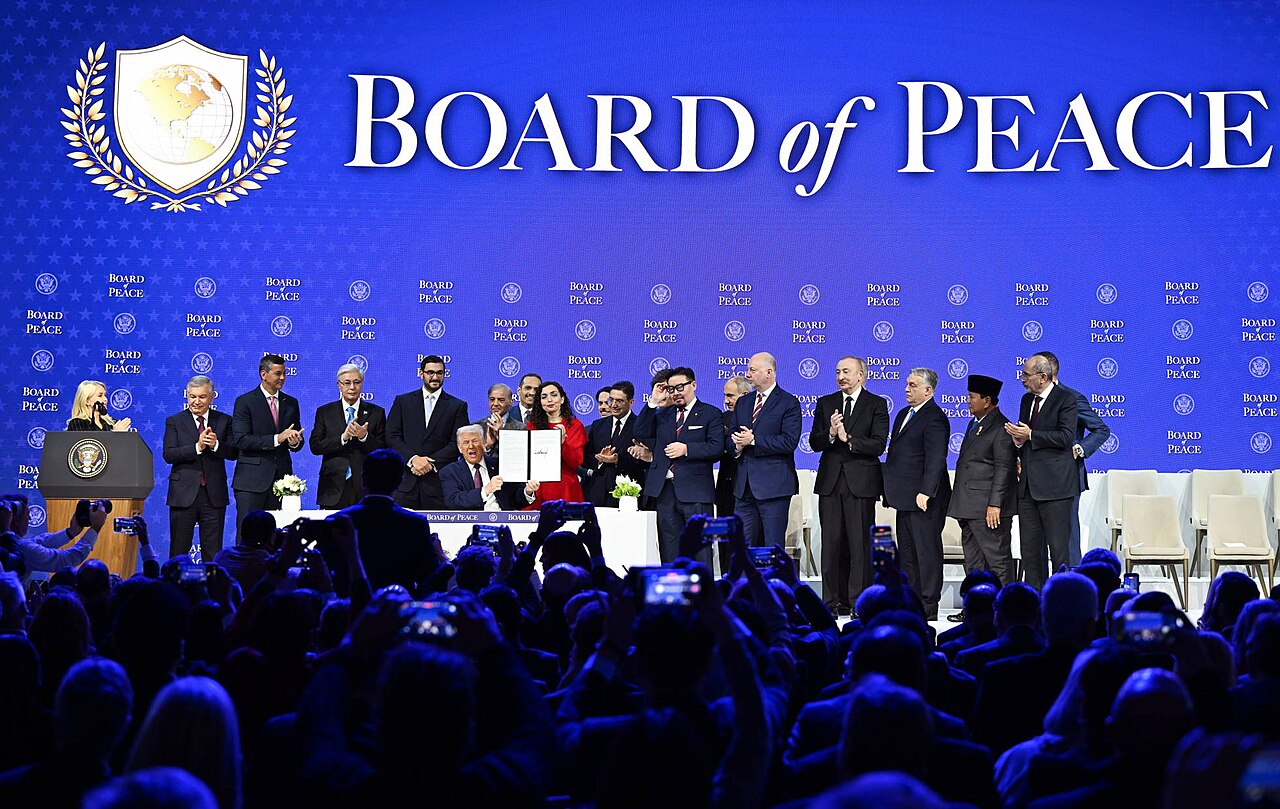
While waiting for something to “explode” in Iran, we warn of possible escalation, as if Gaza were slipping into the background. And yet people are dying there even while the so-called Trump Peace Board is being discussed. Then Venezuela erupts with scenes straight out of an American action film: not only the president abducted, but his wife as well. An American court postures as an institution dispensing justice over a foreign statesman, while the Epstein files generate more interest and debate (especially the disappointment surrounding Chomsky and others) than the ongoing crimes against children, the elderly, the prisoners, and the sick. Are our personal disillusionments and misjudgments truly more important than what is happening on the ground?

Behind all the evils of this world stands a single superpower — the United States; everyone knows it, yet no one can restrain it. What follows are merely words of moral condemnation and political support for those subjected to its various methods of killing. This is not surprising; the cult of death in the U.S. has a bizarre imagination. One need only look at crime series such as CSI: Crime Scene Investigation — in all their versions — to see the countless ways a human being can be killed. But the state (political, military and corporate power combined) has perfected this imagination on entire nations and states. They fall one after another like dominoes, and no one so much as lifts a finger. We have both classical and non-classical methods of destroying a state. Yet today, the most ‘modern’ are genocide, strangulation, and wars of attrition — all to plunder, eliminate the indigenous population, and strip it of agency (sovereignty).

A few years ago, a colleague from Belgrade who had just returned from a holiday in Cuba told me: if you intend to see that beautiful country, hurry. Yesterday, at our regular weekly meeting with comrades from No Cold War, Cuba was our first agenda item. Our comrade Gisela said something that echoed in my mind for hours afterward: genocidal blockade. Indeed, it is easy to indulge in the belief that those with whom we express solidarity are brave, stronger than everything, survivors of many past ordeals — our inspiration. But the images from the ground are not sobering; they are shocking: paralysis of the entire country is expected, hunger, disease (in a country with an extraordinary healthcare system — what irony!). In truth, Cuba has long been on its knees; we are merely waiting for an even more extreme act by the U.S. before we pay attention. (Much as with Iran, Syria, or any other country…) For more than sixty years, it has lived under siege, only now the rope around its neck is tightening. Marco Rubio confirms the old Balkan saying, “Worse the convert than the Turk.” (In English, one could say: there is no zealot like a convert). Born to Cuban parents, he has become an advocate of the glory of the conquistadors and American predators, who cannot tolerate resistance or the offer of a society different from their own, which is sick to its roots. His Munich speech was fit for the heirs of neo-Nazism and neocolonialism; yet worse than the words spoken was the applause of the Europeans.

I will be blunt in conclusion (for we have had enough of wise analyses and verbal acrobatics). First, I am ashamed of my country, which does not even mention the name Gaza (not even accidentally); so sanitized is its subservient rhetoric before the master. Until last year, at least formally, it raised its hand in the UN General Assembly to call for the lifting of the illegal sanctions on Cuba. We stood with the overwhelming majority (even if everyone knows that such symbolic voting is futile). But in October 2025, we became more American than the Americans, placing ourselves among only SEVEN states that voted to maintain the sanctions. Some of us spoke out: shameful! And that was it. Even “Dana” had other issues to address in her writings. Our president continues to pose with children, as befits a kindly granny, yet gives no thought to the children of Gaza or Cuba. She remains silent and enjoys sessions in which she proclaims that “storks do not bring babies” — without mentioning who kills babies.

Recently, in a close intellectual circle, we discussed the unenviable position of Venezuela’s acting president and the necessity of negotiating with the Empire. A comrade, a courageous and inspiring man, said something that froze my blood. In trying to help us grasp the situation of total dependency and threats against the innocent, he said: “They do not want Venezuela to become a new Gaza.” And now, when we speak of Cuba, a similar parallel is drawn. If one does not negotiate with the naked and enraged Emperor, he will turn Cuba into a new Gaza for its eleven million inhabitants. Iran has been suffering for decades. Is it just a different form of killing a nation?

What does international solidarity mean today, when fear has been driven into everyone’s bones? Each state looks to its own vital and national — primarily economic — interests. What of BRICS? Is it a mirage, part of our wishful thinking? Do they not see that the empire’s sword is severing the arteries of the Global Majority at all the key points of the world? Will they continue to whisper: let it not become worse, we will endure. To paraphrase Dante, you who expect an alternative world, abandon all hope. Until the countries of the Global Majority recognize that the epicenter of the new fascism has shifted from Europe to North America, they will not form a genuine anti-fascist alliance –or at least, an alliance that would resist spreading barbarity.

This article was produced by Globetrotter and No Cold War.Email

Biljana Vankovska is a professor of political science and international relations at Ss. Cyril and Methodius University in Skopje, a member of the Transnational Foundation of Peace and Future Research (TFF) in Lund, Sweden, and the most influential public intellectual in Macedonia.


USA Is Using Hunger As A Weapon To Try To Collapse Cuba


February 15, 2026
Source: Geopolitical Economy Report

The Donald Trump administration has imposed an extreme oil blockade to prevent Cuba from getting fuel from any country. Marco Rubio wants to collapse the economy, causing millions of civilians to starve and suffer in order to overthrow the revolutionary Cuban government. Ben Norton explains the monstrous history of US imperialism and its siege of Cuba.


Source: Progressive International

The Trump administration is tightening the noose around Cuba.

In late January, the White House signed a new executive order escalating the siege — authorising sanctions, interdictions, and tariffs on any country that supplies the island with fuel. Washington calls it “maximum pressure.” In practice, it means oil tankers seized at sea, flights cut, financial channels frozen.

Fuel imports stall offshore. Airports run dry. Hospitals ration power. Buses idle in their depots.

Across the island, everyday life is being forced into reverse: cancelled routes, darkened clinics, empty pharmacies, families counting litres of petrol and hours of light.

This is what collective punishment looks like.

And when governments enforce suffering as policy, solidarity becomes a duty.

So this week an international coalition of movements, trade unions, and grassroots organisations announced the Nuestra América Flotilla — a seaborne mission carrying food, medicine, and essential supplies across the Caribbean to the Cuban people.

One of the organisers who took part in last year’s flotilla to Gaza, David Adler, said: “When governments enforce collective punishment, ordinary people have a responsibility to act — break the siege, bring food and medicine, and show that solidarity can cross any border or sea.”

Across the hemisphere, others supporting the Flotilla are saying the same. Colombian Representative María Fernanda Carrascal says it is simple “when a neighbour is denied fuel, medicine, and food, solidarity becomes a duty”. In the United States, Congresswoman Rashida Tlaib has warned that this policy of strangulation “does not speak for the American people.”

The initiative follows the example of the flotillas that challenged the siege of Gaza — citizens refusing to let blockades dictate who eats and who goes without. From Mexico City to Bogotá to Barcelona to Detroit, volunteers are stepping forward to crew vessels, gather supplies, and open new routes of solidarity.

And the response has already struck a chord. Coverage (El DiarioEl PaisCommon DreamsLa JornadaThe NationalTelesurDiario Red) has spread around the world. Thousands have written to join the mission. Workers, parliamentarians, and organisers are asking the same question: how do we help this sail?

Because this flotilla will carry more than aid.

It will carry a message: that the Cuban people are not alone — and that collective punishment will meet collective solidarity.

If they build a blockade, we build a flotilla.

Help us load the ships.

A Mockery of Justice: Torture Victim to Face Trial at Guantánamo After 25 Years

by  | Feb 20, 2026 |

Reprinted from Andy Worthington’s website.

In the long, dark farce of Guantánamo’s military commissions, the recently announced and almost entirely ignored decision by the Pentagon to turn down a plea deal for Abd Al-Rahim Al-Nashiri, a prominent CIA torture victim and the alleged architect of the Al-Qaeda attack on the USS Cole in October 2000, and to proceed, instead, with an unwinnable trial, is just the latest manifestation of a refusal by successive US administrations to reckon with the corrosive effects of the use of torture.

With this decision, the Trump administration has now embraced a sickening and enduring bi-partisan consensus that, when it comes to those accused of the gravest crimes at Guantánamo — including the terrorist attacks on September 11, 2001 — it is preferable to cling to an unworkable belief in vengeance, through a fantastical belief in successful prosecutions that involve the death penalty, than to admit that the use of torture on the defendants has thoroughly undermined that possibility.

The reality, which every administration has denied — from Bush to Obama, and from Biden to Trump — is that torture, undertaken over many years in the CIA’s global network of “black site” torture prisons, is so fundamentally incompatible with justice that the only viable way forward is to agree to plea deals that take the death penalty off the table in exchange for lifelong imprisonment at Guantánamo and full and frank confessions that bring some measure of “closure.”

The history of the military commissions — ill-advisedly revived in November 2001 under the direction of Dick Cheney, revived again in 2006 after a Supreme Court ruling that they were illegal and unconstitutional, and revived again under President Obama in 2009 — is one of almost entirely abject failure, despite the expenditure of billions of dollars to try to prove otherwise.

Only eleven men have been successfully prosecuted, with only two of those verdicts reached after a trial, and with the rest achieved through plea deals, and even this meager number has been undermined by successful appeals that have overturned three of those convictions, and left a fourth hanging by a dubious thread of legitimacy.

However, when it comes to the longest-running efforts to prosecute a handful of “high-value” individuals allegedly involved in major acts of terrorism — Abd Al-Rahim Al-Nashiri and five men accused of involvement in the 9/11 attacks — the weight of torture has been stifling efforts to proceed with successful prosecutions for 18 years.

After the men were brought to Guantánamo from the “black sites”, where Al-Nashiri had been held for nearly four years, in September 2006, they were initially charged in 2008, but had those charges dropped when President Obama took office. In November 2009, Obama’s Attorney General, Eric Holder, announced that the 9/11 trial would take place in a US federal court, while five others, including Al-Nashiri, would face trials in a third version of the military commissions.

The New York trial never went ahead. Obama crumpled under Republican pressure, and the trial was shunted back to Guantánamo, where eventually, in 2012, the five men were charged again.

Ever since, however — for 16 years in Al-Nashiri’s case, and 14 in the cases of Khalid Sheikh Mohammed and the four other men charged in connection with the 9/11 attacks — pre-trial hearings have inconclusively dragged on and on like a Groundhog Day of predictable futility, as the defense teams seek to expose the extent of their clients’ torture, while prosecutors try to keep it hidden.

In Al-Nashiri’s case, numerous international bodies have also, in these long years of unaddressed injustice, issued devastating rulings and opinions regarding his case. In July 2014, the European Court of Human Rights condemned the US for implementing a program of extraordinary rendition and torture, and Poland for hosting a CIA “black site” from 2002 to 2003, where he was held, and in February 2015 the Court ordered Poland to pay €100,000 in damages to Al-Nashiri.

In addition, in 2018, Al-Nashiri’s trial was engulfed in scandal, and there was further international outrage in May 2018, when the European Court of Human Rights condemned the US and Romania for holding Al-Nashiri in a “black site”, and ordered the Romanian government to pay him €100,000 in damages.

Further condemnation took place in June 2023, in another blow to the US government, when the UN Working Group on Arbitrary Detention condemned Al-Nashiri’s imprisonment as arbitrary and called for his release, including, in their opinion, a devastating declaration by Dr. Sondra Crosby, “an expert in internal medicine and the treatment of victims of torture,” who had met with him for approximately 30 hours, and described him as “one of the most severely traumatized individuals I have ever seen.”

The 9/11 plea deals

Finally, in February 2023, after, as I described it in my summary of the commissions, “convicted Al-Qaeda courier Majid Khan was released via a plea deal, having been allowed to deliver a devastating statement about his torture in CIA ‘black sites’, and at Guantánamo, which shocked his military jury to such an extent that seven of the eight jury members urged clemency for him, prosecutors recognized that a successful prosecution in the 9/11 trial was unviable.”

“As a result”, as I proceeded to explain, “they began negotiations with the defense teams, and the convening authority, Brig. Gen. Susan Escallier, for plea deals, in which, with the death penalty taken off the table, they would be imprisoned for life at Guantánamo, having provided a full and frank account of their actions. The plea deals were successfully concluded at the end of July 2024, but the defense secretary Lloyd Austin then tried to revoke them, even though it seemed clear that he had no authority to do so. Although the military judge overruled him, along with the military commission review court, the [Biden] administration then appealed in federal court, leaving the plea deals in limbo as they left office.”
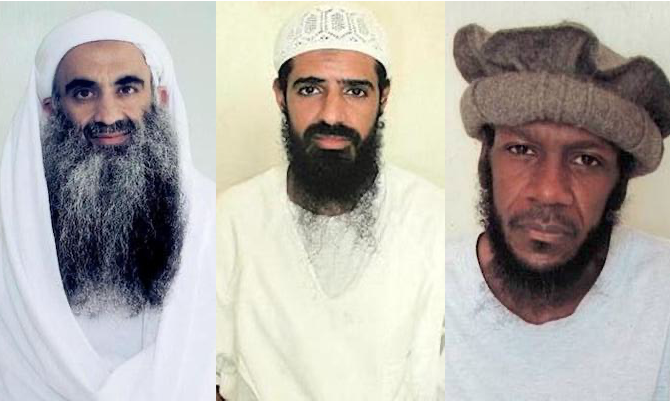
Khalid Shaikh Mohammad, Walid bin Attash and Mustafa al-Hawsawi, all photographed at Guantánamo in recent years by representatives of the International Committee of the Red Cross.

In July 2025, a three-judge panel in the D.C. Circuit Court (the Court of Appeals for the District of Columbia) ruled by 2 to 1 that Lloyd Austin “indisputably had legal authority to withdraw from the agreements.” The majority — Obama appointee Judge Patricia Millett and Trump appointee Neomi Rao — added that, “Having properly assumed the convening authority, the Secretary determined that the ‘families and the American public deserve the opportunity to see military commission trials carried out’”, adding, “The secretary acted within the bounds of his legal authority, and we decline to second-guess his judgment.”

The dissenting judge, Robert Wilkins, another Obama appointee, called it a “stunning” ruling (and not in positive sense), chastising his colleagues for not deferring to the decisions of military courts interpreting military rules.

The ruling hurled KSM and his two co-defendants — Walid Bin Attash and Mustafa Al-Hawsawi — back into the seemingly perennial uncertainty of pre-trial hearings, while the other two co-defendants, who had not agreed to the plea deals, continued to face their own ongoing travails. One, Ammar Al-Baluchi, has continued to pursue his own case against the government, while the other, Ramzi Bin Al-Shibh, was ruled unfit to stand trial by a DOD Sanity Board in August 2023, and, ever since, has been in legal limbo.

The plea deal for Abd Al-Rahim Al-Nashiri

Abd Al-Rahim Al-Nashiri, meanwhile, continued to challenge the government’s efforts to use information derived from so-called “clean team” interrogations after he arrived at Guantánamo as evidence in his case, a challenge that mirrored similar efforts by KSM and the 9/11 co-accused.

In August 2023, the judge in Al-Nashiri’s case, Col. Lanny J. Acosta Jr., had delivered a powerful ruling refuting the viability of the “clean team” interrogations, which had been designed to get him to replicate confessions he had made under torture without any coercion being used, on the basis that it was impossible for him to have delivered any kind of uncoerced self-incriminating statement after the torture to which he was subjected.

Prosecutors appealed the ruling, but on January 30, 2025, the appeals court, the Court of Military Commission Review, upheld Col. Acosta’s ruling, with Allison Miller, one of Al-Nashiri’s lawyers, telling the New York Times that the court had “unanimously rejected” the government’s request to “reinstate” the use of his discredited confession.

The decision confirmed a recognition by prosecutors — as with the 9/11 trial two years before — to abandon hopes for a successful prosecution, and, instead, to negotiate a plea deal. The deal, which, as with the 9/11 deal, dropped the death penalty in exchange for a full confession and lifetime imprisonment at Guantánamo, was announced by Allison Miller at the start of two weeks of hearings in March 2025, as reported by the New York Times, which also noted that Miller had said that a decision on the deal would need to be reached by Donald Trump’s defense secretary Pete Hegseth, but that, at the time, “a military chain of command ha[d] yet to send it to him.”

The plea deal had been agreed on December 12, 2024, but the chief prosecutor, Rear Adm. Aaron C. Rugh, had declined to present it to Lloyd Austin so close to the end of the Biden presidency, and the latest judge in the case, Col. Matthew S. Fitzgerald, had “acknowledged the political climate”, as the Times described it, stating, “We all realize we are operating in dynamic circumstances.” The Times also noted that the lead prosecutor, Capt. Timothy J. Stinson, a Navy lawyer, had “declined to comment on whether he had endorsed the agreement”, although Allison Miller “said in court that he had.”

Writing for the Times, Carol Rosenberg also noted that, since the USS Cole attack, “parents of sailors who were killed in the attack have passed away and many victims have stopped traveling to the Navy base to watch the painfully slow pretrial proceedings.”

Only one, Rosenberg noted, James G. Parlier, a retired Navy command master chief who survived the attack, had undertaken the difficult journey to Guantánamo to observe the proceedings. “For years”, she stated, “he had bristled at the delays and pressed for a capital trial”, but had finally “come to support resolving it through a plea agreement, at the risk of angering some of his former shipmates.”

“We’ve got to close that chapter of our lives,” he said, adding, “There are others who feel the same as me, want to get on with it. I know even if there’s going to be a death sentence we’ll be old men or dead by then.”

Having been told that “the proposed sentencing range would be 20 years to life imprisonment”, he said, “I’m fine with that”, noting that, by the time the sentence ended, “Mr. Nashiri would be over 80.”

Trump’s DOD rejects the plea deal

Despite the promise of “closure”, however, as with the 9/11 trial, when the Pentagon finally responded, the DOD, under Trump, took the same position as Lloyd Austin under Biden, rejecting the “plea agreement and a sentence of up to life in prison” and “setting the stage for the first death penalty trial at Guantánamo Bay to start this summer”, as lawyers explained to Rosenberg for the New York Times on February 5.

The decision, which was not taken by Pete Hegseth, was instead taken by Steve Feinberg, the deputy defense secretary, a businessman worth $5 billion, who, during his confirmation hearing, refused to acknowledge that Russia had invaded Ukraine, and also expressed support for large-scale firings within the Defense Department.

Although prosecutors acknowledged that they had supported the plea deal, they “notified the victims and relatives of those killed in the attack of the decision”, and “invited them to sign up to attend the trial, which is scheduled to start with the selection of a military jury on June 1 and could last six months.”

As Rosenberg explained, under the plea deal, “Mr. Nashiri would have admitted to his specific role in the attack and a military panel would have decided a sentence in the range of 20 years to life in prison. Victims would have testified to their loss, and defense lawyers and the defendant could have offered arguments for leniency that would probably have included descriptions of his torture.”

Instead, with his own discredited confessions excluded, “much of the trial evidence will likely involve US agents testifying about people they questioned at the time in Yemen, financial transactions and other documents they tied to an alias for Mr. Nashiri, who is accused of helping the bombers acquire vessels, explosives and safe houses.”

Another of the survivors, Paul Abney, a retired Navy master chief, expressed his disappointment with the decision, stating that he had “supported the plea bargain to resolve the case sooner ‘mainly for the family members, and for the survivors.’”

“It’s been a long, drawn-out process”, he added, further explaining that, although “there may be families that want to see the death penalty, personally I’d just like to see an end to this, to get some accountability and to give some finality to this thing.”

He said, however, that he would attend the trial “to represent the ship, those who had died and survivors who find the trip too painful”, although he made a point of noting that the prosecutors had “wanted the plea deal”, and had “spent a lot of time working on that.”

The disappointment was also summed up concisely by Allison Miller, who said it “would have brought actual finality to a nearly 26-year-old crime.” Instead, she predicted that the trial itself would air “the horrors perpetuated against Mr. al-Nashiri by the American government”, adding that, even if he is convicted, the case “will likely last through decades of appellate and post-conviction litigation.”

As with the aborted 9/11 plea deal, I can only, in conclusion, echo what I said about Lloyd Austin’s capitulation to notions of unfulfillable vengeance 18 months ago; that it was a shamefully missed opportunity to “redress the malignant folly at the heart of the detention policies undertaken in the ‘war on terror’: responding to terrorism with torture.”

Who knows, now, if there will ever be any closure or any kind of justice?

Andy Worthington is a freelance investigative journalist, activist, author, photographer (of a photo-journalism project, ‘The State of London’, which ran from 2012 to 2023), film-maker and singer-songwriter (the lead singer and main songwriter for the London-based band The Four Fathers, whose music is available via Bandcamp). He is the co-founder of the Close Guantánamo campaign (see the ongoing photo campaign here) and the successful We Stand With Shaker campaign of 2014-15, and the author of The Guantánamo Files: The Stories of the 774 Detainees in America’s Illegal Prison and of two other books: Stonehenge: Celebration and Subversion and The Battle of the Beanfield. He is also the co-director (with Polly Nash) of the documentary film, “Outside the Law: Stories from Guantánamo”, which you can watch on YouTube here.

Source: ScheerPost

California’s 2026 election isn’t just another policy fight — it’s a stress test for whether democracy can still regulate concentrated wealth. As Silicon Valley’s billionaire class pours unprecedented money into the governor’s race, ballot initiatives, and down‑ballot contests, the state has become the proving ground for what Politico calls “the big tech flex.” The Guardian reports that tech donors are executing a full-spectrum political strategy: saturate campaigns, shape narratives, and ensure that any challenge to concentrated wealth is met with overwhelming financial force.

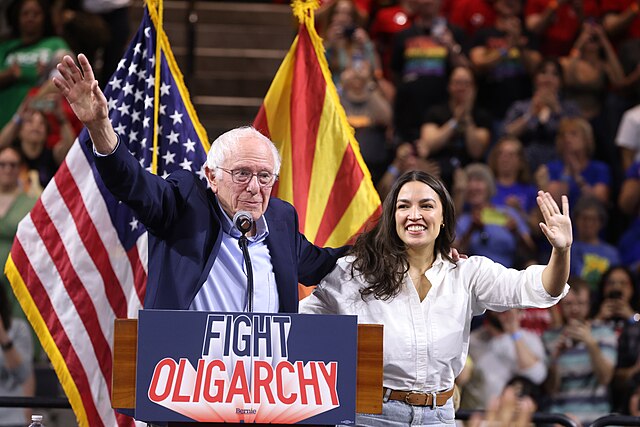
Into this storm steps Sen. Bernie Sanders, who arrived in Los Angeles to back a billionaire tax that has triggered open revolt among the state’s wealthiest residents. “Our nation will not thrive when so few own so much,” Sanders wrote — a line that lands even harder as The New York Times documents billionaires scrambling to restructure assets, shift residency, and even consider divorce to avoid paying more.

This is the collision at the heart of the fight: a state trying to tax extreme wealth, and a billionaire class signaling it may simply opt out. Newsom warns of capital flight. Economists warn of unpredictable shocks. Tech donors are already flooding the political system to shape the outcome.

We laid out the stakes yesterday — and today, we’re publishing the full Bernie Sanders speech that drives the point home.

Key Highlights from Bernie Sanders’ “Billionaire Tax Now” Speech (Los Angeles)

The Central Message

  • Sanders frames the fight over a billionaire tax as the defining moral and economic struggle of our time, arguing that the U.S. is facing “the grotesque level of income and wealth inequality” unseen in its history.
  • He insists the billionaire class has become an oligarchy, detached from society and convinced they have a “divine right to rule.”

Economic Inequality

  • Over 60% of Americans live paycheck to paycheck, struggling with rent, food, healthcare, childcare, and retirement.
  • Meanwhile, “never before have so few had so much wealth and power.”
  • The top 1% owns more wealth than the bottom 93%.
  • One man—Elon Musk—is worth $850 billion, more than 53% of American households combined.
  • CEOs now make 350× the average worker.
  • U.S. billionaires became $1.5 trillion richer in a single year after receiving the largest tax break in history.
  • Over 50 years, $79 trillion has shifted from the bottom 90% to the top 1%.

Corporate Power & Ownership

  • Four Wall Street firms—BlackRock, Vanguard, Fidelity, State Street—are major shareholders in 95% of U.S. corporations.
  • Billionaires increasingly control the media:
    • Musk: Twitter/X
    • Bezos: Washington Post
    • Zuckerberg: Facebook, Instagram, WhatsApp, Threads
    • Ellison: CBS, Paramount, MTV
    • Murdoch: Fox News, WSJ, NY Post

Political Power & Citizens United

  • Sanders calls the political system “corrupt” due to unlimited billionaire spending.
  • Musk spent $290 million to elect Donald Trump.
  • The top 100 richest Americans spent $2.6 billion on the 2024 election.
  • Silicon Valley billionaires are preparing a $200 million AI/robotics super PAC, which Sanders warns will accelerate worker displacement.

AI, Robotics & Worker Threat

  • Sanders warns that billionaire‑driven AI and robotics could throw millions out of work.
  • He calls this “extraordinarily dangerous to the future of the working class.”

The California Fight

  • Sanders says the billionaire tax referendum is not just about revenue—it’s about whether democracy can restrain oligarchic power.
  • He predicts billionaires will run ads threatening job losses and business flight, calling it the same intimidation workers face during union drives.
  • He warns oligarchs: “You are treading on very, very thin ice.

Calling Out Individual Billionaires

  • Sergey Brin (worth $245B) is spending $20M to defeat the tax.
  • Mark Zuckerberg (worth $226B) owns three yachts and 11 Palo Alto homes.
  • Larry Ellison (worth $213B) owns five private jets and fighter jets.
  • Sanders argues they can easily afford to pay more so Californians can access healthcare.

Healthcare & Tax Priorities

  • Sanders blasts the Trump-era tax cuts that removed 15 million people from Medicaid and ACA coverage to fund $1 trillion in tax breaks for the wealthy.

Historical Parallel & Movement Building

  • He compares today’s billionaires to 18th–19th century monarchs, claiming they no longer see themselves as part of American society.
  • He praises Minnesota workers who resisted ICE, saying organized people can defeat authoritarianism.
  • He frames California as the next frontline: “The people of California can show the world that when we stand together, we can take on the oligarchs.”

Closing Message

  • Sanders ends with a rallying cry: “Enough is enough. The billionaire class cannot have it all. This nation belongs to all of us.”