Sunday, May 10, 2026

Trump policy coverage dominates Pulitzer Prize winners

05.05.2026, DPA


The Pulitzer Prizes this year honoured multiple works examining the impact of policies by US President Donald Trump.

Pulitzer administrator Marjorie Miller said during the announcement on Monday that much of the coverage had centred on controversial topics of the year, including immigration policy, sharp cuts to US development aid and reporting on files related to sex offender Jeffrey Epstein.

The Washington Post was awarded for its reporting on the impact of the Trump administration's restructuring of federal agencies. The New York Times won for investigations that uncovered how Trump used his power to financially benefit his family. Journalists at the Chicago Tribune were recognized for their coverage of operations by US immigration authorities in the city.

Awards were also given for reporting on artificial intelligence, a deadly flood in the US state of Texas and destruction in Gaza.

A special citation went to Julie K Brown of the Miami Herald for her 2017–18 investigations into Epstein and the abuse of young women.

Miller said the awards also underscored a commitment to press freedom at a time of growing pressure on media, pointing to restrictions on access to the White House and Pentagon as well as legal action taken by the president against news outlets.

The Pulitzer Prizes are widely regarded as the most prestigious awards in journalism and are also given for achievements in literature, music and theatre.

What to watch out for at the 2026 Cannes Film Festival

A total of 22 films are competing for the Palme d'Or this year as the presitigious Cannes Film Festival begins in the south of France on Tuesday. The nine-person jury this year will be headed by South Korean director Park Chan-Wook but will also feature US celebrity Demi Moore, star of "The Substance".


Issued on: 10/05/2026 
By: FRANCE 24


John Travolta, last seen in Cannes in 2018 for "Solo : A Star Wars Story", will present his directorial debut this year. © Laurent Emmanuel, AFP

The world's most glamorous film festival kicks off in Cannes on Tuesday, promising another action-packed fortnight of world premieres, star-studded red carpets, parties and fashion.

Here are some of the most hotly anticipated moments and appearances:
The main competition

A total of 22 films are competing for the prestigious Palme d'Or for best film which will be handed out on May 23.


Arthouse heavy-hitters such as Spain's Pedro Almodovar, Japan's Hirokazu Kore-eda or Romania's Cristian Mungiu will be up against emerging talent such as Belgian prodigy Lukas Dhont and France's Lea Mysius.

There is industry buzz around "Hope" by South Korean director Na Hong-jin, starring real-life partners Michael Fassbender and Alicia Vikander, as well as AI- and technology-themed "Sheep in the Box" by acclaimed Japanese director Hirokazu Kore-eda.

The nine-person jury this year will be headed by South Korean director Park Chan-Wook but will also feature US celebrity Demi Moore, star of "The Substance".
Hollywood ghosting

Unlike previous editions which have featured Tom Cruise productions "Mission: Impossible" or "Top Gun", no major US studios have chosen Cannes to launch a blockbuster.

Hollywood has traditionally provided some razzle-dazzle and mass-market entertainment alongside the more edgy, independent cinema in the Cannes programme.

Reasons for their absence include cost-cutting, their growing preference for tightly controlled social media-led launches, and the risk that a mauling from the Cannes critics can doom a movie.

Travolta

One man not put off by the prospect of scrutiny from some of the most demanding crowds in the film industry is movie legend John Travolta.

The plane-mad actor will bring some serious stardust when he presents his directorial debut, "Propeller One-Way Night Coach", about a young boy's journey in the "golden age of aviation".

A-listers

Other A-listers from around the world will descend on the Cannes red carpets which will be some of the most celeb-heavy and fashion-rich places on the planet for the next fortnight.

Scarlett Johansson and Adam Driver are set to promote "Paper Tiger", a thriller by American director James Gray, while "Bohemian Rhapsody" star Rami Malek stars in "The Man I Love" by Ira Sachs.

Spanish favourite Javier Bardem, Norwegian star Renate Reinsve, Kristen Stewart and Woody Harrelson are all featuring in films set to screen for the first time on the French Riviera.

Julianne Moore and Cate Blanchett are also set to make appearances, while Barbra Streisand and "Lord of the Rings" director Peter Jackson will pick up lifetime achievement awards.

A Russian returns

The appearance by one of Russia's most decorated independent directors, Andrey Zvyagintsev, will be celebrated for film and personal reasons.

The Oscar-nominated director of "Leviathan" and "Loveless" nearly died due to Covid, spending months in hospital, and fled his homeland after Russia's invasion of Ukraine in 2022.

His first movie since 2017 is called "Minotaur" and tackles the hugely sensitive issue of the Russian bourgeoisie grappling with army conscription at the start of the Ukraine war.
Football

There will be a surprising amount of football at the high temple of cinema, including a British-made documentary "Cantona" about legendary French forward Eric Cantona.


arts24 © FRANCE 24
11:10


An Argentine-made film, "The Match", casts a spotlight on the notorious England-Argentina 1986 World Cup match settled by a goal awarded after a handball by Diego Maradona.


AI-created Lennon

Director Steven Soderbergh will present his documentary "John Lennon: The Last Interview" which features The Beatles songwriter hours before his murder.

Soderbergh has turned the audio-only recording into a film, using archival pictures as illustration and – very controversially – AI-generated images of the late singer.
Best of the rest

With war-hit Iran in the news, "Rehearsals for a Revolution" by Pegah Ahangarani, a film about political repression, appears timely.

After a Nigerian movie screened in a hallowed official slot at Cannes for the first time last year, twin brothers Arie and Chuko Esiri will represent Nollywood again when they show star-packed "Clarissa".

Picked in the Director's Fortnight competition, it features "The Bear" star Ayo Edebiri and "Selma" actor David Oyelowo.

"The Godfather III" and "Ocean's Eleven" actor Andy Garcia presents "Diamond", a "passion project" he has been working on for 15 years.

The first film of a big-budget two-part French production on war-time hero and political colossus Charles de Gaulle will be a major event for the host country.

(FRANCE 24 with AFP)
Thomas and Erika Mann biopic has an oddly twisted premise
DW
May 9, 2026

Premiering at Cannes and starring Sandra Hüller, Pawel Pawlikowski's "Fatherland" is set during the Cold War — a complex period for the prominent anti-Nazi intellectuals.

https://p.dw.com/p/5Cxcx


Sandra Hüller and Hanns Zischler star as Erika and Thomas Mann in 'Fatherland'
Image: Agata Grzybowska/Mubi/AP Photo/picture alliance


Pawel Pawlikowski's "Fatherland" is one of the most anticipated films among the 21 titles vying for the prestigious Palme d'Or this year.

The Polish filmmaker returns to Cannes after winning the festival's best director award in 2018 with "Cold War." The historical romantic drama set between Communist Poland and Paris went on to win the top European Film Awards and earn multiple Oscar nominations.


Pawel Pawlikowski's 'Cold War' also won the People's Choice Award for Best European Film
Image: Britta Pedersen/dpa/picture alliance

Pawlikowski's new film is another exploration of the early Cold War period. It's framed as a road movie undertaken by Thomas Mann (played by Hanns Zischler) and his daughter Erika (Sandra Hüller), as they travel in a Buick from Frankfurt in West Germany to Weimar in East Germany, in 1949.

According to the synopsis of the film, "Fatherland" also explores "themes of identity, guilt, family and love, amid the turmoil and moral confusion of postwar Europe." The biographical work's storyline is already sparking renewed interest in the iconic Mann family.

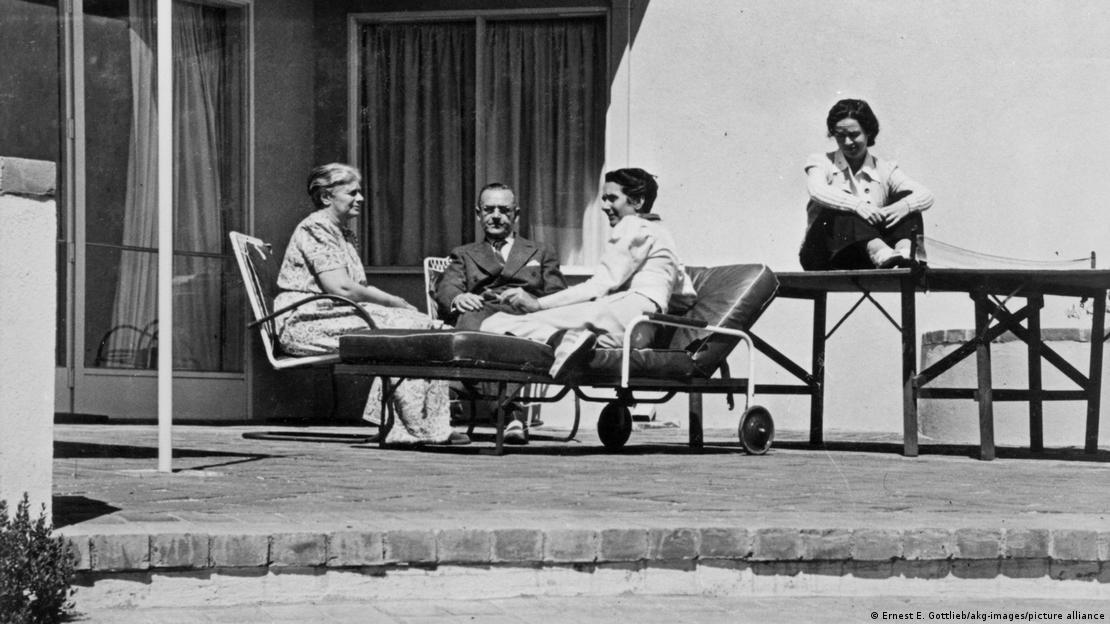
The Mann family, a literary dynasty often referred to as 'Germany's Kennedys' was a prominent, intellectual and wealthy family of writers and artistsImage: Ernest E. Gottlieb/akg-images/picture alliance

What defined the relationship between Thomas Mann and his daughter Erika? How did the prominent exiled family of intellectuals view postwar Germany — and how did the Germans perceive the Manns? And why was the year 1949 particularly important for them?

Thomas Mann's iconic legacy

Thomas Mann, 1929 Nobel Prize in Literature laureate, fled Germany in 1933 due to the Nazis' rise to power. During his exile years (1933-1952), which he spent primarily in Switzerland and the United States.

Having established his renown with novels including "Buddenbrooks" (1901) and "The Magic Mountain" (1924), Thomas Mann became a prominent critic of fascism during Hitler's rule, securing his legacy as a key 20th-century democratic intellectual.

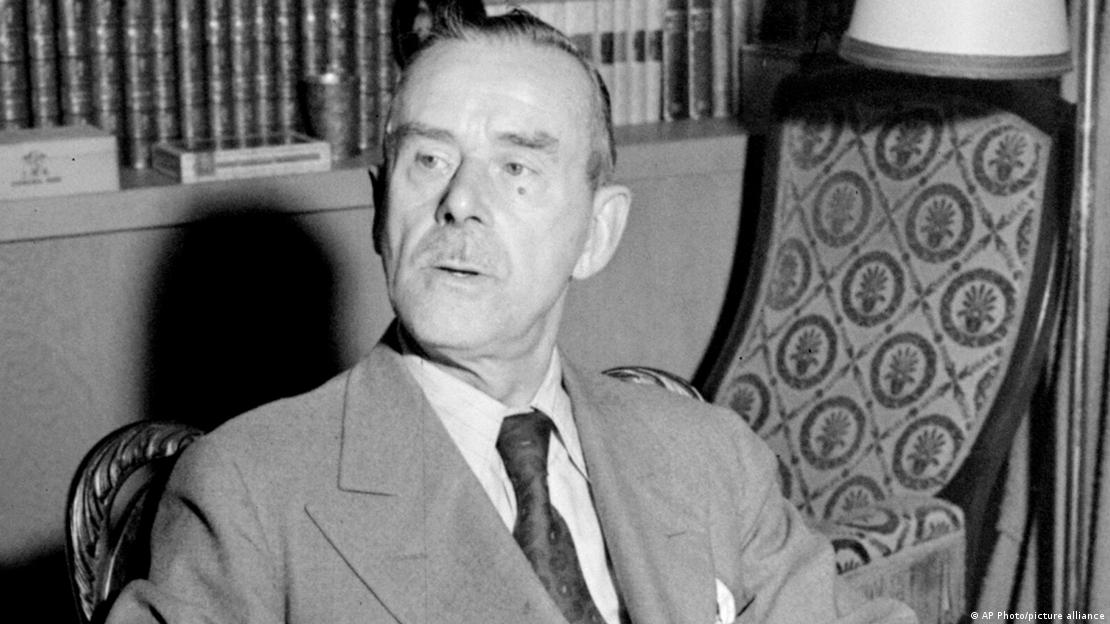
Most famously, Mann's "Deutsche Hörer!" (Listen, Germany!) series of speeches, delivered via the BBC between 1940 and 1945 during his exile in the US, document his resistance work.

Thomas Mann's radio speeches were aimed at the German population
Image: AP Photo/picture alliance


A particular bond with his daughter Erika


When Mann's first child was born in 1905, he openly expressed his disappointment that it was a girl. A son would have been "more poetic, more of a continuation, a new beginning of myself," he wrote in a letter to his brother, Heinrich Mann.

"And yet this daughter, among his six children, became the most important one for the father's poetic and political endeavors," says Irmela von der Lühe, author of a biography on Erika Mann.
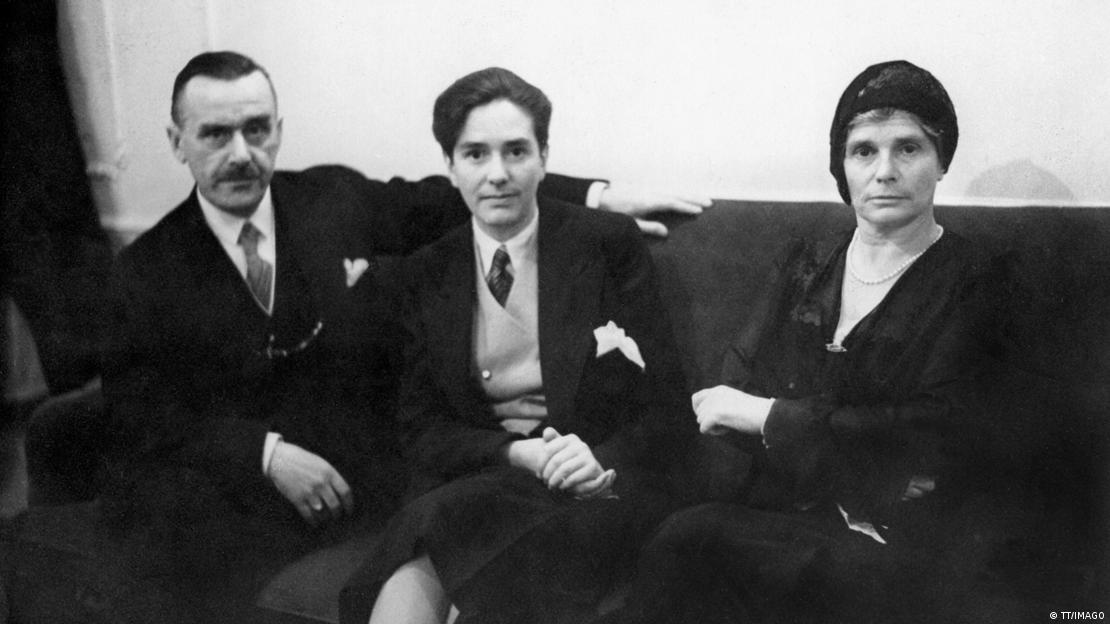
Thomas, Erika and Katia Mann in 1930, when the Nobel laureate held the speech 'An Appeal to Reason,' in which he condemned National Socialism as 'eccentric barbarism'
Image: TT/IMAGO

Indeed, Erika played an influential role in getting her father to actively speak out against the Nazi regime in early 1936. Though he was a known opponent of Nazism as early as 1930, the novelist had remained publicly silent on the topic once Hitler took power. Erika threatened to break ties with her "un-emancipated father" if he didn't drop this cautious approach.

"She had personally clashed with the Nazis very early on," von der Lühe tells DW.

A child of the Roaring Twenties and a talented cultural figure in Berlin, Erika Mann embraced the era's bohemian and experimental lifestyle — until she realized that her generation should have invested more energy in protecting the progressive rights and freedom they enjoyed under the Weimar Republic's democratic constitution.

The year before Hitler seized power in Germany in 1933, Erika was denounced by the Nazis' paramilitary militia for having publicly read a pacifist poem. It affected her acting career and contributed to strengthening her anti-fascist convictions.

In January 1933, Erika Mann co-founded a political cabaret called "Die Pfeffermühle" (The Peppermill) in Munich. She wrote most of its material; the satirical pieces were often anti-fascist. After two months, the Nazis closed the theater company and forced the ensemble into exile.

Through their mother, Katia Mann, who came from a wealthy Jewish industrialist family, the Mann children were also considered Jewish under Nazi racial laws.


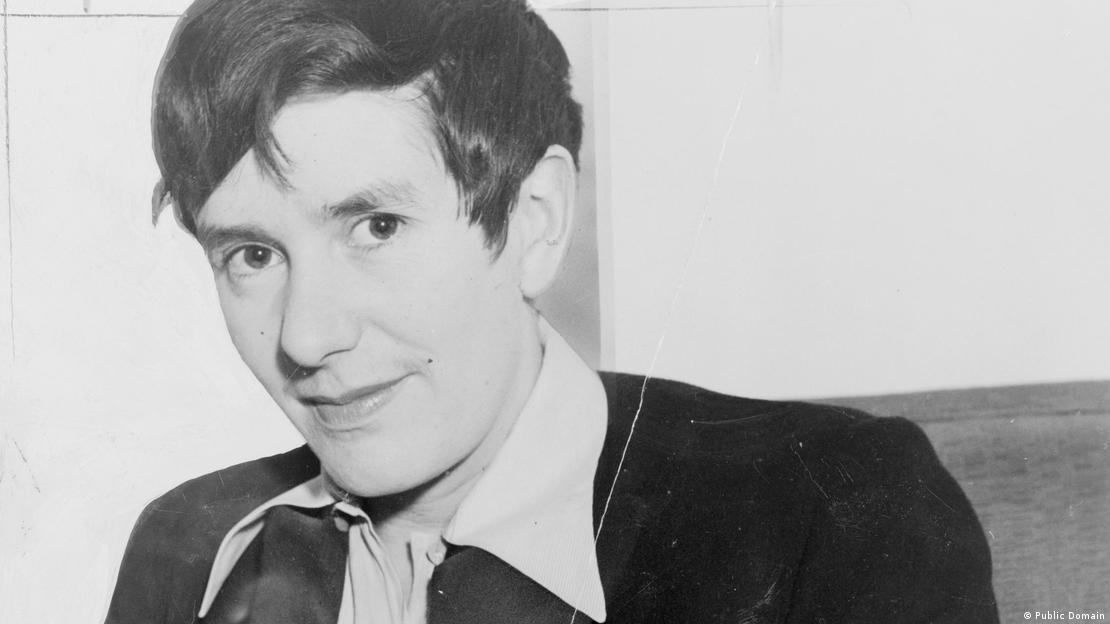
Known for her androgynous style, Erika was also openly bisexual, but this was not a topic she addressed in her activism
Image: Public Domain

In exile, Erika Mann took on a second successful career as a reporter and author, aiming to warn the world about how quickly democracy had broken down under Hitler, despite Germany's renown as being "the land of poets and thinkers."

"That's what I've always found significant about her, and which in my eyes is, unfortunately, very relevant again today," says von der Lühe.
What happened in 1949

Just four years after the end of World War II, Germany was still in ruins, and ideologically divided: October 7, 1949 marked the official establishment of the German Democratic Republic (GDR), a new socialist state based on the postwar Soviet Occupation Zone in East Germany.

After the war, Thomas Mann announced that he would not be returning to live in his home country. He argued in his publications that all Germans shared responsibility for Nazi crimes; this theory of German collective guilt alienated those who had remained in Germany. After all, didn't the Mann family spend all those years living comfortably in exile, while so many others suffered under Hitler?

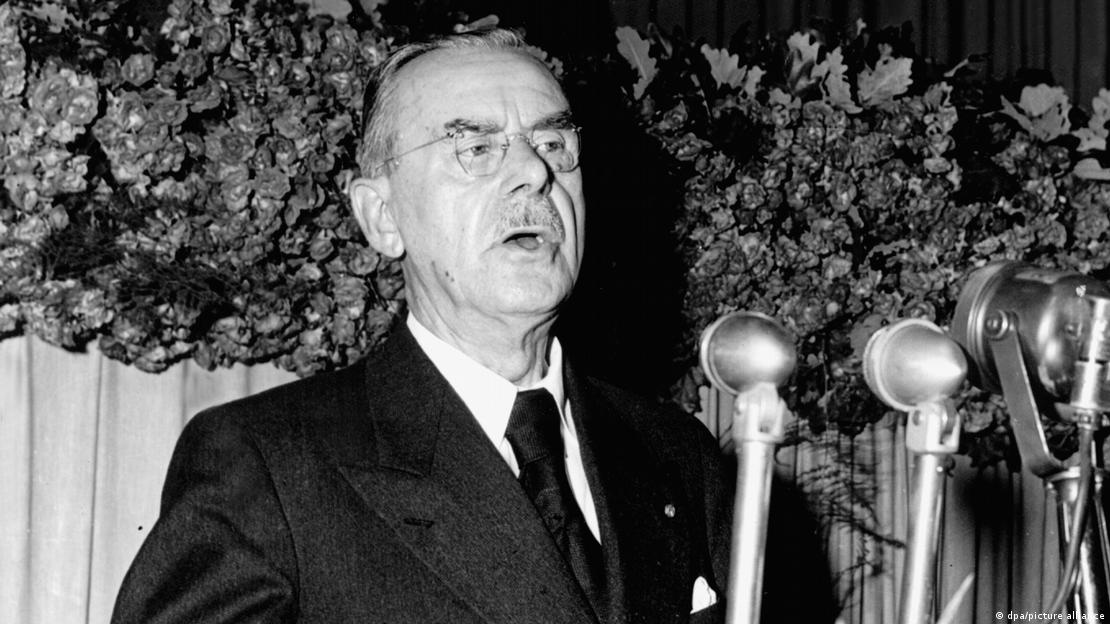
Thomas Mann returned to Germany for the first time since his exile for a visit in 1949, as part of the celebrations marking the 200th birthday of Johann Wolfgang von Goethe. He was invited to receive the Goethe Prize in the West German city of Frankfurt, while the East German city of Weimar offered him an honorary citizenship and the Goethe National Prize .

Thomas Mann giving his speech in Frankfurt in 1949
Image: dpa/picture alliance

In a speech he delivered in both cities, Mann noted that he did not recognize any ideological divisions or occupation zones. "My visit is for Germany itself, for Germany as a whole," he said.

But Erika condemned the project. Von der Lühe notes that the invitation was even at the center of the second major falling-out between Erika and Thomas Mann, after their disagreement about taking a public stance against the Nazis in 1936. Erika felt that her father shouldn't go "to a country where he had been so viciously attacked in the media in recent years," explains the Mann expert.

Those attacks included threatening letters from West Germans; the 1949 Germany visit was under police protection.

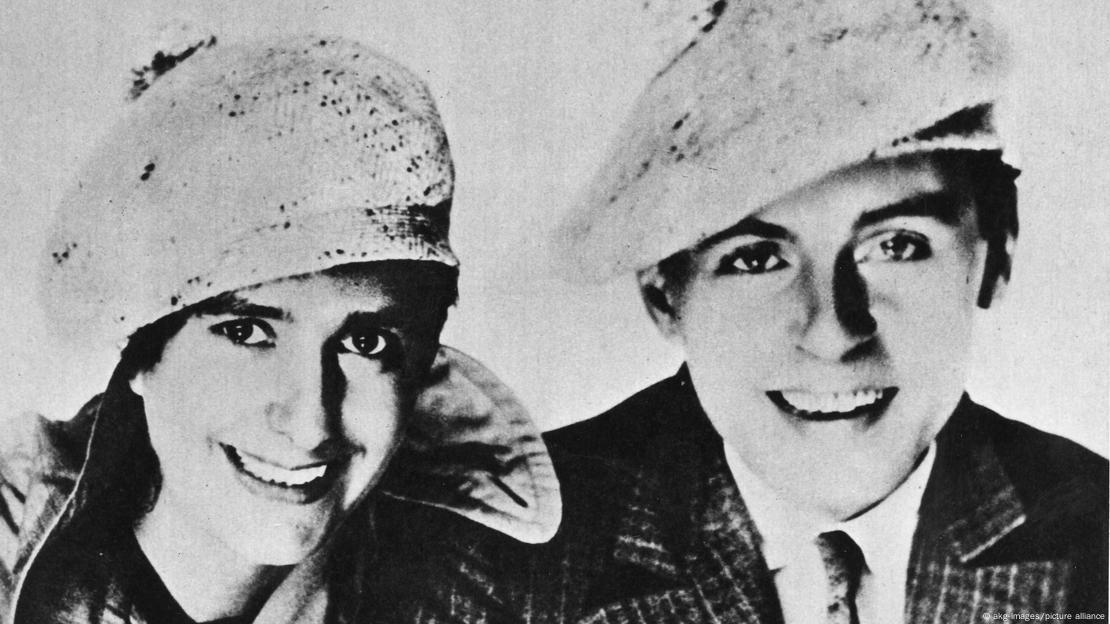
Complicating matters, it was also the year Klaus Mann committed suicide. The second child of Thomas and Katia Mann, Klaus was also a committed anti-fascist author, and Erika had been exceptionally close to him.
Erika and Klaus, Thomas and Katia Mann's two eldest children, were an exceptionally close creative and politically engaged sibling duo
Image: akg-images/picture alliance

Among the many factors that contributed to Klaus' profound disillusionment was the way he had been treated in the US, where the Manns were suspected of being communists. Erika felt Thomas Mann's celebrated stop in Weimar would be perceived as legitimizing communism.

Even though Pawlikowskli's "Fatherland" is based on existing historical figures, its premise is completely fictional. During his well-documented journey from Frankfurt to Weimar, Thomas Mann was accompanied by his wife, Katia. Erika didn't join them — because she had deliberately decided to boycott the tour of their former home country.

Edited by: Sarah Hucal


Elizabeth Grenier Editor and reporter for DW Culture


 Is 'Citizen Kane' really the greatest film of all time?


07.05.2026 DPA


Photo: RKO Radio Pictures/Wisconsin Center for Film and Theater Research/dpa

Orson Welles’ cinema classic would go on to be hailed as the greatest of film all time, but was something of a flop when it was released 85 years ago. What is it that supposedly makes this film so great? And could a feminist film be replacing it on top of rankings?

By Gregor Tholl, dpa

In May 1941, it premiered in a New York cinema, only to become an initial flop. Today, 85 years later, "Citizen Kane" is considered by many to be the greatest film ever made.

The black-and-white film by Hollywood's wonder boy Orson Welles — who was 25 at the time — tells the story of fictional media mogul Charles Foster Kane, in whom contemporaries believed they could easily recognize media mogul William Hearst (1863–1951). The film bombed — at least at first.

So what is it about this work of cinema history that makes it so acclaimed?

The story of the 'greatest film of all time'

In 1952, the team behind the specialist journal Sight and Sound, published by the British Film Institute, had the idea of asking critics to name the "Greatest Films of All Time." This tradition has been repeated every ten years since (and is, of course, just one of many best-of lists).

In 1962, 1972, 1982, 1992 and 2002, "Citizen Kane" topped that prestigious list. In the most recent list (from 2022), "Citizen Kane" ranks third, behind Alfred Hitchcock's "Vertigo" in second place ("Vertigo" was number one in 2012).

Going by the most recent ranking, "Citizen Kane" is no longer the best film of all time.

In a likely surprise to most, first place is now Chantal Akerman's feminist work "Jeanne Dielman" (full original title: "Jeanne Dielman, 23 Quai du Commerce, 1080 Bruxelles", available on Mubi). Meanwhile on the IMDb list of the top 250 films, "Citizen Kane" is only ranked 113th, according to the website's millions of voters. The uplifting prison story "The Shawshank Redemption" (1994) is first.

What 'CitizenKane' is about

In the highly acclaimed "Citizen Kane," a group of reporters tries to explain the last word reportedly spoken by newspaper magnate and politician Charles Kane, who died alone. That word is "Rosebud."

The film opens with a newsreel informing the public about Kane's life. A series of flashbacks then shows various scenes from that life. By the end, the mystery of "Rosebud" is solved.

Audiences watch as Kane inherits a vast fortune as a young boy, builds a media empire as a young adult and ultimately becomes a ruthless man of power.

The sweeping political career that might have crowned his rise is denied him — it collapses because of an affair with singer Susan Alexander, which also destroys his marriage.

Kane marries Susan and becomes obsessed with turning the largely talentless singer into an opera star. The venture fails. Kane dies a bitter old man in his grand castle, Xanadu.

What makes 'CitizenKane' special

Today's viewing habits may make the film seem less remarkable than it once did. But if you try, as best you can, to mentally transport yourself back to 1941, the sheer wealth of innovation becomes apparent.

In visual terms, the film made considerable demands on cinema audiences: extensive use of deep focus, symbolically charged reflections, strong contrasts and sequences shot from extreme high angles (top-down) or low angles (bottom-up).

"Citizen Kane" was also revolutionary for the development of sound in film, then still relatively new. Welles had actors talk over one another and interrupt each other — unheard of at the time.

The film also features an unusual, rather unsympathetic lead character with whom audiences can barely identify. The New York Times once described Kane as an almost Shakespearean figure, somewhere between Hamlet and Lear.

Also striking is the break with linear storytelling. Time jumps occur even within individual scenes. The best example is a breakfast table sequence that shows how Kane's first marriage deteriorates over the years. The setting is always the same room; only the costumes and make-up change. The length of the dining table also grows — effectively conveying the growing distance between the couple.

Welles played Kane at every adult age, spending many hours each day in the make-up chair. His portrayal of Kane is cited as an early example of method acting — a technique in which the actor immerses themselves completely, almost obsessively, in their role.

"Citizen Kane" is regarded as a prototype of the so-called auteur film, because Orson Welles had a hand in almost every artistic aspect, including the screenplay.

Did 'Citizen Kane' win many awards?

After "Citizen Kane" was released, media tycoon Hearst — who believed the film was about him — launched a campaign against lead actor and director Orson Welles, co-writer Herman J. Mankiewicz and the film studio RKO.

Despite its box-office failure, the film was a hit with cinephiles from the start. At the 1942 Oscars, it received nine nominations. However, the film ultimately won only one Academy Award — for best original screenplay, shared between Welles and Mankiewicz.

In late 2020, Netflix released "Mank," starring Gary Oldman in the title role. The film tells the story of alcoholic screenwriter Mankiewicz and his dispute with Welles over the "Citizen Kane" screenplay.

As if the Academy wanted to make up for its failure 80 years earlier, the film by director David Fincher ("Se7en," "Fight Club," "Gone Girl") received ten Oscar nominations in 2021. It won two awards — best cinematography and best production design — surpassing the single Oscar won by "Citizen Kane."


Netflix's 'Lord of the Flies': Timely, engrossing and true to novel

04.05.2026, DPA


Photo: J Redza/Netflix/Eleven/Sony Pictures Television/dpa

A plane goes down and a pack of choirboys turns savage fast — with the jungle itself seeming to scream in red. In Netflix’s new "Lord of the Flies", how far does Jack Thorne push Golding’s classic and which boy becomes the story’s surprising centre?

By Robert Lloyd, Los Angeles Times

Jack Thorne, who co-wrote last year’s prize-winning “Adolescence,” returns with another story of fractured childhood with an admirable, engrossing new adaptation of William Golding’s much-taught novel of boy castaways, “The Lord of the Flies.” (Not to be confused with “The Lord of the Rings,” though I keep typing that by mistake.)

Published in 1954, Golding’s book has an unstated Cold War backdrop — there is passing reference to an atom bomb and “the Reds,” and an old-fashioned animated atom glimpsed through static at the head of the series. The boys, who are British and range in age from 6 to 12, are being evacuated to somewhere — none of them really knows, and it’s not clear anyone else does, either — when their plane goes down on an uncharted desert isle. (The logo on the aircraft is Corinthian Air, make of that what you will.)

The great British stage and screen director Peter Brook (“Marat/Sade,” “The Mahabharata”) filmed a version in 1961 (released in 1963) that somehow found its way onto American broadcast television in my youth that disturbs me still. A coed Filipino version was made in 1975, and a prosaic Americanized take in 1990. In some way Brook’s powerful film, shot in black and white, still feels definitive, even after watching this new series, premiering Monday on Netflix, though it’s a streamlined telling and much of the dialogue was improvised.

Our main characters are older boys Ralph (Winston Sawyers), Piggy (David McKenna), Jack (Lox Pratt) and Simon (Ike Talbut). Each has an episode named for him — as with “Adolescence” it’s a four-part show — the overlaid shifting focus fitting quite well into the novel’s chronology. Ralph is good-hearted and reasonable and about to grow up; Piggy, chubby, bespectacled, asthmatic, stands for mocked intelligence; Jack, increasingly Ralph’s nemesis, is a budding authoritarian, who arrives with a complement of caped and capped choirboys under his command; and Simon, who, in the novel, seems to suffer from epilepsy, is the story’s Prince Myshkin, sensitive and spiritual. (We’ll see him photographed from above, floating in a crucifixion pose.)

It’s hard to know what, if anything, to call a spoiler in a series adapting a 75-year-old fiction routinely, or once routinely, assigned in high school, but I’ll keep mum about the fate of any particular characters and the castaways as a whole for those yet to savour the story’s dark charms.

In many respects, this “Lord of the Flies” is truer to the book than the Brook film. Much of Golding’s dialogue appears here, with all the signal events present and accounted for, though Thorne adds quite a few scenes and events, for dramatic effect or to draw three lines under a point, or to make the good guys better and remind you that the bad guys are scared little boys beneath the bluster and war paint. Suitcases are discovered, containing plot devices. There are interpolated bits of backstory to explain character — Simon and Jack would be left at school over Christmas, like young Scrooge in “A Christmas Carol,” by their parents (abusive and cold, respectively).

Piggy, whom Golding gives no other name, gets one here — Nicholas — albeit held back until later in the series. (Though Ralph is the main protagonist, Piggy — onscreen anyway, in a deep performance by McKenna — reads as the secret central character, and Thorne expands his presence in the narrative far beyond the text.) He’s the one who thinks about keeping the water supply sanitary, and in Thorne’s version, he tells stories to calm the little children, including that well-known folk tale of apocalyptic mass hysteria, “Chicken Licken.” (a.k.a. “Chicken Little.”) He also sings Groucho Marx’s “Hooray for Captain Spaulding” (“He went into the jungle, where all the monkeys throw nuts / if I stay here, I’ll go nuts”) as he wanders through the jungle, which marks him a boy of refinement. (Other Groucho references will come, more dramatically.)

Director Marc Munden seems to be aiming for art here — fair enough — which at times comes across as arty. Between explosions of action, it’s willfully slow, which I suppose life on a desert island might be. (That’s why people are always being asked what books and records they’d bring.) He embraces the island’s offer of crabs and birds and insects, rotting fruit and rotting flesh, photographed close up by cinematographer Mark Wolf, who provides interstitial portraits of various boys, in slightly wide angle, staring at the camera. In one scene it lingers for what struck me as an inexplicably, even discomfitingly long time on the handsome face of a young sociopath pranking a pair of little kids with small stones.

Colors are heightened — by manipulation or because that’s just what the jungle’s like, I don’t know which. Sometimes the forest greens turn red to emphasize extreme states of mind and signal hallucinations. The musical score, by Cristobal Tapia de Veer (“The White Lotus,” which it occurs to me as I write, is a kind of adult take on “Flies”) takes a modern classical approach — not your usual TV miniseries music. It all can feel a little heavy-handed, but extremity does suit the story. Above all, Munden and his crew have done a fine job of wrangling good work from masses of kids, some quite little, in what must have been challenging conditions.

“There was the brilliant world of hunting, tactics, fierce exhilaration, skill,” wrote Golding, “and there was the world of longing and baffled common sense.” On one side, doing the dull work of democracy — “I want to be a good chief,” says Ralph, voted into the office early on, “and we need to be good campmates.” On the other, falling in line behind a power-drunk bully to whom rules don’t matter. (Hmmmm.) But whether you take it as a literary thought experiment regarding pre-teen psychology or an allegory ( alarmingly still apt ) of the ways humanity conducts itself in this world — those keeping the signal fire lighted versus those busy stabbing things with pointed sticks — it’s not a happy tale.

Can a new invention cut harmful particle emissions when cars brake?

07.05.2026, DPA


Photo: TU Chemnitz/Fraunhofer Institute for Machine Tools and Forming Technology IWU/dpa

New laws in the European Union are set to limit emissions of potentially hazardous brake dust from cars from the end of November this year and a German invention could play a major part.

Experts at the IWU machine tools section of the Fraunhofer institute in Chemnitz have come up with a stainless steel-coated brake disc which significantly reduces abrasion and particle emissions.

The new disc also lasts up to 300,000 kilometres or more than five times longer than conventional steel discs. It has been extensively tested and could easily go into production.

The environmental and health impacts of brake dust are now in the spotlight after findings that tiny particles of rubber and plastic given off by car tyres can make it into ground water and foods eaten by humans.

The brake dust issue also applies to electric cars which produce no exhaust emissions locally but still generate wear and tear on tyres and brakes. This means even electric cars will also have to meet stricter standards in future.

Particulate matter from brakes is highly dangerous to human health and is considered a primary environmental risk by the World Health Organization (WHO). The tiny particles, often invisible to the naked eye, can penetrate deep into the lungs, where they lodge and can cause long-term health effects.

From November 29, 2026, newly developed (type-approved) vehicles in the EU will have to comply with the limits.

From the end of 2027 the binding limit value will apply to all newly registered passenger cars and light commercial vehicles, including models that have been on the market for some time.

The new Euro 7 standard sets such clear limits for the first time. For battery electric vehicles, only 3 milligrams per kilometre are permitted.

This is because electric vehicles, which use regenerative braking, often produce less brake dust. For all other types of powertrain, the limit is 7 milligrams per kilometre. This applies to passenger cars and light commercial vehicles with a gross vehicle weight of up to 3.5 tonnes.

Conventional wheel brake systems generally fail to meet these limits, even when combined with high-quality brake pads, said the institute on its website.

Study suggests gut movement may flush excess material from our brains

08.05.2026, DPA


Photo: Sebastian Gollnow/dpa

With each step you take, coordinated contractions in your abdominal muscles help keep you stable and upright.

Now, new research finds that those gentle changes in tension and pressure also affect your brain, and may play a role in the organ's overall health.

Imaging in humans and other animal species has long shown that the brain gently moves inside the fluid-filled skull cavity, but it's never been clear what, exactly, is propelling this motion, said neuroscientist Patrick Drew, a Penn State University professor and associate director of the Huck Institutes of the Life Sciences in the US.

Using advanced imaging, Drew's team observed mice brains before and after the animals began walking. They realized that the brain actually moved just milliseconds before a mouse took a step — the brief moment when the animal's abdominal muscles contracted in preparation for movement.

To test the observation, they strapped pressure sensors around the bellies of lightly anesthetized mice and observed the brain when slight pressure was applied only to the abdominal muscles. The same motion followed. Breathing or cardiac activity didn't trigger the same response.

The connection, Drew and his colleagues determined, is the vertebral venous plexus, a network of veins that connects the abdomen to the spine in mice and humans alike.

"It's like a hydraulic system. It really is very much like the jacks that push your car up, or something that an excavator might have," Drew said. "Whenever you tense those muscles, which you do whenever you make a movement . . . that pushes blood into the spinal cord, it increases the pressure on your brain, and it moves your brain forward."

The paper, which was published April 27 in Nature Neuroscience, answers a puzzling question about the mechanism controlling this long-observed cerebral movement.

It also puts forward hypotheses about why this belly-brain choreography exists.

Drew and his team ran computer simulations of fluid's motion in and around mouse brains. The kind of contraction generated by walking moves cerebrospinal fluid out of the brain, leading Drew to hypothesize that the mechanism plays an important role in flushing out excess proteins and other unnecessary material.

"It's more speculative, but using simulations, we can see that this sort of motion should drive fluid movement and could help clear waste in the brain," Drew said.

In future research, Drew said, the team would like to explore whether the brain is detecting these mechanical signals, and how physical conditions like obesity affect the hydraulic relationship between the abdominal muscles and the brain.

These current findings clarify the relationship between the brain and physical movement, illuminating fundamental mechanics that can apply to other research, said Michael Goard, an associate professor at the University of California, Santa Barbara who studies sensory and spatial processing.

"He did, what I think is a very thorough job figuring out what's causing this movement in the case of locomotion and tying down the mechanical elements," Goard said.

New species of big-lipped koala identified in Western Australia

06.05.2026, DPA

Researchers in Australia have identified a new extinct species of koala with "large, mobile lips" after re-examining fossils in a Perth museum.

A team led by Kenny Travouillon, curator of Mammals at the Western Australian Museum, found that fossils long assumed to belong to the modern species of koala, or Phascolarctos cinereus, actually belong to a previously unknown separate species, named Phascolarctos sulcomaxilliaris. 

The discovery was made after scientists re-examined a fossil skull from Moondyne Cave in Margaret River, some 300 kilometres south of Perth.

"The fossil displayed characteristics we don't see in modern koalas, which prompted further investigation," Travouillon said. 

Researchers analyzed dozens of bones from fossil specimens in the museum's collection, comparing skulls, teeth and postcranial bones with skeletons of modern koalas from Australia's east coast. They found that there were clear differences between the remains of the western specimens and those found in the south-east of the country.

"Deep grooves in the cheekbone housed a large facial muscle, suggesting the animal may have had unusually large, mobile lips, possibly for manipulating eucalyptus leaves, or maybe to flare its nostrils to enhance its sense of smell and detect food from greater distances," Travouillon said.

"Its skeleton was likely less agile than modern koalas and may have spent less time moving between trees."

According to the findings, Phascolarctos sulcomaxilliaris disappeared around 28,000 years ago. "This timing aligns with a major late‑Pleistocene climate event during which eucalyptus forests contracted to around five per cent of their current extent," Travouillon said.

Kids infected as salmonella outbreak linked to pet veiled chameleons

08.05.2026, DPA


Photo: Cordula Kropke/dpa


The US Centers for Disease Control and Prevention has reported that five children across four states have become unwell from an outbreak of Salmonella infections linked to contact with pet veiled chameleons.

A CDC investigation has found that the multistate outbreak is linked to the most common chameleon species in the pet trade.

All of the sick children are 2 years old or younger.

The CDC warned that reptiles are not recommended as pets for children under five, adults aged 65 and older, and people with weakened immune systems as they are more likely to catch a serious illness from germs that reptiles can carry.

Veiled chameleons and other reptiles can carry Salmonella germs in their droppings even if they look healthy and clean. These germs can easily spread to their bodies and anything in the area where they live and roam.

"You can get sick from touching your pet veiled chameleon or anything in its environment and then touching your mouth or food and swallowing Salmonella germs," the CDC specialists warn in a press release.

Singer Bonnie Tyler in induced coma after emergency surgery

09.05.2026, DPA


Photo: Sebastian Gollnow/dpa


British singer Bonnie Tyler is in an induced coma as she recovers from emergency surgery for a perforated intestine in Portugal. 

A statement published on her website confirmed that the induced coma was to “aid her recovery,” it said on Friday.

Tyler, 74, was operated on in a hospital in Faro, Portugal. The surgery went well and she was recovering but her condition then deteriorated due to an infection, Portuguese newspapers Público and Correio da Manha reported.

The statement on Tyler’s website thanks fans for "the incredible outpouring of love and well wishes." It also asks for “privacy at this difficult time,” stating, “We will issue a further statement when we are able to.”

Tyler plans a series of concerts in Europe later this year. “All plans therefore remain unchanged for the time being until we receive reliable first-hand information,” the PR agency responsible for concerts planned in Germany told dpa in response to a query.