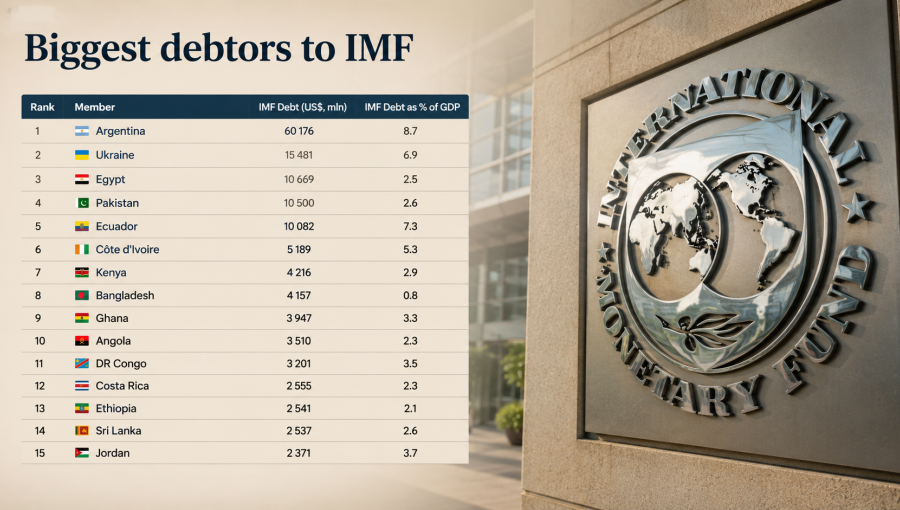
Argentina remains by far the largest debtor to the International Monetary Fund, underscoring the depth of its long-running financial crisis and its dependence on multilateral support. According to the latest data, Buenos Aires owes the IMF $60,176mn, equivalent to 8.7% of GDP — a level that dwarfs other borrowers and reflects the legacy of repeated rescue programmes over the past two decades.
Ukraine ranks second with $15,481mn, or 6.9% of GDP, highlighting the scale of external financing required to sustain the economy during wartime. Egypt, Pakistan and Ecuador follow closely behind, each with IMF exposures of around $10bn, although the relative burden varies significantly when measured against the size of their economies. Ecuador’s IMF debt, for example, stands at 7.3% of GDP, compared with 2.5% for Egypt and 2.6% for Pakistan.
A cluster of emerging and frontier economies rounds out the top 15, including Côte d’Ivoire, Kenya, Bangladesh and Ghana, with liabilities ranging from roughly $4bn to $5bn. While these figures are smaller in absolute terms, they remain significant in relation to domestic output and fiscal capacity. In sub-Saharan Africa, countries such as Angola, the Democratic Republic of Congo and Ethiopia continue to rely on IMF programmes to stabilise public finances and support balance-of-payments needs.
The data also illustrates the diversity of IMF engagement across regions. In Asia, Bangladesh and Sri Lanka have turned to the Fund in response to external shocks and currency pressures, while in Latin America, Costa Rica and Ecuador remain part of a broader pattern of recurrent IMF involvement. Jordan, with $2,371mn in outstanding obligations, reflects the continued reliance of smaller Middle Eastern economies on concessional financing and policy support.

No comments:
Post a Comment