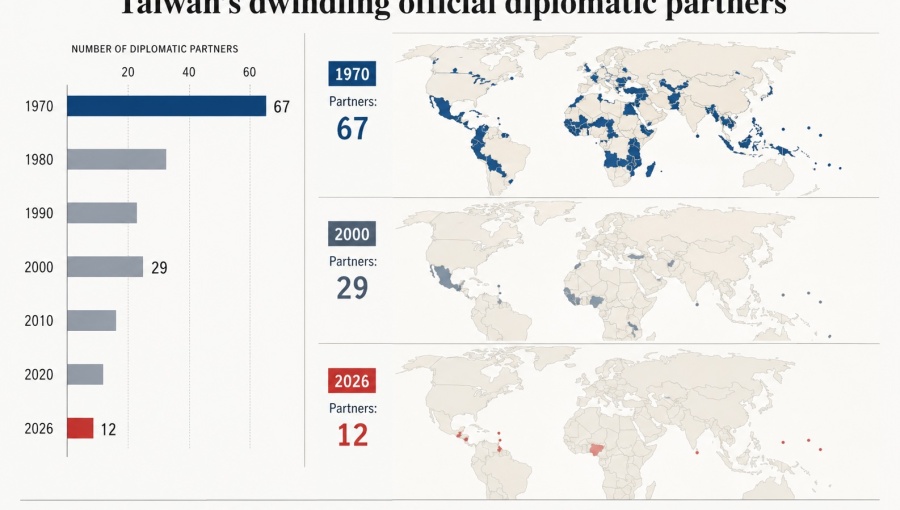
In 1969, Taiwan stood at the peak of its formal diplomatic standing, recognised by approximately 70 countries as the legitimate government of China. Today that number is 12.
Constant pressure by Beijing, which sees the island state as a region of China, has led countries to make a choice between principles and pragmatism. China has grown to become the largest trade partner for the majority of countries in the world.
The trajectory, charted by AFP that maps the collapse of Taiwan's official alliances across five decades, is one of the starkest illustrations of sustained geopolitical attrition in the post-war era.
Since 2016 alone, Taiwan has lost the recognition of ten countries to China. The question, analysts say, is no longer whether that number will fall again, but which country will be next.
The decline accelerated in the 1970s as the People's Republic of China (PRC) consolidated its international standing. The US switched formal diplomatic recognition from Taipei to Beijing in 1979 — a decisive signal that prompted a cascade of defections by other governments.
The shift was sparked by UN Resolution 2758, which expelled the Republic of China's (ROC) representatives from the United Nations in 1971 and seized the People's Republic in their place. Australia, Japan and most of Western Europe followed Washington's lead in recognising Beijing over the subsequent years, leaving Taiwan with formal ties only to countries that had not yet calculated the economic cost of maintaining them.
A similar seat swap followed the collapse of the USSR in 1991, when Russia quickly took over the empty seat, including its place on the United Nations Security Council (UNSC).
The 12 that remain
Taiwan's surviving diplomatic partners are concentrated in the Western Hemisphere and the Pacific: seven in Latin America and the Caribbean, three Pacific island nations, one in Africa — eSwatini — and the Vatican, which maintains ties with Taipei on the basis of its own long-standing dispute with the People's Republic over the status of the Chinese Catholic church.
Haiti's recognition is considered the most precarious. Once Taiwan's strongest foothold in the Caribbean, Haiti is now a failed state in all but name — its government non-functional, its cities controlled by armed gangs, its economy shattered. Haitian officials have engaged openly with Beijing in recent months, hoping that China's permanent seat on the UN Security Council might unlock a multilateral security mission. That engagement already skirts the diplomatic line.
Guatemala is among the most durable remaining allies, with 90 years of diplomatic relations — though even Guatemalan officials have recently faced internal pressure to reconsider the relationship as trade with China grows.
Beijing's toolkit
China's method is consistent: financial inducements, infrastructure investment and the implicit promise of trade access in exchange for switching recognition. Nauru, which switched to Beijing in January 2024 after reportedly requesting NT$2.6bn in aid from Taipei that was not forthcoming, illustrates the economic logic. China is reported to have offered $100mn per year as part of its approach.
If Taiwan were to lose all 12 remaining allies, the practical consequences would be gradual rather than immediate. The US maintains no formal diplomatic relations with Taiwan and yet sells it billions of dollars in arms annually. Japan has no formal relations and remains one of Taiwan's closest economic partners. Practical ties do not depend on the ally count.
But the symbolic and legal implications are significant. Each defection strengthens China's narrative that Taiwan is not a sovereign state but an unresolved question of Chinese internal affairs — an argument that Beijing deploys in every multilateral forum to limit Taiwan's participation in international organisations, from the World Health Assembly to Interpol.

No comments:
Post a Comment