Op-Ed: China's Gray Zone Fleet is Undermining Taiwan's Control at Sea
[By Nathan Attrill]
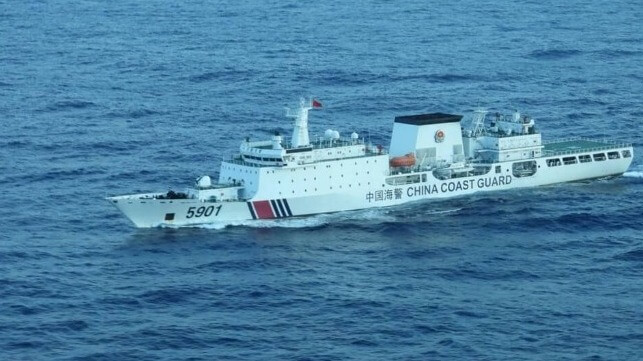
China’s pressure on Taiwan increasingly relies on vessels that aren’t warships. Instead, Beijing is deploying a maritime grey-zone fleet: a network of civilian and paramilitary vessels used to harass, intimidate and probe Taiwan while remaining below the threshold of armed conflict.
This grey-zone fleet is better understood as an ecosystem of maritime actors – including China Coast Guard (CCG) vessels, maritime militia fishing boats, sand dredgers, logistics ships and commercial cargo vessels operating through opaque ownership structures – that can be mobilised to serve state objectives while maintaining plausible deniability.
Presence of Chinese naval warships clearly signals military escalation. But civilian vessels create uncertainty. When fishermen harass Taiwanese patrol boats or commercial ships loiter near subsea cables, Beijing can claim incidents are accidents or private activity rather than state-directed coercion.
Yet the pattern of activity around Taiwan suggests something more deliberate. Throughout 2025, Beijing increasingly used the maritime domain to probe and pressure Taiwan below the threshold of open conflict, turning Taiwan’s surrounding waters into a testing ground for coastal defence, law enforcement authority and escalation management.
A series of non-naval coercive incidents highlighted how China is expanding grey-zone activity through its coast guard, civilian vessels and commercial shipping networks—not as isolated provocations but as part of a broader effort to rehearse control over Taiwan’s maritime approaches.
Chinese coastguard activity in 2025, published by Taiwan’s Ministry of National Defense was also more evenly distributed across the year than in 2024. While 2024 featured sharper spikes, the following year saw a steadier tempo of operations, suggesting a shift toward sustained pressure rather than episodic signalling.
Collectively, these developments point to a deliberate strategy. Rather than preparing solely for invasion, Beijing appears increasingly focused on blockade, quarantine and intense subversion. The aim is to normalise Chinese presence, stretch Taiwan’s response capacity and gradually erode control over its near seas without triggering a conventional military response.
Around Taiwan, these civilian and paramilitary vessels have been used in several recurring ways.
One is mass presence and swarming. Large fleets of sand dredgers and fishing vessels have repeatedly appeared near Taiwan’s outlying islands, particularly around Matsu, sometimes numbering in the hundreds and overwhelming Taiwan’s coastguard patrol capacity.
Another pattern is law-enforcement encroachment. CCG vessels have increasingly entered waters near Taiwanese-controlled islands such as Kinmen, conducting patrols, inspections and boardings. After a fatal incident involving a Chinese speedboat near Kinmen in February 2024, Beijing intensified coastguard patrols and began portraying them as routine enforcement operations. These activities help normalise Chinese presence in waters long administered by Taiwan, gradually reshaping the operational environment.
A third pattern involves pressure on critical infrastructure. In early 2023, two subsea internet cables serving the outlying Matsu islands were severed within days of each other, leaving residents with severely degraded connectivity for weeks.
More recently, suspected cable incidents in 2025 involved vessels flying flags of convenience and exhibiting suspicious Automatic Identification System (AIS) tracking data – the shipborne transponder system that broadcasts a vessel’s identity, position, course and speed for maritime safety and monitoring. In one case, Taiwanese authorities detained the cargo ship Hong Tai 58 and later prosecuted its captain for intentionally damaging a cable linking Taiwan and Penghu.
Even when intent cannot be conclusively proven, such incidents expose vulnerabilities in Taiwan’s maritime digital infrastructure and demonstrate how commercial shipping networks can be leveraged for strategic signalling without overt military involvement.
China’s grey-zone fleet serves not only as a tool of day-to-day coercion but also to prepare the maritime environment for future crises. Chinese strategy emphasises integrating the navy, coastguard and maritime militia into a coordinated ‘three sea forces’ structure. Civilian vessels form the outer layer of activity – monitoring, obstructing and creating friction – while paramilitary and military forces provide escalation options behind them. This approach could prove particularly useful in a blockade or quarantine scenario, where large numbers of civilian vessels could monitor shipping, obstruct ports or support enforcement operations all while maintaining the appearance of non-military activity.
Countering this strategy requires recognising that China’s grey-zone fleet is not merely a fisheries management issue but a deliberate instrument of statecraft. Improving maritime transparency should be a priority. Integrating satellite imagery, AIS tracking and radar monitoring can help identify suspicious vessel behaviour and patterns of coordinated activity. Taiwan’s security partners should also focus on protecting critical infrastructure, particularly subsea cables, by strengthening monitoring along cable routes and improving rapid repair capacity.
Finally, Taiwan’s partners can help strengthen the island’s coastguard capacity. Enhanced surveillance tools, operational cooperation and legal frameworks for maritime enforcement would help Taiwan respond to large numbers of civilian vessels without escalating incidents into military confrontation.
China’s grey-zone fleet works because it exploits ambiguity, blurring the line between civilian activity and state coercion. The challenge for Taiwan and its partners is to remove that ambiguity before grey-zone pressure becomes a permanent feature of the Taiwan Strait.
Notable non-naval coercive incidents in the waters around Taiwan and near Taiwan-controlled outlying islands in 2025
Nathan Attrill is a senior analyst with ASPI’s Cyber, Technology and Security program. This State of the Strait update appears courtesy of ASPI and may be found in its original form here.
The opinions expressed herein are the author's and not necessarily those of The Maritime Executive.

No comments:
Post a Comment