Sunday, May 10, 2026


Iran Hits Bulker off Qatar and Targets Kuwait and UAE as it Responds to US
LNG carrier
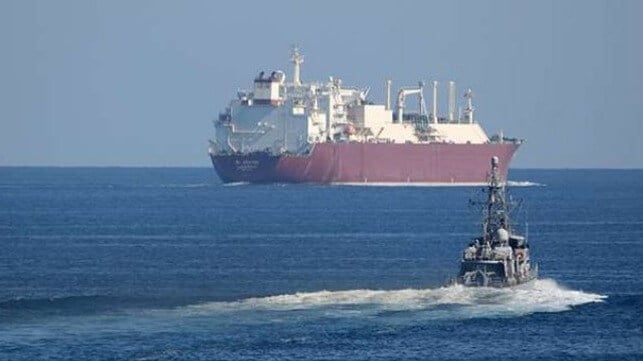
Iran permitted an LNG carrier to transit while hitting a buyer and targeting Kuwait and the UAE (USN file photo)

Published May 10, 2026 11:36 AM by The Maritime Executive


In actions, which can probably best be interpreted as an attempt to maintain pressure on the United States in the context of ongoing negotiations, on Sunday, Iran launched limited attacks against three Gulf countries.

The Kuwaiti Army intercepted two inbound drones early on Sunday, May 10. It did not indicate from which direction the drones had come from, but in a previous attack on April 25, two drones launched at northern border posts had been launched from Iraq, presumably by militias owing allegiance to Iran and at Iran’s initiative.

Also, early on Sunday, a drone struck a cargo vessel in Qatari waters northeast of Doha, causing a fire on board. The vessel was en route from Abu Dhabi to the port of Mesaieed, and the crew managed to put out the fire and to complete the passage. UKMTO reported the incident, as did the Qatari Ministry of Defense, but did not name the vessel that had been hit. The only bulk carrier recorded as having arrived in Mesaieed on May 10 is the Liberian-flagged bulk carrier the MV Laya (IMO 9272864). 

Earlier in the day, a loaded Marshall Islands-flagged LNG carrier, Al Kharaitiyat (IMO 9397327), was reported to have successfully transited the Strait of Hormuz using the Tehran-approved northern route and is expected in Port Qasim, Pakistan, on May 11. The Al Kharaitiyat (113,845 dwt) is managed by Nakilat Shipping Qatar for QatarEnergy. The transit was clearly made with permission from the Iranian authorities, probably as a concession to Pakistan for its part in hosting Iranian-US negotiations. Pakistan is desperately short of LNG imports.

The UAE’s Ministry of Defense reported that the UAE too had been attacked by two drones fired from Iran, which were intercepted and destroyed before they were able to cause any injuries or damage.

Iran’s IRNA news agency reported on Sunday that it had sent its response to the latest U.S. proposal to Pakistan.

These attacks, and the contradiction whereby a Qatari-bound vessel is attacked while a Qatari-owned LNG tanker is allowed transit, are clearly part of an IRGC-led strategy to apply pressure on the Gulf states, so that they in turn will pressure U.S. negotiators to grant Iran concessions in the current round of negotiations. While this may have been the IRGC’s intention, the tactic is equally likely to backfire and provoke GCC states to adopt a more aggressive attitude towards Iran.


Iranian Shadow Fleet Tanker Ablaze off Jask
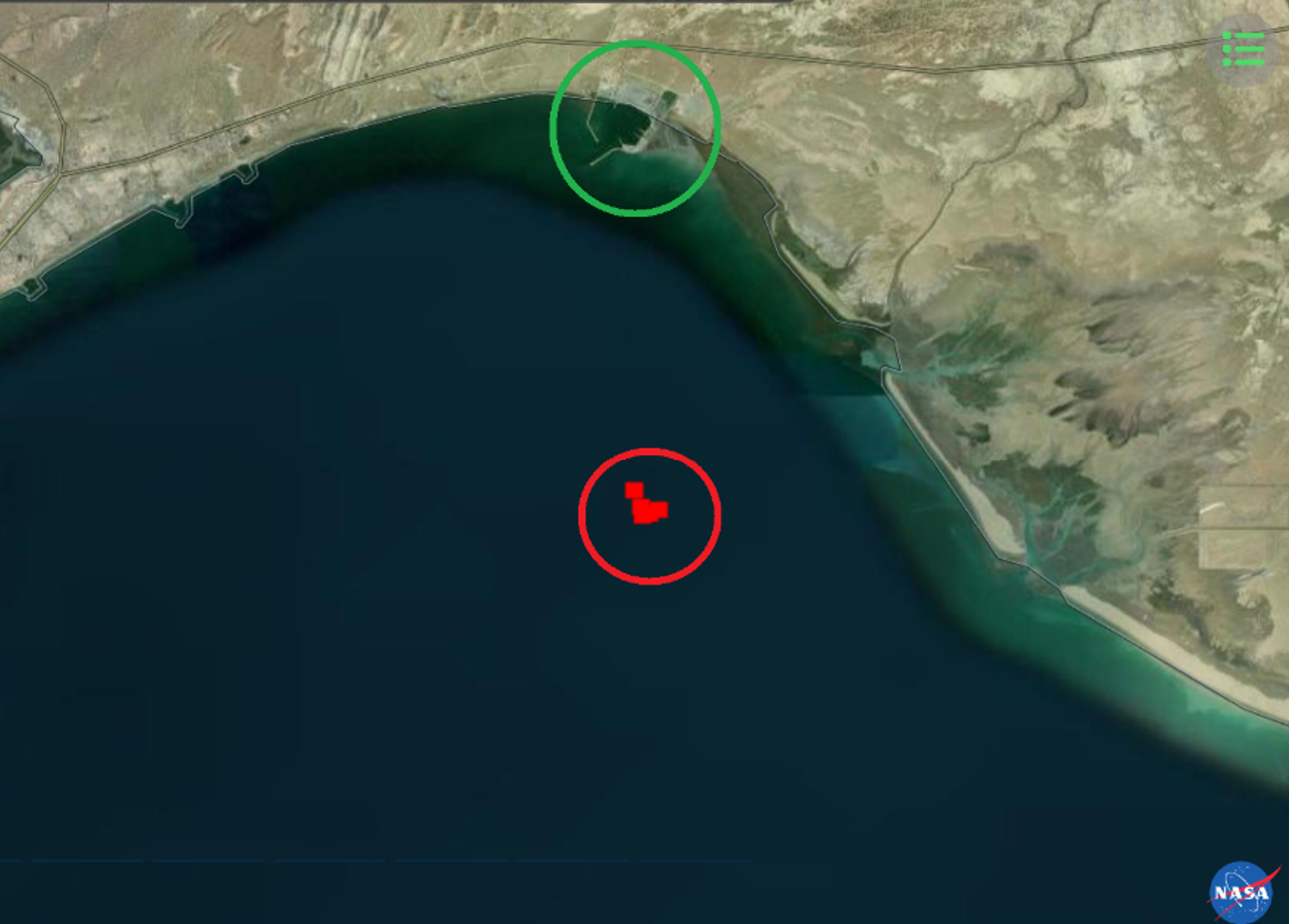
The heat spot being given off by the VLCC Sevda 11.5nm south-east of the Jask headland (circled in red), with the Jask naval base to the north circled in green (NASA FIRMS/CJRC)

Published May 9, 2026 6:12 PM by The Maritime Executive


In imagery taken by the Sentinel-2 satellite on May 9, the sanctioned Iranian-flagged dark fleet tanker Sevda (IMO 9172040) appears to be damaged and on fire, but still afloat, 11.5 nm south-east of the Bandar-e Jask headland. This position is 4.5nm due south of the regular Iranian Navy (Nedsa) base at Jask, which was opened in January 2025 and is home to the headquarters of the Nedsa’s 2nd Naval Region.

From imagery taken on May 9, smoke is coming from the rear of the ship, and accepting the limitations of the low resolution imagery available, the ship does not appear to be sinking. But the heat of the fire is sufficiently intense to show up as a heat spot in NASA FIRMS infrared imaging also captured today.
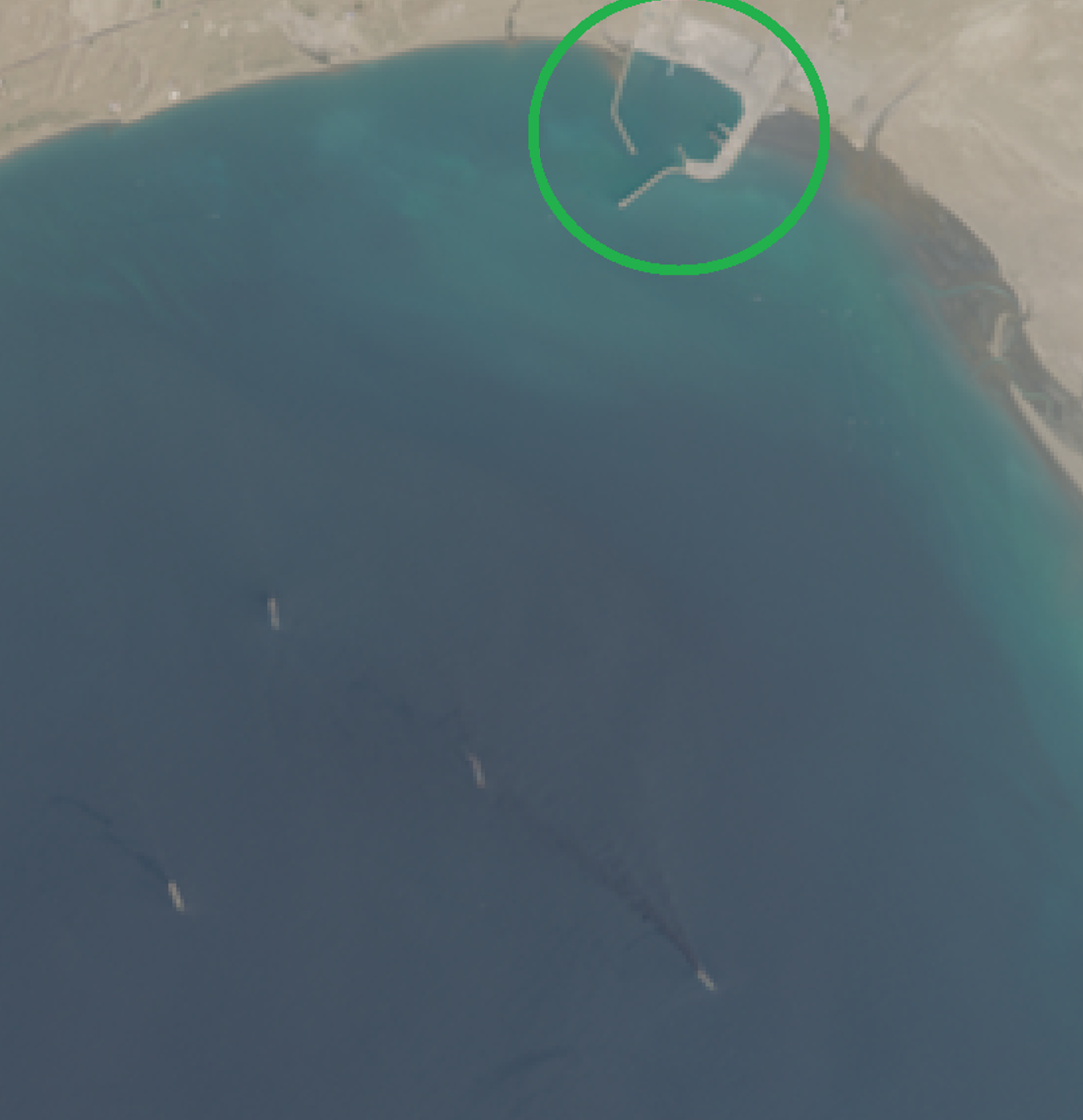
The four tankers affected, with the Jask naval base to the north circled in green (Sentinel-2/CJRC)

To the north-west of the burning Sevda, some 1.6nm distant, is a second, larger vessel, 312 meters long and probably a VLCC tanker, which also appears to be in trouble. From the low-resolution imagery available, the tanker is giving off a small amount of smoke, or is suffering from a leak at the stern. In the same area of the Jask bight, there are two other vessels (likely VLCCs) standing off, with one of the two giving off a small smoke plume and a more pronounced oil leak and the other not apparently in distress. There are no visible rescue craft assisting any of the tankers.

For the last few years, the Sevda appears to have been plying its trade with its AIS system switched off. But when it has been visible, it has been making trips to Zhoushan in China, close by to Shanghai. The 1999-built Sevda was sanctioned by the US Treasury’s Office of Foreign Assets Control in 2012.

These reports accord with news released by CENTCOM that on May 6 and May 8, US Navy F/A-18 Super Hornets attacked the Sevda and two other Iranian-flagged and OFAC sanctioned VLCCs, the tankers Hasna (IMO 9212917) and Sea Star III (IMO 9569205) with 20mm cannon fire and precision-guided munitions, with the intention of disabling propulsion and steering systems without sinking the vessels.

Meanwhile, on the other side of the Bandar-e Jask peninsula, the Single Buoy Mooring (SBM) off the Kooh Mobarak crude oil export terminal was imaged successively on three days between May 6-8. On each occasion the SBM was empty of a tanker but was apparently leaking crude oil – suggesting the SBM has a technical fault.


Iran War Threatens Gulf Investment Boom in Central Asia

  • The 2026 Iran war and Strait of Hormuz disruption are forcing Gulf states to reconsider overseas spending.

  • Gulf sovereign wealth funds had committed more than $16 billion to Central Asia before the conflict, backing major energy, infrastructure, logistics, and banking projects in Kazakhstan, Uzbekistan, and Tajikistan.

  • As Gulf capital becomes more constrained, China could emerge as the biggest beneficiary, expanding its already dominant economic influence across Central Asia while regional governments seek alternative investors and trade routes.

The 2026 U.S.-Israel war on Iran, the Ramadan War, which began with airstrikes on 28 February 2026 and involved Iranian retaliation via missiles, drones, and a blockade of the Strait of Hormuz, has indirectly but significantly constrained investment plans by Persian Gulf petrostates, primarily Saudi Arabia, the United Arab Emirates, and Qatar, along with other Gulf Cooperation Council (GCC) members, in Central Asia.

These petrostates were not direct belligerents but suffered economic fallout from Iranian strikes on their energy infrastructure, ports, aviation, tourism, and logistics, plus the near halt of roughly 20% of global oil and liquified natural gas (LNG) flows through Hormuz.

Goldman Sachs projects GDP hits of up to 14% for Qatar and Kuwait, 5% for the UAE, and 3% for Saudi Arabia if disruptions persist. The United Nations Development Programme estimates the war “may cost economies in the region from 3.7 to 6.0 percent of their collective Gross Domestic Product (GDP)” or US$120-194 billion and exceeds the cumulative regional GDP growth achieved in 2025.” 

War damages have forced a broader fiscal rethink, with at least three GCC governments reviewing trillions in sovereign wealth fund (SWF) deployments, potential pledge reversals, divestments, and sponsorship deals to offset losses and prioritize domestic recovery, defense, and infrastructure hardening. Saudi Arabia has ended its partnership with the Metropolitan Opera in New York City and the LIV Golf, but the real consequences will come from reduced investments in transport, energy, and water projects in Asia and Africa, not image-building projects targeted at well-off consumers in high-income countries

Pre-War Context

Before the conflict, Gulf petrostates had been expanding investments in Central Asia, primarily Kazakhstan, Uzbekistan, and Turkmenistan, as part of economic diversification away from oil, resource-seeking (e.g., uranium, rare earths, gas), and geopolitical hedging, totaling US$16.2 billion by late 2025. Examples included UAE logistics and energy deals, Saudi mining and infrastructure, and broader GCC engagement in post-Soviet markets. These were modest relative to Gulf investments in the U.S., Europe, or Africa but aligned with Vision 2030-style strategies and alternatives to Russian and Chinese influence, which also suited Washington’s interests.

Direct Impacts on Investment Plans

No cancellations of specific Central Asia projects have been officially announced so far, but the war’s economic shock has created clear headwinds through several channels:

Capital constraints and SWF recalibration. GCC SWFs (managing ~$5 trillion) may shift towards domestic needs, e.g., repairing damaged facilities, bolstering defense, and supporting local economies, at the expense of overseas foreign direct investment (FDI). This may signal the end of the era of “big spenders,” with reviews explicitly targeting global pledges, including those 2025 commitments to U.S. president Donald Trump worth US$2 trillion. Central Asia investments, being non-core compared to U.S./Europe or immediate neighbors, are likely to be deprioritized or delayed.

Higher risk premiums and investor caution. The Gulf’s image as a stable “safe haven” has been damaged, raising costs of capital and making ambitious foreign expansions less attractive. This affects not just inbound FDI to the Gulf but also the Gulf states’ outbound investment plans.

Ripple effects on Central Asia. The Hormuz blockade and Iranian route disruptions raised trade and logistics costs for landlocked Central Asian states (which rely on Iranian territory for Gulf access), driving inflation, shortages, and slower growth. This makes the region less attractive for large-scale Gulf investment in the short term, though it has accelerated interest in alternative, such as the Middle Corridor, though the latter has limited utility for trade with South and West Asia.

Specific deals from 2023 to 2025 highlight the momentum that may be endangered:

UAE: First Abu Dhabi Bank financed Uzbekistan’s 500 MW Zarafshan Wind Power Project (Central Asia’s largest renewable project at the time) and supported bond placements. UAE sovereign funds and entities were major players in renewables and re-exports.

Saudi Arabia: ACWA Power and other entities pursued clean energy and infrastructure deals with Kazakhstan and Tajikistan, and US$30 million in concessional loans for Tajikistan’s Kulob Ring Road). The Saudi Arabia-based Islamic Development Bank has financed energy, transport, and agriculture projects in Central Asia.

Qatar: Lesha Bank acquired Kazakhstan’s Bereke Bank (a full bank takeover, the first by a Gulf investor) for US$134 million in 2024. The Qatar Fund for Development committed US$50 million to Tajikistan’s Rogun Hydropower Project and announced plans to participate in gas processing and hydropower ventures in Kazakhstan and Turkmenistan.

Uzbekistan and Kazakhstan (largest economy) have seen the biggest inflows of Gulf investment.

The investments went hand-in-hand with high-level diplomacy. The first GCC–Central Asia Summit was held in Jeddah, Saudi Arabia in July 2023, and a second was planned for Samarkand, Uzbekistan in May 2025 but has been indefinitely delayed. Ongoing ministerial meetings have focused on transport, communications, energy, trade, economic, and cultural exchanges.

In April 2026, Kazakhstan’s foreign minister met his UAE counterpart in Abu Dhabi and delivered a message from Kazakh president, Kassym-Jomart Tokayev, to the UAE’s president, Sheikh Mohamed bin Zayed Al Nahyan. In March 2026, Uzbekistan’s foreign minister and first deputy foreign minister met separately with the ambassadors of Qatar, Saudi Arabia, the UAE, Kuwait, and Oman.

Potential Shifts or Opportunities

There are some countervailing dynamics, but they appear limited by fiscal strain:

Alternative connectivity focus: The Hormuz crisis has validated (and accelerated) Gulf investments in bypass infrastructure (e.g., pipelines, GCC rail projects) and partnerships like China-Pakistan Economic Corridor/Gwadar Port to create land corridors linking the Gulf to Central Asia via Pakistan or the Caspian. This could open niche opportunities for Gulf capital in Middle Corridor logistics or energy links, positioning the petrostates in multipolar trade routes.

Supply diversification: Central Asian states are seeking alternative suppliers (including from the Gulf) for goods previously routed via Iran, which could sustain or modestly expand targeted trade/investment ties—though Gulf exporters are themselves strained.

Energy diversification tailwinds: The Hormuz crisis has highlighted Gulf vulnerabilities, accelerating interest in overland/non-Gulf routes. China is pressing Turkmenistan and Uzbekistan to increase natural gas production, and the crisis may see the revival of discussions on Central Asia-to-China Line D capacity expansion.

Central Asia’s neutrality and lower direct exposure make it a safer diversification play for any residual GCC capital once the ceasefire stabilizes. Kazakhstan, Uzbekistan, and Turkmenistan have welcomed the truce and emphasized peaceful resolution.

Overall, the net effect has been a slowdown or scaling-back of planned Gulf investments in Central Asia. Pre-war momentum has been dented by the need to conserve capital at home amid the worst economic shock to GCC states since the early 1990s (or even the COVID pandemic). Long-term diversification goals remain, but near-term execution is more cautious, with resources funneled toward resilience and core priorities. The situation remains fluid amid the tense ceasefire between Iran and the U.S./Israel, so further shifts could occur if Hormuz disruptions ease or escalate.

Cui bono?

If Gulf capital dries up, other potential investors are Europe, the U.S., Russia, Japan, Turkey, India, or South Korea. The big winner may be China, as the American administration is likely expecting to be the recipient, not the source of, Central Asia investment. (In November 2025, Trump announced over US$ 100 billion in investment and contracts from Uzbekistan and Kazakhstan.)

China has invested about US$89.3 billion in Central Asia and Beijing may see an opportunity to expand its influence in the region, and to drive better terms if it doesn’t have to compete with Gulf investors, though local leaders will have to consider increased public skepticism of Chinese investment.

By James Durso for Oilprice.com


U.S. Navy Remains Poised in the Arabian Sea
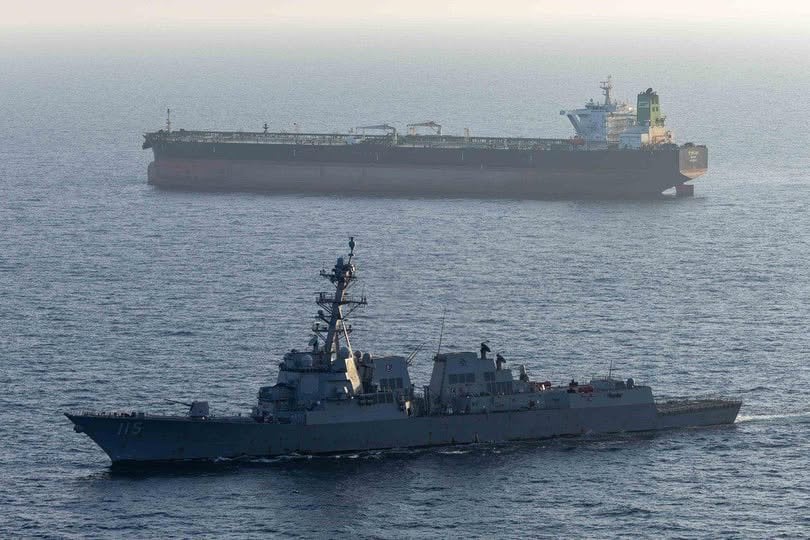
US destroyer redirecting Iranian oil tanker
USS Rafael Peralta (DDG 115) enforces the U.S. blockade of Iranian ports against M/T Stream (CENTCOM)

Published May 9, 2026 3:02 PM by The Maritime Executive


An unexpected release of up-to-date Sentinel-2 satellite imagery covering the Arabian Sea and CENTCOM area on May 6 and 7 has enabled analysts to gain a better understanding of how the U.S. Navy is operating its blockade of the Strait of Hormuz and positioning itself against the threat posed by Iran’s IRGC Navy. Since February 28, access to commercial satellite imagery has often been time-lagged or restricted in coverage, but the recent release has enabled open-source analysts, led by the doyenne of the community MT Anderson, to draw some useful deductions.

In recent days, the U.S. Navy has sent Arleigh Burke destroyers, and probably other craft as well, through the Strait of Hormuz and then back out again, indicating that the 6th Fleet has confidence to counter the IRGC Navy’s threat, at least for short periods of time and when it wants to. This suggests that the U.S. Navy's defensive shield against drones and cruise missiles, as well as underwater threats, remains intact. But it also implies that the U.S. Navy has a good understanding of where mines might be, or has the means to clear a mine-free path when it chooses to do so. On balance, given that a number of ships have also made solo runs through the southern half of the Strait in recent days, it appears that very few, if any, mines have been laid. The Royal Navy of Oman also does not appear to hesitate before moving through these waters to come to the aid of ships in distress.

U.S. Navy ships do not linger in the Strait, and a number of merchant vessels have been hit by the IRGC Navy in recent days, which implies that the IRGC Navy still has a credible anti-ship capability, based mostly on drones and anti-ship missiles fired from mobile launchers, but also from armed fast attack craft indistinguishable from the trader speedboats, which are very common in these waters.

Cognizant of this threat, but also seeking to maintain a blockade targeted specifically against Iranian ships and ports, the U.S. Navy is maintaining a blockade plan that is familiar to students of the Napoleonic wars. For most of the period 1793 to 1815, the Royal Navy maintained a blockade of French ports to strangle French trade and restrict the activities of the French fleet. The blockade was maintained by an inshore squadron of fast and light ships off each port, with a heavier fleet presence held further back, ready to react to any attempted breakouts reported by the inshore squadrons.

Surveillance technologies have made the art of blockading a somewhat simpler business nowadays, but a similar pattern can be seen in the Arabian Sea on May 6. The main blockade line, including at least one of the two Nimitz Class aircraft carriers under CENTCOM and the San Antonio Class flat top USS New Orleans (LPD-18), also with F-35s aboard, is holding east of a line between Ras Al Hadd in Oman and the Iran/Pakistan border at Chah Bahar. The blockade line is thickened up with probably more than just the two Arleigh Burke destroyers, which can be identified. Others are probably hidden behind cloud cover. Inshore, at either end and forward of the blockade line, are two distinctively-shaped Independence Class Littoral Combat Ships, which are optimized for just this role. This laydown allows the blockade to be maintained without overmuch vulnerability to short-range IRGC drone and cruise missile attacks, giving time and space to disrupt any such attacks, but also enables short-duration forays forward into the Strait and, where necessary, to seize blockade runners.
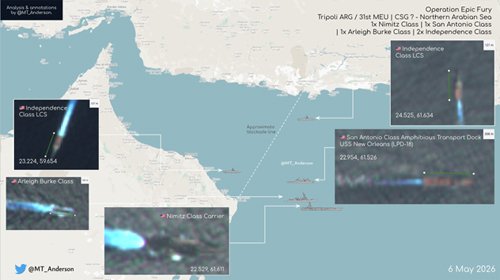
 

MT Anderson’s analysis of US Navy ship deployments in the Arabian Sea, May 6 (@MT_Anderson)


A separate tranche of imagery on May 7 also shows a busy lagoon at the Diego Garcia Naval Support Facility, with an Arleigh Burke destroyer present, and also the distinctive 193-meter MV Ocean Trader (IMO 9457218), which serves as a support base for the mounting of special force operations. The presence of MV Ocean Trader, carrying a key strategic capability, is normally an indicator and warning of a particular strategic focus and often of impending operations. An unidentified 130m long vessel is tied up at the jetty, possibly an Independence Class Littoral Combat Ship, or the cargo vessel Ship SLNC Star (IMO 9415325), which makes regular resupply runs from Singapore to Diego Garcia. Also present in the lagoon, as is normal, is one 291-meter long vessel, and hence either a Bob Hope or Watson Class replenishment ship of the Maritime Pre-positioning Ship Squadron 2 (MPSRON-2). On the South Ramp is a slightly smaller contingent of aircraft than is now normal: two US Navy P-8 surveillance aircraft, four KC-135 refuellers, and two large transport aircraft, but possibly with fighter aircraft in the four hangars.
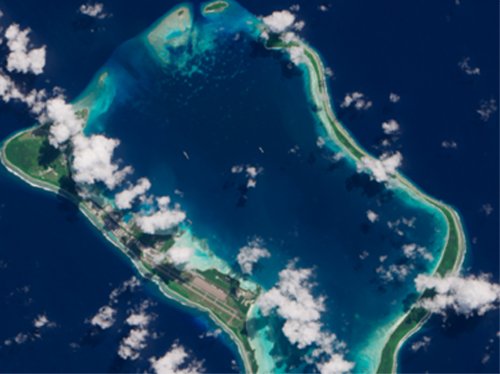
 

The Diego Garcia lagoon on May 7, with three ships at anchor and approximately eight aircraft on the South Ramp (Sentinel-2/CJRC)

There is no sign in the lagoon of any impounded dark fleet tanker. The WANA news agency, which is associated with a particular hardline faction of the IRGC intent on sabotaging any peace deal, claimed with no credibility on May 5 that two seized tankers were en route to Diego Garcia, whilst also admitting that the AIS systems of both these two ships were switched off. Without AIS information, it is difficult to understand how the WANA news agency would know where these two tankers were. In any case, they appear presently not to be in Diego Garcia, and are unlikely to arrive there while Lord Hermer remains the UK’s Attorney General, given his particular internationalist credentials. 


Iran Diverts and Seizes a Tanker Linked to its Own Oil Industry
Iranian forces approach the tanker IMO 9255933, currently trading as Jin Li (IRNA)

Published May 8, 2026 8:15 PM by The Maritime Executive


The government of Iran claims to have seized a sanctioned tanker with longstanding ties to its own oil industry. 

For reasons unknown, Iranian forces claim to have captured and detained the tanker with IMO number 9255933 (currently trading as the Jin Li, previously the Ocean Koi, Cimarron, Daisy 2 and Tania). IMO 9255933 has been involved in moving Iranian HFO and condensate exports for years, according to the U.S. Treasury, and has been part of Iran's shadow fleet since 2020. The vessel was sanctioned in February 2026, along with Shanghai-based owner Ocean Kudos Shipping Co Ltd. Her flag registration with the Barbados registry ceased last year, and she is currently operating as a stateless vessel, as is increasingly common in the shadow fleet.

Treasury's allegations have been independently confirmed. Consultancy TankerTrackers.com told the New York Times that over the last five years, the IMO 9255933 has made at least 16 voyages laden with Iranian petroleum - half of which began with a ship-to-ship transfer, a standard procedure for Iran's covert oil shipping network. 

Windward assesses that the vessel's seizure is likely "performative," since the ship is linked to Iran's own energy exports. The Iranian Navy's announcement of the seizure provided few specifics about the reasons for capturing and detaining a previously-friendly vessel. 

"Implementing the decision of the Supreme National Security Council and with a judicial ruling, the Army Navy seized the oil tanker Ocean Koi, which was carrying Iranian oil and tried to take advantage of the situation in the region to harm and disrupt the oil exports and the interests of the Iranian nation," Iran's military said in a statement to state-run IRNA News. 


Mystery Deepens Over Explosion and Fire on HMM Vessel as Iran Denies Attack
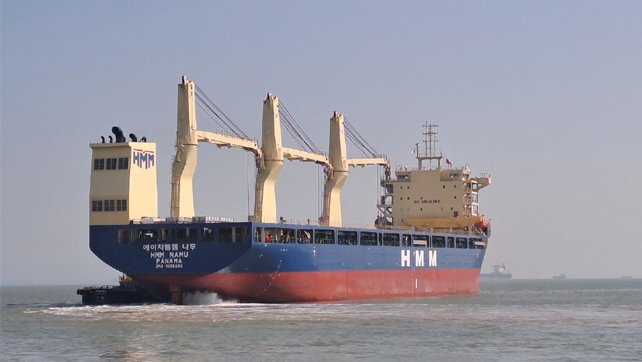
HMM cargo ship
Questions emerged over the cause of the explosion and fire on HMM's cargo ship (HMM)

Published May 7, 2026 1:24 PM by The Maritime Executive


There is a growing mystery over the cause of the explosion and fire on HMM’s new general cargo ship, HMM Namu, which was reported on Monday. As the vessel was anchored off the UAE port of Umm Al Quwain, reports immediately associated it with new attacks from Iran, but now uncertainties are arising, including suspicions that the fire was the result of a mine explosion.

The ship, which was delivered to HMM at the beginning of the year, is a general cargo vessel. It is 38,314 dwt and is registered in Panama. It has been inside the Persian Gulf since the start of the war. Earlier reports put the vessel at Saudi Arabia’s Dammam Port.

The ship was rocked by a powerful blast in its engine room, followed by a fire late on Monday. The fire burned for hours, but HMM reported by Tuesday that it was extinguished and the 24 crewmembers aboard were safe. 

Donald Trump wrote on social media that Iran had “taken some shots” at a South Korean vessel. He called on South Korea to get involved in the efforts to reopen the Strait of Hormuz. 

UKMTO, however, reported the cause of the fire was “unknown,” while Iran’s Press TV supported the claims that Iran had attacked the ship. It cited the navigation restrictions on the Strait of Hormuz. Iran’s embassy in South Korea, however, released a statement saying Iran “firmly rejects and categorically denies any allegations” regarding its involvement in the incident.

The head of the South Korean maritime union, Jeon Jeong-geun, speaking with reporters on Thursday, offered a new theory. He asserts there is no visible hull damage. His theory is that the ship was hit by a shock wave, possibly from a mine or other explosion, and that affected the engine room’s fuel system and caused the fire. He rejects the suggestion that it was an onboard equipment malfunction.

The report notes that there were warnings of possibly drifting mines, and Iran has said it is not sure of the location of all the mines placed by the IRGC. The UAE had also reported that it came under attack around the same time as the explosion on the ship.

Neighboring ships to the HMM Namu in the anchorage reported a loud blast. As a precaution, those ships repositioned away from the HMM vessel, fearing an external attack.

For its part, the South Korean government is reserving judgment. South Korea’s National Security Adviser is noting that there was no flooding or loss of stability. South Korea dispatched a team of seven to investigate, and they arrived in Dubai this morning, May 7. Included in the team are representatives from the Maritime Safety Tribunal and the Korean Register. 

HMM reports a tug was dispatched to the HMM Namu, which is disabled, and it was reaching the vessel on Thursday morning. They said it would take several hours to attach a tow line to the ship and test the equipment. It will be towed approximately 40 miles to Dubai, where it is expected to arrive on Friday morning, and the ship will be put in a dry dock for an inspection.

An official with South Korea’s Foreign Ministry in Seoul said they first needed to “determine the facts,” and then they would be able to identify the cause. The official said decisions on future responses should come after the investigation.

How Strait Of Hormuz Crisis Is Reshaping The Global Economy – Analysis


By Zaid M. Belbagi


For decades, the global economy has operated on the assumption that oil will always flow, tankers will move across the seas, prices will fluctuate within predictable limits and the arteries of international trade will continue to support the functioning of the world. The 2026 conflict in Iran has fundamentally challenged this assumption.

The situation now constitutes the most severe stress test the entire global energy supply system has ever known. At the center of this challenge is the Strait of Hormuz, the waterway that is only 39 km wide at its narrowest point yet through which approximately 20 million barrels of oil and liquefied natural gas usually pass every day. This passage accounts for between 20 percent and 25 percent of all global energy trade. The current crisis is more than geopolitical, as it carries profound economic consequences with implications that extend across the entire world.

The geography of the Strait of Hormuz is the first point of vulnerability. Iran understands that it does not need to match the US in terms of conventional military power to pose a serious threat. Instead, it relies on other tactics, such as placing sea mines in narrow shipping lanes — a strategy designed to block or slow access and make passage dangerous and costly. Large commercial tankers, which are slow and difficult to defend, are particularly exposed to these threats.

The gap between the military capabilities in the region and the vulnerability of the ships carrying the world’s energy is striking and Iran has long understood how to exploit it. In this conflict, control over the strait is the most effective instrument of influence.

Once the strait was effectively closed, the market reacted immediately and the response was severe. Brent crude surged past $120 a barrel within weeks, reaching levels not seen since Russia’s invasion of Ukraine in 2022. There is, however, an important distinction. Unlike previous disruptions caused by a supplier exiting the market, the 2026 crisis involves a strategic chokepoint effectively going dark. This is structurally different and, in many ways, far more difficult to compensate for.

OPEC’s position shifted almost overnight. The organization that spent much of 2025 managing a surplus and curbing output to prevent a price collapse now faces a shortfall it cannot fully fill. Alternative pipelines, such as the East-West Pipeline in Saudi Arabia and the Abu Dhabi Crude Oil Pipeline, have absorbed what they can and production increases from major non-Gulf producers have begun. Still, these measures offset only about half of the lost supply. Nearly 130 million barrels of crude are now stuck in floating storage in the Gulf, loaded onto tankers that cannot deliver, while Washington and Tehran remain far from reaching any agreement.

Energy shocks of this magnitude do not remain confined to oil markets. They ripple outward through fertilizer, freight and food. About a third of global fertilizer trade passes through the Strait of Hormuz and disruptions to those shipments are already pushing up agricultural input costs. The effects on the next growing cycle are only now beginning to emerge. Analysts project a 16 percent rise in global commodity prices. For economies with deep fiscal buffers and diverse import sources, this may appear manageable. For those without such advantages, the consequences are devastating.

Asia has borne the brunt of the crisis. The region receives around 85 percent of all crude shipments from the Gulf and oil imports fell by 30 percent year-on-year in April alone, reaching their lowest level since October 2015. Responses have been improvised and costly.

Japan, which relies on the Middle East for 95 percent of its oil, has turned to American crude, purchasing it at spot market prices inflated by a war premium and shouldering the added shipping costs for a journey that takes twice as long. Indonesia, Southeast Asia’s largest economy, is seeking alternative suppliers in Africa and Latin America and has committed to purchasing 150 million barrels from Russia by the end of the year.

Vietnam, which depends on the Middle East for at least 85 percent of its crude imports, is among the continent’s most-exposed economies. The irony is acute, as the country’s export-oriented manufacturing sector relies on affordable energy to remain competitive. Thailand, which usually imports up to 70 percent of its crude from the Middle East, has introduced government-mandated energy-saving measures, including encouraging remote work to reduce fuel consumption. These responses are real indications of a structural realignment in global energy flows.

The impact on the Global South goes far beyond energy bills. In South Asia and East Africa, higher import costs and currency depreciation are creating serious fiscal stress. Governments are spending billions on duty waivers and fuel subsidies to shield households from the full impact of the crisis — measures that provide short-term relief but add to long-term debt.

In economies where most household income is spent on food, the link between energy prices and food security is immediate. Fertilizer costs rise, food prices follow and purchasing power falls, leaving little margin for error. In 2026, this dilemma between food and fuel is being imposed on governments that neither caused the conflict nor have any ability to resolve it.

The Middle East and North Africa region is at the heart of this global energy transformation. Gulf states are the world’s leading energy exporters, yet they are also directly exposed to the ripple effects of the crisis, with the UAE alone accounting for 18 percent of vessel traffic through the strait. Their wealth provides resilience that neighbors cannot match, but it does not guarantee immunity.

For the broader region, the situation is a defining moment. Some countries, such as Turkiye, could seize this opportunity to establish themselves as hubs for international trade. Buyers are diversifying because the route to market has become uncertain. If that uncertainty persists, it will leave a lasting mark on Gulf export relationships.

The Strait of Hormuz crisis has reminded the world, and the region itself, that geography may not dictate destiny but, in moments like this, it comes perilously close.

  • Zaid M. Belbagi is a political commentator and an adviser to private clients between London and the Gulf Cooperation Council.
The weaponization of shipping channels

DW
May 9, 2026


The crisis around the Strait of Hormuz focused attention on other maritime chokepoints. Experts warn that waterways like the Taiwan Strait or the Strait of Malacca are increasingly being used as geopolitical leverage.


The world economy is dependant on a handful of maritime chokepoints
Image: Cheng Yiheng/Xinhua/picture alliance


Could imposing a toll to pass through the Strait of Malacca, the narrow stretch of water that connects the Indian Ocean with the Pacific, be a profitable business? Indonesia's Finance Minister Purbaya Yudhi Sadewa seemed to float the idea at the end of April. "If we split it three ways between Indonesia, Malaysia, and Singapore, that could be quite something, right?" he said.

He later clarified that he was not being entirely serious, after Indonesian Foreign Minister Sugiono said that his country supported the freedom of navigation and would not be imposing tolls on vessels passing through the strait, which runs between Indonesia, Malaysia, and Singapore.

Nonetheless, the remark raised the specter of maritime traffic being misused for geopolitical leverage, not just in the Strait of Hormuz, but in other waterways, too. "The closure of the Strait of Hormuz has forced policymakers in Asia to face questions over the security of other maritime chokepoints," wrote the Reuters news agency.

The Strait of Malacca is of particular concern. This is the most important shipping route between East Asia, the Middle East, and Europe, accounting for around 22% of international maritime trade.


Dangers of geopolitical leverage


But there are other issues of concern besides piracy and regional conflict. In November last year, the Center for Strategic and International Studies (CSIS) warned of this new danger.

Even non-state actors are now in a position to serious disrupt the flow of global trade, the think tank said, citing attacks by the Houthi militia in the Red Sea. Many shipping companies now avoid passing through the Suez Canal, taking the longer route around the Cape of Good Hope instead, which significantly impacts supply chains and prices.

Political scientist Nikolaus Scholik, former colonel in the Austrian army and senior advisor at the Austria Institute for European and Security Policy (AIES), believes that these are signs of a fundamental change in the geopolitical balance of power.

"We are experiencing today the consequences of a development in which individual states believe they can legally dominate strategically important maritime straits," he told DW. It would be particularly dangerous, he added, if straits like Hormuz, Malacca, or Taiwan were to become levers of geopolitical influence.

Christian Wirth, Asia analyst at the German Institute for International and Security Affairs (SWP), agrees. "Whether a strait is particularly vulnerable depends essentially on three factors: The transport agreement, potential alternative routes, and the political situation in the surrounding area," he told DW. The more important a route is, and the harder it is to bypass, the greater its strategic significance.

'Return of geography'


The Strait of Hormuz, through which a large quantity of global oil and gas exports must pass, is looking particularly vulnerable right now. But Scholik warns that we shouldn't only be looking at the Persian Gulf. "In such a situation, the Taiwan Strait would be even more significant than the Strait of Hormuz," he says, referring to a possible conflict between China and Taiwan. As he points out, a large proportion of Asian trade passes through the Taiwan Strait, as well as through the Strait of Malacca.

The International Institute for Strategic Studies (IISS) recently wrote that geopolitics is currently experiencing the "return of geography." Straits like Hormuz, Bab el-Mandeb or Taiwan are no longer mere geographical passages; they are increasingly becoming strategic levers of geopolitical power. The IISS argues that the close interconnectedness of the world has created new dependencies, and thus also new means of exerting pressure.

In international law, the situation is very clear. "The principle of free transit applies to maritime straits of international importance," said Wirth. "This means that ships, even warships, are allowed to pass unhindered ... through straits that are classified as international waters."

A blockade of an international strait would thus be a serious violation of international law, Wirth said. The United Nations Convention on the Law of the Sea guarantees even warships peaceful passage through coastal waters that are defined as territories of the states bordering the strait. Tolls or charges are categorically inadmissible. They may only be levied on artificial waterways such as the Suez or Panama Canal.


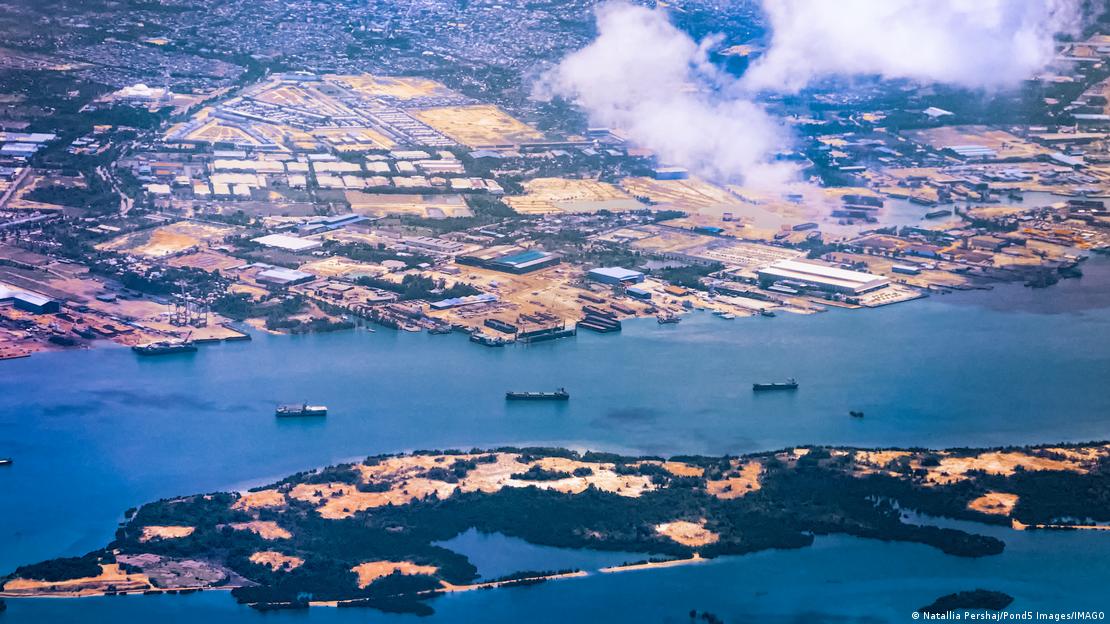
The Strait of Malacca, pictured here in 2020, is vital for Asian trade
Image: Natallia Pershaj/Pond5 Images/IMAGO


The fragility of maritime law

But the real problem is the political realities, said Scholik: "International law only functions if the countries involved are prepared to observe it." That is of course not always the case: In a recent case in the South China Sea, China ignored a ruling by the international Court of Arbitration in the Philippines' favor.

At the same time, experts warn against overestimating conventional military power. "These days, you no longer need a big navy to severely disrupt [traffic through] a strait," said Scholik. Iran, he comments, has shown how small speedboats, missiles, or drones can exert considerable pressure.

However, Wirth argues that the total blockade of a strait also carries huge risks for the state doing the blocking, which generally also suffers economic damage. In the event of an escalation in the Taiwan Strait or the Strait of Malacca, China too would be massively affected.

There are some alternative routes in southeast Asia, such as the Sunda Strait between Sumatra and Java, or the Lombok Strait between Lombok and Bali. Transport through these alternatives is longer and more expensive, but global trade would not be completely suspended if the straits of Taiwan or Malacca were blocked, Wirth said.

Maritime chokepoints

Nonetheless, both experts agree that the globalized economy is becoming increasingly vulnerable. Scholik refers to the "just in time" principle of modern supply chains. Companies hardly keep any goods in stock, which means that even brief interruptions are capable of causing worldwide economic damage.

For that reason, the Center for Strategic and International Studies has warned that the Strait of Hormuz is a symptom, not an exception: The modern global economy relies on a handful of maritime chokepoints, with the potential for global consequences if any are disrupted.

This is why the repercussions of the Malacca debate extend well beyond southeast Asia. The forceful reaction by Singapore, Malaysia, and Indonesia to the suggestion of transit charges demonstrated how tempting it has become to use geographical control as political or economic leverage, but also that calling into question the freedom of navigation represents a serious threat to the world economy.

This article has been translated from German.

Kersten Knipp Political editor with a focus on the Middle East


COMMENT: Iran war’s geopolitical risks alone is not enough to cause a global recession

COMMENT: Iran war’s geopolitical risks alone is not enough to cause a global recession
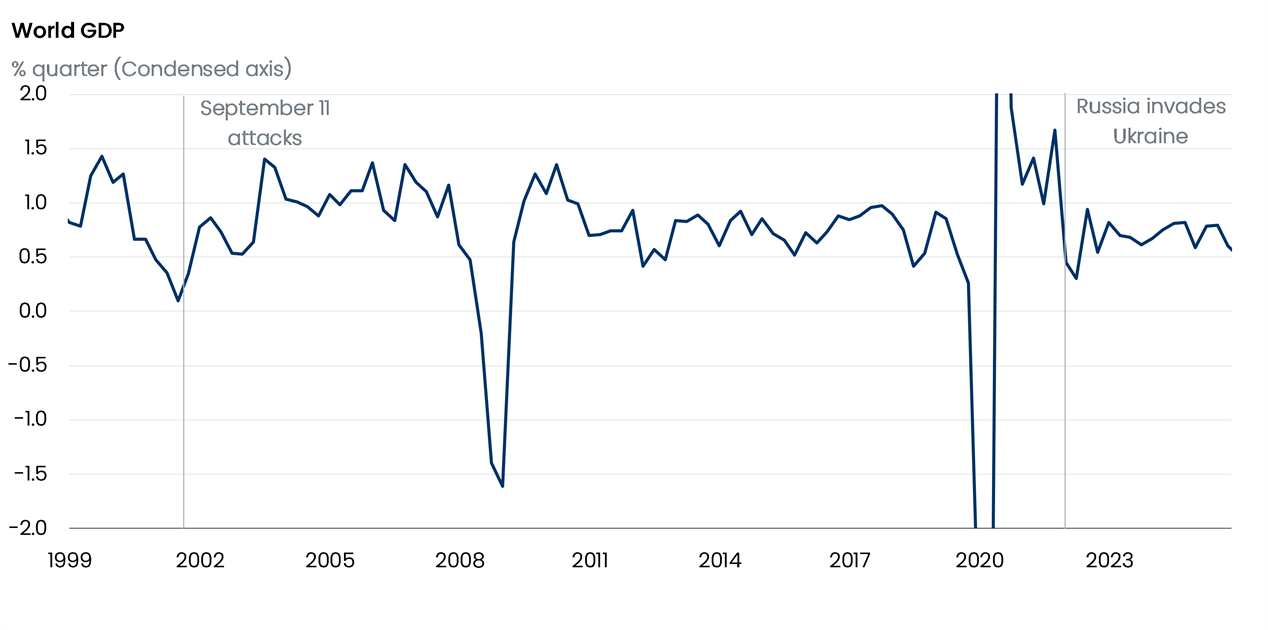
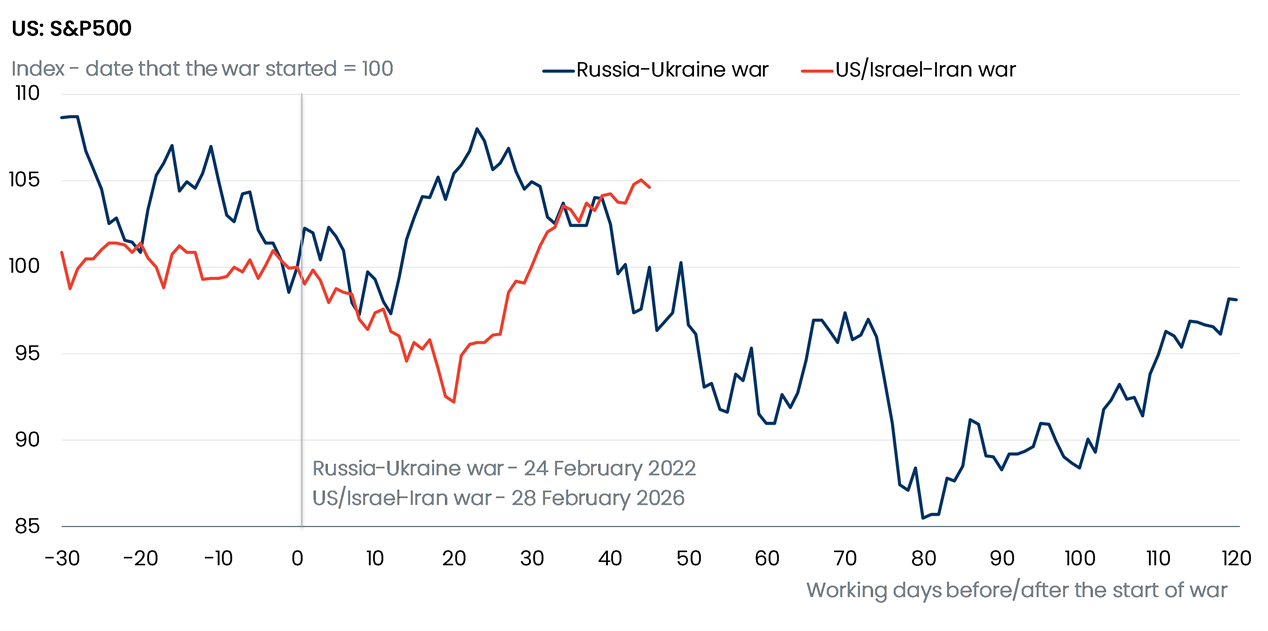
War has sent geopolitical risks up, but that on its own is not necessarily enough to cause a global recession. Despite the outbreak of a fresh war and energy crisis, stock markets have been relatively unaffected and the slow down in global growth relatively modest. / bne IntelliNews
By Ben Aris in Berlin May 6, 2026

The geopolitical shocks of the Gulf war are dominating headlines and investor sentiment, but these shocks rarely act as the primary engine of global economic downturns, according to a note by Ben May, director of global macro research at Oxford Economics.

“Heightened geopolitical risk doesn’t inevitably translate into economic volatility or cyclical downturns,” says May. “But historical experience shows that heightened geopolitical risk doesn’t inevitably translate into economic volatility or cyclical downturns.”

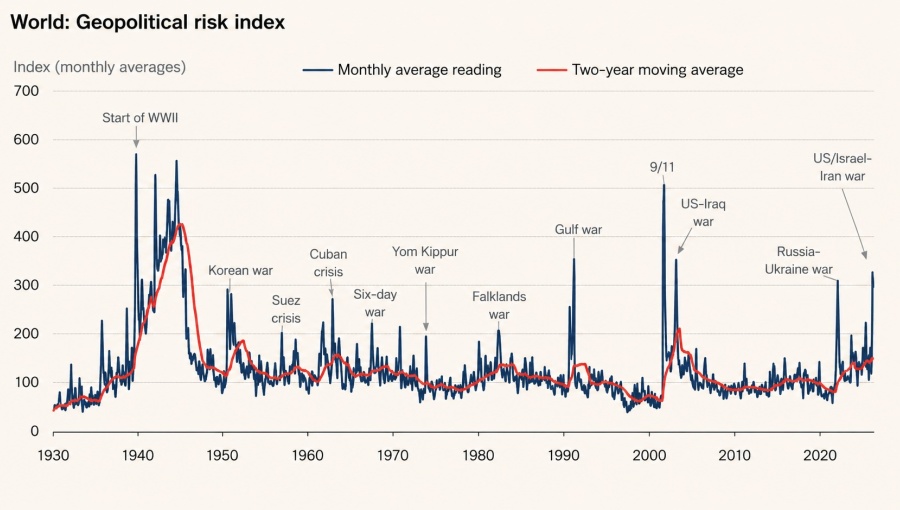
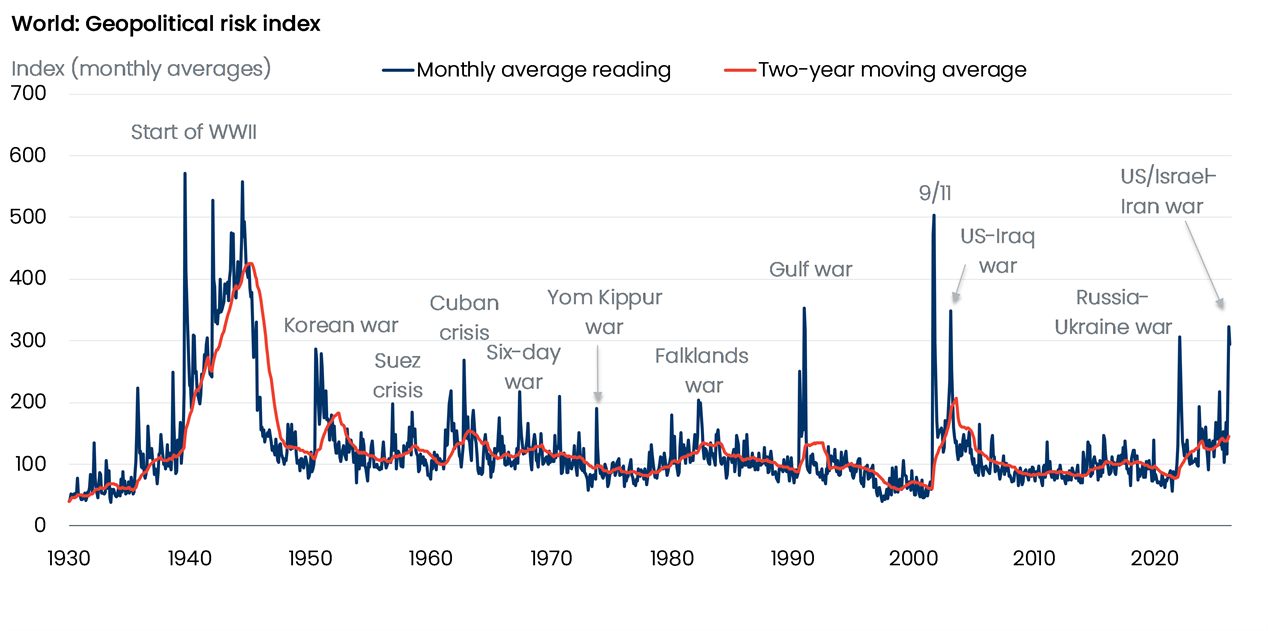
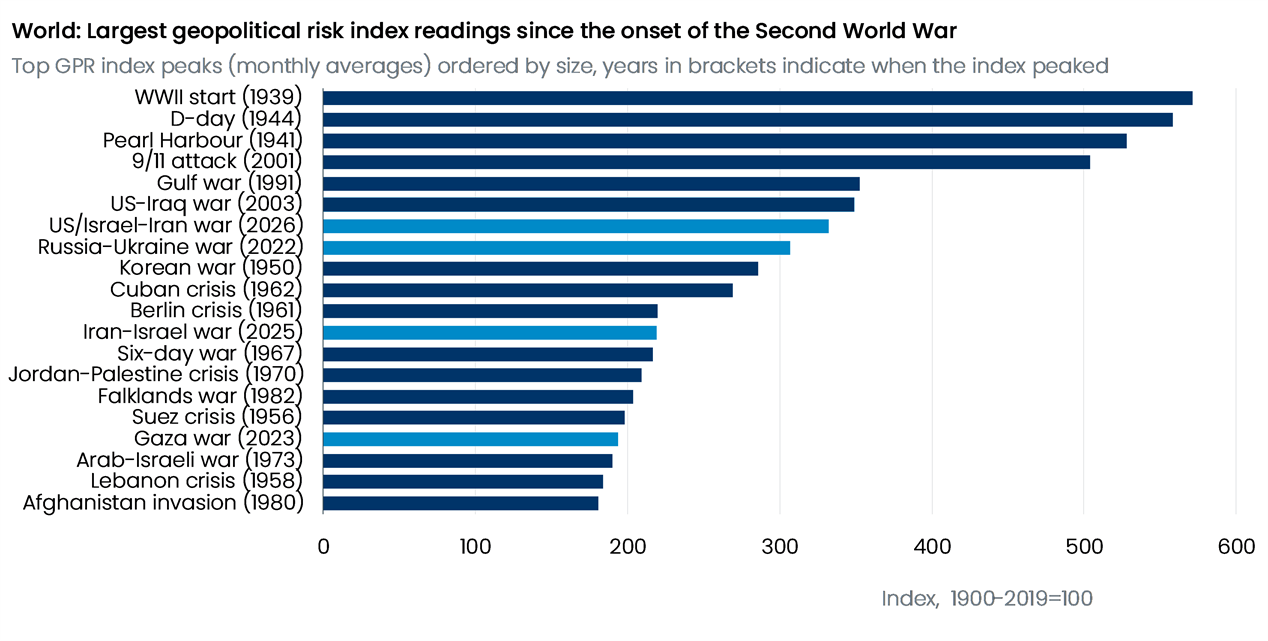
The recent surge in the Geopolitical Risk (GPR) index has reinforced the perception that the global economy has entered a more dangerous phase. Yet, as May notes, “the upward shift since Russia’s invasion of Ukraine looks similar to the step jump after the September 11 attacks — and that period was followed by an upswing in global growth.” In other words, while geopolitical tensions have intensified since the start of Operation Epic Fury on February 28 and clearly this is “the worst energy disruption in history” according to the International Energy Agency (IEA), the crisis has not yet moved into uncharted territory.

The distinction matters. Since 2022, the GPR index has recorded frequent spikes, bookended by the Russia-Ukraine war and the more recent US-Israel confrontation with Iran. But, as May points out, “global GDP growth has been remarkably stable despite these shocks.” The implication is clear: geopolitics alone is insufficient to derail the global economy.

The recent downgrade to global growth expectations reflects this more nuanced reality. Oxford Economics has cut its 2026 global GDP growth forecast by 0.6 percentage points and now expects the level of world GDP to be 0.8% lower than projected earlier in the year. But May is careful to stress that “while the war contributed to this, it wasn’t the only surprise.” Instead, the post-pandemic reopening, supply chain disruptions, and the subsequent inflation shock played decisive roles in tightening financial conditions and dragging on growth.

The true transmission mechanism from geopolitics to the real economy lies elsewhere. “The commodity and financial channels are the crucial shock spreaders,” he says. A useful rule-of-thumb is “a sustained $10 increase in oil prices reduces annual global GDP growth by around 0.1 percentage points.”

During the early phase of the Ukraine war, oil briefly rose from around $90 to $110 per barrel, before falling back to roughly $80 by the end of 2022. The impact, while meaningful, was temporary and limited at the global level.

Europe, however, felt a sharper blow after gas prices skyrocketed in the 2022 energy crisis, illustrating that the economic fallout of geopolitical shocks is often unevenly distributed.

“The surge in natural gas prices caused by Russia turning off the taps was far more concentrated than the oil shock,” May notes, underlining the importance of regional dynamics that are more affected, but don’t necessarily spread and have a global impact.

Nevertheless, the current Gulf War presents a potentially more serious risk, largely because of its implications for global energy supplies. “The Middle East conflict has the capacity to trigger a more substantial economic hit than the Russia-Ukraine war due to the sharper rise in oil prices everywhere,” May says.

Yet even here, Oxford Economics believes its baseline forecasts already incorporate a reasonable allowance for disruption. The greater danger would come from a prolonged interruption to shipping through the Strait of Hormuz, rather than from a broader collapse in confidence.

And the delivery of oil out of the Persian Gulf is restricted, not stopped. About half of the oil that used to be exported via the Strait of Hormuz is still leaving, via Iran’s own unfettered exports, the the Kingdom of Saudi Arabia (KSA)’s westward pipelines that terminate at the port of Yanbu on the Red Sea, and Gulf of Oman oil terminals belonging to the UAE and Oman. At the same time the US has ramped up production and exports and new Venezuelan oil has come onto the market.

One of the more surprising findings is how broader economic uncertainty has remained. “Spikes in geopolitical risk don’t typically push economic uncertainty measures up sharply,” May observes. Forecast dispersion for US GDP and inflation has actually declined since 2022, suggesting that markets have not been gripped by systemic fear. Even historically significant events such as the Gulf War, 9/11, and the Iraq war generated only short-lived increases in uncertainty.

This resilience extends to financial markets. While equity prices initially dipped following geopolitical shocks, subsequent movements have been driven more by monetary policy than by conflict itself. “The tightening in financial conditions in 2022 was not predominantly down to the Russia-Ukraine war,” May argues, pointing instead to the role of rising interest rates and inflation expectations.

None of this is to say that geopolitics is irrelevant. The counterfactual — a world without recent conflicts — would almost certainly have delivered stronger growth. Oxford Economics estimates that global GDP growth in 2022 and 2023 fell short of expectations by around 0.7 percentage points, though only part of this can be attributed to geopolitical tensions.

More broadly, the persistence of elevated geopolitical risk may yet have longer-term consequences. “It will take time to assess whether spillover effects from heightened uncertainty will prove larger than expected,” May cautions. Investment decisions, in particular, tend to respond with a lag, meaning the full impact may not yet be visible.

As IntelliNews has reported, the peak pain from major crises tends to arrive with a long delay. The short-term pain to sectors like aviation and fertilisers are already very visible, but a food shock is on its way that will hit this autumn, and an inflation shock will follow that, spilling into 2027. Separately, the world is on course for a “super El Niño” this year that means all these problems will be exacerbated by what is likely to be the fourth hottest year of all-time and a fourth disaster season that could be as bad, or worse, than the preceding three seasons.

For now, however, the evidence points in a different direction. “Geopolitical shocks may unsettle markets, but they rarely act as the primary driver of global downturns,” May concludes. Instead, it is the secondary effects — higher energy prices, tighter financial conditions, and structural economic adjustments — that ultimately shape the trajectory of growth.


Iran Conflict: Geoeconomics, Fragmentation, And The Possible Trajectories – Analysis


May 10, 2026 
 IFIMES
By Dr. Adnan Shihab-Eldin

We are in a moment when geopolitical tensions in the Gulf—particularly the ongoing conflict involving Iran—are once again intersecting with global energy markets, economic stability, and the trajectory of the energy transition. Beyond the immediate crisis, however, what we are witnessing reflects a deeper structural shift.

As I emphasized in my lecture earlier this year, we are entering an era of fragmentation—of geopolitics, of trade, and increasingly of energy systems.

This is no longer a temporary deviation; it is becoming a defining feature of the global landscape. The current developments in the Gulf are a clear manifestation of this transformation.

The global energy system is today both highly interconnected and structurally vulnerable. Around 20% of globally traded oil passes through the Strait of Hormuz, alongside a substantial share of LNG exports. This concentration creates a critical chokepoint. Recent events demonstrate that even partial disruptions—on the order of 20 to 50 percent—can have disproportionate effects on prices, logistics, and broader economic activity.

At the peak of recent tensions, up to 10–12 million barrels per day of oil—roughly one-fifth of global trade—was at risk, alongside significant LNG flows. Refining and downstream product supply chains were also affected, amplifying the shock across the system. This is not a localized disturbance; it is a global stress test.

Against this backdrop, I will structure the discussion around three scenarios, and within each briefly assess implications not only for the GCC and the wider MENA region, but also for Asia, Europe, Africa, and the United States.

Scenario 1: Ceasefire Holds – Agreement Within Weeks


In the first scenario, the ceasefire broadly holds, leading to an agreement within weeks.

Energy markets would stabilize, with prices easing as risk premiums decline and flows through the Strait of Hormuz normalize.

According to IMF estimates, a 10% increase in oil prices reduces global GDP growth by approximately 0.15 percentage points. A reversal of recent price spikes would therefore provide meaningful support to global recovery.

Regional implications:Asia: As the largest importer of Gulf oil and LNG, Asia benefits most. China, India, Japan, and South Korea would see lower import costs and improved energy security, easing inflationary pressures.

Europe: Despite reduced dependence on Russian gas, Europe remains exposed to LNG dynamics. Stabilization would ease gas prices and storage pressures, supporting industrial recovery.

Africa: Many African economies—particularly importers—would benefit from lower fuel costs and reduced fiscal strain, although exporters would see more limited upside.
United States: As a net energy exporter, the U.S. is less directly exposed. Lower prices may slightly reduce upstream revenues but would support inflation control and consumer demand.

For the GCC, growth remains stable—likely in the range of 2.5–3.5% (IMF estimates)—with continued strong export performance.

From a climate perspective, lower energy prices may reduce short-term urgency, but the episode still reinforces the long-term imperative of diversification.


Scenario 2: Intermittent Escalation – Agreement Within Months


The second scenario involves cyclical escalation, with intermittent disruptions over several months.

In this context, fragmentation becomes operational and visible in markets:Oil prices become volatile, potentially fluctuating between $85–110 per barrel,
LNG markets tighten,

Shipping and insurance costs rise significantly.

The IMF suggests that such volatility could reduce global growth by 0.3–0.5 percentage points, with disproportionate effects on emerging economies.

Regional implications:Asia: The most exposed region. LNG-dependent economies face price spikes, supply uncertainty, and rising industrial costs. Growth in major economies such as China and India could slow, while smaller importers face acute stress.

Europe: Continued LNG dependence exposes Europe to volatility. Price swings could weaken industrial competitiveness and complicate energy transition planning, increasing reliance on security-oriented policies.

Africa: Import-dependent economies face rising fiscal pressure and inflation, while exporters may benefit from higher prices but lack the capacity to scale rapidly. The overall effect remains uneven and often negative.

United States: The U.S. benefits partially as an LNG and oil exporter. However, gains are offset by financial volatility, inflation expectations, and broader global instability.

For the GCC, higher prices support revenues, but uncertainty weighs on investment planning, logistics, and non-oil sector diversification.

From a climate perspective, elevated prices may accelerate renewables and efficiency investments, but energy security concerns could simultaneously reinforce continued fossil fuel dependence.

This scenario illustrates the essence of fragmentation: divergent regional responses to a shared shock.

Scenario 3: No Agreement – Prolonged Volatility Through Year-End


The third scenario is the most severe: no agreement, sustained tensions, and structurally constrained flows through the Strait of Hormuz. Even partial disruption would significantly affect global supply chains:Oil prices could remain above $100 per barrel,
LNG markets could experience severe shortages,

Global trade flows would face sustained disruption.

Preliminary estimates suggest that the broader economic impact could reach approximately $1.5 trillion in trade and output effects.

The IMF and World Bank increasingly highlight stagflation risks:Global growth reduced by 0.5–1 percentage point,
Persistent inflationary pressure,
Elevated financial volatility.

Regional implications:
Asia: The most severely affected region. Heavy dependence on Gulf energy translates into sharp import cost increases, industrial slowdown, and macroeconomic stress, with significant global spillovers.

Europe: Faces renewed energy crisis dynamics—high gas prices, industrial contraction risks, and growing fiscal burdens linked to subsidies and stabilization measures.

Africa: Highly vulnerable. Many economies would experience severe balance-of-payments stress, inflationary shocks, and heightened social risks linked to energy and food prices.

United States: While relatively insulated in supply terms, the U.S. would still face inflationary pressures, tighter financial conditions, and a pronounced slowdown in global demand.

For the GCC, higher revenues may initially appear supportive, but overall effects become more complex: trade disruption, capital outflows, infrastructure risk, and heightened geopolitical exposure.

From a climate perspective, such a scenario may accelerate long-term diversification, but in the short term it reinforces reliance on higher-emission fuels as energy security dominates policy priorities.

Concluding Reflections


Across all three scenarios, one central conclusion emerges: we are no longer operating within a stable, globalized energy system, but within a fragmented, security-driven one.

This carries several implications:Energy security and energy transition are now inseparable and must be addressed in an integrated framework.

The Gulf remains central to global energy supply, but its role is increasingly defined by risk, resilience, and diversification strategies.

Regional impacts are highly asymmetric: Asia bears the greatest exposure, Europe faces structural vulnerability in gas markets, Africa experiences disproportionate economic stress, while the United States remains relatively more resilient yet still globally exposed.

For producing countries, strategic orientation must evolve:from efficiency to resilience,
from transactional trade to integrated partnerships,
and from stable assumptions to planning under persistent uncertainty.

Ultimately, fragmentation should not be viewed as a temporary disruption, but as a structural condition shaping global energy, economic, and climate trajectories.

In conclusion, it is important to emphasize that uncertainty remains high, and that future developments will largely depend on how events unfold in the coming weeks and months. However, what is already clear is that the implications of this conflict will extend far beyond the region—reshaping global energy markets, economic pathways, and climate strategies for years to come.


Particular thanks to GAFG and Prof. Anis H. Bajrektarevic, as well as the consortium of partners, most notably the International Institute IFIMES, for maintaining this important intellectual momentum.

About the author: Dr Adnan Shihab-Eldin is a Kuwaiti physicist, energy economist, and academic, who previously served as Secretary General of OPEC. He is currently a Senior Visiting Research Fellow at the Oxford Institute for Energy Studies and a founding board member of the Kearney Energy Transition Institute. He also serves as Chair of the GAFG Steering Board.

The views expressed in this article are the author’s own and do not necessarily reflect IFIMES official position.