Saturday, May 16, 2026

Who Really Rules Iran Now?

  • The IRGC has emerged as the dominant force in Iran following Ali Khamenei’s death and Mojtaba Khamenei’s limited public role.

  • Hard-line military and security figures now wield growing influence over Iran’s domestic politics and foreign policy.

  • Reformists and moderates remain sidelined as competing power centers shape Iran’s postwar future.

For decades, power in Iran was centralized in the hands of a single man: Supreme Leader Ayatollah Ali Khamenei. But since his killing at the onset of the US-Israeli war with Iran on February 28, decision-making in Tehran has become increasingly decentralized, experts say.

Mojtaba Khamenei has not been seen in public since he succeeded his father in early March. In his absence, a cohort of senior Iranian officials have been effectively running the country.

The Islamic Revolutionary Guards Corps (IRGC), a dominant political player, has now become the decisive force in Iran, experts say. Reformists and moderates have been relegated to the political fringes, leading to a more hard-line and ideologically rigid system.

Key power centers and figures have emerged in what some observers call the Islamic republic 3.0. While many of these figures are aligned on major policies, some fissures have surfaced.

Mojtaba Khamenei: New Supreme Leader

As supreme leader, the 56-year-old has the ultimate say on all state matters. But his authority has been undermined from the outset.

Khamenei was a controversial pick as supreme leader. The cleric had never held public office, and some argued a move toward "hereditary rule" would betray the very anti-monarchist roots of the Islamic Revolution in 1979.

Seriously wounded in the same Israeli air strike that killed his father, Khamenei has also been absent from public view since his appointment on March 8. He suffered injuries to his head, lower back, and foot but was now "in complete health," Mazahar Hosseini, head of protocol in the supreme leader's office, said on May 8.

US intelligence has said it believes Khamenei plays a prominent role in war strategy and managing peace talks with the United States. But in a system where the supreme leader is omnipresent -- issuing audio messages, making video addresses, and appearing in public to display his authority -- his absence is striking.

"Iran has entered a period of transition after the death of Ali Khamenei and the end of his 36-year leadership," Ali Afshari, an Iranian political analyst based in Washington, told RFE/RL's Radio Farda. [It's] a challenging period in which the postwar alignment of forces will be decisive."

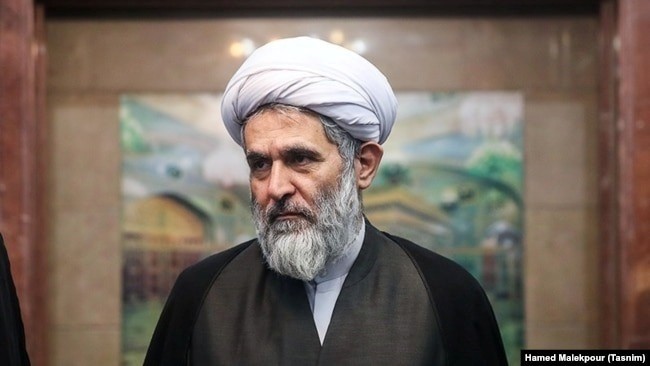
Hossein Taeb: Behind-The-Scenes Operator

A hard-line cleric, Taeb led the IRGC's intelligence branch for 13 years until 2022, when he was dismissed as part of a major security shakeup.
Hossein Taeb
Hossein Taeb is a longtime confidant of Iran's new supreme leader and considered a key figure behind the scenes.

Taeb, who is blacklisted by the United States and European Union for his alleged role in state repression, worked in the supreme leader's office before he was appointed as the IRGC's intelligence chief in 2009.

A longtime confidant of the younger Khamenei, Taeb is considered a key figure behind the scenes. Experts say he could play an important role in managing Khamenei's relationships with key players inside the system.

Ahmad Vahidi: IRGC Chief

The IRGC, the elite branch of Iran's armed forces, has always played a key role in politics. But it is now the dominant political force in the Islamic republic after the killing of Ali Khamenei.

That's despite Israel and the United decimating the leadership of the IRGC, including killing its commander in chief, Mohammad Pakpour.
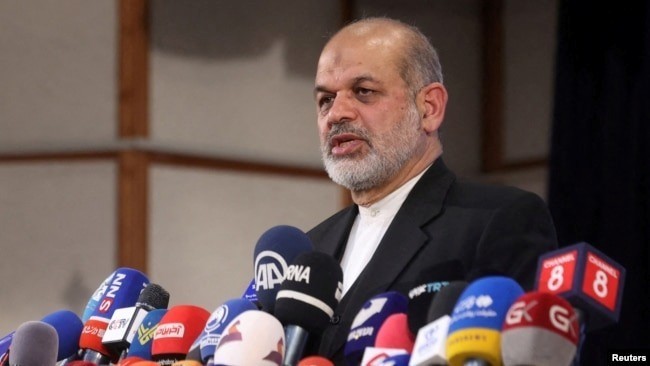
Ahmad Vahidi
Ahmad Vahidi, a former interior and defense minister, took over the IRGC in March.

Pakpour's deputy, Ahmad Vahidi, a former interior and defense minister, took over the IRGC in early March. But experts say it is unclear if Vahidi has the clout and credibility to unite the competing factions within the IRGC.

Experts say the war and the securitization of Iran following Ali Khamenei's death has allowed the IRGC to pay a central role in the domestic and foreign affairs of the country.

"The era after Ali Khamenei remains ambiguous. However, one key fact is visible: the increasing role and power of the IRGC in the administration of the Islamic republic," Mojtaba Najafi, a France-based Iranian political commentator, told RFE/RL's Radio Farda.

"Today, a significant part of the country's administration is in the hands of the IRGC," he added. "Militarization in the economy, politics, culture, and society has also now reached a stage of maturity."

Mohammad Baqer Qalibaf: The Intermediator

Qalibaf is a conservative politician and former military commander who spent decades cultivating ties to Iran's supreme leadership and the IRGC.

After a career overshadowed by corruption scandals and failed presidential bids, he arguably finds himself as the most powerful figure left standing in the Islamic republic.

Experts describe the role of Qalibaf, the parliament speaker who is also Iran's top negotiator with the United States, as a mediator between the different centers of power in Iran. He is considered close to the new supreme leader.
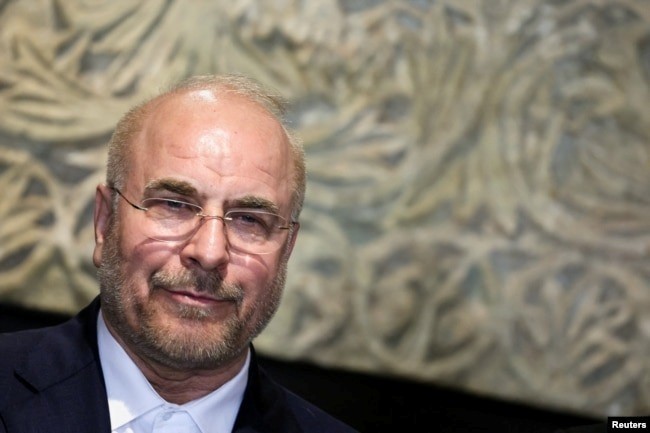
Baqer Qalibaf
Mohammad Baqer Qalibaf, the parliament speaker who is also Iran's top negotiator with the United States, is as a mediator between the different centers of power in Iran.

This was the role played by Iran's powerful security chief Ali Larijani before his assassination in March. Larijani was a unifying figure who brought together competing political factions and maintained strong ties with the IRGC, intelligence apparatus, and clerical establishment.

"Qalibaf has always been a pawn" used by the leadership, Hossein Razzaq, a political analyst based in Germany, told Radio Farda.

"Today, with the elimination of other key pawns, the role he plays for the system has become more prominent."

Mohammad Baqer Zolqadr: Security Chief

A former commander in the IRGC, Zolqadr succeeded Larijani as the head of Iran's Supreme National Security Council, the country's key policymaking body.

While Larijani was known as a shrewd and pragmatic politician, Zolqadr is a hard-line security and military official.

Razzaq considers the general's appointment as an attempt by Khamenei to divide power among his loyalists. His selection, he said, also underscored the dominance of the IRGC in the different centers of power in Iran.

Masud Pezeshkian: The Powerless President

The reformist president is not a major political player and not considered a threat by the hard-liners who dominate the system.
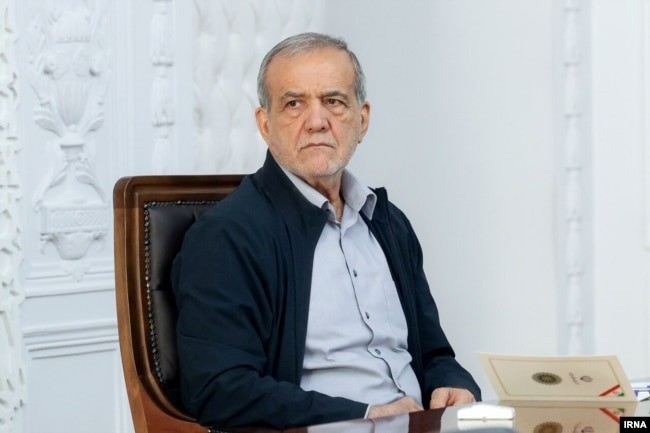
Masud Pezesh
Iranian President Masud Pezeshkian

Pezeshkian's role is administrative, running the day-to-day affairs of the government. But the final decision on major issues, including war and diplomacy, is made elsewhere.

He and Foreign Minister Abbas Araqchi are the only members of the reformist and moderate political camps to play a visible role in the new power structure. Like Pezeshkian, Araqchi does not have decision-making power but follows orders from above.

Still, differences have emerged that pit figures like Pezeshkian and Araqchi who are pushing for diplomacy against generals who oppose making concessions to the United States in negotiations to end the war.

By RFE/RL

The U.S. Should Cut Its Losses In The Iran War – OpEd


May 16, 2026 
By Ivan Eland

The United States currently spends almost a whopping trillion dollars a year on the U.S. military (a level higher than the next nine highest-spending countries combined). Donald Trump wants to increase it to almost a staggering $1.5 trillion per year. Plus, there will be supplemental war spending for a conflict of choice, which the Trump administration estimated at $25 billion but has now increased to $29 billion, a figure that did not pass the straight-face test. One independent cost estimator put the total at $72 billion in direct costs and in the trillions when indirect costs are included, including higher consumer prices caused by higher oil prices, which either go into or are used to transport most other products. In addition, the United States is already carrying a huge debt burden of $39 trillion, with mind-blowing interest payments accruing to U.S. taxpayers.

War hawks have been telling us since World War II that this heavy martial burden for U.S. citizens is needed because the United States has “responsibilities of a superpower.” And the monetary costs pale in comparison to the costs of American military lives and the larger body counts of local people being wracked up in places such as Vietnam, Afghanistan, Iraq, Somalia, and other countries in the continuing and failed War on Terror, and now Iran.

And even more important than all this is the rarely mentioned toll on the American republic at home. War is the greatest cause of overweening government in American history and human history. During the long Cold War and seemingly endless War on Terror, a national security state was created in America, with the first large peacetime standing U.S. military in American history retained and huge military budgets to fund it. With this expanded military, many U.S. overseas bases were retained after World War II, and the United States became the most interventionist state on earth (surpassing even the Soviet Union during the Cold War and with the martial intrusions accelerating further during the War on Terror after this major adversary fell).

In the 1970s, historian Arthur Schlesinger, Jr., realized that large military forces in being and a concomitant intelligence community had shifted power among the branches of government, leading to the rise of an “imperial presidency” that was no longer constrained by Congress as much. Schlesinger correctly saw that such augmented presidential power could be turned inward on Americans.

Although Schlesinger focused his analysis on Richard Nixon and the domestic dirty tricks exposed during the Watergate scandal, the first imperial president had likely been Harry Truman—with command of a newly consolidated Department of Defense and his own new intelligence agency, the CIA, to feed him information and conduct dirty tricks overseas—he thumbed his nose at the constitutional requirement for congressional approval of U.S. wars and unilaterally took the nation to war in Korea in 1950. Since then, presidents no longer ask Congress to declare war before committing the country to hostilities. Since Truman, as the Cold War continued and then the War on Terror replaced it, executive power continued to grow and congressional power continued to diminish.

Thus, Donald Trump did not invent the imperial presidency, but is now taking full advantage of the deterioration of the American constitutional system of checks and balances by employing regular military forces and nationalized National Guard forces at home against civilians against the wishes of state and local officials; using militarized law enforcement forces (ICE, the Border Patrol, and other agencies) to ostentatiously target illegal immigrants brutally but also ensnaring legal ones and U.S. citizens; and directing the FBI and Justice Department to try to investigate and prosecute his political enemies.

Presidential power is now running rogue. Congress needs to push back at its roots and use the War Powers Resolution of the 1970s to end both the Iran War and the continuing War on Terror. The president’s own party is paralyzed by congressional members’ fear that an adverse tweet from Trump will end their political careers, even though there should be strength in numbers to do the right thing. However, many should be even more frightened that the American people will fire them in November if they don’t act to end this pointless war of choice now.


This article was published at the Independent Institute

Saudi Arabia floats non-aggression pact with Iran modelled on Helsinki accords

Saudi Arabia floats non-aggression pact with Iran modelled on Helsinki accords
/ bne IntelliNewsFacebookTwitter
By bnm Gulf bureau May 15, 2026

Saudi Arabia is discussing with allies the idea of a non-aggression pact between Middle Eastern states and Iran following the conclusion of the US-Israeli military operation against the Islamic Republic, Financial Times reported on May 15, citing Western diplomats.

Riyadh is examining the 1975 Helsinki Final Act, signed by the United States, European countries, the Soviet Union and its allies during the Cold War to reduce tensions, as a possible template for the proposed regional framework.

Diplomatic sources said many European governments have backed the Saudi initiative and are urging Persian Gulf states to join the discussion. European officials view such a format as a means of lowering the risk of renewed conflict while offering Tehran security guarantees.

The Helsinki accords, signed on August 1, 1975 in the Finnish capital by 35 states including the Soviet Union, United States, Canada and most European countries, concluded the Conference on Security and Cooperation in Europe.

While not a legally binding treaty, the document became one of the central instruments of détente during the Cold War and laid the groundwork for the establishment of the Organization for Security and Cooperation in Europe (OSCE).

The Saudi initiative comes after a 40-day conflict in which the United States and Israel conducted military strikes against Iran. The campaign disrupted shipping through the Strait of Hormuz, sent Brent crude prices sharply higher and triggered widespread airspace closures across the Persian Gulf.

Saudi Arabia restored diplomatic ties with Iran in March 2023 under a China-brokered agreement, after a seven-year rupture that began with the storming of the Saudi embassy in Tehran in 2016. The rapprochement has gained renewed momentum as Gulf states seek to insulate their economies from further regional shocks.

Iranian Foreign Minister Abbas Araghchi separately accused the United Arab Emirates of being an "active partner" in the US-Israeli campaign during the BRICS foreign ministers' meeting in New Delhi on May 14, alleging Emirati territory had been used to launch strikes against Iran.

The Gulf Cooperation Council, comprising Saudi Arabia, the UAE, Kuwait, Qatar, Bahrain and Oman, has historically maintained varying degrees of engagement with Tehran, with Oman and Qatar serving as intermediaries in past diplomatic exchanges between Iran and the West.

Iran has not yet responded to the report with Iranian press only referring to the reports. 

Relations between the UAE and Saudi Arabia have collapsed following the 40-day war with Iran with Saudi Arabia, Oman and Qatar opposing the UAE, Kuwait and Bahrain putting further strain on the weakened GCC structure in recent days. 

War And Drought Push Lebanon Agriculture To Breaking Point – Analysis


By Giannis Mavris


War, economic collapse and declining rainfall are pushing Lebanon’s agricultural sector to the brink. Even water projects backed by Switzerland are struggling to cope.

Lebanon’s humanitarian crisis is worsening. Nearly one in five people now face acute food insecurity, with more than 1.2 million people affected, according to the United Nations’ IPC hunger scale. The war between Hezbollah and Israel has uprooted an estimated one million people inside the country, while hundreds of thousands have fled to Syria.

This displacement is hitting a country already in crisis. Lebanon’s agricultural sector is badly weakened by a decade of crisis. It has long relied on food imports. Since 2019, the country has been hit by political and financial turmoil, the Covid-19 pandemic, the Beirut port explosion, two wars with Israel, and disrupted supply chains. Meanwhile, the impact of the recent blockade in the Strait of Hormuz remains unclear and rainfall across the region has been below average.

In Akkar, in northern Lebanon, one of the country’s key farming regions, 65-year-old Ahmad Hussain Katlib tends fields and greenhouses in the village of Arqa. The small river that cuts through the village is increasingly one of his biggest worries.


“The water situation is very bad,” he declared during a visit in late 2025. Rainfall had been below average the previous year, and the years before had not been good either. “Fortunately, I have a well. Not everyone does. But groundwater will not last forever,” he added.

In villages such as Arqa, water distribution is traditionally overseen by a municipal appointee known as a “shawish”. When water is scarce, rumours of corruption or mismanagement often spread. “But this year there was not even enough rain for him to swindle us,” Katlib says with a weary laugh.
War deepens the strain on agriculture

The mistrust points to another problem in Lebanon: the instability of the country, which is deeply divided politically. Some fear the latest war could undermine social cohesion, while others hope it might have exactly the opposite effect.

“Lebanon has a valuable opportunity to transform its water sector,” says Nora Ourabah Haddad, the UN Food and Agriculture Organization’s (FAO) representative in Lebanon. “This means strengthening institutions, enforcing regulations, investing in infrastructure and innovation, and connecting water, energy and food systems more closely.” Despite the challenges, she believes sustainable development is still possible.


Ahmad Hussain Katlib has so far been spared the direct impact of the war, which has mainly been fought in southern and eastern Lebanon. He could one day benefit from a water and sanitation project that is now in development.

Put into place by the FAO with Swiss co-financing, the project is designed to provide communities along the river with a safe and reliable supply of water. For Haddad, the timing is critical. “We must improve people’s lives today while protecting resources for future generations,” she said.

In spring 2026, renewed instability in Lebanon raised doubts about how projects like these could continue in the months and years ahead. Asked about the situation, the Swiss embassy in Beirut said it had boosted funding for a UNICEF emergency water project at the end of March. The project provides clean water to internally displaced people.

Long-running humanitarian projects are built on stable and reliable planning. With the ceasefire between Lebanon and Israel repeatedly being violated, planning becomes increasingly difficult.

Another challenge is that Lebanese agriculture depends on seasonal workers, mostly from Syria. In recent months, mounting pressure from the Lebanese government has driven growing numbers of them out of the country.
Humanitarian aid continues to shrink

Even before the latest ceasefire came into effect in April 2026, Lebanon’s agriculture ministry estimated that 22% of the country’s farmland had been damaged by the war. Livestock numbers have also fallen sharply, especially in the south and east. Updated figures have yet to be released.


In March, Switzerland pledged CHF7.5 million ($9.6 million) in humanitarian aid for Lebanon, Syria and Iran. Aid agencies are facing mounting financial pressure. The FAO says it needs around $19 million (CHF14.8 million) in emergency assistance for Lebanon alone, even as its wider budget continues to shrink. In January 2026, the United States withdrew its $300 million (CHF235 million) contribution. It was 14% of the organisation’s total budget.

Brazil: Federal Police Crack Down On Illegal Mining In The Amazon


Illegal mining in Amazon, Brazil. Photo Credit: © POLÍCIA FEDERAL/DIVULGAÇÃO


May 16, 2026
By ABr

Seven areas of illegal mining in the Amazon are the targets of a joint operation by Brazil’s federal police, in collaboration with national environmental authority Ibama, conservation agency ICMBio, and the National Force, with support from the military police of the state of Pará.

From Tuesday (May 12) through today (15), police officers have been operating in the border region between the Northern states of Amapá and Pará, specifically in the municipalities of Laranjal do Jari, in Amapá, and Almeirim, in Pará, where the illegal gold mines are located.

According to the agents, four hydraulic excavators, dozens of engines, three ATVs, two tractors, generators, clandestine camps, and some 3,300 liters of diesel were seized.


By 

By Tessa Gervasini


A Pew Research Center survey found a growing minority of U.S. adults believe religion is gaining influence in American life, and more than half of adults have a positive view of religion.

The May 14 report found that 61% of U.S. adults said religion is losing influence in American life. In contrast, 37% said it is gaining influence, a figure that has risen 19 percentage points in the past two years.

The data in the report, “How Americans Feel About Religion’s Influence in Government and Public Life,” was based on Pew’s survey conducted April 6–12 that included more than 3,500 U.S. adults with questions about religion’s influence in society, Christian nationalism, and the relationship of church and state.


Percentage of U.S. adults who said religion is gaining influence, in a Pew Research Center report released on May 14, 2026. | Credit: Photo courtesy of Pew Research Centre

The survey has an overall margin of error of plus or minus 1.9 percentage points. Pew’s studies on the public’s views about religion’s role in public life are an ongoing effort of the center’s research and therefore included past data for comparison with the 2026 findings.

The research found that 65% of Catholics reported they have a positive view of religion, 12% said they have a negative view, and 22% they have a neutral or unclear view.

Overall, 55% of U.S. adults expressed a positive view of religion’s role in American life and either said religion’s influence is growing and this is a good thing (21%) or that its influence is declining and this is a bad thing (34%).

Christian influence in government

The survey found a small increase in the percentage of Americans who said they want the government to declare Christianity the nation’s official religion. Overall, 17% of U.S. adults express this view, up from 13% in 2024.

Most Americans said the government should promote Christian moral values without making Christianity the official religion (43%) or that the government should not establish an official religion or promote Christian values (38%).

Of adults, 28% said the Bible should have influence on U.S. law. The majority of Catholics surveyed (55%) also reported it should have influence, compared with the 43% who said it should not.

The survey also found that the public’s familiarity with the term “Christian nationalism” has grown since Pew last asked about the topic. There has been a 14 percentage point increase in the share of U.S. adults who reported they have heard or read about Christian nationalism, from 45% about two years ago to 59% in 2026.

Overall there is more of a negative view of Christian nationalism than positive with 31% of U.S. adults who reported they have an unfavorable view of it and 10% who view it favorably.

The survey also asked about the separation of church and state and found there has been a decline from 19% in 2021 to 13% in 2026 in the share of Americans who want the government to stop enforcing separation of church and state, but the percentage of Americans who said the government should enforce it has remained at 54%.

Nearly half of Catholics (49%) reported that the federal government should enforce separation of church and state, and 16% said it should stop enforcing it.

Most people (79%) reported they do not think churches and other houses of worship should endorse candidates during elections. Similarly, 66% also said churches should keep out of political matters.

Political affiliationʼs influence on views of religion in government

The survey found a large difference in respondents’ perspectives based on their political affiliation.

Of Republicans and independents who lean toward the Republican Party, 75% expressed a positive view of religion’s influence in American life compared with 38% of Democrats and Democratic leaners who do so (38%).

Similarly, 45% of Republicans and Republican leaners said the Bible should have influence on U.S. laws, whereas 13% of Democrats and Democratic leaners said the same. Most Republicans (74%) and Democrats (84%) agree that churches should not endorse political candidates.


Most Democrats (68%) said the federal government should enforce the separation of church and state, compared with 42% of Republicans.

IMF: Extreme inequality is fuelling a global debt crisis

IMF: Extreme inequality is fuelling a global debt crisis
A glut of savings by the extreme wealthy is increasing inequality and hindering economic growth that could lead to a debt crisis. / bne IntelliNewsFacebook
By Professor Atif Mian in Princeton May 14, 2026

During the Great Depression, as he saw ordinary peoples purchasing power collapse, Federal Reserve Chairman Marriner Eccles warned that excessive saving by the rich was draining demand and deepening the downturn. To protect them from the results of their own folly,” Eccles told the Senate in 1933 testimony, we should take from them a sufficient amount of their surplus to enable consumers to consume and business to operate at a profit.”

Inequality in the US was then extremely high: The top 1 percent held roughly 42 percent of all wealth. Within a decade, however, the landscape changed dramatically. World War II mobilization and progressive taxation reduced inequality and restored balance between spending and production. The underlying problem that Eccles emphasized faded from public memory as the US economy entered a long period of sustained and more equitable growth.

However, beginning in the 1980s, inequality climbed again: The top 1 percents wealth share rose from about 22 percent in 1980 to roughly 35 percent in 2010. As more income concentrated at the top, the forces Eccles warned against reemerged—high saving by the wealthy weakened overall purchasing power. Yet the expected demand shortfall did not appear immediately: Spending was funded by rising private debt of households below the top. From the mid-1980s through the early 2000s, the rapid buildup of household debt absorbed the excess saving of the rich and sustained aggregate demand.

The global financial crisis of 2008 ended the long run of debt-financed household spending. With deleveraging of private balance sheets, the underlying imbalance Eccles warned about returned with a vengeance: excess saving at the top and insufficient broad-based demand at the bottom. The Fed cut rates to zero, but monetary policy could not close the gap. Fiscal policy was left to carry the load—accept a deep, prolonged slump or run large primary deficits to stabilize incomes and employment. The US chose the latter.

In the Keynesian view, deficits help the economy recover faster in downturns, but the need for them is temporary. When the demand shortfall is structural—driven by persistently high saving of top-income households that capture a large share of total income—the need for deficits is more persistent. In a recent paper, A Goldilocks Theory of Fiscal Deficits,” Amir Sufi, Ludwig Straub, and I show that rising inequality can force governments to run larger, ongoing deficits. Deficits must be large enough to keep the economy away from the zero lower bound (when nominal interest rates reach zero and monetary policy ceases to be effective) and to prevent recessions.

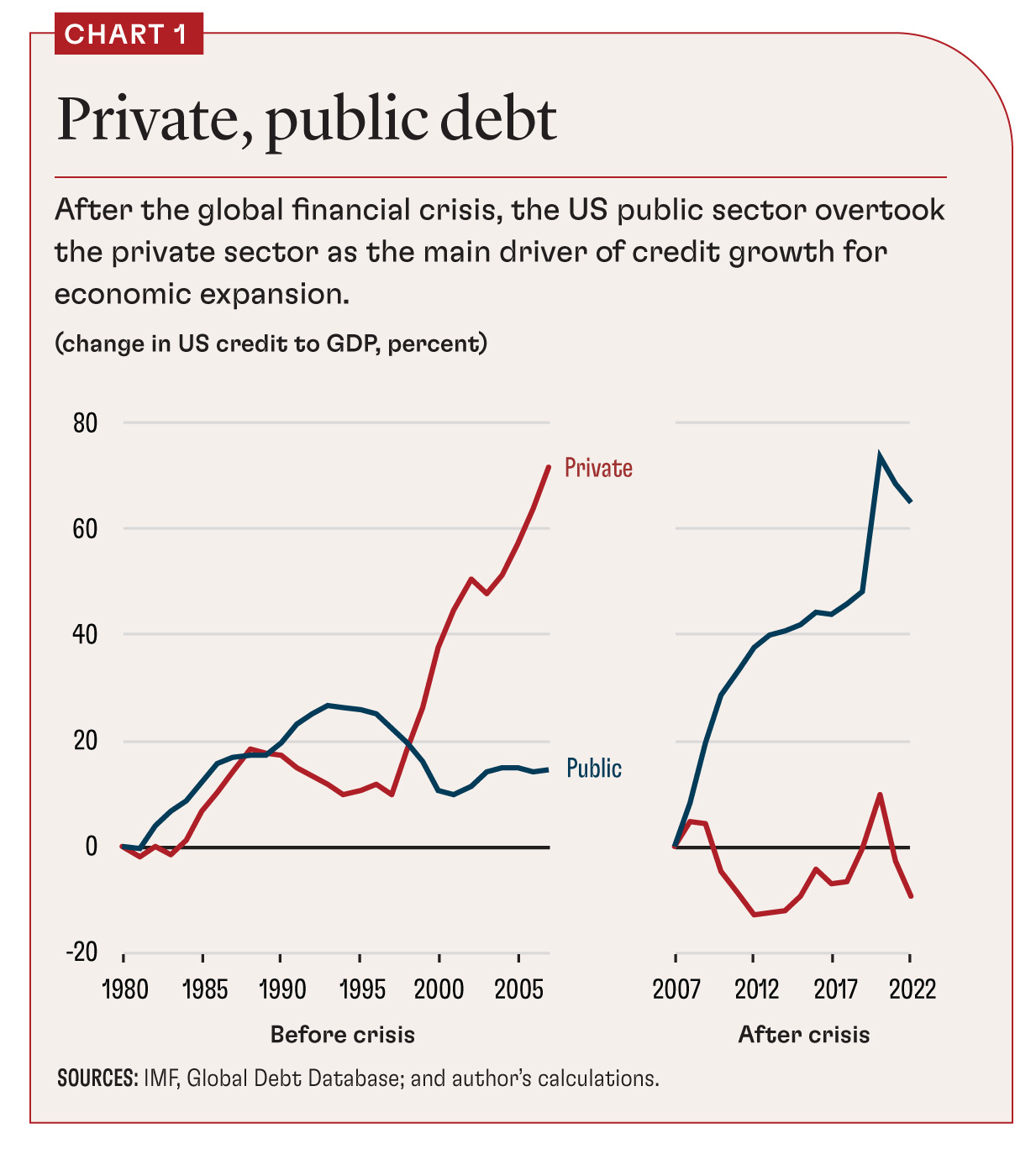
A rising saving glut—excess saving among higher-income households—forces the economy to rely increasingly on debt-financed spending to sustain aggregate demand. Before 2008, the financial system did this by expanding household credit, which supported consumption even as inequality rose. When private credit expansion abruptly ended during the financial crisis, the burden of credit creation shifted to the public sector, as evidence from the US shows.

Chart 1 shows that total credit (public plus private) rises sharply starting in the early 1980s. The blue and red lines decompose the total into private and public credit, separating the precrisis (1980–2008) and postcrisis (2008 onward) periods. From 1980 to 2008, nearly all of the increase in total credit reflects a surge in private borrowing; public debt is comparatively stable.

After 2008, the pattern reverses. Even with the federal funds rate near zero, the private sector could not—or would not—raise leverage further, so sustaining demand required credit growth from the public sector. This is the logic of the Goldilocks” view of fiscal deficits: When private balance sheets are constrained, public borrowing can offset the demand shortfall and help avoid a prolonged slump. Consistent with that prediction, total credit to GDP continues to rise after 2008 at roughly the earlier pace, but almost entirely because public debt increases, while private credit remains broadly flat relative to GDP.

A saving glut in the presence of a zero-lower-bound constraint forces government to increase debt and deficits, but the government also faces a dynamic budget constraint. Push the deficit too far and, over time, interest rates on public debt can rise, making the debt path unsustainable. High inequality and resulting excess saving by the rich present a Goldilocks conundrum for fiscal policy: Deficits cannot be too cold” (too small to offset the demand shortfall) or too hot” (so large that they destabilize debt dynamics). The data suggest that the US was operating near this upper bound in 2019—close to the largest deficit sustainable in the long term.

The larger, persistent fiscal deficits since then may be leading US debt dynamics down a less sustainable path. US fiscal strain is unlike anything seen in its modern history: Federal debt and net interest costs as shares of GDP are near all-time highs. The fiscal deficit is projected to be about 6 percent of GDP, which would keep debt rising relative to the economy and threaten sustainability.

Global evidence

Saving gluts are rising everywhere. The share of income accruing to the top 1 percent has increased worldwide. Corporations are a tax-advantaged vehicle for the rich to save, so global corporate saving has risen significantly over the past few decades. Wealthy sovereigns are fueling higher saving through central banks and sovereign wealth funds. But global investment has not kept up, leading to a saving glut that needs new unproductive credit to sustain consumption demand. Many major economies mirror the US predicament: increased reliance on debt to generate demand, first through private household debt and later through government debt.

Total debt in the UK, for example, began to rise rapidly in the 1980s, driven primarily by private borrowing until 2008, and by public debt thereafter. Japan followed a similar track but started earlier. Its private credit boom ended in the early 1990s, and public debt subsequently absorbed the adjustment. In the euro area, the launch of the euro in 1999 coincided with a rapid buildup in private credit that culminated in the 2008 crisis; since then, private deleveraging has been accompanied by a shift toward higher public debt.

China

China also came to rely increasingly on debt to support demand. But unlike most large economies, it initially did so by exporting its excess saving abroad—running large current account surpluses that increased the rest of the worlds net debt to China. Those external liabilities, in turn, helped finance spending on Chinese goods.

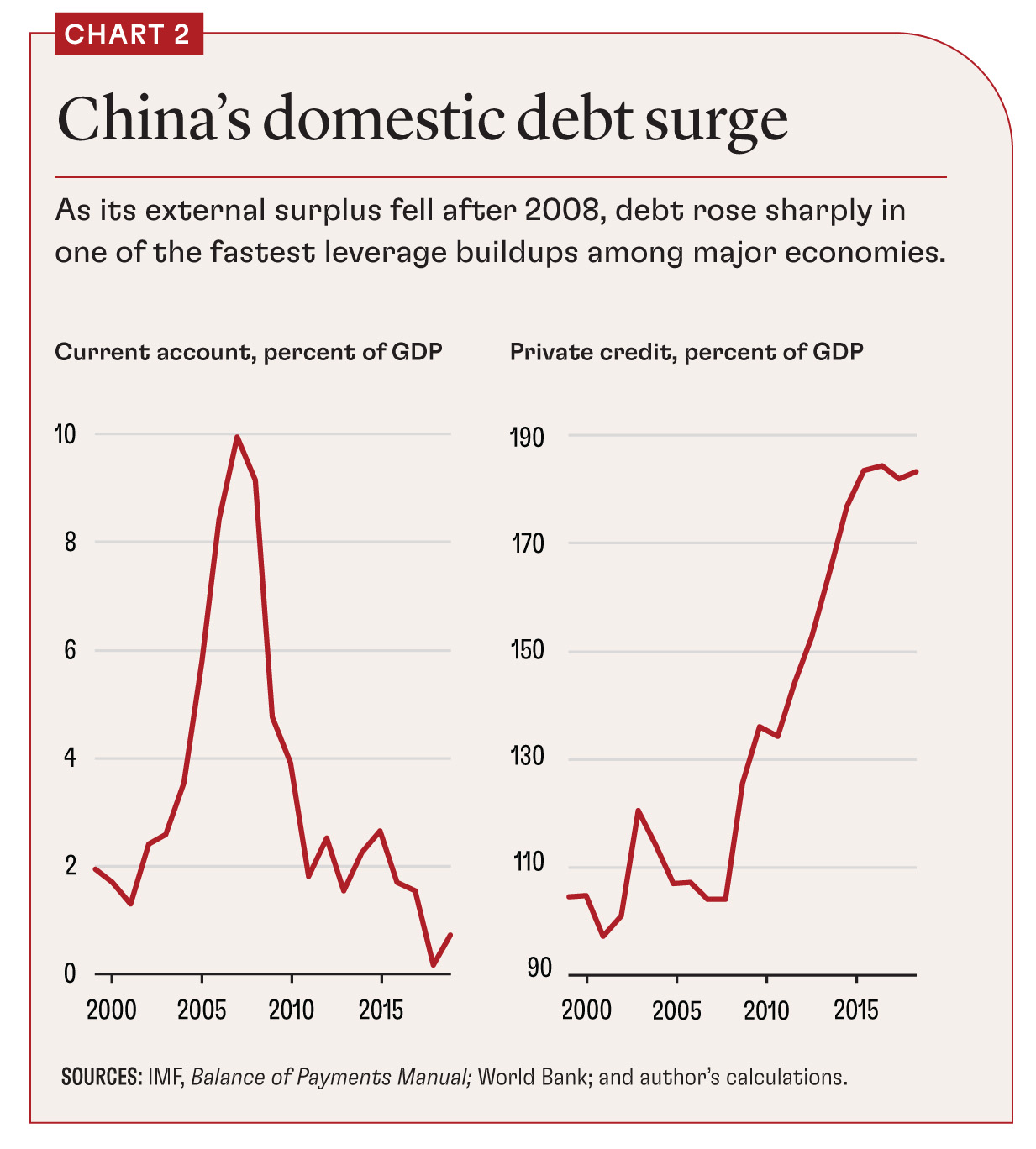
For much of the 2000s, Chinas current account surplus rose sharply as a share of GDP, even as GDP itself expanded at an extraordinary pace (Chart 2). On the eve of the 2008 financial crisis, the surplus approached 10 percent of GDP—exceptionally high for a major economy. Such a large external imbalance was unlikely to be sustainable.

As advanced economies could no longer sustain demand through ever-rising private credit—especially after 2008—Chinas earlier strategy of exporting excess saving abroad faced limits. Continued expansion of net lending abroad that could sustain very large trade surpluses became increasingly difficult. Both sides adjusted by shifting debt creation to new sources: Advanced economies relied more on fiscal deficits, and China turned to domestic credit expansion to support demand in the face of its own saving glut.

As Chinas external surplus receded to more moderate levels after 2008, domestic debt to GDP rose sharply. The increase was broad-based—extending beyond corporate and local government borrowing to include rapid growth in household debt—and represents one of the fastest domestic leverage buildups observed among major economies.

Why does investment not rise?

Why didnt financial markets channel abundant funds into productive investment? Despite rising total debt to GDP, investment to GDP in major economies has remained broadly flat and sometimes has even edged down. Is this because the financial system is not conducive to long-term, patient financing? Or do regulatory and other supply-side constraints inhibit investment?

When excess saving is channeled into unproductive debt that finances consumption rather than investment, borrowers do not generate additional income that can repay the new debt in the aggregate. The result is persistently rising debt to GDP and downward pressure on interest rates to keep the debt sustainable. In earlier work, we refer to this dynamic as indebted demand”: growth sustained by borrowing because underlying spending power is insufficient.

The ultimate fragility

The central risk of relying on indebted demand is that its inherently fragile. Once private borrowers reach their limits—as they did in 2008—maintaining demand requires a larger and more persistent fiscal backstop, which is the reason for rising postcrisis public deficits and debt. Its why todays global fiscal fragility is not an isolated policy choice but the downstream result of an economic systems failure to convert abundant saving into productive investment.

The question today is whether the US government can rein in fiscal spending if markets get nervous. Political polarization and legislative gridlock mean that confidence is limited. The more profound lesson, though, is that structural imbalances—rooted in excess saving by the rich—create the very conditions that expose the economy to such risks. Expecting policymakers to keep deficits in a perpetual Goldilocks range is unrealistic: When inequality suppresses demand, they may err on the side of too little support, as in Eccless era; at other times, they may leave deficits too large for too long, as many fear is happening now.

We often frame inequality in moral terms, but the macro lesson is starker: When too much income pools at the top, demand weakens, deficits persist, and dependence on debt weakens us all. Eccles captured that collective logic in 1933. His advice to take some of the surplus from the wealthiest so that consumers can consume and businesses can make profits is as relevant today as then. As Eccles remarked, This is not soaking the rich; it is saving the rich.”


Atif Mian is the John H. Laporte, Jr. Class of 1967 Professor of Economics, Public Policy, and Finance at Princeton University. This post first appeared in the IMF blog here.