Sunday, May 17, 2026

Rejecting church and state separation is on the wish list for Trump's religious liberty commission

(AP) — Commissioners had an opportunity to describe their wish lists during their most recent meeting in April. There was little dissent as the commissioners, most drawn from Trump’s base of conservative Christian supporters, covered the items they want in the report.


Peter Smith
May 11, 2026

One member calls for a Presidential Medal of Freedom for a baker who refused to create a wedding cake for a same-sex couple.

Another calls for court interventions by the Department of Justice on behalf of Amish parents fighting New York vaccine requirements and Catholic nuns challenging that state’s requirement that they accommodate hospice patients’ gender identities.

And the chair of the Religious Liberty Commission is calling for a federal hotline with this automated recording: “There is no separation of church and state.”

These are just some of the recommendations that members of the advisory panel formed by President Donald Trump last year want to see included in the commission’s final report.

That report is still in the works, but commissioners had an opportunity to describe their wish lists during their most recent meeting in April. There was little dissent as the commissioners, most drawn from Trump’s base of conservative Christian supporters, covered the items they want in the report.

Their ideas reflect the prevailing perspectives on the definition of religious liberty among many conservative Catholic and evangelical activists: increasing avenues for religious expression in public schools; expanding opportunities for faith-based organizations to receive public money; and allowing for religious-based exemptions in areas ranging from labor law to classroom lessons to healthcare mandates.

Such views have also been reflected in Supreme Court decisions issued in recent years by its conservative majority.

Commission criticized for narrow views

Critics of the commission say it embodies a one-sided perspective of Trump’s supporters and is threatening a well-established constitutional separation of church and state, despite the chair’s claims.

A lawsuit by a progressive interreligious coalition argues that the commission fails to comply with federal law requiring advisory panels to feature diverse members and viewpoints.

The lawsuit echoes criticism that most commissioners are conservative Christian clerics and commentators; one is an Orthodox Jewish rabbi. The coalition says members have asserted that America is specifically a Judeo-Christian or Christian nation and notes that most commission meetings took place at the Museum of the Bible in Washington, an institution with Christian leadership.

The Republican administration is asking a federal court to dismiss the lawsuit. The government is citing legal technicalities and contending the law does not define how a commission should be fairly balanced or whose viewpoints should be represented.

Another entity created by Trump — the Task Force to Eradicate Anti-Christian Bias — issued a report saying Christians faced discrimination under the administration of Democratic President Joe Biden in areas such as education, tax law and prosecution of anti-abortion protesters. Progressive groups said that report failed to document systemic discrimination, focused on causes favored by conservative Christians and amounted to advocacy rather than an investigation.

In a further interlocking of Trump-related initiatives, several members of the Religious Liberty Commission are scheduled to take part in a May 17 prayer event marking the country’s upcoming 250th birthday. Several also participated in a recent Bible-reading marathon staged largely at the Museum of the Bible.

Harmony and tension within the commission


The commission has mostly featured agreement among members, with one dramatic exception. One commissioner, Carrie Prejean Boller, was ousted in February after a contentious hearing on antisemitism.

Commission Chair Dan Patrick said Prejean Boller sought to “hijack” the hearing, in which she had sharp exchanges with witnesses about the definition of antisemitism and defended commentator Candace Owens, denying her record of antisemitic statements. Prejean Boller, a Catholic, contended she was wrongly ousted for expressing her beliefs.

In other hearings, witnesses described how they defied workplace regulations that they said conflicted with their conservative religious values on gender, abortion, COVID-19 vaccines and more. Some said they were prevented, at least temporarily, from displaying a religious symbol at work or trying to sing a Christian song at a school talent show.

At the hearing devoted to antisemitism, Jewish witnesses spoke of being harassed and threatened at campus pro-Palestinian protests against Israel. The commission has also heard from some Hindu, Muslim, Sikh and other witnesses.

Even so, critics said the commission mostly focused on conservative Christian and right-leaning political grievances.

The Rev. Paul Brandeis Raushenbush, president of the progressive Interfaith Alliance, one of the groups suing over the commission’s composition, said the panel’s omissions are as significant as what it focuses on.

He said the commission has failed adequately to address such issues as anti-Muslim efforts in Texas and elsewhere, and also the rise of antisemitism on the right, not just the left.

Separation of church and state debate


Raushenbush said he is especially worried about the commission chair’s challenging the very notion of church-state separation

Patrick, a Republican who is the Texas lieutenant governor, repeatedly denounced a concept that is embedded in Supreme Court precedent.

“We need to say there is no separation of church and state,” Patrick said at the April meeting. “That’s a lie.” He suggested printing “a million bumper stickers” to that effect.

No one at the commission meeting disagreed.

Trump made similar comments at a prayer event at the White House in 2025. “They say separation between church and state,” Trump said. “I said, all right, let’s forget about that for one time.”

While the phrase “separation of church and state” does not appear in the Constitution, 20th-century decisions by the Supreme Court cited Thomas Jefferson’s description of the First Amendment as creating “a wall of separation between church and state.” The court applied the First Amendment’s prohibition of any church “establishment” to the states in addition to the federal government, citing the 14th Amendment’s ban on states denying citizens’ rights.

Courts have since wrestled with how to balance freedom of religion and freedom from government-sponsored religion.

Concerns touch on schools, vaccines, workplaces and more


Patrick has advocated for prayer and Ten Commandments postings in public schools.

“I don’t have any malice towards anyone that doesn’t believe in any type of faith,” Patrick told fellow commissioners. “That’s fine. That’s what America is about. But these organizations that are pushed by some ideology and pushed by someone’s bank account who wants to remove God from our country? We need to push back.”

On other issues, various commissioners called for requiring schools and workplaces to post notices of the rights of religious expression and exemptions.

Some called for restoring full pay and pension benefits for military service members who were discharged for refusing COVID-19 vaccines.

Bishop Robert Barron of the Catholic Diocese of Winona-Rochester, Minnesota, called for enabling religious groups such as Catholic Charities to receive federal money without compromising on traditional church teachings about the family.

He also said Catholic immigrants in detention should have humane treatment and access to sacraments and that immigration agents should not disrupt worship services in enforcement actions. The administration last year eliminated a policy against immigration enforcement in sanctuaries, which other religious leaders said should not occur at any time.

Kelly Shackelford, president and chief executive officer of the legal organization First Liberty Institute, called for new requirements that governments pay all legal bills if they lose a religious liberty case. He said many individuals lack the money to challenge the government in court.

“That would be a huge shifting of power in favor of citizens,” he said.

___

Associated Press religion coverage receives support through the AP’s collaboration with The Conversation US, with fun
ding from Lilly Endowment Inc. The AP is solely responsible for this content.


‘Jubilee of Christian Nationalism’: Trump Event Denounced as Attack on Church and State Separation

“If President Trump and his allies truly cared about America’s legacy of religious freedom, they would be celebrating church-state separation as the unique American invention that has allowed religious diversity to flourish.”
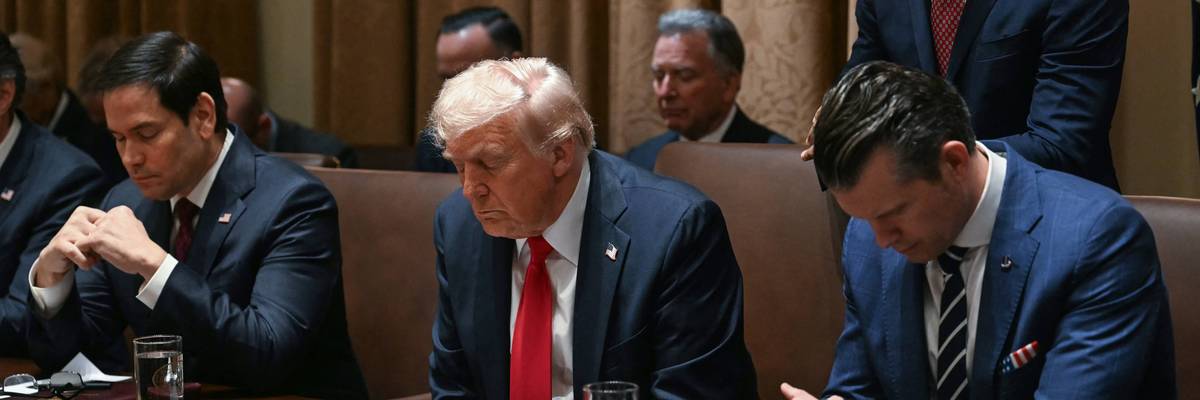


US President Donald Trump bows his head in prayer alongside Secretary of State Marco Rubio, Secretary of Defense Pete Hegseth, and Housing and Urban Development Secretary Scott Turner during a Cabinet meeting at the White House in Washington, DC, on February 26, 2025.
(Photo by Jim Watson/AFP via Getty Images)

Julia Conley
May 15, 2026
COMMON DREAMS


An all-day prayer event scheduled for Sunday on the National Mall is set to feature evangelical Protestant leaders as well as top White House and Republican Party officials as speakers, and is being promoted as a celebration of “thanksgiving” as well as an opportunity for participants to learn about the founding of the nation as the 250th anniversary of its independence approaches.

In reality, said Rachel Laser, president and CEO of Americans United for Separation of Church and State, the “National Jubilee of Prayer, Praise, and Thanksgiving” appears to be a “Jubilee of Christian Nationalism”—with evangelical Christians making up three-quarters of the scheduled speakers, despite the fact that they account for just a quarter of Americans overall.

“If President Trump and his allies truly cared about America’s legacy of religious freedom, they would be celebrating church-state separation as the unique American invention that has allowed religious diversity to flourish in our country,” said Laser. “Instead, they continue to threaten this foundational principle by advancing a Christian nationalist crusade to impose one narrow version of Christianity on all Americans.”

The event, which is partly funded by taxpayer dollars earmarked for the nation’s 250th anniversary, will feature Christian musical performers organized around three “pillars” that are labeled as “miracles” a Christian God bestowed on America, “personal testimonies of God’s healing,” and a “unified moment of rededication.”

At a webinar last month, Rev. Paula White-Cain, who serves as a faith adviser to the White House, said the event is “really truly rededicating the country to God.”

The idea that the founders of the United States intended the country to be a Christian one has long been a fixation of evangelical Christian leaders, despite the lack of evidence for such a claim.

“Look at the document,” Princeton University history professor Kevin Kruse told The Washington Post, referring to the Constitution. “The only rules they wrote about religion were ones that keep religion at arm’s length. No establishment, no limits on free exercise, no religious test for office... There’s a difference between saying America is a nation with many Christians in it and that America is a nation dedicated to Christianity and defined by it.”

Robert Jones, president of the Public Religion Research Institute, told the Post that about a third of Americans currently report that they have no religious affiliation, making the US more religiously diverse than it’s ever been.

“We proudly celebrate 250 years of American independence from kings who ruled over both church and state,” said Laser. “For 250 years, America has been marching toward the promise of a country where all people can be free to live as themselves and believe as they choose, as long as they don’t harm others. Christian nationalists threaten that promise by undermining church-state separation, a pillar of our democracy.”

The jubilee, which will also feature an 18-wheeler “Freedom Truck” featuring educational content made by the right-wing group PragerU and the Christian school Hillsdale College, comes after numerous displays of religiosity from the Trump administration.

Even many of the president’s supporters on the Christian right were aghast at an artificial intelligence-generated image he posted last month on social media, appearing to depict him as a Christ figure. Defense Secretary Pete Hegseth, who is set to speak at the jubilee, has spoken about the US-Israeli war on Iran as Christian crusade and has hosted evangelical worship services at the Pentagon, while Agriculture Secretary Brooke Rollins wrote, “He is Risen indeed!” in an Easter email to federal employees that recounted the biblical story of the resurrection.

Robert Weissman, co-president of government watchdog Public Citizen, noted that the corporate sponsors of Freedom 250, the public-private partnership that’s organizing the 250th anniversary, “may want to curry favor with the Trump administration.”

The sponsors, including John Deere, Oracle, and Lockheed Martin, “should be forced to answer whether they support the extreme agenda they are celebrating,” he said.

“This outrageous event makes a mockery of a core constitutional tenet of American life, the separation of church and state, essentially promoting a particular flavor of white evangelical protestantism as state-sponsored religion,” said Weissman. “This self-proclaimed day of thanksgiving torpedoes the best of American traditions—inclusivity and diversity—and has no place being connected to the US government.”


Opinion

Jesus’ Great Commission is a rebuttal to the Christian nationalism of Rededicate 250

(RNS) — Jesus did not command his followers to build a Christian nation. He commanded them to love, feed, welcome and tell the truth.


People march during the 60th anniversary of the march to ensure that African Americans could exercise their constitutional right to vote, March 9, 2025, in Selma, Ala.
 (AP Photo/Mike Stewart)

Jim Wallis
May 15, 2026
RNS

(RNS) — Forty days after Easter, Christians observe Ascension Day (May 14), celebrating the bodily ascension of Jesus into heaven. After many post-Easter appearances and conversations with his disciples, this was the last time they would see the earthly Jesus, marking the conclusion of his earthly ministry.

Just before his ascension, in what is now often called the Great Commission, Jesus gave his final commandment to his disciples. The Bible says:

“Now the eleven disciples went to Galilee, to the mountain to which Jesus had directed them. When they saw him they worshiped him and some doubted, And Jesus came and said to them, ‘All authority in heaven and on earth has been given to me. Go therefore, and make disciples of all nations, baptizing them in the name of the Father and of the Son and of the Holy Spirit and teaching them to obey everything that I have commanded you. And remember, I am with you always, to the end of the age.” (Matthew 28:16-20)

Growing up in a conservative evangelical church, I struggled with how the Great Commission was often privatized and reduced to a message of personal salvation alone, with little reference to the teachings Jesus commanded his disciples to live out in the world.

I later came to see a fuller and more biblical meaning of the Great Commission — one anchored in the teachings and commandments of Jesus himself. Understanding the importance of this day of ascension guides us to answer the Christian call to help build a more just, compassionate and truthful world for all people by following the way of Jesus and rejecting the narrow privatized interpretation.

The Trump administration violates the Great Commission every day. In Matthew 25, Jesus says, “I was hungry,” yet this administration continues to advance policies that make more people hungry both here in the United States and around the world. Cuts to Supplemental Nutrition Assistance Program benefits have increased our nation’s food insecurity, leaving families to struggle, while the Department of Agriculture has halted data collection efforts, effectively obscuring the human impact these cuts have had and avoiding accountability for the growing hunger facing millions of Americans. Beyond our borders, people are dying amid wars and humanitarian crises that the Trump administration has helped fuel, finance or refused to end.


Work continues on the stage for the Rededicate 250 event on the National Mall, Tuesday, May 12, 2026, in Washington. (AP Photo/Alex Brandon)

Jesus says, “I was a stranger,” yet the cruelty and violence of the White House’s mass deportation policies, disproportionately targeting immigrants of color, continues on. With Markwayne Mullin taking charge of the Department of Homeland Security, there have been efforts to decrease reporting on immigration crackdowns, The New York Times reported. This has been a tactical switch as we approach the midterm elections, due to Republicans’ fears of voter resentment over immigration policies. Even so, in April there was a 94% increase in removal flights, with 245 deportation flights departing in a single month.

Jesus also says, “I was sick,” but the GOP is reportedly considering cutting federal health spending to help supplement the $200 billion military budget to pay for the war on Iran.

These realities should lead Christians, especially those who support the current administration, to ask what it truly means to obey the teachings Jesus commanded his disciples to follow. The Great Commission should give us the opportunity to evaluate whether our public life reflects the values of God’s kingdom.

While the Ascension Day feast technically falls exactly on the 40th day after Jesus’ resurrection, many Christians will observe and celebrate this weekend at church. Also this weekend, two contrasting public events, both anchored by faith leaders, will put forward radically different understandings of what Christians in this moment are being called to do for their separate visions of America.

On Saturday, thousands are gathering in Selma and Montgomery, Alabama, for All Roads Lead to the South — a National Day of Action. The mobilization comes as a response to the dangerous attacks on civil and voting rights we have experienced in the past weeks, including the clear racial gerrymandering efforts across Southern states aimed at weakening Black representation at both the state and national levels. Faith leaders, organizers and activists are joining together in direct action to defend voting rights and Black political power across the South.

While thousands gather in Montgomery, a very different vision of America will be on display at the National Mall the following day. Organizers of the “Rededicate 250: A National Jubilee of Prayer, Praise & Thanksgiving” event, a large-scale Christian nationalist rally framed around the nation’s 250th birthday, are calling Americans to the mall for Scripture, prayer, testimony and what they describe as a “rededication” of the country as “One Nation to God” — language that goes beyond patriotism and firmly advances into a false theological claim about our nation’s identity and divine status. Running from morning fellowship on the Capitol grounds to an evening concert, the event is designed to project the image of a Christian America seeking divine guidance for its next 250 years as a newly chosen nation.

The contrast with Montgomery, and more importantly with the Great Commission itself, could not be sharper.

The Great Commission offers a direct rebuttal to the Christian nationalist vision on display by some politicians today and at Rededicate 250. Its call to make disciples of all nations rejects any privileged status for America, or for any racial or ethnic group, and, by its own logic, is a repudiation of white Christian nationalism. Equally important is the distinction between making disciples and making converts. The Commission is an invitation into the life, teachings and values of Jesus — love, justice, compassion, forgiveness and care for others. The kingdom of God, in other words, is not a political regime or a national identity. It belongs to the whole world.

Aaron Graham, pastor of the District Church in Washington D.C., has a new book, called “Unshakable Faith,” where he speaks to what the Great Commission means to us right now and for the long haul. To follow the things Jesus commanded in a time like this, when authoritarian power holders promise and execute retribution against all who oppose them, will require courage on our parts.

To hold onto our hope we must always remember the cloud of God’s presence that protects and guides us. I am very grateful for how the Great Commission ends, “And remember, I am with you always, to the end of the age.” Knowing that Jesus is with us through it all gives us the courage to follow his teachings in the face of authoritarian power and injustice.

Happy Ascension Day!

(The Rev. Jim Wallis is Archbishop Desmond Tutu Chair and director of Georgetown University’s Center on Faith and Justice and is the author, most recently, of “The False White Gospel: Rejecting Christian Nationalism, Reclaiming True Faith, and Refounding Democracy.” A version of this commentary appeared on the Substack God’s Politics with Jim Wallis. The views expressed here do not necessarily reflect those of RNS.)
Spiritual Politics

The US is not a nation-state, much less a Christian one

(RNS) — The framers of the Constitution went a long way toward making sure that wasn't the case.


Tourists visit the Lincoln Memorial as work continues on the Lincoln Memorial Reflecting Pool, Tuesday, May 12, 2026, on the National Mall in Washington.
 (AP Photo/Rahmat Gul)

Mark Silk
May 15, 2026
RNS


(RNS) — George Orwell famously defined nationalism as “the habit of identifying oneself with a single nation or other unit, placing it beyond good and evil and recognizing no other duty than that of advancing its interests.” But what exactly is a nation?

The term derives from the Latin natio, meaning breed or species, and was adopted in medieval universities to organize students coming from different places. (At the University of Paris, the principal nations were French, Norman, Picard and English-German.) In due course, the term was applied to entire populations, but geography alone did not suffice to establish national identity. What also counted (or could count) was your native language, your ethnicity or ancestry, and your religion.

Countries defined in terms of a single nation thus came to be called nation-states. A significant dimension of 19th-century nationalism was the desire on the part of nations that lacked a country of their own to have one.

After World War I, various nations in Central and Eastern Europe that had been part of multinational empires, like Russia and Austro-Hungary, were enabled to establish nation-states — Poland for the Poles, Hungary for the Hungarians, Lithuania for Lithuanians, etc. In our time, the breakup of the Soviet Union created comparable nation-states like Kazakhstan, Uzbekistan and Tajikistan.

But what of the people in a given nation-state who belonged to a different nation — Ukrainians or Germans or Jews, for example, living in interwar Poland? They could express their national identity through their own (sometimes state-supported) educational and cultural institutions, and with representation in governmental bodies.

All this is at odds with how the United States has defined itself. Within our borders the only nations in the European sense are Native Americans, many of whom have territory and laws of their own and who in fact identify as nations.

If, in the words of the Pledge of Allegiance, we are “one nation,” it’s because of the terms laid out in our founding documents. Or as Supreme Court Justice Neil Gorsuch told New York Times columnist David French the other day, “We’re a creedal nation, right, David? I mean, we don’t share a religion, we don’t share a race, we share an idea, OK?”

To be sure, many Americans identify with a particular ethnic or racial community, a religious body or a country of origin. And while they are not identified as separate nations, they may be considered adherents of separate nationalisms.

Before the fall of the Soviet Union, there were Ukrainian nationalists raising money for an independent Ukraine. Zionists — Jewish nationalists — support the state of Israel as the Jewish homeland. Black nationalists reject integration in favor of self-determination, economic empowerment and racial solidarity.

Such nationalisms relate to the interests or aspirations of minorities of the population. It’s something else entirely when nationalist claims are made on behalf of the majority. These have to do with defining the United States itself.

Christian nationalism thus has to do with advancing the claim that Christianity has special standing in the country. As religion scholar Jerome Copulsky makes clear in a fine essay on this site, the desire to do so has a long history, in large part because the framers of the Constitution went a long way toward making sure that wasn’t the case — rejecting religious tests for office, barring religious establishments and guaranteeing religious free exercise.

According to White House faith adviser Paula White-Cain, Sunday’s daylong federally underwritten Jubilee of Prayer, Praise & Thanksgiving on the National Mall is about “rededicating the country to God.” The thing is, our nation wasn’t dedicated to God in the first place.
A Christian nation? At 250, America is still fighting over what that means

Scholars say American history is more Christian than secular advocates claim — and less religious than Christian nationalists would assert. A look at the complicated, contested history of America as a Christian nation.


Bob Smietana
May 13, 2026
RJS


(RNS) — When people ask Holly Hollman if America is a Christian nation, she has a simple response.

“What do you mean by that?”

The longtime general counsel of the Washington, D.C.-based Baptist Joint Committee for Religious Liberty, which promotes the separation of church and state, Hollman explains that if the question is whether most Americans are Christian, that’s yes. But if they’re asking whether Christians should have special legal privileges that others don’t have, she says her answer is a hard no.

Most historians and legal scholars agree that two things have always been true about the United States — it has no official religion, and Christianity has shaped its culture, laws and public life since before its founding. But what does it mean to be a nation of mostly Christians without a state religion? For most of the nation’s history, the country held that tension without resolving it.

The debate over that question has gained new intensity in the Trump era, especially as the country approaches its 250th anniversary. On Sunday (May 17), the Trump administration will host “Rededicate 250,” a daylong festival of prayer and thanksgiving on the National Mall. The idea, Trump said when he announced the event at the National Prayer Breakfast, is to “rededicate America as one nation under God.” Many of the speakers at the event — most of them Christian and evangelical — espouse the idea that America was and always has been a Christian nation.

The argument is not merely historical. Some proponents of America as a Christian nation argue that non-Christians are essentially second-class citizens — and say only Christians should enjoy religious freedom or have the right to run the country. That’s turned disagreements over America’s founding into a debate over national identity with direct consequences for the country’s growing number of non-Christian Americans.


“The Prayer at Valley Forge” engraving by John C. McRae, from an original painting by Henry Brueckner, circa 1889. (Image courtesy of Library of Congress/Creative Commons). The painting was inspired by a biography of George Washington that contains factual errors, says author Warren Throckmorton.

Until the 1970s, the belief that America was a Christian nation — demographically and culturally — was commonplace, said John Fea, a professor of history at Messiah College in Pennsylvania and author of “Was America Founded as a Christian Nation?” Many of the nation’s laws, on everything from sexuality and marriage to more mundane details, such as what kinds of businesses could open on Sundays, were shaped by Christian ideas.
RELATED: Hegseth, Barron, evangelical leaders to join Trump event rededicating America to God

The notion of America as a Christian country became contested and redefined during the Reagan era and the rise of the religious right, which wanted the country’s laws to be more explicitly Christian. There were calls for official prayers and Bible readings in school and a return to “family values” in response to the sexual revolution of the ’60s and 1970s and the rise of feminism.

All of a sudden, the idea of being a Christian nation became a partisan debate, not a historical one.

“You want to get on the side of Christian America, or you’re going to oppose a Christian America — that pretty much tells you where you are at politically today,” said Fea.

Fea is careful to note that America has never been legally a Christian country — the establishment clause in the First Amendment to the Constitution explicitly forbids establishing an official national religion. Nonetheless, from the earliest days of the republic, many Christians, on all sides of the political spectrum, have argued that all aspects of society, including governmental policy, should be shaped by their faith.


John Fea gives a lecture at the Lumen Center near the University of Wisconsin–Madison on Oct. 3, 2025, in Madison, Wis. (Photo courtesy of Stephen and Laurel Brown Foundation)

Matthew Avery Sutton, a professor of history at Washington State University and author of “Chosen Land,” a religious history of America, said the country is more religious than secular Americans claim and less religious than Christian nationalists would have us believe.

White Protestants, he said, had no qualms about shaping education, politics and foreign policy, as well as the day-to-day aspects of life — especially in the first 150 years of the country’s life. There were Christian prayers in school, and political debates on issues such as immigration, slavery, the use of alcohol and other social issues were rife with references to religion.

And politicians talked a lot about God.

That’s something conservatives like David Barton, a popular evangelical author who promotes the idea that America has always been a Christian nation, get right.

“When they say that the First Amendment did not keep religion out of government but simply kept government out of religion — I think that is an accurate description of the way the First Amendment was applied,” Sutton said.


The flags circling the Washington Monument fly at half-staff in Washington, Thursday, Aug. 28, 2025. (AP Photo/J. Scott Applewhite)

Much of the modern debate about America as a Christian nation has been shaped by a 1947 Supreme Court decision, Everson v. Board of Education. In that case, a New Jersey taxpayer named Arch Everson objected to a local school board policy that reimbursed parents for bus fare to school, even if kids went to Catholic schools.

Everson lost — the court ruled that since the reimbursement went to the parents, it was legal. However, the court also ruled for the first time that the First Amendment applied to state governments — and it made Thomas Jefferson’s idea — that the First Amendment made a “wall of separation” between church and state — an explicit part of law.

“The First Amendment has erected a wall between church and state,” the court wrote. “That wall must be kept high and impregnable.”

That ruling would pave the way for later ones that ended official prayer and Bible readings in school and would eventually shift the way many Americans view this issue, especially those on the political left, Fea argues.


Holly Hollman. (Photo courtesy of BJC)

“For people on the left, especially, Everson has reshaped the way the whole national history, going back to 1776, has been told,” Fea said. “All of a sudden, you have this wall of separation of church and state that’s high and impregnable.”

Sutton said the Everson decision was good for America. But the court’s reading ignored a lot of history. “I like that interpretation better,” he said. “I think that produces a better country, but it is a bit ahistorical.”

Legal experts like Hollman have a different view.

Hollman, who also teaches law at Georgetown University, sees the Everson case not as a turning point but as surfacing a principle present from the beginning.

“There’s a thread in the understanding of the First Amendment — one of the central purposes is to keep the government out of essential matters of religion,” she said. “Certainly, an essential matter of religion is how people believe about God and their relationship to God, and what Scripture they hold as important.”

Sutton pointed to “The Light and the Glory,” a bestselling book first published in the 1970s, after government-sponsored prayer and Bible reading were banned in school, as helping to inspire calls to revive Christian America. Co-written by Peter Marshall Jr., a pastor and speaker who championed the idea that America was founded as a Christian nation, the book was popular with homeschoolers and conservative Christians.

“They helped fuel this idea that the nation was once one thing and that had been lost, and that it’s up to Christians to reclaim it,” Sutton said.

Christians have been making that same argument since the earliest days in the United States, often in ways that sound like the Seven Mountain Mandate, a conservative evangelical idea that Christians should run all parts of society.

“The complete Christianization of all life is what we pray and work for, when we work and pray for the coming of the kingdom of heaven,” the Rev. Washington Gladden, a Columbus, Ohio, pastor and leader of the Social Gospel movement, told the State Association of Congregational Churches of Ohio in May of 1894.

For Gladden, though, making society more Christian meant doing things such as building housing for the poor, ending segregation, giving better wages for workers, welcoming immigrants, putting limits on profits from the stock market and other social causes.

That call to revive a God-blessed past has gained new popularity today in conservative circles, through writers such as Barton and through the rise of Christian nationalists. For them, making society more Christian means making sure conservative Christians have political power and opposing same-sex marriage and abortion.

Much of what proponents cite as proof that America was founded as a Christian nation is factually incorrect, according to Warren Throckmorton, a retired psychology professor and author of “The Christian Past That Wasn’t,” due out May 19.

Throckmorton notes that Ben Carson, the former secretary of Housing and Urban Development, neurosurgeon and author, claimed that prayer saved the U.S. Constitution. While on a book tour in 2024, Carson told the story of how delegates to the Constitutional Convention in June of 1787 found themselves bogged down. Then Ben Franklin suggested that the delegates start praying and asking for “the assistance of Heaven.”

“And they knelt and prayed. And they got up and they put together the Constitution of the United States, which I think is a God-inspired document if we will follow it,” Carson said, at an event Throckmorton recounted in his book.

Franklin did implore delegates to pray, said Throckmorton. But they decided not to.

“The Convention, except three or four persons, thought prayers unnecessary,” Franklin would later write.

For Throckmorton, concerns about the separation of church and state go way back — all the way to his distant ancestor, John Throckmorton, a follower of the Baptist preacher Roger Williams. When Williams was exiled from Massachusetts after clashing with Puritan leaders, John Throckmorton joined him in what became the state of Rhode Island — one of the few early Colonies not to have an official state church.

Warren Throckmorton, author of a new book, "The Christian Past That Wasn't" (Courtesy photo)

"The Banishment of Roger Williams" by Peter F. Rothermel, circa 1850.
 (Image courtesy Wikipedia/Creative Commons)

“Religious freedom in America and separation of church and state does not only go back to Williams, but it goes back to the people who are willing to sacrifice everything and move to Providence with him,” Warren Throckmorton said.

Even though most Americans have been Christians, Throckmorton said, there’s been no consensus on the most Christian way to run a country. Those disagreements started even before the country was founded — like the feud between Williams, a Baptist, and the Puritan leaders of Massachusetts, who were Congregationalists. Christians even fought over which edition of the Bible to read in public schools — leading in the 1800s to the so-called Bible War in Cincinnati and the riots in Philadelphia between Catholics and Protestants.

Those disagreements continue today with different Christians arguing over immigration enforcement policies and claims by Defense Secretary Pete Hegseth that God has blessed America’s war on Iran.

“There’s no unified view with Christianity,” said Throckmorton.

In his latest book, Throckmorton debunks what he calls seven myths about America’s past — from the idea that early colonists made a “covenant” with God to the idea that America’s founders were all Christians and wanted to create a Christian homeland.

These myths are built on stories like the one about Franklin and prayer — which are partially true — in order to create a politically useful version of the past.

“One of the reasons that founding myths arise is so that we can feel a part of something bigger than ourselves — part of a really great country and a really great religion,” he said. “I mean, you don’t want to be a part of a bad religion or a bad country.”

Daniel Darling, author of “In Defense of Christian Patriotism,” is sympathetic to the claim that Christianity is a central part of America’s identity. Christianity has long served as America’s civil religion, he said, providing a common moral framework for American culture and law.

Along with giving a sense of right and wrong, that framework taught that our fellow citizens are people made in God’s image and, as such, have inalienable rights not from government but from God, said Darling.

He said that Christianity and especially churchgoing also helped provide social capital and build community, two things that are in short supply these days as religion has declined over the past few decades. When people say they want to get back to being a Christian nation, Darling thinks they are really longing for a return to a sense of community and common purpose. They don’t want to go back to the 1950s, he said, because that would mean undoing the progress that’s been made on civil rights and other issues since then.

“But I do think there is a sense that we’ve lost something good, even if we’ve made progress. I think you can hold those two things together.”

Fea said that as a historian, he wants to know what people think being a Christian nation means. He pointed to Martin Luther King Jr.’s letter from a Birmingham jail, which linked “Judaeo Christian” values to the nation’s founding.

Civil rights protesters, King wrote, drew on the heritage.


In this file photo taken April 12, 1963, the Rev. Ralph Abernathy, left, and the Rev. Martin Luther King Jr., right, are taken by a policeman as they led a line of demonstrators into the business section of Birmingham, Alabama. Arrested for leading a march against racial segregation, King spent days in solitary confinement writing his “Letter from Birmingham Jail,” which was smuggled out and stirred the world by explaining why Black people couldn’t keep waiting for fair treatment. (AP Photo)

“One day the South will know that when these disinherited children of God sat down at lunch counters, they were in reality standing up for what is best in the American dream and for the most sacred values in our Judaeo Christian heritage,” he wrote, “thereby bringing our nation back to those great wells of democracy which were dug deep by the founding fathers in their formulation of the Constitution and the Declaration of Independence.”

Fea said that there has often been a backlash in American culture during times of demographic and social change. That was true in the 1800s, when Irish immigrants came to the U.S., and in the early 1900s, when Italians and other Europeans arrived, and it’s been true in recent years with Hispanic immigrants — and with Muslim and Hindu immigrants.

He believes that backlash is helping fuel the arguments that America is a nation for Christians. Recently, Jenna Ellis, a former Trump lawyer turned podcaster, argued that freedom of religion only applied to Christians — not those of other faiths.

“I mean, we don’t have all of these protections for our rights that our founders recognize come from God, our Creator, so that we can go out and live a pluralistic society and say, well, let’s recognize the dignity of Islam,” she said, claiming that the founders only wanted to protect Christians.

Fea says that’s not what history tells us. The founders knew that Hindus and Muslims might make their way to America and believed religious freedom applied to them.

“The challenge at the 250th is to think about how we can still hold on to those ideas about equality, liberty and religious freedom and make them work in a modern context,” he said.
Christian nationalism isn't a MAGA aberration. Historian Matthew Sutton says it’s the whole American story.

(FāVS News) — In his new book, Sutton argues Christianity has shaped American identity and politics for centuries.


“The Chosen Land: How Christianity Made America and Americans Remade Christianity” and author Matthew Avery Sutton. (Courtesy images)

Cassy Benefield
May 15, 2026
RNS


(FāVS News) — America is largely a Christian nation but it’s complicated, argues Matthew Avery Sutton in his new book, “Chosen Land: How Christianity Made America and Americans Remade Christianity.”

The book claims to be a 500-year historic survey of Christianity in America just in time for the nation’s 250th anniversary, which marks the signing of the Declaration of Independence.

“I started off with the question … ‘Why are Americans more Christian than our peer nations?’” Sutton said, adding that his goal was to explain historically why that matters. “The book was my effort to go back into the archives, go back into the sources and try to figure out what it is that’s unique or distinctive about the United States and its history that has led us to today.”

With 20 years of professional work at the intersection of religion and politics, Sutton now chairs Washington State University’s history department.

Prior to “Chosen Land,” he wrote five other history books that focus on specific areas of American Christianity, including “American Apocalypse: A History of Modern Evangelicalism.”


To the source

As a historian, Sutton demonstrates his expertise. Each of the book’s 31 chapters includes a curated list of works alongside footnotes, so readers can trace the scholarship behind his arguments.

“To tackle a book like this, I was essentially doing two things. One was building on [an] entire generation of scholarship — folks who are much more specialized in certain eras to try to figure out how they understood the particular periods they were studying and then combine that with archival research,” Sutton said.

Fellow historian Seth Dowland, a professor of religion at Pacific Lutheran University in Parkland, Washington, called Sutton’s book “incredibly ambitious” and a “massive survey” of generations of American religious historians.

“What I think Sutton is attempting to do is … to try to synthesize it into an accessible narrative of American Christianity and using Christian activism as the sort of throughline,” Dowland said.

That thread challenges familiar narratives — about the Constitution’s secular and nonsecular roots, the First Amendment’s intent and the role marginalized communities have played in reshaping American Christianity from within.


American Christianity’s origins up to the present


Matthew Avery Sutton, on the Pullman campus of Washington State University, April 28, 2026. (Photo by Robert Hubner/Washington State University)

Beginning with Native Americans and how they viewed religion as part of their culture, Sutton exposes the “vibrant and diverse” place 15th-century America was before “the Christian invasion began.”

From there, he moves on through early Spanish conquests and missions work and writes about how Christopher Columbus believed God had chosen him as part of fulfilling the Bible’s prophecies of the last days. Sutton explains how Spanish soldiers often justified beating and killing Indigenous men and raping Indigenous women, while at the same time some Franciscan monks complained these acts “‘brought discredit on our teaching.’”

The book concludes with President Donald Trump’s second presidency and how he began “not just as a politician, but a self-anointed messiah.”

Sutton noted Trump’s choice of words during his 2025 inaugural address regarding the assassination attempt against him months earlier: The president used Christian language to suggest that his survival was divine intervention.

“‘Just a few months ago … an assassin’s bullet ripped through my ear. But I felt then, and believe even more now … I was saved by God to make America great again,’” Sutton quotes Trump saying.


Rebranding American Christianity


In between these two historical worlds of past and present, Sutton shows how Christians in America rebranded and redefined Christianity to gain followers and influence over the centuries, since America’s founding documents prohibited federally sponsored churches. Each Protestant denomination competed for followers like companies would compete for buyers in the free market.

He also asserts that the First Amendment has been rebranded into a mythos of coming from high-minded secularism, instead of what he defines as the “crass pragmatism” of the founders.

“The goal was to ensure that the major competing Protestant denominations (Baptists, Methodists, Presbyterians, etc.) could get along to ensure the survival of the American experiment, rather than to keep religion out of government entirely,” he said.
Christian nationalism is as old as America itself

Sutton also spends some time in his book defining Christian nationalism and pointing out that it has shaped the whole of American history. Rather than defining it as “good” or “bad,” he identifies it as “productive” versus “problematic.”

“Christian nationalism has influenced activists across the political and religious spectrum, Black and White, left and right, for centuries,” Sutton writes. “Americans have never really separated church from state, nor have they truly championed the free exercise of religion. Christian activists from Frederick Douglass to Jerry Falwell used the Bible to try to impose their values and beliefs on the nation.”

Dowland believes “Chosen Land” is also more than a book on Christian nationalism. It’s about broadening that focus to see Christian nationalism in more contexts than the “MAGA wing of evangelicalism.”

“The [real] story is whose vision of Christianity is going to triumph in American life as opposed to Christian nationalism being a sort of descriptor of a bad variety of Christianity that wants to violate the separation of church and state,” Dowland said.

But then the argument against Christian nationalism needs to not be “we shouldn’t have religion in our politics,” argues Sutton.

“I don’t think that’s fair to people of faith to ask them to put their faith on a shelf,” he said.

However, he does think it’s fair to ask Christians, and by inference other people of faith, if applying their religion is “in the best service of the country” and all citizens in a pluralistic understanding.

Will Christianity shape America’s future?


Joan Braune, a Gonzaga University faculty member and researcher of fascist and Christian nationalist movements, agreed that Christians should advocate for their values on the basis of faith. However, “it is important that this happens within the context of a secular state,” she said.

“As long as this project is framed as a ‘Christian’ endeavor on the part of the state, it would remain one in which non-Christians have a secondary status, are seen as outside the norm of what it means to be American, are in some way suspect and have a worldview that is secondary in the formation of laws,” Braune said.

This would include a state run by progressive Christians, too, she added.

Sutton concludes “Chosen Land” by asking another question: “Does the recent rise of a new form of Christian nationalism mark the dawn of a new theocracy — or Christian nationalism’s last desperate grasp?”

He writes, “As we search for answers, one truth remains: the conviction that the United States is God’s chosen land — and Americans his chosen people — has shaped our nation from the beginning. It continues to shape it now. But will it shape our future?”


Reverend stuns with speech at Trump's 'Rededicate 250' event: 'Shocking!'

Robert Davis
May 17, 2026 
RAW STORY


RSBN screenshot

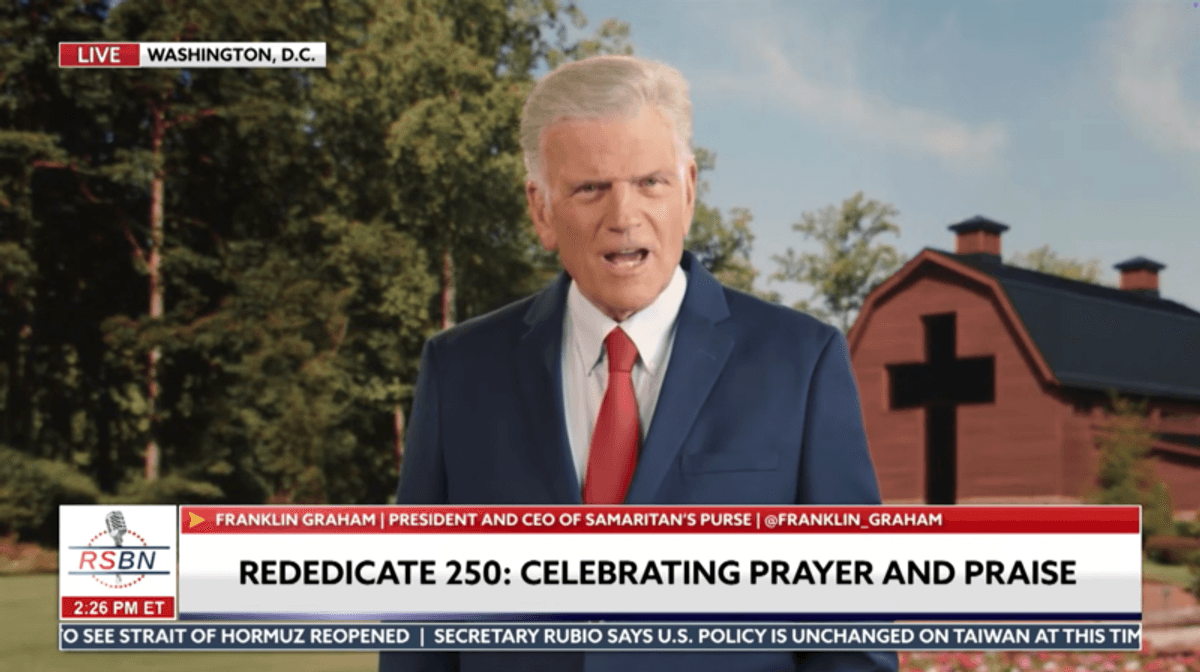
A prominent Evangelical reverend stunned political analysts and observers on Sunday with his speech during President Donald Trump's "Rededicate 250" prayer event at the National Mall.

The Rev. Franklin Graham, the son of the late preacher Billy Graham, spoke via a pre-recorded video at the prayer event, describing America as a country that has become "morally rotten" and "completely sick with sin." He mentioned issues like "transgenderism" and "opening women's locker rooms to men" as a couple of examples.

"Why do we need to rededicate ourselves?" Graham said. "When God sent the flood and destroyed the earth, it was because man's heart had become so evil and violent. In the news, we see unimaginable violence: rapes, murders, [and] unimaginable violence. Video games are full of violence. We have an insatiable appetite for violence."

Graham's comments came at a time when the Trump administration was receiving significant scrutiny for its handling of the war in Iran, including the president's multiple threats to annihilate the Iranian civilization.

The "Rededicate 250" event was billed as a "historic gathering of Americans" at the National Mall for worship, prayer, and "giving thanks for God’s presence in our national life throughout 250 years of American history," according to the event's website.

Political analysts and observers reacted to Graham's speech on social media.

"No mention of corruption, starting illegal wars, carpet bombing schools, funding genocide, building concentration camps, torture, destruction of the constitution, kicking people off healthcare, cutting free school meals, giving all the money to the rich? SHOCKING!" liberal political commentator Kyle Kulinski posted on X.

"Did he mention an actual sin that seems all too common—sexual abuse by clergy?" Bill Kristol, editor at large for The Bulwark, posted on X.

"It’s telling that Graham is never this concerned about poverty, health care access, or anything that would actually make people’s lives better," Hemant Mehta, a former "Jeopardy!" champion, posted on X. "Just bigotry all the way down. That’s what Jesus taught him."


Heavily edited video of Trump address at national prayer event sparks outrage

Robert Davis
May 17, 2026 
RAW STORY


CSPAN screenshot

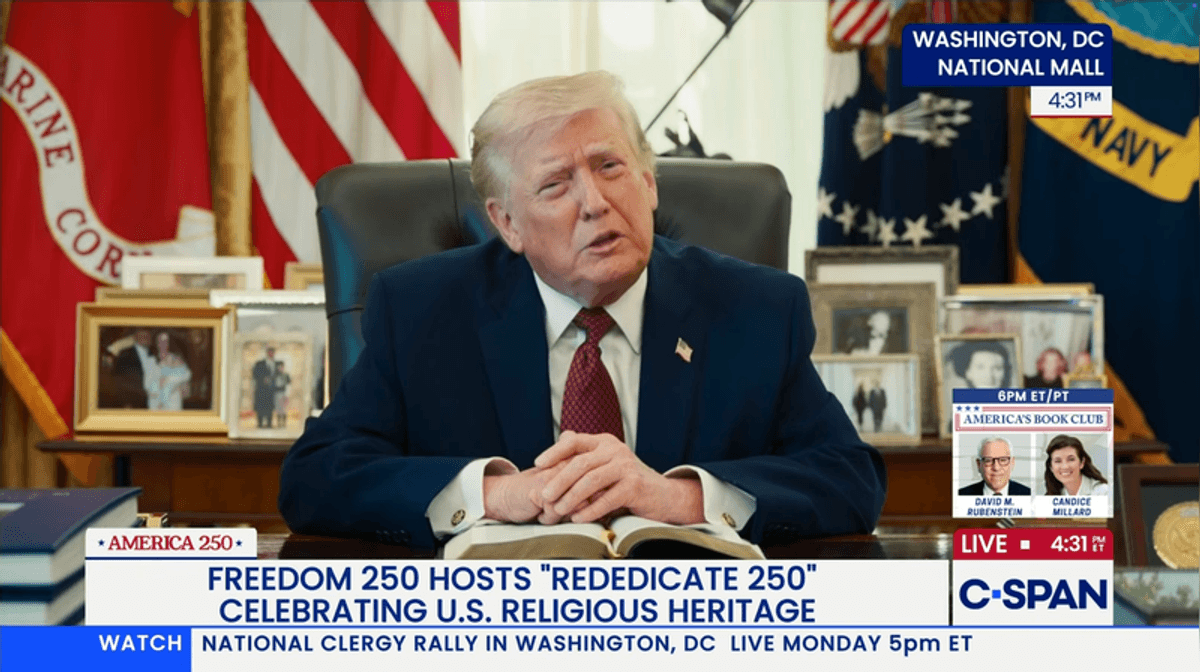
President Donald Trump sparked outrage on Sunday after his heavily edited recorded speech played at his national prayer event in Washington, D.C.

Trump addressed the crowd at his "Rededicate 250" event, billed as an effort to highlight "God’s presence in our national life throughout 250 years of American history," according to the event's website. It was held at the National Mall and featured appearances from Trump's Defense Secretary Pete Hegseth and several prominent MAGA and Evangelical Christian figures.

In the video, Trump appears to struggle to read a Bible verse. Onlookers also noted multiple edits to the video, which called the authenticity of Trump's message into question.

Political analysts and observers mocked the clip on social media.

"Holy s---," Ron Filipkowski, editor-in-chief of the MeidasTouch Network, posted on X. "This is a prerecorded message with lots of obvious edits, and this is the best he can do? He looks like a cadaver, sounds like he's on a ventilator, and can't even properly read the sections that come from a book he's never read."

"Lmao is Trump 'reading' a Bible verse from a teleprompter," political commentary account "Wu Tang is for the Children" posted on X.

"Disturbingly theocratic," Julian Andreone, Capitol Hill reporter for Drop Site News, posted on X.


Opinion

What Freedom 250’s prayer wall reveals about Christian nationalism’s true believers

(RNS) — Again and again, the prayers on the site show a portrait of a nation in pain, and that America is a divinely chosen place that must protect itself from enemies.


A broad variety of submitted prayers on the America Prays website. (Screen grab)

Karen E. Park
May 15, 2026
RNS

(RNS) — As part of the “Rededicate 250” event in Washington, D.C., on Sunday (May 17), organizers are inviting Americans to submit prayers for the nation through a public online “prayer wall” on the affiliated America Prays website. While the so-called rededication of the United States as “One Nation Under God” is drawing a great deal of attention for its fusion of politics, theology and nationalism, the prayer wall itself has received little scrutiny.

A close look at the words found on the site — where Americans are exhorted to “share what’s on your heart” in the verbal formulation of contemporary American evangelicalism — offers a rare opportunity to watch what looks like real Christian nationalism. It appears not merely as political rhetoric from movement leaders, but as lived devotional language among the posted prayers, which seem, not surprisingly, to be entirely Christian in their orientation.

The prayers on the wall are divided by categories like “Country,” “Military,” “Family,” “Healing” and “Peace.” Since there is a form that must be filled out by anyone wishing to contribute a prayer, it is reasonable to assume not all the prayers shared with the government through the website are posted publicly.

Many of the prayers are deeply personal. For example: “I am believing God for a new vehicle, furniture and beds for our place. Thank you.” –Texas, May 13. Or “Pray for daughter in law to get help for bipolar schizophrenia. . .My heart aches, I know God is in control.” — California, May 12. Another person says they are going through a “bad divorce,” but knows “God is my lawyer and he will make things right.”

Taken together, these anguished personal prayers reveal a portrait of a nation in pain.

The prayers use colloquial grammar and spelling, and appear to be written by real people – with real names and actual problems like ALS, joblessness and loneliness. In this way, the prayer wall provides a strikingly authentic contrast to the “Voices of Liberty” quotations elsewhere on the Freedom 250 website, which purport to be the words of “real Americans” explaining “what freedom means to them” but which appear to be AI-generated fakes.

But in Prayer Wall sections dedicated to “Country” and “Military,” the devotional language of Christian nationalism emerges clearly. Here is one example from Missouri, May 11: “Lord Jesus, King Jesus dawn our nation from the festering pit we have fallen into the past decades. Destroy our enemies physical and spiritual. Allow us to be the city on the hill you desired us to be. Allow us to discipline ourselves and other nations for your glory alone. We love you and rededicate ourselves now in your holy mighty name Jesus, Amen”


The prayer includes vivid language about personal devotion, national decline, spiritual warfare, American exceptionalism and fantasies of political restoration. To this person, the nation itself has become a sacred object: fallen, endangered, chosen and in need of purification and recommitment. But the nation is, at the same time, a weapon that can be used to “discipline other nations for your glory alone.”

A prayer card from the America Prays website of a prayer submitted from Missouri on May 11. (Screen grab)
A prayer card from the America Prays website of a prayer submitted from Arizona on May 14. (Screen grab)

Another prayer in the “Country” section (from Arizona, May 14) reads: “Lord Jesus please hear our cries for this nation and the world. You and only You can truly fight this battle we are in. This spitiritual [sic] battle against evil. I pray for our leaders to seek You in all they do, trust You and Your plans for this nation. That You would protect them and their families as they believe and trust in You. I pray Psalm 91 over this nation, especially verse 11: ‘For He will give His angels orders concerning you, to protect you in all your ways.'”

Again and again, the prayers on the site return to similar themes: America as a divinely chosen nation that has drifted from God; enemies both internal and external; fears of moral collapse; hopes for restoration; calls for repentance; and requests for divine protection over the country and its leaders.

The prayer wall, taken as a whole, is especially striking for the way in which these grand national and religious narratives coexist alongside deeply ordinary personal anxieties. The result is an emotional public theology in which private suffering, national identity, religious symbolism and political longing are deeply intertwined.

The fusion of the theological and the political has long been part of American religious life. Historians have noted the persistence of providential language in American politics from the Puritans onward — the belief that the U.S. possesses a unique divine mission and stands in a covenantal relationship with God. But the prayers collected on the Freedom 250 site reveal how intensely devotional that language remains for many Americans. The nation is imagined as more than a political entity, but as a spiritual project whose fortunes rise and fall according to both divine favor and satanic power.

The language of spiritual warfare appears repeatedly on the prayer wall, across all categories. Participants pray against “darkness,” “evil forces” and enemies “physical and spiritual,” as well as attacks on Christianity itself. In many cases, the boundaries between political opponents, cultural change, demonic influence and national decline are impossible to separate.


The prayers also reveal the continuing emotional power of older forms of American civil religion. References to the U.S. as a “city on a hill,” to national chosenness and to America’s divine purpose appear constantly throughout the submissions. What emerges is a vision of the nation not as a democratic republic governed by the people or of a constitutional order governed by laws, but as a sacred community whose religious identity is in need of urgent restoration and defense.

While the speeches that will be made on the National Mall by religious and governmental leaders like Speaker Mike Johnson, the Rev. Franklin Graham and Bishop Robert Barron will be important to analyze and contextualize, the prayer wall may actually tell us more about the emotional and spiritual structure of contemporary Christian nationalism than the speeches ever could. The Freedom 250 prayer wall offers a glimpse into how Christian nationalist ideas operate not only as political arguments or propaganda being imposed from above, but as useful and powerful frameworks through which many Americans interpret their own suffering, hope, fear and national identity.

(Karen E. Park, a historian of American Christianity, is co-editor of “American Patroness: Marian Shrines and the Making of US Catholicism.” She writes on Substack at Ex Voto. The views expressed in this commentary do not necessarily reflect those of Religion News Service.)

Christian group has '15-foot-tall' surprise in store for 'Church of Trump' DC event

Alexander Willis
May 17, 2026 
RAW STORY


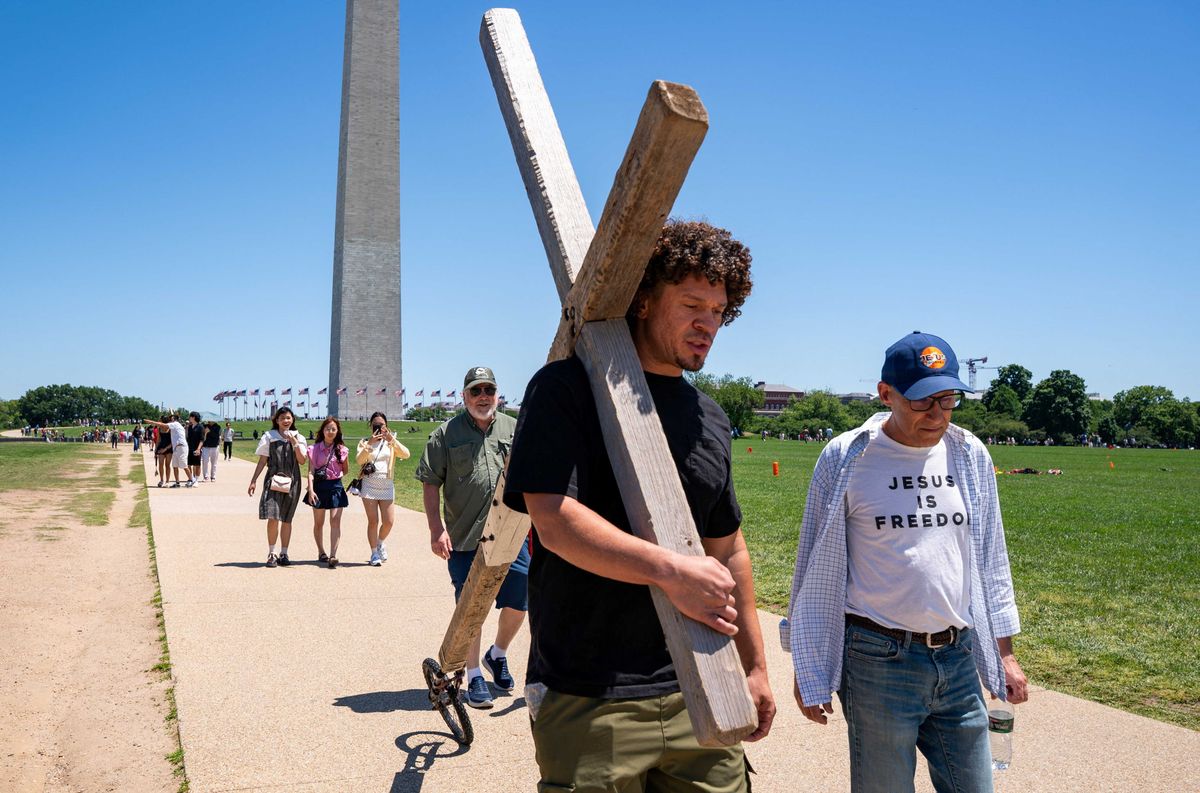
A man carries a wooden cross near the Washington Monument ahead of the "Rededicate 250: National Jubilee of Prayer, Praise and Thanksgiving" event aimed to celebrate America's 250th birthday, in Washington, D.C. , U.S. May 16, 2026. REUTERS/Seth Herald


President Donald Trump is expected to be joined by several of his top officials and allies Sunday in Washington, D.C. for Rededicate 250, a national prayer event hosted on the National Mall, and one Christian group is working to erect a “15-foot-tall” surprise for the president in protest.

Organized by Freedom250, a Trump-aligned group that has received millions of taxpayer dollars, the event has been decried by some critics as promoting Christian nationalism. The government watchdog group Public Citizen, for instance, condemned the event as being “less like a traditional religious event and more like a program for the Church of Trump.”

Thousands are expected to attend the free event, among them being protesters, some of whom belong to Faithful America, which describes itself as a “network of progressive Christians,” per a report published Sunday by The Washington Post, which described them as a “Christian group focused on opposing religious nationalism.”


Working in tandem with another group, Freedom From Religion Foundation, which the Post described as a “mostly secular group focused on church-state separation," the two groups have a surprise planned for the president, one that appears to parody the recent erection of a 22-foot-tall, $400,000 gold-plated statue of Trump at one of his golf clubs.

“The organizations said they will erect a 15-foot-tall balloon of ‘a golden calf with a Trump-like visage’ a few blocks from the prayer event,” the Post reported.

The nation’s capital has been host to a number of installations designed to mock the president, including the installation of satirical arcade game cabinets last week mocking Trump’s wildly unpopular war against Iran, and the erection of statues depicting Trump with convicted sex-offender Jeffrey Epstein.


Rededicate 250 touts a star-studded prayer bash with politicians, Christian celebrities

(RNS) — But a new poll finds many Americans aren’t comfortable mixing religion and politics.


Work continues on the stage for the Rededicate 250 event on the National Mall, Tuesday, May 12, 2026, in Washington. (AP Photo/Alex Brandon)

Kathryn Post and Yonat Shimron
May 14, 2026
RNS

(RNS) — Bishops, evangelical influencers, Cabinet members and an actor who plays Jesus are a few of the speakers and performers scheduled to participate in “Rededicate 250,” the Trump administration’s daylong prayer celebration happening on the National Mall this weekend.

Advertised as a “rededication of our country as One Nation Under God” and a “once in a lifetime national moment,” the Sunday event is intended to reflect on the faith of America’s founders and to appeal to God to bless and guide the nation. It’s an initiative of Freedom 250, a White House-backed, public-private campaign staging patriotic events to celebrate the nation’s 250th birthday (not to be confused with the bipartisan America 250 efforts). Supporters welcome the event as a tribute to America’s roots, while critics say the Christian-saturated, MAGA-heavy festival casts an exclusionary vision of America’s past and present. Americans United for Separation of Church and State suggested the event advances Christian nationalism rather than religious freedom.

The rally has inspired both supportive and oppositional pre-events, the former led by activist and worship leader Sean Feucht, and the latter spearheaded by the Interfaith Alliance and a cadre of progressive religious leaders.

In recent days, a handful of Christian celebrities have been announced as Rededicate 250 participants. Grammy-winning Christian musician Chris Tomlin, known for the hits “Holy Forever” and “How Great Is Our God,” will headline the event. Jonathan Roumie, the Catholic actor, influencer and star of the hit Jesus show “The Chosen,” was recently added as a speaker. Roumie has spoken at the March For Life and starred in a Super Bowl ad. He will be joined by evangelical influencer, podcast host and “Duck Dynasty” alum Sadie Robertson Huff, who built a ministry platform catered to women and has over 5 million Instagram followers.


Other listed speakers include many of President Donald Trump’s closest friends and allies, most of them conservative Christians. Prominent political figures include House Speaker Mike Johnson (a Southern Baptist); Defense Secretary Pete Hegseth (who worships in churches linked to the Communion of Reformed Evangelical Churches); and Secretary of State Marco Rubio (a Catholic). Trump is expected to send a recorded video message.

Of the 19 faith leaders currently listed, 18 are Christian, and most are evangelical. Among them are the Rev. Franklin Graham, president and CEO of the Billy Graham Evangelistic Association; Pastor Samuel Rodriguez, president of the National Hispanic Christian Leadership Conference; Pentecostal preacher and White House faith office senior adviser Paula White-Cain; and Pastor Robert Jeffress, who leads First Baptist Church in Dallas.

Bishop Robert Barron, who leads the Diocese of Winona-Rochester, Minnesota, and Cardinal Timothy Dolan, who recently retired from his position as bishop of the Archdiocese of New York, both Catholic, are also scheduled speakers.

The only non-Christian religious leader currently listed is Rabbi Meir Soloveichik, who leads Congregation Shearith Israel in New York City and serves on Trump’s Religious Liberty Commission.

Why Hillsdale? The Christian liberal arts school hosting Erika Kirk for commencement

According to organizers, the speaker list is still being finalized.

If Trump’s religious revival is meant to encourage a fusion of Christianity and government, a new Pew Research poll released Thursday (May 14) shows Americans are not buying it. Although more than half of Americans say religion plays a positive role in society, they do not want their government to stop enforcing separation of church and state.

The poll, taken in April among 3,592 U.S. adults, shows that those views have barely budged over the past few years. Eight of out 10 Americans say religious congregations should not support candidates in elections. And two-thirds say churches and other houses of worship should keep out of political matters.


“17% of U.S. adults now say they want Christianity to be the official religion of the U.S.” (Graphic courtesy of Pew Research Center)

As for Christian nationalism, the poll shows, it is far from popular.

Only 17% of Americans think the government should declare Christianity the official religion of the U.S., a slight jump over 2024 when 13% said so. Generally, the idea of Christian nationalism remains more negative than positive: 31% view it unfavorably, 10% view it favorably and the rest don’t know enough or don’t have an opinion.

“To the extent that President Trump has a rally that explicitly espouses Christian nationalism, he’s not going to get very far beyond, perhaps, the people at the rally,” said John Green, professor emeritus of political science at the University of Akron. “There are people that have that view, but they’re a very small minority, even within the Republican Party.”

The poll also found 52% of U.S. adults think “conservative Christians have gone too far in trying to push their religious values in the government and public schools.” It had a margin of error of plus or minus 1.9 percentage points.

Feucht, the activist and musician, and Pastor Mark Driscoll, who were previously rumored to be Rededicate 250 participants, will instead be hosting a concert at Washington, D.C.’s Sylvan Theater. In a video this week, Feucht said Driscoll would join him at Saturday’s concert, which he described as a “four-hour revival meeting” that’s part of the battle for the “soul of America.”

Several groups have come out against Rededicate 250. The Council on American-Islamic Relations called for organizers to expand the speakers list to better reflect the nation’s diverse religious landscape.

“Muslims have been present in significant numbers in the country since the colonial era,” the advocacy organization said. “Inviting speakers who represent many faiths projects the strength of our religious liberty.”

Americans United for Separation of Church and State said the event advanced Christian nationalism rather than religious freedom, and on Friday, a group of progressive faith leaders — including the Rev. Paul Raushenbush, president and CEO of the Interfaith Alliance; Rabbi Jonah Pesner, director of the Religious Action Center of Reform Judaism; and the Rev. Adam Russell Taylor, president of Sojourners — will host a virtual press briefing that argues Rededicate 250 misrepresents how America’s founders approached religious tolerance.

As a counterpoint to the Rededicate event, Interfaith Alliance said it will team up with protest artist Robin Bell to project pro-religious freedom messages, including “Democracy NOT Theocracy” and “Reject Christian Nationalism,” on the walls of the National Gallery of Art on Thursday evening.

“Instead of leaning into the incredible tapestry of American religion, they’re really only highlighting a thin slice of American religiosity, and elevating it into a primary role and a privileged role, one could argue, with government funding,” Raushenbush said. “Unfortunately it feels more like a political rally than a religious one.”

Jack Jenkins contributed to this reporting.


Christian nationalists cling to Trump because they 'know they’re in decline'


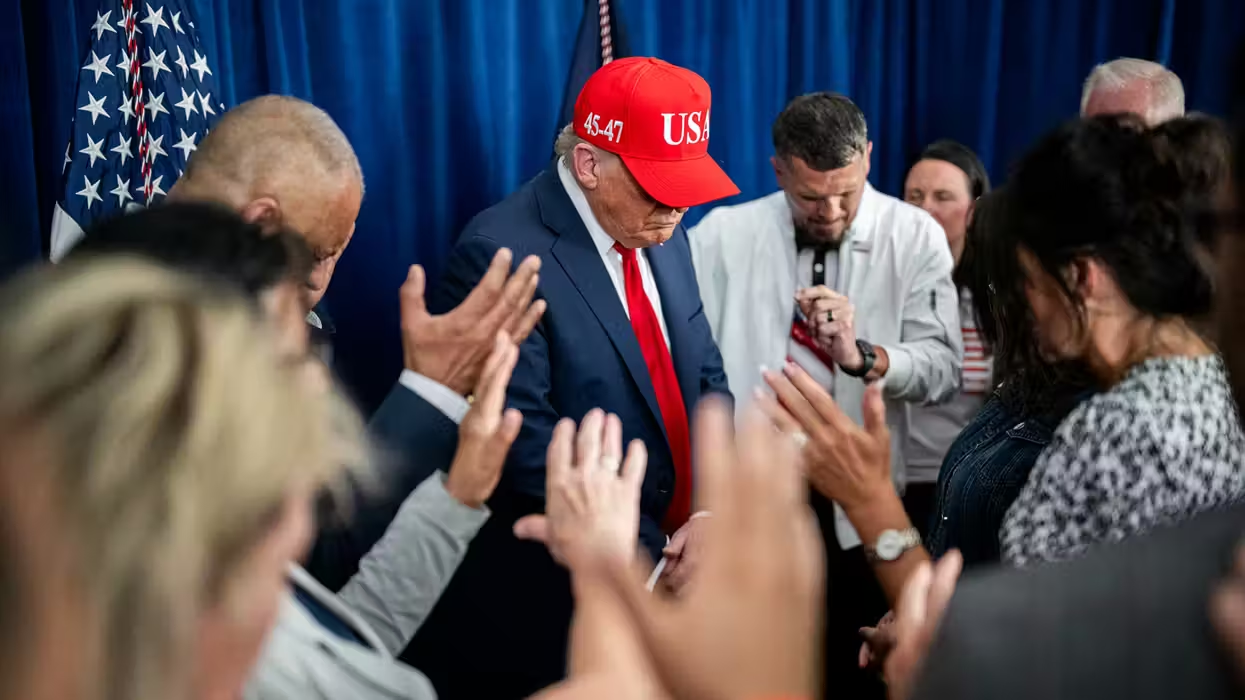
Faith leaders pray over President Donald Trump in the Oval Office, Image via the White House.
May 14, 2026
ALTERNET

President Donald Trump and his administration have openly preached for Christianity to shape national policy since he began his second term — yet the vast majority of Americans do not share this agenda.

“The religious right has been ascendant during the second presidency of Donald Trump, and they’ve harnessed his disdain for rules and norms to blur the lines between church and state,” reported Vox's Christian Paz on Thursday. “Inside the White House, the secretary of defense has framed the war in Iran and American military action abroad as sanctioned and guided by God. Outside the government, this alliance between church and state often skirts near the edge of outright idolatry. Conservative pastors are erecting golden statues of Trump (but insisting it does not mirror the infamous golden calf of the Old Testament). They’re extending their hands over the president in prayer after comparing him to Jesus and standing by him, with some mild criticism, after he cast himself as an AI-slop Messiah.”

Yet despite this open call for religion to dictate American policy, Paz reported that a recent survey by Pew Research Center reveals that most Americans do not want this to happen. A mere 10 percent identify as Christian nationalists, compared to 31 percent who oppose them and 59 percent who have no opinion. When it comes to the division between church and state, 13 percent want it weakened while 54 percent support it and 32 percent have no opinion.


According to the Public Religion Research Institute’s president and founder Robert P. Jones, Trump and his administration are pushing for “one sector of Christianity" that has failed to catch on with both religious and non-religious Americans.

“It hasn’t resulted in major shifts in the landscape,” Jones explained. “In other words, they’re not pulling people into that worldview. They’re basically just appealing to a small subset of Americans who already hold those views and who just happen to be their political base.”


Even some former Trumpers oppose Trump’s Christian nationalism. In March former Republican US Rep. Joe Walsh said that the theocrats are “out of the closet. They're loud and proud. Speaker of the House Mike Johnson talks about this. Republican members of Congress talk about this. Republican and MAGA thought leaders talk about the fact that America needs to be a Christian country. It needs to be officially designated as a Christian country.”

Citing how Secretary of Defense Pete Hegseth openly cited Jesus Christ when discussing his war against Iran with US troops, Walsh added that Hegseth “knows that not every American worships Jesus Christ. So what's he doing? Here's what he's doing. Pete Hegseth is a white Christian nationalist. Pete Hegseth, the Secretary of Defense, is a white Christian nationalist. He wants America to be a white Christian nation.”

“Our founders were very enlightened,” Walsh continued, saying that even though many of them were religious Christians they made sure that “we do not have an official state religion. The very thought of that, the very notion of that is antithetical to what America is. … Christian nationalism is utterly un-American … as un-American as Islamism is. … Islamism is a radical concept that everybody's got to be Islam. Christian nationalism, same thing. Everybody's got to be Christian. Both are utterly un-American.”


He added, “And I guess what I'm saying right now is, as I close on this, this Un-American, and by the way, un-Christian belief, has overtaken the Republican Party. And we need everybody to wake up to it. Fast. and help all of us, help everyone defeat it.”