Sunday, May 17, 2026


US Trapped by Iran’s Resilience; Why the Solution Is Agreement, Not Attrition


by | May 15, 2026

In recent months, a painful but increasingly undeniable conclusion has begun to emerge across Western think tanks, mainstream media, and U.S. intelligence assessments: contrary to Washington and Tel Aviv’s initial expectations, Iran has neither collapsed, fragmented, nor moved toward surrender. On the contrary, the conflict has exposed layers of what can only be described as Iran’s “structural resilience” – a resilience many in the West either underestimated or failed to include in their strategic calculations altogether. The central question is no longer whether the United States can inflict damage on Iran. The real question is whether such pressure is actually capable of producing Washington’s desired political outcome.An increasing number of Western analyses now suggest the answer is no. The United States and its allies are gradually realizing that they are confronting a country capable of enduring pressure, reproducing internal control, managing crises, and exporting the costs of war beyond its borders. This reality has drawn Washington into what may be called “the trap of Iranian resilience” – a situation in which continued pressure no longer changes Tehran’s behavior but instead exponentially raises the costs for America itself.

In the early stages of escalating confrontation, the dominant assumption in Washington was that a combination of military strikes, maritime pressure, infrastructure destruction, and psychological warfare could disrupt Iran’s decision-making system. Yet even some recent U.S. intelligence assessments now acknowledge that Iran possesses the capacity to withstand sustained pressure over a prolonged period. When classified evaluations speak of Iran’s ability to endure months of maritime pressure and blockade, it effectively means that America’s most important coercive lever has failed to produce the rapid strategic results initially anticipated. This issue extends far beyond the military battlefield. One of the most significant dimensions of Iran’s resilience lies in its ability to transfer the costs of conflict to the global economy. Rising insecurity along energy routes, scattered attacks in strategic waterways, and disruptions to maritime security have directly affected global energy markets. The surge in oil prices beyond psychologically critical thresholds is not merely an economic indicator; it is a geopolitical message. Iran has demonstrated that if it is forced to bear the costs of war, those costs will not remain confined within its own borders. Instead, part of the burden will be shifted onto the global economy, international energy markets, and even the domestic political environment inside the United States. This is precisely where America’s strategy begins to erode. Washington has entered a conflict that becomes more costly the longer it continues – from inflationary pressure and domestic political divisions to the depletion of military stockpiles and growing criticism regarding the war’s unclear objectives. What was initially framed as an operation to rapidly contain Iran has increasingly become a stage upon which the limitations of American power are being exposed.

Inside Iran, meanwhile, the war has not produced the kind of social collapse many Western circles expected. New Western analyses openly acknowledge that the wartime atmosphere has actually helped the Iranian state reassert security control over public space. The political system has relied on loyalist networks, security organization, and the cohesion of the regime’s hard core to reinforce social control. In other words, rather than weakening the political structure, the conflict has given it an opportunity to redefine and rebuild its security order. This point is strategically significant for the United States because a major part of the initial calculations rested on the assumption that external pressure could widen internal fractures and transform public dissatisfaction into political crisis. Yet even some Western media outlets now concede that the wartime environment has reduced the visibility and activity of opposition groups while restoring a more securitized atmosphere in urban spaces. This means one of the central indirect objectives of maximum pressure has also failed to materialize.

At the same time, Iran’s power structure has not suffered the kind of paralysis Western strategists anticipated. Recent intelligence assessments suggest that even under wartime conditions, Iran’s political system has managed to establish a form of controlled distribution of power – a model in which decision-making is coordinated across institutions, preventing a complete breakdown of command structures. This is precisely what distinguishes Iran’s structural resilience from many other regional actors. In numerous states, severe military pressure can trigger the collapse of the chain of command. In Iran, however, the system appears designed to preserve operational continuity even under crisis conditions.

In the military sphere, the West is also gradually recognizing that the complete destruction of Iran’s deterrence capabilities is nearly impossible. The survival of significant portions of Iran’s missile infrastructure and launch capabilities sends a clear message: even large-scale attacks cannot reduce Iran’s capacity for retaliation to zero. This is why many newer Western analyses have replaced earlier ambitions of collapse or regime transformation with the more limited concept of “containment.” That shift in language is, in reality, an indirect admission that the original strategic goals have failed.

Perhaps the most important factor complicating the equation, however, is the international dimension of the conflict. The confrontation with Iran is no longer merely a bilateral struggle. Growing Russian support and the emergence of a broader anti-Western alignment around Tehran indicate that this conflict is increasingly becoming part of a larger global power competition. Military technology transfers, intelligence cooperation, and logistical support provide Iran with the means to sustain a prolonged war of attrition. This poses a major challenge for the United States because Washington is no longer dealing solely with Iran, but with a network of actors who increasingly view the weakening of American influence as aligned with their own strategic interests.

Under such circumstances, continued attempts to break Iran’s resilience look less like a realistic strategy and more like a gradual erosion of American power itself. The experience of recent years has demonstrated that Iran cannot be managed through formulas designed for fragile states. Economic pressure alone did not collapse the political system. Military threats did not produce surrender. War itself failed to destroy the cohesion of the state. On the contrary, every stage of external pressure appears to have activated new mechanisms of adaptation and reconstruction within Iran.

This raises the central question: if breaking Iran is not possible, then what is the logical alternative?

An increasingly serious answer is beginning to emerge even within some Western circles: accepting the reality of Iran’s resilience and moving toward a fair agreement. The United States must recognize that the issue with Iran is not one of elimination or collapse, but rather the management of an established regional power. The longer Washington delays acknowledging this reality, the greater the costs it will incur – economically, strategically, and geopolitically.

A negotiated settlement with Iran should not be viewed as a sign of American weakness. Rather, it would represent an acknowledgment of the limits of power in a world no longer governed by the unipolar assumptions of past decades. Iran has demonstrated an ability to absorb pressure, impose costs, and buy time. Under such conditions, continuing a war of attrition only deepens the crisis.

Ultimately, perhaps the most important lesson of this confrontation for the United States is that not every power can be managed through a strategy of “pressure until surrender.” Some states – especially those possessing geopolitical depth, cohesive security structures, and asymmetric warfare capabilities – cannot be broken; they can only be engaged through compromise. Iran today occupies precisely such a position: a country not on the verge of collapse, but one increasingly forcing the West to recognize that the path out of crisis lies not in fantasies of defeating Iran, but in accepting reality and pursuing a balanced and sustainable agreement.

Greg Pence is an international studies graduate of University of San Francisco and my articles have been published on websites like Middle East Monitor.

All The Time In The World… NOT!

by | May 18, 2026

If the Donald does not wish to bring down upon himself the ignominy of being the first US president to be impeached, convicted and removed from the White House by the US Marshals, he damn well better start reading the Iranian settlement proposals.

Even if he doesn’t like the first sentence, as he boasted.

I looked at it, and I don’t like the first sentence. I just throw it away.

That’s because he doesn’t have “all the time in the world” to find an off-ramp from his Iranian War disaster, as he claims. In fact, the dual blockade he has triggered in the Persian Gulf is fast draining the world’s working stockpiles of a broad array of commodities. About 30 million BOE/day (barrels of oil equivalent) is ordinarily generated inside the Persian Gulf and exported to the global economy, including petroleum in all its product variants, LNG, LPGs, sulfur, helium, aluminum and more.

In the case of petroleum products alone, the stockpile drain is now turning into a torrent, as we reach the 76th day in which normal Persian Gulf export volumes have been reduced by 90% or more. And although the current inventory balances look big because stockpiles are measured in the billions of barrels, the picture is deteriorating far faster than its appears to be on the surface.

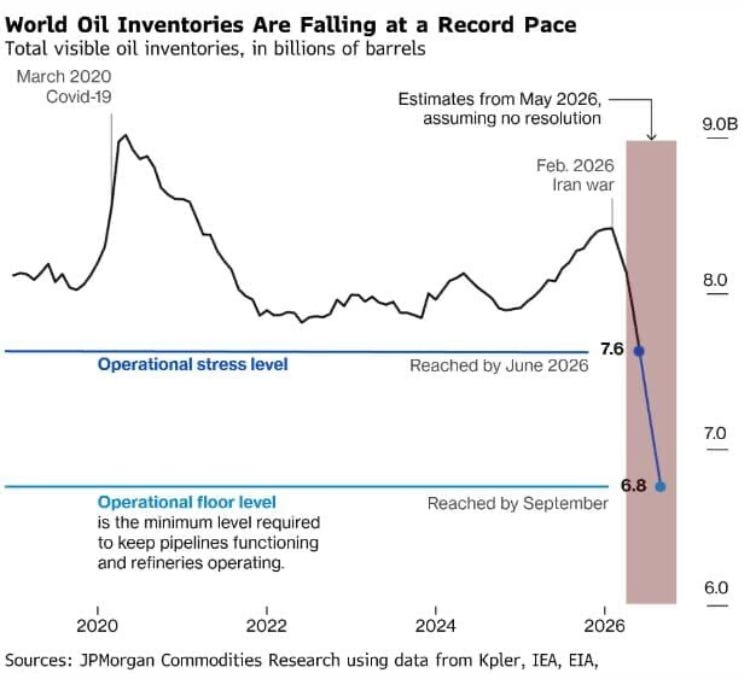
In the first place at the onset of Bibi & Trumpy’s foolish war on Iran, global commercial stocks of crude and products combined were unusually high at about 8.5 billion barrels, owing to a modest surplus of production versus consumption during the last two years.

However, it should also be noted that the true recent baseline for global commercial petroleum stocks is a fair amount lower or about +/- 8 billion barrels per the graph above. So there was an extraordinary cushion of about 500 million barrels at the start of the war, but that’s already long gone.

Moreover, the aberrantly high levels shown for Q1 2020 (9 billion barrels +) doesn’t really provide any useful benchmark because that was strictly due to pandemic-based worldwide shutdowns of normal economic activity in consumption sectors ranging from cancelled global airline flights, to reduced trucking and rail mileage, to domestic travel and commuter-based curtailment of gasoline use.

Secondly, when you look at the normal global commercial stocks of about 8.0 billion barrels from the bottom up, it quickly becomes apparent that most of these barrels are spoken for and are not available as inventory cushion to prolong the Donald’s apparent waiting game. For instance, there is normally about 1.0 billion barrels in transit on the blue water in tankers, but those barrels are not some kind of floating surplus; they are actually the product of physics and current shipping technology.

To wit, it takes between 20 and 40 days for most global waterborne transit to get to Japan, China, Taiwan, Korea or Rotterdam or the US Gulf coast from the Persian Gulf, among dozens of other in-take points. Over any reasonable period of time, the the VLCCs which transport most of the global waterborne inventory are not going to get any bigger or travel any faster.

So this amounts to what is known as “pipeline fill” in the trade, but is only the most obvious case of a multitude of storage and transit points between the oilfields of the Persian Gulf and end markets. You have the same thing, with overland pipelines throughout the US, Europe, Russia, China and places in-between, where there are tens of millions of barrels always moving through system.

Next, there are massive tank farms at refinery and upstream distribution points. Likewise, hundreds of millions of barrels at any moment in time are moving through petroleum product pipelines, rail tankers, trucking tankers and other channels of distribution downstream of refineries.

And yet that’s not the whole of it. As you move closer to retail and end users there are more refined product tank farms, hundreds of thousands of gasoline and diesel fuel stations with their own storage tanks, and finally hundreds of millions of auto, tractors, trucks, locomotives and aircraft, which carry their own rolling inventories

Just in the case of the the light vehicle fleet in the USA, there are 285 million vehicles on the roads, which carry about 2.42 billion gallons of fuel at any point in time. That’s another 58 million barrels in the working inventory of the system.

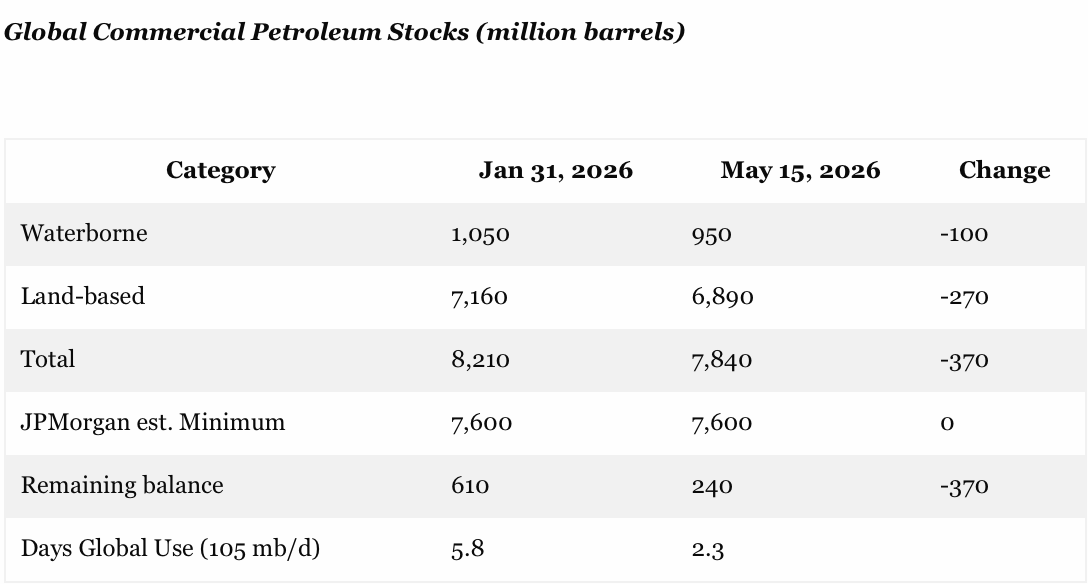
In any event, JPMorgan estimates that this normal “pipeline fill” or working inventory amounts to about 6.8 billion barrels on a worldwide basis. So even though the global commercial stocks totaled about 8.21 billion barrels on the eve of the war on January 31, upwards of 83% of that represented working inventories rather than a usable supply cushion.

Thus, as shown in the table below, the true usable surplus in the global petroleum inventory was about 610 million barrels as if January 31st, which represented just 5.8 days of ordinary global consumption of about 105 million barrels per day. Moreover, due to stockpile depletion since then as of May 15, the waterborne stock is down by-100 million barrels and land-based stock by -270 million barrels.

Overall, 370 million barrels or 60% of the true pre-war surplus has already been used up. So the current 240 million barrel excess above the JPMorgan estimated minimum working inventory amounts to just 2.3 days of normal global consumption.

When the system drops below the 7.6 billion working inventory minimum level, random disruptions begin to erupt unpredictably. For instance, refineries use a variety of different grades of crude oil, and if a certain blend-stock comes in short, refinery output and downstream availability can be sharply curtailed. Likewise, refinery product slates are extremely complex ranging from LPGs to jet fuel, gasoline, several distillate blends, heavy oils, asphalt and much more in-between.

When these output become unbalanced in the distribution system, more compounding outages and shortages develop. And that’s to say nothing at all about the true Big Enchilada of this massive, complex and delicate supply chain. To wit, the 7.6 billion barrel working inventory estimated by JPMorgan represents normal, steady-state, non-disrupted conditions.

But when shortages or outages develop or even fears of them proliferate, operators up and down the petroleum supply chain begin to build up precautionary stocks. This is, what was known as”topping the tank” during the supply disruptions of the 1970s. It amounts to rational hoarding behavior in the face of a stressed supply chain.

For instance, just adding 7 gallons to the normal auto tank in the USA alone, as happened in the 1970s, would drain upwards of 50 million barrels of inventory from the supply chain upstream of the gas pumps.

In all, therefore, the global inventory system is very close to the edge of a hoarding breakout. That is, at the point where there is very little true surplus cushion left in the global inventory system and hoarding based supply disruptions begin dramatically disrupt and roil the system.

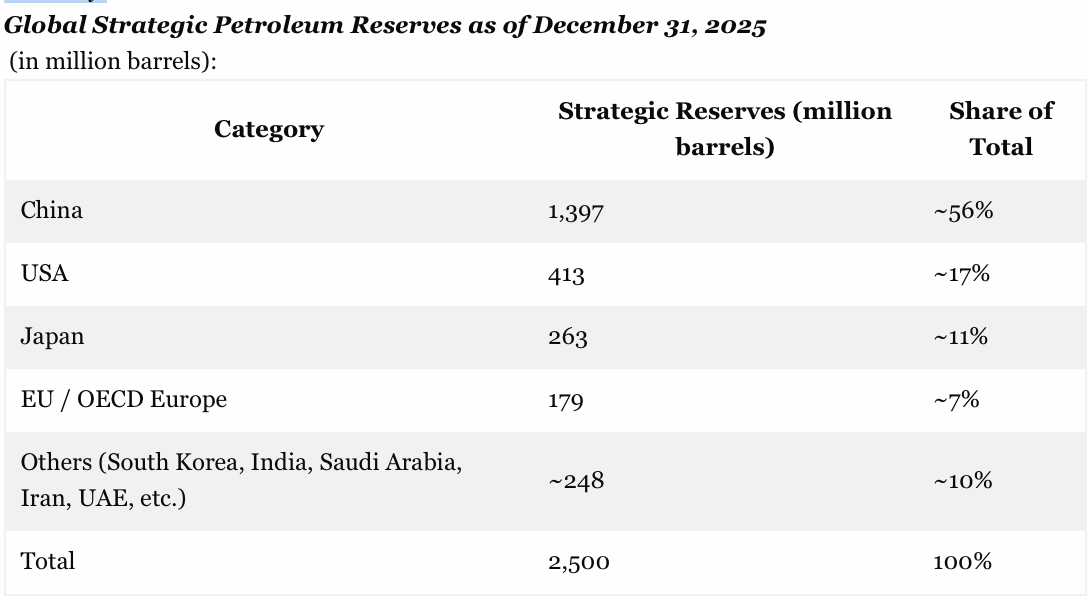
To be sure, there is another 2.5 billion barrels of so called strategic or govenrment managed “emergency” stockpiles, but these numbers aren’t nearly what they are cracked up to be, either. As shown below, 55% of the total is held by China, which may or may not release it into world markets based on what suits the convenience and purposes of the rulers in Beijing.

Notably, Trump didn’t even raise the issue during his visit—notwithstanding the fact that Chairman Xi sits on 50% of all the available surplus on the planet (2.5 billion of strategic reserve stocks plus the above calculated 240 million barrels of remaining excess commercial stocks). Likewise, Japan sits at the end of a 30 day supply line from the Persian Gulf that has been essentially shutdown until the Donald’s war ends, meaning Tokyo is likely to hoard its own strategic reserves zealously.

And this gets us to the Donald’s real delusion: To wit, the false belief that “drill baby, drill” policies and surging US petroleum exports means that he can wait to settle the war as long as he pleases because the US economy is somehow insulated from the supply and price dislocations now roiling the global markets.

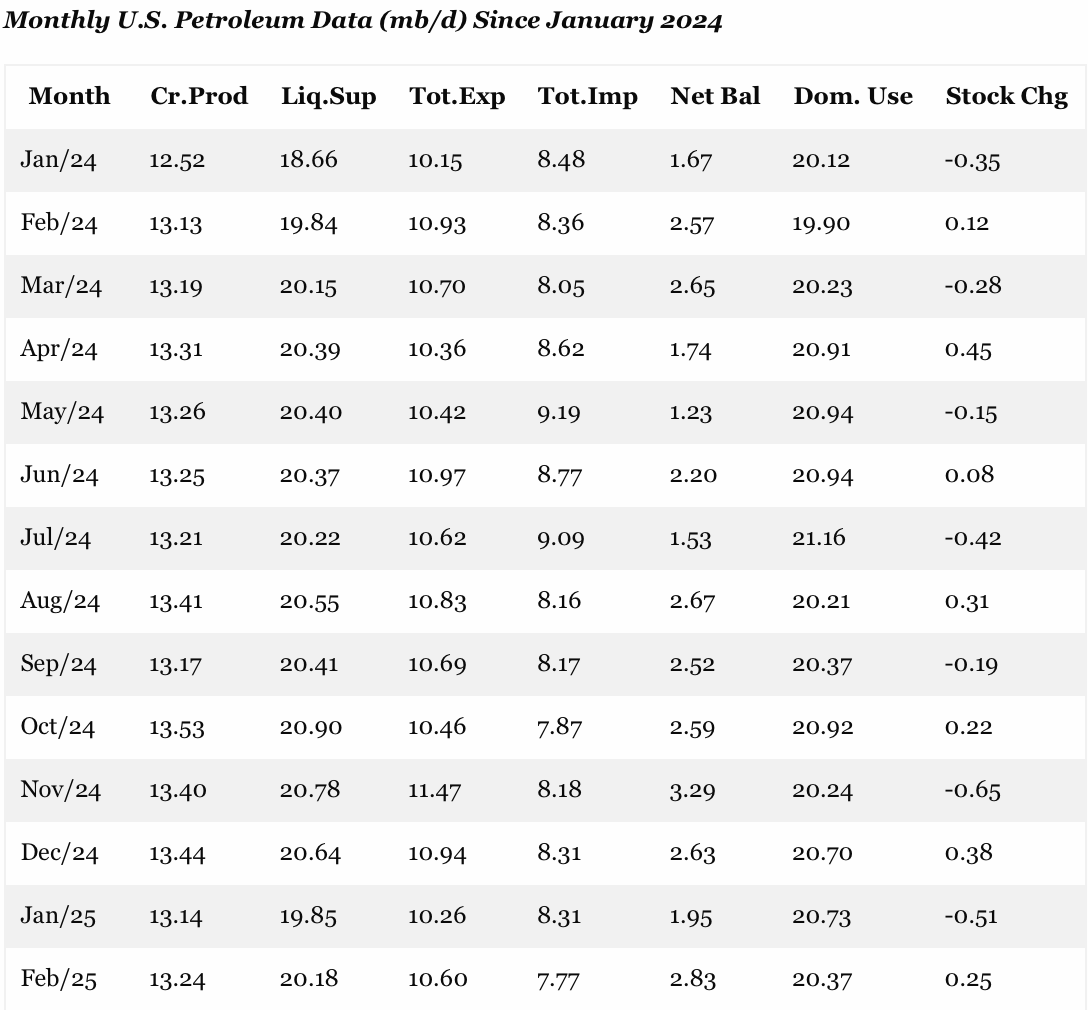
He’s dead wrong. When you track through the numbers carefully, as was done by Grok 4 in the table below, it becomes blatantly obvious that the only thing really going on is that the huge export shortfall from the Persian Gulf is resulting in nearly a barrel-for-barrel drain on US commercial and SPR stockpiles.

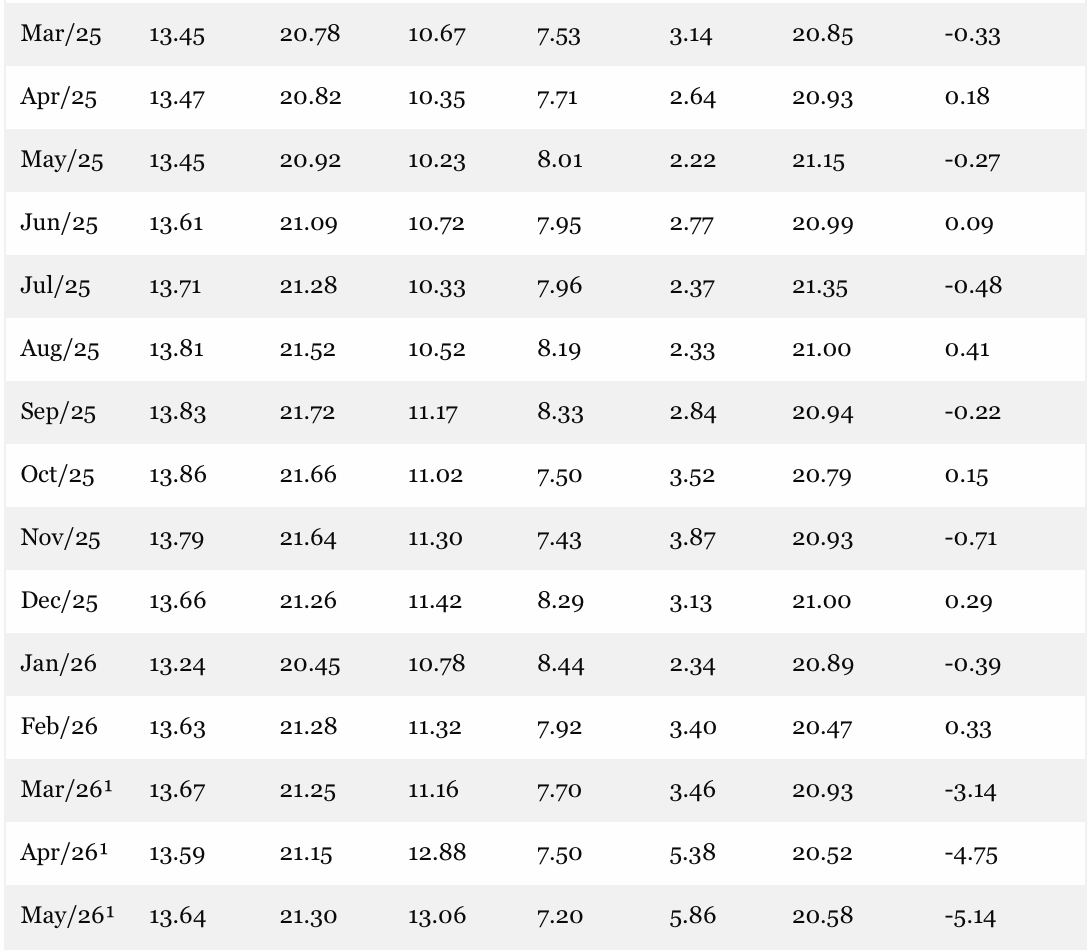
That’s right. Since February 28th there has been no increase in either crude oil production at about 13.6 million barrels/day (first column) nor total liquids production (second column). The latter includes natural gas liquids and refinery gains, where production is averaging about 21.2 million barrel per day.

At the same time, US exports have soared, as the Donald has been wont to point out. Combined exports of crude oil and products totaled 11.32 million barrels in February before any war impact and rerouting of tankers to the US Gulf Coast. But as of mid-May, the run rate of exports has hit 13.06 million barrels per day, representing a +1.74 million barrel per day gain in US petroleum exports.

So the question recurs. If production has not increased where did the surge in US exports come from?

Alas, the table below gives the answer: Whether he knows it or not, the Donald is draining the gas tank.

That is to say, 100% of the increase in exports has been derived from drawing down commercial stocks and the government SPR (Strategic Petroleum Reserve).

  • Cr.Prod = Crude Oil Production
  • Liq.Sup = Liquids Supply (Crude + NGPL)
  • Tot.Exp = Total Exports (Crude + Products)
  • Tot.Imp = Total Imports (Crude + Products)
  • Net Bal = Net Exports (Exports – Imports)
  • Dom. Use = Domestic Use / Product Supplied (apparent consumption) — stable ~20.5–21.4 mb/d
  • Stock Chg = Total inventory change (commercial + SPR); large negative = big draw

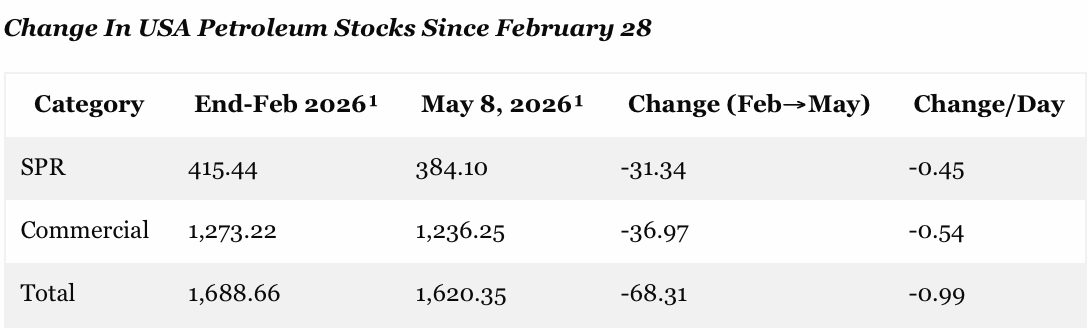
For want of doubt, here are the before and after stock numbers for the USA. Between February 28 and May 15 upwards of 68 million barrels have been drawn down from the SPR and commercial stocks. That amounts to 1 million barrels per day for the period as a whole; and explains how the huge surge of exports during the last six weeks of April and May to date have been supplied.

Notes:

  • SPR: Crude oil only (Strategic Petroleum Reserve).
  • Commercial: All commercial inventories (crude oil + petroleum products, excl. SPR).
  • Total: SPR + Commercial.
  • Large draws driven by record-high net exports in March–May 2026 while production and domestic use remained stable.
  • Daily rates show consistent inventory pressure (~1 million barrels per day total draw on average).

In a word, if the Donald had someone around him competent (and brave) enough to explain to the POTUS that he is draining the US petroleum tank at an unsustainable rate, he might start reading the entirety of what Iran is putting on the table.

As it is, he is within a few months of thundering petroleum supply chain crash landing in both the global market, but also on main street America, as well. If that happens, a Dem sweep in the fall elections and the first ever impeachment and removal from office of a sitting president is on the table.

To use to the Donald’s favorite phrase, that will truly be like something you have never seen before.

David Stockman was a two-term Congressman from Michigan. He was also the Director of the Office of Management and Budget under President Ronald Reagan. After leaving the White House, Stockman had a 20-year career on Wall Street. He’s the author of three books, The Triumph of Politics: Why the Reagan Revolution Failed, The Great Deformation: The Corruption of Capitalism in America, TRUMPED! A Nation on the Brink of Ruin… And How to Bring It Back, and the recently released Great Money Bubble: Protect Yourself From The Coming Inflation Storm. He also is founder of David Stockman’s Contra Corner and David Stockman’s Bubble Finance Trader.

The Man Who Seeks To Rule the World


by | May 18, 2026 |

Although Donald Trump has never been modest about his abilities or reluctant to exercise personal power, during his second term in office he has shown clear signs of megalomania.

One sign, of course, is his blatant demand for the territory of other nations.   Since January 2025 alone, he has suggested annexing or seizing control of Greenland, Canada, Mexico, the Panama Canal, Gaza, Venezuela, and Cuba.  In addition, he has proclaimed the “Donroe Doctrine,” declaring that “American dominance in the Western Hemisphere will never be questioned again.”

Although the NATO alliance, a collective security pact, has been the cornerstone of U.S. defense policy for the past 77 years, Trump has become a bitter critic of NATO to such a degree that its other members, aghast at this turn of events, have begun exploring the reshaping of the Western alliance without the participation of the United States.

Other actions, too, have underscored Trump’s decision to “go it alone” in world affairs.  Like the foremost military conquerors of the past, Trump has been busy building up his nation’s armed forces and their weaponry.  The United States is already the world’s biggest military spender, with about three times the military spending of the number two nation (China).  Nevertheless, this April Trump proposed adoption of a record $1.5 trillion U.S. military budget, with the largest annual increase ever in Pentagon funding:  42 percent.  This dramatic increase does not include an expected supplemental budget for the Iran war, which could cost an additional $200 billion.

Trump’s 2027 fiscal year military budget calls for $98 billion in nuclear weapons spending, most of it to build a new generation of U.S. nuclear weapons.  Having unilaterally withdrawn the United States from previous nuclear arms control and disarmament treaties with Russia and recently let the last of them lapse, he now has fewer treaty constraints on his nuclear ambitions.  Accordingly, he recently announced that he has given orders for the resumption of U.S. nuclear testing, which has not been conducted since 1992.  Furthermore, like past U.S. presidents, Trump has assumed the power to launch a nuclear war totally on his own.  And he has publicly and repeatedly threatened to do so.

Although the U.S. Constitution gives Congress – and not the President – the authority to declare war, Trump has shown no hesitation at sending U.S. armed forces into combat.  In a little more than a year, without so much as consulting Congress, he ordered the obliteration bombing of Iran’s nuclear facilities, the destruction of dozens of suspect boats and their crews, the bombing of Venezuela and the kidnapping of its president, a naval blockade of Cuba, and – jointly with Israel – a devasting war upon Iran.  The latter, which has already killed thousands and wounded tens of thousands of people, displaced 3.2 million Iranians, and thrown the global economy into turmoil, is widely unpopular and continues today.  Queried in January 2026 about such international actions, Trump brushed aside international law and said that he relied solely on his own opinion, which was “the only thing that can stop me.” 

Not surprisingly, Trump has no use for the United Nations and most other international organizations, and has worked zealously to cripple them.  Since his second term began, he has had the U.S. government withdraw from such key UN agencies as the World Health Organization, the UN Human Rights Council, the UN Relief and Works Agency, and UNESCO.  In addition, the Trump administration has imposed severe sanctions on the International Criminal Court and its top officials.

U.S. funding cuts for the United Nations have been severe.  In July 2025, the Trump administration pushed rescissions legislation through the Republican-controlled Congress that pulled back $1 billion in funding previously allocated to the world organization, with devastating effects on a broad variety of programs, including UNICEF, the UN Environment Program, and the UN Fund for Victims of Torture.  Furthermore, the administration refused to make its mandated dues payments to the United Nations, running up a debt to it – by far the world’s largest – of nearly $4 billion.  As a result, UN Secretary-General Antonio Guterres warned in February 2026 that the world body faced “imminent financial collapse.”

On September 23, 2025, Trump’s hostility toward the United Nations spilled over into what Le Monde called “a blistering speech” during his first UN General Assembly appearance since his re-election.  In what the French newspaper termed a “full-frontal attack on the global organization,” Trump condemned it for “empty words,” failing to assist him in the seven wars that he claimed to have ended, and for “funding an assault” by refugees on Western nations.  He also depicted climate change as “the greatest con job ever perpetrated on the world.”

Although it’s tempting to regard this behavior as reflecting an overheated nationalism, the remarkable degree to which Trump regards himself as the savior of the world suggests a more personal lust for supreme power.

The Trump-centered vision of the world is exemplified by his creation, soon thereafter, of an international “Board of Peace.”  Although the Board’s initial activity was a peace project for Gaza, its charter called for “a more nimble and effective international peace-building body,” which – together with Trump’s remarks – has led disgruntled European officials to describe it as a substitute for the United Nations.  Trump, who appointed himself lifetime chair of the Board of Peace, would decide which nations could join the Board (with those paying $1 billion or more becoming permanent Board members) and which members could join the Executive Board (which would implement the decisions of the Board of Peace).  The power to veto decisions of the Executive Board was granted by Trump . . . to Trump!

This descent into megalomania is deeply disturbing, for the dangers to the world, and even to human survival, are sharply enhanced by one-man rule, and even by one-nation rule.

How long will it take to recognize that international security requires the sharing of power by all people and nations in the human community? 

Lawrence S. Wittner (https://www.lawrenceswittner.com/ ) is Professor of History Emeritus at SUNY/Albany and the author of Confronting the Bomb (Stanford University Press).

'Critical point' for consumer shortages flagged as 'emergency buffers fail simultaneously'

Alexander Willis
May 17, 2026 
RAW STORY


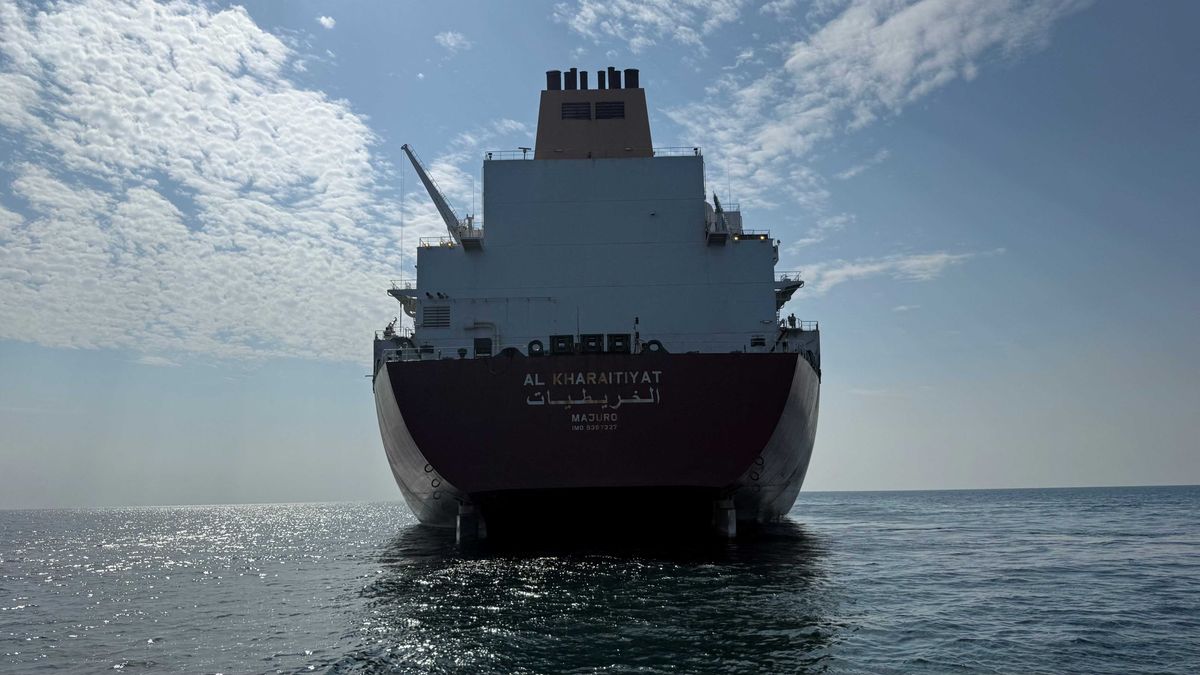
A photo taken on December 5, 2025, of Al Kharaitiyat vessel, which data shows it was sailing towards the Strait of Hormuz on Saturday, May 9, 2026, after departing Qatar's Ras Laffan en route to Port Qasim in Pakistan, in this picture obtained from social media. Obtained by Reuters/via REUTERS

Renowned international security expert Robert Pape issued a dire warning on Sunday that an irreversible “critical point” had been reached in the U.S. war against Iran, one that risks sparking global shortages and economic disruptions on a scale not seen in decades.

“Two months ago, I warned that the Iran war was not simply creating an oil price spike. It was creating the conditions for shortages, supply disruptions, and eventually economic contraction,” Pape, a professor of political science at the University of Chicago, warned in an analysis published Sunday on his Substack. “That transition is now beginning.”

Among Iran’s first responses to the “unprovoked” attack from the United States and Israel was to close the Strait of Hormuz – a critical shipping waterway through which 20% of the world’s oil trade historically flowed – to U.S.-aligned vessels. Predictably, the strait’s partial closure sent oil prices skyrocketing.

With the war now stretching into its 78th day as of Sunday, the strait’s closure has finally exhausted worldwide “buffers” that have helped to slow the economic impact from disrupting trade through what is among the busiest shipping channels on earth, Pape warned.

“The critical point is no longer oil prices alone,” Pape wrote. “The world’s emergency buffers – inventories, reserves, subsidies, and logistical workarounds – are beginning to fail simultaneously.”

Signs of existing stockpiles or resources still in transit being exhausted have already reached the United States. The final shipment of oil from the Strait of Hormuz before its partial closure arrived in California earlier this month, and reporting suggests a major shortage of motor oil may be imminent.
Fox News host brutally mocked for startling monologue: 'Move over, North Korean state TV'

Robert Davis
May 17, 2026 
RAW STORY


Fox News screenshot

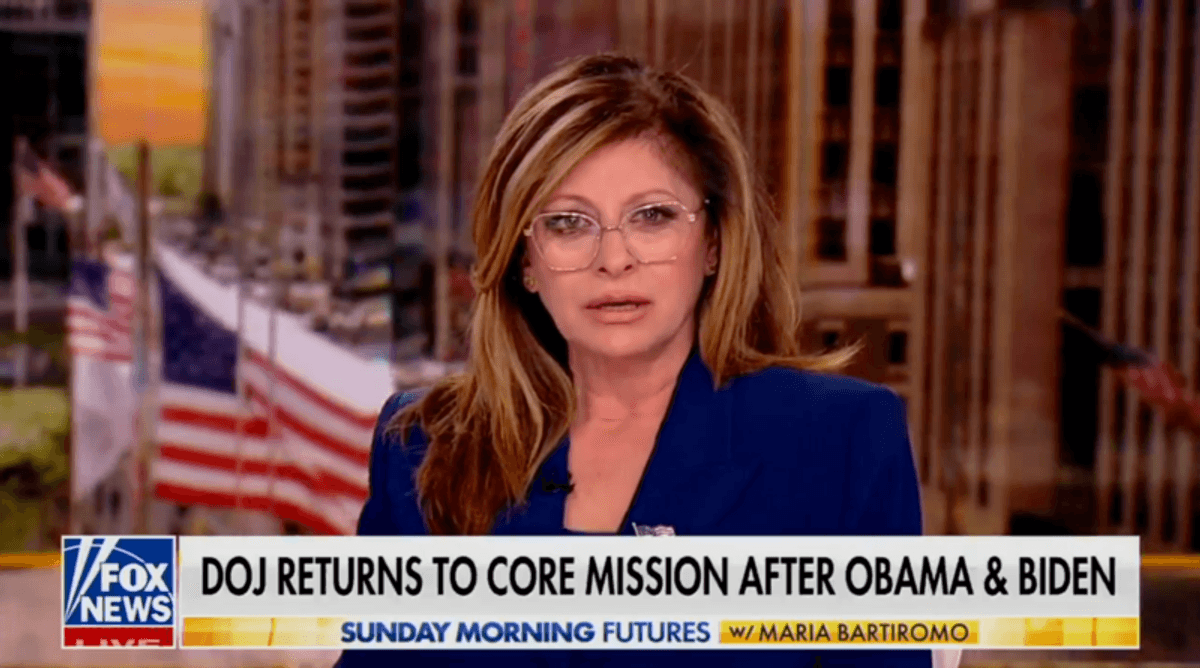
Onlookers mocked Fox News host Maria Bartiromo on Sunday after she shared a startling monologue during the opening segment of her weekend show, "Sunday Morning Futures."

In the monologue, Bartiromo claimed that her show had been one of the "leading critical journalists" covering government mismanagement, ranging from the "made-up Russia collusion story" that "ripped the country apart" to the "coordinated attack on the American people" by Democrats trying to "hide serious mental incapacitation" of former President Joe Biden.

Bartiromo's comments came at a time when President Donald Trump is ramping up his attacks against Democrats as the 2026 midterm elections draw closer. The president has blamed "hate speech" by Democrats for recent episodes of political violence, including the alleged shooting that took place at the White House Correspondents' Dinner.

Political analysts and observers mocked Bartiromo's comments on social media.

"Move over, North Korean state TV," journalist Aaron Rupar posted on Bluesky.

"No, Maria, this is not 'critical journalism,'" political analyst Scott Lucas posted on X. "It's lying as an outlet for a convicted felon in the White House. I trust this helps you."

"One of the jokes among my friends is that when you try to accurately describe what Trump/the GOP are doing right now, you sound like a crazy person," Jason Karsh, a former Obama administration official, posted on Bluesky. "But if you’ve ever talked to a committed Fox viewer, they will hit you with stuff like this constantly. How do you have a conversation with that?"

"Bat-s--- crazy," journalist John Harwood posted on X.

"She’s just reading Q drops now," Jim Stewartson, a political analyst, posted on X.
Intelligent people's politics determined by their wallet — not their brain: scientists
May 13, 2026 
ALTERNET

For years, scientists have researched whether there is any connection between genetic intelligence and political preference, yet the results were contradictory. By incorporating class into the research, however, one researcher has found a startling and consistent pattern: Intelligent people are inclined to be left-wing economically if they were born poor and right-wing economically if they were born wealthy.

“In this study, I argue that this puzzle can only be understood from a gene–environment interaction (GxE) perspective,” wrote Uppsala University's Department of Government researcher Rafael Ahlskog in the journal Political Psychology. “Drawing on traditional theories of political preference formation, I argue that genetics associated with cognitive performance should cause more left-wing economic preferences if you grow up in relative poverty, but more right-wing economic preferences if you grow up affluent. Utilizing variation in a polygenic index (PGI) of cognitive performance within dizygotic twin pairs, coupled with unique register data on economic conditions for the twins, their parents, and their childhood neighborhood, I show that the causal effect of the PGI on economic conservatism is zero on average, but indeed sizable and sign-discordant by class background.”

Ahlskog added, “The GxE perspective thus has wide-ranging implications for future research attempting to integrate genetic methods into political psychology.”


In short, while intelligence does impact a person’s political preferences, smart people will lean toward conclusions that are perceived as providing the most benefit to their specific class, regardless of its specific ideological content.

To learn this, Ahlskog decided to study a large sample of fraternal twins born between 1943 and 1958 and studied by the Swedish Twin Registry (Zagai et al., 2019).


“The twins have also been connected to rich registry sources for things like education and income, as well as to the intergenerational registry, allowing the addition of the same register variables for the parents of the twins,” Ahlskog added. “A separate full population register dataset has been used to obtain information about context/neighborhood [socioeconomic index].”

Despite its robust source base, the study is not without its limitations.

“he genetic predictor is a noisy measurement that only captures a fraction of the actual heritable traits for cognitive performance,” reported PsyPost's Karina Petrova on Wednesday. “Comparing genetic differences within local twin pairs amplifies this measurement noise even further. As a result, the reported effects are likely much smaller than the actual biological impact.”


Petrova added, “The geographical and historical realities of the respondent group also matter. The individuals in this sample grew up in Sweden during the middle of the twentieth century, a period defined by the rapid expansion of the modern welfare state. Class-based politics and labor movements were highly salient in their daily lives.”

This is not the first study to demonstrate a link between intelligence and political ideology. A February study in the journal Intelligence studied 7,000 third-grade students by determining their IQs, following up with the high IQ and non-high IQ students six years later to confirm their IQs and then do so again 35 years later to assess their political views. It found that non-gifted men were more likely to be conservative than gifted men, while for women there was no difference between IQ groups and their political views.

On a related note, an April study published in the journal Personality and Social Psychology Bulletin revealed that among 1,600 people dating online, liberals overwhelmingly and disproportionately were likely to rank men who supported right-wing conspiracy theories about vaccines and election denial to be less intelligent than those who did not. Liberals were also found to reject conservatives at much higher rates than conservatives rejected liberals.


“Disclosing conspiracy beliefs in online dating profiles undermines impressions of warmth, intelligence, and trustworthiness, which are important for online dating success,” the authors wrote in their conclusion. “Right-wing conspiracy beliefs were particularly stigmatized, with liberals being harsher in their judgments and conservatives showing greater leniency.”


Super El Niño: Why some Americans are prepping for the big one


A street scene on a rainy night. One person's umbrella has blown in reverse. A cyclist pedals into the rain. Another person leans into the downpour. El Niño can mean a rainy U.S. Southwest, warmer winters in the North and less Atlantic hurricane activity – but not always. Bill Tompkins/Getty Images
May 15, 2026

Talk of a “super El Niño” developing in 2026 is gaining momentum, with concerns rising that this climate pattern could bring extreme rainfall, heat, drought and destructive flooding around the world.

The signals appear to be in place: The tropical Pacific is warming along the equator, and computer models point toward extreme conditions by the end of the year.

However, forecasting El Niño is not like predicting next week’s weather. Forecasts for El Niño typically aren’t reliable before late spring – not because scientists don’t understand the system, but because we understand its limits.

As an ocean-atmospheric scientist who studies El Niño, I spend a lot of time thinking about what scientists can forecast confidently – and what remains uncertain. Here’s what we know about the current event, what we still don’t, and why many regions should begin preparing now, even if a strong, or “super,” El Niño never fully materializes.

Why is El Niño hard to forecast in spring

The starting point for any El Niño forecast is the heat stored beneath the surface of the eastern equatorial Pacific Ocean. Computer models use data about those conditions to simulate how ocean temperatures will evolve over the coming months, and how they affect weather patterns around the world.

Right now, an exceptionally large reservoir of warm water sits beneath the surface there. In principle, this ocean heat should be a reliable signal of El Niño developing. In practice, what happens next depends heavily on what the atmosphere does.

The warm reservoir was shaped by a burst of wind activity in early 2026. Normally, the Pacific trade winds blow from east to west along the equator, pushing warm water toward Asia and leaving cooler water near South America. But in April, a pair of cyclones straddling the equator caused the wind direction to reverse. This short-lived reversal triggered a downwelling Kelvin wave – a pulse of energy beneath the ocean surface moving eastward along the equator.

That subsurface pulse has now reached the eastern Pacific, helping fuel intense warming off South America. At the ocean surface, this can resemble the early stages of a strong El Niño.

But there is a catch.

For El Niño to develop fully, the ocean and atmosphere need to lock into a feedback loop: Warmer surface waters weaken the trade winds, triggering more downwelling Kelvin waves that push warm water eastward and reinforce the warming. But that loop doesn’t engage automatically. It requires repeated bursts of eastward winds to sustain the process.

Until that feedback loop takes hold, the ocean-atmosphere system is in an unpredictable phase. It might tip into a super El Niño. It might not.

Spring is precisely when forecasts are most uncertain. Impressive early signals can fade if the winds don’t cooperate.

There’s a further complication: When models detect strong subsurface warming, they can simulate a stronger feedback loop than actually develops.

The result is that models can look too confident – even alarming – despite the system not being locked in. As of mid-May 2026, the wind patterns needed to amplify the warming have not clearly emerged.

We’ve seen this scenario play out before. In both 2014 and 2017, forecast models were pointing toward strong El Niño conditions by midyear. In both cases, the anticipated wind patterns never fully materialized and El Niño either stayed weak or returned to a neutral state. The early signals were real, but the expected follow-through didn’t happen.

So what do the forecasts suggest?

The current forecasts for 2026-27 still span a wide range in mid-May – from expecting weak to strong El Niño conditions.

How the winds behave in the coming weeks will determine what develops. If trade winds weaken again at the right moment, it could tip the system into self-sustaining warming – the kind that’s hard to stop.

As of mid-May, long-range weather forecasts weren’t showing strong eastward wind bursts on the horizon that could strengthen El Niño. In fact, quite the opposite was expected for the second half of May: a burst of winds blowing in the opposite direction. A full month without major eastward wind activity would be a meaningful brake on ocean warming.

The Pacific has loaded the dice for El Niño, and the National Oceanic and Atmospheric Administration’s May outlook reflects elevated odds of El Niño developing and potentially strengthening later in the year. By NOAA’s mid-June update, the picture should be substantially clearer.

El Niño intensity matters for weather worldwide

The difference between a weak El Niño and an extreme one is not subtle. It reshapes climate patterns across the globe – and with them, real-world risks.

If El Niño intensifies into a strong or “super” event, it can drive drought in the Amazon, fires in Indonesia, flooding in Peru and heavy rainfall in parts of California and southern South America. These effects could materialize by the Northern Hemisphere winter, when El Niño typically peaks.

In some regions, the stakes are immediate.

In India, the monsoon rains, which support agriculture and water supplies for hundreds of millions of people, have historically weakened during strong El Niño events. Even modest shifts in monsoon strength can bring food and water shortages, and harm economies.

At the same time, when El Niño is strong, hurricane activity in the Atlantic is typically suppressed – a rare upside – while the eastern Pacific often becomes more active with storms.

El Niño can even push global temperatures temporarily higher, as changes in cloud cover and the amount of heat the ocean releases alter the planet’s energy balance.

In contrast, a weak El Niño produces far more muted effects. This is why predicting intensity matters.

Using uncertain forecasts in real-world decisions

Because El Niño forecasts deal in probabilities, deciding how to prepare for the seasons ahead should be based on managing risk – not waiting for certainty.

El Niño’s impact does not occur everywhere at once. Some effects emerge quickly. Its impact on the Indian monsoon and Atlantic hurricane activity unfold over the summer and early fall.

Other impacts arrive later, toward the end of the year when El Niño peaks, bringing extreme rainfall to parts of South America between November and January. In Southeast Asia, scorching heatwaves often emerge even later, in April of the following year.

In regions like India, decisions about how to respond to El Niño risks cannot wait for more certainty. Communities need to prepare their water infrastructure now in case El Niño means the monsoon season brings too little rain.

Even where forecasts suggest reduced risks – such as a quieter Atlantic hurricane season – it would be a mistake to assume safety. Destructive hurricanes still hit in otherwise quiet years.

Pedro DiNezio, Associate Research Professor in Climate Modeling, University of Colorado Boulder

This article is republished from The Conversation under a Creative Commons license. Read the original article.