Sunday, May 17, 2026

Socialism: A prospect, not a utopia


flying cars in Moscow

First published at /spichka

There will be no Gulag under the new socialism — an article by Boris Kagarlitsky

Preface by /spichka

Building socialism requires two things: taking people’s fears seriously and carrying out expropriations.

Boris Kagarlitsky wrote this article from a Russian penal colony, where he is currently serving his sentence. Here is the new socialism he is proposing (no utopias included).

Why should you read this letter?

You most likely talk to people who do not share your political views — or who perhaps have none at all. You explain that the global economy has reached a dead end, that declining birth rates across the world are the result of neoliberal policies. Your listeners nod in agreement. But sooner or later, the question arises:

“So what are you proposing?”

It is a reasonable yet disarming question. How would you answer?

Up until 2022, there was a sense of political timelessness. Marxists were preoccupied with the old “Stalin or Trotsky?” disputes. The outbreak of the “special military operation” brought many back to reality. It became clear that we do not have decades to spend arguing over long-dead leaders. It is time to learn how to communicate our ideas to people beyond Marxist communities.

Without a positive program, we can only agitate among other Marxists.

Of course, even before 2022, there were those writing about a socialist project — Boris Kagarlitsky or Andrey Kolganov, for example. However, these discussions failed to resonate among Marxists, as they never addressed the question that seemed to matter most: why “Stalin is better than Trotsky”.

Alexey Safronov is one of the authors whose work brings us closer to understanding socialism as a project. In 2025, he published a book titled The Great Soviet Economy1, where, in his concluding remarks, he posed the question: what comes next? Later that year, he released a video on the channel Prostye Chisla (“Prime numbers”) about democratic planning — “Direct Economic Democracy: The Technology Is Ready, Now It’s Up to People”.

It is time to arrive at a shared understanding of what kind of socialism we want to build — and how. A discussion is needed.

The time has come for Marxists to clarify their positions and bring the debate to a higher level.

To initiate this discussion among Marxists, we asked Boris Kagarlitsky to share his vision of socialism. He agreed and wrote:

I’ll send the text in batches of three or four pages so the mail and the censors don’t get overwhelmed — experience shows shorter messages get through faster, and it’s easier for me too (5 October 2025).

Boris Kagarlitsky sent us the article over the course of several months, a few pages at a time. We then continued discussing the text with him and refining the wording — ordinary editorial routine, though slow when conducted through the prison mail system. During this correspondence, he decided to add a postscript:

After reading your comments, I decided to add a postscript to the text, where I respond to the questions that you raised (15 December 2025).

We think this text deserves to be a starting point for a discussion that can engage different communities.

What is this letter about?

Boris Kagarlitsky wrote an extensive text on socialism as a future prospect. To be precise, it is not about how everybody will get a decent life under socialism, but about the first steps towards transforming society.

He did not intend to explain how socialism should be built, since that will depend on the starting conditions. If you’d like to read more about this, take a look at our article “The theory of the transitional period” and its follow-up. In those articles, we reflect on the experience of the USSR and other socialist countries to determine whether socialism was built there.

Kagarlitsky outlines possible starting points for transforming society. These are just the first steps, and we shouldn’t stop there.

To anticipate what follows, let us be clear: Kagarlitsky’s ideal is not simply a mixed economy with democratic institutions.

For the moment, we are not ready to articulate our position on every aspect discussed in the text. Our detailed view of socialism as a project will follow in a separate article later on.

But we stand firmly with Boris Kagarlitsky on one point: we need to develop a system of principles on the basis of which we want to transform society.

What we need are principles for transforming society, not stories about a beautiful life under socialism.

In the Manifesto, Marx and Engels outlined ten measures, “which appear economically insufficient and untenable, but which, in the course of the movement, outstrip themselves, necessitate further inroads upon the old social order, and are unavoidable as a means of entirely revolutionising the mode of production”.2

This is how we should think about it as well. In the article “Marx, Engels and the transitional program”, we have already explained the logic behind the proposals of the classical Marxists — why they formulated particular points, and how we can formulate our own positive program on that foundation.

Which brings us back to the central question: “So what are you proposing?”

We now turn to Boris Kagarlitsky, writing from Penal Colony No. 4 in Torzhok.


Socialism: a prospect, not a utopia

A vision of the future or a project? Or how I stopped building castles in the air

Politicians and publicists keep asking, with a kind of obsessive persistence, about the “vision of the future”, addressing allies, like-minded supporters, and opponents alike, and not only within the political left. I remember attending an official event in the early 2000s where yet another expensive report on Russia’s future was presented — outlining what the country was supposed to look like by 2020. Needless to say, the reality of 2020 bore no resemblance to that presentation.

The problem with such reports is rarely in what the authors made up. It lies in the ridiculously short time frame between creating a project and putting it into practice. Had they pushed their predictions out to 2050 — or better, 2100 — they could have avoided the embarrassment. By the time the target date arrived, no one would be left alive who remembered the report’s contents, or even that it had existed at all.

Utopian writers of the early modern period were more farsighted. They would place their ideal society on some distant, imaginary island — or even on the Moon.3 This is where the word “utopia”, coined by Thomas More, comes from4 — that is, a place that does not exist. And, I would add, never will.

Thinking about the future instead of utopias

Does this mean we should stop thinking about the future? Certainly not. The ability to act with the future in mind, planning years and sometimes decades ahead, is fundamental to the existence of human civilization. But the question is how we think — and what goals we set for ourselves.

“So what is your alternative?”

This reproach is constantly directed at the political left: “Your critique of modern capitalism is quite convincing, but what is your alternative?” It is a fair question. Yet the answer most of our comrades offer is methodologically flawed. An alternative should not be a description of a beautiful life in some non-capitalist paradise, but a set of concrete, interconnected solutions to the problems of the present.

An alternative is not a description of a beautiful life under socialism, but concrete proposals for addressing the problems of capitalism.

This is particularly important for two reasons.

First, the real future will emerge from practical transformations carried out here and now. And if, for example, we decide to introduce strict censorship in the name of freedom for all, the outcome will bear little resemblance to what we promise.

Second, if there is no clear and direct link between the “now” and the “later”, then dreams of a wonderful future do nothing to stop us from behaving as completely unprincipled opportunists in the present. After all, this does not contradict our convictions: one set of principles for the dream, another for sinful reality.

This is precisely why Marx and Engels were right in their critique of utopian thinking.5

What we need is not a vision of the future, but a set of principles on which to base solutions to current problems.

We must therefore begin with a critique of the existing socio-economic order, identifying its main contradictions and problems — by overcoming them, we will in fact create a new society. First of all, it is important to understand why the solutions currently offered within capitalism either do not work or fail to work as expected.

What we are witnessing today is not just a series of crises, but a crisis of the entire economic system.

What we are facing is not just a series of crises, but above all a set of interconnected crises that together take on a systemic character. The numerous moderate reform initiatives intended to address these growing problems have only made the situation more complex and confused.

No one denies the ecological crisis, the financial turmoil, the widening social disparities often reduced to the issue of inequality, or the alarming rise in conflicts. But it is crucial to recognize that all these phenomena are interconnected, and that any solution can only be found through a comprehensive transformation of the economy and society.6

Two initial conclusions follow from this:

  • Structural changes affecting relations of power and ownership are necessary;
  • The development of democratic planning institutions is essential.

Institutions of democratic planning will make it possible to transform and shape the economic structure in a coordinated and purposeful way, not only in the interests of the majority but for the development of humanity.

Democratic planning will make it possible to organize the economy in the interests of humanity’s development.

This last point is, unfortunately, crucial, since short-term interests often run counter to long-term prospects. This is evident not only in ecological crises but also in market cycles, where rapid stock price growth sets the stage for inevitable economic collapse. Here, however, we encounter the central problem — one that can only be resolved in practice: how to move beyond the narrowly understood immediate interests of the masses without sacrificing their democratic freedoms or calling into question their right to oppose even fundamentally correct and objectively overdue policies. In a sense, this is the main contradiction of socialism.

Economic democracy

Ota Šik, in his classic work Plan and Market under Socialism7 pointed out that abolishing private property does not eliminate differences in interests between individuals and social groups. The capitalist market allows these differences to be regulated, but not in accordance with any social optimum; instead, outcomes are determined by the balance of forces — power, income, and property. This is precisely why modern society, torn apart by sharp contradictions, not only social and class ones, is in urgent need of a different mechanism. Even worse, the classical market mechanism no longer functions. This is not, as libertarians would claim, the result of irresponsible leftists or greedy corporate elites interfering with its “normal” functioning, but of the concentration of capital and the rising cost of research, which have made free and equal competition a utopia.

Free competition no longer exists. A new mechanism is needed to reconcile the interests of different groups in society.

The Singaporean economist Martin Khor8 demonstrated that the ideal model of competition described by Adam Smith works only when hundreds of independent producers operate within a single market, responding solely to prices determined by effective demand. As the number of producers declines to a few dozen, the mechanism begins to fail. If there are fewer than ten, they tend to orient themselves toward one another rather than the consumer, and, even without direct coordination, effectively form a cartel-like arrangement. This is sometimes referred to as “Khor’s theorem” or the “oligopolistic market rule”.

Libertarian critics of monopolies will, of course, call for breaking up large corporations as a solution to the problem. But this would mean reversing the process of capital and technological concentration that underpins economic progress, as well as reducing resources for research and development. The only way to compensate for this would be to increase the role of the state in research and investment, which is equally unacceptable to libertarians and liberals.

There is only one way out of the current situation — economic democracy based on the socialization of the largest corporations.

The real response to such challenges lies in creating a mechanism of economic democracy based on the socialization of the largest corporations, informational transparency, and the integration of the efforts of different economic actors. This does not imply the abolition of the market, but it does require, as John Keynes pointed out, the socialization of investment under the control of democratic representative bodies accountable to society.

This task can only be resolved in practice: conflicts and disagreements are inevitable, which is precisely why democracy is essential as a mechanism for the dynamic resolution of contradictions. Will this democracy retain the features of parliamentarism? Most likely, only partially. Traditional procedures will have to be supplemented by new forms of stakeholder participation in decision-making. One example is the involvement of city residents in urban planning through participatory budgeting in Porto Alegre, Brazil.9

Examples of direct economic democracy already exist. One of them is Porto Alegre in Brazil.

One way or another, there will be a need to develop mechanisms of multi-level coordination without abolishing existing political institutions — parties, trade unions, and civic organizations. Another point is that, over time, bodies of sectoral or local self-government, integrated into systems of economic, social, and environmental coordination, may come to play a more important role than parliament.

Will such a system turn out to be too complex? Only practice will tell, but there are already reasons to assume that it will be no more complex than the Soviet system of administrative planning or the market-corporate-bureaucratic coordination typical of today’s advanced capitalist economies.

The scope of property socialization may vary considerably depending on conditions.

Given differences in capital concentration, global integration, democratic traditions, and, not least, the balance of political and class forces across societies, the scale, forms, and depth of property socialization will vary considerably depending on local conditions. For this reason, the following discussion will focus on what can be done in the Russian context. And yet, some general trends can be identified globally.

General principles:

  • Socialize research, production, as well as online platforms;
  • Develop not only the state sector, but also forms of cooperation with private initiative;
  • Ensure the collective use of the benefits of socialized property.

First, this concerns the socialization of research and production currently controlled by large corporations, as well as the socialization of the platforms through which a significant share of economic activity is carried out — as convincingly argued by Nick Srnicek10 and Yanis Varoufakis.11 The forms of socialization may also vary: they may include buyouts, asset redistribution, bankruptcy procedures, and expropriation — depending on the political, economic, and social context.

Second, this does not imply the total nationalization of all production and exchange, as in the Soviet Union.12 Even the Soviet Union’s allies in the Eastern Bloc allowed a certain degree of freedom for private entrepreneurship, which developed with some success, helping to compensate for the bottlenecks of bureaucratic planning.13 The economy will be “mixed”, but what exactly is combined, and in what proportions, is a matter of practical politics.

The economy will be “mixed”, but the composition of that “mix” is a matter of practical politics.

Third, the development of socialized production under current conditions is inseparable from collective consumption. Energy networks integrating large numbers of users, public transport, and accessible platforms for obtaining goods and information — all of this already exists today. These practices — now largely dominant thanks to the internet — are exactly what we must rely on as we integrate and develop collective infrastructure, in which these systems are closely and efficiently interconnected. The internet is perfectly compatible with private business and individual consumption, but is already at odds with the corporate market.

Having outlined some general principles, we can now propose a number of measures to transform the Russian economy and society, which are clearly in need of change.

Public sector

Which companies should be socialized?

When Marx spoke of the contradiction between the social character of production and private appropriation, he drew the logical conclusion that production must develop under society’s direct control. Clearly, this contradiction cannot be resolved without challenging private property. However, it is already clear that building a public sector capable of addressing strategic development tasks does not require indiscriminate nationalization. It is reasonable to assume that the more a given sector, industry, or company serves common needs at the national and global level, the greater the need for its socialization.

The fundamental contradiction of capitalism cannot be resolved without challenging the system of private property.

In the Russian context, the following sectors stand out: transport infrastructure, defense enterprises, strategic civilian machine-building (primarily transport), the mining industry, energy, major banks, metallurgy, and forestry and water management.

An attentive reader will immediately notice that these are exactly the sectors in which Russia’s so-called state corporations operate. But that is precisely the point: in reality, these companies are not state-owned even in the bourgeois sense of the term. They are private joint-stock corporations with substantial state participation.

Russian state corporations are essentially ordinary joint-stock companies with state participation.

Meanwhile, Marx rightly emphasized that property is a social relation. The state’s acquisition of shares does nothing to change property relations or relations of production. However, it does create a precedent — not always a positive one — and opens up opportunities for the redistribution of resources, typically in favor of a privileged group within oligarchic business structures.

In modern society, resources are redistributed mainly by non-market means.

The redistribution of resources, inevitable in a developed modern economy, has long been carried out primarily through non-market mechanisms, yet it remains a highly complex, costly, and corruption-prone process. This is hardly surprising in a system dominated by private property and private interest. The widely promoted principles of public-private partnership, popularized in the late 20th century, are essentially mechanisms for legitimizing corruption — regardless of whether it occurs in Russia, the United States, India, or Western Europe.

If a company cannot operate without state support, it should be transferred to the public sector.

The public and private sectors should interact only through the market. Here, one might even shake hands with libertarians: the market it is. But if a company cannot operate without state support, or cannot fulfill a socially beneficial function without it, then it should be transferred to the public sector.

In practice, public interest, along with environmental, social, and other objective requirements, is indeed realized, but largely through penalties imposed on businesses. The public sector, however, should be oriented not towards profit maximization but towards addressing social problems. This does not mean it should operate at a loss, but profit-seeking and ensuring financial sustainability are by no means the same. Profit, therefore, cannot and should not be the primary, let alone the only, measure of success for public enterprises.

It is clear that in the digital era, there is a need to create open and transparent online platforms, and that decentralizing economic decision-making will enable the development of diverse forms and levels of public-sector activity. For instance, housing and utilities will most likely fall under the control of municipal authorities and local self-government.

Europe provides examples of state-owned companies that were not only profit-driven but also addressed social problems.

The Western European experience of recent decades is worth recalling here. In Austria, regional authorities set up construction companies in several federal states, whose operations — within the framework of market competition — led to falling housing prices. Another example is the well-known Finnish company Sitra, established in the 1990s. It functioned as a state-backed venture capital fund, tasked not only with generating profits but also with promoting job creation in the regions, raising the economy’s technological level, ensuring employment for women, and more. Sitra’s remarkable success in the late 20th century propelled Finland to the forefront of technological development in Europe.

Governance in the public sector

How will governance in the public sector differ from classical forms of capitalist management? One starting point is the existing experience within the modern economy of so-called “teal organizations”, characterized by minimal hierarchy and active employee participation in decision-making. Yet within the private sector, such organizations sooner or later encounter a conflict between the interests of shareholder-owners and workers. In the public sector, this contradiction would be removed. This does not mean that new contradictions will not emerge; rather, democratic procedures must be created to resolve them.

Sectoral congresses are one form of democratic governance.

At a higher level, one form of democratic governance could be sectoral congresses, where professionals collectively discuss existing problems and propose organizational and staffing solutions for the state to consider. Such congresses of teachers, agronomists, and engineers began to emerge in Russia after the February Revolution of 1917, but the practice did not develop any further: civil war is hardly a time for professional congresses. Today, it would be entirely feasible to return to this model at a new level.

Clearly, enterprises and sectors differ in their degree of readiness for self-management. Moreover, for obvious reasons, not all issues can be resolved at this level. Centralized planning and management bodies, operating under the control of representative, democratically elected authorities, must ensure the setting of development priorities, which are already discernible in broad outline today.

Priorities

For decades, international forums have issued eloquent documents on the need to protect the planet from ecological catastrophe, accompanied by speeches about the value of human life, the importance of culture and education, and the creation of more humane and comfortable living conditions. Yet, unfortunately, the reality around us clearly contradicts all this.

Environmental initiatives are alien to the market economy, as they do not lead to profit maximization.

The problem is that various environmental and humanistic demands are, so to speak, bolted onto the market-corporate economic system, appearing as external and alien factors. They are expected to operate from the outside — through incentives or penalties — without affecting the overall logic to which private companies are objectively subject: the logic of profit maximization and capital accumulation.

At the same time, what matters fundamentally is the initial purpose — what an organization is created for and according to what criteria it is structured. This is why, incidentally, universities, armies, and scientific academies, even within capitalism and with considerable resources at their disposal, have not become fully bourgeois institutions, although they have been partially bourgeoisified.

Democratic planning must develop its own priorities and create the structures needed to implement them.

Democratic planning must not only develop its own priorities, but also create the corresponding structures to support them. In Russia, the adoption of the new Forest Code in the 2000s had catastrophic consequences, turning forestry into an ordinary commercial sector — much like the commercialization and privatization of railways in Russia and the UK led to similarly damaging results. In the face of the global ecological crisis, reforestation and afforestation have become a central task. It is worth recalling the significant work carried out in this area during the early Soviet period.14

Development priorities must be set based on social, environmental, and cultural needs.

Forestry, transport, energy, science, and education — all these sectors can become powerful drivers of economic growth, but their primary objectives must be set on the basis of social, environmental, and cultural needs. Even technologies themselves can develop in different directions depending on what developers prioritize. The story of airships is a classic example. As late as the 1970s, they were proposed as an ideal solution for cargo transport in Siberia and the Far East, but they did not fit the agenda of the machine-building sector and failed to attract military interest, despite the military being the most generous client. Notably, despite the clear potential of such projects, airship development in both the United States and Britain met the same fate.

The pursuit of state-defined, non-economic goals creates opportunities for economic growth.

By contrast, when non-economic goals were at the center of the state agenda and became institutionalized, they gradually shaped the economy and created new opportunities for its growth. Mass tourism, for example, emerged as an industry from the widespread introduction of paid holidays for workers — a policy that businesses fiercely resisted at the time.

By shaping new priorities, we inevitably shape a new economy, with structures and rules different from those of today.

New priorities — a new economy.

The humanization of life is an equally important issue around which socio-economic reconstruction can be organized. A glance at modern cities is enough to see how improvements in everyday comfort for the middle class coexist with the rising levels of psychological distress and alienation. The growing concentration of population and resources in megacities and urban agglomerations leads to the decline of small and medium-sized towns and to a crisis of social infrastructure in rural areas. It goes without saying that no one is advocating a return to the policies of Pol Pot, who, under the influence of Jean-Jacques Rousseau, sought to abolish the capital city by expelling its population. Yet the over-urbanization of our time leads, in the long run, to a future that is no less dystopian.

The only possible response to this challenge is a policy of re-urbanization aimed at developing small and medium-sized towns, as well as agro-towns directly integrated into the rural environment and economy. This will require substantial investment in cultural, healthcare, transport, educational, and even informational infrastructure. In the long run, however, it will generate not only new sources of economic growth, but a new quality of growth — one that is far more balanced and, crucially, is not accompanied by destructive effects on people’s inner well-being.

Only society itself can determine development priorities.

The formation of new development priorities must be a task for society as a whole, engaging people not only in strategic discussions but also in implementing practical projects. There are no miracle solutions that can or should be imposed from above. The responsibility of the left lies in developing its proposals, advancing initiatives, and shaping its agenda in such a way that they gain traction among the broader public — turning them from party-political or ideological positions into something commonly shared. This is precisely what the difficult work of hegemony involves.

No matter how many compelling ideas we put forward or how many appealing visions of the future we create, the real prospects for development will depend on the balance of forces and on our ability to unite people and social groups that still remain quite skeptical of our ideas.

To become the majority, we must first learn to be recognized as one of their own.

What matters most here is not utopias or promises of happiness in some distant future, but political solutions that work here and now.

A prospect, not a utopia

I hope that readers of this article will not be left with the impression that the limit of my ambitions is a mixed economy with a developed public sector and strong democratic institutions — even though, in the current circumstances, that alone would be a significant step forward. I have deliberately confined myself to a brief outline of changes that are sufficiently radical for the present moment, yet at the same time realistically achievable and entirely concrete.

The paradox is that even the implementation of such a program, which some may regard as limited, will encounter a whole range of issues and difficulties, obstacles and unforeseen developments. In addressing them, we will not only move closer to realizing our project but also transform it and, most likely, radicalize it.

During its implementation, the left project will change and become more radical.

The aim of transformation is not to remake everything at once in accordance with a pre-formulated plan and a rigid ideology. Rather, the first wave of changes should initiate a new logic of development — one that transforms the priorities, needs, and opportunities of society and thereby shapes subsequent transformations, until, as Marx put it, social evolutions cease to be political revolutions. This logic inevitably leads us beyond market relations and commodity exchange, the narrow limits of which are already being exceeded by new technologies that allow, for instance, near-infinite replication. In such cases, by sharing knowledge, software, images, or technologies, we do not lose them as we once would have lost a material object through sale. The knowledge economy, by definition, ceases to be a commodity economy.

The first wave of changes must initiate a new logic of development.

This, however, does not imply the possibility of a return to Soviet-type administrative-bureaucratic planning. Even if someone wished to bring such a system back, nothing worthwhile would come of it, simply because it was the transition to a new technological era that predetermined the inevitable demise of the Soviet centralized system to a far greater extent than any “betrayals” or economic inefficiencies — as dogmatic communists and dogmatic liberal anti-communists respectively tend to claim. A knowledge economy requires unrestricted exploration, flexible thinking, and people who are not constrained by bureaucratic and ideological restrictions.

The Soviet economy cannot be restored, no matter how much some might wish it.

Both the negative and the positive aspects of the Soviet experience must, however, be taken into account on the path to the future, through a critical analysis of its achievements — sometimes associated with an unprecedentedly effective concentration of resources in priority areas — and its failures, which produced an equally remarkable waste and misallocation of resources where such priorities were absent.

Even today, a key source of economic inspiration for us lies in the ideas and projects of the communist reformers of the 1960s — Ota Šik15, Włodzimierz Brus16, or Rezső Nyers17 — not to mention their predecessors, Oskar Lange18 and Michał Kalecki.19

At the same time, we continue to draw new insights from examining the failures of the planned economy in the Soviet Union — for example, when reading Alexey Safronov’s important recent book The Great Soviet Economy.20 But the main historical lesson cannot be reduced to an understanding of the shortcomings of bureaucratic centralization. A technocratic utopia that assumes that “computers will calculate everything” would be no less of a dead end.

A technocratic utopia is also a dead end. Machines will not be able to formulate our interests for us.

Even the most intelligent machines will not be able to formulate our interests for us, which, as Ota Šik already showed,21 will in any case remain contradictory — and these contradictions often arise not only between people, but within one and the same individual. The constant, multi-level reconciliation of interests, the search for compromises based on available resources and general priorities — this is the task of democratic planning: the work of many people, with their needs, desires, tastes, and even fears, which must also be taken into account.

Machines make our labor easier and can even turn it into a source of pleasure, but they will free us neither from responsibility nor from the need for activity that transforms and improves the world around us. A future in which, as the old Soviet song has it, “the robots do the work, and man is happy”, would truly mark the end not only of history but of society itself. The transformations for which we struggle are not aimed at creating a republic of idlers, but at building a system that offers the greatest possible scope for the collective and individual self-realization of human beings through creative, free activity. As Marx and Engels wrote in The Communist Manifesto, “the free development of each is the condition for the free development of all”.22

Some may call this a utopia. We call it a prospect.
  • 1

    Safronov, A. V. (2025). The Great Soviet Economy, 1917–1991. Moscow: Individuum.

  • 2

    Marx, K., & Engels, F. (1888). Manifesto of the Communist Party (S. Moore, Trans.; rev. by F. Engels), p. 41.

    Engels made a similar point in The Principles of Communism:

    “It is impossible, of course, to carry out all these measures at once. But one will always bring others in its wake. Once the first radical attack on private property has been launched, the proletariat will find itself forced to go ever further, to concentrate increasingly in the hands of the state all capital, all agriculture, all transport, all trade. All the foregoing measures are directed to this end”, Engels, F. (1952). Principles of Communism (P. M. Sweezy, Trans.). New York: Monthly Review Press, p. 15.

  • 3

    /spichka: For example, this was the case with Thomas More and Cyrano de Bergerac.

    In 1516, Thomas More published Utopia, whose full title is A Little Book, Truly Golden, No Less Beneficial than Entertaining, on the Best State of a Commonwealth and on the New Island of Utopia.

    In 1657, the French writer Cyrano de Bergerac published the utopian novel The Other World: Comical History of the States and Empires of the Moon, in which he described the customs of the Moon’s inhabitants as a way of criticizing society on Earth.

  • 4

    /spichka: Thomas More was the first to use the word “utopia”. In Greek, it means either “no place” or “righteous place”. This ambiguity is built into the word itself: the ideal place it describes does not exist, but still sets a standard. Due to the popularity of More’s book, the word entered many languages.

  • 5

    /spichka: In the article “Keep the course towards Pyongyang”, we discussed the question “What is the task of socialism?” There, we criticized the utopian approach to defining socialism and its goals.

    Socialism is essential not because it represents a just society, nor because it promises cheap ice cream and cotton candy at kiosks, but because the contradictions of capitalism reach their limits and society can no longer develop within the old economic system. This is what modern utopians fail to understand.

  • 6

    /spichka: In the article “Marx, Engels and the transitional program”, we showed how the classical authors viewed a program of social transformation. As you may recall (you do remember, don’t you?), the Manifesto contains just ten points, none of which appear radical on its own, but taken together they lead to a socialist transformation of society.

  • 7

    /spichka: Ota Šik (1919–2004) was a Czechoslovak economist and politician.

    After the Nazi occupation of Czechoslovakia in 1939, he joined the resistance and, in 1940, the Communist Party of Czechoslovakia (KSČ). In 1941, he was arrested by the Gestapo and sent to a concentration camp, where he was imprisoned alongside the future KSČ leader Antonín Novotný.

    From 1961, he served as director of the Institute of Economics of the Czechoslovak Academy of Sciences and, from 1962, as a member of the Central Committee of the Communist Party. In 1968, he became deputy prime minister, after which his political career ended.

    His book Plan and Market under Socialism was published in Czechoslovakia in 1968, and he became one of the key economic thinkers of the Prague Spring.

    When Warsaw Pact troops entered Prague in 1968, Šik was on holiday in Yugoslavia. Fearing arrest, he emigrated to Switzerland, where he lived for the rest of his life, writing and teaching at the university.

    Šik advocated a “third way”. He even published a book with that title: The Third Way: Marxist-Leninist Theory and Modern Industrial Society (1972). The first two paths were capitalism and Soviet socialism; the third was democratic market socialism.

  • 8

    /spichka: Martin Khor (1951–2020) was a Malaysian economist and journalist. He wrote extensively on globalization and the confrontation between the Global South and the Global North, showing how Europe and the United States impose dependency on developing countries.

    In 2020, Rabkor published an obituary of Martin Khor, providing a detailed account of his work:

    “Martin Khor: The making of a global activist” // Rabkor. — 17.04.2020. — URL:https://rabkor.ru/columns/left/2020/04/17/martin_kho_becoming_a_global_activist/

  • 9

    /spichka: Porto Alegre is a city in Brazil and the capital of one of its states.

    In 1989, the city launched an experiment with participatory budgeting — also known as civic or citizen budgeting — a form of direct democracy in which residents are involved in shaping the budget.

    In Porto Alegre, councils composed of local residents were established — and continue to be formed to this day. Initiative groups, drawn from their members, propose projects to improve the city, and the councils decide on them.

    The experiment was a success: Porto Alegre is now considered one of the best cities in South America in terms of municipal service provision.

  • 10

    /spichka: Nick Srnicek is a Canadian political scientist and author of Platform Capitalism (2016), a study of the evolution of capitalism since the 1970s, focusing on the growing role of digital platforms in the economy.

  • 11

    /spichka: Yanis Varoufakis is a Greek left-wing economist who studies the transformations of capitalism in the neoliberal era and the Great Recession that began in 2008. His most recent book, Technofeudalism, is devoted to these issues. For Boris Kagarlitsky’s review, see Spichka: “Technofeudalism: a prisoner’s review”. 

  • 12

    /spichka: Initially, the Bolsheviks had no intention of nationalizing all enterprises, as is evident from Lenin’s April Theses, published on 7 April 1917.

    The decisions made in the first year after the October Revolution were not preplanned; the Bolsheviks were reacting to emerging threats. This was also the case with the decree “On the Nationalization of Large-Scale Industry and Railway Transportation Enterprises” of 28 June 1918. Shortly before its adoption, an agreement was reached with Germany that the Soviet side would not have to pay compensation for enterprises nationalized before 1 July. Once this was secured, the decree was drafted and published overnight, marking the first wave of mass nationalization.

    For more details, see Alexey Safronov’s video “Yury Larin in the First Months after October” or his lecture “War Communism and the NEP”. Safronov also discusses this in The Great Soviet Economy.

  • 13

    /spichka: Artels — production cooperatives — operated in the USSR from the early years of Soviet authority until 1956. Their activity was not directly planned; only the supply of raw materials was included in the plan. In the Stalinist economy, artels ensured diversity in the range of goods, compensating for the difficulties of planning a wide variety of products.

    By 1955, there were 12,667 artels operating in the USSR, employing 1.8 million people. Industrial cooperatives included 2 research institutes, 22 experimental laboratories, and 100 design bureaus. Artels produced 33,444 different types of goods.

    Artels accounted for 5.9% of gross industrial output, but produced 40% of furniture, 70% of metal household goods, and almost all toys.

    In 1956, the Central Committee of the CPSU and the Council of Ministers of the USSR issued the decree “On the Reorganization of Production Cooperation”, under which artels were transformed into state enterprises.

    For more detail, see Alexey Safronov’s The Great Soviet Economy or his lecture “The Beginning of the Khrushchev’s Decade, Part 2”.

  • 14

    /spichka: In 1924, the USSR developed its first plan for forestry development, although large-scale reforestation only began four years later. Between 1928 and 1937, 100,000–120,000 hectares of forest were planted annually.

  • 15

    /spichka: Ota Šik (1919–2004) was a Czechoslovak economist and politician.

    After the Nazi occupation of Czechoslovakia in 1939, he joined the resistance and, in 1940, the Communist Party of Czechoslovakia (KSČ). In 1941, he was arrested by the Gestapo and sent to a concentration camp, where he was imprisoned alongside the future KSČ leader Antonín Novotný.

    From 1961, he served as director of the Institute of Economics of the Czechoslovak Academy of Sciences and, from 1962, as a member of the Central Committee of the Communist Party. In 1968, he became deputy prime minister, after which his political career ended.

    His book Plan and Market under Socialism was published in Czechoslovakia in 1968, and he became one of the key economic thinkers of the Prague Spring.

    When Warsaw Pact troops entered Prague in 1968, Šik was on holiday in Yugoslavia. Fearing arrest, he emigrated to Switzerland, where he lived for the rest of his life, writing and teaching at the university.

    Šik advocated a “third way”. He even published a book with that title: The Third Way: Marxist-Leninist Theory and Modern Industrial Society (1972). The first two paths were capitalism and Soviet socialism; the third was democratic market socialism.

  • 16

    /spichka: Włodzimierz Brus (1921–2007) was a Polish economist and party activist. In 1961, he published The General Problems of the Functioning of the Socialist Economy, arguing that both democracy and the market were necessary on the path to socialism.

    In 1968, Brus was expelled from the Polish United Workers’ Party. In 1972, he emigrated to the United Kingdom, where he continued to write on Marxism and defend his views.

    Brus sought to resolve the contradiction whereby bureaucracy is necessary in the transition to socialism, yet it appropriates control over society. How, then, can bureaucracy be overcome?

  • 17

    /spichka: Rezső Nyers (1923–2018) was a Hungarian economist and a member of the Hungarian Socialist Workers’ Party.

    From 1960 to 1962, he served as minister of finance; from 1962, he was a candidate member of the Politburo of the Central Committee of the Hungarian Socialist Workers’ Party and chairman of the party’s economic commission. From 1966, he was a full member of the Politburo. In 1968, Hungary launched the reforms initiated by Nyers: directive planning was scaled back, and enterprises were granted greater autonomy. In 1972, the reforms were curtailed, and by 1975, Nyers was removed from the Politburo.

  • 18

    /spichka: Oskar Lange (1904–1965) was a Polish economist, a deputy in the Sejm of the Polish People’s Republic from 1952, and from the same year a member of the Polish Academy of Sciences. From 1964, he was one of the four acting chairmen of the State Council of the Polish People’s Republic — that is, one of the acting heads of state.

    Lange held that Soviet directive planning was flawed and that nationalized property had to be combined with the market in order to build socialism.

    Some of his works include: The Theory of Reproduction and Accumulation (1963), Optimal Decisions (1967), andIntroduction to Economic Cybernetics (1968).

  • 19

    /spichka: Michał Kalecki (1899–1970) was a Polish left-wing economist.

    In 1935, Kalecki left Poland to work in Britain and later in the United States. In 1955, he returned to the Polish People’s Republic, where he became an economic adviser to the Council of Ministers and worked in the State Planning Commission. From 1966, he was a member of the Polish Academy of Sciences.

    Kalecki developed Marxist political economy. In 1970, his book Introduction to the Theory of Growth in a Socialist Economy was published in the Soviet Union.

  • 20

    Safronov, A. V. (2025). The Great Soviet Economy, 1917–1991. Moscow: Individuum.

  • 21

    For more detail, see: Šik, O. (1967). Plan and Market under Socialism. Prague: Academia.

  • 22

    Marx, K., & Engels, F. (1888). Manifesto of the Communist Party (S. Moore, Trans.; rev. by F. Engels), p. 42.

The road to hell — and back

Epochal Crisis: the Exhaustion of Global Capitalism 
By William I Robinson 
Cambridge University Press, 2026.

Tune your radio to something like the BBC World Service for a week and you will get a full picture of the global crisis: climate disaster, genocide in Gaza, militarisation and ongoing wars, economic collapse, poverty, political-military repression, and conspicuous consumption by emergent ruling elites within billionaire capitalism. 

For socialists and the left, a key theoretical task is pulling this together to grasp where we are going and, as ever, what is to be done. In his latest book, Epochal Crisis, William I Robinson attempts just that. It is, to put it bluntly, a mind-blowing assessment, in which Robinson claims world capitalism has entered a final, epochal, multidimensional crisis. 

His book is filled with immense insights and written in a very accessible style. If you want to understand what is going on in the world, then read this.

Economic crisis

Underlying the economic crisis lies the workings of fundamental Marxist categories: the overaccumulation of capital, especially by digital capitalist corporations, matched by corresponding underconsumption by vast sectors of the world’s population, especially workers, the marginalised and the “surplus population” — “illegal” workers living on the margins of rich countries, socially or geographically, and integrated into or expelled from the labour force as needed.

It is a its heart a crisis of profitability — a long-term economic crisis that is accelerating. Robinson claims artificial intelligence may be able to hold this off, but just like the dot-com bubble two decades ago, it will not be able to do this for long.

This long-term economic crisis has generated a crisis of social reproduction. All the forms of social stability associated with the “Golden Age” — the period between 1950–75 — are breaking down. In advanced capitalist countries such as Britain, there is a housing crisis, an education crisis, a healthcare crisis, a prison crisis, and the appearance of what Gilbert Achcar, following Antonio Gramsci, calls “morbid symptoms.”1 You could also place in the same category the crisis in the ghettos, the crisis in refugee camps, and the overarching crisis in the Global South.

How can we measure this “crisis of social reproduction”? One way is healthy life expectancy — not the number of years people live, but the number of years they live healthy lives, free from major long-term illness or disability. A recent British report demonstrated an overall decline in healthy life expectancy by an average of two years. It also showed a 20-year gap between the most deprived areas, such as former coalfields, and wealthy areas, such as Richmond, on the southwest fringe of London.

Military accumulation

In a series of overlapping analyses, Robinson show how all these elements generate inevitable systems of control, summed up in the idea of global civil war. Some have objected to this terminology, but the reality of a cascading story of mass repression against the poor and exploited when they resist cannot be denied. This overlaps with another key Robinson category: militarised accumulation.

The past five years have demonstrated militarised accumulation on an epic scale. Donald Trump’s administration has just announced its 2026 “defence” budget: an astounding US$1.4 trillion, which represents a rise of 40%. 

Militarised accumulation includes the rise of military-monster corporations, such as RTX (formerly Raytheon) and Northrop Grumman, which are closely integrated with hi-tech corporations such as Apple and Meta. Four key AI executives have been awarded the rank of lieutenant colonel in the US army: Andrew Bosworth (Meta), Shyam Sankar (Palantir), Kevin Weil (OpenAI) and Bob McGrew (Thinking Machines). 

These awards are far from purely symbolic. They represent a deep-seated integration of the military and computing companies through cloud data storage, surveillance, target acquisition, weapons design and logistics. You can see all this in action in Ukraine, Gaza, Lebanon and a host of countries targeted by US-made drones and missiles.

So, the epochal crisis finds expression in wars and domestic repression all over the planet. The boosting of domestic repression agencies aimed at immigrant populations and refugees is also a fundamental aspect of the war on unruly populations. ICE agents raiding US cities and terrorising immigrant communities are the most vivid example of this process.

Fascism

Epochal economic and social crises come bundled with political crises. State repression both gives rise to and is a product of the era of neofascism. Modern fascism strongly opposes climate science. As the example of the Trump regime shows, neofascism is a major obstacle to fighting climate change.

We are now in the epoch of climate catastrophe. In the next five years, we are likely to have at least one year where the global average exceeds 1.5 degrees above pre-industrial levels. A devastating 2 degrees above pre-industrial averages would unleash major social catastrophes on a dystopian scale. 

If this happens, waves of climate refugees would leave the Middle East, Western Asia and Sub-Saharan Africa for Europe.

Tipping points

We should keep in mind that, on the economic front, key tipping points may be caused by developments “outside” the economy. Such was the case with the 1974–75 recession, the result of an oil shock caused by the Arab-Israeli war, which ultimately crashed the Keynesian welfare state and mixed-economy Fordist regime and eventually ushering in neoliberalism.

We are living through a period where another 2007–08-style stock market crash is highly likely, but this time much worse. That is because the 2007–08 crash was overcome by swamping the banks with quantitative easing, with Britain and the United States in particular accumulating gigantic debts so that banks could survive. The huge debt overhang was never paid off: US public debt is now more than $38 trillion and British debt is £2.88 trillion.

A new major banking or financial crash could see one or more major capitalist powers unable to raise sufficient funds to allow banks to meet their obligations, including the personal savings of millions of customers. 

A “global Argentina” could ensue: customers unable to withdraw cash, credit and debit cards unusable, standing orders failing, people defaulting on mortgage and rent payments, and a purely cash economy emerging. Millions would lose their jobs and social catastrophe would ensue, just as it did in Argentina after the 2001 government bankruptcy.

Resistance

In a global Argentina, all bets would be off as far as political outcomes are concerned. If the world enters such a phase without a strong anti-capitalist and workers’ movement, fascism would run rampant. Most people would be primarily concerned with survival, with little time for politics. 

But as Argentina showed, millions could turn to social and collectivist solutions when capitalism neither wants, nor can, provide the means for them to live.

To be clear, Robinson does not explicitly predict this outcome. But you do not need a weather forecaster to see the dangers and urgent need for ecosocialist alternatives. 

Doubts and elaboration

There is one nagging doubt, however, and one area that needs further elaboration.

The nagging doubt is the use of the word “imperialism.” Robinson thinks that globalised capitalism makes assigning capital to particular national states misleading. Perhaps, but I think he goes too far down this road. 

There are still nationally-based state apparatuses that try to bully weaker states and act as if they are defending national capital. Britain, the United States and China fall into this category. Imperialism has changed, but at the level of inter-state competition, it is alive and well.

The area that needs more elaboration — and the author knows this — is how to build an anti-capitalist, ecosocialist movement on a mass scale. 

Nevertheless, what this book does is vividly outline the terrain of struggle and where we have to fight. The definitive account of how catastrophe capitalism gets turned around will be written in the streets, the factories and in communities.

  • 1

    Gilbert Achcar, Morbid Symptoms, Relapse in the Arab Uprising (2016). See also his The New Cold War: the US, Russia and China (2025), where Achcar provides a very different take on imperialism to that of Robinson.

Class struggle today: Fragmentation and the crisis of political form


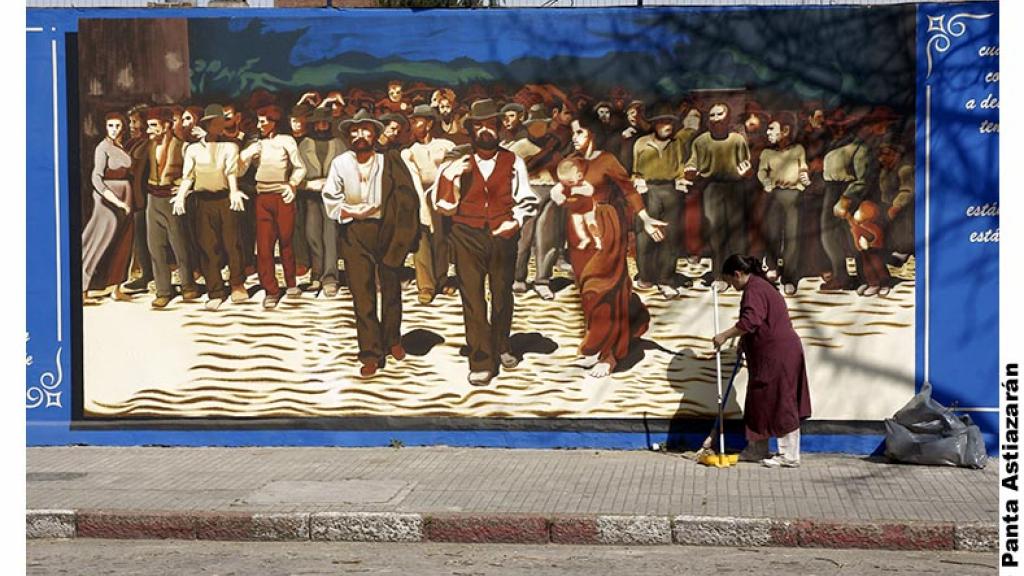
sweeper in front of mural

It has become fashionable to declare that class struggle has faded into the past — dissolved by deindustrialisation, scattered by fragmented labour markets, eclipsed by identity-based movements, and exhausted along with the institutions that once gave it political form. From this vantage point, class appears to have lost its centrality, surviving at best as a residual category of analysis.

Yet this verdict rests on a fundamental confusion between the visibility of class struggle and its structural necessity. Rather than transcending class antagonism, capitalism has shifted and restructured the battleground. What has weakened is not the antagonistic relationship between capital and labour, but rather the political and organisational forms through which that antagonism was once legible, durable and effective.

The present crisis of class politics is therefore not a crisis of absence but one of recomposition under adverse conditions. To understand class struggle today, one must begin from this reorganisation, rather than from nostalgia for lost forms or retreating to cultural explanation.

Neoliberalism and the reorganisation of class relations

Neoliberalism, often mischaracterised as the state’s retreat in favour of markets, has entailed a profound reorganisation of state power, aimed at reshaping class relations. It has resulted in flexible employment, diluted welfare systems, tightened migration regimes and commodified public services.

Far from withdrawing, the state has become deeply involved in organising the grounds for accumulation and disciplining labour. This overhaul has altered the form of class struggle, which is dispersed from the point of production across a wider social terrain: housing, debt, care, health, education, borders and policing. To insist on this point is not to deny the continuing importance of workplace struggles, but to recognise that exploitation and domination are now organised across the whole of social life. The question is not whether class struggle exists, but why it so often fails to accumulate into a durable political force.

Informalisation is often treated as a descriptive condition: the absence of contracts, regulations or security in labour markets appears either as a residue of underdevelopment in the Global South or a contingent erosion of previously stable employment in the Global North. However, this is not merely a labour market restructuring; it is a mode of class rule.1

In much of the Global South, informal work is not marginal or transitional but the dominant form of proletarian existence. Historically, formal jobs have never functioned as a universal norm capable of anchoring social reproduction.2 Employment has long been episodic, multi-sited and interwoven with household survival strategies, petty commodity production, migration and debt. Neoliberal restructuring did not introduce this condition; it consolidated it.

Informality today is structured through state policy, with urban planning regimes criminalising street vendors, while selectively tolerating them. Welfare systems regulate populations without ensuring rights, and control is exercised through policing and regulation rather than labour law. Migration regimes create a large, necessary workforce that remains in a legally precarious situation. Informality represents regulation without protection, rather than a lack of regulation.

In the Global North, informality takes a different historical form but serves a similar function. Here, it appears to be a process of regression: subcontracting chains, bogus self-employment, zero-hour contracts, platform jobs, and the expansion of migrant and racialised labour regimes. Often portrayed as technological disruption or labour market flexibility, the reality is a deliberate dismantling of the wage norm.

The institutional compromises that once stabilised employment relations — collective bargaining, welfare entitlements, and employment law — were hollowed out and the risks of reproduction shifted back to households and individuals. This fragmentation strategy hampers collective bargaining and shifts social costs to communities, which in turn undermines workers’ collective power.

Despite localised protests and workers’ mobilisations, workers lack organisational cohesion. Informalisation fragments not only employment relationships but also time, space and legal status. Work becomes intermittent, dispersed across sites and often criminalised or semi-legal, raising the costs and risks of sustained organisation. Under such conditions, collective action is repeatedly forced into short cycles of mobilisation, which makes accumulation structurally difficult rather than politically misdirected.

Class struggle sans wage norm

Even though class struggle always extended beyond the workplace, for much of the 20th century, the wage relationship functioned as its principal organising axis. Stable employment, identifiable employers, collective bargaining and legally recognised unions provided the material and institutional basis on which conflict between labour and capital could be generalised.

Today, wage relationships can no longer serve as the primary point of political aggregation. Workers confront not a single employer but a dispersed set of intermediaries, algorithms, municipal authorities and welfare offices. The classical strike, while it persists, is losing its capacity to function as a universal weapon.

This transformation does not depoliticise workers; it displaces the sites of struggle. This displacement multiplies conflict zones without providing a common institutional or organisational anchor. Struggles emerge simultaneously across housing, welfare, care and employment, yet there is no mechanism capable of linking these sites into a unified resistance. The result is not depoliticisation, but a dispersion of political energies across disconnected fronts.

The growing centrality of struggles over social reproduction is also reflected in the expansion of what has been described as a “connected” workforce across care, education, health and service work.3 Far from representing a sphere insulated from capitalist domination, this workforce is increasingly subject to the same imperatives of control, deskilling and rationalisation that historically transformed industrial work. Now, managerial techniques and digital systems systematically measure, script, and reorganise practices of care, emotional engagement and human connection — long treated as informal, feminised or naturalised capacities.

This change does not elevate reproduction above class conflict; it intensifies it. As capital seeks to extract value from labour that is inseparable from human interaction, struggles over workloads, staffing ratios, time and professional autonomy become central forms of class antagonism. The politicisation of care is not a cultural shift but a material consequence of accumulation’s deepening penetration into the conditions of social reproduction.

Care work is exemplary rather than exceptional. Similar processes impact education, logistics, platform services and public-sector work, as they increasingly subject relational and temporal capacities to measurement and control. The expansion of such work indicates not a shift away from class conflict, but capital’s extension into domains previously partially shielded from direct valuation.

Identity, difference and class recomposition

The fragmentation of contemporary class struggle is often attributed to the rise of identity politics. Struggles around race, gender, caste, migration, sexuality or nationality appear as key, diverting attention from exploitation and undermining class unity. Proponents of identity politics treat class as merely one identity among others, no longer capable of providing a central unity for political action. These positions misidentify the problem by transforming a structural condition into a cultural dispute.

Of course, identity plays a crucial role in stratifying work and governing inequality in capitalist societies, rather than being a mere ideological construct. It helps segregate workers based on gender, race, caste, citizenship and legality, resulting in hierarchies that support capital accumulation and control. For instance, migrant workers can be deported, women’s work is often relegated to caregiving or flexible roles, and racialised or caste-affected individuals frequently occupy the most hazardous and marginalised types of work. Capitalism, as a totalisation of all exploitation, absorbs identity as a fundamental mechanism of class rule, rather than merely a superficial marker of difference.4

The problem, therefore, is not identity as lived experience or the basis of resistance, but as a political form detached from mechanisms of generalisation. When struggles remain confined to particularised grievances, they become intelligible to power precisely because they do not threaten the organisation of accumulation as a whole.

Identity-based struggles are integral to class struggles, as they act as responses to special forms of domination, such as gendered violence, racialised policing, caste oppression and exclusionary citizenship practices. However, it is useful to examine the political forms through which these identity struggles manifest. Under neoliberal conditions, such struggles tend to be individualised and mediated through NGOs and legal frameworks, shifting the focus from collective opposition to issues of recognition and inclusion. Despite the recognition of differences, the underlying structures that perpetuate inequality remain largely unchanged. 

This form of mediation represents a deliberate governance strategy that manages social conflict while upholding existing accumulation. NGOisation continues not merely due to political naivety but because it aligns with the project-based, depoliticised logic of neoliberal governance. Operating within donor frameworks and administrative mandates, these forms stabilise survival while neutralising antagonism, mostly replacing confrontation with management and collective power with representation.

By interpreting structural domination as personal or group grievances, it restricts the potential for broader struggles, making identity a marker of vulnerability instead of a foundation for collective strength. This leads to a paradox where, despite the proliferation of identity struggles and heightened visibility, class dynamics remain static. The working class appears divided, not due to new differences, but because of a lack of political organisation.

We must acknowledge the critical role identity conflicts play in class formation, rather than dismissing them as mere distractions from class issues. Without a process of recomposition, differentiation solidifies hierarchy, turning identity into a tool for reorganising class power rather than a means of challenging it. 

The contemporary prominence of “middle-class” identity — celebrated in the Global South and mourned in the Global North — should be read not as evidence of class transcendence but as a politically-induced formation that channels status anxiety and inequality away from capital and toward fragmented, often reactionary, forms of social identification.

A renewed class politics cannot resolve this impasse by appealing to an abstract unity or by demanding that particular struggles subordinate themselves to a pre-given class agenda. Class unity is not a sociological fact; it is a political achievement. It must be constructed across differentiated positions produced by capitalism itself. This requires recognising identity struggles as diagnostic — revealing where exploitation, dispossession and coercion are most concentrated — while insisting that their political horizon cannot remain confined to recognition or representation.

Recomposition, in this sense, does not mean erasing difference. It means organising across difference. Feminist struggles point toward the decommodification of care and socialisation of reproduction. Migrant struggles raise questions of borders, labour discipline and imperial hierarchies. Anti-racist and anti-caste movements expose the coercive apparatuses that manage surplus and informalised workforce. When generalised in this way, identity struggles deepen class politics rather than fragment it.

Political accumulation and political form

The above analysis points to a paradox that defines the present conjuncture. Class antagonism is widespread and often acute. Informalisation, dispossession and coercive governance generate recurrent waves of struggle across labour markets, communities and territories. Yet these struggles rarely accumulate into durable challenges to capitalist power. Mobilisation is frequent; transformation is rare. The central problem confronting the left today is therefore not the absence of struggle, but the absence of political forms capable of accumulating it.

Political accumulation refers to the capacity to preserve struggles beyond their moment of eruption, generalise demands across sectors, and sustain pressure over time. It is distinct from mobilisation. Without accumulation, even intense and repeated struggles fail to alter the balance of class forces.

This problem cannot be explained by a lack of militancy, consciousness or moral commitment. Nor can it be reduced to repression alone. It is rooted in the structural conditions; namely, the fragmentation of labour, the displacement of struggle from the workplace to multiple sites of reproduction, and the differentiation of the working class along lines of identity, legality and access to resources. These conditions generate antagonism while simultaneously undermining the mechanisms through which antagonism can be generalised.

Political accumulation requires mediation.5 It depends on organisations and institutions capable of linking struggles across sectors, translating local conflicts into general demands, and sustaining confrontation with capital and the state over time. Under contemporary conditions, such mediating forms are weak, absent or politically misaligned. The result is a proliferation of struggles that remain episodic, sectoral or symbolic.

One response to this impasse has been electoralism. Faced with fragmented movements and declining organisational capacity, many on the left have treated electoral success as a shortcut to power, substituting representation for organisation and policy programs for social forces. Yet electoral strategies detached from class organisation confront a hostile state apparatus and organised capital without the capacity to reshape the balance of forces. When electoral openings close, as they often do, the underlying weakness of accumulation is brutally exposed.

This substitution is visible even in the most sophisticated contemporary debates on working-class “dealignment,” particularly in the United States, where extensive empirical work documents declining electoral support for social-democratic parties among working-class voters across racial lines. While such analyses rightly reject culturalist explanations and emphasise material grievances, they nonetheless treat electoral realignment as the primary horizon of class politics — reducing recomposition to a problem of messaging, candidate selection or policy delivery. 

The intensity of this debate is itself symptomatic of the deeper organisational vacuum: where durable forms of class organisation are weak or absent, electoral alignment becomes the proxy through which the crisis of political accumulation is interpreted.

A second response has been movementism, the valorisation of spontaneity, horizontality and continuous mobilisation. This orientation correctly recognises the limits of institutional politics and the importance of struggles beyond the workplace. But without durable forms of coordination and strategy, it tends to confuse intensity with power. Mobilisations erupt, generate visibility and then dissipate, leaving organisational capacities no stronger than before.

Recent debates within the workers’ movement reflect this impasse. Proposals that emphasise leverage at logistical “choke points” in supply chains — ports, warehouses, transport hubs — implicitly recognise that capitalist power is no longer concentrated at a singular workplace or wage relation, but dispersed across networks of circulation and reproduction. This shift usefully directs attention to the material infrastructures through which accumulation is organised under contemporary capitalism.

Yet the strategic limitation of such approaches lies not in their diagnosis of where disruption may occur, but in their inability to resolve the problem of political accumulation. Disruptive capacity, even when precisely targeted, does not in itself generate durable organisation or generalisable class power. Without mediating forms capable of linking episodic disruption to sustained collective strategy, logistical leverage risks reproducing the same pattern that afflicts contemporary mobilisation more broadly: intensity without accumulation, confrontation without recomposition.

A third form of mediation is NGOisation, particularly prevalent in contexts of informalisation and state retreat. NGOs often stabilise survival, provide services and articulate grievances in the language of rights and inclusion. But precisely because they operate within narrow institutional mandates, they tend to depoliticise conflict. They manage vulnerability rather than confront accumulation, translating structural antagonisms into technical problems or individual cases.

These responses differ politically, but they share a common limitation: they substitute partial forms of mediation for the hard work of class recomposition. None resolves the problem of accumulation because none reconstructs the organisational capacities needed to confront capital and the state as class actors.

The weakness of political form is therefore not accidental. It reflects the historical disarticulation of the workers’ movement, the erosion of parties rooted in class organisation, and the absence of new forms capable of operating across new labour regimes. Where such forms do exist, they are often confined to specific sectors or moments, lacking the capacity to generalise.

This does not imply that political form can simply be reinvented at will. Forms emerge from struggle, but they also shape its trajectory. The challenge today is not to replicate inherited institutions — unions, parties or fronts — as they once existed, but to develop forms of organisation capable of linking production and reproduction, formal and informal labour, citizens and non-citizens, without collapsing these differences into abstraction.

Crucially, the state cannot be treated as a neutral instrument awaiting capture. It is a central site of class power. Political accumulation therefore requires strategies that confront the state as a terrain of struggle, and not merely an arena of representation. Without sustained pressure from organised social forces, state power reproduces existing class relations, regardless of electoral outcomes.

The persistence of fragmented struggle alongside weak accumulation has produced widespread frustration on the left. This frustration often expresses itself either as cynicism toward politics or as impatience with organisation itself. Political accumulation today demands recomposition across fragmented social relations. It requires forms of organisation that can operate at multiple scales, endure beyond moments of mobilisation, and articulate a general antagonism without erasing difference. 

This is a demanding task, and there are no shortcuts. But without confronting the problem of political form directly, class struggle will continue to erupt without converging, and mobilisation will continue to substitute for power.

Recomposition should be viewed as a historical process rather than simply an organisational design. It unfolds unevenly, is characterised by conflict, failure and partial advances, and is influenced by shifting relations between production, reproduction and state power. Any sustainable class politics will arise from these contradictions, rather than from simplistic solutions.

There is no blueprint for this task. Political forms cannot be designed in abstraction from struggle, nor can they be improvised without regard to the conditions they must confront. What can be said is that the problem facing the left today is not the absence of class antagonism, but the absence of forces capable of organising it at scale and over time.

  • 1

    Jan Breman, At Work in the Informal Economy of India (Oxford University Press).

  • 2

    Jairus Banaji, Theory as History: Essays on Modes of Production and Exploitation (Haymarket).

  • 3

    Lise Vogel, Marxism and the Oppression of Women (Brill); see also Nancy Fraser, “Contradictions of Capital and Care,” New Left Review, on reproduction as a structural site of crisis.

  • 4

    Stuart Hall, “Race, Articulation and Societies Structured in Dominance,” and Nicos Poulantzas, State, Power, Socialism

  • 5

    Daniel Bensaïd, Marx for Our Times, on political accumulation, temporality, and organisation.


DSA’s future: Socialism, elections and the limits of relying on the ballot line


DSA convention

Paul Le Blanc’s review of A User’s Guide to DSA: 5 Debates That Define the Democratic Socialists performs a useful service, as it treats the Democratic Socialists of America (DSA) seriously. That alone is welcome. Too much of the socialist left either dismisses DSA as hopelessly reformist or romanticises it as the embryo of a mass workers’ party. Le Blanc does neither.

Instead, he maps debates and identifies the caucuses. He recognises the organisation’s democratic vitality and shows that DSA is now a central terrain on which the future of socialism in the United States is being contested. Taking DSA seriously also means recognising its limitations. DSA is not, at present, a party oriented toward comprehensive socialist transformation.

Instead, it functions as a combination of an election-focused group, an activist network, a debate forum, and an educational organisation. That combination gives DSA its importance, but it also sets real limits on what it can achieve. The issue is not whether DSA matters — it clearly does. The question is whether it can evolve beyond a project aimed at moving the Democratic Party to the left within the existing political system.

The Democratic Party problem

The main question remains DSA’s relationship with the Democratic Party. A User’s Guide to DSA lists the usual options: stay in, leave later, leave now, use the ballot line for now, or build a new party. These debates matter but may distract from the central issue. The Democratic Party is not simply a ballot line. It is a central mechanism through which US capitalism incorporates social movements, channels labour politics, manages protest and turns radical demands into bargains compatible with the system. This is not accidental — these functions are built into the party.

So, the issue is not simply whether socialists should run as Democrats. The question is whether the party gains more by absorbing socialists than socialists gain by using its ballot line and infrastructure. Candidates may begin with clear programs, strong principles and real grassroots energy. But after the election, they confront the routine pressures of capitalist governance: donors, media narratives, committee hierarchies, legislative bargaining, party discipline and the demand to seem “serious” or “responsible.” In practice, “responsible” usually means managing within capitalist limits — not building an independent working-class organisation.

This is not only about individual missteps. It is about how the system operates. The state can turn radicals into reform managers without always needing to defeat them through force — sometimes it just gives them a committee seat.

Elections and class power

This is not a call for socialists to avoid elections. Electoral campaigns can spread socialist ideas, expose capitalist hypocrisy, win reforms and create openings for class struggle. Figures such as Bernie Sanders, Alexandria Ocasio-Cortez, Rashida Tlaib and Zohran Mamdani have helped bring socialism to a mass audience. That shift in visibility matters. Still, increased awareness of socialism does not automatically translate to actual socialist power.

A socialist in office who lacks dedicated support from organised workers and others is likely to adapt to the system. The real base is not the person in office, but the ability of workers, tenants, students, immigrants and others to organise and act. This means unions, rank-and-file caucuses, tenant organisations, strike committees, anti-war coalitions, immigrant defence networks, socialist education and democratic groups of struggle are essential. Elections should support this work, not replace it.

The risk for DSA is that elections become the main focus. Campaigns are exciting: they raise money, get media coverage and can win. Organising at work or with tenants is slower and harder, and political education often receives less attention. Building strong working-class groups is not as thrilling as election night. But without those groups, socialist politics depend too much on individuals and election cycles.

That dynamic raises another critical question: the state’s role in shaping outcomes. A widespread problem in DSA is an unclear understanding of the state. The state is not a neutral institution. Electing better people does not, by itself, change its core functions: protecting property relations and preserving the existing order. Courts, police, prisons, the military and government agencies do not go away if socialists win office. Even if reforms are passed, they must be carried out by institutions that still operate under the rules of capitalism.

For that reason, socialist strategy must go beyond passing laws. The working class cannot just take over the existing state and run it better. It needs to build its own democratic power through struggle. This is not an argument against reforms. Reforms matter when they empower people, improve lives and reveal class divisions. But reforms are misleading if they foster the belief that socialism can gradually develop within capitalism simply by upgrading public services. Socialism is not only about better services — it is about democratic working-class rule over production, distribution and society.

DSA’s democratic vitality — and its limits

Le Blanc rightly sees DSA’s internal pluralism as a sign of vitality. The existence of caucuses, debates, resolutions and contested strategy is not a scandal. This is normal in a living socialist organisation. Even so, internal diversity of views alone does not guarantee that DSA has a unified or clear strategy.

DSA includes social democrats, Marxists, election-focused members, labour activists, anti-imperialists and others. Some see socialism as just a better welfare state. This range can help, but it also makes it hard to move forward.

Every serious socialist organisation must answer basic questions: What is the road to power? What is the role of elections? What is the relationship between reforms and revolution? What is class independence? What obligations do endorsed elected officials have to the organisation? How does DSA relate to unions, social movements and the Democratic Party?

Labour: The strategic core

The strongest and most important debates in DSA are about labour. Joe Burns points out in A User’s Guide to DSA that even the strongest union is still working within capitalism. That reality does not make unions unimportant. Unions are necessary, but they are not enough.

They can fight over wages, hours, safety, dignity and power on the job. But they do not automatically generate socialist politics. A strike can raise consciousness, yet it can also remain limited to bread-and-butter demands unless socialists help connect workplace struggles to the fight against capitalist rule.

That is why the rank-and-file strategy is important. Socialists should not see workers as people to be organised by experts. They should also not assume that sudden action is enough. The goal is to build democratic groups within unions that can challenge bosses and union leaders who oppose change. The working class does not need heroes — it needs to be organised, clear about its goals, and sure of its own strength.

Class, race and oppression

Le Blanc also highlights one of DSA’s strengths: its broad understanding that class struggle cannot be separated from struggles against racism, sexism, xenophobia, queer oppression and imperial violence. This is not identity politics. It is a basic Marxism. Capitalism exploits a working class that is divided by race, gender, citizenship, sexuality and geography. These divisions are not minor. They are the means by which capitalism maintains control. 

Socialists should go beyond viewing socialism as a simple alliance among oppressed groups. The task is not to choose between class and oppression, but to understand that confronting oppression helps the working class learn to act together. The working class does not become united by ignoring its divisions — it becomes united by facing and overcoming them.

Internationalism against campism

The debates over imperialism are especially important. Socialists in the US have a primary duty to oppose US imperialism. In practical terms, this includes opposing sanctions, occupations, coups, military aid to colonial violence, and the bipartisan machinery of empire. Opposing imperialism, though, does not mean supporting every state or group that opposes the US. That is not real internationalism.

The point is not to pick a camp, but to maintain class independence in every conflict. For socialists, this requires unambiguous opposition to Israeli apartheid, occupation, ethnic cleansing and genocide. Yet supporting Palestinian liberation does not mean politically aligning with Hamas or other non-socialist forces. Liberation depends on mass democratic struggle from below, strengthened by regional working-class solidarity and the defeat of imperial domination.

The Lenin question

Le Blanc’s review closes by invoking Vladimir Lenin’s insistence on learning. That emphasis matters: the left needs more learning and less preaching from people who think they already know everything. Lenin also forces questions about organisation, rupture and state power. 

The real question for DSA is not about calling people Leninists. Labels do not matter much. What matters is whether DSA can go beyond talking, campaigning and elections to become a group capable of acting in real political crises.

Can it be organised beyond election cycles? Can it discipline its public representatives? Can it root itself in workplaces and communities? Can it help build united fronts without breaking down into liberal coalitions? Can it fight the far right without becoming an appendage of the Democratic Party? Can it oppose imperialism without campism? Can it educate members not only to vote correctly at convention but to act strategically in struggle?

These are the questions that count.

What DSA might become

DSA’s future is not settled — that is precisely why it matters. DSA could become the left wing of the Democratic Party, using socialist words for reform politics. It could become a loose group of activists, moving from one campaign to another without a clear plan. It could also break apart because of disagreements. Or it could become part of the process through which a real socialist party is born in the US.

Reaching that outcome will require more than growth, more than caucus competition, and more than elections. DSA will need to break away from dependence on the Democratic Party — first politically, and then organizationally. It will need to focus on labour organising, tenant work, anti-imperialist action, political education and real democracy.

DSA remains at a crossroads. It must decide whether to build a true alternative rooted in working-class self-organisation or remain mired in elections and tenuous alliances. To rise to the challenge, DSA must be unambiguous about the state, the Democratic Party and internationalism. Its priority must be to construct organisation, clarity, independence and genuine power. Socialism demands nothing less.

Socialism is not simply an identity, a brand or a set of local policies. It needs to be taken literally. DSA is a place where people are trying to turn this idea into an organised force. Le Blanc’s review helps us see what is happening. But seeing is just the start. Next comes the harder job: deciding what to do. And unlike a magazine symposium, a DSA convention agenda does not allow unlimited debate time.

Anthony Teso is a member of the Democratic Socialists of America, Tempest Collective and Solidarity in the United States.

‘Building a Movement for the Future,’ Bernie Sanders Endorses 61 State and Local Progressives

“Our political revolution is a multiracial, multigenerational working-class movement built from the ground up,” ready to “fight for the kind of changes our country desperately needs,” the senator said.


US Sen. Bernie Sanders (I-Vt.) brought his Fighting Oligarchy Tour to Mumford High School in Detroit, Michigan on May 3, 2026, appearing with Senate candidate Dr. Abdul El-Sayed.
(Photo by Sarah Rice/Getty Images)

Jessica Corbett
May 15, 2026
COMMON DREAMS

US Sen. Bernie Sanders on Friday announced his endorsement of more than five dozen progressives running for local and state political offices across the country, from Arizona and Missouri to Georgia and New Jersey.

“In this pivotal and dangerous moment in our country’s history, we need leaders at every level of government who are prepared to take on the billionaire class and fight for working families. We need bold solutions to the crises we face, not tinkering around the edges,” Sanders (I-Vt.) said in a statement.

The 84-year-old caucuses with Democrats in the Senate and twice sought the party’s presidential nomination, in 2016 and 2020. During those campaigns and since—particularly with the Fighting Oligarchy Tour he launched shortly after Republican President Donald Trump returned to office last year—he has encouraged Americans, especially younger people, to get involved in US politics.

“In the last 15 months, we have recruited over 8,500 Americans to run for office, many of whom are Independents,” the senator noted. “Our political revolution is a multiracial, multigenerational working-class movement built from the ground up.”

“Today, I am proud to endorse 61 progressives running for state and local office across America,” said Sanders. “They will fight for the kind of changes our country desperately needs.”

In Arizona, Sanders is supporting Bobby Nichols for Tempe City Council, Analise Ortiz for state Senate District 24, Mariana Sandoval for state House District 23, Brian Garcia for state House District 8, and two candidates for state House District 9: Lorena Austin and Jacob Martinez.

In California, he is backing four state Assembly candidates: Jessie Lopez for District 68, Ada Briceño for District 67, Fatima Iqbal-Zubair for District 65, and Sandra Celedon for District 31. He’s also endorsing Joz Sida for Fontana mayor, Marissa Roy for Los Angeles city attorney, and multiple people running for LA City Council: Hugo Soto-Martinez for District 13, Faizah Malik for District 11, Estuardo Mazariegos for District 9, and Eunisses Hernandez for District 1.

In Colorado, he is endorsing Chela Garcia Irlando for state Senate District 34, Gabriel Cervantes for state House District 31, and Tyler Quick for Adams County Commission. In Delaware, Sanders is backing Shay Frisby for state Senate District 5, Adriana Leela Bohm for state Senate District 1, and Rae Krantz for state House District 6.


In Florida, he is supporting Kyandra Darling for state House District 62, and in Georgia, he is backing Ruwa Romman for state Senate District 7. In Iowa, the senator is endorsing India May for state House District 58, Leila Staton for state House District 54, and three Johnson County supervisor candidates: V. Fixmer-Oraiz, Jon Green, and Mandi Remington.

Sanders is also supporting Scott Houldieson for Indiana Senate District 1, Frank Henderson for Kansas House District 6, Robert LeVertis Bell for Kentucky House District 43, Eboni Taylor for Michigan Senate District 3, Justice Horn for the 1st District in Missouri’s Jackson County Legislature, Tick Segerblom for Nevada’s Clark County Commission, Ali Aljarrah for New Jersey’s Passaic County Commission, and Daisy Maldonado for New Mexico’s Doña Ana County Commission.

In New York, where Sanders was notably an early supporter of democratic socialist NYC Mayor Zohran Mamdani, he is now endorsing three state Senate candidates—Yuh-Line Niou for District 27, Jessica Gonzalez-Rojas for District 13, and, Aber Kawas for District 12—as well as several state Assembly hopefuls: Adam Bojak for District 149, Maurice Brown for District 129, Dan Livingston for District 123, Conrad Blackburn for District 70, Eli Northup for District 69, Illapa Sairitupac for state Assembly District 65, Eon Huntley for District 56, Christian Celeste-Tate for District 54, David Orkin for District 38, Samantha Kattan for District 37, Diana Moreno for District 36, and Shamsul Haque for District 30.

In Pennsylvania, the senator is supporting Mark Pinsley for state Senate District 16, Sierra McNeil for state House District 195, and Brad Chambers for State House District 41. He’s also backing David Morales for mayor of Providence, Rhode Island; Julio Salinas for Texas House District 41; and Jaelynn Scott for Washington House District 37. In West Virginia, he’s endorsing three state House candidates: Olivia Miller for District 80, Cody Cumpston for District 6, and Dave Cantrell for District 3.

Sanders had previously announced his support for US Senate candidates Peggy Flanagan in Minnesota, Dr. Abdul El-Sayed in Michigan, and Graham Platner in Maine, as well as multiple progressives running for the House of Representatives, including Dr. Adam Hamawy in New Jersey’s 12th Congressional District earlier this month.

“We’re building a movement for the future,” Sanders told The New York Times, which first reported on his new endorsements Friday.

“Our effort is to lead a national movement against Trump’s authoritarianism and kleptocracy and unnecessary wars and his contempt for the Constitution,” he explained. “But equally important, the American people need an alternative to the Democratic establishment, which is significantly dominated by big-money interests.”