New Jersey Bets Big on Small Nuclear Reactors
- New Jersey has approved a competitive procurement process for at least 1,100 MW of advanced nuclear generation, positioning itself as an early adopter of next-generation reactor technology.
- State officials see advanced nuclear as a way to improve grid reliability and provide clean baseload power as electricity demand rises from AI and data center expansion.
- While the United States is accelerating support for advanced reactors, China continues to outpace the U.S. in nuclear construction and is expected to become the world's largest nuclear power producer.
The newest frontier for the global nuclear renaissance is none other than New Jersey. This month, the state officially enacted a law launching a competitive procurement process to review and select a minimum of 1,100 megawatts (MW) of nuclear power. That power is set to come from next-generation nuclear power projects such as small modular reactors (SMRs), which have been receiving increasing attention on a global scale for their potential to scale at a relatively affordable price tag as compared to traditional large-scale fission reactors.
New Jersey already sources a large amount of its electricity from nuclear energy. At present, 40 percent of the state’s energy and 80 percent of its clean energy come from traditional nuclear power plants. But now the state wants to be at the vanguard of innovative next-gen nuclear rollouts as well. “Giving serious consideration to additional supplies of nuclear power would serve our energy needs,” said New Jersey Senator Burzichelli. “Advanced nuclear power is clean, reliable and strengthens our long-term energy security.”
The legally binding procurement process includes a strict review timeline for the New Jersey Board of Public Utilities (NJBPU) to compile and select expressions of interest for advanced nuclear technologies. A quick timeline is needed in order to keep up with the state’s ballooning energy needs, which are being driven up at a rapid clip thanks to the buildout of data centers and other energy-hungry infrastructure to support the growing tech sector.
“This new law is an important step toward increasing base load capacity, improving grid reliability, and ensuring our state has the energy needed to support residents, businesses, and economic growth,” Erick Ford, President of the New Jersey Energy Policy Coalition, wrote in a recent press release.
With the artificial intelligence boom demanding more and more energy 24 hours a day, seven days a week, building out round-the-clock, baseload clean power sources is more important than ever. Against this backdrop, nuclear is an increasingly obvious choice for its ability to produce constantly and at high capacity without producing greenhouse gas emissions. However, in the United States, the nuclear revolution has been hampered by extremely high development costs and miles of red tape. This is where SMRs come into the picture.
The emerging technology has a number of advantages as compared to traditional nuclear reactors. These smaller models can be built in a factory and then assembled on-site at a fraction of the cost. They also include passive safety features that make them safer than full-scale plants. Finally, their output can be easily and quickly manipulated. “This flexibility helps balance the power grid during extreme weather events, which often cause sudden disruptions to less resilient infrastructure,” highlights a recent report from Interesting Engineering.
The Trump administration has been particularly bullish on building out advanced nuclear technologies, including SMRs, in the United States as part of its aim to “produce lasting American dominance in the global nuclear energy market.” Executive Order 14301, issued by Trump in May 2025, mobilizes resources from the U.S. Department of Energy’s Reactor Pilot Program to accelerate the testing and commercialization of advanced nuclear technologies in order to bring them to scale.
However, some critics think that this focus is misguided and that a focus on next-gen technologies could be undermining Trump’s goal of quadrupling the nation’s nuclear energy production capacity by 2050. A recent op-ed for the Wall Street Journal argued that “The administration is chasing unproven technology when it could encourage Wall Street investment in large-scale reactors.”
Moreover, the Trump administration’s desire to keep America first when it comes to nuclear mobilization and innovation may be far too little, too late. China has been building nuclear capacity, including advanced technologies, at a breakneck pace, and is on track to overtake the United States and France to become the world’s largest producer of nuclear energy within the next decade.
“By a wide margin, China will have the world’s most dynamic and significant nuclear industry through 2035,” an analyst for Gavekal Technologies recently told the South China Morning Post. “Construction efficiencies mean China can build a new plant in about six years, compared with more than a decade for the latest Vogtle reactors in the US.”
New Jersey’s new law will no doubt be a winning strategy for the state’s own energy security and clean energy goals, but it is ultimately a drop in the bucket compared to the buildout being spearheaded by Beijing.
By Haley Zaremba for Oilprice.com
Bangladesh's $12.65 Billion Nuclear Bet Faces Its Biggest Test Yet
- Bangladesh's Russian-built Rooppur plant, priced at $12.65 billion, is set to connect its first reactor to the grid next month.
- Emerging economies now account for most of the 80 nuclear reactors under construction worldwide, a shift from nuclear's traditional wealthy-nation dominance.
- Bangladeshi officials plan to skip another mega-project and pivot to small modular reactors after Rooppur, pointing to costs driven up by the falling taka.
The world is turning toward nuclear power as a solution to the increasingly dire energy trilemma – the tricky issue of sourcing energy that is simultaneously affordable, sustainable, and secure. As the artificial intelligence boom pushes energy demand into the stratosphere in rich nations, and back-to-back oil shocks and soaring temperatures leave poor nations scrambling for alternative energy sources, the nuclear option is looking increasingly appealing for a broad range of national contexts.
“With energy security now ranking alongside climate commitments as a top policy priority, nuclear power appears positioned to play a central role in the global electricity landscape through mid-century,” the Foreign Policy Journal reported last month. This includes planned nuclear expansion in strong nuclear sectors like the United States and Canada, as well as in smaller economies that are trying out nuclear for the first time.
Historically, nuclear energy has been dominated by wealthier nations, as nuclear power plants are notoriously expensive to develop and nuclear waste additionally requires strong governance and lots of money to manage. As a result, just five economically powerful nations – the United States, France, China, Russia, and South Korea – account for more than 70 percent of global nuclear energy output.
But that trend is rapidly changing. Most of the 80 nuclear reactors currently under construction in the world are in emerging economies, marking a sea change in nuclear development. India and Pakistan have each kickstarted nuclear power sectors in recent years, and more emerging economies are soon to follow. Even tiny nations like Singapore are now considering the technology as its benefits are highlighted by global energy market volatility.
“For these countries, nuclear helps to decarbonize their grids while avoiding an over-reliance on intermittent power sources such as solar and wind,” Bloomberg wrote in a recent report. “It’s also a way of cutting dependence on imports of fossil fuels that are vulnerable to external shocks — notably Russia’s invasion of Ukraine and the Iran war.”
However, while this approach is helping countries to wean themselves off of their dependence on fossil fuel imports, the development of nuclear power in emerging economies is still largely being funded by external actors. China and Russia have been facing off in the African nuclear energy sector for years now, each vying to establish dominance and influence in the burgeoning sector. And Bangladesh, the next emerging economy slated to become nuclear-capable, is doing so thanks to a Russian-built nuclear energy plant.
When the Rooppur plant is completed in 2028, the facility will supply as much as 15 percent of Bangladesh’s electricity. The first of the plant’s two reactors is expected to be fully operational by 2027. However, even with the investment of a richer country, the power plant could prove to be problematically expensive for Bangladesh, especially since the Bangladeshi taka has plummeted in value since the project was initially greenlit a decade ago.
“Under the main contract with Russian state-owned company Rosatom, the plant will cost around $12.65 billion, including the first few years’ fuel,” reports Bloomberg, based on figures from the World Nuclear Association.
While the operators of the facility maintain that the plant is a worthwhile investment, and will ultimately be more cost-effective than alternatives thanks to the low long-term operational costs of nuclear plants, Bangladeshi officials say that they won’t opt for another large-scale nuclear project after Rooppur is up and running. Instead, the energy minister has indicated that Bangladesh will focus on small modular reactors, which promise smaller price tags and shorter timelines than traditional nuclear power plants.
Bangladesh may prove to be a cautionary tale for other emerging economies considering adopting nuclear energy – or, alternatively, it could be a promising proof-of-concept.
“Whether Bangladesh can move past these setbacks and begin reaping the rewards of cheap, clean electricity will be of great interest to the next wave of potential nuclear adopters,” reports Bloomberg. “They will be watching closely next month when Rooppur’s first reactor is set to be connected to the grid.”
By Haley Zaremba for Oilprice.com
Bruce Power completes on-site hot cell
_24344.jpg)
The facility was delivered through a Canadian collaboration of Bruce Power, Kinectrics and Bird Construction, alongside a broad cross-functional team from across Bruce Power's operations, engineering, licensing, radiation protection, safety and project delivery organisations. The structure incorporates more than 90,000 kilogrammes of concrete, a 7,000-kg personnel door and one of the largest lead-glass viewing windows of its kind, allowing operators to safely handle irradiated materials using precision manipulators.
With major construction complete, the project now moves into the licensing, commissioning and operational readiness phase.
Bruce Power currently has an application before the Canadian Nuclear Safety Commission (CNSC) to change the lutetium-177 (Lu-177) production process to incorporate the use of the hot cell facility. Once licensed by the CNSC, the hot cell would allow Bruce Power to perform Target Carrier Removal (TCR) on site, an important step in preparing Lu-177 for further processing into cancer therapies at off-site facilities.
"Bringing this capability to the Bruce site is expected to streamline logistics, reduce transportation requirements, improve worker safety, lower emissions and strengthen Ontario's isotope production infrastructure," Bruce Power said.
Lutetium-177 is used in targeted radionuclide therapy to treat certain tumours and prostate cancer, with its precision enabling destruction of cancer cells while sparing healthy tissue and minimising side-effects.
"Today's milestone represents the next chapter in Bruce Power's leadership in producing cancer-fighting medical isotopes and demonstrates what can be achieved through Canadian innovation, expertise and partnership," said James Scongack, Bruce Power's Chief Operating Officer and Executive Vice-President. "From the design and engineering work to construction and project execution, this facility showcases the strength of Ontario's nuclear industry and supply chain. By bringing more of the isotope supply chain infrastructure and activities on site, we are creating a more efficient pathway to deliver cancer-fighting therapies to patients around the world while reinforcing Canada's position as a global medical isotope superpower."
Bruce Power has played a leading role in isotope production for decades. Since 1986, cobalt-60, used to sterilise about 30% of the world's single-use medical devices, has been produced at the Bruce site. Since 2021, Bruce Power has also produced medical-grade cobalt-60 used in radiation therapy treatments, and in 2022, the company's Isotope Production System became the first commercial nuclear power reactor in the world to produce lutetium-177. The Isotope Production System technology was developed in partnership with Kinectrics Inc and Framatome Canada's Isogen joint venture and uses Bruce Power's Candu reactors to irradiate ytterbium-176, transforming it into lutetium-177 which is then processed and distributed to healthcare facilities around the world.
The new hot cell further expands that leadership and supports future growth, including plans to expand isotope production capabilities through an additional Isotope Production System in Bruce unit 6.
Spanish regulator supports Almaraz licence extension
_11426.jpg)
In June 2020, the Nuclear Safety Council (CSN) approved the operation of Almaraz until June 2030, as licence renewals are for 10 years. However, given the agreed-upon closure schedule as part of Spain's phase-out of nuclear energy, it was decided to extend operations only until October 2027 for Almaraz unit I and one year later for unit II.
On 30 October last year, the board of operator Centrales Nucleares Almaraz-Trillo (CNAT) officially requested an extension to the operating licence for both Almaraz units. The decision, taken at an extraordinary meeting of the board of directors and the general assembly of shareholders, seeks to extend the life of the two units to June 2030. CSN received a request on 17 November from the Ministry for Ecological Transition and the Demographic Challenge for a mandatory report on the application to modify the operating licence of the Almaraz plant.
The Plenary Session of the CSN has now issued a conditional, favourable report on the renewal of the operating licence for the Almaraz plant.
"The decision adopted by the Plenary Session is based on verification of the plant's proper functioning and the maintenance of an adequate level of safety to continue its operation," the CSN said.
The CSN said it requested the necessary information from CNAT to accompany the application. The operator submitted this information between December 2025 and February 2026. Since then, the CSN's technical team has been analysing this documentation to assess the safety aspects of the facility that it considers necessary for a potential extension of the operating license until 2030.
Among the aspects analysed were the documentation related to the aging status of structures, systems, and safety components, the life management plan, and the environmental rating of equipment. The review also examined compliance with the action and improvement plans associated with the periodic safety review for the full ten-year period, which served as the basis for the previous authorisation renewal, currently in effect.
Similarly, the plant's used fuel management capacity has been assessed up to 2030, and it has been concluded that, with the incorporation of the planned ATI-100 storage facility, along with the existing capacity, there is sufficient storage capacity until the date requested by the operator. Other aspects related to fire protection and human resource management have also been analysed for the same period. In this latter area, the operator is required to maintain adequate minimum staffing levels for safety-related positions.
In total, CSN's report is based on 29 documents prepared by 16 specialist areas of the regulator involved in the process. In addition to these documents, compliance with the conditions and commitments included in the current operating licence has been verified through continuous monitoring and control of the facility by the regulator.
CSN will submit its report to Ministry for Ecological Transition and the Demographic Challenge, which will now be able to make an informed decision regarding the renewal until 2030.
Decision welcomed
"CNAT wishes to reiterate its commitment to continuing the safe, reliable, and efficient operation of the Almaraz Nuclear Power Plant, maintaining the high standards that place it among the best plants in the world according to the World Association of Nuclear Operators," the operator said. "With an annual investment of EUR50 million (USD57 million) dedicated to upgrading, updating, and modernising its equipment, the Almaraz Nuclear Power Plant is technically well-positioned to continue operations - much like the North Anna Power Plant in Virginia, USA, Almaraz's 'twin' facility, which has secured an 80-year operating licence." The two units at Almaraz will have been operating for 47 and 46 years respectively in 2030.
The CSN positive decision was welcomed by Spain's nuclear industry forum Foro Nuclear. "The continued operation of Almaraz in the coming years will help strengthen security of electricity supply, support the stability of the power system and contribute to the achievement of climate objectives," it said. "Its firm, dispatchable and carbon-free electricity production is particularly valuable in a context of increasing electrification, growing integration of renewable energy sources and the need to enhance energy autonomy.
"Foro Nuclear trusts that the final decision will recognise the strategic, social and regional value of Almaraz: a safe and reliable facility that contributes to system stability, competitiveness and decarbonisation, while supporting high-quality employment, economic activity and territorial cohesion in Extremadura."
Phase-out plan
Spain's seven operating nuclear power reactors - Almaraz I and II, Ascó I and II, Cofrentes, Trillo and Vandellós II - generate about 20% of its electricity. Under the country's nuclear phase-out plans, agreed in 2019, four reactors are scheduled to close by the end of 2030 - including the two Almaraz ones - while the remaining three reactors will shut by 2035.
The Almaraz plant currently supplies more than 7% of the electricity consumed in Spain, equivalent to 4 million homes, and employs about 4,000 people. Almaraz units I and II are pressurised water reactors with a net capacity of 1,011 MWe and 1,006 MWe, respectively. Unit I entered commercial operation in 1983 with unit II following the next year. The plant is owned by Iberdrola (53%), Endesa (36%), and Naturgy (11%).
Rosatom says projects for 18 nuclear units being implemented
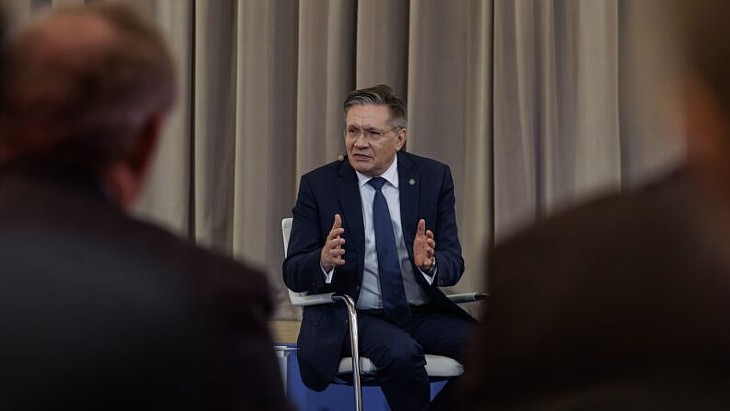
Outlining financial results for the first half of the year, Rosatom Director General Alexei Likhachev said the aim was to increase revenues to RUB4 trillion (USD51.3 billion) by 2028, Tass reported, which would be an increase of nearly 18% on this year.
According to the in-house publication Strana Rosatom’s report of the speech, Likhachev said: "Productivity must be increased by 12% annually. This will allow for a 10% annual wage increase. Profitability must grow by 20% annually. This will allow us to maintain development projects. This year, we plan to reduce costs by 5%, and in 2028, to reduce costs cumulatively by more than 10% compared with 2025. This will allow us to achieve increased productivity and profitability in the face of a generally negative economic environment.
"Under the current circumstances, Rosatom is maintaining a substantial investment programme. We immediately abandoned a number of projects or postponed their implementation to a later date, guided by several criteria, the main one being efficiency through 2030 - that is, greater profit and revenue per ruble invested. And, of course, without compromising the fulfillment of state objectives. The final size of the investment programme exceeds RUB900 billion. It remains one of the largest in the country.”
Russia's energy strategy includes plans for 38 new nuclear power units with a combined capacity of 29.3 GW and a 25% share of generation from nuclear by 2045. Likhachev said that projects for 18 new nuclear power units at nine sites were now in "various stages of implementation", with an objective this year to prepare for first concrete at three of the projects in 2027.
"A preliminary site has been identified in Primorye; we will be building VVER-1000 reactors. We are currently conducting survey work, conducting safety assessments, and formalising the land for construction," he said, with the other two construction starts due to be at Beloyarsk for the BN-1200 and at the Smolensk nuclear power plant.
In the current year, Rosatom expects to "significantly exceed" the target to generate 214 billion kWh "through additional generation from the new unit at the Kursk Nuclear Power Plant, reduced maintenance, and overall improved plant efficiency".
In its results Rosatom, which reports an average headcount of 402,300 people, said it is also aiming to continue growing its North Sea Route operations and is forecasting a record of 40 million tonnes of freight volume for the year.
European Investment Bank agrees to Cernavoda refurb loan
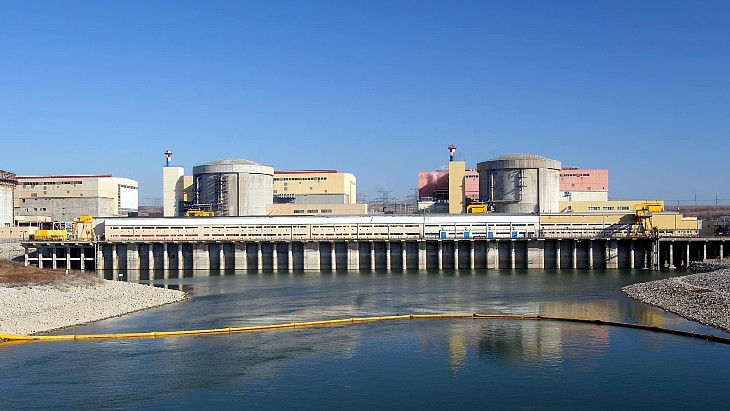
Cosmin Ghita, CEO of Nuclearelectrica, said "the involvement of renowned international banking institutions in securing external financing for the CNE Cernavoda Unit 1 Refurbishment Project represents a historic step for the development of the civil nuclear energy sector".
The European Investment Bank and nuclear
The European Investment Bank is owned by the 27 European Union member states, who are split in their opinions on nuclear energy. The bank has not been investing in new nuclear projects, but has issued some loans for modernisation and safety-related projects. It says it "adopts a technology-neutral approach in line with the European Union's decarbonisation goal and the objectives of ensuring security of energy supply and competitiveness in an environmentally sustainable, cost-efficient, effective, safe and socially acceptable way".
The funding for the Romanian project was part of a EUR3.7 billion package of measures, including new electricity networks in Belgium and Spain, wind farms in Germany and solar generation in France, approved by directors of the European Investment Bank and the European Investment Fund this week.
In total in 2025, the European Investment Bank agreed EUR100 billion in new financing and advisory services for 870 projects "under eight core priorities that support EU policy objectives: climate action and the environment, digitalisation and technological innovation, security and defence, territorial cohesion, agriculture and the bioeconomy, social infrastructure, strong global partnerships and the savings and investments union".
The Cernavoda project
The Cernavoda plant consists of two operating 650 MWe Candu-6 reactors. Unit 1 entered commercial operation in 1996 and unit 2 in 2007. Nuclearelectrica plans to extend the operating life of unit 1 to 60 years. The unit 1 refurbishment project began in 2017 and is currently in the second of three phases. The third phase, scheduled for 2027 to 2029, starts with the shutdown of unit 1 and includes all the work required on it, and its recommissioning. There are also two unfinished reactors at the plant - most of the work on units 3 and 4 was done in the 1980s before being halted. It was reported in 2021 that unit 3 was 52% complete and unit 4 30% complete and there is a separate project focused on completing them.
Cernavoda 1 currently supplies nearly 10% of the country's electricity. Nuclearelectrica, the owner and operator of the Cernavoda plant, is majority-owned by the Romanian State and is the only nuclear power operator in the country.
The estimated nominal value of the project is EUR3.2 billion (USD3.8 billion). According to financing details submitted to the European Commission for approval, Romania plans to support the refurbishment of the nuclear unit through four measures: a grant of EUR600 million; state guarantees for loans taken to finance the investment; a two-way contract for difference (CfD) running for 30 years to provide stable revenues to the plant; and a protection mechanism for regulatory changes during construction and operation.
In December 2024, the company signed the engineering, procurement and construction (EPC) contract for the refurbishment with a consortium of Korea Hydro & Nuclear Power, AtkinsRéalis's Candu Energy, Canadian Commercial Corporation and Ansaldo Nucleare. In September last year, Nuclearelectrica signed a EUR540 million financing contract with a banking syndicate led by JP Morgan for the refurbishment. Under a contract signed in October last year, France's Arabelle Solutions will provide equipment and services for the refurbishment of Cernavoda 1’s turbine-generator, as part of the 30-year life extension project.
Candu units are pressurised heavy water reactors designed to operate for 30 years, with a further 30 years available subject to refurbishment. This includes the replacement of key reactor components such as steam generators, pressure tubes, calandria tubes and feeder tubes. It involves removing all the reactor's fuel and heavy water and isolating it from the rest of the power station before it is dismantled. Thousands of components, including those that are not accessible when the reactor is assembled, are inspected, and all 480 fuel channels and 960 feeder tubes are replaced during the high-precision rebuild.
Ghita said the project would fit with European Union priorities relating to environmental and energy security policy and "the refurbished Unit 1 will account for an additional 9% per year of Romania’s clean, safe, and stable energy supply for the period 2030–2060".
Constellation invests in Blue Energy
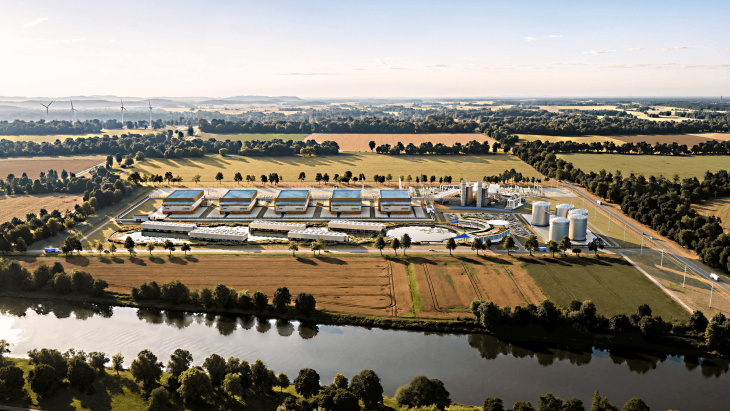
Blue Energy says that reactors make up less than 10% of the cost of a nuclear power plant, with most of the cost coming from "construction and regulatory challenges in the rest of the plant". Its model is for a modular, reactor-agnostic power plant architecture to house the next generation of nuclear reactors using centralised manufacturing at existing shipyards. It says this will cut construction time, with the temporary use of gas generation meaning power can be delivered within 36 months.
The investment by Constellation Technology Ventures in Blue Energy marks the first investment by Constellation - which operates more than 19,000 MWe of nuclear generating capacity in the USA - in a US nuclear developer advancing small modular reactors. Stemming from the Massachusetts Institute of Technology's Nuclear Science and Engineering Department, Blue Energy was founded by Jake Jurewicz and Matt Slotkin in 2023.
"With demand for near-term power rising, Constellation's investment will help Blue Energy meet America's need by making new nuclear development predictable, rapidly scalable, and project financeable for the first time in history," said Blue Energy CEO and co-founder Jake Jurewicz. "This relationship helps us leverage an established operator, proven technology, and innovative, project-financeable deployment models to expand access to nuclear energy. Together, we're demonstrating that the future of nuclear energy isn't a decade away and doesn't take a leap of faith on technology or construction execution, it's being built right now."
David Dardis, Constellation Senior Executive Vice President and Chief External Affairs and Growth Officer, added: "Constellation is committed to exploring innovative pathways that can help accelerate the deployment of advanced nuclear technologies in the United States and allocate risk appropriately. The Constellation Technology Ventures investment in Blue Energy supports its deployment plans for GE Vernova Hitachi's BWRX-300, a proven technology with a potential path to scale for the next generation of nuclear energy."
Earlier this year, Blue Energy announced it had raised USD380 million and forged a strategic collaboration with GE Vernova to develop a multi-gigawatt gas-to-nuclear project utilising GE Vernova gas turbines and BWRX-300 small modular reactors. The company also recently secured a key US Nuclear Regulatory Commission licensing milestone that supports its goal of delivering reliable power in 48 months or less through its phased gas-to-nuclear deployment strategy.
In November last year, Blue Energy announced an agreement with AI infrastructure firm Crusoe through which it secured a site for an up to 1.5 GW nuclear plant in the Port of Victoria, Texas, to power Crusoe AI factories on a nearby site. Blue Energy says its gas-to-nuclear conversion will see it power the proposed 1,600-acre Crusoe AI factory campus from 2028, with a transition to nuclear generation by 2031.
Blue Energy says it could begin early site works on its first planned project in Texas in 2026, to support a final investment decision in 2027.
Podcast: The US's historic Hanford site, and accelerated decommissioning
In this episode, Karthik Subramanian, Chief Engineer and Innovation Director for Hanford Tank Waste Operations Closure, discusses the progress of the work taking place at Hanford - which is a 586 square mile site, about the same size as London - and the plans to clean-up, regenerate and re-industrialise the area, emulating a model demonstrated at the Oak Ridge and Savannah River sites.
He says that as well as the value of the land, there is also the value of an experienced, skilled workforce at decommissioning sites, and pre-existing approvals as a nuclear site.
"Many of these sites are seen as liabilities, and decommissioning is seen as a liability by governments. They need to be seen as assets, an asset that can be accessed. And that conversation, when it changes to 'how do we access this asset', that is a conversation we need to have with the private financing sector ... whether nuclear turns to nuclear or nuclear turns to solar or nuclear turns to whatever industry, when we can start talking about these sites as an enterprise, as an enterprise asset, as an institutional national asset, whether it be land or the skilled workforce or whatever, is when that conversation begins to take hold with the private industry," he said.
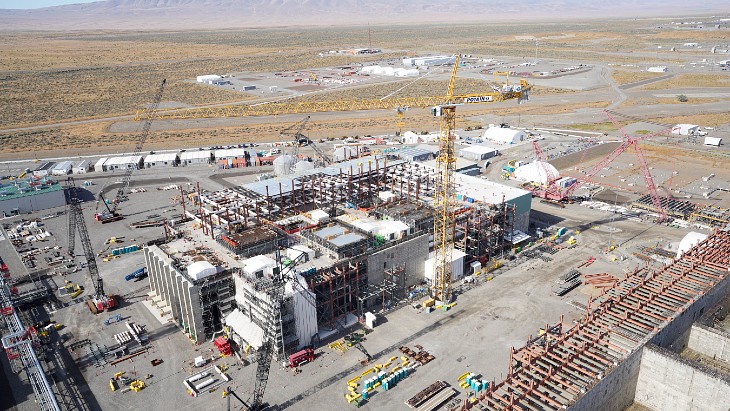
Hanford's High-Level Waste Facility, is currently under construction (Image: US DoE)
He is joined by his Amentum colleague Mike Houghton, vice president of the environment division within Energy and Environment International, for a wider conversation on decommissioning and how to increase opportunities for private finance: "Financing is critical, and I think there's various models around in other sectors that allow private finance to be utilised alongside public finance. I think what's changing over recent years is the insight into the value that these sites have. The new nuclear renaissance is really helping with that. You can see the value of existing sites - they've got a skilled workforce, they've got grid connections, they've got a licence as a nuclear site. They've usually a community around them that's supportive. So there’s real value in these areas."
Here is an edited transcript of the interview:
About the Hanford site
Karthik Subramanian: "The Hanford site covers 586 square miles, so it's an enormous operation. Originally, over 40 years, the Hanford site was involved in the production of nuclear materials for weapons production, including plutonium, supporting the defence industry for decades through nine reactors, multiple separations facilities, storage facilities. And out of that came a large amount of chemical and radioactive waste. There are 177 tanks that contain about 56 million gallons of waste, chemical and radioactive waste. And so the largest tank waste cleanup mission is ongoing at Hanford. There's been success in building and operating a vitrification plant for low-level waste, success in getting to a position in which we can take waste into a grouted waste form and now we're moving into cleanup not only for the tank waste, but of all the subsurface cleanup that needs to be done. Hanford started in the early 1940s. And so you're looking at 80 years of work and then probably another 30 to 50 years of cleanup going on at the Hanford site. From the defence mission standpoint, there was a workforce that was able to support all of that work and now that same support and that local community is supporting the cleanup mission. Now, moving forward as part of that cleanup mission, the Department of Energy and the US government has exercised some great creativity in how do you access this 586 square miles once cleanup is done, to regenerate, to re-industrialise, to revitalise that. Success in cleanup and moving into the cleanup mission, that will take some time, in the meantime, there is an incremental approach to accessing parts of that site."
Hanford's history
KS: "It was part of the original Manhattan Project. The B reactor was the first reactor to go critical and it is now a National Park Service landmark, a National Historical Site. So if you get out to Hanford, it's very interesting you can visit, Oppenheimer has a desk at the B reactor with his name on it. It's an amazing bit of history there."
The tank waste
KS: "These are underground metal tanks that contain the tank waste that was produced, liquid waste originally, but which now has become sludge, salt cake, and liquid waste. There's a great amount of work in remote retrieval technology, in remote inspection technology. Part of what we do is asset care to ensure safe storage. So inspection technologies, corrosion technology, structural analysis. We work hand in hand with the national laboratories that are a big part of supporting the technical basis for it. They are underground tanks that contain this waste and we at the Hanford site go from safe storage to what we call retrievals to move it into newer-style tanks. Then we pre-treat the waste and we immobilise the waste to ultimate closure."
"The ultimate aim is to take that waste and then immobilise it in a waste form that'll hold the waste for geologic timeframes. And so with the volume and mass of the waste that we have, it's another 30 to 40 to 50 years of working through that waste, depending on which waste we're working on. We have just now started the vitrification facility for the low-level waste, and it's working extremely well. We're now about several million gallons into pre-treating the waste with what's called a tank-side caesium removal system, a modular system that does filtration and caesium ion exchange to capture caesium. As we move forward, we have a plan to perform that action in other parts of the Hanford site. And so the technology has been demonstrated, and we continue to do more technology work and make the whole process more efficient."
"The high-level waste vitrification facility is being built and we'll move into high-level waste vitrification when that facility comes online. Today, it's low-level waste vitrification that's ongoing. And also a project to do low-level waste, low-temperature waste forms, grouting or cement waste forms using commercial facilities outside the state of Washington. The new regulatory framework has really been successful in accessing as many technologies as possible to make the Hanford mission more efficient and bring forward the end date of the Hanford mission. And the Department of Energy, the owner of the site, has been really taking a great leadership position in negotiating those things with our regulators."
"Each of the sites in the US has got a comprehensive land-use plan that is part of the structure. Hanford has one … a programme to enter industrial land use on the Hanford site. Oak Ridge has been successful doing that as well. Other sites, Savannah River is now moving into that area. So again, under government leadership and the contractor leadership and creativity, they've been moving into these arenas in which they're accessing these large sites. And I think part of that is that we underestimate the workforce that's there, the technical, the skilled craft, skills that are on these sites. These are large technical, nuclear, chemical processing facilities that have been around a long time. So the workforce in those local areas is a highly skilled, highly talented workforce that knows how to work in a disciplined manner on these sites. Oftentimes, we look at just the technical portions - acres of land - but the reality is, in order to be able to revitalise industrial uses of these sites, it's the workforce and the skilled workforce that comes with that experience, that right education, whether it be engineering, operations, maintenance, craft. And I think that workforce is critical to underpin any revitalisation efforts."
Has the idea of decommissioning being just a cost liability been changing?
Mike Houghton: "Both Karthik and myself were at the BNP Paribas Asset Management Decommissioning Conference in London where there were also representatives from all sectors - mining, oil and gas and renewables as well - in conversation with the finance community, government representatives from many different countries. There was a very positive discussion to understand the liabilities that sit around these various sectors. In many other sectors, it's considered that the liabilities are underestimated, but the issue is how transparency can be brought to all sectors from a liability costing perspective and how innovative ideas for financing solutions can be considered."
KS: "There was a lot of interest in the nuclear side of things. I think for the finance industry, it is really an education system. The more we can educate the finance industry with the technical details of the nuclear work stream, the more they become comfortable with the opportunity that is there. And so here's our chance to bring and integrate and collaborate with the finance team as a nuclear industry to ensure them that there is a risk, but it's a controlled risk."
MH: "I think it's important to start thinking around decommissioning, not just about the liabilities, but the opportunity and the opportunity to move into a transition and look forward to how can we reuse sites? Much of the conversation is around how can finance and finance and delivery models influence that? How can we work more with the stakeholders, the local communities to think about, and be creative about the opportunities for these sites? Understanding the successes at sites in the US like Oak Ridge and ideas that Hanford are exploring and how can they be employed in the UK as well. So trying to come up with ideas that the industry can utilise, think about, and move the conversation forward."
What is accelerated decommissioning?
MH: "I think the first thing to say about accelerated decommissioning, is that it's not about cutting corners or rushing. It's about thinking more carefully about getting the planning right - so earlier planning, thinking carefully about the sequencing of those activities so we can do them in a timely manner in the right order and thinking at the same time about the future uses of the site. So you don't wait until you've cleaned the site up. You start to think earlier about the future potential for that site. When we talk about acceleration, it's about doing things in a timely manner and being able to reduce the overall hotel costs for that particular site or operation."
KS: "System planning is a really important part of accelerating decommissioning. Having an end vision, and once we agree on what that end vision looks like and the transition vision looks like, then the technical portions of that will follow. We have access to a lot more tools now to execute our work on a technical scale. Whether it be design work, whether it be control systems, remote handling, robotics, all these things. I think harnessing technologies is part of accelerating decommissioning, and bringing commercial tools to bear. There also needs to be agreement on what the end vision looks like, and then the opportunity to system-plan your way to an end result while harnessing all the new technologies that come along the way. This is hard work and maintaining a safe envelope is really important."
MH: "Overall, if we can safely decommission the sites around the world - and that there are increasing number of ... reactors and operations that are going to be decommissioned over the next 20, 30, 40 years - if we can do that safely as an industry, that secures and protects the ability to have new generation as well, electricity generation through SMRs, AMRs, new gigawatt stations. So safely decommissioning and hazard-reducing the sites around the world is important to the industry. It's important that we share that learning and we get the best benefit for the industry across the world. Reducing the costs through learning new technologies and being able to confidently predict the liability costs is an important element for governments and owners of the sites."
Should more be invested to speed up decommissioning?
MH: "Governments are pressed for money and they're focusing their spending in areas that ensure safety, so in the UK to ensure that the highest hazards are addressed. You're also seeing maintaining safety for the lower hazard areas. Financing is critical, and I think there's various models around in other sectors that allow private finance to be utilised alongside public finance. What is the role for the private sector to come in and support the government sector? I think what's changing over recent years is the insight into the value that these sites have. The new nuclear renaissance is really helping with that. You can see the value of existing sites - they've got a skilled workforce, they've got grid connections, they've got a licence as a nuclear site. They've usually a community around them that's supportive. So there’s real value in these areas.”
KS: “This is the crux of the discussion going on globally. Many of these sites are seen as liabilities, and decommissioning is seen as a liability to the UK government, the Japanese government, or the US government. They need to be seen as assets, an asset that can be accessed. And that conversation, when it changes to 'how do we access this asset', that is a conversation we need to have with the private financing sector. I listened to the conference and we've heard the term 'closure' over and over - it's not 'closure', it's an opening. And whether nuclear turns to nuclear or nuclear turns to solar or nuclear turns to whatever industry, when we can start talking about these sites as an enterprise, as an enterprise asset, as an institutional national asset, whether it be land or the skilled workforce or whatever, is when that conversation begins to take hold with the private industry. So the more that we as an institution and enterprise can show the value of the asset versus the depreciation of the liability, then I think that's, I’m by no means a finance person, so I'm probably using all these terms incorrectly, but it's an asset that has yet to be accessed. So if we can turn that corner into assets vs liabilities, then on balance, I think the private industry will see that the opportunity is there.”
