Saturday, July 18, 2026

Trump administration won’t give Canada credit for concessions: U.S. trade official


Published:


WASHINGTON — The United States’ top trade official says the Trump administration isn’t going to give Canada credit for its trade concessions as official negotiations between Ottawa and Washington remain stalled.

United States Trade Representative Jamieson Greer said Wednesday he’s glad Canada dropped its digital services tax and “rolled back” its Online Streaming Act but they “don’t really get credit for doing something bad and then undoing it.”

“That’s just good practice on their part,” Greer said at the Aspen Security Forum in Aspen, Colo.

Prime Minister Mark Carney dropped the tax last June, hours before payments from tech giants would be due, in a bid to resume suspended trade talks. The tax was to require the companies to pay tax on some of their revenues earned from Canadian users.

The effort seemed to steady the Canada-U.S. relationship briefly and a limited deal on some of U.S. President Donald Trump’s sector-specific tariffs appeared imminent last October. 

But the U.S. froze talks again that month after Trump was angered by an Ontario-funded ad quoting former president Ronald Reagan criticizing tariffs.
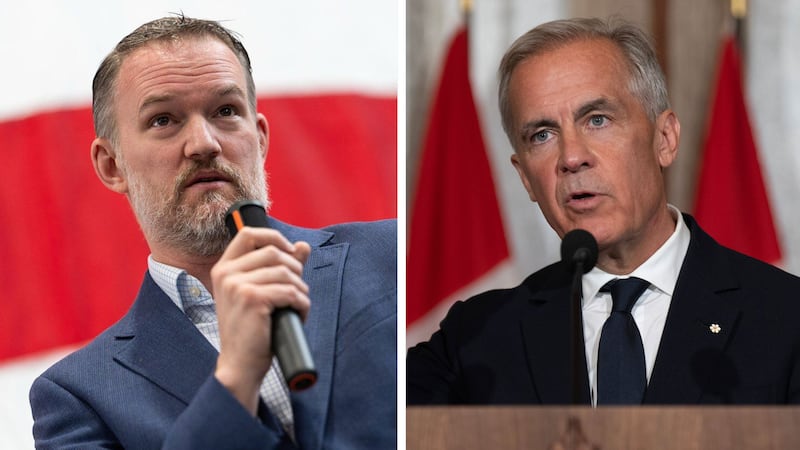
U.S. Trade Representative Jamieson Greer and Prime Minister Mark Carney are seen in this composite image. (AP Photo/Julia Demaree Nikhinson; THE CANADIAN PRESS/Adrian Wyld)

In June, Ottawa directed the CRTC to reconsider its decision to triple streamers’ financial contributions to Canadian content as part of its work to implement the Online Streaming Act. The decision came down after protests from American interest groups and U.S. Ambassador to Canada Pete Hoekstra.

The relationship between Canadian and U.S. trade officials slowly thawed this year. Greer said he’s in weekly contact with his Canadian counterparts and he’s offered Ottawa proposals to “put us in a better position.”

He also said “we just haven’t seen a lot of movement.”

The United States formally announced that it was not renewing the Canada-U.S.-Mexico-Agreement on trade, known as CUSMA, at the start of July.

The agreement stays in place under annual rolling reviews for up to a decade, at which point it will expire if no extension agreement is negotiated.

Canada and Mexico both said they wanted a 16-year extension.

The continental trade agreement has shielded Canada and Mexico from many of Trump’s tariffs but industries like steel, aluminum, automobiles and cabinetry are being slammed with separate duties.

Those sector-specific duties have been a key issue for Canada’s negotiators and Trump seems unwilling to shift his stance on the tariffs.
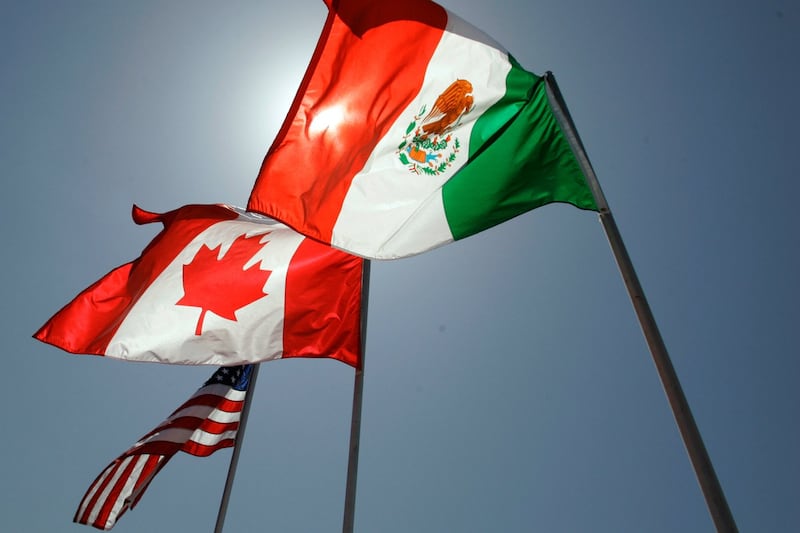
National flags representing the United States, Canada, and Mexico fly in the breeze in New Orleans on April 21, 2008. (AP Photo/Judi Bottoni, File)

Washington and Mexico have launched formal CUSMA negotiations but no such talks have started with Ottawa.

Greer said the Mexicans are “pragmatic” but the “trade deficit in Mexico really is a challenge.” He said there are issues with Mexico regarding overcapacity, subsidies, unfair trading practices and monetary policy.

Greer didn’t cite specific trade irritants with Canada but he repeated a Trump administration talking point when he claimed Canada and China were the only countries to retaliate after the president imposed his sweeping tariffs.

He said Trump also remains focused on lowering the trade deficit with Canada. That deficit is largely driven by oil imports; without taking energy into account, the U.S. runs a trade surplus with Canada.

Greer did speak optimistically about a future agreement with Canada, indicating that some of the talks need to happen at the highest levels.

“The reality is if the president and Prime Minister Carney have an understanding, I’m sure we can put together something that makes sense to get us over the hump,” he said.

“We’re always going to trade some with Canada, just because they’re there.”

This report by The Canadian Press was first published July 16, 2026

Kelly Geraldine Malone, The Canadian Press


Trump blasts Canada over wildfire smoke, threatens to increase tariffs


Updated:


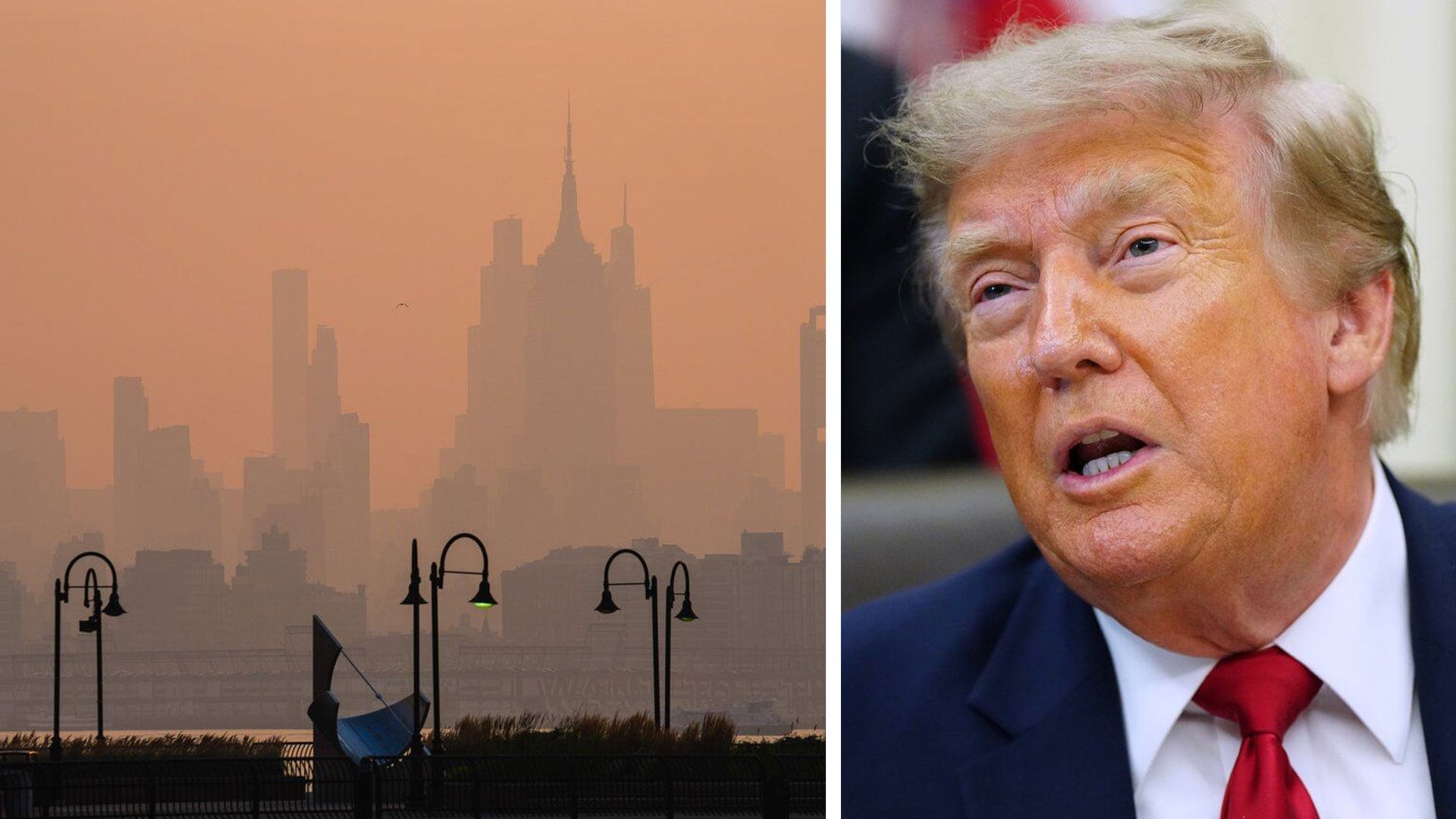
U.S. President Donald Trump says the cost of pollution from wildfire smoke drifting south of the border “must” be added to the tariffs imposed on Canadian goods.

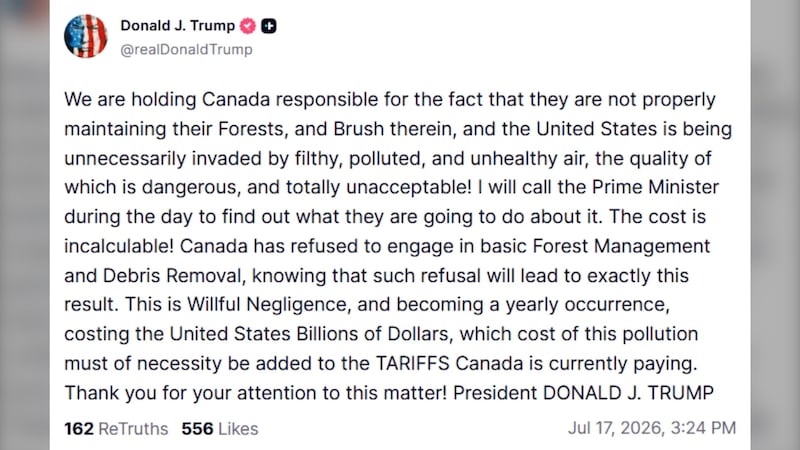
“We are holding Canada responsible for the fact that they are not properly maintaining their Forests, and Brush therein, and the United States is being unnecessarily invaded by filthy, polluted, and unhealthy air, the quality of which is dangerous, and totally unacceptable!” the president wrote Friday on Truth Social.

“This is Willful Negligence, and becoming a yearly occurrence, costing the United States Billions of Dollars, which cost of this pollution must of necessity be added to the TARIFFS Canada is currently paying.”

U.S. President Donald Trump shares a post on Truth Social criticizing Canada for its handling of the wildfires on July 17, 2026. DONALD TRUMP/Truth Social

Trump is the latest U.S. politician to criticize Canada for its handling of the wildfires. Earlier this week, a handful of Michigan state representatives claimed Canada has not done enough to address the smoke, which has led to deteriorating air conditions in northern U.S. states.

Republican representatives John James, Jack Bergman, Lisa McClain and John Moolenaar penned a letter Thursday titled “Canada’s Apologies Won’t Clear Michigan’s Skies.”

They accused Canada of not acting with “urgency” to address wildfire smoke in recent years, and claimed “nothing has changed except that our patience has run out.”

James, a Trump-endorsed candidate for governor of Michigan, took to social media Thursday to issue a “final warning to Canada” to better manage the fires, adding “American lungs” are paying for Canadian “inaction.”

“Sovereignty comes with responsibility, and the responsibility to prevent a foreseeable disaster from crossing into another country’s airspace has not been met,” he wrote.

Detroit topped the IQAir global index for poorest air quality in the world on both Thursday and Friday. Toronto held that rank on Wednesday.

Ontario’s Aviation, Forest Fire and Emergency Services says the fire that impacted Collins was more than 350,000 hectares large on Thursday (Heather Wright/CTV News)

Response to Trump’s comments

The president’s wildfire comments drew reaction from both sides of the Canada-U.S. border.

Ohio Republican Sen. Bernie Moreno took a shot at Prime Minister Mark Carney on X, writing that Canada’s wildfire management was proof “you don’t have to be very smart to get elected as a liberal, you just have to be woke.”

In another post, Moreno claimed that taking every automobile in America off the road for a year would equal the pollution spreading to the U.S. in a few weeks. He didn’t cite statistics or a source.


“We are being systematically gassed by inept Canadian politicians,” Moreno wrote, adding a check mark to “higher tariffs,” “sanctions” and “victims fund,” seemingly referring to hypothetical measures against Canada.

Meghan McCain, daughter of the late Arizona Sen. John McCain and a prominent conservative commentator, agreed with them.

“YESSS! Thank you President Trump!!! Our children can’t go outside and we’re all ensconced in lethal levels of smoke because of Canada’s failed policies,” she wrote on X.

Dimitris Soudas, who served as director of communications for former prime minister Stephen Harper, defended Canada in a lengthy post on X.

“The reality is that Canada’s forests cover nearly 350 million hectares, roughly nine per cent of the world’s forests, much of it remote wilderness where fire has been a natural part of the ecosystem for thousands of years,” Soudas wrote. “No country on Earth has the capacity to remove every tree, every branch, or every piece of combustible material across landscapes of that scale.”

He urged the U.S. to work together with Canada to tackle the challenge of wildfires.

“Climate conditions, prolonged drought, lightning strikes, insect infestations, and extreme weather have all contributed to longer and more severe wildfire seasons across North America,” Soudas wrote. “This is a shared continental challenge, not a uniquely Canadian one.

Perry Johnson, a businessman running to be governor of Michigan, praised Trump for “holding Canada responsible” for what the U.S. president said was the country’s improper management of forests resulting in the polluted air.

“Thank you President Trump for stepping in where Michigan leaders have failed. We must hold Canada accountable for this crisis and make sure it doesn’t happen again!” he wrote on X.

More than 900 wildfires active in Canada

Meanwhile, several Ontario communities have been evacuated as wildfires tear through the region, dealing yet-untold damage.

“It’s terrible,” said Diane Laybourne, who fled to Thunder Bay, Ont., after an evacuation order in her home community of Armstrong. “Having to go out in it, you just want to get in some place where the air is clean.

There were 43 new active wildfires reported on Friday — 15 of those being human-caused, 18 natural and 10 undetermined — bringing the total to 903 across Canada, an increase from the 858 reported Thursday, according to the national wildfire summary.

Of those 903, 122 are burning out of control, 29 are being held and 73 are under control.

Instead of ‘chirping,’ send help: Ford

Ontario Premier Doug Ford was asked Friday about the growing number of American criticisms on wildfire management. In response, he alluded to Canada’s contributions to fighting U.S. fires in recent years, including those that ripped through California last year, and assistance during the Georgia hurricane in 2024.

“If there are some politicians out there chirping away, well, maybe what you should do rather than complain is send support, send help, because we have done the exact same thing for our American friends, and that’s what you’re supposed to do,” he said.

Just days ago, 56-year-old Canadian pilot Nicholas Dale was killed while fighting a forest fire in Colorado. Dozens of first responders honoured his death during a procession in Grand Junction, Colo.

With files from CTV News’ Ethan Morneau, Christl Dabu, Phil Tsekouras and Michele Brunoro.

Luca Caruso-Moro

Opens in new window

Breaking Digital Assignment Editor, CTVNews.ca


Canada to be hit with increased U.S. tariffs on fresh mushrooms


Updated:


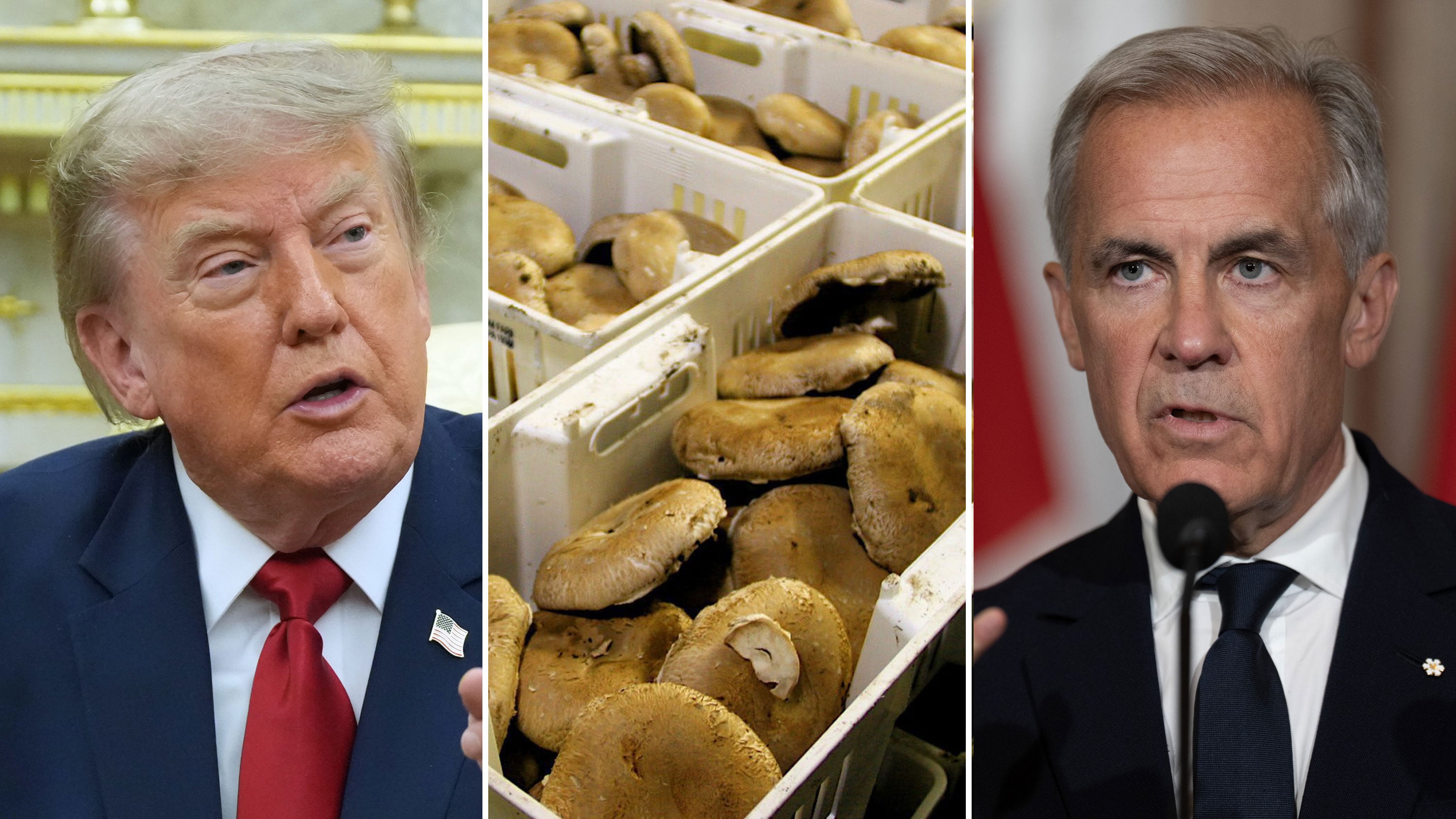
U.S. President Donald Trump, Prime Minister Mark Carney and a crate of fresh portabella mushrooms are shown in a combination photo. (AP Photo/THE CANADIAN PRESS/Julia Demaree Nikhinson/Adrian Wyld/Dean Fosdick)

WASHINGTON — The U.S. is moving to slap more tariffs on fresh Canadian-grown mushrooms in response to a U.S. Department of Commerce probe that an industry representative said did not prove Canadian growers are selling unfairly.

A fact sheet provided by Mushrooms Canada said the U.S. department’s preliminary anti-dumping duty determination, released Tuesday, proposes an 8.26 per cent tariff on most fresh Canadian mushrooms.

Three companies are being hit with individual tariff levels. Champ’s Fresh Farms Inc. is facing a 8.71 duty, Highline Produce Limited is braced for a 11.80 tariff and Farmers’ Fresh Mushrooms, Inc. is looking at a two per cent tariff.

Mushrooms Canada CEO Ryan Koeslag said the tariff rates show the idiosyncrasies of U.S. anti-dumping law, rather than the commercial realities of the North American mushroom market.

“U.S. anti-dumping law contains technical calculation rules that can produce a finding of ‘dumping’ even when business sense and market realities tell a different story,” Koeslag said in a news release. “A straightforward comparison of true average U.S. prices to true average Canadian prices would show no dumping at all.”

The U.S. hit Canada’s mushroom sector with separate 2.84 per cent countervailing duties in May. That Department of Commerce investigation alleged Canadian mushroom producers received unfair government subsidies, something the industry denies.

Countervailing and anti-dumping duties are separate from U.S. President Donald Trump’s massive tariff agenda. Trump has used different tools to hit countries around the world with tariffs and Canada is also being hammered by his sector-specific duties on things like steel, aluminum, automobiles and cabinetry.

The Commerce Department launched the anti-dumping investigation in January after receiving a complaint from the U.S.-based Fresh Mushrooms Fair Trade Coalition, which was pushing for tariffs of up to 44 per cent on Canadian imports.

Koeslag said the investigation shows that the “original dumping allegations were overstated.”

The case is far from over and Koeslag said “Mushrooms Canada will continue to participate fully in the process and demonstrate that the allegations against our sector are unfounded.”

This report by The Canadian Press was first published July 14, 2026.